
Building a corporate learning ecosystem is no longer a back-office HR project — it is a strategic investment that directly determines how fast your workforce can acquire, apply, and scale new capabilities.
Organizations that integrate technology, content, and culture into a unified learning ecosystem consistently outpace competitors in productivity and retention. This guide covers the core elements, implementation approach, and trends shaping how enterprise L&D teams build future-ready learning ecosystems in 2026.
A learning ecosystem is an integrated environment that combines technology platforms, content libraries, and organizational culture to support continuous employee development. Unlike a standalone LMS, a learning ecosystem connects every stage of the employee journey from onboarding and role-based upskilling to leadership development and cross-functional reskilling — into a single, data-informed experience.
Example: IBM’s corporate learning ecosystem links its LMS, internal credentialing (badges), and on-the-job projects. Studies show that employees who engage with the ecosystem’s badge system are measurably more likely to meet sales targets and advance internally — making learning directly traceable to business outcomes.
A corporate learning ecosystem is built on three interdependent elements: technology that tracks and personalizes learning, content that matches learner context and pace, and a culture that makes continuous development the default — not the exception. Remove any one of these and the ecosystem stalls.

In modern learning tech ecosystems, technology acts as the engine—streamlining access to learning content, tracking real-time progress, and delivering analytics that power strategic learning decisions. As highlighted in Forrester’s 2024 evaluation, platforms like LMS and LXP enable employees to shape their learning journeys through centralized, user-friendly systems.
With advancements like generative AI (GenAI) and seamless business integrations, these tools are transforming learning into a strategic driver of measurable outcomes, equipping organizations to stay agile and future-ready.
Content is the heart of the ecosystem, ensuring relevance and engagement. Whether it’s bite-sized microlearning modules that fit into a packed schedule or immersive simulations that mimic real-world scenarios, effective content meets learners where they are and keeps them motivated to grow.
But technology and content can only go so far without the right culture. A culture that prioritizes growth, celebrates learning, and encourages employees to acquire new skills creates the foundation for sustained success.
By 2030, 85 million jobs could go unfilled globally, with 71% of CEOs citing the talent shortage as their top challenge. This highlights an urgent need for companies to integrate onboarding and upskilling into a seamless journey. Forward-thinking companies are replacing external hiring with internal talent development—leveraging integrated learning ecosystems to reskill and upskill employees for long-term sustainability.
Combining these processes equips employees with modern skills while aligning them with company goals, fostering productivity and retention.
For instance, Amazon’s $1.2 billion Upskilling 2025 initiative showcases the impact of strategic training investments.
Aligning onboarding with upskilling builds a future-ready workforce—making it essential for today’s competitive landscape.
Technology is now the operational core of any effective learning ecosystem — connecting LMS, LXP, analytics, and content delivery into a single personalized experience for every employee.
The shift from fragmented tools to integrated platforms is where most organizations stall: data sits in silos, learning paths are generic, and L&D teams lose visibility into what is actually working. Yet, many organizations grapple with fragmented systems, outdated tools, and data silos that stifle their ability to deliver tailored learning journeys.
These inefficiencies not only disrupt the flow from onboarding to upskilling but also limit the potential of learning programs to meet evolving workforce demands.
A fully optimized learning tech ecosystem connects LMS, LXP, and analytics platforms—breaking down silos and enabling personalized, data-driven learning pathways for every employee. This integration fosters an environment where employees transition smoothly through personalized learning paths, blending tutorials, collaborative projects, and on-the-job training into a unified experience.
For L&D teams, centralized data becomes a strategic asset—powering precise, data-driven decisions to enhance training outcomes and align with business objectives.
While implementing a learning ecosystem unlocks significant potential, it’s often met with hurdles like employee resistance and difficulty in proving ROI. Yet, with a carefully planned approach, these challenges can be transformed into stepping stones toward success.
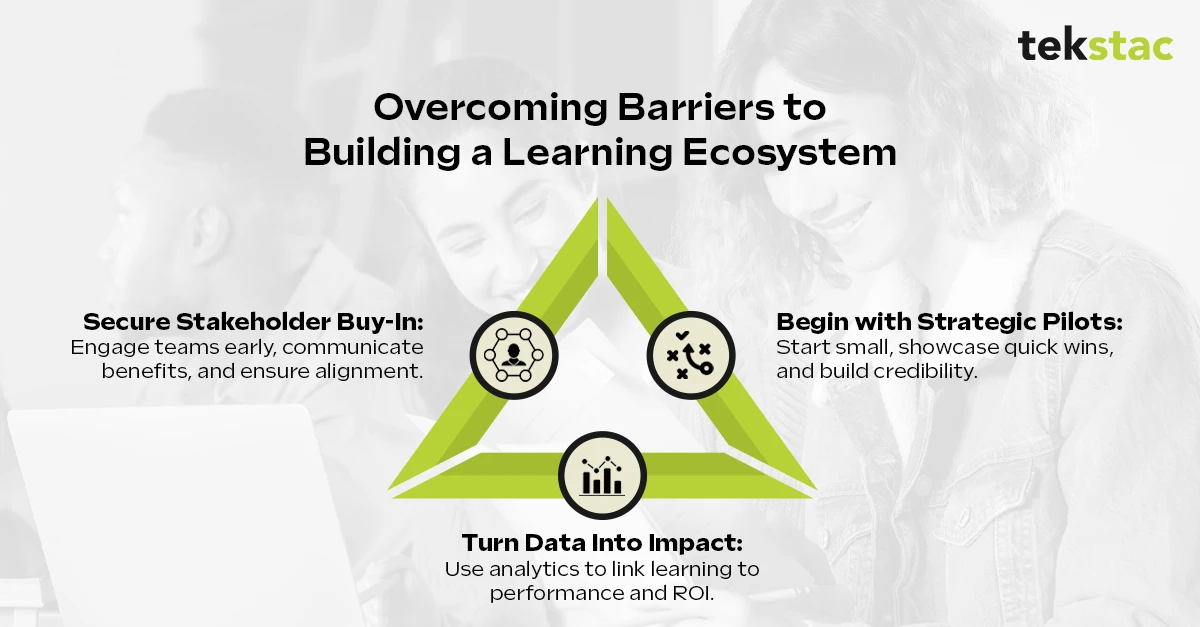
Pilot programs are an ideal starting point, enabling organizations to introduce the ecosystem gradually. This controlled rollout not only minimizes risk but also establishes credibility by showcasing early wins, building trust among stakeholders.
Engaging employees, business teams and leadership from the outset is essential. Open dialogue about the system’s long-term benefits—improved productivity, skill development, and operational efficiency—fosters alignment and ensures smoother adoption.
Analytics act as the bridge between strategy and outcomes. By linking learning initiatives to measurable performance gains, organizations can demonstrate ROI with clarity, justifying ongoing investment while driving confidence across all levels.
IBM implemented a comprehensive learning system that significantly enhanced employee performance. Studies revealed that time spent on learning and the achievement of internal learning credentials, known as “badges,” were positively associated with meeting sales targets and career advancement.
Emerging trends such as microlearning, hybrid work models, and AI-driven analytics are revolutionizing how organizations build future-ready workforce.
Forward-thinking organizations recognize that workforce agility is the foundation of long-term success. By aligning learning ecosystems with emerging trends and leveraging analytics to guide decision-making, they don’t just prepare for change—they drive it.
A connected learning ecosystem helps organizations move beyond one-time training and build a workforce that can continuously adapt, grow, and perform. By aligning onboarding, upskilling, and skills measurement, businesses can improve employee readiness, engagement, and long-term performance.
Organizations looking to build a scalable learning ecosystem need a platform that connects learning with measurable skill outcomes.
Ready to transform workforce development? Explore how Tekstac helps organizations streamline onboarding, upskilling, and skills assessment in a single platform.
1. What are the best platforms to build a learning ecosystem for corporate training?
The strongest corporate learning ecosystems typically combine an LMS for structured, compliance-driven learning with an LXP for personalized, self-directed paths — connected via API to your HRIS. Leading enterprise platforms include Tekstac for skills assessment and role-based upskilling, alongside integrations with tools like Workday Learning and SAP Success Factors. The right platform depends on three factors: your workforce size, the complexity of your skill gaps, and whether your priority is onboarding speed, continuous development, or both.
2. What are the best practices for designing an effective learning ecosystem within an organization?
Start with a skills audit before selecting any technology — platforms built on unmeasured gaps produce low engagement and poor ROI. The most effective learning ecosystems are designed around four principles: personalization by role, integration with existing HR workflows, content mapped to business KPIs, and a measurement framework that connects learning completion to performance outcomes. Pilot with one team or function before organization-wide rollout to establish credibility with leadership.
3. What features should you look for in a learning ecosystem platform?
For enterprise L&D teams, the non-negotiable features are skills assessment capability to baseline current proficiency, LMS/LXP integration or native dual functionality, analytics that surface individual and team-level learning gaps, and support for multiple content formats microlearning, simulations, and instructor-led. For tech-intensive industries specifically, hands-on labs and coding challenge environments are critical additions that generic content platforms do not support.
4. How do you measure the ROI of a corporate learning ecosystem?
Measure ROI across three dimensions: efficiency (time-to-proficiency per role), performance (OKR or KPI attainment before and after targeted learning), and retention (turnover rate in teams with high learning engagement versus low). IBM’s internal data provides a benchmark: employees who completed structured learning credentials within their ecosystem showed measurable improvement in sales target attainment and career advancement rates. Establish your baseline metrics before deployment — without a pre-implementation benchmark, post-deployment ROI claims are unverifiable.