
In today’s rapidly evolving workplace, the definition of being “skilled” is constantly changing. What was relevant a few years ago may no longer be sufficient, as new technologies, roles, and expectations reshape how work gets done. Insights from World Economic Forum and McKinsey & Company indicate that the lifespan of professional skills is shrinking rapidly, with many technical skills becoming outdated within just 3–5 years.
This is where skill development becomes critical, not as a one-time effort, but as a continuous, evolving process.
But what exactly is skill development, and why does it matter so much for career growth today?
Skill development is the structured, continuous process of building, refining, and applying capabilities that enable individuals to perform effectively in their current roles while preparing for evolving responsibilities. At its core, it goes beyond acquiring knowledge to focus on application, adaptability, and measurable impact.
India’s workforce landscape is undergoing rapid transformation with the forecast about an estimated 3%-5% increase in the GDP of India by the year 2035. As organizations compete to stay relevant, the need for a skilled and adaptable workforce has become more critical than ever. In this context, skill development is no longer just an individual advantage.
With AI and automation, the job market is more volatile than ever. The need of the hour is to be a professional who is agile, flexible, and capable of adapting to technological shifts through continuous skill development. Organizations today value employees with a mix of technical skills, soft skills, and digital fluency, making career upskilling and reskilling essential for long-term success.
For example – In fields like IT and Technology, medicine, and education, it is not just important but mandatory to adopt new skills and learn new programs. Investing one’s time and effort in continuous learning helps professionals stay relevant during accelerated developments and uncertainties.
By developing new skills, professionals can find avenues to new career opportunities and steady growth in their current designation or position. Research shows that those who dedicate time to upskill and reskill achieve faster career progression and are more likely to attain senior positions.
Organizations must consider this and endorse learning and development to help employees get faster promotions and salary growth.
For example – A professional could get new certifications or seek training in some areas to position oneself as an SME or expert in their field and accordingly negotiate for higher salaries.
Enhancing your skills leads to greater efficiency and improved productivity at work. Learning modern tools through skill development reduces manual tasks, allowing professionals to focus on strategic initiatives. In fact, companies that invest in employee training see a 24% higher profit margin than those that don’t, highlighting the direct impact of continuous learning on business success.
For example – developing advanced Excel skills can help a professional in the automation of repetitive tasks, finish complex calculations quickly, save time in decision-making, and perform faster and more detailed analyses.
In terms of boosting efficiency, enhancing their skill set can help professionals make fewer errors, and enhance collaboration at work.
Employers today are looking for professionals with the right skills to drive innovation and efficiency. Backed by the right workforce skills insights, individuals can better understand what the market demands. If you are a professional looking for a job change or aiming to change your career path, then here are some things to do –
In a market inundated with candidates having similar qualifications and educational backgrounds, developing valuable skills can help you stand out.
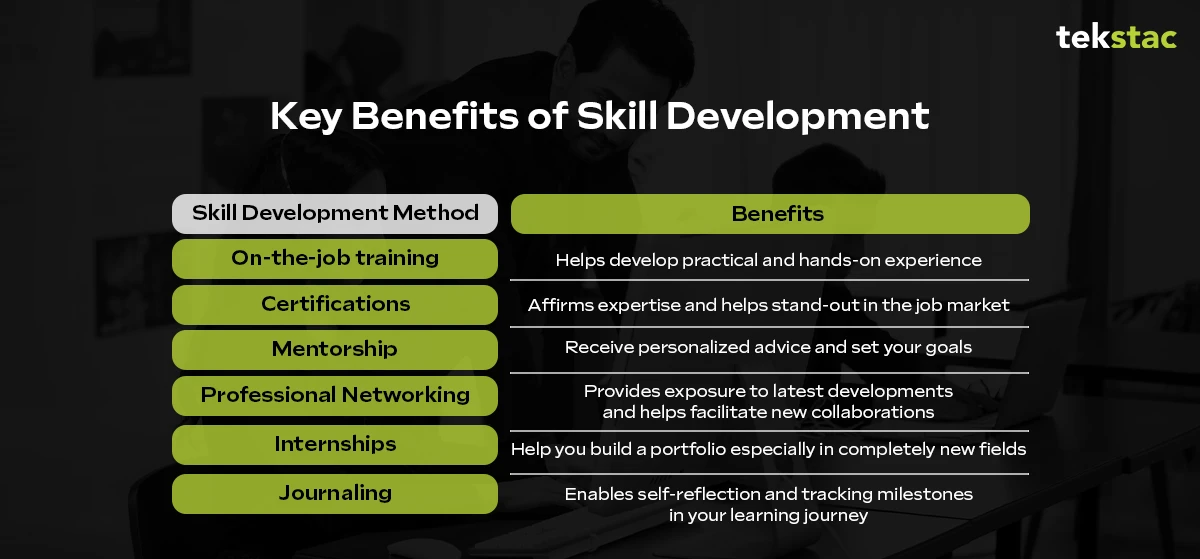
An effective skill development plan goes beyond training; it aligns business needs with workforce capabilities. Here are the key components:
Define clear skill categories and proficiency levels to establish what “good” looks like. This ensures consistency in assessments, development, and role alignment.
Build a current view of workforce capabilities using assessments, performance data, and real work signals. This forms the foundation for accurate skill gap analysis.
Identify critical skill gaps based on business goals and prioritize development efforts that directly impact outcomes.
Create structured learning journeys with hands-on practice, feedback, and real-world application to drive measurable improvement.
Equip managers with tools and accountability to support ongoing learning, feedback, and continuous skill development within teams.
Tekstac transforms skill development from a one-time initiative into a continuous, strategic system that drives real workforce outcomes. It bridges the gap between understanding current capabilities and taking the right actions to build future-ready skills.
By combining structured learning with live demos, real-time feedback, and applied practice, Tekstac enables organizations to identify skill gaps, accelerate upskilling and reskilling, and build job-ready talent at scale.
Skill development is no longer a one-time effort but a continuous process that shapes long-term career growth and organizational success. According to SHRM 2025 L&D Executives Priorities report, 1 in 3 L&D leaders (33%) have identified skills training as a top priority, with a strong focus on role-specific and personalized learning. To truly realize its impact, individuals and organizations must make skill development a consistent habit.
1. What are the top 3 in-demand AI skills to learn in 2026?
The most in-demand AI skills in 2026 go beyond just technical expertise. Key skills include:
These skills are increasingly essential as AI becomes embedded across roles and industries.
2. How can you start skill development and add it to your resume?
Start by identifying relevant skills based on your career goals and industry demand. Focus on building them through structured learning, hands-on projects, and real-world applications.
When adding skills to your resume:
Employers increasingly value applied skills over theoretical knowledge, so demonstrating real impact is key.
3. How can you create a skill development plan that actually works?
An effective skill development plan starts by aligning skills with business goals, followed by assessing current capabilities to identify gaps. It should include targeted learning pathways with hands-on application, enable employees to apply skills through real work opportunities, and involve managers in driving development. Most importantly, success should be measured through outcomes like performance improvement, mobility, and readiness.
4. What are 5 developmental skills?
Five core developmental skills that consistently drive professional growth are:



thanks for info.
Great blog! Skill development is truly important for long-term career growth.
Thanks for sharing this informative post!
Absolutely agree! 🌟 Skill development truly plays a pivotal role in career growth. In today’s competitive world, continuous learning and upgrading one’s skills are essential to stay relevant. Whether it’s technical expertise, communication, or leadership abilities — every skill adds value and opens new doors of opportunity. Great insights shared in this post!