
The future of work is being shaped by more than HR alone. It is being influenced by people and talent leaders, researchers, advisors, analysts, CEOs, and other voices who are challenging how organizations think about people, leadership, technology, and work.
We curated a list of 50 Global leaders in this space whose ideas, work, and influence are helping shape that conversation. Some are driving change within global organizations. Others are advancing new thinking through research, advisory work, analysis, or public conversations. What connects them is their ability to move the conversation forward and offer perspectives that matter in a rapidly changing world of work.
We have divided the list of 50 leaders into four sections based on the nature of their roles and influence: AI & Skills Transformation, Analysts & Researchers, CHRO Practitioners, and Advisors & Authors.
Senior people leaders driving transformation from within organizations through talent strategy, culture, employee experience, and workforce planning.
VP People Experience & Technology, Global Operations, Amazon
He oversees HR strategy across Amazon’s customer service, fulfillment, transportation, delivery, and robotics operations globally. His remit includes workforce staffing and employee relations across some of the company’s largest operational units. He has won several accolades including 2018 Michigan Chronicle – “Man of Excellence” and “2018 Most Influential Blacks in Corporate America” by SAVOY Magazine.
VP of Talent Acquisition, BNP Paribas
Erika’s career has centered on diversity, equity and inclusion alongside talent acquisition strategy. She is a key member of Global Centers of Excellence and is a recipient of 11 professional awards, including the 2023 Trailblazer Award. She serves as National President/CEO of the National Association of African Americans in Human Resources, where she drives leadership development.
EVP and Chief People Officer, Dayforce
She focuses on driving business growth through leadership development, culture, employee experience and strategic workforce planning. Her work sits at the intersection of HR practice and HR technology, given Dayforce’s own position as a software provider. She has been recognized by the National Diversity Council as one of the Top 50 Most Powerful Women in Technology.
Chief People Officer, One Workplace
Gianna brings deep expertise in building high-performing, people-first organizations during periods of growth and transformation. Her work centers on creating scalable people practices, strengthening talent strategies and helping organizations turn employee experience into a business advantage. She also contributes her perspective to the broader HR technology ecosystem through advisory work.
Chief Human Resources Officer, U.S. & Canada, Marriott International
He is a talent acquisition leader who has built HR practices across both Fortune 500 companies and venture-backed startups. His background bridges enterprise hospitality HR with startup-stage talent strategy. He has written two books named ‘The 9 faces of HR’ and ‘Best Boss Ever.’
SVP and Chief People Officer, LinkedIn
Teuila Hanson has helped advance LinkedIn’s work on inclusion, belonging and workforce equity. Under her leadership, LinkedIn reported a 127% increase in its Black senior population and a 74% increase in its senior Latino population as part of its broader representation goals. She leads strategy and people functions aimed at addressing complex business, talent and cultural challenges.
Chief Colleague Experience Officer, American Express
Monique Herena has made colleague experience a strategic lever for leadership, growth and organizational resilience. She has helped shape an approach at American Express that connects leadership development, succession, colleague listening, wellbeing and continuous learning. She also contributes to the wider HR profession through the CHRO Association and the National Academy of Human Resources.
Chief People Officer, Cisco
Kelly Jones has been recognized for turning employee wellbeing and inclusion into tangible workplace initiatives. Her work has included expanding neurodiversity support, menopause resources, parental leave and leadership wellbeing programs. She leads Cisco’s People & Communities team, setting people strategy for the company’s global workforce.
Group SVP, People & Culture, Warner Bros. Discovery
Donald Knight brings a strong business lens to people and culture, focusing on how talent and organizational culture can contribute directly to business performance. He is known for a strong commercial focus, using people strategy to deliver financial results and drive business growth at Warner Bros. Discovery.
CHRO, Baylor Scott & White Health
Cristi Lockett focuses on building people strategies that can support organizations through complex transformation, with particular emphasis on talent, leadership, inclusion and change. Her focus areas include diversity and inclusion, crisis communication, change management and talent acquisition.
EVP Chief People Officer, Alaska Air Group
She leads people strategy across talent acquisition, leadership development, total rewards and culture, and advises the airline’s leadership team and board. In this role, she supports Alaska’s vision to connect people to the world through a remarkable travel experience rooted in safety, care and performance.
Chief People Officer, Cushman & Wakefield
Holly Tyson has led major workforce and culture transformations, including the cultural integration of a significant acquisition at Zebra Technologies. More recently, she has emerged as a voice on how AI will reshape work, emphasizing the need to redesign jobs while preserving human judgment and critical thinking.
CHRO, ADM
Jennifer Weber has built her leadership around navigating organizations through significant transformation, including consolidation, M&A, and periods of rapid growth. Her work has spanned talent acquisition, development, culture and broad-based business transformation, giving her a strong track record of connecting people strategy with the operational realities.
People, Sustainability & Communication Manager, Ingka Group
She sits on Ingka Group’s (IKEA) Group Management team, working to align people and sustainability strategy with the company’s founding purpose. Her mandate spans co-worker experience, customer focus, and sustainable business growth. Biesèrt is also a member of the World Economic Forum CHRO community, the world’s leading Chief Human Resources Officers community.
Leaders helping organizations navigate AI adoption, workforce transformation, skills evolution, and the changing nature of work.
Chief People and AI Enablement Officer, ServiceNow
Jacqui Canney is focused on improving employee experiences and preparing the workforce for the future. Under Jacqui’s leadership, ServiceNow is weaving AI learning, upskilling, behaviors, and hands-on experience into every role, team, and function. She is a member of Fortune’s Most Powerful Women community.
Chief People & Digital Technology Officer, Moderna
Tracey Franklin has been instrumental in connecting people strategy with technology and business transformation. During her leadership of the HR function, the organization scaled from roughly 800 to nearly 6,000 employees globally. She has also played a key role in advancing AI initiatives, bringing together workforce strategy, digital transformation and emerging technology.
Senior Vice President and Chief Human Resources Officer, IBM
Nickle has helped make AI a practical part of IBM’s HR transformation, with HR itself serving as an early testing ground for the technology. Her work has focused on using AI and automation to redesign employee experiences and improve productivity and accelerate innovation.
Chief People and Sustainability Officer, Siemens AG
Judith Wiese has made lifelong learning a measurable part of Siemens’ workforce strategy. Under her people and sustainability agenda, Siemens invested €442 million in learning and development in FY2024, with employees averaging 27 hours of digital learning, exceeding the company’s 25-hour target a year early.
Global Lead, Talent & Organization, Accenture
Karalee Close is helping organizations rethink work for a human-and-AI workforce. She has helped develop a structured approach for bringing AI agents into real business functions, tested through Accenture’s own corporate operations. She also launched the Human+AI Impact Initiative, bringing together technology, talent, academic and innovation expertise.
Founder, Agentic Connect
Christopher J. Fernandez is a leading voice on human-centered AI and the future of work. He previously led Microsoft’s global HR AI transformation, helping shape how AI is understood, implemented, and applied across HR and the wider organization. He focuses on changing the world’s labor market through human-centered AI.
Analyst, Future of Work and Workforce Transformation, Gartner
Emily advises CHROs and other C-suite executives on the future of work, with a focus on AI’s impact on the workforce. Her core area of focus is AI’s impact on the workforce and new ways of working. She also helps executives with topics around new employment models and evolving employee expectations.
Chief Executive Officer & Co-Founder, Phenom
Driven by a purpose to help a billion people find the right work, Mahe built WorkOps, an operating model that gives enterprises the precision to deploy autonomous agents at scale with the context that each role, industry, geography, and moment demands. Under his leadership, Phenom has become one of Inc. 5000’s fastest-growing private companies for six consecutive years.
Analyst, AI in HR and Future of Work, Gartner
Drawing on consulting, HR practitioner and vendor experience, Lydia Wu focuses on how AI creates durable value in HR and helps CHROs turn AI strategy into practice. Her work focuses on the practical application of AI in HR, examining how emerging technologies intersect with human behavior, trust, governance, data, and operating models.
People Director, Avalanche Studios Group
Johannes Sundlo has built a distinctive voice around making AI adoption practical for HR and business leaders. Through his FullStackHR work, he has supported 150+ organizations globally, helping leadership teams move from AI experimentation to measurable changes in workflows, governance and adoption.
Senior Partner & Global HR Transformation Leader, Now To Next
Jason is recognized as a leading voice in global generative AI strategy within HR technology, working as a speaker, author, analyst and consultant. He has authored two best-seller books and now drives Generative AI strategy and services, helping organizations rethink HR as a digital function rather than a collection of technology projects.
CEO, UKG
Jennifer Morgan is the CEO of UKG since 2024, leading the company’s strategic direction and operations She has been globally recognized for her outstanding leadership and results, including being named one of the Most Powerful Women in Business by Fortune, Most Powerful Women in the World and Technology by Forbes, and as a Great Place to Work CEO For All Leadership.
EVP & Chief People Officer, Microsoft
Amy Coleman has played a central role in shaping Microsoft’s employee experience on a global scale, with a focus on creating a culture that attracts, develops and retains talent. Her work brings together culture, leadership, employee experience and organizational effectiveness to help build a workforce that can adapt and thrive as the nature of work evolves.
Researchers and analysts translating workforce trends, people data, and technology shifts into insights that help organizations make better decisions.
Co-Founder and Principal Analyst, RedThread Research
Dani Johnson is a leading voice in learning, careers and human capital strategy. She has spent the majority of her career writing about, conducting research in, and consulting on human capital practices and technology. Before starting RedThread, Dani led the Learning and Career research practice at Bersin, Deloitte.
VP, HR Business Insights & People Insights, Microsoft
She leads Microsoft’s HR Business Insights organization, building advanced analytics and employee-listening capabilities that inform enterprise decisions. She is recognized as a thought leader on using data and AI to improve workforce outcomes and employee experience. At Microsoft, her work has brought together employee survey data, attrition, diversity and de-identified workplace signals to uncover workforce patterns.
Chief Research Officer; Author, AI for HR, Lighthouse Research & Advisory
He leads research initiatives focused on talent strategy, innovation and technology as Chief Research Officer at Lighthouse Research & Advisory. Ben is an expert speaker on the future of work as it relates to talent, technology, and innovation. His book on AI serves as the definitive guide to artificial intelligence and machine learning applications for HR and talent.
Co-Founder and Managing Partner, Insight222
David is a is a global expert in people analytics. He co-founded Insight222 in 2017 to help CHROs place people analytics at the center of business decision-making. He is also a speaker, author and host of the Digital HR Leaders podcast.
Chief Research Officer and Managing Partner, Sapient Insights Group
Stacey has been a leading member of the HR practices and technology research community, producing groundbreaking research on high-impact HR organizations. She leads the industry’s HR Systems Survey and is the author of “Introduction to HR Technology.” She also hosts an award-winning podcast and is a globally recognized speaker on HR technology and workforce strategy.
Founder, Aptitude Research
Madeline is a global speaker and analyst focused on talent acquisition and employee experience. She is the co-author of Best Practices in Leading a Global Workforce and is often quoted in leading business publications. Her work helps companies both validate and re-evaluate their strategies and understand the role technology can play in driving business outcomes.
Vice President and Principal Analyst, Constellation Research Inc.
Holger provides strategy and counsel to key clients, including Chief Information Officers, Chief Technology Officers, Chief Product Officers, Chief HR Officers, investment analysts, venture capitalists, sell-side firms, and technology buyers. He covers next-generation enterprise applications and the future of work as a principal analyst.
Principal Analyst, Forrester
Betsy specializes in talent management strategy and technology, known for practical research on improving work experience through technology and leadership. With a wide range of HCM experience including research, strategy, design, and delivery, Betsy has been both a practitioner and a strategic partner to heads of HR, talent, and learning.
CEO and Principal Analyst, Valoir
Rebecca is a leading expert in Technology ROI, human capital management (HCM), and analytics and AI technology and strategy. She helps organizations maximize the business value of their digital transformation investments. She works as a researcher, author and speaker covering the HR technology space.
Founder & CEO, Fosway Group
David leads Fosway’s research, analysis and insight into next-generation HR, talent and learning technology. He personally leads Fosway’s research and corporate advisory agenda. He is the author of over 150 research papers and articles as well as being a leading speaker at major conferences and events around the world.
Partner, HRTechRadar
Anita Lettink is an international keynote speaker, advisor and author. She has been recognized as a Top 25 Global Thought Leader on the Future of Work. She helps companies and workers prepare for the challenges and opportunities of the changing world of work.
Head of Talent Insights & Analyst; Author, iCIMS
Trent leads talent insights at iCIMS, an enterprise talent acquisition platform, helping organizations use data-driven strategies to hire more effectively. He is known for translating workforce trends into actionable business insights. He is also a Learning and Development maestro, and High Performance Coach, attempting to reshape the future of HR.
Independent advisors, authors, coaches, and thought leaders shaping how organizations think about leadership, HR, technology, and the future of work.
Chief Work Officer, Sol
Cara is a recognized leader in the evolution of the modern workplace and in scaling high-growth companies. She most recently served as Chief People Officer at Lattice and previously held senior HR leadership in renowned companies. She is also co-founder of PeopleTech Partners, a group of 500+ HR leaders working to bring new HR/recruiting technologies to market.
Board Director, Senior Advisor and prior IBM CHRO, Kraft Heinz/HBS
Diane Gherson is widely recognized for pioneering the use of AI to transform HR, helping move the function beyond traditional people processes toward a more technology-enabled model. Her work has shaped thinking around workforce analytics, employee experience and the future of HR, and she continues to influence the field through board and advisory roles.
Organizational Psychologist, Executive Coach and Author, Feels Human
Gena Cox is a Thinkers50-recognized executive coach and the author of Leading Inclusion, a multiple award-winning guide to building inclusive organizations from the top down. She has advised leaders at Fortune 500 and global organizations on culture, employee experience and leadership impact.
Future of HR Leader, Deloitte Consulting
Kyle advises CHROs and HR leadership teams on HR strategy, AI-powered operating models, and the future skills and roles needed to drive measurable business outcomes. He helps business and HR leaders drive business and workforce outcomes through Deloitte’s knowledge and practical understanding of HR operating models, processes, AI and automation capabilities.
Co-Founder and Chief Product Officer, Ikona Analytics
A thought leader in People Analytics and HR transformation, with a focus on turning organizational knowledge into actionable intelligence. His work has been recognized among the leading voices in People Analytics, including being named a Top 20 People Analytics Influencer globally in 2025 and a Top 30 influencer in 2026.
Co-Founder and Chief Strategy Officer, H3 HR Advisors
Trish Steed is a seasoned HR executive and strategic advisor with a proven track record of aligning business objectives with transformative people strategies. With deep expertise in market analysis and trend forecasting, Trish has guided companies navigating the evolving landscape of human capital management.
Founder/Managing Principal, IA
Mark is recognized as an HR technology and transformation thought leader whose writing, speaking and advisory work help Global 1000 leaders navigate organizational change. By offering unbiased and candid advice to C-level leaders in nearly all geographies and vertical market segments, Mark has brought great value to his clients and employers.
Founder & Chief Energy Officer; Author, Transformational HR, PTHR
Perry is a globally recognized HR futurist, author, and speaker. An award-winning HR practitioner, he is a two-time TEDx speaker and three-time author with three decades of experience in change and organization design. He was inducted into the HR Most Influential’s Hall of Fame in 2023.
Global HR & Transformation Leader, The HR Scientist
He is an international keynote speaker on AI, workforce strategy and organizational transformation, and also works as an HR tech investor and strategic advisor. His expertise spans multi-country leadership, talent acquisition, agile HR transformation, organizational design, and DEI. He has received multiple honors, including the ‘He for She’ Award, Innovation HR Award.
Advisor & Podcaster, Amy Wilson Advisory
Amy Wilson helps CEOs and leaders navigate the business and leadership shifts required to make AI transformation work, not just the technology itself. She advises HR tech founders and enterprise leaders, and co-hosts “The Meg & Amy Show,” helping leaders make sense of AI’s impact on work and the workforce.
President, EXec EXcel Group
Ian Ziskin is a business leader, board advisor and member, coach, consultant, CHRO, entrepreneur, teacher, speaker, and author. He is the lead author of The Secret Sauce for Leading Transformational Change. In 2007, he was elected a Fellow of the National Academy of Human Resources, considered to be the highest honor in the HR profession.
The future of work will not be shaped by one function, one role, or one industry. It will be shaped by people who are willing to question established ways of working, understand what is changing, and turn those insights into action.
That is what makes this 50 leaders list stand out. Across vital roles, these individuals are contributing to some of the most important conversations facing organizations today; from AI and skills transformation to leadership, workforce resilience, culture, and the changing nature of work.
At Tekstac, we see this shift every day. Building a future-ready workforce requires understanding which skills matter, where capability gaps exist, and how organizations can turn learning into measurable readiness and business outcomes.
Book a demo to explore how Tekstac helps organizations measure real capability, close skill gaps, and accelerate workforce transformation.
Executives are worried, and the worry has a number attached to it. As the gap between the skills organizations have and the skills they need keeps widening, Skills Intelligence has moved from a nice-to-have capability to a boardroom concern. For nearly two decades, the Learning Management System (LMS) has been the backbone of corporate learning.
But the LMS was built to manage learning, not to understand it. AI has exposed that limitation, and as AI reshapes how people learn and how organizations operate, learning technology is undergoing a fundamental shift: from systems of record to systems of intelligence, what’s increasingly being called Skills Intelligence.
At its simplest, Skills Intelligence is the ability to continuously identify, measure, and act on the skills an organization has, the skills it needs, and the gap between the two. It isn’t a feature bolted onto an LMS. It’s a different architectural starting point: a Learning Intelligence Layer that reads real signals from the business and responds to them, rather than waiting to be told what to deliver.
| Traditional LMS | Skills Intelligence Platform |
|---|---|
| Delivers assigned courses | Continuously identifies skill and capability needs |
| Tracks learning activity and completion | Reads signals from learners, teams, roles, and business priorities |
| Requires manual updates and interventions | Recommends personalized learning and next-best actions automatically |
| Measures past learning performance | Continuously adapts to changing workforce and business needs |
WEF’s Future of Jobs Report found that 63% of employers now cite skills gaps as the top barrier to business transformation, a scale of change that legacy LMS infrastructure was never designed to address. Even a well-executed skill gap analysis tends to hit a wall somewhere between “we identified the problem” and “we did something about it.” That wall isn’t analytical, which means better dashboards won’t fix it.
The gap analysis usually sits inside a workforce analytics or skills intelligence tool. Learning content lives in the LMS. Gap data is organized around skills and roles, while learning content is organized around courses and topics, making it difficult to deliver personalized learning at scale. The two structures don’t naturally talk to each other. Someone has to build that bridge manually, usually someone who already has a full-time job, which is why the translation either doesn’t happen or happens once and fails to scale.
A gap analysis report tells you where the problem is. It can’t tell you what to assign, to whom, by when, or what happens if nobody engages. A dashboard creates awareness, but without a workflow attached to it, awareness rarely turns into movement. It’s a map of the gap, not a route out of it.
HR owns the skills data. L&D owns the learning programs. Managers own development conversations. But who owns the connection between an identified gap and a specific intervention, assigned to a specific person, on a specific timeline? In most organizations, the honest answer is nobody, and that accountability gap is exactly where momentum disappears. It’s a structural design flaw, not a personal one, which also means it’s fixable.
LinkedIn’s Workplace Learning Report puts the pace of this change in sharper relief: the skills required for jobs have already shifted by roughly 25% since 2015, and that rate is projected to accelerate to 40–70% by 2030. The move from LMS to Intelligence Layer isn’t only a technology decision. It changes how L&D leaders think about their own role. In an LMS world, L&D’s primary job is content production and program management: building courses, running workshops, managing enrollments, reporting completions. Valuable work, but increasingly automatable, and increasingly disconnected from the outcomes leadership actually cares about.
In an Intelligence Layer world, that job changes. L&D’s primary work becomes defining what capability the organization needs to build, setting the conditions for continuous development, and interpreting the signals the system surfaces. Coordination is handled by agents; strategy is handled by people. That’s a more durable position for the function, and it’s the foundation of the kind of skills-first leadership that CHROs are increasingly expected to model at the top.
A Skills Intelligence platform like Tekstac can enhance recruitment, support skills development, and improve talent management. For organizations, Skills Intelligence supports strategic workforce planning by giving leaders a comprehensive view of skills data aligned to future business needs. It improves talent acquisition by identifying gaps and helping recruit the right people into them. It optimizes L&D by designing targeted programs around actual gap data rather than assumption. Together, these are the building blocks of Skills-Based Organizations.
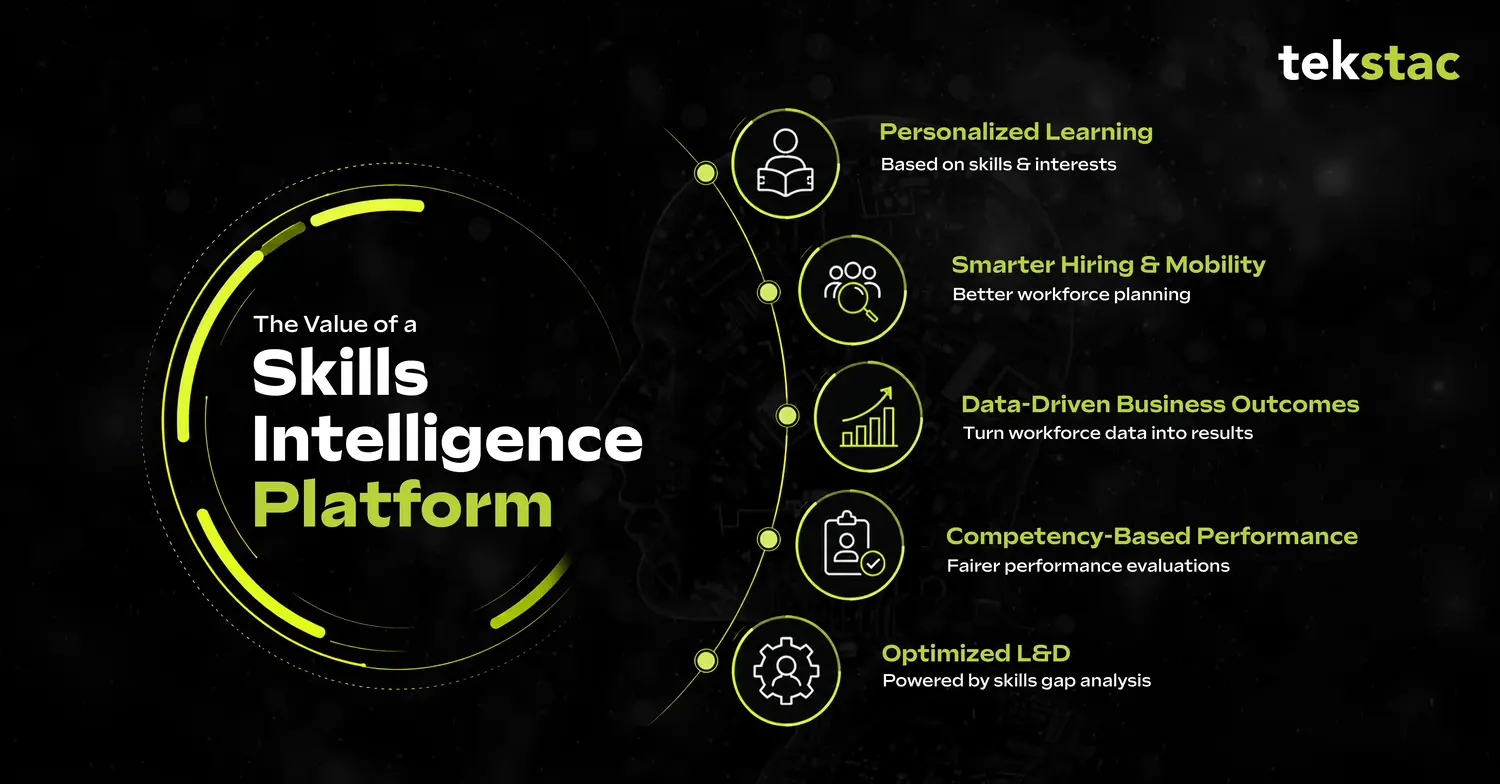
Closing the gap between skills data and skill-building action is precisely the problem Tekstac’s Skills Intelligence approach is built around. The platform has the Skill Insights hub that connects skill gap analysis directly to role-based learning pathways, so identification happens easily. For L&D leaders and CHROs evaluating whether their current LMS can carry this weight, that connective layer, not another course library, is usually the missing piece.
The LMS remains the foundation of enterprise learning, but its role is expanding beyond content delivery into an intelligent system of action. The organizations that recognize this earliest will build workforces that are faster, more capable, and more adaptable. That is the essence of Skills Intelligence: not another dashboard, but an operating model for continuous capability building.
Ready to see what a Skills Intelligence layer would look like on top of your existing LMS?
Talk to the Tekstac team about mapping your organization’s skills gaps to real deployable skill profiles.
1. How do Skills Intelligence platforms differ from traditional HR tools?
Skills intelligence platforms go much further by continuously identifying, validating, and analyzing workforce skills in real time. Instead of simply tracking completed courses or certifications, they map skills to roles, business goals, and future capability needs, helping organizations make better decisions about hiring, upskilling, internal mobility, and workforce planning.
2. What is the impact of AI on skills intelligence?
AI transforms Skills Intelligence by automating skill discovery, identifying capability gaps, and recommending personalized learning paths at scale. It continuously analyzes data from learning activities, projects, assessments, and job roles to create an accurate picture of workforce capabilities. This enables organizations to predict future skill requirements, accelerate reskilling initiatives, and make faster, data-driven talent decisions.
3. What are the challenges in deploying Skills Intelligence platforms?
Successful deployment requires more than implementing new technology. Organizations often face challenges such as fragmented skills data, inconsistent skill frameworks, poor integration with existing HR and learning systems, and low employee participation. To maximize value, businesses need a clearly defined skills taxonomy, reliable assessment methods, executive sponsorship, and a culture that encourages continuous learning and skills validation.
4. How do you know if your LMS is failing?
An LMS may be falling short if it measures learning activity instead of workforce capability. Common signs include high course completion rates with little improvement in on-the-job performance, limited visibility into actual skill gaps, generic learning recommendations, and difficulty linking learning outcomes to business goals. If your LMS cannot identify these, it may be time to move beyond traditional learning management toward a skills intelligence platform.
Reid Hoffman’s book ‘Superagency: What Could Possibly Go Right with Our AI Future’ asks a provocative question: what if AI expands human capability instead of replacing it? That question now defines the reality of AI in HR.
Across boardrooms in every corner of the world, AI is no longer experimental; it is operational. CHROs are not asking whether AI belongs in HR. They are asking how fast they can deploy it without losing control.
During HR roundtables we conducted across India in 2025, several CHROs shared that their organizations reduced hiring timelines by up to 47% after implementing AI-driven recruitment systems. That number isn’t incremental. It’s structural. This blog walks through the frameworks, implementation models, real-world impact metrics, and leadership decisions shaping that shift in 2026 so HR leaders can move from experimentation to enterprise transformation.
At its foundation, artificial intelligence in HR refers to the integration of machine learning, predictive analytics, generative AI, conversational systems, and intelligent automation into core HR processes.
This includes:
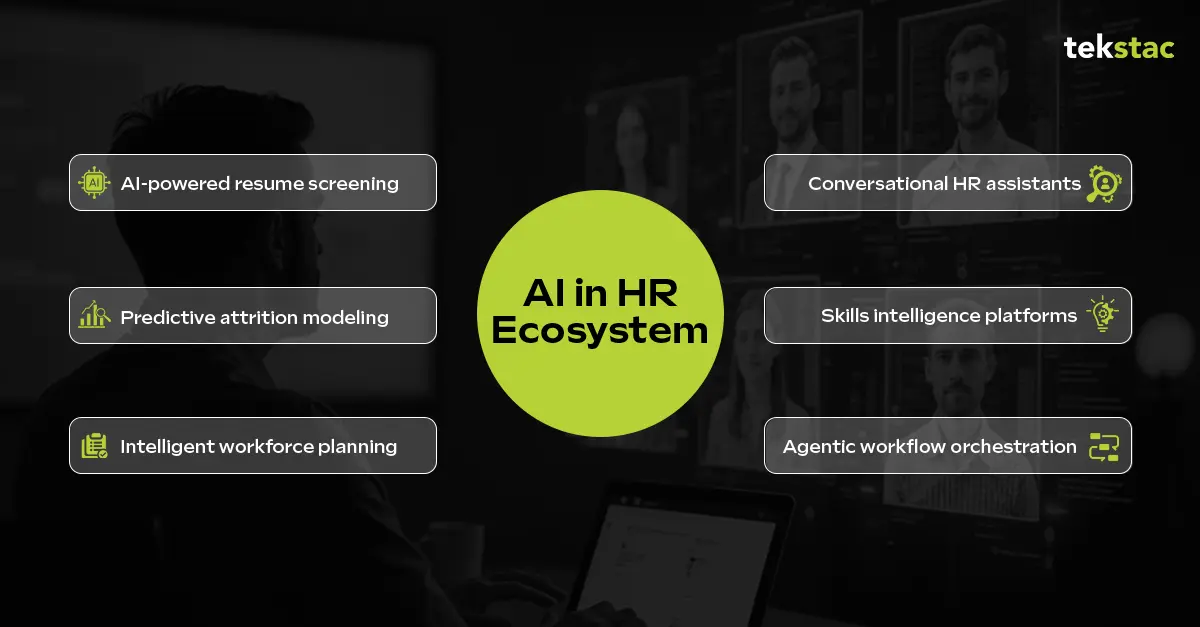
Unlike traditional HR automation, which focused on digitizing forms and workflows, AI introduces cognition into systems. It enables pattern recognition, forecasting, personalization, and adaptive decision-making.
This marks the shift from process digitization to digital HR transformation.
Instead of asking what happened last quarter, HR can now ask:
The urgency around AI adoption in HR is not theoretical. Let’s see some actual numbers.
According to McKinsey & Company – Global AI Survey, 65% of professionals report their organizations use AI in at least one business function. Yet within HR specifically, maturity remains uneven.
43% of organizations now use AI in HR, up from 26% in 2024. 45% of Indian organizations have already integrated Generative AI into HR, with 93% reporting increased efficiency.
And yet 93% of employees say AI is underutilized. 55% of HR leaders say their tech stack does not meet evolving needs. 60% of business leaders admit they lack a clear AI implementation vision.
This is the paradox of the current moment: High investment. Low clarity.
The organizations delaying implementation are not saving money. They are widening the capability gap.
The Future of Work with AI will not wait for organizations to feel ready. To remain competitive, organizations must focus on helping employees outskill AI, building capabilities that complement AI technologies rather than lag behind them.
Josh Bersin describes the current phase of AI in human resources as enthusiastic but immature. Many companies are experimenting, but few have identified high-impact, scalable use cases.
He emphasizes that AI deployment is not like ERP rollouts. It requires iteration, trust-building, and continuous governance, particularly in hiring and performance evaluation.
At the same time, one of the leading reports in 2026 projects that the global AI in HR market will grow from $4.3 billion to $25 billion by 2031.
Drivers of this growth include:
Much of this momentum is being shaped by emerging AI trends in L&D, as organizations rethink how skills are built, measured, and scaled across the enterprise.
The following case studies highlight how AI is transforming HR from an administrative function into a strategic growth engine.
A global retail enterprise deployed an AI-powered hiring assistant. Due to this, application completion rates increased from 50% to 85%. Hiring timelines reduced from 12 days to just 4.
Result? Efficiency improved and more importantly, candidate experience improved.
In another remarkable instance, Unilever implemented AI-driven assessments in early hiring stages and reported improved diversity in candidate pipelines while reducing time-to-hire. As former CHRO Leena Nair stated:
“Technology should remove bias and enable meritocracy, not reinforce existing patterns.”
On the contrary, AI in HR also had some negative results. Take, for instance, Amazon’s AI recruiting tool, which showed gender bias in training data that resulted in eradicating the tool itself.
These examples illustrate both the power and responsibility of AI and automation in HR.
Agentic AI represents a major leap beyond rule-based automation. HR adoption of Agentic AI currently sits at 15%, but Salesforce projects it will reach 64% within two years.
Unlike isolated tools, Agentic AI systems can plan, reason, and execute multi-step workflows across systems. At Advanced Micro Devices (AMD), an AI-powered HR service orchestration agent was deployed to handle high-volume employee support across systems like SAP SuccessFactors and Microsoft Teams. Instead of routing every request to a human helpdesk, the agent interprets employee intent, retrieves context from HR systems, initiates workflows, routes approvals, and escalates complex issues when needed. The result for AMD was an 80% reduction in time to resolve inquiries, 50% of requests handled via self-service.
The impact of AI in HR isn’t limited to automation. Its value unfolds across three powerful layers: operational efficiency, strategic intelligence, and employee experience.
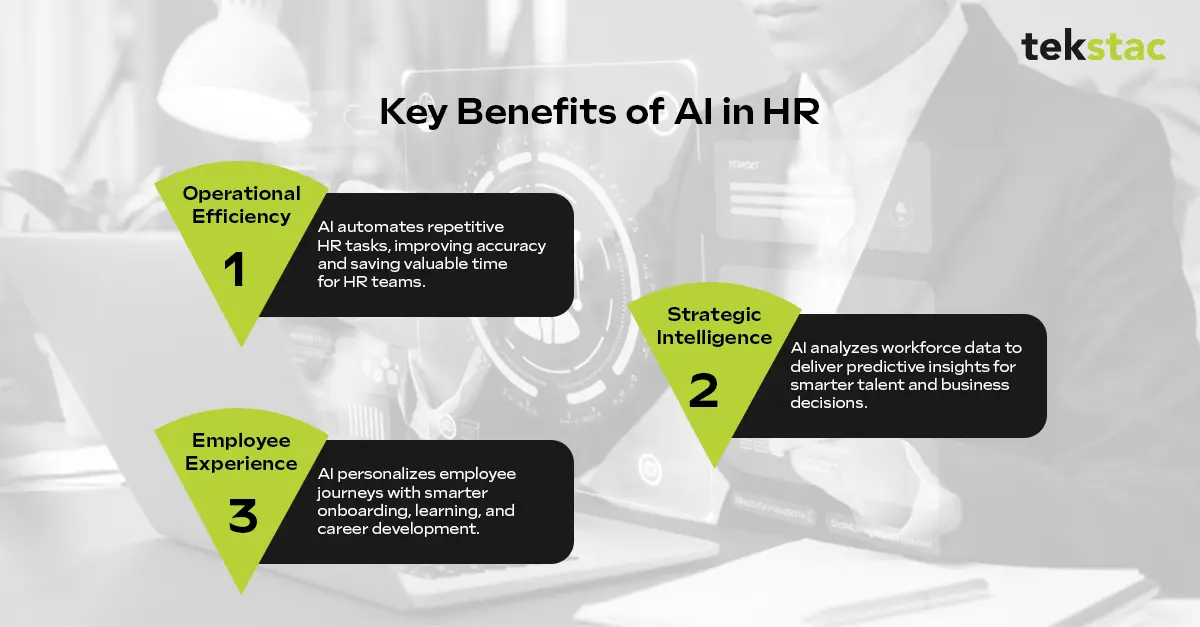
At the foundational level, AI streamlines everyday HR operations. From resume screening and interview scheduling to payroll validation and helpdesk queries, repetitive and time-intensive tasks can now be automated with precision.
In fact, as per ETHR, 68% of companies say AI improves job accuracy in HR processes, while 72% report enhanced productivity and time savings.
Beyond efficiency, AI elevates HR from administrative execution to predictive strategy. Machine learning models analyze workforce data to identify patterns and generate forward-looking insights.
Organizations are using AI for:
Instead of relying on reactive reports, HR leaders can anticipate risks, model future scenarios, and make data-backed talent decisions aligned with business goals.
AI also plays a critical role in personalizing the employee journey. It enables:
As organizations shift toward skills-first talent models, AI-powered workforce upskilling becomes essential. Today, 88% of organizations report active upskilling programs, and companies investing in reskilling are 2.5 times more likely to achieve positive business outcomes from AI initiatives.
AI is increasingly helping HR teams work smarter, not harder, by automating routine tasks, improving decision-making, and enhancing employee experiences. Here are five standout AI tools that are shaping the future of HR:
AI transformation is not an IT initiative. It is a people transformation.
More than 70% of enterprises are investing in AI, yet many struggle to extract value due to skill gaps and change resistance.
CHROs must lead in three critical areas:
As Prabir Jha, leading HR advocate in India, has consistently articulated in his writings and leadership conversations, digital transformation succeeds only when capability transformation precedes technology adoption.
The top HR leaders in India are already demonstrating what proactive AI leadership looks like, integrating technology with talent strategy.
AI’s greatest value emerges when strategy and talent are synchronized.
CHROs must build AI literacy, embed ethical guardrails, and champion cross-functional partnerships.
AI’s greatest value emerges when strategy and talent are synchronized.
CHROs must build AI literacy, embed ethical guardrails, and champion cross-functional partnerships.
The most effective HR leaders are not reacting to AI. They are orchestrating it.
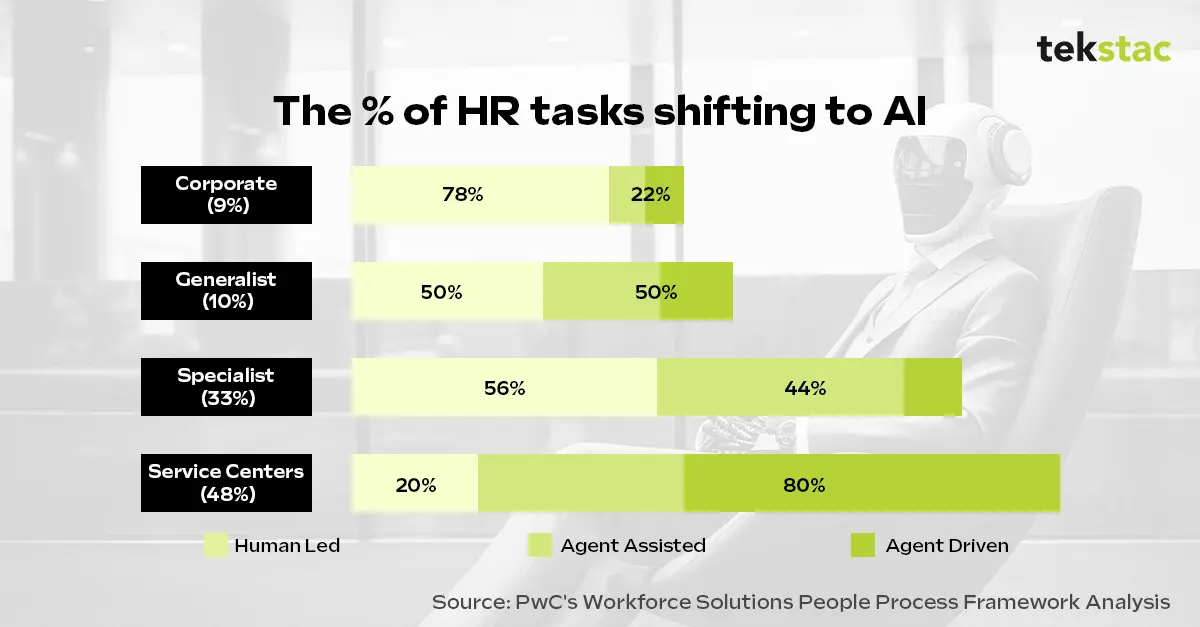
When discussing AI implementation in HR, Dave Ulrich, widely known as the Father of Modern HR has discussed recently about an analysis from PwC’s Workforce Transformation Team, which examined how AI is likely to reshape the four core elements of the HR operating model. The central idea is powerful. AI should not sit as a separate HR initiative.
It should be embedded into the HR operating model to increase stakeholder value.
AI implementation succeeds when it is structured, intentional, and aligned with business outcomes. While many organizations begin with isolated pilots, sustainable impact comes from a clear framework that connects technology, people, and processes.
Identify high-impact processes. Evaluate tech stack readiness. Assess data quality and governance models.
Many companies fail here by rushing implementation without clarity.
Start with high-volume workflows like recruitment or onboarding. Measure KPIs such as time-to-hire, cost-per-hire, and satisfaction.
68% of companies report improved job accuracy during AI pilots.
Scale gradually with governance, bias audits, and structured change management.
AI deployment must be iterative, not disruptive.
Disciplined scaling differentiates strategic transformation from fragmented tool adoption.
Despite rapid momentum, adoption is far from universal. 17% of organizations still have no plans to implement AI in HR, reflecting hesitation around risk, readiness, and ROI clarity. Even among adopters, concerns remain significant. This signals a critical leadership gap: technology is advancing faster than organizational capability.
For CHROs, the real challenge is not whether to use AI, but how to implement it responsibly at scale. AI systems influence hiring decisions, performance evaluations, compensation modeling, and employee monitoring. Without strong guardrails, the same systems designed to drive efficiency can amplify bias, compromise privacy, or erode employee trust.
This is why forward-looking HR leaders are prioritizing:
“AI will not replace humans — but humans who use AI will replace those who don’t.” — Sam Altman, CEO, OpenAI
The fear isn’t new. Every technological leap has sparked the same question: Will machines take over? The broader debate around AI stealing jobs often frames the future of work as a zero-sum game: humans versus machines. In HR, that anxiety feels personal. But here’s the reality: AI doesn’t replace HR. It reshapes it.
AI can screen thousands of resumes in seconds. It can flag skill gaps, predict attrition risk, and automate interview scheduling. What it cannot do is read nuance in a candidate’s life story, sense cultural alignment in a conversation, or coach a struggling employee through uncertainty. The future of HR is not “AI vs Humans.” It is AI-powered Humans. As Alim Dhanji, Chief People Officer at TD SYNNEX puts it, “AI is an enabler; it cannot replace the human element in HR. Judgment, empathy and understanding context are areas where AI falls short.”
One of the most searched queries around AI in HR is simple: “How do we measure ROI?” Because experimentation is exciting. But leadership cares about outcomes. According to IDC, 92% of organizations plan to increase their AI investments, with AI spending projected to grow at 1.7x the rate of overall digital technology spending in the next three years.
Organizations investing in AI and automation in HR are increasingly tracking impact across four dimensions:
A global enterprise reduced recruiter screening time by 42% after implementing AI-assisted shortlisting. That translated to thousands of hours saved annually.
AI-driven candidate matching improves role-skill alignment.
This directly impacts:
With strong talent analytics, organizations can now correlate hiring inputs with performance outcomes, something impossible at scale before.
AI-based skill mapping identifies who can move where.
Instead of external hiring, organizations now redeploy internal talent. That reduces hiring costs, onboarding time, and cultural friction.
This is where AI workforce planning becomes strategic, not administrative.
Companies adopting AI powered workforce upskilling report:
A product head from an enterprise client once said: “Earlier, we were guessing who might fit a future role. Now we can see it. Skills tell the story.”
That visibility is ROI.
While many organizations talk about implementing AI in HR, very few know where to begin.
This is where Tekstac’s GenAI Labs bridges the gap between experimentation and enterprise-ready execution. Instead of introducing AI as a standalone tool, Tekstac approaches HR automation as a structured capability-building journey.
Let’s take a closer look at how this works.
Inside Tekstac’s GenAI Lab, HR teams learn how to build AI-assisted resume shortlisting workflows that:
One of the overlooked areas of AI in HR is candidate communication. Generic outreach emails often result in low response rates and weaker employer branding.
Through our GenAI Lab, HR teams learn how to:
This dramatically improves candidate experience, a key metric in modern digital HR transformation.
Interview scheduling may seem operational, but at scale it becomes a coordination challenge across recruiters, hiring managers, and candidates often across time zones.
Inside Tekstac’s GenAI Labs, HR teams simulate AI-driven scheduling workflows that:
What makes this powerful is the simulation layer. This reduces risk during full-scale
The measurable impact typically includes:
The AI in HR market is projected to reach $25 billion by 2031. Agentic AI adoption will accelerate dramatically. The transformation is structural.
Organizations that approach AI with clarity, governance, and human-centered leadership will not just modernize HR, but they will redefine it.
The next wave of AI in HR will include:
AI in HR 2026 is not about tools. It is about redesigning how organizations hire, develop, engage, and scale talent. On one side are fragmented pilots and unclear governance. On the other hand, organizations are executing disciplined AI-driven workforce transformation with measurable ROI. The divide is widening. Artificial intelligence in HR will not define the future; how leaders implement it will.
If you’re looking to turn AI strategy into measurable outcomes, explore Tekstac’s platform demo.
1. What are the top AI in HR certifications for CHROs and HR leaders?
Here are some of the most recognized AI certifications suitable for senior HR leaders:
2. Is AI going to eliminate HR jobs or finally prove HR’s value?
This question often misses one critical point: AI isn’t just another HR tech tool. It’s built on machine learning, which means it improves over time. Many industry leaders anticipate a shift from partial automation to near-full workflow automation within the next 5 years. That doesn’t mean humans disappear. It means humans focus on approval, judgement, and complex decisions. HR teams will likely become leaner operationally, but stronger strategically.
3. How to implement AI responsibly in HR?
Responsible AI in HR means using AI in ways that are ethical, transparent, and aligned with organizational values. Before adopting any AI tool, CHROs should ensure it’s evaluated and approved, safeguarding security and compliance. AI use must respect privacy and data protection, with internal policies that prevent input of sensitive or confidential information. Organizations should be transparent about how AI is used, maintain clear documentation for traceability, and have oversight to catch errors, bias, or risk.
As organizations accelerate through AI adoption, evolving business models, and continuous disruption, one reality is becoming clear: skills, not roles, are now the true currency of work. Traditional talent models built around static job descriptions, rigid hierarchies, and tenure-based progression are struggling to keep pace with rapid technological and market shifts. In this environment, skills-first leadership have emerged as critical leaders driving skills-first transformation, bringing a clear mindset to workforce transformation.
Skills-first talent leaders go beyond implementing new tools or learning platforms. They drive a fundamental shift in how talent is understood, developed, and valued. For these future-ready leadership India exemplars, hiring moves from pedigree to potential.
As Josh Bersin, global HR and L&D thought leader, explains:
“Skills are becoming the new organizational currency. Companies that understand, develop, and deploy skills dynamically will outperform those still managing jobs and titles.”
Building on this shift, Tekstac presents the Top 25 skills-first leadership champions in India, who are translating intent into impact. Together, these workforce transformation leaders are shaping up a workforce model designed for resilience and relevance.
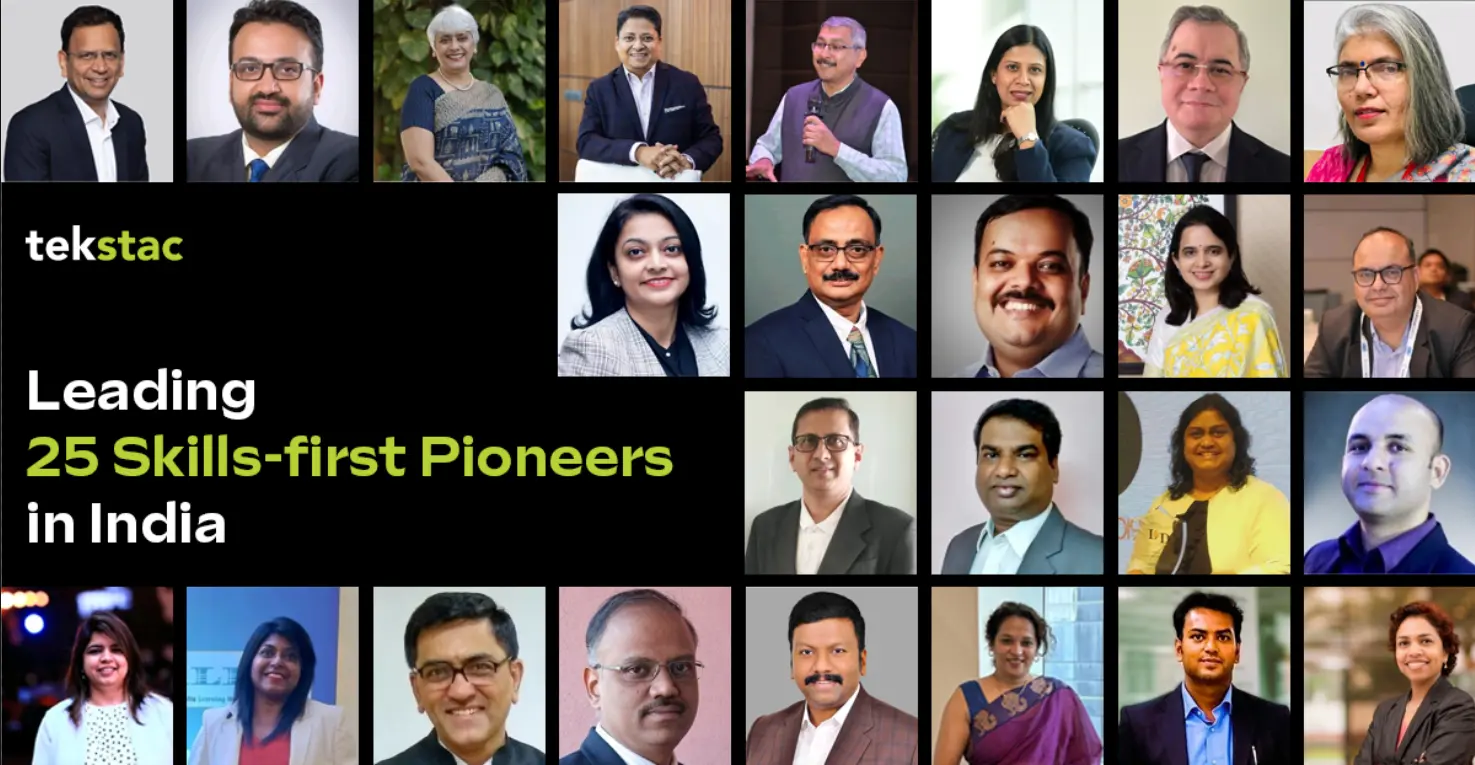
CHRO, Zensar
With over 26 years of global HR leadership experience, he has led diverse workforces, scaled businesses, and built high-performance cultures across geographies. As Zensar’s CHRO, he leads global HR transformation, cultivating a distinctive culture to evolve into a fully skills-based powerhouse. His earlier career includes 12 years in the UK, where he built and scaled European HR operations for multinational IT organizations, delivering best-in-class employee experiences.
Global HR Head, Coforge
Ankur Berry brings 23+ years of global HR leadership, managing 10,000+ workforces across 25 countries. His integrity-driven approach emphasizes inclusive upskilling, building skills-first cultures that prioritize capability over credentials. Recognized as a Top 50 Influential HR Tech Leader, he champions humane talent development for multinational agility.
Former Global Chief People Officer, Cipla
Raju Mistry is a widely recognized HR leader whose work has been acknowledged across platforms such as Forbes Best Employers and ETHRWorld Top 50. She combines strong L&D strategies with data-led people analytics, an approach that also earned her recognition as a SHRM 2025 award winner. Her inclusive people practices have consistently contributed to Great Place to Work certifications.
CEO, Tesco Business Solutions & Tesco India
A visionary leader with over 20 years of experience, Dr. Sumit Mitra oversees a global workforce of 20,000+ colleagues across India, Hungary, and Central Europe. He is renowned for transforming Global Capability Centers (GCCs) into engines of innovation and strategic value. Under his leadership, Tesco’s global operations have integrated cutting-edge AI and data-led retail solutions, setting benchmarks for excellence in the retail-tech landscape.
Director – Human Resources, Bosch Global Software Technologies (BGSW)
With a career spanning over three decades, Dr. Mohan Bellur is a specialist in navigating large-scale organizational transformations and cultural shifts. He leads HR strategy for one of the world’s largest software hubs, focusing on the intersection of technology, talent, and leadership. His expertise in industrial relations and strategic workforce planning has been pivotal in scaling Bosch’s engineering excellence and fostering a culture of continuous learning.
Head of People & Culture, India, SAP
With 23 years of expertise, Shweta Mohanty leads SAP India’s HR, pioneering initiatives to build a skills-based organization. Her D&I advocacy (Girls Power Tech) builds diverse, skilled talent pools. She expands learning models enterprise-wide.
CHRO, Mphasis
Leading global HR for 25+ years, Ayaskant integrates talent management, L&D, and analytics for performance breakthroughs. As Executive Council member, he operationalizes skills-first strategies worldwide. He elevates people as strategic assets.
Director of Learning and Development, APAC, CGI
With over 25 years of cross-functional expertise, Srilata leads the L&D strategy for the APAC region, driving talent transformation for a massive, diverse workforce. She specializes in building high-performance cultures through agile learning frameworks and leadership development initiatives. Her work focuses on bridging the gap between digital disruption and human capability, ensuring talent readiness across one of the world’s most dynamic markets.
EVP (Former CHRO), L&T Technology Services
Having transitioned from a strong foundation in the public sector to executive leadership at L&T, he excels at engineering skills-focused transformations. A recognized NHRDN leader and keynote speaker, he is dedicated to building future-ready workforces that bridge the gap between traditional engineering and digital innovation.
AVP and Global Head of Learning and Development, LTIMindtree
A seasoned leader with over 25 years of experience, Ritu orchestrates global learning strategies that align with large-scale organizational priorities. Having held leadership roles at Wipro and Accenture, she is a specialist in navigating complex IT talent ecosystems. She was named one among the Top 50 UK Woman Leaders by Santander and a recipient of global awards from ATD and Brandon Hall.
CHRO, R Systems
A dynamic HR leader with 20+ years of experience, Satyadeep specializes in driving organizational transformation across global tech and product engineering firms. Previously a core leader at Reliance Jio and Bajaj Finserv, he is an expert in scaling digital talent, performance management, and building robust leadership pipelines. At R Systems, he leads the people strategy for a global workforce, focusing on high-growth culture and tech-driven HR innovation.
Director & India Lead – Learning, Talent and OD, Publicis Sapient
With over 2 decades of experience across the IT and digital business transformation sectors, Varun spearheads the talent development strategy for Publicis Sapient in India. He is a specialist in crafting high-impact “Power Skill” frameworks and leadership development programs that align with rapid technological shifts. His expertise lies in building agile, learner-centric cultures and leveraging data-driven insights to enhance organizational performance and employee experience.
Senior Director, PwC
A 25-year HR veteran, Priya fosters “Diversity in Thought” via data-driven L&D, championing women’s empowerment and cultural agility. Her transformative initiatives integrate business strategies with talent upskilling. She coaches teams for excellence.
Vice President – Head Learning & Development, Birlasoft
With 28 years of experience across giants like Capgemini and Genpact, Deepak is a veteran architect of global learning ecosystems. He specializes in re-engineering L&D strategies through mergers and divestitures, integrating AI-powered coaching and NextGen learning platforms. At Birlasoft, he leads the “Early Edge” initiative, focusing on transforming first-generation talent and building “human-centric” leadership capabilities, emphasizing empathy and resilience as the ultimate superpowers in an AI-driven world.
Global Head – Learning & Development, Persistent Systems
A PhD-holding leader with a unique background in testing quality management and process engineering, Dr. Manoj Apte brings a rigorous, analytical approach to talent transformation. At Persistent Systems, he has engineered high-impact learning journeys that bridge the gap between technical expertise and leadership excellence. He recently received the ‘Transformative L&D Leader’ award from ETHR part of the ETHCA.
Vice President – Talent Development, Goldman Sachs
With 23+ years across 10 countries, Divya designs learning ecosystems for 200,000+ employees, coaching BU leaders on $400M+ accounts. Her Train-the-Trainer programs build skills at scale across 129 nationalities. She engineers organization-wide proficiency.
Executive Vice President – People & Talent, Indium Software
Mahendran advances skills-first frameworks in software innovation, optimizing talent for testing and engineering excellence. His operational expertise builds adaptive teams ready for digital shifts. He bridges skills gaps with precision.
Strategic L&OD Leader, Rakuten
Mahesh is a high-impact architect of organizational capability, currently leading a global L&D ecosystem for 8,000+ employees across 12 countries. With 22+ years of experience, he built Rakuten’s first internal digital university, improving skill proficiency by 40%. Recognized as one of the “100 Most Talented Training & Development Leaders in Asia,” he is a specialist in creating “Tech Bridge” programs that align engineering excellence with business innovation.
Vice President – People Experience & Talent Transformation, Infogain
A strategic HR leader with over 18 years of experience across IT, Consulting, and FMCG, Hemant leads large-scale HR modernization for a global workforce of 5,000+. Previously a leader at EY, he is an expert in leveraging data science and people analytics to design future-ready talent ecosystems. His work at Infogain focuses on building “human-first” digital engineering cultures, integrating AI-enabled HR technology, and spearheading global leadership hiring.
Global Head Learning and Development, Mastek
With over 30 years of experience, Madhavi is a strategic L&D leader known for building scalable talent engines in the IT services sector. Having held key roles at Mastek for the last 26 years, she specializes in aligning global competency frameworks with business growth. At Mastek, she drives digital-first learning initiatives, focusing on hyper-personalization and GenAI upskilling to ensure the workforce remains agile.
President & CHRO, Inspira
With 24+ years of strategic leadership across the IT and BFSI sectors, Lalith is a powerhouse in HR transformation and change management. Having spent 17 years at Sify Technologies, where he rose to CHRO, he is an expert in integrating AI and digital solutions into employee experience. At Inspira, he oversees global human capital across India, USA, ASEAN, and MEA, focusing on business-aligned workforce planning and building resilient, high-performance cultures for the cybersecurity and data analytics industry.
Associate Vice President – Global Talent Leader, Sutherland Global Services
With over two decades of experience, Mary is a highly decorated L&D strategist and certified Master Facilitator. A specialist in building end-to-end learning ecosystems, she is renowned for co-curating full-stack digital technology training and high-impact executive coaching programs. Her career is marked by prestigious industry recognition, including L&D Leader of the Year 2024 (6th CHRO Confex, Bangalore), Next Gen L&D Luminary (GWFM & People Decode, August 2023) and Top 20 L&D Transformation Leaders (Transformance Forums, December 2022).
AVP, Head – Learning and Development, Hexaware Technologies
With 20+ years in the IT industry, Tanuja is a future-focused leader at the intersection of tech fluency and human-centered design. At Hexaware, she architects data-driven learning ecosystems that integrate directly with business agility. She is renowned for building specialized Centers of Excellence (CoEs) in Cloud, AI/ML, and Agile, leveraging strategic partnerships with giants like AWS, Microsoft, and Google.
Sr. VP – Global Head – Talent Acquisition, L&D, Happiest Minds Technologies
A powerhouse leader with a over 3 decades of overall experience, Rajesh brings 14 years of sales and P&L experience into the heart of HR. This commercial lens allows him to lead Talent Acquisition and L&D at Happiest Minds with a sharp focus on business growth and quality of hire. He is an expert in AI-based automation and process enablement, specializing in workforce management and large-scale IT recruitment.
Group Executive & Head Human Resources, Axis Bank
With 27+ years of experience across premier financial institutions, Rajkamal is a transformational leader known for reimagining traditional banking HR. Since joining Axis Bank in 2015, she has pioneered industry-leading initiatives like “Gig-A-Opportunities” (alternate work models), “Come As You Are” (LGBTQ+ inclusion), and “HouseWorkIsWork” (valuing homemakers’ skills).
Embracing skills-first leadership at the organizational core isn’t optional, it’s survival in India’s talent tsunami. These leaders driving skills-first transformation offer actionable blueprints: invest in micro-learning, analytics-driven upskilling, and diverse pipelines. Follow their LinkedIn wisdom, replicate their wins, and position your team for 2030 dominance.
What’s your next skills initiative? Tag a skills-first talent leader below and spark the conversation!

The holiday season is more than a break; it’s a pause. A moment to step away from calendars and KPIs, and refuel the mind with inspiration we rarely have time for during the year. And what better way to recharge than with a holiday books that:
We’ve curated 20 recommended holiday reads across four categories: Leadership & Business, AI & Future of Work, HR & L&D, and Classics. Each book offers ideas and perspectives that can help HR and learning leaders lead better, develop people smarter, and build organizations ready for what’s next.
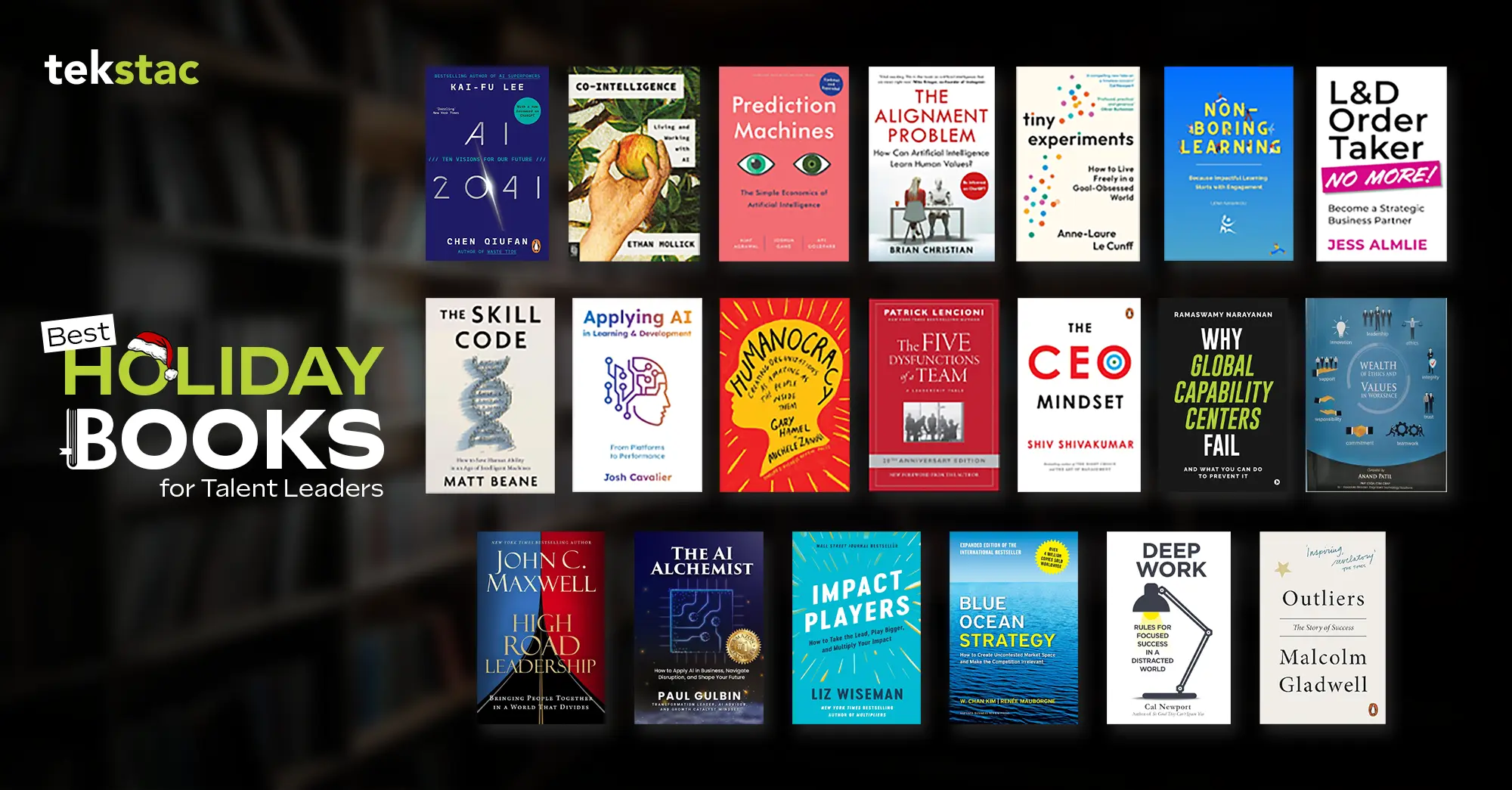
1. AI 2041 – Kai-Fu Lee & Chen Qiufan
One of the best year-end reading recommendations include this book which combines science fiction and analysis to show how AI reshapes jobs, business, and society by 2041.
2. Co-Intelligence – Ethan Mollick
Practical playbook for collaborating with AI ethically and effectively in workplace teams.
3. Prediction Machines – Ajay Agrawal, Joshua Gans & Avi Goldfarb
Shows how AI simplifies prediction tasks and offers frameworks for applying AI strategically in business decisions.
4. The Alignment Problem – Brian Christian
Explains the importance of aligning AI systems with human values and organizational goals.
Understanding AI is no longer optional. These books equip leaders to anticipate disruption, integrate AI ethically, and prepare their teams for a future where human and machine collaboration drives results.
“India ranks 2nd globally in average reading hours, with readers spending nearly 352 hours a year reading—making intentional holiday reading a powerful reset for leaders.”
5. Tiny Experiments – Anne-Laure Le Cunff
Guides L&D leaders to test new learning approaches with low-risk experiments. Encourages micro-iterations that produce real insights.
6. Non-Boring Facilitation – Lena Nasiakou
A hands-on guide for engaging interactive facilitation. Covers gamified methods and somatic approaches to make learning sessions more effective.
7. L&D Order Taker No More – Jess Almlie
Encourages L&D professionals to move from request-based training to strategic impact. Focuses on aligning learning with organizational goals. One of the popular HR strategy books.
8. The Skill Code – Matt Beane
Explains how to preserve craft skills and mentor talent in the world of automation. Offers frameworks for skill development and human-centered learning.
9. Applying AI in Learning & Development – Josh Cavalier
Covers practical applications of AI in learning and performance. Shows how to leverage adaptive learning platforms and measure ROI.
For HR and L&D leaders, these holiday books provide actionable tools to build learning cultures, upskill employees, and ensure organizational agility in the AI-driven era.
10. Humanocracy – Gary Hamel & Michele Zanini
Shows how bureaucracy slows organizations and crushes initiatives. Learn how autonomy, trust, and distributed decision-making outperform top-down control. A must-read holiday book for leaders.
11. Five Dysfunctions of a Team – Patrick Lencioni
Offers a practical framework for building cohesive teams. Explains how trust, accountability, and alignment can overcome collaboration gaps.
12. The CEO Mindset – Shiv Shivkumar
The author shares lessons from his career and 13 other leaders, emphasizing prioritization, reflection, time management, relationships, and trust. This book guides readers to cultivate leadership values and habits for a meaningful career.
13. Why Global Capability Centers Fail: And What You Can Do to Prevent It – Ramaswamy Narayanan
Examines why many GCCs underdeliver and provides practical frameworks, case studies, and scorecards. A must-read for leaders managing global teams to transform transactional centers into strategic, value-creating platforms.
14. Wealth of Ethics and Value in Workspace – Anand Patil
Focuses on ethics, values, and leadership in the workplace. Demonstrates how responsible, value-driven leadership can enhance both culture and performance.
15. High Road Leadership – John Maxwell
This book provides practical frameworks to help leaders elevate team trust, navigate conflict with maturity, and create cultures where people choose collaboration over competition.
These are one of the best books to read during holidays that help leaders rethink culture, strategy, and influence. They provide frameworks to inspire teams, make smarter decisions, and create organizations that thrive.
16. The AI Alchemist: How to Apply AI in Business, Navigate Disruption, and Shape Your Future – Paul Gulbin
Explores AI-driven role transformations and skill requirements. Provides strategies for reskilling and staying relevant in evolving workplaces.
17. Impact Players – Liz Wiseman
Focuses on identifying high-impact contributors in organizations. Guides leaders on building teams with the skills that drive business results.
Job roles and skill demands are changing rapidly. These holiday books help leaders design future-ready roles, identify talent gaps, and reskill teams for maximum impact.
18. Blue Ocean Strategy – W. Chan Kim & Renée Mauborgne
A groundbreaking framework that shows leaders how to move beyond crowded markets and create uncontested spaces for growth. The book blends research and real-world case studies to reveal how value innovation, strategic clarity, and bold thinking can unlock new opportunities.
19. Deep Work – Cal Newport
A modern classic that argues our ability to focus without distraction is becoming a rare and extremely valuable skill. Newport shares practical methods to build deep concentration, reduce digital noise, and do more meaningful work in less time. A highly relevant holiday books for leaders shaping productivity norms in an always-on workplace.
20. Outliers – Malcolm Gladwell
Gladwell explores what truly sets high achievers apart, revealing how success is shaped not only by talent, but also by opportunity, timing, environment, cultural influences, and deliberate practice. A timeless classic indeed!
Classics never go out of style. They provide timeless principles on team dynamics, strategic thinking, and human behavior, essential for making informed and impactful decisions.
AI Snake Oil: What Artificial Intelligence Can Do, What It Can’t, and How to Tell the Difference – Arvind Narayanan & Sayash Kapoor
A sharp, evidence-based guide that cuts through inflated AI promises. It arms leaders with practical frameworks to make informed, ethical, and high-impact decisions in AI-driven workplaces, without falling for buzzwords.
These holiday books bring together actionable insights on leadership, HR strategy, talent development, and AI-driven transformation. Some are well-known classics in business and leadership, books that many leaders revisit year after year for good reason.
Others are underrated gems, titles you may not find on every mainstream list, yet they offer perspectives that can shift how we lead, learn, and design work for the future.
Even if just one book sparks a new idea, challenges an old assumption, or helps you make a better decision, this holiday reading list will have done its job.
Because sometimes, one powerful insight is all it takes to change the game.
And the next step is turning those insights into action.
If you’re looking to build stronger skills, develop future-ready talent, and prepare your workforce for what’s next, explore how Tekstac can help your organization turn learning into measurable workforce capability.
1. What are the best HR books to read in 2026?
The best HR books to read in 2026 cover topics such as leadership, talent development, AI, workplace transformation, employee experience, and the future of work. This list brings together 20 books across leadership, AI and future of work, HR and L&D, and classic business titles.
2. Which books should HR leaders read about AI and the future of work?
Books about AI and the future of work can help HR leaders understand how artificial intelligence may influence jobs, skills, workforce strategy, and human-AI collaboration. The AI & Future of Work section of this list includes titles focused on these themes.
3. Are there any classic business books HR leaders should read?
Yes. Classic business and leadership books remain relevant because many address enduring topics such as leadership, organizational culture, decision-making, strategy, and people management. The Classics section of this list includes established titles that continue to offer useful perspectives for today’s HR leaders.
Cognitive overload happens when the volume of information in workplace training exceeds what an employee’s working memory can process — leading to burnout, drop-offs, and poor retention. It’s a structural problem, not a willpower problem: the brain has a fixed processing bandwidth, and most corporate training ignores that limit.
Despite all the learning platforms, content libraries, and online courses available, many organizations struggle with cognitive overload. It actively harms motivation, engagement and retention.
Most platforms keep adding more and more videos, content, and courses, forgetting that the human brain does not thrive on abundance, but instead on clarity.
And this is where Tekstac, an AI-powered skilling platform built for enterprise technical teams, does things differently. But before that, let’s explore what cognitive overload means.
Cognitive overload happens when the brain is overwhelmed with more information than it can reasonably process. Rather than laziness or a lack of willpower, it’s more about bandwidth, which can be stretched thin.
For example, imagine a learner who’s working with legacy systems, upskilling in cloud tech, preparing for certifications, and still trying to deliver on business goals. If we add to this a cluttered LMS interface with hundreds of unstructured modules on top, it becomes cognitive overload.
This results in burnout, drop-offs, minimal knowledge retention, and frustrated teams. This is the real cost of cognitive overload, and it’s the cost most traditional LMS platforms ignore.
This concept traces back to Cognitive Load Theory, developed by educational psychologist John Sweller in 1988. Sweller identified three types of mental demand competing for working memory: intrinsic load (the inherent difficulty of the material itself), extraneous load (poor formatting, clutter, or delivery that adds no learning value), and germane load (the effort that actually builds lasting understanding). Traditional LMS platforms tend to increase extraneous load — cluttered dashboards, unstructured content dumps — without ever reducing intrinsic load. That combination is why cognitive overload persists even as course libraries keep growing.
Learning Management Systems came into prominence as a way to organize and distribute training content. However, most of these systems were built decades ago for compliance training, not rapid tech skill development.
Below are the reasons why traditional LMS platforms fall short when it comes to employee training and development, causing cognitive overload:
Many LMSs typically offer learners a massive library of courses, videos, documents, and quizzes. The problem here is that there’s little guidance on what to choose or why. This is similar to walking into a gigantic bookstore without any recommendations, maps, or curated sections. Similarly, employees feel lost, overwhelmed, and eventually walk away. This is because they see hundreds of modules, many irrelevant to their job or skill level, and realize that there’s no actual career path forward.
In any organization, no two tech roles are the same. A data scientist has very different learning needs than a systems administrator. Yet, LMS platforms treat everyone like they are learning the same thing, thereby wasting valuable time and also adding to the mental burden of sorting through what is useful and what is not.
As mentioned, most LMS content consists of videos, slide decks, and PDFs. Passive learning demands a lot of mental effort without much interaction, which is tough to maintain, especially when working on day-to-day responsibilities. Without proper opportunities to practice the skills learned, learners will not be able to retain the knowledge or apply it confidently.
Some platforms either lack meaningful assessments or rely on generic, manually graded quizzes that do not provide timely that do not always provide actionable feedback. When learners fail to understand where they stand or what to focus on next. This cognitive overload drains motivation and makes the learning experience confusing.
When challenges arise, especially in complex tech learning, learners may be left to figure out on their own. This is because traditional learning platforms leave learners with little to no access to mentors, coaches, or communities. This can amplify cognitive overload and the risk of burnout as well.
Most importantly, many LMS platforms disconnect learning from real business goals or project demands. Learners may complete courses merely because they were assigned, feeling it as an obligation rather than a pathway to growth.
Ultimately, all the above factors combine to create an environment that causes cognitive overload.
While most platforms aim to treat the symptoms of cognitive overload via shorter videos, better UI, and nudges to take breaks, Tekstac tackles the root causes by rethinking how content is delivered, practiced, assessed, and supported.
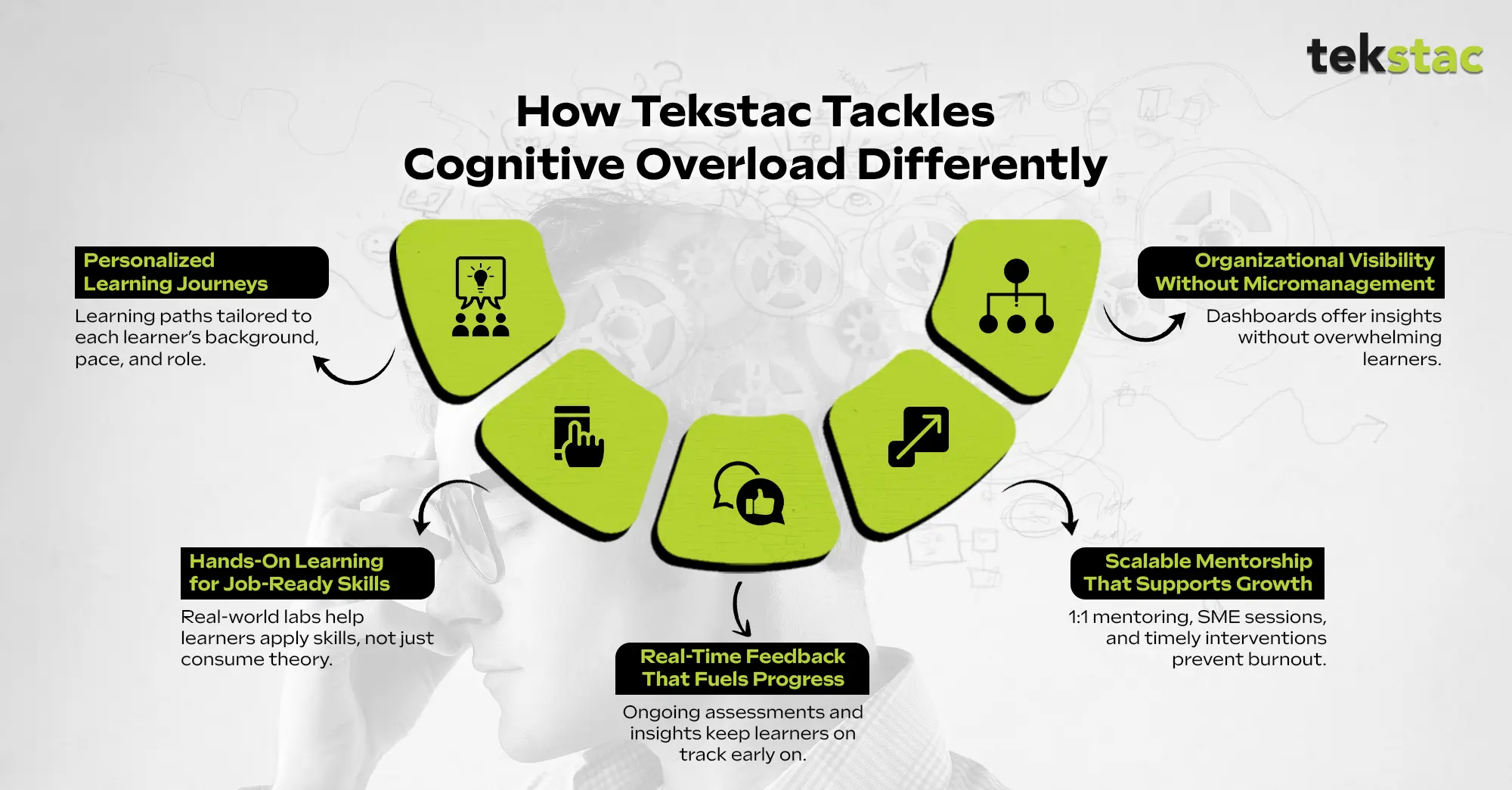
Cognitive overload arises when every learner is forced down the same path, regardless of background, goals, or pace. Tekstac helps flip that through:
Custom learning paths: Be it a college student being prepared for onboarding or a full-stack developer upskilling for an upcoming project, with Tekstac, organizations can personalize learning tracks with only the relevant content.
AI-powered recommendations: Tekstac adapts the learner journey depending on performance and feedback, thereby suggesting remedial content, skipping what the employee already knows, and encouraging where support is needed.
Pre-onboarding to project readiness: Learning is not dumped on users in one go, but rather it’s sequenced smartly from foundational to advanced with ample opportunities to show application along the way.
Result: Learners will no longer drown in irrelevant content. Each user is shown what they need, when they need it.
Reading documentation or watching lectures can only go so far. The real overload kicks in when learners cannot seem to connect theory to application.
Immersive hands-on labs: Tekstac’s lab environment mirrors real-world systems, right from databases to cloud infrastructure. Hence, learners learn by doing.
Lab-as-a-service: No external setup is needed. Learners need to just log in, practice, and build muscle memory.
Project-specific training: Organizations can deploy labs aligned to their tech stack, thereby making sure it is relevant and application-ready from day one.
Result: This way, learning is anchored in action. This improves retention and reduces cognitive overload or fatigue caused by passive intake.
We might observe that some learning platforms assess only at the end, leading to binge-learning followed by failures. Here’s how Tekstac helps overcome this:
Auto-evaluated assessments along the way: Each module ends with quizzes or code checks that immediately allow learners to understand where they fell short.
Video and scenario-based assessments: Real-world judgment is tested instead of just memory recall.
Plagiarism checks and reliability index: Removes blind spots in assessment credibility. This enables more honest learning loops.
Result: Learners stay calibrated throughout instead of discovering gaps too late in the learning journey.
One of the biggest causes of cognitive overload is the feeling of being stuck and not supported. Tekstac handles this with scalable human touchpoints.
Mentor marketplace and 1:1 connects: Learners can engage with experts directly to resolve any blockers.
SME sessions and hackathons: Keeps motivation high and concepts applied.
Automated/manual learning interventions: Based on learner data, facilitators can step in when progress slows down and before employee frustration sets in.
Result: This way, learners never feel isolated. The system anticipates where support is required before burnout occurs.
Leaders drown learners in content, hoping something will stick. Tekstac enables smarter program management.
Skill inventory visibility: Know who is learning what, and how they’re progressing, at any time time — down to individual skill insights.
Custom dashboards and predictive analytics: Spot high performers, identify gaps, and align training to project demand.
Audit trails and accountability: All activity is logged, but not surveilled. This helps build trust without compromising on standards.
Result: Learning is made more accountable.
Theory can only go so far. To really understand how cognitive-friendly learning transforms skill development, let’s walk through real-world use cases where Tekstac shapes how talent upskills.
Let’s say an IT consulting & services company need to onboard and skill 200 freshers on Python, cloud computing, and containerization in just 6 weeks. Traditional LMS-based training with heavy video lectures, PDFs, and scattered lab access had failed. Learner dropouts were high. Completion didn’t translate to readiness.
How Tekstac helped:
Cognitive outcome: Learners were focused, confident, and retained more because they were never overloaded to begin with.
A tech product company wanted to reskill 50 backend developers on a new microservices architecture while they continued working full-time. Long training hours or forced weekend bootcamps had led to resistance before.
Tekstac helped in the following ways:
Cognitive outcome: This led to zero dropouts, and developers applied what they learned directly to upcoming product modules.
Cognitive overload, when unaddressed, can be the blocker behind most failing learning programs. It can show up in low completion rates, poor retention, and that frustrating gap between training and real-world application. Most companies may not even realize that it’s happening.
Here, the solution is a better design rather than more content. Learning must be structured around how the human brain works, meaning that it must be layered, contextual, and purposeful. Tekstac addresses these challenges by curating learning paths, delivering hands-on practice and feedback, and so on, thereby ensuring that learners walk away with job-ready skills.
Organizations that are looking to create a workforce that learns faster, retains more, and applies with impact it’s effective to start by fixing the learning experience itself.
See how this works for your team: request a Tekstac demo.
1. What causes cognitive overload in workplace training?
Cognitive overload occurs when employees receive more information than their working memory can be processed effectively. Common causes include lengthy training modules, irrelevant content, poor learning pathways, constant context switching, and passive learning formats. Traditional LMS platforms often contribute by presenting unstructured content without personalization, making it difficult for learners to retain knowledge and apply skills in real-world situations.
2. What are the common signs of digital information overload?
Digital information overload often appears as reduced concentration, slower decision-making, lower course completion rates, poor knowledge retention, frequent distractions, and learner fatigue. Employees may revisit the same content repeatedly, struggle to prioritize learning tasks, or disengage from training altogether. Identifying these signs early allows organizations to redesign learning experiences that improve focus and long-term retention.
3. How can organizations reduce cognitive overload in LMS training?
Organizations can reduce cognitive overload by delivering personalized learning paths, breaking complex topics into smaller modules, incorporating hands-on practice, providing timely assessments, and using AI-driven recommendations. A modern learning platform should present relevant content based on learner roles and skill levels instead of overwhelming users with large, unstructured content libraries.
4. Are there recommended applications for managing digital distractions?
Yes. Digital distraction management tools such as focus timers, website blockers, task management applications, and notification controls can help learners stay engaged. However, organizations should also address the root cause by adopting learning platforms that minimize unnecessary content, personalize learning journeys, and deliver structured training experiences that reduce cognitive overload rather than simply managing distractions.
5. How does cognitive overload affect employee productivity?
Cognitive overload reduces employee productivity by overwhelming working memory with excessive information, making it harder to focus, learn, and make decisions. As a result, employees may take longer to complete tasks, retain less knowledge, make more errors, and experience mental fatigue. Delivering personalized, well-structured learning in smaller modules helps improve engagement, knowledge retention, and overall workplace performance.
Generative AI is no longer a futuristic concept—it’s part of everyday life. A 2025 Deloitte survey revealed that 50% of professionals use generative AI for personal tasks, while 25% already apply it at work.
If employees are this quick to adopt AI in daily life, why should corporate learning lag behind?
AI-powered personalized training meets employees where they are, making learning more intuitive, engaging, and effective. In fact, EY projects AI could boost productivity in India’s IT sector by 45%, underscoring the scale of impact.
Traditional training models—static, one-size-fits-all, and disconnected from real-time skill needs—are no longer enough. Instead, AI in personalized learning enables adaptive pathways, role-specific upskilling, and continuous performance optimization. Organizations that embrace it can develop talent at scale, improve retention, and future-proof their workforce in an AI-driven era.
Historically, corporate learning programs have relied on standardized content delivery, which often fails to engage employees or address specific skill gaps. This generic approach can lead to disengagement and suboptimal performance.
In contrast, AI in personalized learning acknowledges that each employee has unique learning preferences, paces, and professional goals.
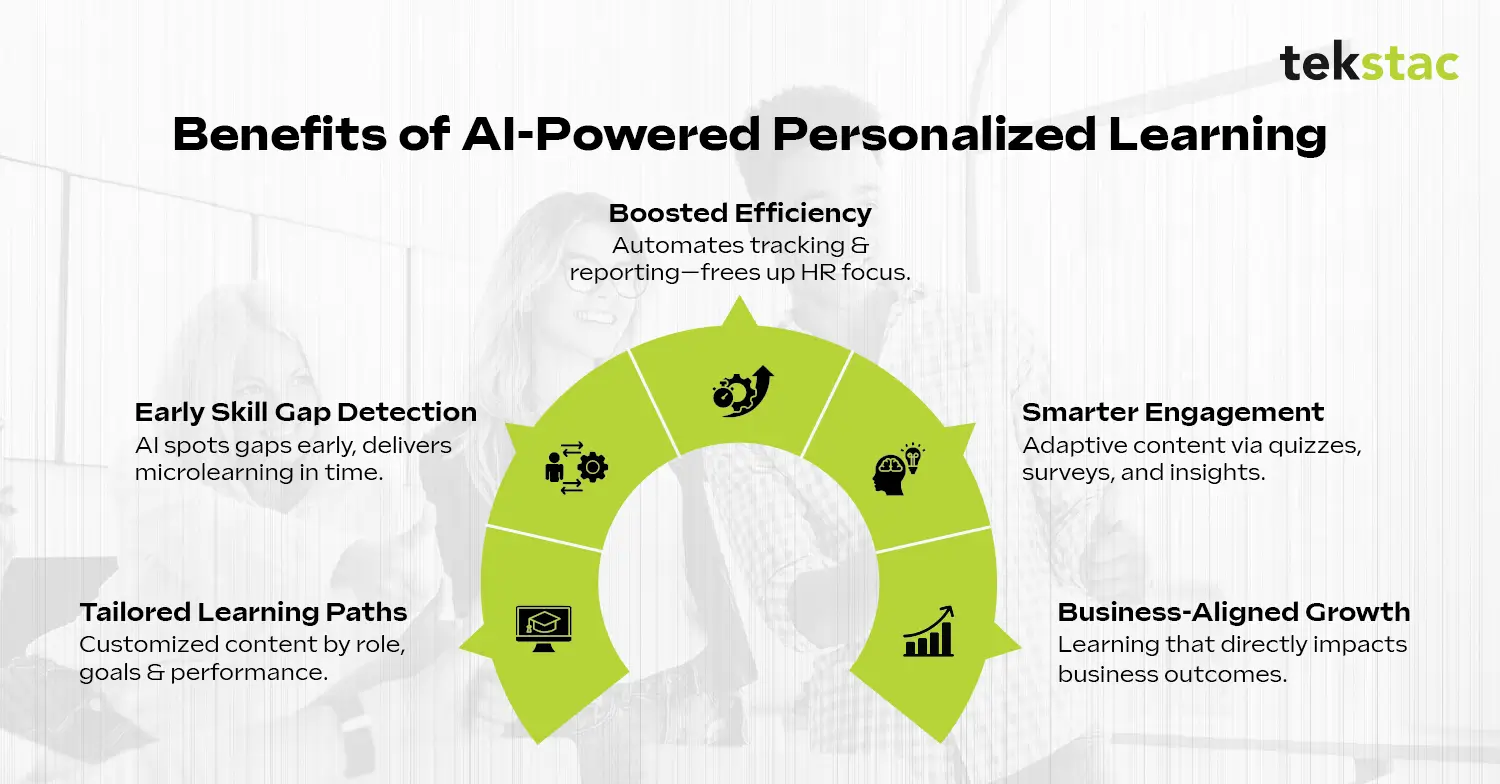
Traditional learning systems rely on fixed content modules, which often fail to resonate with individual learning preferences and skill gaps. However, AI-powered adaptive learning pathways transform training into a continuously evolving, employee-specific experience.
The successful integration of AI into corporate training involves several strategic steps:
Generative AI extends beyond just real-time conversations—it automates, personalizes, and refines corporate training programs at scale.
AI-powered multimodal learning is changing the way training happens by making content more engaging and tailored to different learning styles. Instead of just reading a manual, learners can watch AI-generated explainer videos, interact with role-playing simulations, or even train in virtual reality (VR) environments.
This is especially useful in industries like manufacturing, where AI-driven simulations let technicians practice maintenance in a risk-free virtual space—improving retention and reducing real-world mistakes. It’s all about making learning smarter, more interactive, and personalized for each individual.
AI is making workforce upskilling easier by helping employees grow without interrupting their daily work. Instead of traditional training, AI personalizes career development by mapping learning paths to future job roles, so employees are always prepared for what’s next.
It also recommends microlearning modules, allowing employees to learn in small, manageable chunks during their workday.
AI helps HR teams predict internal talent mobility trends, ensuring high-potential employees stay engaged and move into roles that match their skills and career goals. It’s all about smarter upskilling that benefits both employees and businesses.
While technical skills are critical, AI in personalized learning is addressing the often-overlooked area of leadership and interpersonal skills in corporate training.
Generative AI is bridging this gap by enabling real-time AI coaching in areas like:
AI is breaking language barriers in global workforce training by making learning accessible to everyone, no matter what language they speak. With AI-powered real-time translation, companies can deliver the same training across different regions without losing clarity or meaning.
AI converts live training sessions into multilingual transcripts, generates real-time subtitles for videos, and even localizes training materials by adapting them culturally and linguistically.
This ensures every employee gets the same high-quality learning experience, boosting inclusivity and knowledge retention across multinational teams.
AI is transforming crisis training for corporate leaders by creating realistic, high-pressure simulations where they can practice decision-making without real-world risks. It doesn’t just test their responses—it also provides AI-driven feedback, analyzing both their emotional and logical approach to problem-solving.
AI can generate alternative scenarios, helping leaders stay prepared for unexpected challenges. For example, George Mason University uses AI-driven simulations like “Go-Rescue” to train professionals in crisis response, allowing them to practice decision-making in dynamic, real-world scenarios.
This kind of smart, adaptive training ensures that executives build confidence and resilience in handling crises before they happen in real life.
Several organizations have successfully implemented AI-powered personalized learning:
As AI technology continues to evolve, its role in corporate training is expected to expand. Future developments may include more sophisticated predictive analytics, greater integration with other HR systems, and the use of virtual reality to create immersive learning experiences. Organizations that embrace these advancements will be better positioned to develop a skilled, adaptable, and engaged workforce.
While the benefits are substantial, organizations must navigate challenges such as data privacy concerns, the need for significant initial investment, and potential resistance to change among employees. Ensuring ethical use of AI and maintaining transparency in how data is utilized are paramount.
What if your team could learn smarter, faster, and in a way that truly fits their roles? Experience AI-driven personalized learning with a free demo today!
1. How does AI in personalized learning improve corporate training?
AI tailors training to each employee’s role, skills, and pace—making learning more engaging, relevant, and effective than one-size-fits-all methods.
2. What are examples of AI-powered personalized learning?
Examples include adaptive learning pathways, AI-driven coaching, microlearning modules, real-time feedback systems, and AI simulations for leadership, crisis, and technical training.
3. Why is AI in learning important for workforce development?
AI enables scalable, role-specific upskilling and continuous performance optimization—helping companies future-proof talent and retain employees in fast-changing industries.
4. Can AI replace traditional corporate training programs?
Not entirely. Instead, AI complements training by personalizing content, automating progress tracking, and enabling real-time coaching—making programs more effective and efficient.
What happens when cost centers start becoming innovation hubs? When your “support team” begins leading global digital strategy? That’s the story of Global Capability Centers (GCCs) today.
Global Capability Centers (GCCs) — offshore or nearshore units set up by multinational corporations to consolidate functions like IT, finance, analytics, and increasingly, digital innovation — are no longer back-end operations units.
“You can’t power the future with a leadership model built for the past“.
This is where the Chief Human Resources Officer (CHRO) must step in, not just as an HR function head but as a transformation architect. One who doesn’t merely manage talent but champions transforming leadership re-engineering mindsets to drive performance, agility, and innovation.
The scale and sophistication of GCCs are growing rapidly. India, for instance, now houses over 1,580 GCCs employing more than 1.66 million professionals (NASSCOM, 2024). McKinsey observes the “10/30/50 approach”: 10% of enterprise leaders, 30% of global talent, and 50% of new-age skills now sit in GCCs- signaling their shift from support arms to innovation powerhouses.
This evolution demands a mastery of leadership skills—shifting focus from managing processes to managing outcomes, from task execution to strategic thinking, and from local efficiencies to global collaboration.
Leadership- more than technology- is the defining factor in this transformation.
Mindset is central to leadership transformation because tools and processes cannot change how leaders make decisions, tolerate risk, or drive innovation. In GCCs, where operational habits run deep, mindset is the upstream blocker that every downstream capability program depends on.
GCC leadership often lags in this area. Built in traditional operational models, leaders tend to exhibit behaviors that are risk-averse, delivery-focused, and hierarchical. This doesn’t fit today’s environment that thrives on innovation, agility, and digital thinking.
A 2024 Deloitte Human Capital Trends report reveals that only 21% of GCC leaders feel prepared to lead in a digital-first, innovation-driven world
CHROs must be deliberate in shifting these deep-seated beliefs and behaviors, and that starts with reimagining how leadership is defined, developed, and deployed in the GCC context.
CHROs drive leadership transformation in GCCs through five core strategies: redesigning development programs to mirror business goals, enabling strategic thinking over execution, using people analytics to personalize growth, building inclusive leadership archetypes, and redefining success metrics for the innovation era.
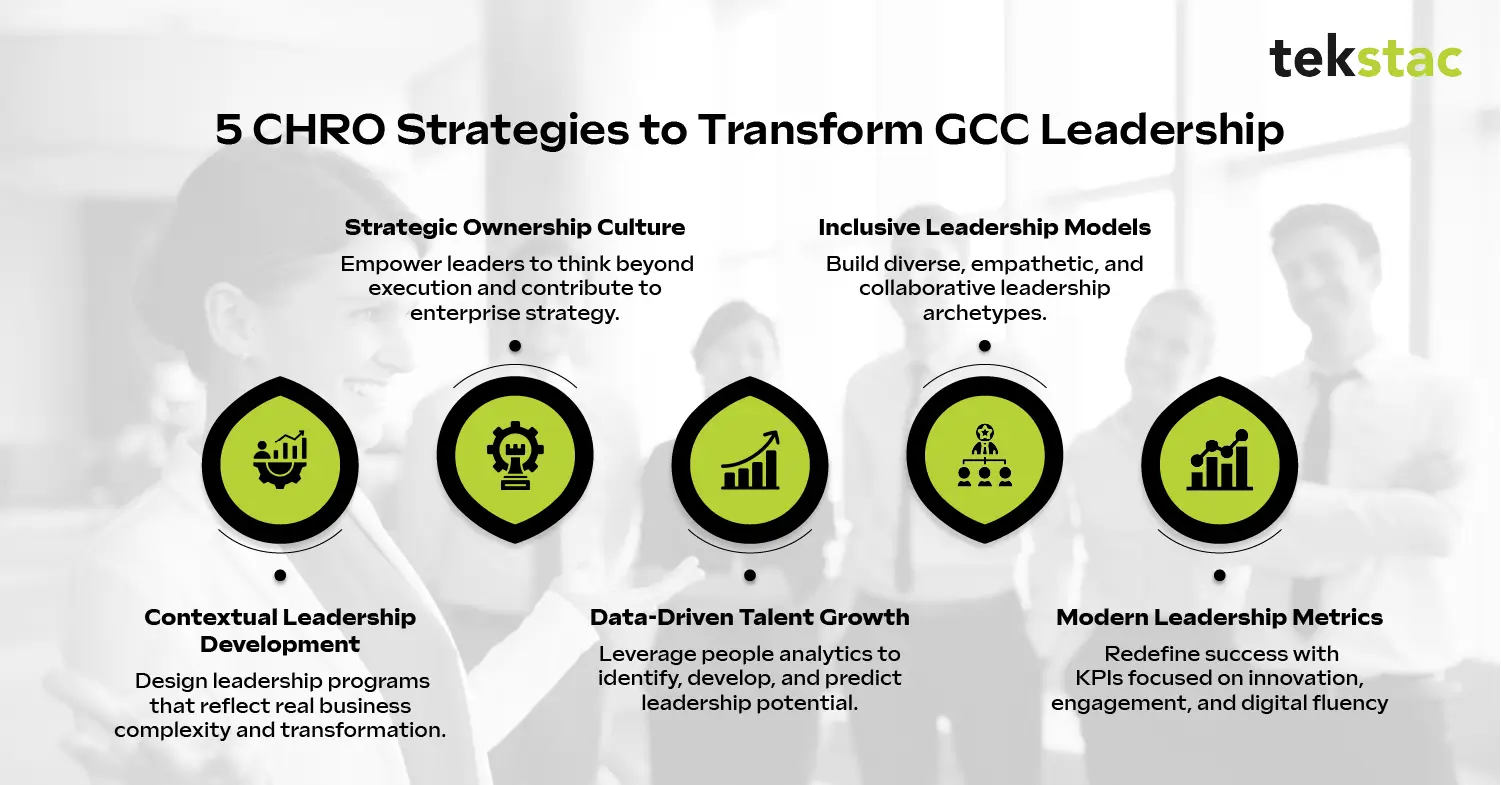
The problem: Most leadership development programs within GCCs are standardized, generic, and often imported from global HQs without contextual relevance. These programs fail to address the unique blend of operational, cultural, and innovation demands that GCC leaders face.
CHRO solution: Redesign leadership development to mirror real-time enterprise goals. Leaders must experience challenges that are ambiguous, complex, and cross-functional, just like the world they operate in.
End goal: Leaders don’t just learn- they transform how they think, lead, and solve.
The problem: Many GCC leaders still operate in a “tell me what to do” culture. They focus on executing HQ directives instead of questioning, innovating, or suggesting strategic improvements. This restricts the GCC’s potential to lead value creation.
CHRO solution: Empower leaders to own strategy, not just execution. This involves fostering a mindset shift from servitude to stewardship.
End goal: Leaders begin to act like entrepreneurs inside the enterprise—thinking bigger, faster, and beyond boundaries.
The problem: Leadership identification and growth are often subjective. Promotions are based on tenure, visibility, or “who you know,” rather than data-backed potential. This blocks real talent from emerging.
CHRO solution: Use people analytics for leadership transformation; measurable, personalized, and predictive.
Example: A GCC in the healthcare tech sector used behavioral analytics to identify that 65% of its mid-level leaders struggled with ambiguity. They rolled out a “Leading in Uncertainty” track, resulting in better decision-making speed during project pivots.
End goal: Talent decisions are no longer based on intuition- they’re based on intelligent, predictive, and personalized data.
The problem: Many existing leadership models are still built on outdated ideals- assertiveness, dominance, and output over empathy, inclusion, and long-term impact. This makes leadership homogeneous and limits innovation.
CHRO solution: Build inclusive leadership archetypes rooted in modern behaviors- collaboration, adaptability, authenticity, and empathy. These models must reflect the diverse, global, and hybrid nature of today’s GCCs.
Some advanced GCCs are now using AI-based sentiment analysis tools to assess inclusion in everyday communication- emails, meetings, and feedback sessions.
End goal: Leaders become magnets for diverse talent and create spaces where all voices are heard, valued, and leveraged.
The problem: Too often, leadership success is measured by outdated metrics: output volume, team size, budget managed, or on-time delivery. These miss the essence of transformational leadership.
CHRO solution: Redefine leadership KPIs to align with enterprise innovation, human impact, and future readiness.
A US-based retail GCC shifted from individual performance ratings to team-based leadership effectiveness ratings, directly linked to team innovation output and engagement.
End goal: Leadership success becomes about what value you create, not what title you hold.
The CHRO is no longer responsible just for culture fit- they are responsible for culture shift.
This includes:
When CHROs lead mindset transformation at the top, the ripple effect is enterprise-wide.
A leading European banking GCC based in Bangalore recently transformed its leadership layer through a CHRO-led initiative called “Leadershift.” The program combined reverse mentoring, agile team rotations, leadership “lab” projects, and analytics-backed coaching.
Results in 12 months:
This proves that leadership transformation is not theoretical, it delivers measurable ROI.
By 2027, over 60% of GCCs will own end-to-end digital product portfolios (Bain & Company), requiring leaders fluent in cross-cultural collaboration, digital strategy, and ambiguity navigation. Building that leadership resilience now is the CHRO’s most urgent mandate.
This means that future-ready GCC leadership will be:
The CHRO’s influence is central to shaping this profile.
We often talk about digital transformation, but without leadership transformation, it’s just automation. GCCs need leaders who can unlock exponential value, not just optimize processes.
CHROs who act now challenging outdated norms, rewiring culture, and building innovation-ready mindsets — will determine which GCCs lead and which ones follow.
Tekstac helps CHROs and L&D teams build the skills intelligence infrastructure that powers leadership transformation — from predictive analytics to personalized development journeys. [Explore Tekstac for GCC Teams →]
1. Why do GCCs need leadership transformation?
GCCs have evolved from cost centers into innovation hubs — yet many leadership models have not kept pace. Without transformation, leaders remain order-takers rather than value creators, limiting the GCC’s ability to own digital strategy, drive agility, and compete globally.
2. What role does the CHRO play in GCC leadership transformation?
The CHRO acts as a transformation architect — redesigning leadership development programs, deploying people analytics, building inclusive archetypes, and redefining success metrics. They shift from managing HR to driving enterprise-wide culture and capability change.
3. How can people analytics support leadership transformation?
People analytics enable CHROs to make leadership decisions based on data rather than intuition. Through 360-degree feedback aggregation, predictive potential dashboards, and attrition risk tracking, organizations can identify who is ready to lead, who needs coaching, and where toxic leadership patterns exist.
4. How long does leadership transformation take in a GCC?
Results vary, but structured programs typically show measurable impact within 12 months. A European banking GCC reported a 37% increase in employee trust in leadership and 21% faster digital product cycle times after one year of a CHRO-led transformation initiative.
5. What metrics measure leadership transformation success?
Modern GCCs measure leadership transformation through innovation velocity, psychological safety scores, cross-team collaboration indices, engagement uplift post-leadership transition, and Digital Quotient (DQ) scores — not just output volume or team size.
A three-hour lecture and a 73% pacing preference for self-directed e-learning don’t coexist for long. Today’s learners aren’t rejecting structure — they’re rejecting formats that ignore how they actually absorb information.
They need systems that respect their time and actually deliver results.
Blended learning benefits offer exactly that: an innovative fusion of digital flexibility and human interaction that matches how modern minds actually work.
Blended learning is not just throwing Zoom calls at traditional classrooms and calling it innovation. Real blended learning combines digital efficiency with human insight to create learning experiences that actually stick.
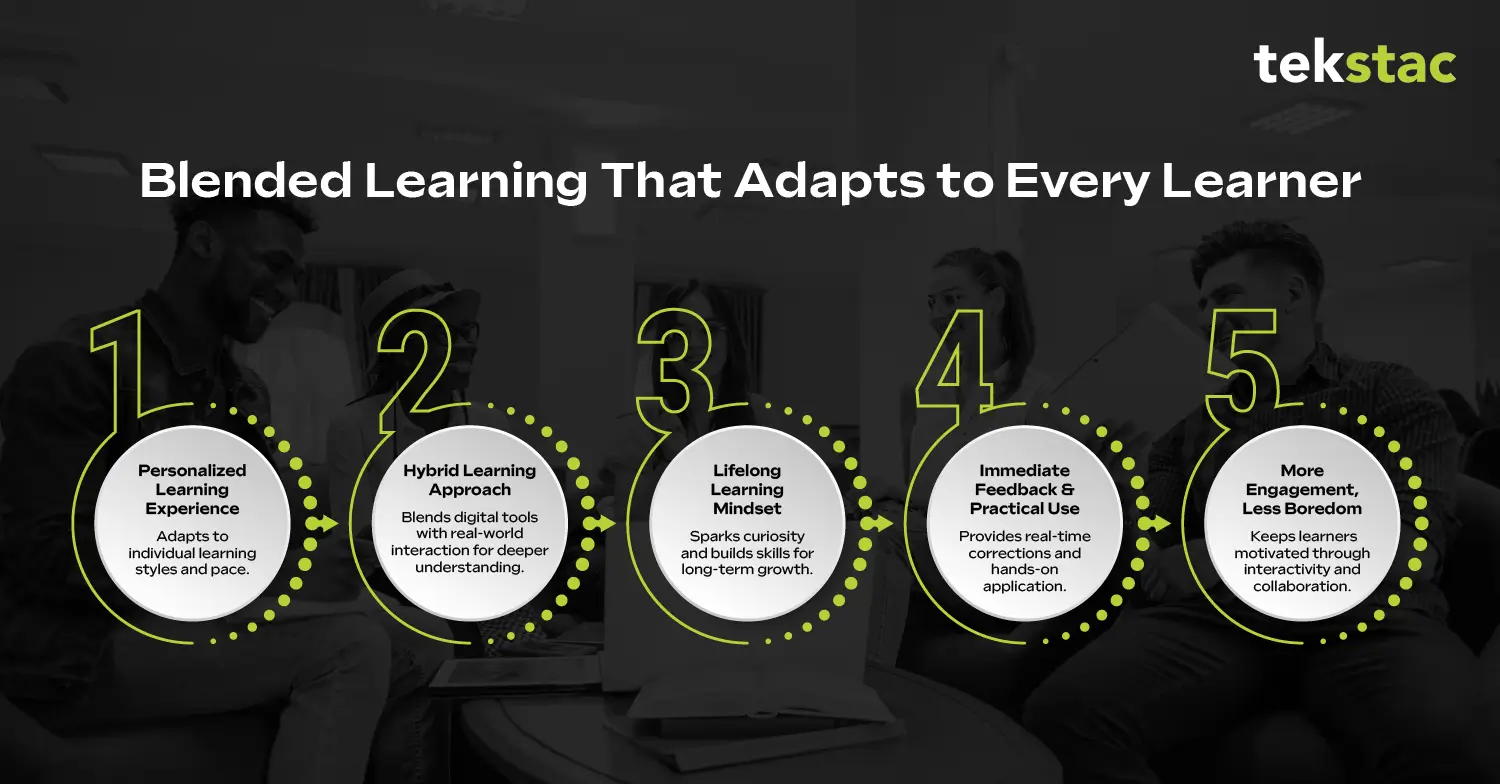
This hybrid learning approach recognizes a simple truth: not everything needs to happen in a classroom, and not everything should happen behind a screen.
Gen Z learners don’t start with theory when solving problems. They search for the problem on Google, watch a 3-minute tutorial, try something immediately, and iterate rapidly based on results.
Traditional education punishes this natural learning behavior by forcing linear progression and treating exploration as cheating. Blended learning benefits embrace digital-native approaches through:
Blended learning to pair online instruction with face-to-face mentorship is the model most aligned with how Gen Alpha learns: search-first, hands-on, and iterative. Like Gen Z before them, Gen Alpha defaults to digital tools for first exposure and relies on in-person sessions for feedback and complex problem-solving.
Your personalized learning experience isn’t about choosing between light and dark mode—it’s about systems that adapt to how you actually learn and perform.
Innovative blended platforms track time spent on individual challenges, common error patterns across multiple attempts, preferred learning formats, and peak performance hours when focus is strongest.
This data actively shapes your next learning session:
The system becomes your learning assistant, not your taskmaster demanding compliance with rigid schedules.
The magic happens when online and offline elements work together strategically rather than operating as separate, disconnected experiences.
Lifelong learning mindset isn’t just a corporate buzzword—it’s economic survival. Skills become obsolete faster than ever, and successful learners adapt quickly to changing requirements.
Blended learning benefits support continuous growth by removing time constraints that prevent working professionals from upskilling effectively, while providing just-in-time learning when specific skills are needed for immediate projects.
Your brain doesn’t learn in straight lines. Research from the Journal of Educational Psychology shows that varied learning contexts improve retention by up to 40% compared to single-format instruction.
Blended learning benefits align with natural information processing through spaced repetition, where online modules reinforce concepts over time while offline sessions provide different contexts for the same skills, creating emotional connections to abstract ideas.
Active recall replaces passive consumption:
Forget completion rates and quiz scores. Blended learning benefits show up in metrics that actually impact careers and personal growth.
Portfolio development with tangible projects demonstrates competency more effectively than certificates, while skill application in current roles within 30 days proves learning transfer to practical situations.
The era of sitting through boring lectures and hoping for the best is over. Blended learning benefits offer a clear path to skills that actually matter, delivered in ways that respect your time and intelligence.
Your competition isn’t just learning the same skills you are. They’re learning how to understand better, faster, and more effectively than traditional methods allow.
Stop wondering if there’s a better way to learn. Start experiencing the transformation that happens when technology and human insight work together seamlessly.
See how a blended learning model can be built around your team’s skill gaps — request a demo and we’ll map it out together.
1. Which learning model, combining online instruction with face-to-face classes, is preferred by most Gen Alpha students?
Blended (hybrid) learning is the closest fit to how Gen Alpha approaches learning — self-directed digital exploration paired with in-person mentorship for harder problems. This mirrors the search-first, iterate-fast pattern already seen in Gen Z, just starting earlier.
2. What is blended learning, and why does it work better than a fully traditional classroom for Gen Z and Millennials?
Blended learning combines self-paced digital instruction with scheduled face-to-face sessions, so routine content is handled online and human time is reserved for problem-solving, feedback, and mentorship — the parts a screen can’t replace as effectively.
3. How does e-learning specifically benefit Millennial learners?
Millennial learners benefit from e-learning’s flexibility to fit study around full-time work and family commitments, plus the ability to revisit difficult material without the social friction of asking to repeat a lesson in a group setting.
4. What are the most important blended learning benefits for career growth?
The clearest career benefits are personalization (learning adapts to skill gaps rather than a fixed curriculum), faster time-to-competency through applied practice, and direct mentorship access during the in-person component — all of which translate more directly into workplace performance than a completion certificate.
Companies are investing more than ever in employee training programs. Yet, for many HR and L&D teams, answering a basic question remains frustrating: ‘Is it working?
Despite billions of dollars invested in upskilling and workforce training each year, 61% of training leaders still do not measure the ROI of employee training programs, per a LearnUpon survey of training leaders. Even when training outcomes are evaluated, Even when training outcomes are evaluated, they’re often reduced to surface-level metrics, such as completion rates, smiley-face surveys, or test scores. While these are useful, they are neither sufficient nor adequate.
Many organizations cite lack of clear goals, insufficient resources, and uncertainty about where to start as the top challenges in measuring training ROI.
Let’s take a realistic approach and a practical step-by-step process that covers actual training costs, integration with business goals, and how to use the data you already have.
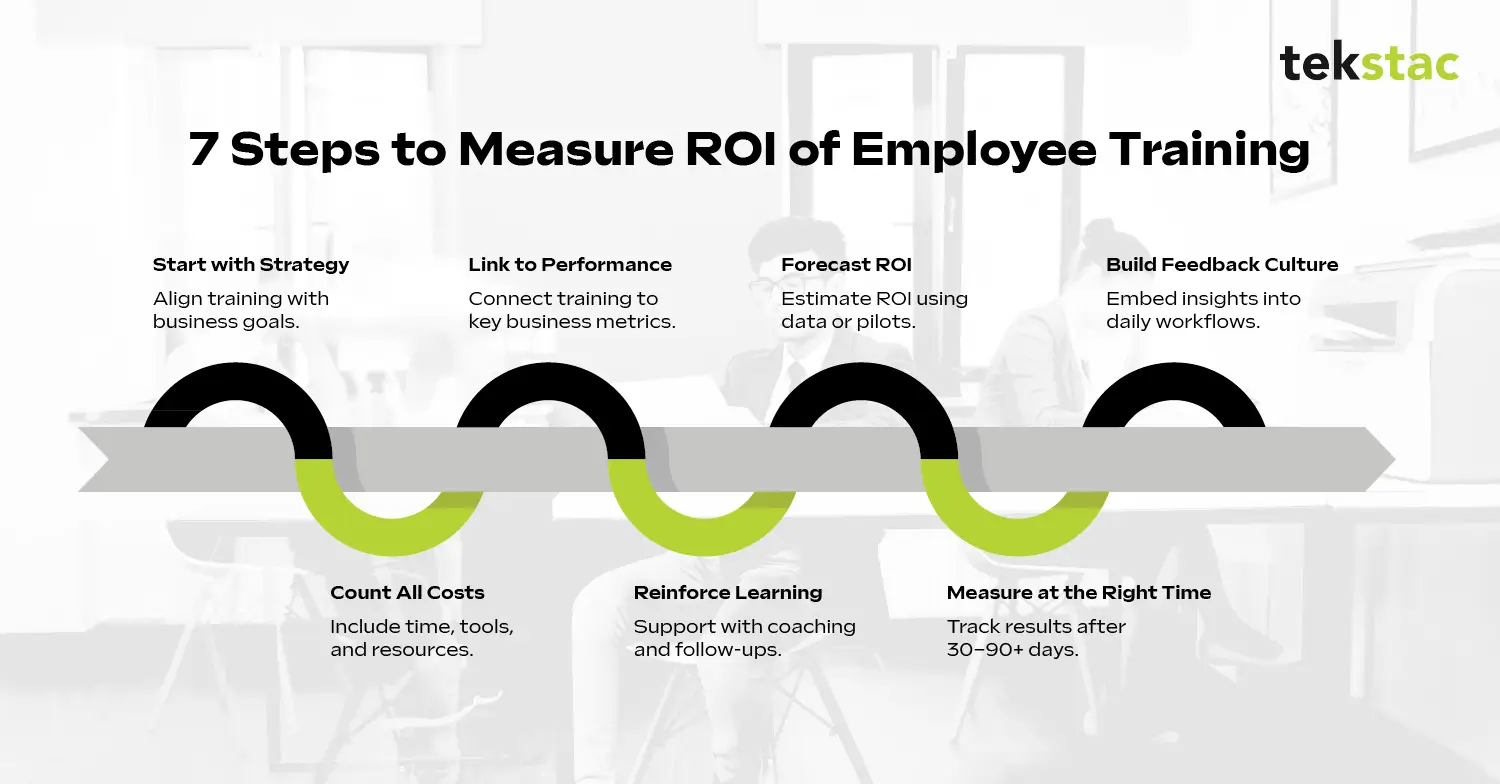
Most organizations begin their workplace training by identifying skill gaps, those missing competencies or technical skills employees lack. Focusing solely on skill gaps is a limited view that misses alignment with the company’s broader strategic goals and outcomes.
If L&D efforts fail to connect to what the business is trying to achieve, measuring learning impact becomes ineffective. Hence, without this strategic intent, most organizations fall prey to measuring ineffective ROI metrics like course completions or quiz scores but not outcomes such as increased revenue, improved customer satisfaction, faster product launches, etc.
To do this practically, begin every training program with a conversation beyond HR or L&D. Bring in stakeholders from business units, operations, sales, and leadership. Ask questions like:
From there, create learning objectives that tie directly to these priorities. This sets the foundation for meaningful ROI measurement. Determining learning success through business KPIs rather than just learning KPIs allows you to identify the right metrics upfront.
For example, instead of “improve negotiation skills,” a strategic intent might be to “reduce average sales cycle time by 15% through improved negotiation.”
Training budgets are generally calculated based on platform licenses, facilitator fees, or travel expenses. However, this approach does not capture the full cost of ownership of workplace training programs. Here’s how to ensure a more accurate cost baseline:
Employee time: Every hour spent in training is not spent on other productive work. This opportunity costs scales quickly across large cohorts.
Manager involvement: This includes conducting follow-ups, assigning pre-work, or leading on-the-job practice sessions, as they dedicate time and energy that needs to be accounted for.
Post-training reinforcement: Job aids, nudges, simulations, or coaching continues long after completing a course.
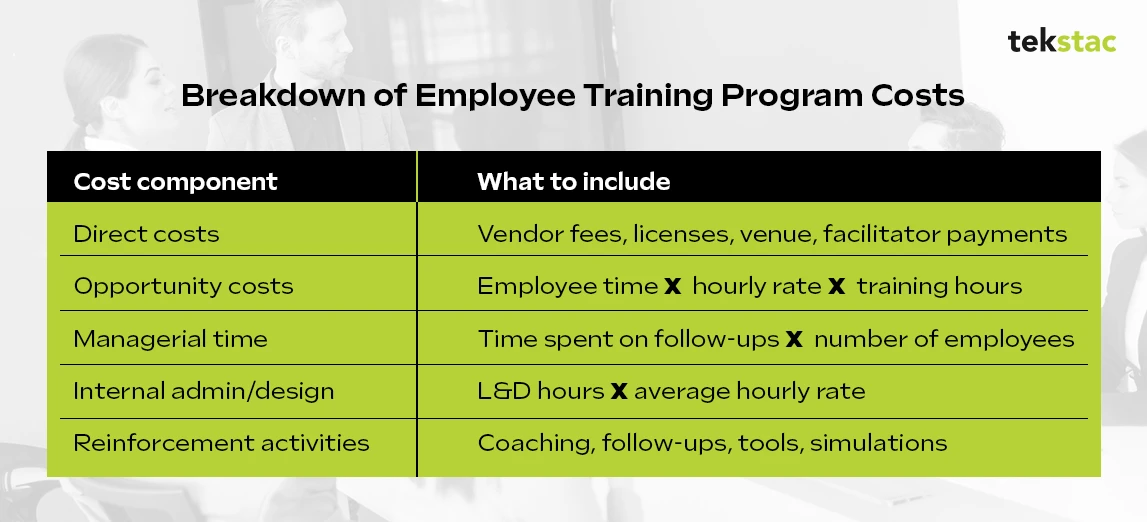
Many companies hesitate to investigate these costs out of fear they’ll seem too high, but being honest about the real cost of training actually strengthens credibility when showing impact, as leaders need an accurate number rather than a lower one.
Connect training outcomes with relevant performance data, sales figures, error reduction, customer satisfaction scores, or productivity rates. Start by identifying which business metrics your training will influence, then collaborate with data owners in departments like sales, customer success, or operations. They often track these metrics regularly and can provide historical data for comparison.
Now, create a simple data dashboard or report that overlays training participation data with these business KPIs over time. Look for patterns like improvements in key metrics following the training rollout—segment data by employee groups who took the training versus those who didn’t to isolate the impact.
For example, if average sales increase by 10% post-training in your trained group compared to untrained peers, that’s a clear signal of positive ROI. You can then translate that uplift into dollar values for your ROI formula.
Some employee training programs fail because of what happens after the session ends. Per Hermann Ebbinghaus’s Forgetting Curve research, as much as 90% of learning is forgotten within a month if not reinforced. As we observe, most L&D programs still operate on a “one-and-done” model.
Training is not a single event; it’s a process of behavioral change. Without reinforcement, there’s no lasting change, hence no real ROI. This means measuring training ROI must include structured reinforcement. Here’s what to include:
Tip: When planning your program, allocate at least 20-30% of your training budget or timeline to reinforcement.
A simple way to measure ROI with reinforcement in place would be to use this formula:
ROI of training programs (%) = (Total Benefit – Total Cost)/Total Cost x 100
Let’s break this down:
Total benefit = Business gains because of the training (e.g., time saved, revenue increased, increase in resolution times, etc.)
Total cost = Training costs + time + reinforcement tools or coaching
Predicting ROI upfront helps align expectations and secure stakeholder buy-in. Many organizations skip this step, making it harder to justify investments or set realistic goals. You can estimate the potential business impact your training can have based on historical data, benchmarks, or pilot programs. Forecast the costs involved so you have a clear picture of the investment
Predicted ROI (%) = (Expected Benefit – Cost)/Cost x 100
You can use smaller pilot groups to test training impact quickly before wider rollout and gather early performance signals, like knowledge application or behavior change, to adjust predictions. While predictive ROI isn’t perfect, it sets a proactive foundation for tracking and optimizing training success.
Measuring ROI too soon can be the biggest trap. True business impact from training often takes time to materialize. Behavior changes, productivity gains, or revenue improvements rarely appear overnight. It’s important to recognize that a training program might initially show a negative ROI or no measurable benefit—not because it failed, but because you haven’t yet reached the break-even point where benefits outweigh costs. To measure employee training ROI right:
If, after the appropriate measurement window, ROI remains negative, don’t see it as a failure but as a sign to dig deeper. It could mean the training wasn’t aligned with business priorities, the delivery method ineffective, or the benefits are harder to quantify. Use this insight to reassess training goals, refine the training content, improve reinforcement strategies, or adjust your metrics.
Training effectiveness depends heavily on how well it aligns with organizational culture, leadership support, and employee readiness to change. If the culture resists new behaviors or lacks reinforcement mechanisms, ROI will suffer despite great content or delivery. Factors like peer influence, manager involvement, and workplace norms shape whether learning turns into performance improvements.
Create channels to collect feedback not only immediately after training but throughout the learning journey. This includes:
The key here is to partner with managers to embed learning checkpoints into regular workflows, leverage technology platforms that allow real-time feedback and data integration, and communicating changes periodically.
Want practical strategies and future trends in employee development?
👉 Explore more in our full blog.
To actually measure training impact, the preparation work starts much earlier, with how you design your training ecosystem. There’s a need for a tool that not only delivers content but effectively tracks, connects, and analyzes every learning touchpoint against actual business KPIs.
Tekstac’s learning analytics and management modules help perfectly:
The platform also powers your learning experience with custom learning paths, mentor marketplace, virtual sessions, auto-evaluated practice labs, AI-proctored assessments, and many more. With over 1 million professionals upskilled, 24 million+ learning hours, and enterprise customers like IBM, PwC, Capgemini, and Cognizant, Tekstac is built for organizations that want to transform how they train and upskill. See Tekstac in action.
1. Why is ROI significant in training evaluation?
ROI is significant in training evaluation because it helps organizations determine whether training investments deliver measurable business value. By tracking outcomes such as productivity, performance, retention, and cost savings, companies can justify learning budgets, improve training effectiveness, and make more informed workforce development decisions.
2. How can we measure ROI from employee development programs beyond just satisfaction surveys?
Go beyond satisfaction surveys by tying training to measurable business KPIs — sales performance, error rates, productivity, or customer satisfaction — rather than completion rates. Segment performance data by who took the training versus who didn’t, then translate any uplift into dollar terms using the ROI formula: (Total Benefit – Total Cost) / Total Cost × 100.
3. What is the formula for calculating training ROI?
The standard formula is ROI (%) = (Total Benefit – Total Cost) / Total Cost × 100, where Total Benefit reflects business gains like time saved or revenue increased, and Total Cost includes delivery, employee time, and reinforcement. A Predicted ROI version — (Expected Benefit – Cost) / Cost × 100 — can be used before rolling out.
4. How do you measure employee training impact and ROI together?
Track leading indicators (knowledge retention, behavior change, engagement) soon after training, and lagging indicators (sales performance, error rates, customer satisfaction) over a longer 30–90 day window, then compare trained versus untrained groups to isolate the training’s actual effect.
5. What tools help measure training ROI?
Effective training ROI tools combine learning data with business KPIs in one view — look for custom dashboards with real-time progress tracking, predictive analytics to anticipate outcomes before rollout, and skill inventory monitoring, rather than tools that only report completion rates.