
Agentic AI courses have become one of the most visible ways for organizations to prepare employees for the next stage of AI. They introduce learners to AI agents, autonomous workflows, orchestration, tool use, and the frameworks needed to build intelligent systems.
But there is a growing gap between completing an Agentic AI course and being ready to do Agentic AI work. An employee can finish a learning path, pass an assessment, and receive a certificate without necessarily being able to decide whether an agent is the right solution, build one on the organization’s technology stack, evaluate its behavior, secure it, or take it toward production.
That distinction is becoming important in 2026. As enterprises move from experimenting with generative AI to building more autonomous workflows, this article will shed light on what Agentic AI courses should infer and how Tekstac is doing it differently.
Agentic AI courses are designed to help learners understand how these systems are built, deployed, and applied to real-world use cases. Instead of simply responding to a prompt, an agentic system can plan a task, reason through different steps, use tools and APIs, interact with other systems or agents, and adapt its approach to achieve a defined goal.
This makes Agentic AI courses useful for building a foundation in areas such as agent architectures, reasoning patterns, orchestration, context engineering, tool calling, RAG, evaluation, and multi-agent systems.
The timing matters. Enterprises are increasing their AI investments, while the skills required to build and manage these systems are evolving quickly. In India, 45% of organizations identify AI, digital and data skills as their single largest workforce constraint, according to the SHRM India Skill Intelligence Report. The report also found that only 34% of organizations have formal, systematic measurement of skilling outcomes.
So the enterprise challenge is twofold: build the skills and know whether those skills exist.
This is why Agentic AI courses online are only one part of the answer. The more important question is what the learner can demonstrate after completing them.
A useful way to evaluate an AI learning initiative is to move beyond completion rates and ask 6 practical questions.
1. Can learners build on the required stack?
Can they build RAG applications, AI-assisted software, or agentic workflows using the languages, frameworks, APIs, cloud platforms, and tools relevant to the organization?
Knowing the concept of an agent is different from building one that works in a real environment.
2. Can teams operate what they build?
Production readiness requires more than creating an impressive prototype. Teams need to understand gateways, observability, evaluation pipelines, cost controls, monitoring, and drift.
3. Can learners exercise AI coding judgment?
AI coding assistants can accelerate development, but developers still need to verify generated code, identify hallucinations and errors, test outputs, and understand where AI-generated code should not be trusted.
4. Can they recognize trust and security risks?
Agentic systems can interact with tools, data, APIs, and enterprise systems. Learners therefore need to identify risks such as prompt injection, excessive permissions, unsafe outputs, data exposure, and governance gaps.
5. Can they make sound solution-design decisions?
Not every problem needs an agent.
A capable practitioner should be able to evaluate RAG versus fine-tuning, agents versus conventional automation, build versus buy, and trade-offs involving cost, latency, quality, reliability, and complexity.
6. Can the organization see workforce capability?
Finally, L&D and business leaders need to know where capability exists.
Which employees are ready? Who is close but needs mentoring? Where is the organization’s bench thin? Which roles require deeper development?
These questions turn learning from an attendance metric into a workforce capability conversation.
There is no universal best Agentic AI course. As organizations accelerate their AI investments, the focus is shifting toward building the capabilities needed to put AI into practice. McKinsey’s research found that 92% of companies plan to increase their AI investments over the next three years, yet only 1% of leaders consider their organizations mature in AI deployment. This makes choosing the right learning path even more important.
Here are seven courses and resources that can provide useful exposure to the field:
A technical learning experience combining Python, generative AI concepts, ChatGPT, and project-based work.
Designed for managers and business leaders who want to understand AI agents and their strategic applications.
An introductory option covering agent concepts, NLP, reinforcement learning, and responsible AI.
Focuses on CrewAI and the design of multi-agent systems for task delegation and automation.
A hands-on video series covering agent design, pipelines, and approaches to building and scaling agents.
Introduces AI agent fundamentals through practical enterprise use cases and the Agentforce ecosystem.
A longer-form learning resource covering generative AI development, tools, and production-oriented deployment concepts.
For individuals, these can be useful starting points. Some free Agentic AI courses and video resources can also help learners explore the fundamentals before committing to deeper learning.
For enterprises, however, simply making a list of resources available does not solve the harder problem.
What happens after the learner finishes?
A Gen AI and Agentic AI course certificate tells an organization that someone completed a learning experience. It does not necessarily tell the organization what that person can build.
A learner may know what MCP is without knowing when it should be used. They may be able to create an agent workflow from a tutorial without understanding how to evaluate its output. They may understand multi-agent architecture conceptually without being able to troubleshoot a failing workflow.
This is not a criticism of courses. It is a reminder that courses and capability serve different purposes. The course provides knowledge. Practice develops muscle. Skill assessment provides evidence. Projects reveal application. Mentoring helps learners navigate ambiguity.
Together, these elements create a much stronger picture of readiness.
This is where Tekstac takes a different approach to building Agentic AI capability. Rather than treating Agentic AI as another collection of videos or modules, Tekstac’s approach combines learning content with practice, mentoring, assessment, and real-time visibility. Its platform supports role-aligned learning paths, hands-on AI learning, mentoring, auto-evaluated assessments, and analytics designed to show where learners stand.
Instead of jumping from one new agentic tool to another, learners build their understanding progressively; from foundational AI concepts and context engineering toward agentic application development and protocols such as MCP.
The technology stack also moves from experimentation toward production-oriented agent building. Learners can work across tools and frameworks such as n8n, Langflow, Flowise, LangGraph, CrewAI, MCP and A2A, with observability introduced through tools such as LangFuse.
The objective is not to make someone familiar with a long list of AI tools.
It is to help them understand how to design an agentic system, why a particular approach makes sense, how its components work together, and what needs to be controlled when the system moves beyond a prototype.
The difference becomes clearer when the learning journey is looked at as a whole.
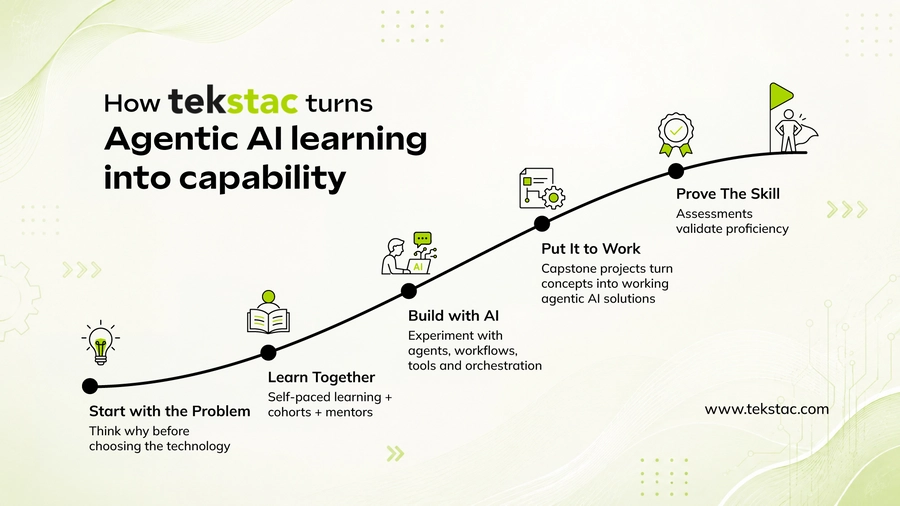
Learners are encouraged to think about the why and the so what before deciding what technology to use. This matters because an impressive agent that does not solve a meaningful problem is still a poor solution.
The approach also helps learners develop the judgment needed to navigate an AI landscape where tools and frameworks are changing constantly.
The learning experience combines self-paced content with cohort interaction and office hours.
That matters particularly for working professionals. Instead of spending synchronous time-consuming lectures, learners can use that time to discuss challenges, ask questions, work through problems, and get feedback from mentors and peers.
Learners do not stop at understanding how an agent works.
They work with agent workflows, tool use, orchestration, and observability. Tekstac’s hands-on labs are designed to provide environments where learners can experiment with technology and receive automated feedback.
A capstone project provides another important layer. Instead of ending with a quiz or certificate, learners bring together their understanding of the problem, architecture, tools, agent workflow, and design decisions into a working prototype.
The value of the capstone is not simply that something gets built. It creates an opportunity to demonstrate the thinking behind the solution; the problem being addressed, why an agentic approach was selected, what changed during iterations, and what the learner would need to consider before taking it further.
Assessment then becomes more than a final checkpoint. Tekstac combines quizzes and auto-evaluated technical assessments with practical labs and role-based learning to provide evidence of proficiency and identify areas that need improvement.
Building job-ready AI skills will remain a key priority for enterprises. They give employees the concepts, frameworks, tools, and vocabulary needed to enter a rapidly evolving field.
As enterprises move toward autonomous workflows and AI-enabled operating models, they will need more than employees who understand Agentic AI. That requires a shift from measuring learning activity to measuring demonstrated capability.
Tekstac approaches this shift by bringing together problem-first Agentic AI learning, hands-on practice, mentoring, capstone projects, skills validation, and readiness mapping. The result is a learning journey designed not simply to answer, “Did the employee complete the course?” but to get closer to the question that matters more in 2026.
Book a demo to know more about our Agentic AI learning paths and how to turn them into workforce decisions.
1. What skills are needed to learn Agentic AI?
A basic understanding of AI, machine learning, or large language models is useful. Depending on the learning path, learners may also benefit from knowledge of Python, APIs, prompt engineering, RAG, cloud platforms, and software development concepts.
2. What is the difference between Generative AI and Agentic AI?
Generative AI primarily focuses on creating content such as text, code, images, or summaries in response to user input. Agentic AI extends these capabilities by enabling AI systems to plan, make decisions, use tools, and execute multi-step tasks toward a goal.
3. Is Agentic AI difficult to learn?
Agentic AI can involve several advanced concepts, but a structured learning path can make it easier to build the required skills progressively. Starting with LLM fundamentals and moving toward tool use, orchestration, and multi-agent systems can provide a practical learning progression. Platforms like Tekstac offer structured Agentic AI Learning Paths that bring together concepts, hands-on labs, assessments, and practical application.
An enterprise learning adoption curve is the journey employees follow from initial awareness of a learning platform to consistent skill application and measurable business impact. The adoption curve of any enterprise learning initiative rarely follows a straight line. Some employees actively explore every new learning opportunity, while others wait until they see clear value before participating. Many engage only when learning becomes directly relevant to their work.
Understanding these different patterns of learning adoption is the key to improving learner engagement, strengthening workforce capability, and delivering measurable business outcomes.
Adoption curves, often called S curves, are one of the more insightful tools, which is the cumulative rate at which a population adopts a product, service, or technology over time.
This idea is not new. In 1962, communication theorist Everett Rogers introduced the Diffusion of Innovations theory, explaining how new ideas spread through populations over time. His adoption curve showed that people embrace change at different speeds, from innovators and early adopters to the early majority, late majority, and laggards. Although Rogers originally applied this thinking to innovations and technology, the same principle is remarkably relevant to enterprise learning adoption.
Organizations often invest significant time and resources in deploying learning platforms, designing learning paths, and creating skill development programs. However, many still assume that once a platform is available, employees will naturally use it. In reality, learning platforms are adopted much like any other enterprise technology. Success depends less on the availability of learning content and more on how effectively organizations guide employees through the adoption journey.
This is the thinking behind the Tekstac Adoption Curve. Rather than viewing learning as a one-time enrollment or course completion, it treats enterprise learning adoption as a progressive journey where employees build awareness, develop engagement, demonstrate competence, and eventually contribute to organization-wide capability intelligence.
One of the biggest misconceptions in workplace learning is that providing access automatically creates engagement. Most organizations measure platform success through enrollments, course completions, or login statistics. While these metrics indicate activity, they rarely demonstrate whether employees are building capabilities that improve business performance.
The same pattern exists across enterprise software. Organizations purchase sophisticated platforms with powerful capabilities, yet employees often use only a small portion of what is available. The problem is rarely the technology itself. Instead, it is the absence of structured adoption strategies that help users gradually discover, trust, and incorporate new workforce capabilities
Learning platforms face a similar challenge. Without clear skill visibility, personalized recommendations, continuous guidance, and meaningful validation, many learners lose momentum after their initial interaction. Learning becomes another corporate initiative rather than an integrated part of professional growth.
This is particularly significant as organizations respond to rapidly changing skill requirements. According to LinkedIn’s Report, four out of five professionals want to develop AI-related skills, while organizations increasingly recognize learning and career development as essential drivers of retention and business performance. The report also found that organizations with stronger learning cultures demonstrate healthier leadership pipelines, greater internal mobility, and higher employee retention.
According to McKinsey report, 55% of leaders say successfully building AI capabilities of employees will bring exponential productivity gains.
These findings reinforce an important point: learning outcomes improve not because organizations offer more content, but because they build environments where employees continuously engage with learning.
In fact, our joint research with SHRM India found that only 1 in 10 organizations have the foundational building blocks needed to transform workforce skills, highlighting why enterprise learning success depends on adoption.
The Tekstac Adoption Curve applies this understanding to enterprise learning. Instead of focusing only on content delivery, it structures the learner journey into five progressive stages that move employees from awareness to measurable business impact.
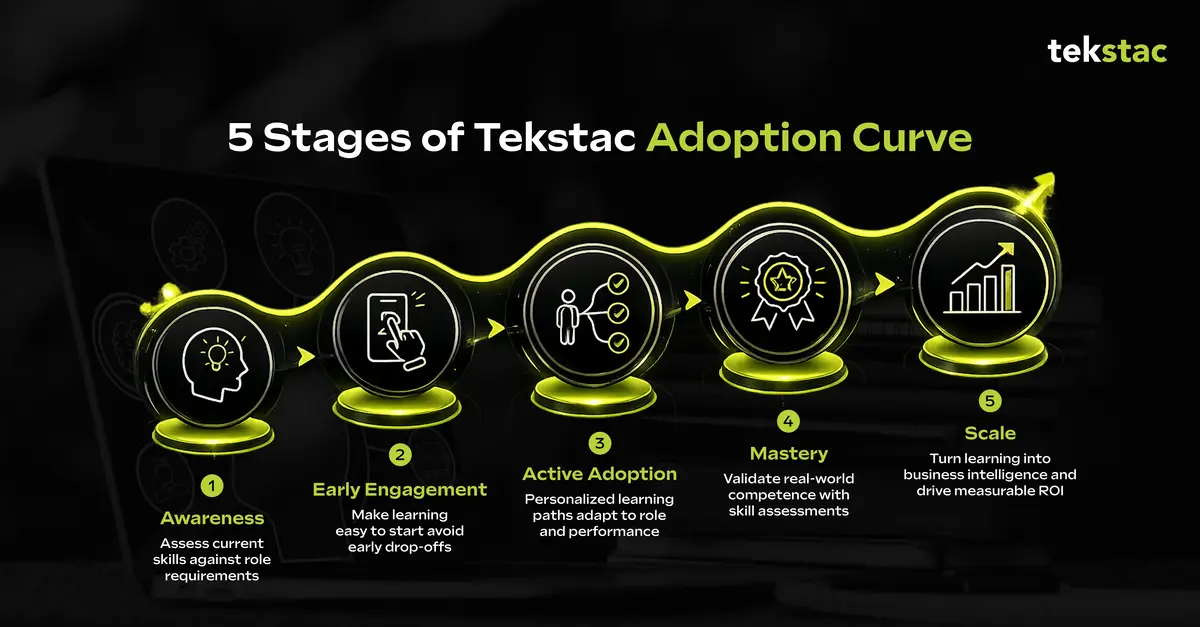
The first stage of the Tekstac Adoption Curve focuses on building this awareness through structured skill assessments. Rather than asking employees what they would like to learn, organizations first establish where existing capabilities stand against role expectations.
This approach enables enterprises to identify critical skill gaps before recommending learning interventions. It also provides employees with greater confidence because learning is connected directly to their current role, future aspirations, and business objectives instead of generic course catalogs.
Many enterprise learning initiatives lose participants during the earliest stages. Complex onboarding, overwhelming content libraries, and unclear learning priorities often prevent meaningful employee learning engagement.
The second stage focuses on reducing this initial friction.
Instead of presenting hundreds of disconnected courses, learners receive guided recommendations that make it easier to take the first step. Personalized suggestions, AI-assisted guidance, and intuitive learning experiences help employees move quickly from intention to action.
For example, Johnson & Johnson redefined workforce development by moving beyond skills alone to a whole-person model that also considers experience, motivation, and aspirations. This shows that courses alone are not enough.
Employees rarely progress at the same pace. Some learners quickly master foundational concepts and require advanced challenges, while others need additional practice before moving forward. Treating every learner identically often results in disengagement at both ends of the spectrum.
The third stage emphasizes personalized learning paths that continuously adapt based on learner progress, role requirements, assessment performance, and evolving skill priorities.
At this stage, learning curve becomes habitual rather than event-driven.
The fourth stage of the Tekstac Adoption Curve focuses on validating competence rather than measuring attendance through skill insights.
Skill assessments, practical exercises, coding environments, simulations, project-based evaluations, and performance validation provide organizations with far greater visibility into actual capability development.
This distinction is becoming increasingly important as enterprises prepare workforces for emerging technologies such as artificial intelligence, cloud engineering, cybersecurity, and data science. Organizations require employees who can confidently apply skills in business situations, not simply recall theoretical concepts.
The final stage extends beyond individual learners.
As organizations accumulate assessment results, skill inventories, learner engagement data, and competency validations, learning evolves into an enterprise-wide intelligence system.
Leaders can begin answering strategic workforce questions with greater confidence.
Instead of measuring learning through course completions, organizations measure workforce readiness.
This creates a continuous feedback loop where enterprise learning supports workforce planning, talent development, succession planning, and business transformation simultaneously.
At this stage, learning adoption curve becomes an organizational capability rather than an individual activity.
Every organization contains innovators who eagerly explore new ideas, early adopters who demonstrate value, and larger groups who require evidence before changing established behaviors. Enterprise learning follows the same pattern.
Rather than expecting immediate organization-wide participation, successful learning ecosystems recognize these differences and design experiences that support every stage of adoption. Employees receive clarity before learning, guidance during learning, validation after learning, and opportunities to continue growing throughout their careers.
This progression creates stronger learner engagement because employees understand not only what they need to learn, but also why that learning matters to their individual growth and organizational success.
The future of enterprise learning will not be defined by the number of courses organizations provide or the sophistication of their technology stacks. It will be defined by how effectively they move employees through the adoption curve: from awareness to engagement, from engagement to mastery, and from individual growth to enterprise capability.
Agentic AI is all over, and the only way to skill up is to view learning as a continuous capability-building journey rather than a transactional training event. When organizations understand where employees are on that journey and provide the right support at every stage, learning adoption becomes sustainable,workforce upskilling becomes measurable, and enterprise learning begins delivering the business outcomes it was designed to achieve.
Book a demo and see how Tekstac’s Agentic AI capability helps your workforce learn, practice, and demonstrate the skills needed to build and work with AI agents.
1. What is enterprise learning adoption?
Enterprise learning adoption refers to how effectively employees embrace and consistently use a learning platform, program, or capability-building initiative within an organization. It goes beyond enrollment numbers to measure meaningful participation, course completion, knowledge application, and long-term behavior change.
2. What makes a learning platform successful?
A successful learning platform is one that delivers measurable business outcomes while providing an engaging learning experience. It offers personalized learning paths, relevant content, hands-on practice, and clear progress tracking. Most importantly, it helps employees build job-relevant skills that improve individual performance and organizational capability.
3. How long does enterprise learning adoption take?
The timeline for enterprise learning adoption varies depending on the organization’s size, culture, change management strategy, and platform implementation. Initial adoption may begin within a few weeks, but achieving sustained engagement and organization-wide usage typically takes between 3 to 12 months.
4. How can organizations improve learner engagement?
Organizations can improve learner engagement by making learning personalized, and easy to access. Role-based learning paths, AI-powered recommendations, interactive labs, gamification, social learning, and manager involvement encourage continuous participation. Regularly measuring learner behavior, collecting feedback, and refining learning experiences also helps maintain engagement and ensures employees see tangible value from their learning journey.
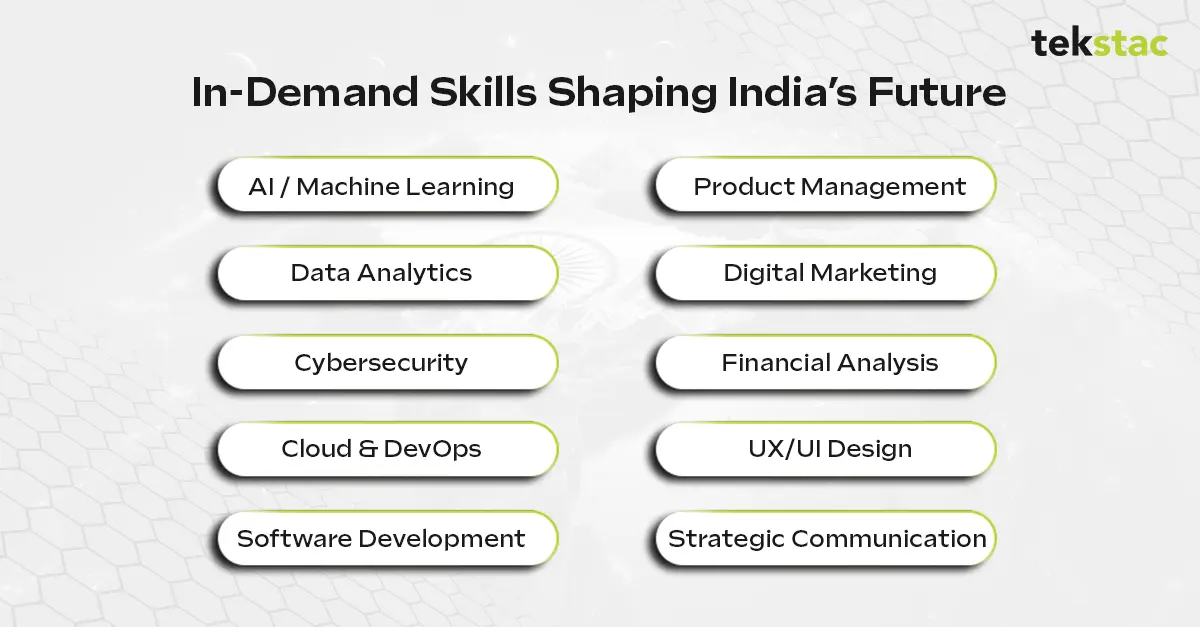
The top high demand skills for the next 10 years in India are AI/ML, Data Analytics, Cybersecurity, Cloud/DevOps, Software Development, Product Management, Digital Marketing, Financial Analysis, UX/UI Design, and Strategic Communication. Together, these 10 capabilities define who gets hired, promoted, and paid more through 2035, regardless of degree or seniority.
Roles like AI prompt engineer, MLOps specialist, and cloud security architect barely existed five years ago. They are now among India’s fastest-growing job titles, according to LinkedIn’s 2025 Jobs on the Rise report. At the same time, NASSCOM data shows entry-level IT roles declining by 18% as automation absorbs repetitive tasks. The skills for the next 10 years determine which side of that shift you land on.
According to the World Economic Forum’s Future of Jobs Report 2025, nearly 44% of workers’ core skills will need to change by 2030. McKinsey’s Global Institute echoes this, projecting that up to 12 million occupational transitions may occur in India alone this decade. Organizations have responded by shifting their hiring filter from academic credentials to demonstrated capability. They are prioritizing outcomes, portfolios, and proof of work.
As per Gartner’s 2025 HR Technology Survey found that skills-based hiring adoption grew by 39% year-over-year among enterprise technology firms. NASSCOM’s State of the Tech Talent Report estimates India faces a deficit of 800,000 qualified professionals in AI, cloud, and cybersecurity roles, despite producing 1.5 million engineering graduates annually.
In simple terms, the market rewards capability over credentials.
India’s labor market is undergoing a transformation driven by AI, automation, and digital infrastructure.
The World Economic Forum predicts 170 million new jobs by 2030. For India specifically, the WEF projects a net gain of approximately 11 million jobs by 2030, concentrated in technology, green energy, and care economy sectors, but only for workers who have already transitioned their skills.
Deloitte’s 2025 Global Human Capital Trends report found that organizations which invested in structured upskilling saw 2.4x higher internal mobility rates; meaning skilled employees are also more likely to grow within a company, not just get hired.
This is why skills for the future workforce are becoming the most valuable career currency.
| Skill | Demand Level | Typical Salary Growth Potential |
|---|---|---|
| AI / Machine Learning | Very High | Very High |
| Data Analytics | Very High | High |
| Cybersecurity | High | High |
| Cloud / DevOps | High | High |
| Software Development | Very High | High |
| Product Management | High | Very High |
| Digital Marketing | Medium to High | Medium to High |
| Financial Analysis | Medium to High | High |
| UX/UI Design | Medium to High | High |
| Strategic Communication | Universal | Career Multiplier |
A. TECH SKILLS
Why This Matters Now
AI is no longer a niche skill; it’s becoming as fundamental as internet literacy once was. From recommendation engines to fraud detection and generative AI tools, AI is embedded into how businesses operate. According to LinkedIn’s 2025 Emerging Jobs Report, AI and generative AI-related job postings in India grew 3.1x year-over-year, making it one of the fastest-scaling emerging skills in India.
Current Market Reality
What You’ll Actually Earn
What You Need to Learn
Why This Matters Now
If AI is the engine, data is the fuel. Every organization today generates vast amounts of data, but very few can translate it into meaningful insights. This is why data analytics continues to rank among the most valuable in-demand skills.
A 2025 Nasscom-Zinnov report found that only 23% of Indian organizations have a data analytics function that directly influences C-suite decisions. Unlike some specialized technical roles, data analytics is relevant across industries; from finance and healthcare to retail and logistics. What has changed, however, is expectation. Companies are no longer looking for professionals who can only analyze data; they want individuals who can connect data insights to business outcomes. This shift has elevated the role from a support function to a strategic one.
Current Market Reality
What You’ll Actually Earn
What You Need to Learn
Why This Matters Now
As organizations become more digital, their exposure to cyber threats increases. Cybersecurity is no longer a backend function—it is central to business continuity. This makes it one of the most essential skills required for future jobs.
The nature of cyber threats is also evolving. With the rise of AI-driven attacks and increasingly sophisticated hacking techniques, companies need professionals who can anticipate and mitigate risks proactively. India, in particular, faces a significant shortage of cybersecurity talent, creating strong opportunities for those entering this field. What makes this skill unique is its long-term relevance—security will remain a priority as long as digital systems exist.
Current Market Reality
What You’ll Actually Earn
What You Need to Learn
Why This Matters Now
Cloud computing has become the backbone of modern business infrastructure. Every application, platform, and digital service relies on cloud systems to function efficiently. This makes cloud expertise one of the most critical digital skills in demand today. The demand for cloud professionals continues to outpace supply, particularly in India, where digital transformation is accelerating across industries. For professionals, this translates into strong career growth and global opportunities.
Current Market Reality
What You’ll Actually Earn
What You Need to Learn
Why This Matters Now
Software development is one of the most important next generation skills. The demand for full-stack developers, in particular, reflects the industry’s need for versatility. At the same time, the integration of AI tools into development workflows is reshaping how software is built, making continuous learning essential for professionals in this field.
Current Market Reality
What You’ll Actually Earn
What You Need to Learn
B. DIGITAL & BUSINESS SKILLS
Why This Matters Now
India has seen a 52% increase in product manager job postings between 2022 and 2025, driven by the rise of SaaS companies, fintech platforms, and consumer super-apps. Unlike most tech roles, PM salaries jump steeply with experience; a 3-year PM at a funded startup typically earns more than a 7-year software engineer at a service company. What makes this role unique is its emphasis on decision-making. Product managers are responsible for identifying market needs, defining product strategies, and ensuring successful execution.
Current Market Reality
What You’ll Actually Earn
What You Need to Learn
Why This Matters Now
The shift toward digital platforms has transformed how businesses reach their audiences. Marketing is no longer limited to traditional channels; it is driven by data, algorithms, and user behavior. This makes digital marketing one of the most practical digital skills in demand.
Current Market Reality
What You’ll Actually Earn
What You Need to Learn
Why This Matters Now
India processed over 14.3 billion UPI transactions in January 2025 alone, making it the world’s most active real-time payments market. This volume has created a structural need for financial analysts and is now one of the high paying skills.
Current Market Reality
What You’ll Actually Earn
What You Need to Learn
Why This Matters Now
India’s EdTech sector saw 22 million new users in 2024, all of whom interact with products designed in English but used in Hindi, Tamil, or Bengali. UX designers who can research and prototype for multilingual, low-bandwidth users are commanding a growing premium that English-first markets simply don’t create. This has elevated UX/UI design from a supporting role to a core business function. It is now one of the most essential skills for the future workforce.
Current Market Reality
The Taggd report highlights rising demand due to:
What You’ll Actually Earn
What You Need to Learn
C. HUMAN & COGNITIVE SKILLS
Why This Matters Now
The most underpaid insight in India’s upskilling conversation is that communication and problem-solving skills amplify every other skill on this list. A data analyst who presents insights clearly earns 25–35% more than one who cannot, according to LinkedIn Salary benchmarking data. This is why communication skills continue to rank among the most important future skills in India.
Current Market Reality
What You’ll Actually Earn
Not a direct salary skill, but a career multiplier
What You Need to Learn
India’s workforce is at an advantage that other large economies don’t have: a young, English-fluent, tech-curious population that is already in the middle of this transition. The 10 skills in this article are not predictions; they are current hiring realities. The gap between who gets hired and who doesn’t is narrowing to a single question: have you built the evidence to prove what you can do?
Platforms like Tekstac are designed for exactly this; structured, role-aligned skill insights with assessments that create the kind of verifiable proof employers now require. If you’re mapping out your upskilling path, it’s worth starting there.
1. Is foundational skill like Microsoft Excel still in demand today in the age of AI?
Yes, Microsoft Excel continues to be one of the most widely used tools across industries, especially for data analysis, reporting, and operational tracking. When combined with analytics or business intelligence tools, Excel becomes a strong foundational component of broader digital skills in demand, improving both efficiency and decision-making capability.
2. Why do skills matter more than degrees today?
The shift toward skills-based hiring is driven by the need for immediate, measurable impact. While degrees provide foundational knowledge, they do not always reflect a candidate’s ability to perform in real-world scenarios.
3. What are the most important future skills in India?
Technical skills such as AI, data analytics, cybersecurity, and cloud computing are driving demand across industries. At the same time, organizations are placing increasing value on communication, problem-solving, and adaptability. The combination of these capabilities reflects the broader shift toward a skill-based economy, where both technical expertise and human judgment play a critical role.
4. Why is adaptability considered a high-demand skill?
Adaptability is a high-demand skill because workplaces today are constantly changing with new technologies, roles, and expectations. People who can quickly learn, adjust, and handle change are more likely to stay relevant and perform well. It also helps them take on new challenges, work across different situations, and grow in their careers, making them valuable to any organization.
Reference Links:
Fewer than one in three corporate training programs directly improve business KPIs, according to the LearnOps Industry Report. L&D managers who want a seat at the leadership table need to measure training ROI, not just completions. That requires a clear skills gap analysis, SMART KPI frameworks, and technology that connects learning outcomes to workforce performance, which is exactly where an AI-powered upskilling platform like Tekstac is designed to help.
While most of them still measure the traditional surface-level metrics such as:
These numbers still don’t answer the most important question: Did skill development actually change performance?
Tekstac is an AI-first skill development and intelligence used by enterprise clients including IBM, PwC, Capgemini, Zensar and Cognizant. It connects training delivery to measurable business outcomes through real-time analytics, skills gap analysis, and role-aligned learning paths. With over 1 million professionals upskilled across 27 million+ learning hours, Tekstac is built for L&D teams that need to prove ROI to leadership.
Traditional L&D metrics, completion rates, attendance numbers, and assessment scores are easy to report but impossible to connect to business performance.
The core problem is activity tracking masquerading as impact measurement. A sales team can complete a negotiation program with 95% attendance and strong quiz scores. If quarterly revenue stays flat, the program delivered activity, not capability. The same logic applies to leadership development, onboarding, and compliance training.
Replacing surface-level metrics with skills gap analysis means mapping current team capabilities against the skills required to hit specific business goals, identifying the gaps, and building training interventions with a measurable success criterion, before launch not after.
It means mapping current skills to business goals, finding critical gaps, and creating focused upskilling programs to close them.
This shifts L&D from spotting problems to solving them, building the right skills, in the right people, at the right time.
L&D business KPIs help organizations move from measuring participation to measuring performance change. Remember to identify the right KPIs for your L&D.
The role of KPIs in L&D:
Did you know? According to the LearnOps Industry Report 33% of organizations don’t measure L&D success at all, leaving most training budgets unaccountable to leadership.
Listed below are some of the common challenges faced in tracking business KPIs
One of the biggest hurdles for L&D managers is convincing leadership, that training delivers value. Without robust data, learning is seen as a “nice-to-have” rather than a strategic growth driver.
Attendance numbers and retention rates are simple to report, but they don’t tell the full story. True measurement requires both quantitative data (scores, completions, proficiency levels) and qualitative insights (employee satisfaction, perceived value, behavioral change).
Overcoming these challenges requires the right employee performance KPIs, the right measurement approach, and the right technology.
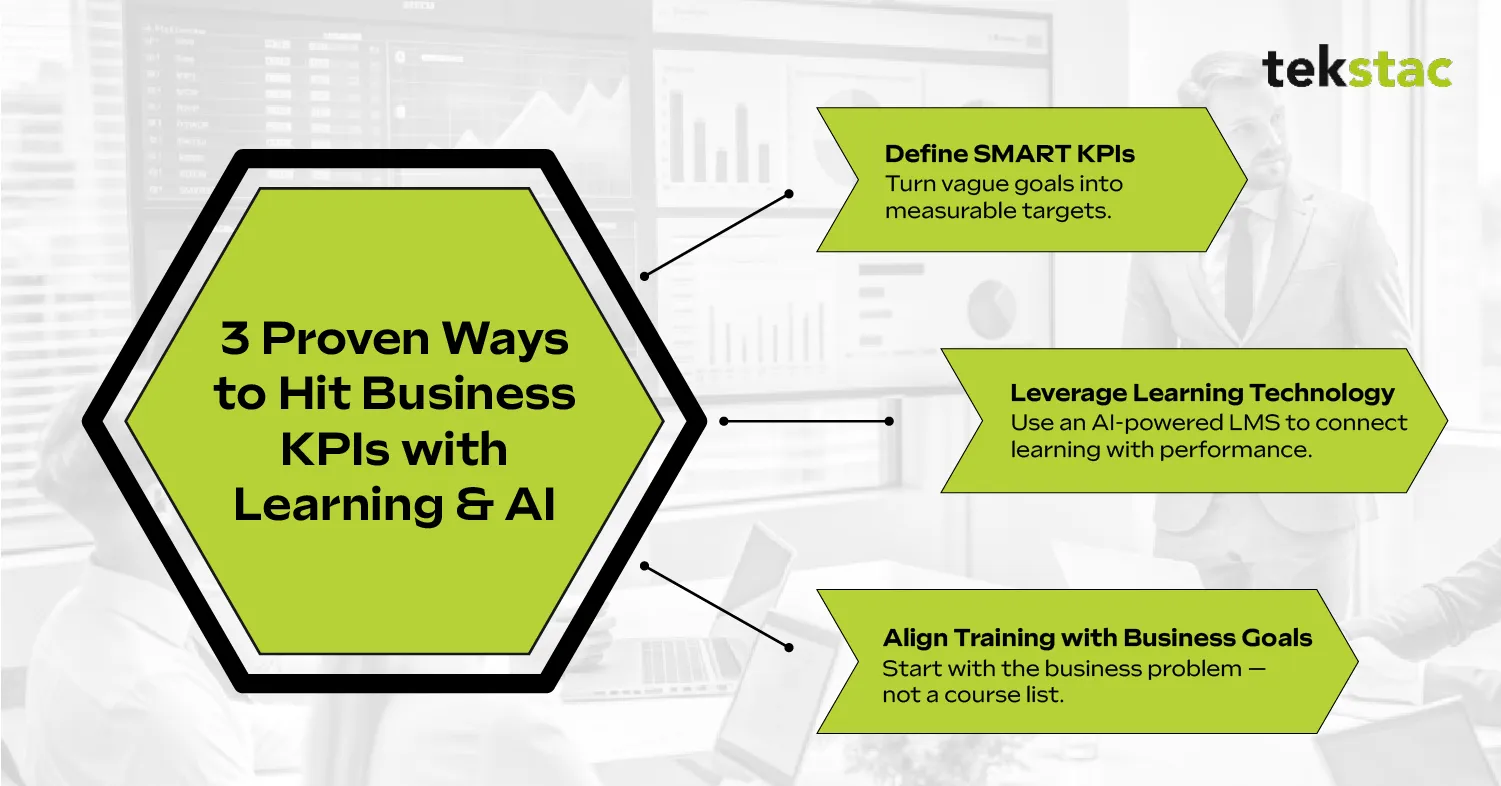
Instead of “Improve onboarding,” a SMART KPI would be “Reduce new hire ramp-up time by 20% within six months.”
To truly measure and maximize the impact of learning, organizations need more than just training delivery—they need visibility, precision, and scalability. This is where an AI-powered Learning Management System (LMS) makes the difference and tracks upskilling impact on KPIs.
A AI-powered LMS can:
This shifts L&D from being reactive to proactively shaping workforce performance.
Training should always start with a business problem, not a course catalog. Ask upfront:
When learning initiatives are designed with these questions in mind, they not only engage employees but also prove their impact to stakeholders.
Tekstac empowers L&D managers to link training directly to business performance through powerful learning analytics and management tools.
Skills gap analysis at scale
Tekstac maps each learner’s current proficiency against role-specific skill requirements, automatically surfacing gaps and assigning targeted content. L&D managers see a real-time dashboard of team capability, not just who completed what, but who is ready to perform.
Training ROI measurement built in
Unlike traditional LMS platforms that stop at completion of tracking, Tekstac links learning activity to business metrics. L&D leaders can show leadership in which programs improved time-to-competency, productivity benchmarks, or retention rates, in the same reporting interface.
Beyond L&D success measurement, Tekstac powers learning delivery with:
With 1 million+ professionals upskilled, 27 million+ learning hours, and enterprise clients like IBM, PwC, Capgemini, Zensar and Cognizant, Tekstac is proven at scale.
It’s time to stop tracking skill development for just the numbers. Instead of asking “Did employees finish the course?”, L&D managers must ask “What business KPI did this program improve?”
Track what matters and focus more on metrics stakeholders already value. Identify the employee performance KPIs before launching a program.
Need assistance with all this?
Tekstac transforms L&D from tracking hours and completions to driving measurable performance, stronger KPIs, and a future-ready workforce.
1. What is the most important L&D business KPIs to track?
The five most measurable L&D business KPIs are:
2. How do L&D teams prove training ROI to leadership?
Establish a measurable baseline before launch, define which business metric the training should move, then track that metric for 60–90 days post-training. An AI-powered LMS like Tekstac automates this linkage, connecting learning data to business performance dashboards in real time.
3. How does an AI-powered LMS improve L&D KPI tracking?
An AI-powered LMS improves L&D KPI tracking by automating skills gap analysis, personalizing learning paths, and providing real-time dashboards that connect training data to business performance indicators, removing the manual data work that prevents most L&D teams from building a credible ROI case.
4. What are the 4 pillars of KPI?
The four pillars of KPIs typically include strategic alignment, measurable metrics, accountability, and continuous monitoring. These pillars ensure that key performance indicators are clearly linked to business goals, can be tracked with data, have responsible owners, and are regularly reviewed to improve performance.

How many times have you gotten praise at work that didn’t quite hit right?
Like it was from someone who didn’t really see the effort you put in — or the struggles you faced. That’s the most common experience with traditional top-down recognition, which misses the mark because it’s distant, generic, or delayed.
This disconnect is exactly why peer-to-peer recognition is becoming essential in modern workplaces. Recognition carries more meaning when it comes from colleagues who work alongside you, understand the challenges, and witness the real impact of your effort.
In fact, a study by the Harvard Business Review found that 82% of senior leaders feel they don’t receive enough recognition. That says a lot about the culture collapse in organizations even today.
The traditional employee engagement strategies are ineffective today. Our way of recognizing employees is stuck in the past, being outdated and out of sync with how work actually gets done today. What we need is something real and immediate, coming from people who see the hard work and impact of work every single day. That something is peer-to-peer recognition.
Peer-to-peer recognition is when employees recognize each other’s work, contributions, and skills. They recognize publicly and directly, without waiting for a manager or a leader to do it. It’s that shout-out from the teammate who saw you stay late just to get that project done. Or a quick thanks from a coworker who knows exactly how much time you saved them.
Top-down praise has been the traditional way workplaces recognize achievements for decades. It flows from management down through the organizational hierarchy, and this model is currently showing its age. What once seemed like the natural order of workplace acknowledgement now feels increasingly disconnected from the real work happening on the ground.
Picture this: a manager who’s not involved in the daily grind gives praise based on a quarterly review or what they heard from someone else. The timing’s off. They don’t really get the full picture. So when the praise finally comes, it feels more like formality than real thanks.
This model can also result in a system where employees look up for approval rather than around for collaboration. If we look around, the modern workplace doesn’t operate in typical hierarchical lines anymore. Projects across departments, teams form and dissolve based on need, and some of the most valuable contributions happen in the spaces between job descriptions. Yet our recognition systems remain stuck in an organizational chart that doesn’t reflect how work actually flows.
Furthermore, managers have limited bandwidth, making recognition another item on an already crowded to-do list. What should be immediate and genuine becomes scheduled, hence organizations are now shifting towards peer-to-peer recognition.
The shift we’re seeing, from hierarchical praise to peer recognition, is not a trend; rather, it delivers measurable advantages that traditional top-down systems simply cannot match.
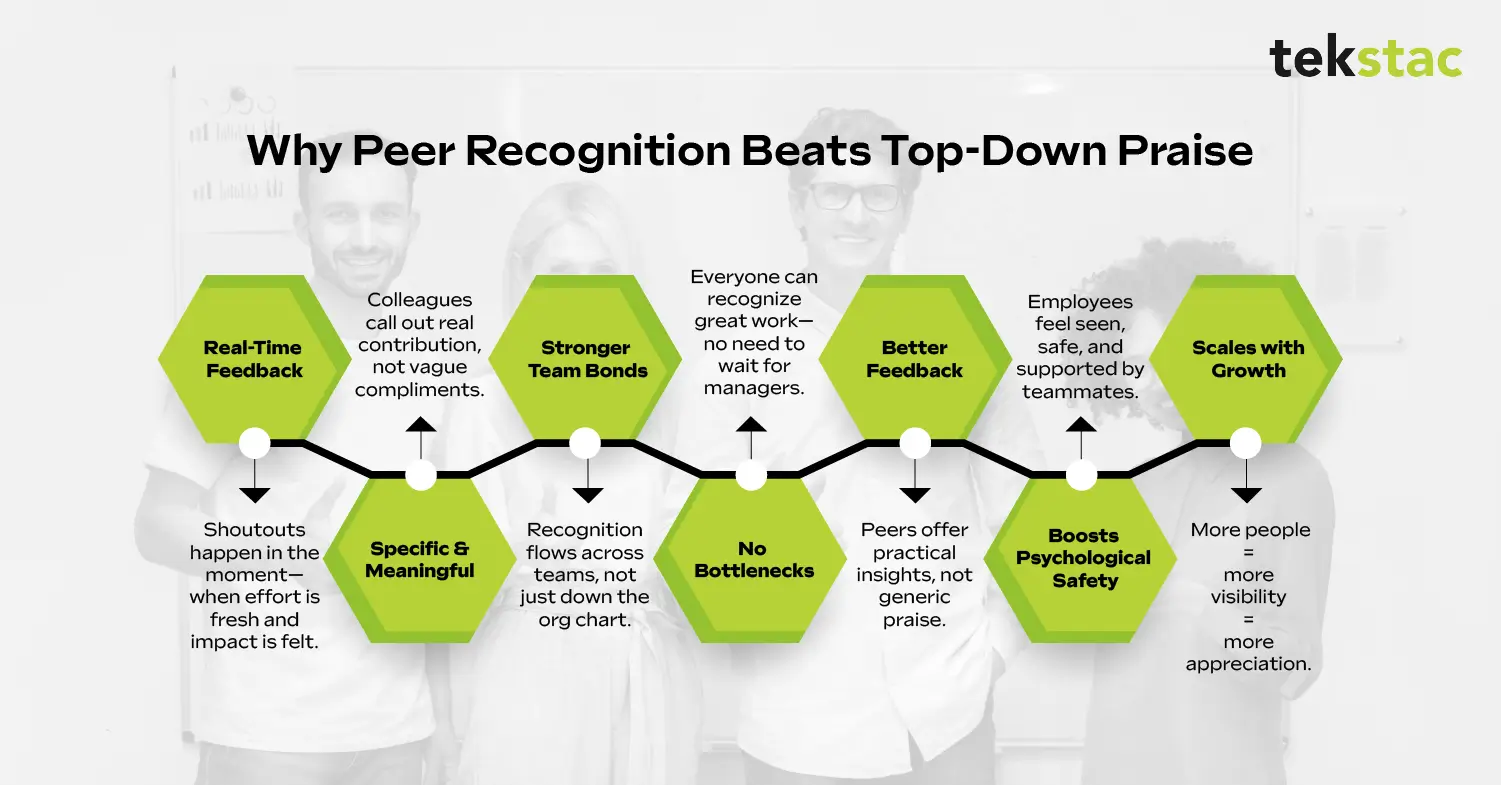
Peer recognition operates on the principle of proximity, as colleagues work alongside each other, see the real challenges, and witness the actual problem-solving process. Hence, peer to peer recognition naturally addresses specific contributions rather than broad performance categories. In contrast, top-down recognition often lacks the same level of detail because managers don’t always see day-to-day contributions.
Recognition loses power when it’s delayed. Acknowledgement hits hardest when it comes right after the win, while the effort is still fresh. That’s why peer-to-peer recognition works so well. They happen naturally, in the moment, not because some formal process says they have to. This immediacy also means that recognition can influence ongoing work, encouraging continued collaboration and excellence within the same project cycle.
Most companies focus on the relationships between managers and their teams. However, while this is important, it is only one way how people can connect at work. When colleagues recognize each other directly, it creates a different kind of connection, boosts employee morale and motivation and morale, rather than just formal mail.
Managers, despite good intentions, cannot always see every contribution, which can create recognition gaps when they are busy or unaware. Peer-to-peer recognition spreads this responsibility across the team, ensuring good work is noticed more often.
The best recognition goes beyond praise and offers insights that help people improve. Peer-to-peer recognition is effective because co-workers understand the work closely and can explain why a contribution mattered. This level of detail turns appreciation into continuous learning. In contrast, top-down praise often stays broad and lacks the specifics needed to repeat success.
Psychological safety at work is the confidence to speak up without fear of judgment, and peer recognition helps build it naturally. When teammates appreciate each other’s work, people feel safer sharing ideas and admitting mistakes. This support shifts focus from fear to improvement. Manager recognition is valuable, but it doesn’t always create the same level of comfort as peer-to-peer appreciation. Social recognition at work is equally important.
The quality and frequency of recognition often decline as team size increases. Peer-to-peer recognition scales more naturally when teams grow, with more people noticing and appreciating diverse contributions. It strengthens as teams expand or shift across projects. Unlike fixed top-down systems, it adapts easily to change.
Recognition should not stop at daily work. It also plays a powerful role in learning and upskilling cultures.
Peer-to-peer recognition itself is evolving and becoming more complex in 2026 as AI enters the workplace. A recent report shows that 67% of employees can still distinguish between human-written and AI-generated recognition messages. The real differentiator will be creating authentic, human-centered recognition cultures supported by technology.
Ready to see this in action? Discover how Tekstac enabled a fortune 500+ tech company to transform its culture by onboarding and upskilling 40,000+ fresh graduates, creating the visibility, accountability, and cross-team connections that make peer-to-peer recognition thrive.
1. Why is peer-to-peer recognition important?
Peer-to-peer recognition strengthens everyday work culture because appreciation increases visibility of contributions, builds psychological safety, and encourages continuous learning.
2. How do you structure peer-to-peer recognition in your company?
The most effective structures are simple, visible, and integrated into daily workflows. This can include digital recognition platforms, monthly shout-outs during team meetings, learning-achievement highlights, or internal community boards.
3. What types of rewards or recognition programs work best?
Not all recognition needs to be monetary. You can combine social recognition at work with experiential rewards such as course sponsorships, mentorship opportunities, or skill-building programs.

Global Capability Centers (GCCs) were once primarily cost-saving arms for multinational corporations, handling back-office operations like IT support, finance, and HR. But the landscape has shifted dramatically. Today, these centers are transforming into dynamic innovation hubs, driving digital transformation, customer experience strategies, and AI-led growth initiatives.
This evolution is backed by hard data: according to a 2024 McKinsey survey, 63% of global CXOs say their GCCs are now central to innovation and not just execution.
These are no longer back-end functions- they’re strategic frontlines. For CXOs, the message is clear: the next wave of innovation will be orchestrated from these hubs, not just headquarters.
One of the foremost drivers of this shift is the availability of high-quality, innovation-ready talent in GCC locations. Countries like India, Poland, the Philippines, and Mexico boast a rich pool of engineers, data scientists, UX designers, and domain experts. These professionals are not just executioners; they are creators. GCCs have evolved into hubs where design thinking, AI/ML experimentation, and digital product development thrive.
“Our India GCC is no longer just a delivery arm. It’s where some of our most groundbreaking AI models are being built and tested.” – CTO, Global Retail Conglomerate
Advancements in cloud computing, AI, low-code platforms, and collaborative tools have made it easier for distributed teams to co-create and deploy solutions globally. GCCs, empowered with access to the same tools and platforms as headquarters, now participate in high-impact innovation projects from day one.
Forward-thinking CXOs are increasingly issuing mandates for GCCs to lead in specific innovation areas. Whether it’s building AI capabilities, launching new digital products, or experimenting with new business models, GCCs are being positioned as co-owners rather than implementers.
COVID-19 forced rapid digital transformation. Enterprises had to pivot overnight, and GCCs became crucial in ensuring business continuity and innovation agility. Many organizations realized that these centers could deliver more than support- they could lead transformation.
GCC transformation means shifting a center’s mandate from executing predefined tasks to owning outcomes — product roadmaps, customer metrics, and P&L accountability. Where a traditional GCC delivers what headquarters specifies, a transformed GCC decides what to build next. This shift shows up in three measurable ways: decision rights (can the GCC greenlight a feature without HQ sign-off), budget ownership (does the center control its own innovation fund), and metrics (is it evaluated on SLA adherence or on adoption and revenue impact). Bain’s 2024 outlook found over 60% of GCCs are expected to manage end-to-end digital product portfolios by 2027 — transformation, in practice, is this handoff of ownership.
Innovation Hubs are not just about ideas; they are about execution at scale. GCCs that operate as innovation hubs share the following characteristics:
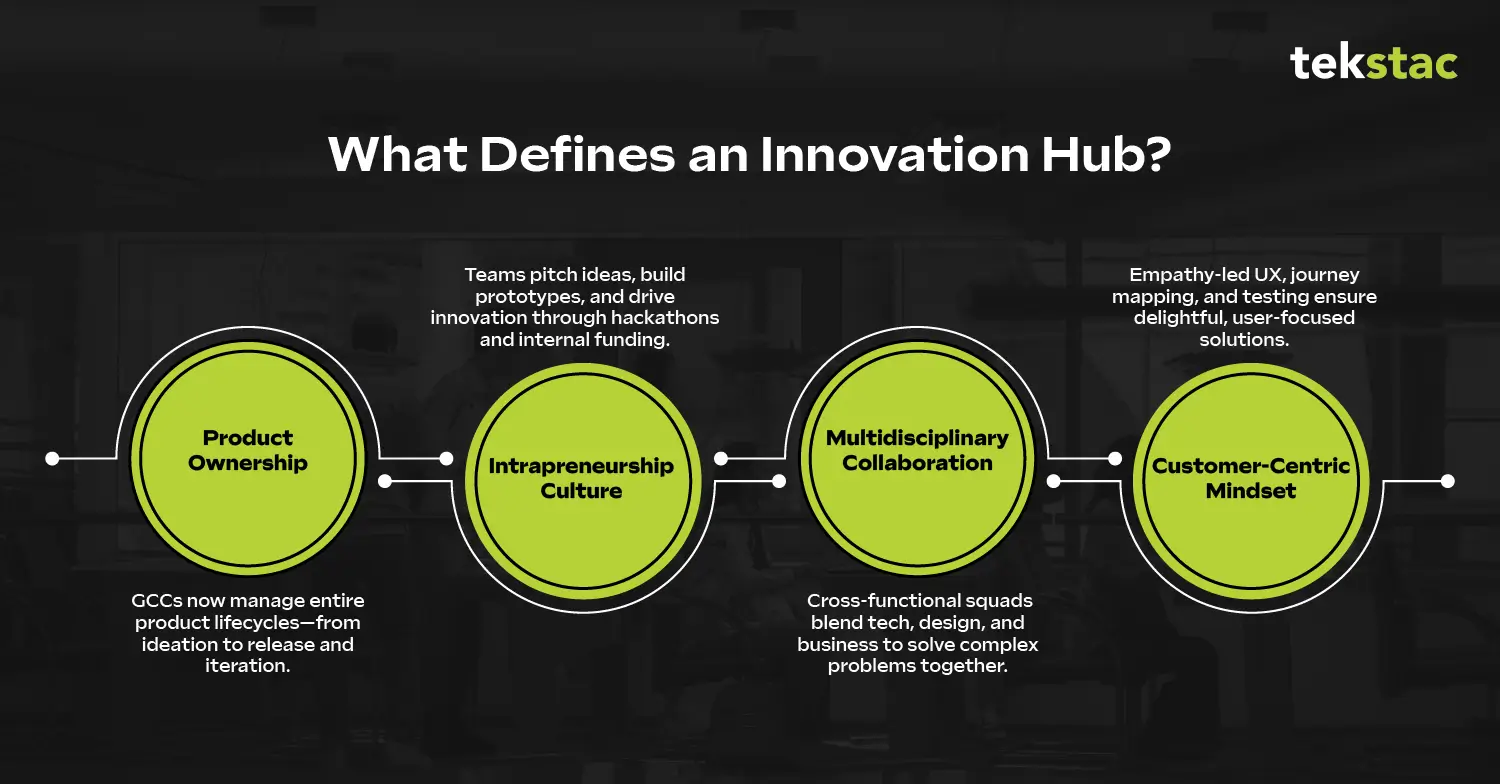
GCCs are no longer just contributors to product development- they own product lifecycles. From ideation to release and iteration, they manage global digital platforms and services.
Innovation hubs promote a culture of intrapreneurship. Teams within GCCs are encouraged to identify problems, pitch solutions, and prototype products. Internal hackathons, innovation funds, and sandbox environments fuel this ecosystem.
Successful innovation hubs bring together diverse talent- engineers, designers, marketers, and business analysts, to collaborate on solving complex problems. GCCs are building integrated squads that mimic startup-like environments.
GCCs are investing in ethnographic research, journey mapping, and UX testing to ensure solutions are not just functional but delightful. Empathy-led design is now a core philosophy.
Target’s GCC in Bangalore is a prime example of a successful innovation hub. The center has developed supply chain optimization algorithms, AI-driven product recommendations, and mobile app enhancements that have directly impacted customer experience and revenue.
JPMorgan Chase’s global centers are leading the charge in blockchain experimentation, fraud detection algorithms, and personalized financial advisory bots- much of this driven by their offshore teams.
Philips and GE Healthcare have expanded their GCCs in India to include R&D labs. These centers are now responsible for building diagnostic imaging algorithms and digital health solutions that are deployed globally.
GCCs function as R&D engines when they run original research and development work, not just support existing product lines. Philips and GE Healthcare’s India GCCs, for example, build diagnostic imaging algorithms and digital health solutions deployed globally; output that originates in the GCC rather than being handed down from headquarters. This model works because GCC locations concentrate deep technical talent (data scientists, ML engineers, domain specialists) at a cost structure that supports sustained experimentation, not just one-off projects. The distinction from a delivery-focused GCC: R&D driven centers file patents, publish research, and own IP not just implementation tickets.
The transformation of GCCs into innovation hubs begins with leadership intent. CXOs must communicate a bold vision and empower their GCCs with the autonomy and budget to pursue it.
Hierarchical bottlenecks kill innovation. Successful CXOs are redesigning governance models to reduce dependencies and allow faster decision-making within GCCs.
Rather than evaluating GCCs on cost savings or SLA adherence, CXOs are introducing innovation KPIs like patents filed, products launched, adoption metrics, and user satisfaction scores.
Innovative GCCs have direct access to business stakeholders and markets. CXOs are facilitating this by embedding GCC leads into global leadership forums and ensuring seamless collaboration across regions.
Despite the momentum, certain challenges persist:
Many stakeholders still view GCCs as cost-saving mechanisms. Changing this narrative requires constant internal communication, success stories, and leadership advocacy.
As the demand for digital skills rises, so does attrition. Innovation hubs need to create compelling employee value propositions, offering growth, global exposure, and impact.
Some GCCs struggle with understanding customer needs due to geographical distance. Investing in market immersion programs, customer interviews, and real-time feedback loops is essential.
GCCs are poised to lead AI experimentation and automation at scale. From generative AI applications to process re-engineering bots, these hubs will be central to intelligent enterprise evolution.
Many GCCs are now tasked with designing ESG dashboards, carbon accounting systems, and green supply chain solutions. Innovation is no longer just about tech, it’s about purpose.
The next frontier is not just about innovation within GCCs but orchestrating innovation across ecosystems– startups, academia, government, and other corporate partners.
The shift from cost center to innovation hub is not a trend, it’s a strategic imperative. For CXOs, the question is no longer whether GCCs can drive innovation, but how to scale and sustain this transformation.
Enterprises that embrace this shift will enjoy faster time-to-market, deeper customer insights, and resilient digital platforms. More importantly, they will tap into the collective brilliance of global talent to solve problems that matter.
GCCs are no longer the back office. They are the brain trust.
1. How do GCCs evolve from execution centers to innovation hubs?
GCCs transition from execution centers by investing in advanced technologies, skilled talent, AI-driven automation, engineering excellence, and strategic ownership. Instead of focusing only on operational efficiency, they lead product innovation, digital initiatives, and enterprise transformation.
2. What role does AI play in GCC transformation?
AI enables GCCs to automate repetitive tasks, improve decision-making, enhance software development, strengthen cybersecurity, and personalize customer experiences. By integrating AI into core operations, GCCs increase productivity while accelerating enterprise-wide innovation.
3. What makes GCCs innovation hubs today?
Global Capability Centers (GCCs) have evolved beyond support functions to become innovation hubs by driving AI adoption, product engineering, digital transformation, R&D, and data analytics. Modern GCCs contribute directly to business growth, accelerate innovation, and help enterprises build competitive capabilities across global markets.
4. What defines a successful GCC innovation strategy?
A successful GCC innovation strategy combines strong leadership, AI adoption, continuous workforce upskilling, engineering excellence, cross-functional collaboration, measurable business outcomes, and investment in emerging technologies to deliver long-term enterprise value.
AI-powered proctoring is the technology that makes virtual assessments credible at enterprise scale — monitoring learner behavior in real time, flagging suspicious activity across webcam, screen, and audio channels, and generating a verifiable Trust Score for every assessment attempt.
As organizations scale training across geographies and job roles, one challenge consistently surfaces for L&D leaders: how do you verify that the person behind the screen is genuinely learning — and not gaming the result?.
AI-powered proctoring leverages artificial intelligence to monitor video and web activities of learner behavior during assessments and flag suspicious activities in real time.
Tekstac’s proctoring suite includes:
But Tekstac’s solution goes beyond surveillance- it delivers data-backed trust by giving L&D teams evidence they can act on.
AI-powered proctoring bridges the trust gap in virtual assessments by making it technically difficult to cheat without detection. Where digital learning creates loopholes.
All of this raises a key concern: How do you ensure the person behind the screen is truly learning, not just performing?
Tekstac’s AI Proctoring Platform technology is purpose-built to answer that.
According to the 2025 LinkedIn Workplace Learning Report, 94% of companies say upskilling and reskilling are vital for business success, yet 62% of L&D leaders cite “assessment credibility” as a top challenge in virtual learning environments.
In a world where training data influences promotions, hiring, role-fitment, and project allocation, unreliable assessment results can undermine the entire learning initiative.
This is exactly why Tekstac’s AI-Powered Proctoring exists, to bridge the trust gap between learning and performance by making assessments smart, secure, and credible.
Upgrade your employee training and development strategy with AI-powered insights — book a quick demo.
Integrated AI-powered proctoring delivers six measurable advantages over bolted-on third-party tools: built-in activation at every assessment type, verifiable video submissions, learner-transparent fairness signals, HR-usable credibility data, ethical deterrence without punishment, and configurable oversight matched to assessment criticality.
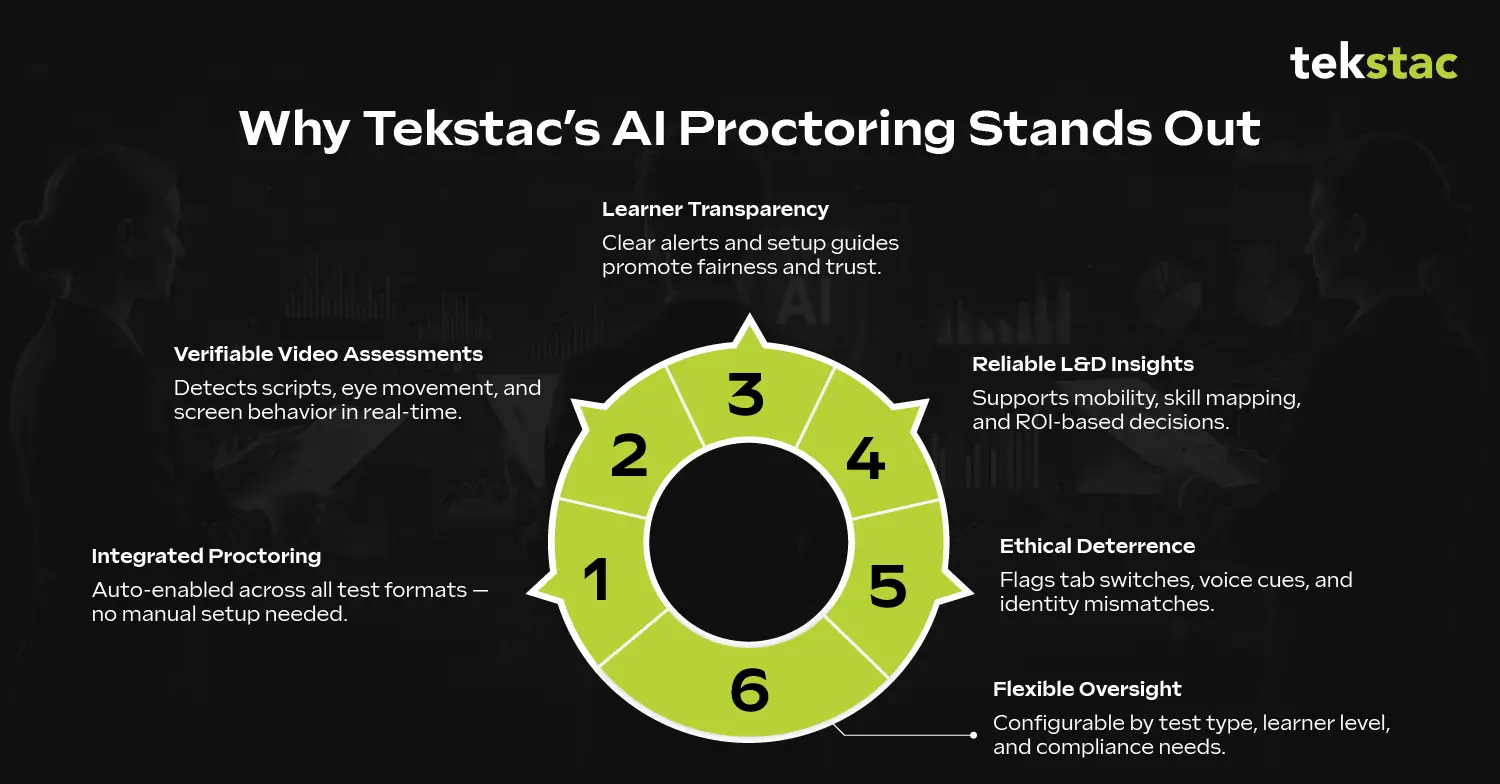
Many platforms add third-party proctoring as a post-process. Not Tekstac. Proctoring is deeply integrated within the assessment engine.
Every time a learner attempts a test, whether it’s MCQs, assignments, coding tasks, or video submissions. Tekstac automatically activates AI-based monitoring. There’s no manual step required.
What organizations get:
This allows managers to review learner behavior in context and take fair, confident decisions based on facts, not assumptions.
Video-based assessments are increasingly popular for evaluating real-world capabilities like communication, problem-solving, and tech fluency.
But are they truly reliable when done remotely?
Tekstac enhances video assessments by:
This ensures that what appears as a confident video submission is genuinely the learner’s work, not a scripted or assisted performance.
Trust doesn’t only go one way; learners need to feel the system is fair too.
Tekstac empowers learners by:
This approach builds a culture of accountability, where learners are motivated to perform well because their honest effort will be recognized and rewarded.
A certificate means nothing without credibility. But when proctoring data is reliable, it becomes a decision-making tool.
Here’s how:
With Tekstac’s AI-Powered Proctoring, assessment scores carry real weight — not just as symbols of completion, but as proof of competence. That data becomes even more powerful when connected to skills insights — giving L&D leaders a unified view of capability gaps, assessment performance, and role-readiness across the entire workforce.
When learners know monitoring is inactive, assessment of integrity degrades. A 2025 SHRM study found that 43% of employees were admitted to searching for answers during unproctored online tests. Intelligent deterrence not punishment — is the most effective response.
These features act as non-intrusive deterrents, encouraging learners to give their best effort, knowing there’s intelligent oversight in place.
One assessment doesn’t fit all. A coding challenge for entry-level engineers requires different oversight compared to a leadership evaluation.
Tekstac offers configurable proctoring based on:
This ensures that proctoring isn’t rigid, it’s custom-fit for your organization’s structure and values.
In the digital age, skill development is not a one-time event, it’s a continuous journey. But for that journey to mean something, there needs to be trust- trust in data, trust in results, and trust in the learner.
Tekstac’s AI Proctoring makes that trust possible.
By offering built-in proctoring, intelligent violation tracking, reliable video evaluation, and transparent learner engagement- Tekstac ensures that every assessment is fair, evidence-based, and business-aligned.
So, the next time you evaluate someone’s readiness for a role, a promotion, or a new project, you won’t just see scores, you’ll see truth.
Don’t let questionable results shape your business decisions.
See Tekstac’s AI-Powered Proctoring in Action – Book a Free Demo to Experience Trusted, Secure, and Fair Assessments.
1. What is AI-powered proctoring in employee training?
AI-powered proctoring in employee training is the use of artificial intelligence to monitor learner behavior during online assessments — tracking webcam activity, screen usage, audio signals, and content patterns to detect and deter dishonesty. Unlike traditional invigilation, it operates automatically at scale, generating a Trust Score for each learner that L&D and HR teams can use for promotion, certification, and role-fitment decisions.
2. How does AI-powered proctoring work in a virtual assessment?
AI-powered proctoring works by activating multiple monitoring layers simultaneously when a learner begins an assessment: webcam tracking detects face identity and multiple persons, screen monitoring flags tab switching and unauthorized applications, audio detection identifies external voices or prompts, and copy-paste detection matches submitted content against known web sources. Each violation is timestamped, severity-rated, and consolidated into a single learner of Trust Score.
3. How does remote AI proctoring detect suspicious learner behavior?
Remote AI proctoring detects suspicious behavior through continuous pattern analysis across three channels. Visually, it uses face detection to flag identity mismatches, multiple persons in frame, or prolonged eye movement away from the screen. Behaviorally, it monitors tab switching frequency, unauthorized application launches, and unusual response timing that may indicate external assistance. Content-wise, it analyzes pasted text against web sources and AI-generated output patterns. Each signal is severity-rated in real time — so reviewers see not just that a violation occurred, but how serious it was and when.
4. What are the data privacy implications of using AI proctoring tools?
AI proctoring tools collect sensitive personal data biometric identifiers, screen recordings, audio feeds, and behavioral patterns — which places them under data protection regulations including GDPR, India’s DPDP Act 2023, and enterprise data governance policies. Key implications for organizations are learner consent must be obtained before monitoring begins, recorded data must be stored with defined retention limits and access controls, and proctoring providers must be able to demonstrate compliance with applicable privacy frameworks. Tekstac addresses this through configurable proctoring modes that allow organizations to adjust monitoring scope based on compliance requirements — ensuring oversight does not come at the cost of learner data rights.
5. Can AI proctoring detect ChatGPT or AI-generated answers?
Yes. Modern AI proctoring platforms including Tekstac flag AI-generated content patterns by analyzing writing style consistency, pasting behavior, and response timing. Copy-paste detection also traces submitted text against known AI tool outputs. As generative AI adoption grows, AI-generated content detection has become a core proctoring capability for enterprise L&D teams.
Your best engineer just left.
Again. Official reason?
“Looking for better growth opportunities.” But let’s be real, they just couldn’t see a future here.
Now the team’s left picking up the pieces, and you’re stuck trying to figure out promotions with half-baked feedback and gut calls. You’re hoping you’re getting it right, but deep down, you’re not sure.
And it’s not just about losing one person. It hits harder, and morale dips. Work slows down.
The problem?
Most career progression plans are just broken. Too much guesswork. Too much politics. Not enough clarity or fairness.
So yeah, it’s not just a one-off. It’s a pattern. And if nothing changes, the best people will continue to walk out the door.
A career progression plan is a structured roadmap that defines how an employee can grow within an organization mapping current skills, identifying capability gaps, and outlining the steps, milestones, and support needed to reach the next role or level of responsibility. It differs from a job description (which defines a current role) and an annual review (which evaluates past performance). According to Gartner, only 46% of employees feel supported in growing their careers at their organization, which means for most companies, career progression exists in name only. Done well, a career progression plan aligns individual ambition with business capability needs, reduces reliance on external hiring, and is one of the most measurable tools for improving long-term retention.
Here’s what’s happening in your organization under the guise of employee career development:
Gallup estimates that replacing an employee in a technical role cost around 80% of their annual salary, and that figure excludes the compounding costs: stalled projects, knowledge loss, and the morale hit the team left behind.
It’s time to treat career development like a well-engineered system—methodical, data-driven, and continuously evolving.
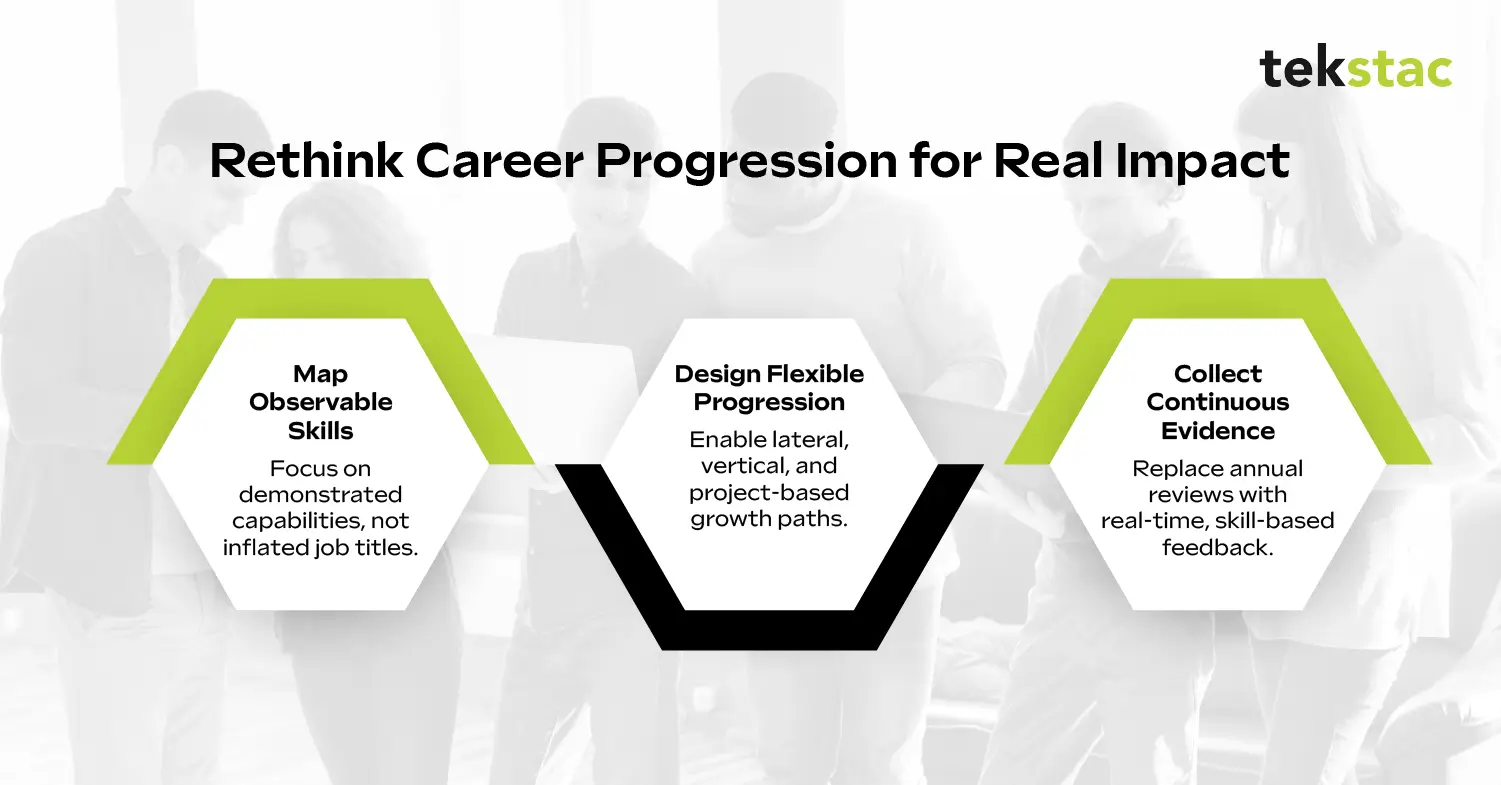
Define what people can do—don’t rely on vague titles.
People don’t grow in straight vertical ladders—they flourish across diverse, evolving career pathways.
Why evaluate performance once annually when engineers are evolving daily?
This is not a nice-to-have. It’s a competitive business advantage when engineers’ growth aligns with organizational growth goals.
Strategic workforce intelligence: Use real-time, anonymized skill data to answer critical questions: “Are we technically ready for our next 18-month roadmap? Who’s closest?“—without gut guessing.
When leaders leave, don’t scramble. Plan ahead.
Ditch HR vanity metrics—track indicators reflecting real system health and strategic impact.
Forget generic courses—build learning into everyday work.
The best engineers don’t just want a title; they want a Career Progression Plan that’s visible, practical, aligned to impact, and personally meaningful. Help them see the art, science, and movement of their career. Do that, and you’ll stop losing great people to uncertainty.
Building a career progression plan that holds up at scale requires more than a spreadsheet and an annual review cycle. Tekstac is an AI-powered skills intelligence platform used by enterprise teams at IBM, PwC, and Capgemini to map role-aligned skill requirements, track capability development in real time, and connect learning investment to measurable business outcomes. If career progression at your organization is still running on gut calls and guesswork, Tekstac gives you the infrastructure to make it systematic. [Request a personalized demo →]
1. What should a career progression plan include?
A strong career progression plan includes: the employee’s current skill profile, the skills required for the next role or level, a clear gap analysis, defined milestones with timelines, the development resources available (training, mentoring, projects), and a review cadence. Plans without defined milestones and gap analysis are not progression plans they are intentions.
2. Why do most career progression plans fail?
Most career progression plans fail because they rely on visibility over performance (the loudest employees get promoted), annual reviews over continuous evidence, and manager judgment over structured data. Without a system to capture real skill development over time, progression becomes subjective, and subjective progression drives attrition.
3. How does a career progression plan improve employee retention?
Career progression plans improve retention by giving employees a visible, credible path forward. According to LinkedIn’s Workforce Learning Report, employees who make an internal move are 75% more likely to stay long-term compared to 56% for those who don’t. which means a functioning progression plan is one of the most cost-effective retention tools available.
4. What is the difference between a career ladder and a career progression plan?
A career ladder is a fixed, vertical hierarchy each rung represents a promotion to a higher title. A career progression plan is more flexible: it accommodates lateral moves, diagonal growth (e.g., a developer in building product thinking), and role evolution over time. Career ladders reward tenure; career progression plans reward capability.

Learning outcomes define what learners should know, understand, or be able to demonstrate after completing a course, certification, or corporate training program. Unlike learning objectives, which focus on what instructors intend to teach, emphasize measurable learner achievements. They help organizations evaluate training effectiveness, identify skill gaps, improve employee performance, and demonstrate learning ROI. Whether you’re designing an employee training program or evaluating workforce readiness, clearly defined learning outcomes provide the foundation for measurable business success.
Learning outcomes are the specific skills, knowledge, attitudes, and competencies that a learner is expected to acquire as a result of a learning experience. Unlike learning objectives, which describe what the instructor aims to teach, learning outcomes describe what the learner can do after the training. These outcomes are measurable and actionable, making them essential for evaluating learning effectiveness.
Examples of learning outcomes include:
Although the terms learning outcomes and learning objectives are often used interchangeably, they serve different purposes in education and corporate training. Learning objectives describe what instructors intend to teach, while learning outcomes focus on what learners can demonstrate after completing the training. Understanding this distinction helps organizations design measurable training programs, assess learner performance, and align learning initiatives with business goals.
| Learning Objectives | Learning Outcomes |
|---|---|
| Instructor-focused | Learner-focused |
| Broad | Measurable |
| Course design | Performance evaluation |
| Teaching plan | Demonstrated skills |
Bloom’s Taxonomy is a widely recognized framework for creating measurable learning outcomes. It helps educators and L&D professionals use clear, action-oriented verbs to define what learners should know, understand, and demonstrate after training. By aligning learning outcomes with Bloom’s Taxonomy, organizations can design more effective assessments, accurately measure skill development, and connect training outcomes to business performance and ROI.
Organizations invest millions in learning and development each year. But without concrete measurement, these initiatives risk becoming superficial. Here are some key reasons why measuring learning outcomes is critical:
Measuring outcomes helps determine whether a training initiative led to improved skills or behavior change. This validation ensures that learning is meaningful, not just procedural.
Assessment of learning outcomes helps identify skill gaps, enabling personalized learning paths. For instance, if a learner struggles with a certain concept, targeted content or support can be introduced. Over time, this leads to continuous improvement in both learning content and learner performance.
When learning outcomes are tied to business objectives (like improved customer satisfaction, increased productivity, or reduced error rates), it creates alignment between individual development and organizational success.
In today’s data-driven world, L&D departments are increasingly accountable for delivering measurable results. Outcomes-based measurement offers transparency and builds credibility with stakeholders.
You can’t demonstrate ROI without data. Measuring learning outcomes provides the metrics needed to correlate learning interventions with business impact, making it possible to justify or even expand the L&D budget.
Traditional learning measurement methods, such as tracking attendance and course completion, are giving way to more sophisticated, data-rich approaches. Organizations now leverage data analytics to capture granular insights into learner performance, progression, and engagement.
This shift is fueled by the increasing availability of digital learning platforms and AI-driven tools that collect, process, and analyze learning behavior in real-time. Predictive analytics, adaptive assessments, and learning experience platforms (LXPs) are transforming how we measure success. By using data to continuously evaluate and refine learning interventions, organizations ensure that every learning dollar is spent strategically.
According to a Deloitte survey, 61% of high-performing organizations use data analytics to support learning strategy development- more than double the rate of their lower-performing peers.
The ultimate goal of measuring learning outcomes is to prove—and improve—return on investment (ROI). Here’s how outcomes data directly impacts ROI:
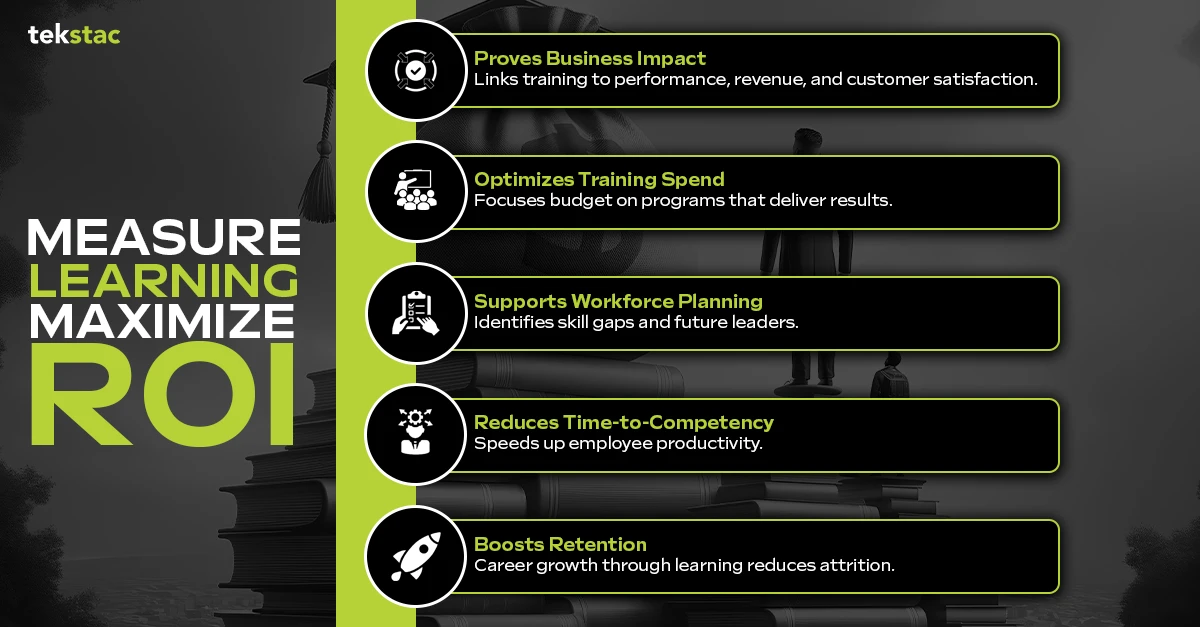
Clear outcomes link learning efforts to key business metrics such as employee performance, customer satisfaction, and innovation speed. For example, improved sales training outcomes can be measured against increased revenue or shorter sales cycles.
Outcome data helps identify high- and low-performing programs, enabling better budget allocation. By cutting ineffective initiatives and scaling successful ones, organizations maximize learning ROI.
By measuring outcomes, organizations can identify future leaders, skill shortages, and team strengths. This enables proactive talent management and succession planning.
Effective training backed by measurable outcomes shortens the time it takes for employees to reach full productivity, accelerating ROI.
Employees who see real career progression through skill development are more engaged and less likely to leave, significantly reducing attrition costs.
Many organizations still rely on traditional methods like attendance tracking, course completion rates, or post-training feedback forms. While useful for gauging engagement or satisfaction, these methods do not assess skill application or knowledge retention.
Modern approaches include:
When you have clear data on what works and what doesn’t, you can make better decisions about content, delivery methods, and resource allocation.
Learners who see a direct link between their efforts and career growth are more motivated. Measurable outcomes act as milestones that validate progress.
A McKinsey study reveals that only 40% of companies align learning strategies with business objectives, underscoring the need for clearer measurement frameworks that connect learning outcomes to performance and ROI.
A Harvard Business Review report shows that companies that effectively measure and act on learning data are 24% more profitable than their peers.
In a fast-changing market, the ability to rapidly upskill or reskill talent is a competitive advantage. Measuring learning outcomes helps build this agility.
According to a LinkedIn Learning report, 73% of L&D professionals say their leadership wants them to connect learning to business outcomes. Accurate measurement makes this possible.
Despite its importance, outcome-based measurement is not without challenges:
This is where intelligent learning platforms like Tekstac come into the picture.
Tekstac is a 360° skilling platform that integrates learning, assessments, and analytics to provide a holistic view of learner development. Unlike traditional LMS or LXPs, Tekstac is designed to focus on outcomes, not just activities. Its learning engine is built to simulate real-world scenarios and projects that mirror actual workplace challenges.
Tekstac assessments cover multiple formats, including auto-evaluated coding tasks, case-study evaluations, scenario-based MCQs, and AI-proctored video assessments. Each assessment is role-mapped, which ensures that learners are tested on job-relevant skills. This results in more precise measurement of learning outcomes and more actionable insights.
Tekstac’s assessment engine generates deep insights into skill proficiency, growth trajectory, and role readiness. For organizations, this means they can:
Ultimately, Tekstac doesn’t just help you assess what learners know- it helps you understand what they can do. And when learning outcomes are that clear, ROI follows naturally.
Turn learning outcomes into measurable business results with Tekstac. Discover how our AI-powered skills assessments, learning analytics, and role-based learning paths help organizations validate workforce capabilities and maximize training ROI. Book a demo to see how Tekstac can transform your learning and development strategy.
1. What is the purpose of measuring learning outcomes?
Measuring learning outcomes helps organizations evaluate training effectiveness, identify skill gaps, and link learning to business results and ROI.
2. What are the best platforms for tracking learning outcomes in online courses?
The best platforms for tracking learning outcomes in online courses include learning management systems (LMS), learning experience platforms (LXP), and skills assessment platforms such as Tekstac. These platforms provide assessments, analytics dashboards, progress tracking, and measurable insights into learner performance and skill development.
3. What is the difference between learning objectives and learning outcomes?
Learning objectives describe what training intends to teach; learning outcomes define what learners can actually do afterwards.
4. How do learning outcomes impact ROI?
They provide measurable evidence of performance improvement, enabling better budget allocation and business impact analysis.
5. Which companies offer software solutions to measure learning outcomes in corporate training?
Several companies offer software solutions to measure learning outcomes in corporate training, including Tekstac, Degreed, Cornerstone, Docebo, and other enterprise learning platforms. These tools combine assessments, analytics, skill tracking, and performance insights to help organizations evaluate training effectiveness and business impact.
Employee retention has become a critical challenge for organizations in 2026. While market fluctuations and digital disruption continue to reshape the workplace, employee engagement, career growth, and workplace experience increasingly influence whether people stay or leave.
Gallup’s latest workplace research highlights the scale of the challenge, reporting that one in two U.S. employees is actively watching for or seeking a new job. For leaders, this makes employee retention more than a workforce metric; it is a strategic priority for maintaining engagement, productivity, and long-term talent stability.
The crisis deepens when you realize that it is not industry-specific. Healthcare, tech, finance, and education are all experiencing record-breaking turnover.
Employees are not just checking out. They are burning out, making employee retention harder than ever. Employees attribute their mental health struggles directly to their workplace. Poor managers and toxic cultures are cited more often than any other factor.
AI Insight: Predictive analytics can now forecast employee attrition up to 6 months in advance based on behavioral and engagement data.
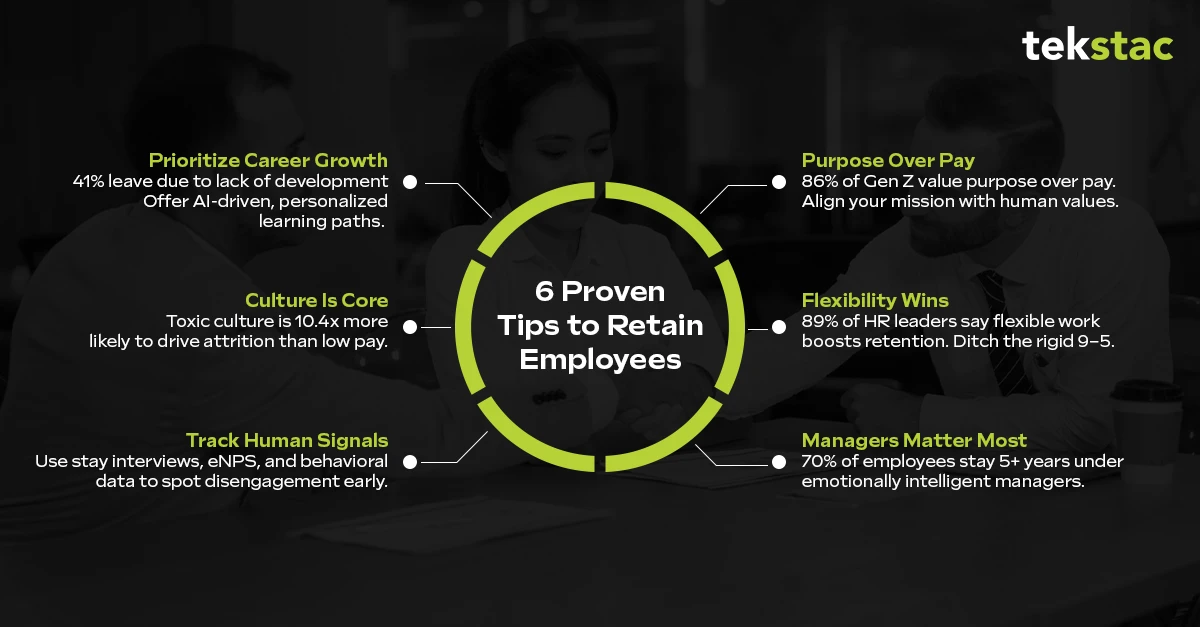
The smartest leaders in 2026 know one truth. People no longer work just to survive, they work to matter. You cannot build loyalty or ensure employee retention with salaries alone. People want to be part of something that reflects who they are.
If your company stands for nothing beyond revenue, you will attract mercenaries. But if it stands for something meaningful, you will build an army of believers.
The traditional 9-to-5 office model has become obsolete. Rigid work policies are no longer sustainable, as they contribute to higher attrition rates.
Consider these key insights:
In 2026, the role of managers has evolved beyond traditional oversight. They are now pivotal in shaping employee experiences and retention. Emotionally intelligent leadership is no longer a luxury but a necessity.
Leadership must transition from authority-based models to empathy-driven approaches. Managerial KPIs should encompass team well-being alongside performance metrics.
In today’s workplace, effective leadership and employee retention are intrinsically linked.
Employees are more likely to stay when they can see a clear path for growth within the organization. By connecting skill development, career progression, and internal mobility, companies can strengthen employee retention while building future-ready talent.
Investing in personalized development strategies not only enhances employee satisfaction but also significantly reduces attrition rates.
In 2026, culture isn’t a side note. It’s the core strategy. You can’t patch a toxic environment with perks or pay raises.
When people sense distrust, bias, or disconnection, they leave.
A toxic workplace is 10.4 times more predictive of attrition than low compensation.
In 2026, data doesn’t just belong to customers. It belongs to employees too. Smart organizations are using behavioral analytics and AI to identify disengagement before it becomes departure.
Use data for
Retention isn’t a mystery. It’s a model. And Tekstac is the platform turning this model into results. Tekstac enables organizations to personalize growth, identify skill gaps, and align learning with business outcomes through AI-powered career mapping, immersive Practice Labs, and performance dashboards that connect development with delivery.
Tekstac stands at the forefront of AI trends in skilling, bringing the latest innovations in adaptive learning, personalized upskilling, and real-time skills tracking into the corporate environment.
It supports the broader digital and talent transformation in L&D, helping organizations shift from static training modules to dynamic, scalable, and employee-centered learning ecosystems.
Tekstac is not just a training solution. It is a talent ecosystem. With intelligent analytics, it gives leaders real-time clarity on performance, progression, and potential.
The game has changed. Employees are no longer waiting for your strategy. They are evaluating it. If your systems are rigid, if your managers are untrained, if your culture is performative, your best people will walk.
Now is not the time for temporary fixes. It’s the time for transformation
These are not trends. These are the new table stakes. If you want to retain, you need to become worthy of retention.
1. How do I calculate employee retention?
Employee retention is calculated by dividing the number of employees who remain at the end of a period by the number at the start, then multiplying by 100. A higher percentage indicates stronger retention.
2. What are the benefits of implementing a robust employee recognition program?
A strong employee recognition program improves engagement, motivation, job satisfaction, and loyalty. Regular recognition helps employees feel valued, strengthens workplace culture, and improves employee retention.
3. What drives employee retention?
Key drivers include purpose-driven work, flexible policies, career growth, supportive managers, and a positive company culture that values employee well-being.
4. How to measure employee retention rates using SaaS platforms?
SaaS platforms can measure employee retention by tracking workforce data, turnover trends, tenure, engagement, and retention rates through centralized dashboards and real-time workforce analytics.