
We are in 2026, and one may ask, “Are IT certifications still credible?”. A thought-provoking example surfaced recently: someone with the title “Specialist in Digital Transformational Technology” proudly shared completing a basic AI prompting course. Sounds odd, right?
This highlights a growing challenge in IT upskilling: too many professionals chase easy online certificates just to look credible on paper.
A smart IT professional focuses on certifications that strengthen their foundation, broaden their capabilities, and prepare them for real-world challenges. Employers are increasingly able to distinguish between superficial credentials and actual competency.
Choosing the right certifications becomes easier when guided by skill insights that highlight the most in-demand capabilities and evolving workforce needs.
With that in mind, here are 10 top paying IT certifications in demand for 2026.
IT certifications are professional designations offered by organizations and companies to validate your expertise in specific skills, tools, and IT knowledge areas. They provide structure to learning and upskilling, ensuring that professionals gain the confidence to apply their knowledge in real-world scenarios.
IT certifications can help professionals validate in-demand skills, strengthen their credentials, and position themselves for high-paying jobs in fast-growing technology fields. In 2026, they help IT professionals for various reasons listed below:
Technology roles are changing faster as AI reshapes the skills organizations need. The World Economic Forum identifies AI and big data, networks and cybersecurity, and technological literacy among the fastest-growing skill areas through 2030 making targeted certifications increasingly relevant for keeping technical capabilities current.
Along with skills, IT certifications also improve paychecks. Professionals with certifications in high-demand fields like cybersecurity and cloud computing also command top-tier salaries.
Even if a job doesn’t require certifications, earning one can increase the chances of promotions compared to peers or help employees land their dream role. Organizations can also ensure that employees possess the right skills to adapt to new IT trends.
According to IDC, the overall Indian public cloud services market is expected to reach $30.4 billion by 2029. This shows that cloud computing is a skill in high demand. AWS, for example, now offers certifications and micro credentials spanning cloud, security, machine learning, and agentic AI. Some of the cloud certifications one can do include,
The below certifications position employees as the go-to experts for designing and managing interconnected on-premises and cloud systems. These are important for businesses embracing hybrid setups for flexibility.
As the IT training and certifications market is growing at a rapid pace, data engineering has become increasingly important for building reliable data pipelines, analytics systems, and AI workloads. Certifications in data engineering, machine learning, and AI help professionals build the technical foundation required for this shift.
One of the top certifications in the IT industry is Gen AI. It is moving beyond prompt-based experimentation toward applications and autonomous AI agents. Certifications focused on generative AI, AI application development, and agentic AI can help professionals build, deploy, and manage AI-powered solutions. Some of the popular certifications are:
AI and Machine Learning have become the norm, and being certified in this field enables employees to lead challenging projects involving deep learning, NLP, or predictive analytics in high-demand industries.
Certifications in this area validate the ability to manage enterprise risk, design security strategies, and align cybersecurity initiatives with business goals.
Pro tip: This isn’t something to rush. The scope is wide and the depth is real. A six-to-twelve-month preparation window allows for steady progress.
With stricter regulations and growing focus on accountability, organizations need professionals who understand governance frameworks, audits, and compliance requirements. These IT certifications demonstrate expertise in evaluating IT controls, managing risk, and ensuring regulatory alignment—making them valuable for senior and advisory roles.
Despite the rise of cloud and AI, strong networking fundamentals remain critical. Certifications in this area validate the ability to design, manage, and troubleshoot enterprise networks that support large-scale digital operations and hybrid environments.
Project and program management certifications validate leadership skills in planning, coordination, risk management, and delivery.
Enterprise architecture plays a critical role in aligning technology with long-term business strategies. Certifications in this domain validate a professional’s ability to design scalable systems, guide digital transformation initiatives, and make architecture-level decisions that impact the entire organization.
Earning these certifications provides several benefits, especially for employee career development, in the following ways:
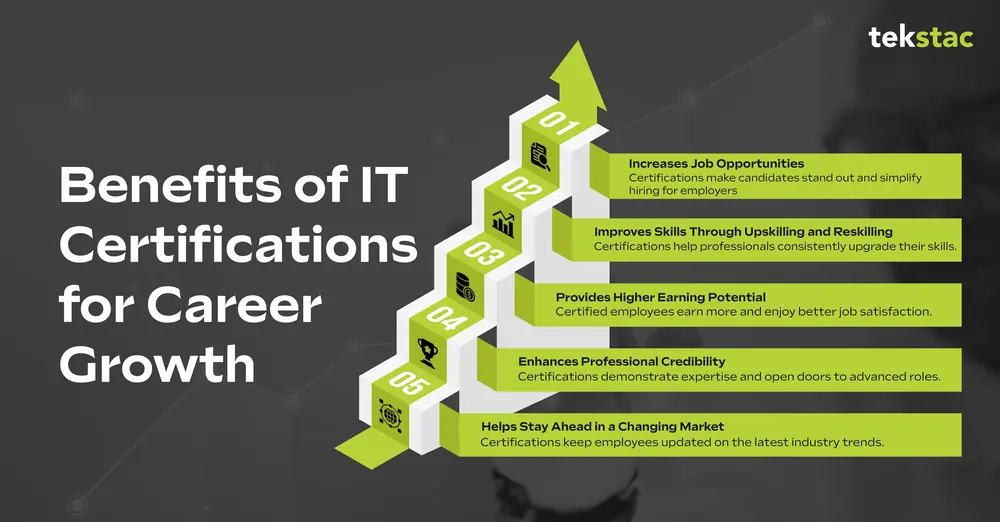
Employers are always looking for candidates with IT certifications because it shows they’re competent and ready for specific roles. It further helps recruiters identify top talent, especially in a competitive market where 82% of employers face a skill gaps. Ultimately, hiring certified professionals will reduce the time spent training new employees.
For employees, 16% of IT professionals reported landing a new job because of their certifications, while 35% of IT decision-makers acknowledged that certified staff add value by simplifying the hiring process.
Most IT certifications validate an employee’s ability to solve real challenges. With 75% of professionals pursuing certifications to increase technical expertise, employers benefit from a workforce that consistently upgrades its skills.
Certified professionals help reduce skill gaps within teams and increase the organization’s overall competency.
This makes it easier to implement new technologies and maintain a competitive edge in the market.
Certified professionals earn 20% more annually than their non-certified peers, and 60% report an improvement in the quality of their work after obtaining certification. Organizations offering better pay to certified employees also benefit from increased loyalty, retention, and job satisfaction.
Earning IT certifications helps employees demonstrate their expertise and projects.
For example, certifications like Microsoft Azure Solutions Architect Expert or Cisco CCNP demonstrate proficiency and open opportunities for advanced roles.
These include positions like Cloud Architect, Network Engineer, or Cybersecurity Specialist, where specialized knowledge is essential.
Certifications help employees stay current on the latest tools and techniques, ensuring they’re always in tune with industry changes. This means certified professionals bring fresh, updated insights to the workplace, helping organizations stay ahead.
For employers, this expanded network and knowledge base translate into better service, increased customer satisfaction, and increased innovation. It is a win-win for both the employee and the organization.
When do IT certifications become essential for your employees? These specific challenges listed below are a clear sign to explore IT certifications:
If your organization is having trouble completing projects on time or dealing with recurring technical issues, it may be a sign that employees lack the required skills. IT certifications address these gaps by equipping your team with up-to-date cybersecurity, cloud computing, or software development knowledge.
The IT industry is being reshaped at a pace never seen before, and organizations that cannot keep up may be left behind. If your teams struggle to adopt or leverage emerging technologies, certifications can bridge the gap. Certified professionals gain an in-depth understanding of industry best practices and provide solutions to organizational challenges.
Certifications can prove your team’s expertise if you’re losing business or struggling to build trust with clients. These certifications, along with experience, can be highlighted on your website, LinkedIn, or marketing materials to reassure clients that your workforce is capable and qualified to handle their needs.
Certified team members make it much easier to shift to new specialist areas such as machine learning, DevOps, or cloud computing. This ensures that the employees have clear learning paths with hands-on practice when resolving new, complex domains.
Opportunities for professional development are valued among employees. If your organization struggles to retain talent, providing support for certifications, such as reimbursing costs or providing study time, would also increase employee satisfaction. Such initiatives would not only enhance individual performance but also prove that your organization is committed to the career growth of its employees.
Traditional learning and training methods may not tie the learning to business outcome. To bridge the skills gap smarter, organizations need a platform packed with industry-relevant IT certifications and skill development programs. Tekstac has successfully upskilled 1 million+ professionals with 500+ learning paths.
Its customizable library of certifications and training resources ensures your workforce possesses the required skills in 2026 and beyond. You can also enjoy AI-driven personalization, real-world projects, and performance tracking. Book a demo to see how Tekstac can help your workforce build the skills needed for 2026 and beyond.
1. Which IT certifications are in demand for high-paying jobs in 2026?
Certifications in AI, machine learning, cloud computing, cybersecurity, data engineering, and enterprise architecture can help professionals build skills relevant to high-paying technology roles. Certification alone does not guarantee a higher salary, but it can provide a recognized way to validate specialized skills.
2. Is an AI certification enough to get an AI job in 2026?
No. An AI certification can validate foundational or specialized knowledge, but employers also look for hands-on experience, problem-solving ability, technical skills, and the ability to apply AI to real business problems. Combining certification with projects, labs, and practical experience can make the credential more valuable.
3. Should I choose a certification based on technology or the job role?
Choose based primarily on the role you want to perform. A certification should strengthen the skills required for that role rather than simply follow a popular technology. For example, someone targeting a data engineering role may benefit more from a data engineering certification than a broad cloud credential.
4. Are cloud certifications still valuable with the rise of AI?
Yes. AI workloads depend heavily on cloud infrastructure, data platforms, security, and scalable computing. Cloud skills therefore remain foundational even as organizations adopt generative AI and agentic AI.