
Talent mobility, or internal mobility, refers to the movement of workers across an organization, whether that’s between roles, departments, or locations. Typically, such mobility serves to achieve strategic objectives while also offering growth and development opportunities to employees.
In 2026, talent mobility trends are increasingly shaped by AI adoption, global work models, and the need for continuous upskilling—making internal mobility a strategic priority for organizations.
There’s plenty for leaders to consider as businesses continue to recover from the pandemic, grapple with the impacts of AI, and navigate a changing workforce with more global and hybrid work than ever—not to mention a need to achieve more with fewer resources. How do you determine where to focus your 2026 strategies? Moreover, how can you ensure you’re able to not only accomplish business goals but also grow employee retention and development?
The answer is a strong talent mobility strategy, and there are several trends to be aware of for 2026.
This next year continues the widespread recovery from the impacts of the COVID-19 pandemic, bringing a renewed focus on workforce strategy and the challenges and benefits of both remote and on-site work. An increasingly global workforce also means more opportunity for employees to change not only their role, but their location.
As AI gains traction, it changes both how companies operate and the work—or upskilling—required of employees. Reliance on AI can save costs and address some talent shortages, but won’t solve all economic challenges faced by companies.
These challenges can all be addressed by a robust talent mobility strategy. Read on to dive into the top six talent mobility trends to watch in 2026.
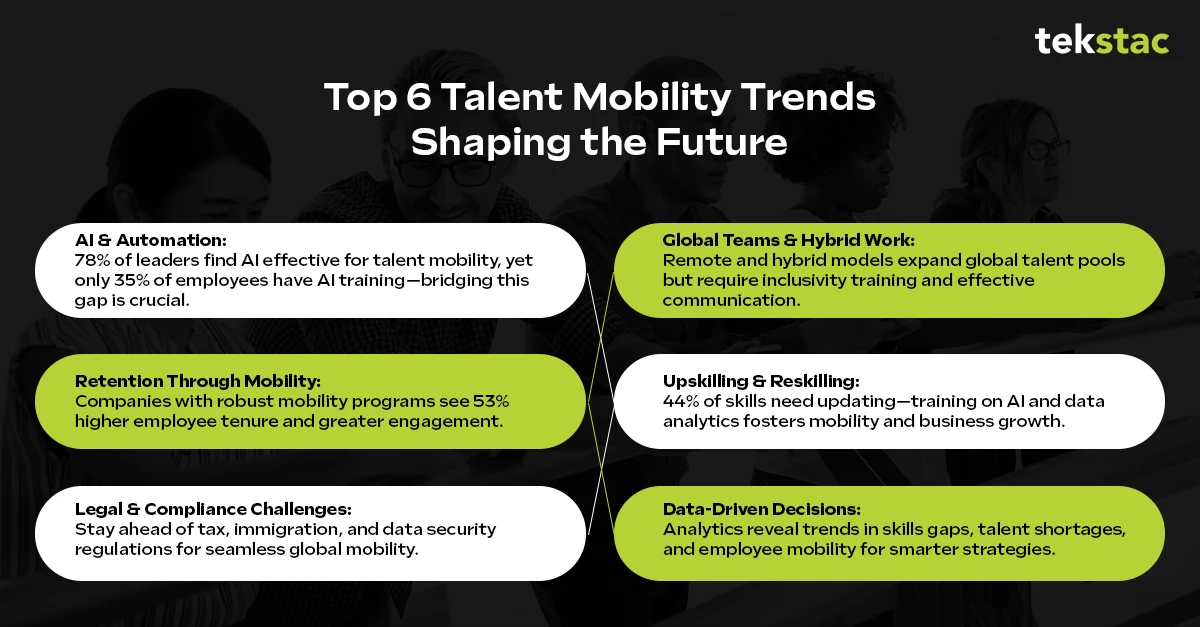
In recent years, AI has shown an ability to match employees with opportunities, with two thirds of leaders making investments in this area and 78% finding AI effective at identifying talent mobility opportunities.
Beyond simply identifying opportunities, the advancement of AI has also opened up new roles for employees who want to grow their AI skills. Although three quarters of companies are adopting AI, just 35% of employees have received AI training. This is a huge opportunity for companies looking to improve mobility.
At the same time, AI can reduce the need for human workers, forcing some employees into mobility they may not have sought on their own. Per the World Economic Forum, future advancements in technology could eliminate 83 million jobs, meaning these workers must pivot into something new.
When the pandemic thrust employees across the globe into remote work, companies were unprepared for this shift in working styles. Over time, however, many businesses have realized the benefits of a hybrid or remote model.
Not only does global and hybrid expand the talent pool by allowing companies to hire across the world, but building global teams opens up new opportunities to employees who may be interested in relocating.
However, there are challenges to managing global and hybrid organizations, so you must understand how to foster inclusivity and engagement. Train your teams on cultural differences to enable stronger partnership across geographies. Keep time zones in mind when scheduling meetings and deadlines, and focus on transparent communication to keep employees aware of all changes and updates.
A major benefit of talent mobility is its ability to increase employee retention. For instance, 64% of workers surveyed said that the opportunity to take on international assignments would encourage them to stay in their roles.
But mobility doesn’t have to be cross-continental to be impactful for retention. Companies with plenty of talent mobility options see 53% higher tenures as compared to those without. When employees feel they’re provided with ample opportunities for growth and development, they’re more likely to stay with the organization.
Only a third of organizations have a formal mobility program, but if you’re ready to create a strategy, consider investing in internal job marketplaces (or AI-driven matching), detailed career ladders and pathways, and training opportunities.
Nearly two thirds of company leaders report an increasing skills gap among employees, which negatively impacts mobility options. In other words, the ability for employees to move within the company relies upon training and skills development.
And the important skills are evolving—according to the World Economic Forum, an average of 44% of individuals’ skills will need to change, with more priorities placed on skills like AI, data analytics, and other systematic and technological knowledge.
Giving employees a chance to gain new skills will open up mobility opportunities while also meeting key business objectives.
Explore the latest Learning and Development Trends to stay ahead in crafting effective upskilling programs.
Assess the critical skills your teams may be missing, then consider developing internal training opportunities or partnering with skilling platforms or systems. Tekstac, for instance, provides an end-to-end platform to help your team develop and improve their skills.
It will pay off: companies with strong talent mobility programs not only see higher retention, but also 79% more employee promotions to leadership.
More and more, companies must stay abreast of ongoing changes to global mobility, tax, and immigration regulations. While there are several benefits to global mobility, these employees may trigger tax liabilities or risks companies must be aware of and compliant with.
Additionally, employment law varies across jurisdictions, which requires continued awareness of contract laws, pay and hour requirements, and worker classifications.
Plus, requirements for work visas and permits differ by country, with some countries being easier to move between than others. Staying informed of these details will be critical to a strong mobility strategy.
Finally, you’ll need to understand regional data privacy and security regulations and ensure compliance.
Leveraging data analytics to discover market trends, employee needs, mobility patterns, and other information can change the game for your talent mobility strategy.
Rather than relying on anecdotal details, use advanced analytics to see exactly where your teams need to upskill or retrain. At the same time, you can assess past mobility trends, like movement between departments or levels. Combined with employee performance data and business objectives, you can even institute customized mobility options.
Plus, leaders can use data insights to understand trends like talent shortages, skills gap, or global talent maps, which make it easier to decide who to hire and where to hire them.
A robust analytics platform can centralize this data and provide dashboards and visualizations that help you make critical decisions.
Start the new year off right with a renewed focus on talent mobility. Not only does this improve your employee experience and lead to higher retention, it also gives you a chance to upskill your teams and achieve critical objectives while staying on top of technological advancements.
Be sure to stay informed of changing laws around data privacy, immigration, and employment, and keep an eye on areas your teams could use new skill sets.
For the best shot at growing your teams’ skills and offering increased mobility, you want a platform like Tekstac. With over 500+ learning paths, hands-on practice labs, and comprehensive assessments, you can upskill your team, accelerate talent mobility, and set your employees up for success. See how our platform enhances talent mobility.
Leverage Tekstac’s 360° skilling platform to boost internal mobility, enhance retention, close skill gaps, and cut hiring costs.
Strengthen Your Talent Development Strategy
Talent mobility delivers results only when supported by a structured talent development strategy. Tekstac enables organizations to design role-based skill pathways, leadership readiness programs, and continuous learning frameworks that align workforce capabilities with long-term business goals.
1. What is the key global mobility trends in 2026?
Global mobility trends in 2026 include hybrid international assignments, cross-border remote work, skills-based mobility, increased compliance focus, and the use of AI to manage global workforce movement more efficiently.
2. How are workplace mobility trends changing in 2026?
Workplace mobility trends are shifting toward internal role movement, project-based assignments, hybrid work models, and location-flexible roles, driven by skills shortages, AI adoption, and evolving employee expectations.
3. How does AI support talent mobility platforms?
AI supports talent mobility platforms by analyzing skills data, predicting role readiness, recommending learning pathways, and matching employees to internal opportunities based on business demand and career interests.
The job market is rapidly evolving with emerging technologies and automation. These changes are disrupting the workplace on multiple fronts keeping business and HR teams on the hook. According to the World Economic Forum reports that nearly half of all workers will require reskilling within the next few years as automation and AI continue to redefine job roles across industries.
This rapid technological acceleration is widening skill gaps across organizations. Just as an outdated smartphone struggles to run new apps, a company with outdated skills may fail to meet new market demands. Technological acceleration, particularly due to automation and artificial intelligence, has created a demand for new skills making old ones redundant.
To stay competitive, organizations must proactively identify and close these skill gaps by investing in integrated upskilling and reskilling programs. These initiatives should be comprehensive, future-focused, and designed to continuously upgrade both technical and professional competencies.
Here is a list of 6 groundbreaking skills that will be most valuable assets for individuals as well as organizations in 2026.
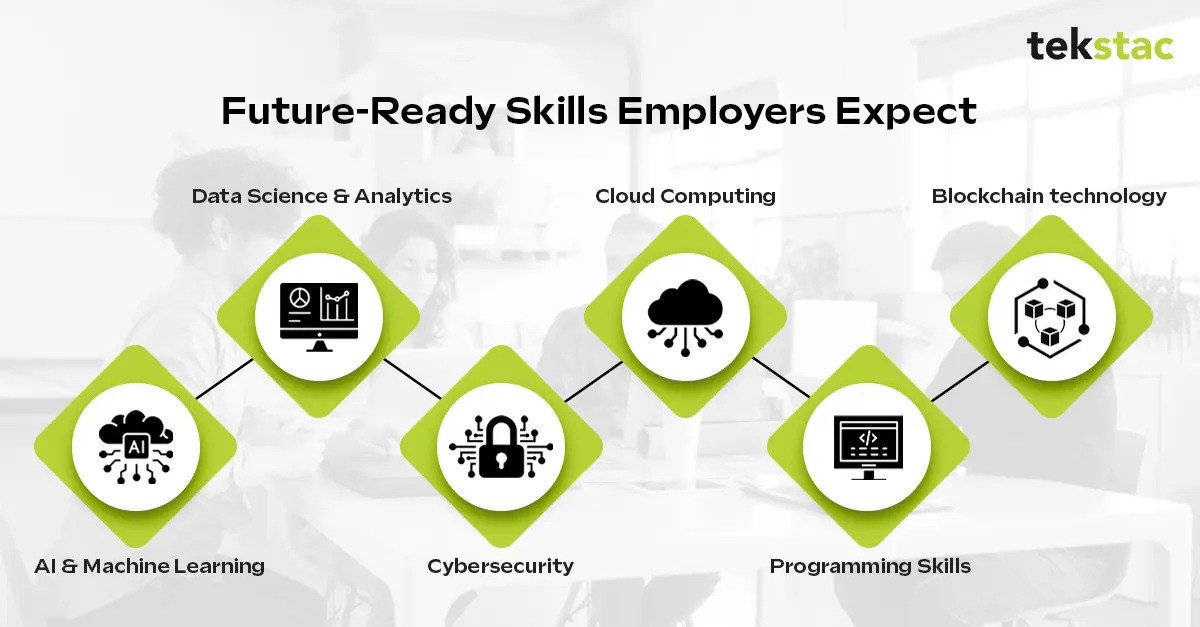
AI and Machine learning, particularly generative AI like OpenAI’s GPT models, are the most in-demand technologies today. These technologies have the power to significantly enhance productivity in the workplace through automation.
However, rapid adoption has also created critical skill gaps. While new roles in AI continue to grow, many organizations lack talent with the right expertise in AI development, deployment, governance, and ethical use. This gap makes it difficult for businesses to fully integrate AI into day-to-day operations.
To close these skill gaps, organizations must invest in structured upskilling programs that build AI, data literacy, and responsible AI capabilities, enabling teams to use AI effectively and gain a sustainable competitive edge.
Data has become one of the critical competencies of business as data-driven decisions offer a competitive advantage. The data analytics field has become vital for businesses due to its ability to offer intelligent insights.
The demand for data science skills is increasing. As per a LinkedIn report, the data science job postings have exhibited a 46% annual growth.
The data science skills are the pivot for customer behavior analysis, predictive modelling, market trend analysis and optimizing operations. There are multiple tools and platforms that must be learned to master data science.
Data security and compliance have become baseline requirements for most industries as they handle large data. Cybersecurity professionals are needed to identify vulnerabilities and implement security systems while ensuring compliance.
Cybersecurity is a valuable skill in such a business environment that faces heightened cyber threats. There is a growing need for cybersecurity professionals who can ensure data privacy and handle large-scale cyber threats.
In 2026, cybersecurity is likely to remain a valuable skill due to the widening skills gap. Organizations need to develop learning programs to strengthen the security of their data and IT infrastructure.
Cloud computing has become the epic center of modern IT infrastructure. The cloud platforms allow companies to scale up and provide operational agility.
Enterprises are embracing cloud technologies such as AWS, Azure, and others. The demand for professionals with skills in application development and management in cloud environments is increasing.
Organizations face cloud skill gaps and need trained professionals to design secure, resilient cloud infrastructures through structured learning and certification programs.
These three programming skills remain most in demand by employers as modern software development revolves around them. Python plays a key role in data science and artificial intelligence.
SQL is an indispensable element of data analytics and dataset management. While Java is a favorite choice for enterprise management and Android development.
The programmers with expertise in these technical languages are highly valued. Employers particularly value those programmers who can combine this technical expertise with software development and team skills.
Blockchain technology started from cryptocurrencies and has now become a major force transforming the supply chain and financial aspects of businesses. The demand for this technology has surged as it is considered to be secure in the digital ecosystem.
Blockchain expertise can be developed by gaining an understanding of cryptocurrency basics, distributed ledger technology and blockchain architecture. However, practical skill development requires hands-on experience in the development of blockchain platforms.
Both organizations as well as employees need to manage the skills gap for sustainable growth and development. Embracing learning, sharing knowledge and collaborating is the key to managing the skills gap.
Organizations need to build a learning ecosystem that is comprehensive, secure and scalable. Progressive organizations are leveraging learning platforms to upskill their existing employees to meet future demands.
Learning platforms help organizations identify and close skill gaps through targeted training, auto-evaluate assessments and effective learning interventions. By covering a broad spectrum of technologies and skills, these platforms support a continuous learning environment aligned with evolving business needs.
Employees can use these platforms to bridge their own skills gap by gaining real-time insights into training programs. Case-study–based learning and hands-on practice labs ensure well-rounded upskilling that translates directly into job performance.
The 2026 skill challenge requires a robust learning infrastructure to promote and cultivate a learning culture. It offers an opportunity for those who are willing to learn new skills and aim to apply them in creative ways.
Tekstac is a comprehensive learning platform designed to close skill gaps and future-proof workforces. Through hands-on practice labs and real-world scenarios, employees can confidently build complex technical skills that align with evolving business needs.
Be ready to tackle today’s skill gaps and tomorrow’s challenges—start your upskilling journey with Tekstac.
1. How can organizations effectively address skill gaps?
Organizations can address skill gaps by investing in continuous learning platforms, offering targeted upskilling programs, and aligning training with future job roles and technologies.
2. Why do skill gaps exist in 2026?
Skill gaps in 2026 exist due to rapid advancements in technology, especially AI and automation. As job roles evolve, many employees lack the up-to-date skills needed for emerging tasks, creating a mismatch between job requirements and workforce capabilities.
3. How do I overcome skill gaps as an employee?
You can overcome skill gaps by actively upskilling through online courses, certifications, and hands-on practice. Focus on high-demand areas like AI, data analytics, and cybersecurity, and choose platforms like Tekstac that offer real-world learning experiences.
4. What skills are employers looking for to close gaps?
Employers in 2026 seek skills in AI and machine learning, data science, cybersecurity, cloud computing, programming (Python, SQL, Java), and blockchain. These skills help businesses adapt to digital transformation and maintain a competitive edge.
The World Economic Forum’s Future of Jobs Report predicts that technological advancement will create 69+ million new jobs and displace 83+ million jobs by 2027. This shift presents organizations with an urgent challenge: upskilling and reskilling the workforce with future-ready digital skills.
Gartner’s 2024 HR Leadership Priorities report highlights that 44% of employees lack the digital skills needed for their current and future roles. As the disparity between current capabilities and future demands grows, investing in platforms that deliver scalable, impactful learning solutions is no longer optional—it’s essential.
The rise of remote and hybrid work models has transformed employee learning preferences. Organizations now seek skills development & learning platforms that combine flexibility with measurable impact on both workforce capabilities and business outcomes.
Let’s explore the five critical features that define an effective enterprise upskilling platform, helping decision-makers build future-ready teams.
Any platform that works well has learning content at its core. Employees need to be able to reach a lot of different resources that are relevant to their jobs, industries, and skill sets.
LinkedIn’s 2024 Workplace Learning Report reveals that 91% of L&D leaders prioritize helping employees learn new skills to deal with new problems, with industry-specific training showing the highest impact on employee performance.
Modern platforms must offer:
Business Impact: Tekstac’s customizable learning paths have helped organizations achieve measurable improvements in employee skill acquisition through industry-specific content delivery.
Effective skill development requires practical application. ATD’s 2023 State of the Industry Report indicates that organizations investing in experiential learning see a 42% higher employee proficiency rate compared to traditional training methods.
For example, a cybersecurity sandbox can allow users to:
Tekstac’s integrated upskilling lab environment enables real-time practice across various technologies, from programming languages to cloud infrastructure, ensuring skills transfer directly to work scenarios.
According to Deloitte’s 2023 Human Capital Trends report, organizations using AI-driven learning platforms report 37% higher employee engagement in development programs. Modern upskilling platforms powered by AI can:
Example: An AI-driven system might identify a junior developer’s potential for cloud architecture roles and create a customized learning path incorporating both technical and architectural skills.
Leaders in learning and development (L&D) may find it hard to show stakeholders how well skills development and learning programs work. Enterprise upskilling platforms with advanced analytics dashboards show how employees are growing how they are learning new skills, and how the company is doing. These solutions help people make better decisions by connecting learning results to employees’ productivity and performance.
Research from Deloitte shows that companies that use learning data will see a 30% rise in the productivity of their employees.
Businesses should make sure that the platform does more than just collect data. It should also give them actionable information, like insights on how ready a team is to learn new skills or how engagement has changed over time.
The WEF Future of Jobs Report 2023 indicates that 75% of organizations are accelerating their digitalization plans, requiring platforms that can securely scale while maintaining data protection standards. Key requirements include:
Security Insight: Single-tenant platforms provide dedicated infrastructure for each client, preventing data cross-contamination and enabling customized security policies. This is crucial for sectors like healthcare and finance.
To pick the right workforce upskilling platform, you need to investigate its features and check its ability to scale and meet your company’s needs. “What should I prioritize when investing in an upskilling platform?” is a question that business and L&D leaders often ask.
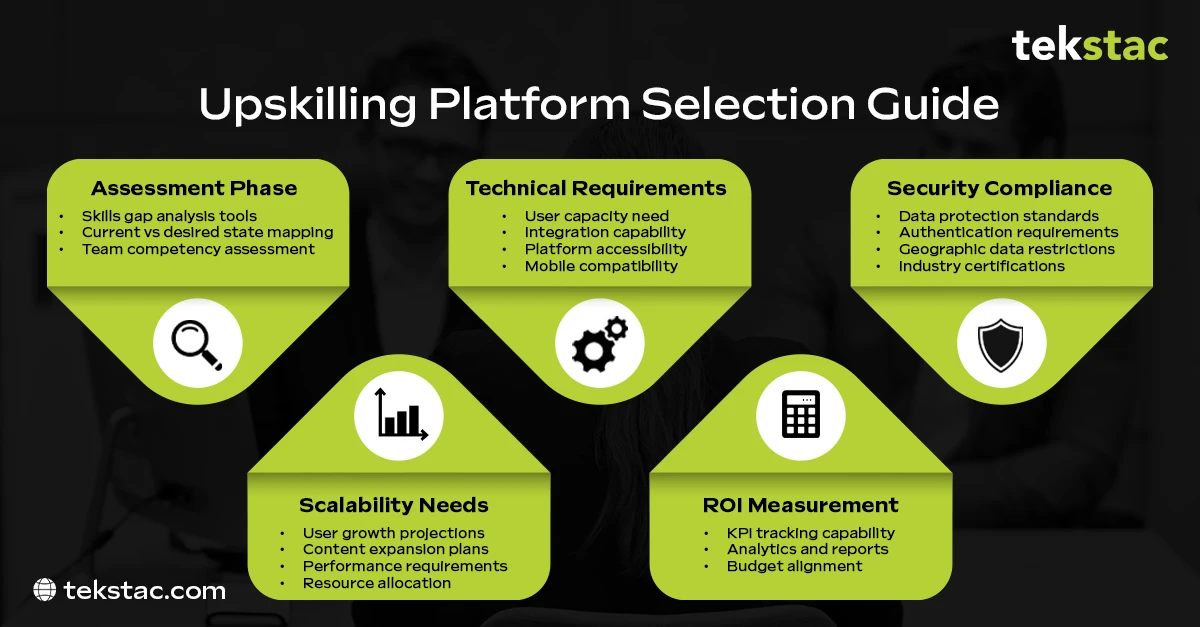
One of the most important steps is to focus on platforms offering comprehensive solutions for technology and soft skills. Such skills as leadership, communication, and emotional intelligence are critical for holistic workforce development.
Do not forget to check for the integration with your existing HR tools and systems. A platform that supports integration with learning management systems (LMS) guarantees a smooth workflow and allows you to track learning outcomes in real time.
Business tip: If you want to get the most out of the money you spend on training, pick options that have strong reporting and integration capabilities. Modern platforms like Tekstac combine these essential features with enterprise-grade security and scalability.
The platform’s comprehensive approach includes rich learning content, hands-on labs, and advanced analytics, enabling organizations to build future-ready teams efficiently.
For many organizations, the question isn’t whether to invest in upskilling but how to measure its return on investment (ROI). When evaluating ROI, consider both tangible and intangible benefits, such as increased employee productivity, reduced turnover, and internal talent mobility to fulfill talent needs.
Platforms with advanced analytics and predictive capabilities help track metrics such as time to competency, post-training performance, and overall engagement. This data supports decision-making and helps secure buy-in from stakeholders by demonstrating measurable impact.
Hint for businesses: Choose platforms with built-in ROI measurement tools to link learning outcomes directly to business goals and performance metrics.
Are you ready to transform your upskilling and reskilling strategy to future-proof your workforce? Contact our experts to discover how Tekstac’s enterprise-grade upskilling platform can accelerate your team’s growth.
In the rush to fill a position with the right candidate, many organizations overlook the importance of pre-hiring assessments, leading to costly hiring mistakes. Without proper evaluation methods in place, businesses risk selecting candidates who may not be the right fit for the role.
A bad hire isn’t just someone missing a skill or two; they can be expensive. According to CareerBuilder, a bad hire costs at least $18,700 for executive-level positions and more than $37,150 on average for Indian companies. Beyond financial loss, bad hires contribute to decreased productivity, low morale, and higher turnover rates, which impact overall business performance.
A CareerBuilder survey revealed the top reasons for bad hires:
This data underscores the importance of accurate pre-hiring assessments and pre-employment assessments, which help employers move beyond resumes and focus on proven skills. Organizations often rely on outdated hiring methods, focusing too much on resumes and interviews without truly assessing candidates’ skills. Fortunately, with advancements in technology and the growing adoption of AI, recruiting high-quality candidates has become more efficient and precise.
As of July 2024, 88% of companies globally use Artificial Intelligence (AI) for HR practices, according to LinkedIn’s Future of Recruitment Playbook.
AI can rapidly analyze vast amounts of candidate data—ranging from resumes to assessments—to identify hires that align with top-performing talent already within an organization. Beyond identification, AI enhances pre-hiring and pre-employment assessments by creating skills-based hiring tests that measure both technical expertise and soft skills crucial for workplace success.
Organizations using AI-driven pre-hire assessments are 46% more likely to find successful, skill-fit hires (CareerBuilder, 2024). These assessments are based on real-world job scenarios, ensuring candidates are not only skilled but also ready to perform from day one.
Additionally, AI-driven tools enhance assessment integrity by monitoring for suspicious activities and evaluating cultural fit, significantly reducing turnover.
With AI and recent technologies in the market, pre-hiring assessments are evolving in how candidates are assessed.
Below are the top 10 pre-hiring assessment trends HR must watch out for:
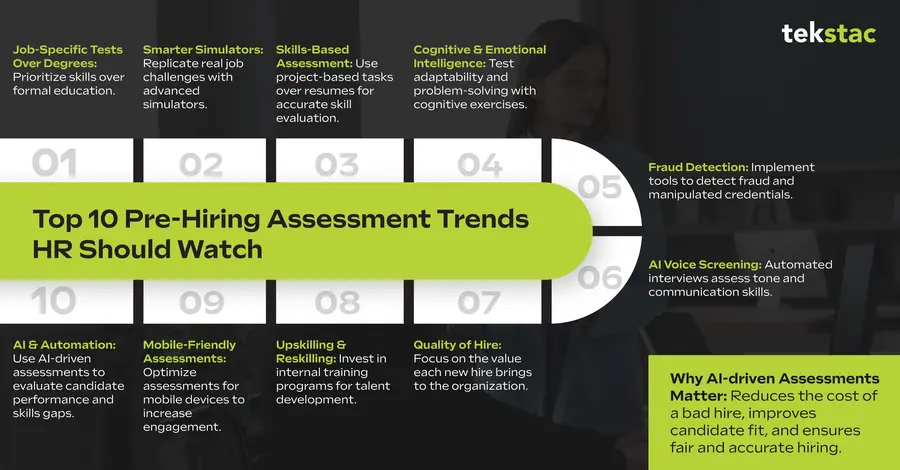
Companies are increasingly prioritizing skills over formal education. According to a recent McKinsey report, organizations are re-evaluating degree requirements and shifting toward skills-first hiring. This means talent acquisition teams will need to invest in job-specific tests that accurately measure the skills necessary for success in a role.
Hiring managers are now leveraging AI-powered competency frameworks that break down required skills for each position, ensuring a precise match between the job description and the candidate’s capabilities. This shift opens doors for non-traditional candidates, enabling companies to tap into a wider and more diverse talent pool.
Advanced simulators are becoming integral in assessing practical skills. They replicate real-world challenges to evaluate candidate performance. For instance, coding simulators test a developer’s debugging abilities, while customer service simulators assess how well candidates handle client inquiries.
Simulations provide a hands-on approach, allowing candidates to showcase their abilities in real-time. This trend is particularly prominent in IT, healthcare, and finance industries, where job performance depends heavily on applied knowledge.
Companies are moving beyond traditional resumes and interviews, favoring skills-based interviews, project-based assessments, and job-focused tasks. This shift reduces reliance on self-reported claims and ensures hiring decisions are based on proven competencies.
HR teams are adopting AI-driven skills assessment platforms that use adaptive testing to evaluate candidates dynamically, adjusting difficulty levels in real-time based on responses.
Employers recognize the importance of hiring candidates with strong cognitive and emotional intelligence. Assessments now include problem-solving tasks, role-playing scenarios, and situational judgment tests to minimize the risk of hiring cultural misfits.
AI-driven cognitive testing evaluates not only logical reasoning but also adaptability, creativity, and emotional intelligence—factors that contribute significantly to job performance and teamwork.
With the rise of AI-generated resumes and fraudulent applications, companies must implement assessment tools with built-in fraud detection. AI-driven hiring platforms can now verify credentials, detect inconsistencies, and prevent hiring mistakes based on manipulated data.
With features like plagiarism detection and remote proctoring, AI ensures that candidates take assessments honestly, making it easier to top talent based on merit.
AI-powered voice screening is revolutionizing initial candidate assessments. These systems analyze communication skills, tone, and response patterns to generate insights for recruiters. However, organizations must ensure these technologies align with DEI (Diversity, Equity, and Inclusion) goals to prevent bias.
With declining global hiring volumes, companies are shifting focus from the number of hires to the value each new hire brings. According to LinkedIn’s Future of Recruitment 2024 Playbook, measuring “quality of hire” through AI-driven analytics and post-hire performance tracking will be a key metric in talent acquisition.
Quality-of-hire metrics are calculated based on onboarding success, performance ratings, productivity levels, and retention rates within the first year of employment.
Companies struggling to find skilled candidates externally increasingly turn to upskilling and reskilling programs for existing employees. Employees must participate in training programs followed by assessments to check their suitability. This approach to building a skilled workforce reduces excessive reliance on external hiring and at the same time, improves employee retention and reduces overall cost.
With mobile devices now dominating internet usage, candidates expect to complete hiring assessments on their smartphones. Companies are optimizing pre-hire tests for mobile accessibility, enabling candidates to participate conveniently.
This shift increases application completion rates and allows companies to reach a wider talent pool, including gig workers and passive candidates.
Along AI tools are enhancing resume screening, automated interview evaluations, and candidate performance analysis. They generate detailed reports highlighting skill gaps and strengths, providing HR teams with data-driven hiring insights.
Automated pre-hire assessments reduce human bias and accelerate the hiring process, allowing recruiters to focus on strategic decision-making rather than administrative tasks.
Training and onboarding costs add an average of $1,252 per employee and 10+ hours of HR time.
Traditional hiring methods no longer suffice. By adopting AI-driven pre-hiring assessments and pre-employment assessments, companies gain accurate insights, reduce costs, and hire talent that delivers measurable business impact.
For organizations hiring tech talent, specialized platforms such as Tekstac are transforming recruitment with competency-based assessments, real-time AI-driven proctoring, and automated candidate evaluation. These platforms offer integrity-focused hiring solutions, ensuring fairness, accuracy, and data-backed decision-making.
With hiring trends evolving rapidly, AI-driven assessments are becoming indispensable. Organizations investing in smart, data-backed hiring solutions will gain a competitive advantage, ensuring they onboard the right talent for long-term success.
To stay ahead, companies must explore AI-powered tools that align with their hiring goals—ushering in a new era of efficient, skills-based recruitment.
1. What are pre-hiring assessments?
Pre-hiring assessments are structured tests that measure a candidate’s skills, personality, and job readiness. Unlike resumes, these evaluations provide real performance insights, making them more reliable than traditional screening methods.
2. How do pre-employment assessments reduce bad hires?
Pre-employment assessments evaluate real-world skills and behaviors, helping recruiters avoid reliance on claims. By testing ability, cultural fit, and integrity, they significantly reduce the risk of costly hiring mistakes.
3. Why are AI-driven pre-hiring assessments important in 2026?
AI-powered pre-hiring assessments use adaptive testing, fraud detection, and performance analytics. They improve hiring accuracy, ensure fairness, and help recruiters select candidates with both technical and soft skills.
4. Are pre-employment assessments better than interviews?
Yes. Unlike interviews that may be biased, pre-employment assessments provide data-backed insights into a candidate’s abilities, ensuring objective and skills-first hiring decisions.