
In 2026, the pace of change has exploded. Emerging AI trends in L&D are redefining every aspect of workplace operations and learning. Yet, many organizations are still training like it’s 2010.
The world of Learning and Development (L&D) is at a turning point, as outdated systems clash with the urgent need for workplace upskilling with AI, and companies struggle to keep pace with the demands of digital transformation in L&D.
While AI promises hyper-personalization, real-time insights, and automation at scale, the uncomfortable truth is that most businesses are stuck delivering cookie-cutter training that satisfies no one.
The rise of AI trends in learning tech has made it clear: generic learning paths are obsolete. Workers demand training that reflects their roles, goals, and learning styles. Instead, they’re handed recycled slide decks and linear modules that neither engage nor empower.
AI Trends in L&D refer to the emerging ways artificial intelligence is transforming workplace learning. They include hyper-personalized learning paths, predictive analytics, adaptive content, skill intelligence, and AI-powered coaching that improve performance, retention, and training efficiency across the organization.
To understand how these trends fit into a broader workforce strategy, explore our AI in HR strategy and transformation.
This article explains the six most important AI trends shaping corporate learning in 2026, backed by industry research and real-world insights. You’ll learn about:
Let’s start with the cold reality: most L&D systems are failing.
According to LinkedIn’s Workplace Learning Report, 71% of L&D professionals are exploring, experimenting with, or already integrating AI into their work — though turning that activity into measurable business outcomes remains the harder, less-solved part.
This hesitation has consequences. When 70% of training programs fail to deliver measurable outcomes, it’s not a user problem. It’s a system problem.
Current systems offer little more than completion data. They can tell you who clicked “Next,” but not who actually learned, retained, or applied anything.
Meanwhile, over half of learners abandon online courses midway, citing poor alignment with their roles. And with automation reshaping industries, job requirements evolve faster than most training teams can respond.
The result?
Disengaged employees, wasted budgets, and unmet business goals.
In a world moving at the speed of light, delivering personalized training isn’t just a “nice to have” anymore. It’s mandatory. L&D systems must know more than job titles.
They need to understand learning behaviors, career goals, and real-time performance data.
In companies that have embraced it, training time has dropped, skill application has soared, and employee retention has improved.
Organizations using AI in L&D commonly report measurable gains in both productivity and employee retention. At its core, this is transformation, not just tech.
Here’s what legacy systems don’t do: connect learning to business outcomes. AI-powered platforms, on the other hand, don’t just deliver content, they learn from it. They track not just engagement but impact.
Leveraging AI, modern systems can track how skills evolve over time, pinpoint where progress stalls, and identify who’s ready for a promotion—exactly what AI Trends in workplace learning are now shaping across forward-thinking organizations.
By year two of using these systems, organizations report smarter decision-making, less rework, and clearer succession planning.
By year three, AI-powered learning starts surfacing insights that no spreadsheet ever could: like which departments are overperforming, which skills correlate with project success, or where burnout is brewing.
This isn’t hypothetical.
This is happening now.
People don’t hate learning.
They hate irrelevant learning.
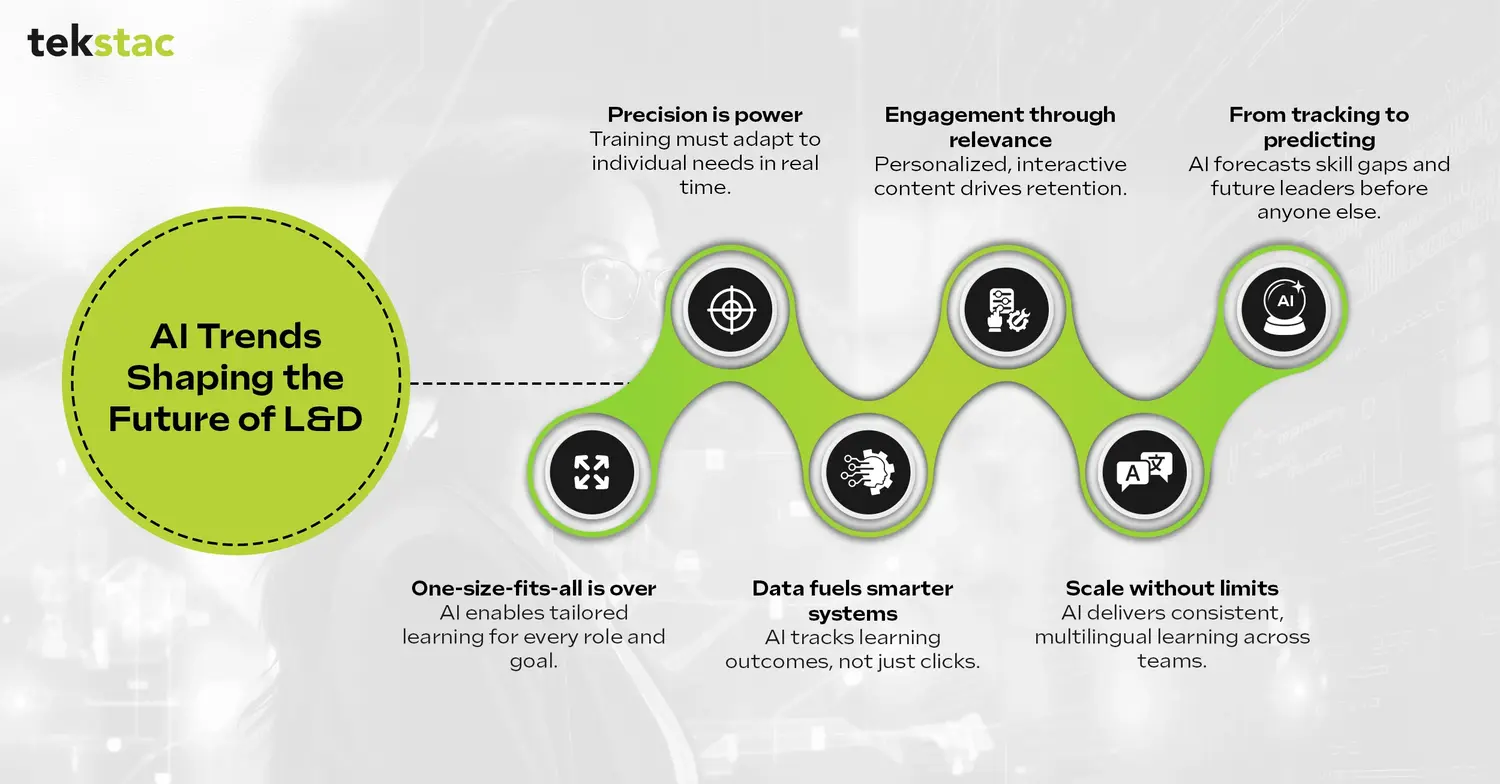
AI fixes this by making training feel personal, and customized for each individual so they feel it’s relevant for them but not forced.
It gives instant feedback, transforms lessons into interactive stories, and builds safe simulations where employees can practice without fear of failure.
Platforms like Tekstac are already using this approach.
With adaptive learning paths, localized content, and role-based recommendations, learners don’t just consume content, they experience it.
Learners increasingly favor AI-assisted training formats over traditional ones, and engagement data backs this up.
Traditional L&D hits a ceiling fast. More people means more facilitators, more costs, more logistics. But with AI, scaling is seamless.
Whether you’re training 10 or 10,000, the experience remains consistent and high-quality.
Companies using AI for training report meaningfully lower delivery costs while simultaneously increasing reach and effectiveness.
Multilingual support, auto-translation, and real-time content adaptation mean global teams can access the same content, tailored to their needs and context.
This levels the playing field and ensures inclusivity, a critical but often neglected component of enterprise learning strategies.
It’s no longer enough to ask whether someone completed a course.
The real question is: did it make a difference?
With AI, you no longer have to guess. You can see skill proficiency rising, time-to-productivity falling, and internal promotions accelerating.
Industry research from groups like Brandon Hall Group consistently links AI-based learning to higher retention and faster skill acquisition.
In forward-thinking companies, L&D leaders don’t chase KPIs, they shape them.
Predictive dashboards now alert managers to emerging leaders, identify team-level skill gaps, and recommend training before performance dips. The next step beyond prediction is action — agentic AI takes it further by autonomously assigning the right learning path or escalating a skill gap to a manager, without anyone first having to ask it to.
It marks a shift from learning to strategic talent development.
AI Trends in L&D are not just about better tools — they are redefining how organizations measure productivity, skill growth, and talent readiness.
At the center of this transformation is Tekstac.
It’s not just another learning platform, it’s a complete AI-driven learning intelligence system.
Built for scale, flexibility, and performance, Tekstac integrates content creation, real-time analytics, and adaptive delivery into one seamless experience.
From SHRM-aligned learning paths to auto-generated content and knowledge checks, Tekstac personalized every aspect of training.
It identifies where each learner stands, maps growth paths, and shows HR and leadership where the talent pipeline is headed. It connects every learning act to a real business outcome, be it faster onboarding, increased internal mobility, or improved customer results.
And the impact is measurable. Companies using Tekstac report up to 48% reduction in learning cycle time and 65% improvement in content relevance for high-skill roles like software development.
Whether you’re a tech giant, a healthcare provider, or a logistics firm, Tekstac adapts to your needs, your teams, and your goals.
The companies winning in 2026 are those who stopped viewing training as a checkbox and started seeing it as a growth engine.
They moved from one-size-fits-all to one-path-for-each. From passive completion to active transformation. And from static dashboards to living, predictive maps of workforce capability.
So here’s the truth: if your training platform can’t personalize, can’t scale, and can’t connect to business outcomes, it’s not slowing you down, it’s keeping you behind.
The shift to AI-powered learning isn’t just smart.
It’s inevitable.
Make the move to a platform that sees your people not just as learners, but as your competitive edge.
A platform that doesn’t just keep up with the future, but creates it.
Tekstac isn’t the next step. It’s the leap forward.
Want to adopt AI Trends in your L&D strategy? See a live demo of Tekstac’s AI-driven learning platform in action.
1. How is AI improving workplace learning outcomes?
AI boosts learning outcomes through hyper-personalized learning paths, adaptive content, and real-time feedback. Employees learn faster and retain more because training aligns with their roles and skill gaps.
2. What’s the next big AI trend in learning and development?
Skill intelligence platforms — systems that map role-based skills, predict future gaps, and auto-recommend upskilling paths. They shift L&D from delivering content to building workforce readiness.
3. What is the ROI for adopting AI in corporate training?
Organizations see higher retention, faster onboarding, and reduced training costs. AI turns L&D into a measurable business growth driver by improving productivity and workforce performance.
4. Which industries benefit from AI-driven L&D?
Industries with fast-changing skills need — tech, BFSI, healthcare, logistics, manufacturing, telecom, and retail. Any sector requiring rapid onboarding or upskilling gains from AI learning.
5. What are the latest AI trends in learning and development?
The leading AI trends in L&D right now are hyper-personalized learning paths, predictive analytics for skill and performance gaps, adaptive content delivery, AI-powered coaching and feedback, and skill intelligence platforms that map role-based skills to future business needs.
6. What are the most effective corporate AI talent development strategies?
The most effective strategies connect AI-driven learning directly to business outcomes — using predictive analytics to anticipate skill needs before rollout, tracking skill proficiency rather than just course completion, and tying training data to real metrics like time-to-productivity and internal mobility.
A new chapter of work is unfolding, one where intelligence isn’t just human anymore. Automation is no longer limited to manufacturing lines; it is now influencing decisions in boardrooms, creating efficiencies in customer service, and powering the tools we use to design, write, market, and build. Amid this digital surge, organizations are under immense pressure to future-proof their workforce, and those that fail to adapt risk falling irreversibly behind.
AI workforce planning, once centered around static job descriptions and annual headcount forecasting, has evolved into a living, breathing discipline. Today, it requires a sharp lens into market disruptions, a granular understanding of skill demand, and the foresight to align talent with transformation.
AI isn’t coming- it’s already here. The real question is.
How do we plan for a workforce that’s ready for it?
Workforce planning is the strategic process of aligning an organization’s talent supply with its future business needs. In the AI era, it involves analyzing skill gaps, predicting future roles, and integrating automation insights to ensure the right people, with the right skills, are in the right place at the right time.
For decades, companies operated on predictable cycles. Job roles stayed the same, learning happened in classrooms, and promotions followed tenure. But with AI integrating into core business processes, change has become exponential. Roles like “AI Trainer,” “Prompt Engineer,” and “Ethical Technologist” didn’t exist five years ago. Now, they’re critical.
According to the World Economic Forum’s Future of Jobs Report 2025, employers anticipate that 39% of workers’ core skills will change by 2030.
This shift is expected to result in the displacement of 92 million jobs, while simultaneously creating 170 million new roles, leading to a net increase of 78 million jobs globally.
Organizations clinging to legacy workforce planning models are struggling. These models assume that tomorrow’s roles will look like today’s—and they won’t. Roles will continue to dissolve, combine, or morph into hybrid jobs that require human judgment alongside machine intelligence.
Planning for static roles has become planning for obsolescence. The modern approach must center on capabilities, adaptability, and ecosystem thinking.
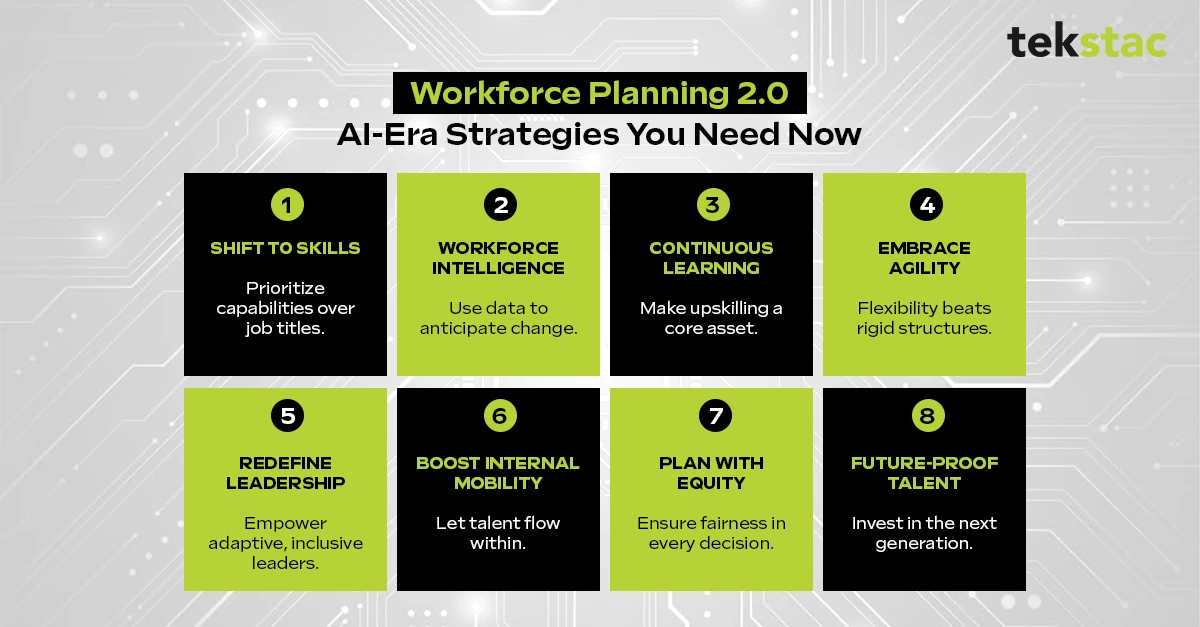
The future doesn’t speak in job titles, it speaks in skills. The shift from role-based to skill-based planning is one of the most defining features of workforce transformation.
According to a McKinsey Global Survey, 87% of executives say they are experiencing skill gaps in the workforce or expect them within a few years.
Companies that once hired for predefined roles are now deconstructing them into component skills. A “Sales Manager” may need a blend of customer empathy, data analysis, CRM automation, and generative AI knowledge. These skill clusters enable flexible deployment across multiple use cases, transforming people into assets who evolve as fast as the business does.
The most resilient organizations are building detailed skill taxonomies, continuously analyzing gaps, and fueling internal mobility by aligning learning pathways with emerging demand.
This is not about filling vacancies- it’s about future-proofing talent at the molecular level.
In an AI-dominated landscape, information is power, but insight is everything. Advanced workforce planning now relies on real-time data, AI-driven forecasting models, and skill heatmaps that predict where growth or decline is likely to happen.
This new skills intelligence helps organizations look beyond the next quarter and plan for the years ahead. It allows leaders to anticipate disruptions, identify at-risk functions, and act before the market does.
Workforce planning isn’t reactive anymore. It’s anticipatory, strategic, and deeply integrated with how organizations approach innovation, mergers, technology upgrades, and global expansion.
Data-backed planning doesn’t just reduce risk, it creates a competitive advantage.
In the age of AI, learning agility has become the new corporate currency. Companies that embed continuous learning into their DNA are building workforces that can pivot, scale, and lead through uncertainty.
The learning paradigm is also changing. No longer confined to annual workshops or lengthy courses, the future of learning is fast, flexible, and integrated into the flow of work. Microlearning modules, AI-recommended content, skill simulations, and just-in-time knowledge delivery are becoming the new norm.
Organizations that prioritize learning are no longer asking, “What should we train our people on?” but rather, “How do we create an environment where learning never stops?”
This cultural shift redefines talent strategy—from acquiring skills externally to cultivating them internally.
Stability used to be the hallmark of successful planning. Today, agility reigns supreme. Workforce planning in the AI age demands the ability to reconfigure teams, redeploy talent, and rethink structures with speed.
Cross-functional teams, project-based work, and skill-sharing networks are replacing rigid hierarchies. The gig economy, freelance platforms, and talent clouds are allowing organizations to dynamically tap into external capabilities when needed.
Success now lies in how quickly a company can reassemble its talent around an opportunity.
This shift isn’t just structural, it’s psychological. It means fostering a mindset across leadership and the workforce that embraces ambiguity, experimentation, and reinvention.
Workforce planning cannot thrive without leaders who understand transformation. In the AI era, leadership is no longer about control, it’s about navigation.
Leaders must guide their teams through ethical dilemmas, reskilling initiatives, AI adoption fears, and complex change cycles. They must inspire confidence while acknowledging uncertainty. And perhaps most importantly, they must lead with empathy.
AI may enhance performance, but only humans can drive culture. Leaders who understand this balance are not just technology champions, they’re people architects.
Future-ready leadership isn’t technical; it’s transformational.
In a market where skill shortages are the new normal, internal mobility is one of the most underutilized tools in workforce planning. Companies already sit on goldmines of untapped potential, employees who, with the right upskilling, could transition into high-demand roles.
Progressive organizations are building talent marketplaces that allow employees to self-navigate toward growth. AI algorithms suggest internal opportunities based on skill fit, career aspirations, and business need, creating a dynamic ecosystem of movement, growth, and engagement.
This isn’t just good HR, it’s good economics. It reduces hiring costs, boosts retention, and cultivates a more future-ready workforce from within.
As AI reshapes work, inclusion must be non-negotiable. Historical biases in data, unequal access to learning, and algorithmic decision-making can all exacerbate existing workplace inequities if left unchecked.
Strategic workforce planning in the AI era must be intentionally inclusive. That means designing systems that account for fairness, ensuring diverse perspectives in AI training datasets, and democratizing access to upskilling programs.
Organizations that embed equity into their planning are not only doing the right thing, they are creating environments where innovation thrives, talent flourishes, and risk is reduced.
The future must be fair or it won’t be sustainable.
The implications of AI-driven workforce planning don’t stop with current employees. They extend to schools, colleges, and the way we prepare our children for careers that don’t yet exist.
The OECD estimates that 1.1 billion jobs are liable to be radically transformed by technology in the next decade.
The next generation must be equipped not just with coding skills but with curiosity, adaptability, ethical reasoning, and creative problem-solving. Parents, educators, and companies alike have a role to play in bridging the skills of today with the possibilities of tomorrow.
The career ladder has been replaced by a career lattice. Students of today will not have a single job for life, they’ll likely have multiple careers, across domains, augmented by machines, but driven by human values.
If workforce planning is the compass for organizations, career readiness is the compass for individuals.
The rise of AI isn’t just an industrial revolution- it’s a human one. And like every revolution, it requires bold thinking, new tools, and a reimagined vision for how we build and sustain workforces.
Effective workforce planning in the AI era is about more than numbers on a spreadsheet. It’s about enabling people to grow, adapt, and lead in a world where change is constant. It’s about creating alignment between business ambition and human capability. And above all, it’s about ensuring that as machines rise, so too does our collective capacity for innovation, empathy, and progress.
The future of work is not being built in the future. It’s being built now. And those who plan wisely will shape it.
1. Why do we do workforce planning?
Workforce planning helps organizations align talent supply with future business goals. It ensures that the right people, with the right skills, are in place to meet changing market demands and strategic priorities.
2. How is AI changing workforce planning?
AI enables real-time skill analysis, predictive forecasting, and smarter talent deployment. It transforms workforce planning from reactive headcount management into a proactive, data-driven strategy.
3. How does AI help in strategic workforce planning?
AI analyzes large volumes of talent, market, and performance data to predict future skill requirements and guide smarter hiring, training, and mobility decisions.
4. What are the challenges in AI workforce planning?
Common challenges include data quality issues, bias in AI models, limited integration across HR systems, and lack of workforce analytics skills.
What makes employees stay, grow, and contribute their best? It’s not just a paycheck or job security, it’s the opportunity to learn and evolve. A strong, AI-powered learning culture gives people the tools to upskill, adapt, and drive business success through continuous, data-driven development.
The LinkedIn Workplace Learning Report 2025 reveals that companies investing in personalized, AI-powered L&D see higher engagement and retention. Employees now seek personalized workplace learning experiences that blend seamlessly into daily workflows rather than isolated training sessions. When organizations build a learning culture into their DNA, they don’t just build a skilled workforce, they build a future-ready business.
A learning culture is not just about conducting training sessions; it’s about embedding learning into everyday work processes. A learning culture involves:
A strong, continuous learning culture powered by AI ensures employees are empowered to develop critical skills, innovate faster, and adapt to constant change. But the challenge lies in how to embed this culture into the organization’s DNA through effective workplace learning strategies.
Many organizations struggle to establish a learning culture due to several key barriers, especially when training and development is not integrated with day-to-day work.
76% of L&D professionals report that management does not prioritize learning. Leaders must set the tone by actively participating in and advocating for employee development.
Formal hierarchies and bureaucracies can make learning difficult. Employees may feel that learning takes them away from their core responsibilities. To counter this, organizations should embed adaptive learning for workforce upskilling directly into daily workflows, supported by intelligent learning platforms.
Some companies focus solely on formal training while neglecting informal, social, and digital learning. A mix of learning methods, such as mentorship programs, peer learning, and digital learning platforms—can enhance engagement.
Employees are often hesitant to experiment and take risks in learning due to fear of negative consequences. Encouraging a growth mindset and normalizing failure as a part of the learning process is essential.
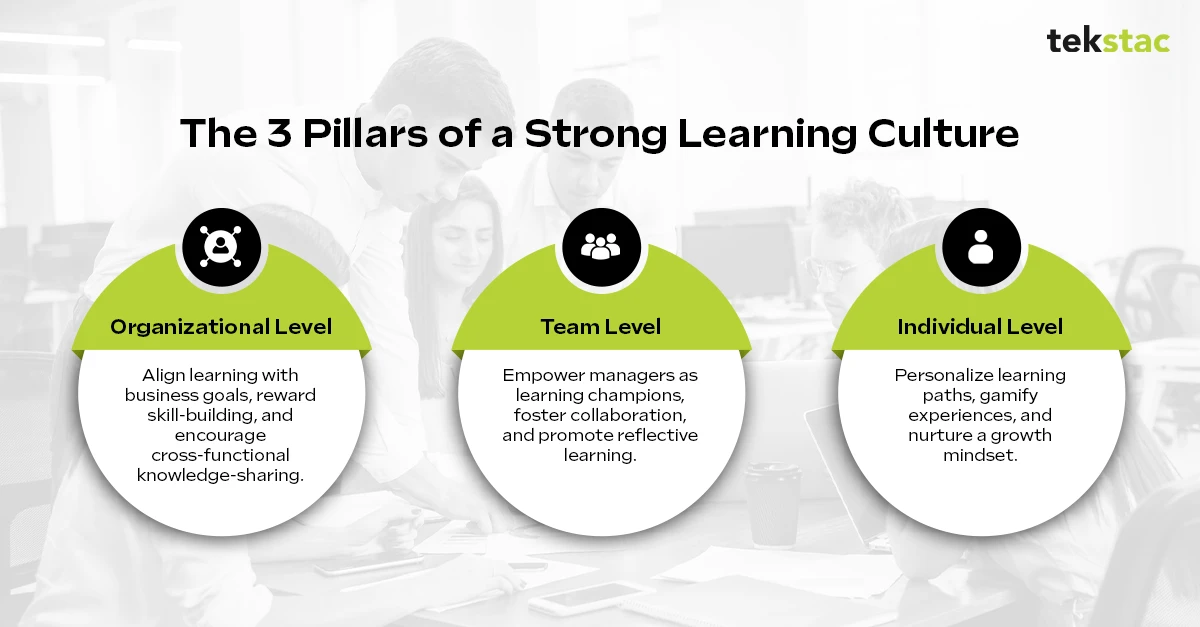
To develop a successful learning culture, organizations must take a systemic approach, integrating learning at three levels:
Not all learning is equal. Your brain naturally pays more attention when something feels relevant and rewarding. That’s why personalized learning isn’t just a trend, it’s the key to making training actually work. A strong learning culture ensures employees are continuously engaged, motivated, and developing skills that matter.
Companies that get this right don’t rely on outdated, one-size-fits-all training. They use AI and VR to make learning interactive and tailored to each person.
Companies with a strong learning culture experience 30–50% higher retention rates. Employees are more likely to stay in organizations that invest in their growth.
According to a study by Emerald Works, businesses with a mature learning culture see:
A learning culture is not built overnight—it requires a strategic, long-term commitment from leaders, teams, and individuals. By embedding learning into everyday work, providing multiple learning opportunities, and aligning L&D with business objectives, organizations can unlock the full potential of their workforce.
Investing in learning today means building a workforce that is engaged, skilled, and ready for the future—especially when guided by the latest Learning and Development Trends shaping talent strategies globally. With Tekstac, learning isn’t just another checkbox—it becomes a part of everyday growth. Give your employees the tools to succeed, innovate, and thrive.
Transform the way your employees learn and grow with Tekstac Our cutting-edge platform offers AI-powered personalized learning, hands-on practice labs, and gamified learning to drive engagement and skill development.
Experience the Future of Learning & Development Today!
1. What are the 6 steps to creating a culture of learning?
Define a learning vision, enable leadership support, integrate AI tools, encourage collaboration, personalize learning paths, and reward continuous skill growth organization-wide.
2. How can AI help build a learning culture?
AI personalizes learning paths, recommends relevant content, tracks progress, and enables adaptive, continuous upskilling aligned with business goals and employee performance.
3. Why is a learning culture important for retention?
Employees stay longer when learning is continuous, personalized, and rewarding—it boosts engagement, growth opportunities, and trust in organizational development.
4. How can Tekstac help build a learning culture?
Tekstac uses AI-powered personalization, gamified learning, and hands-on labs to embed continuous learning into workflows, improving engagement, skills, and retention.
For years, companies have tackled workforce development like plugging holes in a sinking ship—spot a problem, run some training sessions, and hope it’s enough to keep you afloat. In a world shaped by Generative AI, that skilling model isn’t just outdated—it’s risky.
This is where Predictive Skilling comes in. By combining predictive analytics with workforce skilling, organizations forecast future capability needs before gaps appear. This proactive ecosystem ensures employees aren’t only trained for today—but fully prepared for tomorrow’s AI-driven market shifts. Skill gaps aren’t shrinking; they’re multiplying. While AI capabilities race ahead, organizations playing “catch-up” only fall further behind.
A handful of forward-thinking businesses have stopped trying to “patch gaps” altogether. Instead of reacting to skill deficiencies after the fact, they’re predicting future needs and training for them before they become urgent. This approach is all about predictive skilling ecosystems, which leverage generative AI to ensure employees aren’t just ready for the present—they’re primed for whatever the market demands next. Platforms like Outskill AI are helping organizations implement these predictive learning strategies effectively.
Traditional thinking assumes you can identify skill shortages, run a training program, and magically achieve alignment with business goals. This might have worked when industries moved at a slower pace. But when markets can pivot overnight, by the time you’ve identified one shortfall, the industry’s already shifted again.
A global logistics giant in 2025 found this out the hard way. After investing millions in retraining employees to use AI optimization tools, they discovered that competitors had already adopted generative AI to predict demand fluctuations in real time. By the time the giant’s employees were fully trained, it had lost critical market share to nimbler rivals.
The lesson is pretty stark: unless you can skill at the speed of business, you risk stagnating. Generative AI now offers a way to anticipate and fill skills before they become bottlenecks.
According to the World Economic Forum, by 2025, 50% of employees will need reskilling due to rapid technology adoption and automation.
Predictive skilling ecosystems, powered by generative AI, flip the entire paradigm. Instead of frantically closing gaps, they aim to keep gaps from forming in the first place. Here’s how they do it:
A multinational insurance company made headlines in 2024 by rolling out a predictive skilling ecosystem. Instead of anxiously watching rivals, they chose to be proactive. They spotted that AI would soon reshape underwriting, so they used generative AI to build specialized learning paths for their underwriters—teaching them to interpret AI-generated risk models and make quicker, more accurate decisions.
Within a year, claims-processing times fell by 40%, and underwriting accuracy soared. But the true power lay in how this approach kept evolving. Even as AI technologies advanced, their workforce advanced too, widening a competitive gap that competing insurers struggled to close.
Shifting to a predictive model isn’t a snap of the fingers, but it is essential. Here are the core steps:
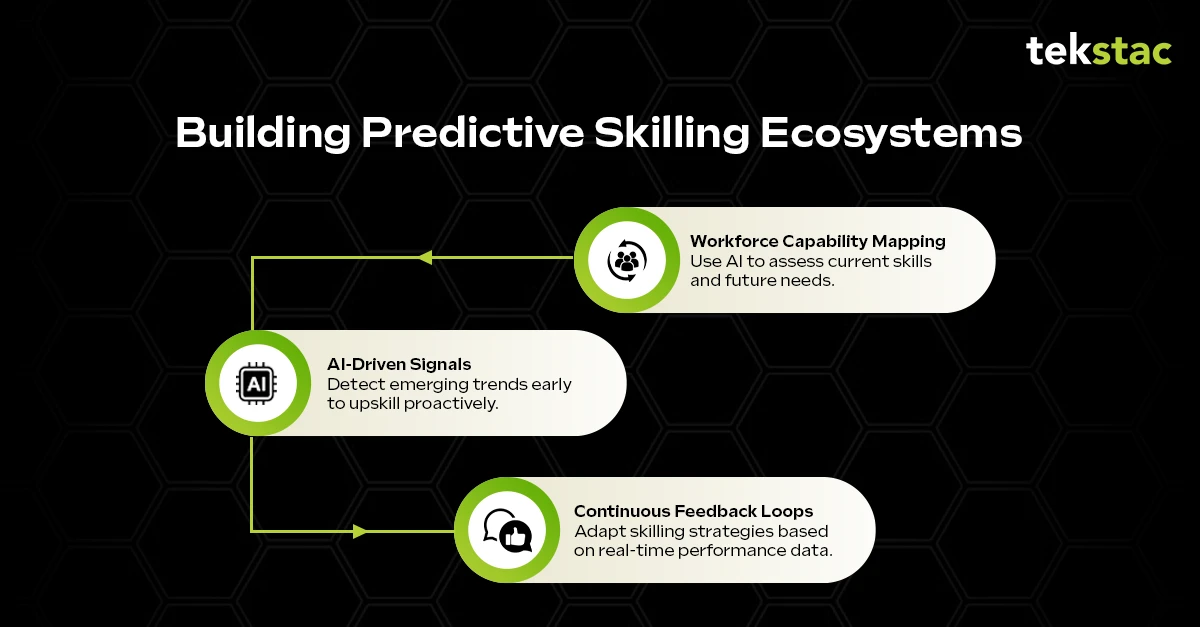
Companies that master this process aren’t just investing in employees; they’re making sure the organization remains vital, no matter how fast the market pivots.
For Chief Transformation Officers, Chief Learning Officers, and any C-suite leader, the path is clear: move beyond outdated skilling platforms and embrace predictive ecosystems. The cost of waiting is huge—lost opportunities, stunted growth, and slipping market position. In contrast, the payoff for acting now can be nothing short of transformational.
Predictive skilling doesn’t just help your workforce keep up; it aligns people strategy with business strategy, ensuring that you’re prepared for tomorrow’s challenges. Once you stop chasing skills and start defining the future, you’ll find you’re no longer patching holes—you’re sailing ahead of the storm.
Predictive analytics uses real-time data and AI models like random forests and gradient boosting to reveal which skills an organization will need next and who should develop them, while forecasting relies mostly on past patterns to project trends. Predictive analytics goes further by offering actionable guidance, making it far more effective for preparing talent instead of reacting after gaps form.
Skills like AI literacy, data analytics, critical thinking, adaptability, and digital collaboration will stay essential as technology evolves. AI models such as large language models and clustering algorithms help organizations identify which of these capabilities are most relevant for their roles. These future-ready skills allow employees to stay aligned with rapidly changing business needs.
Predictive modeling uses algorithms such as ARIMA, transformers, and pattern-matching models to compare current workforce capabilities with emerging job and technology trends. By spotting gaps before they appear, organizations can launch training programs early instead of reacting after performance issues surface. This proactive approach strengthens continuity and reduces skill-related risk.
Predictive skilling applies recommendation models and skill-graph algorithms to map current employee strengths against future demands and pinpoint who needs which skills next. This enables targeted learning paths that keep talent development aligned with organizational change. As a result, the workforce stays ready as transformation unfolds rather than trying to catch up later.
The rise of AI is redefining the workforce at an unprecedented pace. Automation, machine learning, and intelligent systems are not just streamlining operations—they are transforming the very nature of jobs. The skills that once guaranteed career stability are now outdated, making workforce upskilling an urgent priority. Without proactive learning initiatives, companies risk falling behind in an AI-driven economy. As job roles evolve and new technologies take center stage, organizations face a critical challenge: How can they future-proof their employees for the era of AI?
Workforce upskilling in today’s context is no longer optional—it is the foundation for future-ready talent. AI-powered insights are shifting the way businesses approach learning and development. Traditional training models, built on static courses and classroom-style sessions, no longer align with the needs of a dynamic workforce. The demand now is for AI-powered workforce upskilling solutions that are agile, data-driven, and tailored to individual learning paths.
Organizations that embrace this shift are not just closing skill gaps; they are building a workforce that is resilient, adaptable, and ready for the next wave of innovation.
Skills define success, but the challenge is keeping them relevant. As AI continues to integrate into workflows, the gap between emerging technology and employee capability is widening. Many companies recognize the urgency of workforce upskilling, but the execution remains a challenge. Investing in skill development is no longer an HR initiative—it’s a business priority.
A July 2024 AI-Enabled ICT Workforce Consortium report found that 91.5% of ICT jobs are expected to experience either high or moderate transformation due to AI advancements. Automation is reshaping industries at an unprecedented pace, making data science, machine learning, and cybersecurity the most sought-after skills, while traditional skills like basic coding are becoming less valuable.
Companies that fail to upskill their workforce risk productivity losses. Without proper upskilling initiatives, industries face risks such as technological stagnation, trade imbalances, and even national security threats.
AI and automation are not just changing roles; they are creating entirely new job categories. Employees must be equipped with digital expertise, analytical thinking, and problem-solving capabilities to stay competitive. However, upskilling must go beyond generic training modules. Organizations need solutions that:
An intelligent approach to workforce upskilling ensures companies are not just keeping pace with change but staying ahead of it.
AI is no longer a futuristic concept—it is the engine powering workforce transformation. Unlike conventional training programs, AI-driven upskilling platforms provide a personalized, measurable, and scalable approach to skill-building.
This data-driven approach enables companies to deploy workforce upskilling strategies that are precise, efficient, and results-driven — moving from guesswork-based training calendars to adaptive, always-current development programs that scale with the organization.
A one-size-fits-all approach to learning is ineffective. AI-driven platforms customize training programs based on an employee’s current skills, learning pace, and career goals. By offering tailored content, businesses ensure employees gain relevant expertise that directly impacts their roles.
A recent survey revealed that employees are three times more likely to be using AI at work than their leaders expect. While only 4% of executives believe their employees currently use AI for over 30% of their daily tasks, the actual percentage reported by employees is 13%. This gap highlights the need for structured, AI-powered upskilling strategies to harness existing enthusiasm and maximize workforce potential.
Traditional assessments fail to provide immediate, actionable insights. AI-powered evaluations continuously track progress, offering instant feedback and recommendations. This ensures employees stay on course while allowing organizations to measure the effectiveness of their workforce upskilling initiatives.
According to a recent McKinsey report on AI in the workplace, 94% of employees and 99% of C-suite executives report having some level of familiarity with generative AI tools, highlighting the rapid adoption of AI across organizations. Yet, many organizations are slow to implement AI-driven upskilling programs. This hesitation is a missed opportunity, as real-time assessments not only enhance learning outcomes but also help businesses optimize their training investments.
Workforce trends evolve rapidly. AI-driven analytics help businesses anticipate future skill demands, enabling proactive upskilling. By preparing employees in advance, companies ensure a seamless transition into new roles and technologies without disruption.
These capabilities highlight how upskilling is becoming a core part of HR strategy rather than just a learning initiative. For a complete view on aligning AI with workforce transformation, refer to our AI in HR guide.
Research shows that 92% of executives plan to increase AI investments over the next three years, yet only 1% consider their organizations to be “mature” in AI deployment. This disconnect underscores the need for predictive analytics in upskilling initiatives, ensuring businesses can forecast skill requirements and bridge gaps before they impact productivity.
The most effective workforce upskilling solutions for enterprises combine three capabilities: AI-driven skills gap assessment that identifies what each team member needs, personalized learning paths that adapt to role and pace, and analytics that connect skill progression to business performance. Without all three, upskilling remains a training calendar — not a capability strategy.
The three most common barriers to effective workforce upskilling are: inability to identify the right skill areas for investment, employee resistance to training perceived as additional workload, and difficulty measuring whether upskilling is producing business impact. AI-powered solutions address all three — through data-driven gap identification, workflow-integrated learning, and outcome analytics that connect training to performance.
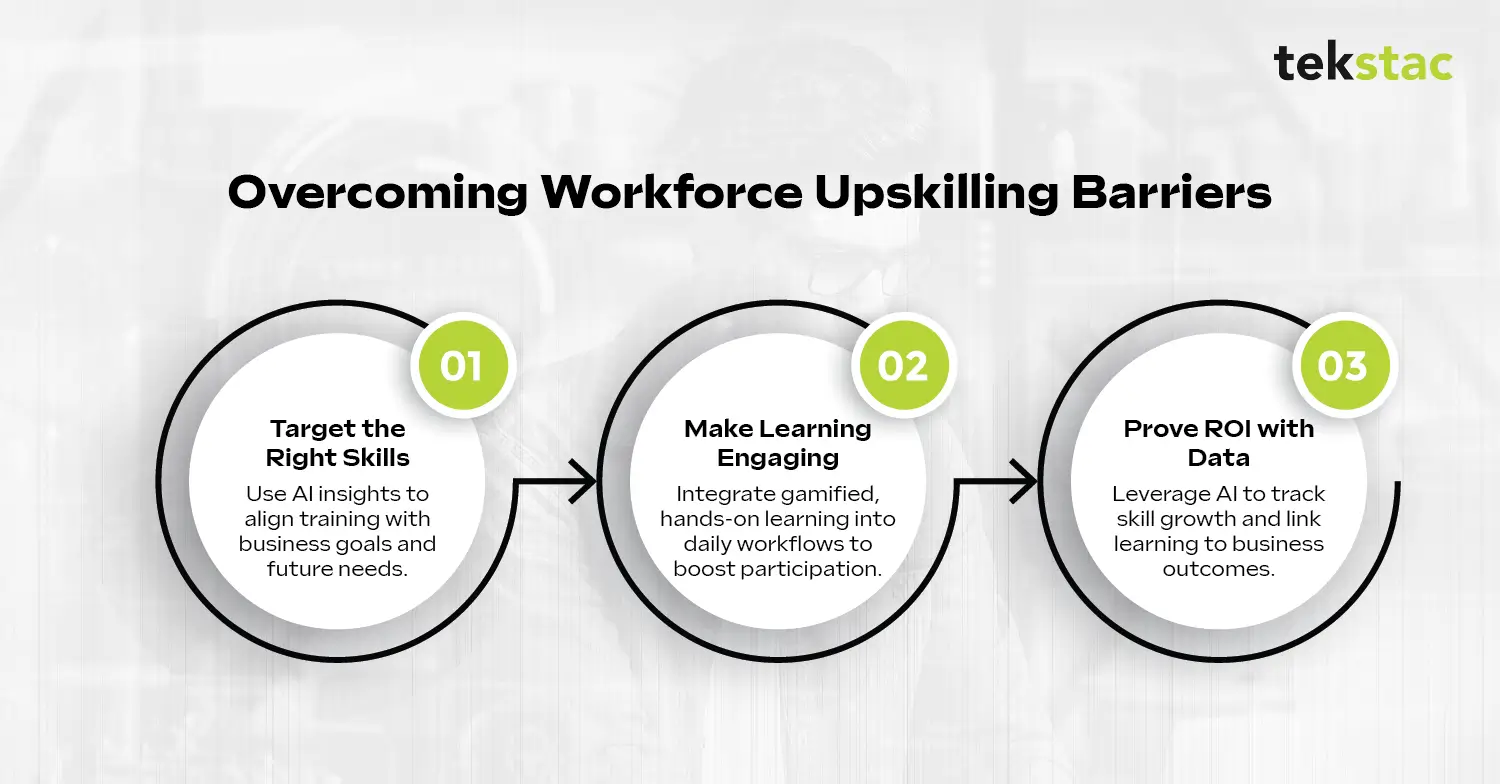
Many organizations struggle with identifying the right skill areas for investment. AI-driven insights remove the guesswork by pinpointing critical skills needed across teams. This enables companies to build a workforce upskilling strategy that directly aligns with business growth.
The shift toward AI is already happening—employees are 47% more likely than leaders realize to believe that AI will replace 30% of their work in the next year. Without targeted learning initiatives, businesses risk losing talent and falling behind competitors who are actively investing in AI-driven training solutions.
Resistance to change is common, especially when employees perceive upskilling as an additional workload. By integrating learning into daily workflows, offering hands-on labs, and using gamified experiences, companies can create a culture where continuous learning feels natural and engaging.
Studies show that employees trust their organizations more than universities and tech firms when it comes to responsible AI deployment. Companies that invest in transparent, well-structured upskilling programs can leverage this trust to drive higher participation and engagement in AI learning initiatives.
Without measurable outcomes, upskilling remains an expense rather than an investment. AI-powered platforms track skill progression, measure performance improvements, and tie learning outcomes to business impact. This ensures workforce upskilling delivers tangible value rather than just ticking a compliance box.
Executives are aware of this challenge—half of business leaders believe AI tool development within their companies is too slow. Talent skill gaps are cited as a primary reason for the delay. By investing in AI-driven workforce upskilling, companies can accelerate AI adoption, maximize efficiency, and drive long-term business success.
Companies that prioritize workforce upskilling are not just future-proofing their business—they are gaining a competitive edge. AI-powered learning solutions enable organizations to cultivate a highly skilled workforce capable of driving innovation and operational excellence.
As the pace of technological change accelerates, the question is no longer whether to invest in upskilling—but how quickly companies can implement intelligent, AI-driven learning solutions. The time to act is now. Workforce upskilling and reskilling for digital transformations is the foundation of long-term business success.
Start by identifying the skills your team will need—not just today, but for the future.
Tekstac, an enterprise AI skilling platform trusted by IBM, PwC, and Capgemini, delivers AI-powered workforce upskilling through personalized learning paths, hands-on labs, and skills intelligence dashboards — giving L&D teams the data to build capability strategically, not reactively. [Explore Tekstac’s workforce upskilling platform]
1. What are the best workforce upskilling solutions for enterprises?
The most effective enterprise workforce upskilling solutions combine three capabilities: AI-powered skills gap assessment to identify what each employee needs, personalized learning paths that adapt to individual pace and role requirements, and real-time analytics that tie skill progression to measurable business outcomes. Platforms like Tekstac deliver all three in an integrated LMS environment, enabling L&D teams to move from guesswork-based training to evidence-based capability building at scale.
2. How does AI improve workforce upskilling?
AI improves workforce upskilling in three ways: it personalizes learning by analyzing each employee’s current skills, learning patterns, and career goals to recommend targeted content; it tracks progress in real time through continuous assessments rather than periodic tests; and it uses predictive analytics to identify future skill requirements before gaps affect productivity. Together, these capabilities make upskilling faster, more relevant, and measurable — replacing static training calendars with adaptive, always-current development programs.
3. What is a workforce upskilling platform and what should it include?
A workforce upskilling platform is a technology solution that enables organizations to assess employee skills, deliver personalized learning content, track progress, and measure business impact — all in one system. Key capabilities to look for include: AI-driven skills gap analysis, role-based learning path customization, hands-on labs and practical assessments, integration with existing HRIS and LMS systems, and analytics dashboards that connect learning outcomes to performance metrics.
4. What is data and AI upskilling and why does it matter?
Data and AI upskilling is the process of building literacy and practical capability in data analysis, machine learning, AI tool usage, and related disciplines across a workforce — not just in technical teams. It matters because AI adoption fails without employees who can interpret data, work alongside AI systems, and make decisions informed by analytical outputs. A 2024 AI-Enabled ICT Workforce Consortium report found that 91.5% of ICT jobs face high or moderate transformation due to AI — making data and AI upskilling a business continuity requirement, not a nice-to-have.
5. How do you measure the ROI of workforce upskilling programs?
ROI from workforce upskilling is measured through four indicators: productivity improvement (output per employee before and after training), skill progression rate (speed at which employees move from assessed gap to demonstrated capability), retention impact (comparing turnover rates between upskilled and non-upskilled cohorts), and AI adoption velocity (how quickly employees integrate new tools into daily workflows). AI-powered platforms that track learning outcomes against performance data make this measurement continuous rather than retrospective.
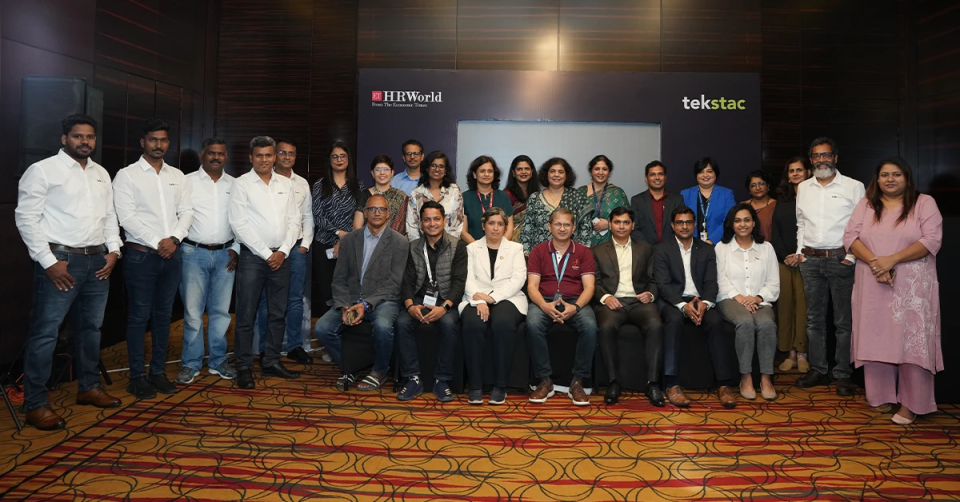
By 2027, six out of ten employees will need to upskill, yet less than half have access to adequate training, according to the World Economic Forum. This growing gap between evolving industry demands and workforce capabilities poses a serious challenge for businesses. In an era of rapid technological advancements, continuous learning is no longer just an HR initiative—it has become a strategic necessity for companies to stay competitive and future-ready.
Companies that treat learning as a core business function—integrating AI-driven development plans and tailored career paths based on current Learning and Development Trends—aren’t just keeping pace with change; they’re driving it. According to industry leaders, continuous learning is no longer a buzzword but a business imperative, essential for staying competitive in an evolving landscape.
They stress that staying ahead requires more than just offering training programs. It demands a strategic, AI-powered approach to skill development, strong leadership involvement, and a culture where learning is deeply embedded into everyday work. Today, the real question isn’t whether to invest in continuous learning—it’s whether businesses can afford not to.
Tata Technologies is prioritising continuous learning as a business-critical necessity, particularly in the rapidly evolving automotive and technology sectors. The company runs multiple learning programs for lateral hires but places equal emphasis on upskilling long-tenured employees who have been with the organization for decades.
Tracy Austina Zacreas, AVP – Global Head – Technical Learning and Development, highlights this focus, stating that Tata companies, including Tata Technologies and Tata Motors, have a legacy of long-serving employees—many working with the same skill sets for 35 to 40 years. “In most other organizations, a five-year tenure qualifies for a long-service award, but at Tata, employees build decades-long careers,” she explains.
However, as industries transform, the risk of these employees being left behind increases, making continuous learning essential. “This poses a challenge for the organization, making continuous learning a business-critical necessity,” says Zacreas. To bridge the gap, Tata Technologies is upskilling employees across operations, supply chain, and procurement, ensuring they are equipped to handle emerging technologies such as Gen AI, software-defined vehicles, and cybersecurity.
“From reading data sheets to negotiating with vendors for crucial components like motors, our goal is to ensure they stay relevant in a rapidly transforming landscape,” she adds. For Tata Technologies, continuous learning is not just a program—it is a strategic function. “Continuous learning ensures our experienced workforce does not miss the bus as industries embrace cutting-edge innovations,” Zacreas asserts.
Even the best AI platforms and learning management systems (LMS) won’t drive learning on their own. This is why learning journeys have been customized to cater to the specific needs of different employee segments at Infosys. Whether it’s tenured employees, team leaders, or those preparing for managerial roles, tailored interventions have been created for each group.
“For every segment, partnerships have been formed with leading platforms like Tekstac, LinkedIn Learning, and Udemy, offering specialized learning interventions to address unique needs. The Learning and Development (L&D) team oversees these interventions, ensuring they are focused and impactful for every employee,” Savio Freitas, Practice Lead HRD at Infosys, emphasizes.
This personalized, segment-based approach is how a continuous learning culture is fostered, ensuring that every employee has the support and resources they need to grow and succeed within the company.
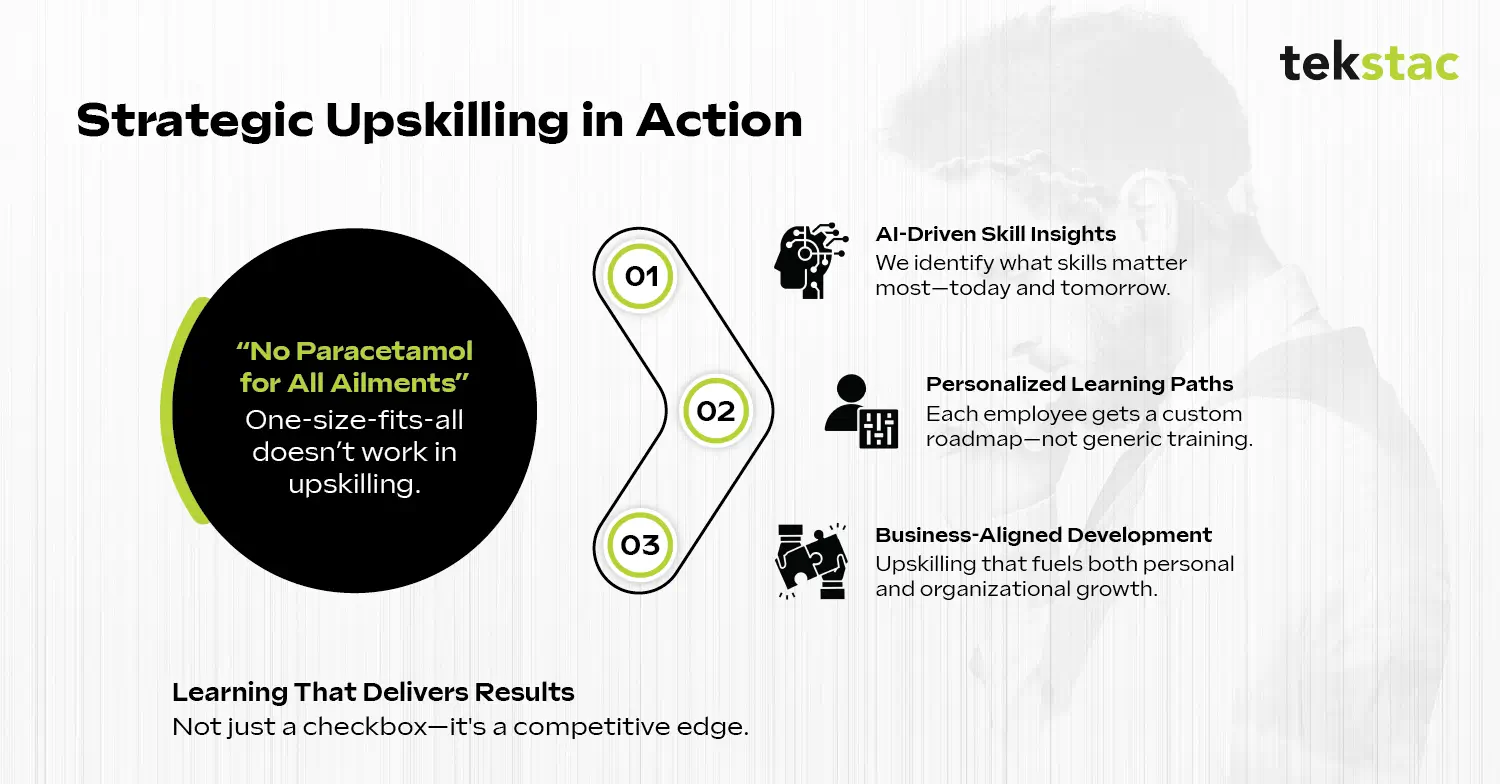
“We believe in a targeted approach to learning—there’s no ‘paracetamol for all ailments,’” says Manmohan Sharma, Talent Management at QX Global Group. And that’s why QX follows the Individual Development Plan (IDP) model, ensuring upskilling is precise and relevant. Sharma explains how they do it:
“This way, learning isn’t just a checkbox—it’s a tool for staying competitive,” he adds.
Want to accelerate your team’s growth?
Discover how effective upskilling strategies can drive your digital transformation and future-proof your organization.
At Amdocs, continuous upgradation in technology isn’t just an option—it’s a necessity. Simren Mehn, Practice Lead- OD & Senior Leadership Development-(Global) at Amdocs, emphasizes the importance of scaling to stay competitive. “If you’re not scaling yourself, you’re losing the game,” she says.
As a product-led service company, Amdocs creates core products that get customized for telecom organizations, requiring a mix of skills in both emerging technologies and legacy systems.
One of the company’s key initiatives involves conducting a deep skill analysis to identify:
“To support this, Amdocs is piloting an AI-based learning system that helps employees create skill profiles, self-assess, and receive targeted learning recommendations. Employees can rate themselves on a scale from basic to advanced, and managers can assess them as well. The system automatically identifies skill gaps and pushes relevant learning content,” explains Mehn.
However, Mehn emphasizes that merely implementing a system isn’t enough. “Driving learning through business units and leadership involvement is key,” she explains. L&D is no longer just an HR function—it’s a strategic business imperative.
Leaders at Amdocs understand that without continuous learning, they risk becoming obsolete. By embedding learning into the company culture, Amdocs ensures business relevance and long-term success.
The examples above highlight how companies are embedding continuous learning into their business strategies, ensuring employees remain relevant and competitive in a rapidly evolving world. But learning isn’t just about access—it’s about the right tools, the right interventions, and a culture that drives engagement.
Platforms like Tekstac play a crucial role in this transformation. By offering AI-driven insights, personalized learning journeys, and business-aligned skill development, these platforms enable organizations to provide targeted upskilling opportunities. Whether it’s reskilling long-tenured employees, ensuring managers are equipped for leadership, or closing critical skill gaps, leveraging the right learning ecosystem ensures that upskilling is not just a corporate checkbox but a strategic advantage.
The choice isn’t whether to upskill—it’s how quickly and effectively organizations can do it.
1. Why is continuous upskilling important for future-ready companies?
Continuous upskilling ensures that employees keep pace with emerging technologies, maintain productivity, and drive innovation. It prevents skill obsolescence and supports long-term business growth.
2. How can AI improve continuous upskilling?
AI personalizes learning paths, identifies skill gaps, and provides data-driven recommendations to accelerate employee growth and business outcomes.
3. Why is continuous learning and upskilling important?
Continuous learning and upskilling are essential to keep employees’ skills aligned with evolving technologies and business needs. They help individuals stay relevant, boost innovation, and enable organizations to remain competitive in a rapidly changing market.
Workforce capacity planning is the key to ensuring your organization has the right people in the right roles at the right time. Strategically aligning the workforce with objectives helps businesses stay agile, meet demands, and achieve long-term goals.
Whether managing seasonal demand, launching a new product, or preparing for future growth, an effective capacity plan ensures you have the resources needed to succeed.
In this guide, we’ll explore why workforce capacity planning is crucial and walk you through four essential steps to make it a success.
Workforce capacity planning is a process in which the organization determines the number and type of workers needed to support its current and future needs.
According to Fortune, around 82% of employees are at risk of burnout this year, but only half of employers consider well-being when designing work.
The goal is to ensure the organization has the right people in the right roles at the right time to support operations and achieve its mission. This includes fostering upskilling and reskilling initiatives to drive digital transformation.
Workforce capacity planning may seem challenging, but companies that implement it effectively can unlock significant advantages that improve both employee well-being and business efficiency.
1. Minimizing Burnout: By monitoring employee workloads and ensuring tasks are evenly distributed, managers can prevent burnout, reduce turnover, and maintain a healthier, more engaged workforce.
2. Better Decision-Making: With tools to identify skill gaps and allocate resources strategically, leaders can ensure high-priority projects are assigned to the right people, maximizing team potential through inclusive leadership programs.
3. Saving Time and Money: Effective capacity planning reduces the need for frequent hiring and its associated costs. By optimizing its workforce planning processes, Schneider Electric saved over $15 million and unlocked 200,000 productivity hours.
Workforce capacity planning is vital for ensuring your business has the talent to meet current and future demands. Following a structured approach, you can optimize resources, reduce costs, and align your workforce strategy with organizational goals.
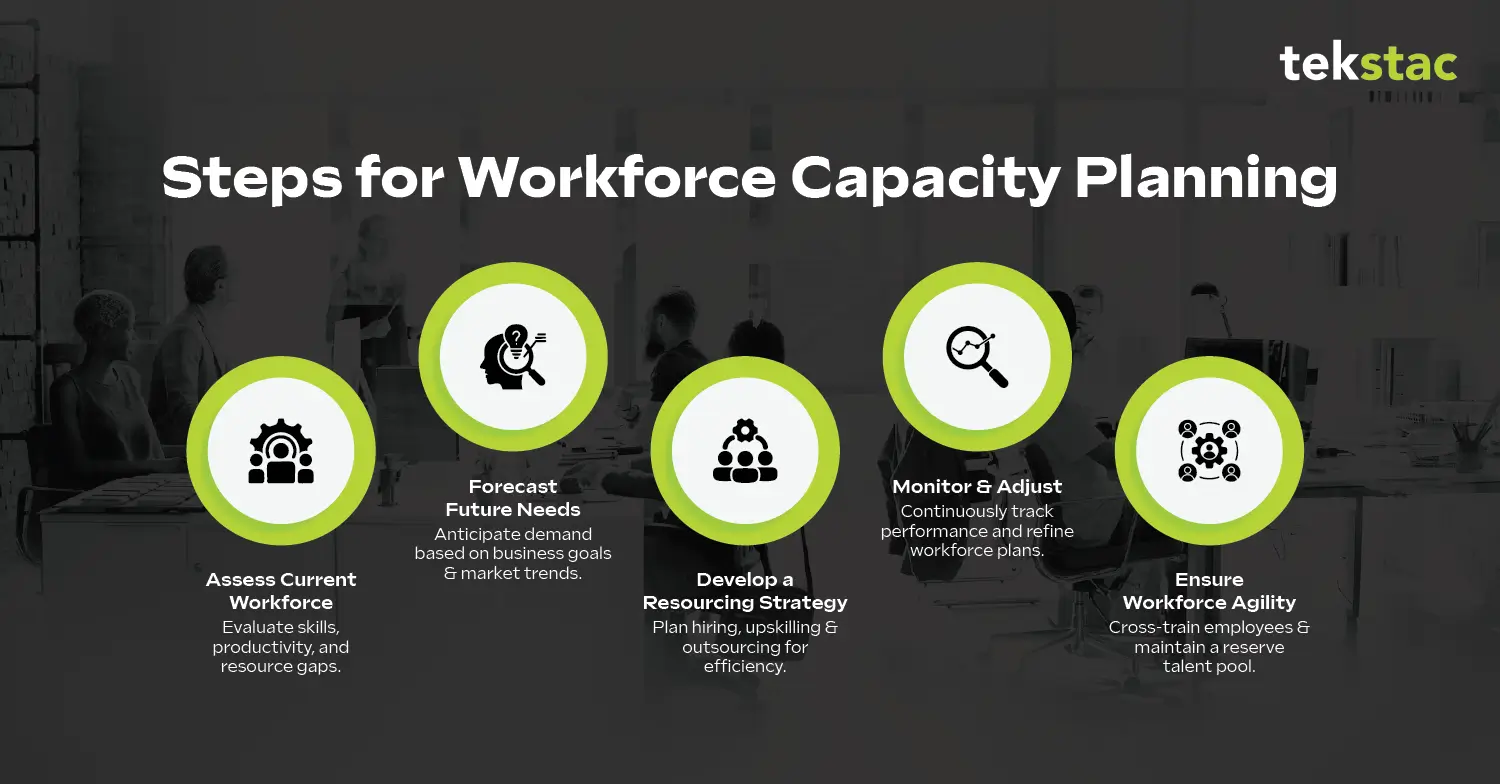
Understanding your current workforce is the foundation of effective capacity planning. This step ensures you know where your team stands and identifies gaps that must be addressed.
Planning for the future requires anticipating workforce demands based on market trends, business goals, and potential challenges.
After analyzing current capacity and forecasting future needs, create a comprehensive strategy to bridge gaps and meet demand.
An effective workforce plan involves an ongoing process of continual evaluation as well as refinement.
Workforce capacity planning is a critical tool for achieving business success. By assessing current capacity, forecasting future needs, and implementing a strategic resourcing plan, you can ensure your organization is prepared for challenges and opportunities.
As workforce dynamics and technology evolve, capacity planning will only grow in importance. Embracing innovation and agility helps businesses stay ahead and secure long-term success.
But planning alone isn’t enough—building the right skills matters too. To discover how employee training and development can strengthen your workforce and future-proof your business, explore our guide on The Future of Employee Training and Development.
1. What is the main goal of workforce capacity planning?
The main goal of workforce capacity planning is to align employee skills and availability with business needs, ensuring the right people are in place to boost efficiency, prevent burnout, and support growth.
2. How does workforce capacity planning help prevent employee burnout?
By monitoring workloads and balancing tasks, capacity planning prevents employee overload, improves well-being, and supports long-term engagement.
3. What are the key steps in workforce capacity planning?
The process typically includes assessing current workforce capacity, forecasting future needs, developing a resourcing strategy, and continuously monitoring and adjusting plans.
4. How can technology improve workforce capacity planning?
Tools like HR analytics, AI-driven forecasting, and workforce management software provide real-time insights into capacity, utilization, and skills gaps, making planning more accurate and efficient.
What if your training programs could truly adapt to every learner’s needs? Generative AI (Artificial Intelligence) is reshaping Learning and Development (L&D) by providing adaptive, scalable, and data-driven solutions tailored to diverse learner profiles.
Say goodbye to outdated, one-size-fits-all training. AI brings new possibilities, from creating personalized learning paths to delivering interactive content and automating assessments.
But as exciting as these advancements are, they come with challenges that demand attention. Tackling Generative AI challenges in L&D is essential for ethical and effective adoption by 2025.
The biggest generative AI challenges in Learning and Development include data bias and poor data quality, ethical and compliance risks, lack of transparency, high implementation costs, content hallucinations, limited personalization, and resistance to adoption. Addressing these challenges is critical for building fair, scalable, and effective AI-driven L&D programs.
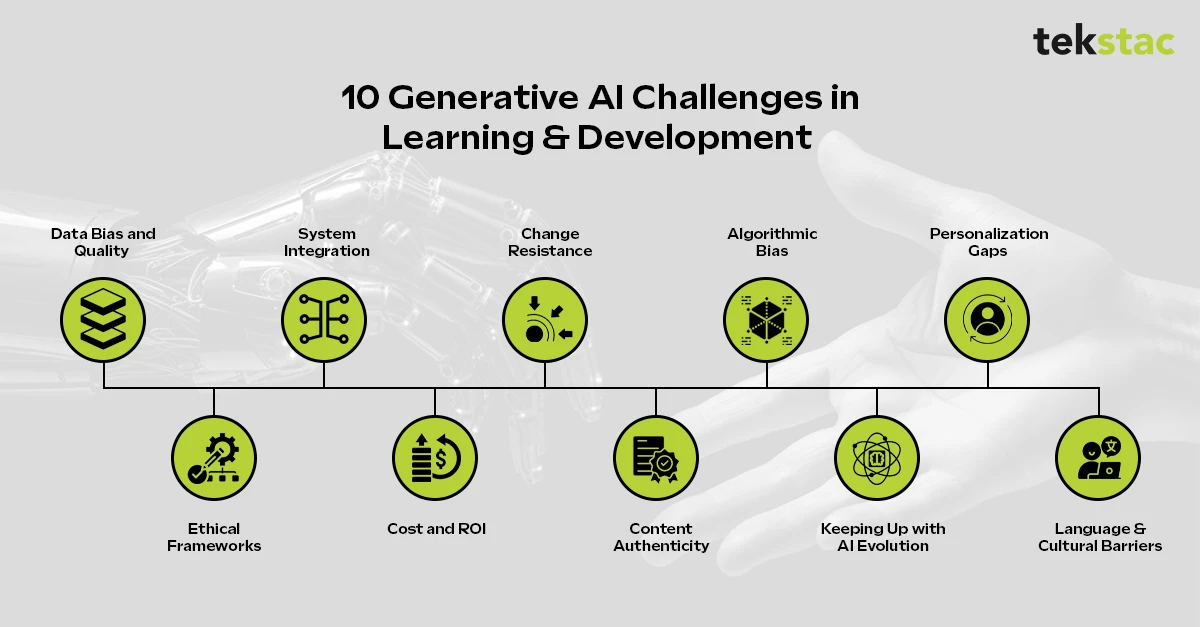
The first major challenge lies in tackling algorithmic bias and data quality issues. A 2024 report highlighted that 42% of organizations struggle with poor data quality, which undermines the accuracy of AI outputs.
Bias in datasets can perpetuate stereotypes and negatively impact the inclusivity of training materials. For example, biased AI models might produce content that unintentionally alienates certain groups, eroding trust and engagement among learners.
To overcome this, organizations must prioritize:
These actions ensure fairness while maintaining the reliability of AI-driven learning systems.
In regions such as India and Southeast Asia, organizations adopting generative AI in Learning and Development face additional challenges related to varying digital maturity levels, multilingual delivery requirements, and uneven AI readiness across teams.
One of the biggest Generative AI challenges lies in the transparency of generative AI models and algorithms. Often referred to as “black boxes,” they make it hard to understand how decisions are made, raising significant ethical concerns. This opacity can create dilemmas when it comes to accountability and trust. To address these issues, global powers like the U.S. and China are stepping up by advancing AI regulations aimed at promoting transparency and fairness.
For businesses, this means aligning with emerging ethical standards to ensure they not only stay compliant but also foster trust among their teams and stakeholders. Tackling these Generative AI Challenges with a proactive approach is essential for creating AI systems that are both reliable and equitable.
Key strategies include:
By embedding ethics into their L&D strategies, organizations can create AI-powered solutions that are both innovative and trustworthy.
Integrating generative AI into existing systems presents technical challenges, especially for organizations reliant on legacy learning management systems (LMS). These traditional platforms often lack the flexibility required for dynamic AI tools, leading to compatibility issues and inefficiencies.
To address this:
Such strategies minimize disruptions while enabling seamless integration of cutting-edge tools.
While the financial investment in generative AI can seem significant—ranging from $100,000 to $600,000 per project, according to a Scaleup Ally report—the potential return on investment (ROI) makes it a game-changer for Learning and Development.
AI-based training systems can streamline workflows, enhance learner engagement, and provide data-driven insights that improve program effectiveness, ultimately saving both time and resources.
To maximize ROI, organizations can:
By aligning investments with measurable outcomes, businesses can ensure that every dollar spent contributes to creating impactful and sustainable L&D programs.
Integrating AI into Learning & Development (L&D) presents notable Generative AI Challenges, particularly concerning organizational resistance to change. Employees often view AI as a potential threat to their job security, while leadership may hesitate due to financial implications. A 2024 PwC report reveals that 39% of workers are apprehensive that AI could render their current skills obsolete.
To overcome resistance, organizations should:
Through collaboration and education, businesses can foster a culture of acceptance and enthusiasm for technological innovation.
Generative AI models occasionally produce misleading or plagiarized content, raising concerns about authenticity. A 2023 study introduced the Hallucination Evaluation benchmark for Large Language Models (HaluEval), revealing that models like ChatGPT generate hallucinated content—plausible yet unverifiable information—in approximately 19.5% of their responses.
Solutions include:
By implementing these measures, organizations can maintain the integrity of their training programs.
One of the most significant Generative AI Challenges lies in addressing algorithmic bias, which can undermine equitable learning opportunities and reinforce existing inequalities. For example, career guidance tools powered by AI might unintentionally push learners away from certain professions if the underlying data reflects societal biases.
Addressing this requires:
These efforts ensure AI tools empower all learners, regardless of background.
As AI technologies evolve rapidly, staying updated becomes a challenge for L&D teams. Traditional training models risk obsolescence if they fail to adapt.
Recommended strategies include:
By embracing agility, organizations can future-proof their L&D initiatives.
Despite its potential, generative AI often struggles to deliver true learner personalization. Many systems rely on standardized datasets, which fail to account for individual preferences, learning styles, or career goals.
To address this, organizations should:
These approaches create more engaging, relevant, and impactful learning experiences.
Generative AI’s limitations in handling diverse languages and cultural contexts present significant challenges for multinational organizations. A 2024 report from the World Economic Forum highlighted that most AI chatbots and language models are trained on only about 100 of the world’s 7,000 languages, with English being the dominant focus.
Organizations can overcome these barriers by:
By addressing these challenges, businesses can create inclusive L&D programs that resonate with a global workforce.
While it’s important to address the challenges, generative AI also opens up exciting opportunities in Learning and Development. By leveraging its capabilities, organizations can:
By solving the challenges of generative AI, organizations can create better Learning and Development programs that are fair, effective, and help everyone succeed.
For forward-thinking solutions inspired by industry-leading practices, explore a 360° skilling platform that innovative approaches to unlock the full potential of AI-driven L&D.
1. What is the major challenge associated with generative AI models?
The major challenge associated with generative AI models is ensuring accuracy, fairness, and trust at scale. Models can produce biased or hallucinated outputs if trained on poor-quality data, making governance, validation, and human oversight critical for enterprise Learning and Development.
2. What are the three limitations of generative AI?
The three main limitations of generative AI are data bias, lack of explainability, and hallucinated or inaccurate outputs. In L&D, these limitations can impact learner trust, assessment accuracy, and the effectiveness of personalized training programs.
3. Is generative AI reliable for corporate training?
Generative AI can be reliable for corporate training when used with proper governance, high-quality data, and human oversight. While it enhances personalization and scalability, organizations must validate content, monitor bias, and align AI outputs with learning objectives to ensure consistent training quality.
4. How can organizations overcome generative AI challenges?
Organizations can overcome generative AI challenges by investing in clean and diverse data, adopting explainable AI, implementing ethical frameworks, upskilling L&D teams, and combining AI automation with human review. This approach ensures responsible, scalable, and high-impact learning experiences.

What will define a company’s success in attracting talent in 2026? The answer lies in a compelling Employer Value Proposition (EVP).
In a world where the workplace is evolving faster than ever, a well-articulated EVP is no longer optional—it’s the key to standing out in a competitive job market.
As we step into 2026, having a clear and authentic EVP is emerging as a critical strategy for attracting and retaining top talent. Employees are no longer satisfied with salaries and perks alone—they expect meaningful support in areas like:
According to a Pew Research study, only 1 in 2 employees are satisfied with their employer’s benefits, while just a third of them feel they have adequate opportunities for advancement. With such low satisfaction rates, it’s absolutely clear now that having a strong EVP is essential.
There’s no doubt left about its importance.
This article explores major trends reshaping EVPs in the near future. From embedding purpose-driven work to embracing hybrid models, these insights reveal how companies can build EVPs that meet employee expectations and secure a competitive edge in the evolving job market.

In today’s workforce, employees are no longer content with just a paycheck—they yearn for a sense of purpose. A purpose-driven approach has become the cornerstone of a competitive employer value proposition (EVP), helping organizations connect employees to something far greater than their daily tasks.
This alignment with purpose has a profound impact on talent retention and engagement. Employees increasingly gravitate toward roles that reflect their personal values. Whether it’s contributing to sustainability efforts, advocating for social justice, or participating in impactful community programs, purpose-driven companies hold a unique appeal.
Paying attention to employer branding ensures that this purpose is clearly communicated to both current and prospective employees.
The numbers are compelling: employees who find passion and purpose in their work are 300% more likely to stay with their organization.
But crafting a meaningful employer value proposition takes more than words—it demands authenticity. Employees need to see purpose embedded in leadership decisions and reflected in the organizational culture.
Embedding purpose is just the beginning. As employee expectations continue to evolve, organizations must dig deeper. Purpose must fit smoothly with personalized employee engagement plans. This helps create a workplace where people feel valued and driven.
When done right, this alignment not only boosts satisfaction but also cements loyalty in the long run.
While purpose creates the foundation of an EVP, personalization ensures it resonates with diverse employee needs.
In today’s fast-paced job market, the era of one-size-fits-all Employer Value Propositions (EVPs) is behind us. Employees now look for more—opportunities that align with their values, aspirations, and career ambitions. A carefully designed EVP can help your organization stand apart by addressing these deeper needs.
Personalization is at the core of a standout EVP. When you take the time to craft messages that resonate with specific groups—whether it’s tech professionals or sales teams—you’re not just hiring for skills. You’re creating connections with people who share your mission and vision. It’s about finding ways to show candidates that their unique goals matter to your company.
Beyond recruitment, a strong EVP plays a key role in strengthening company culture. When your core values and objectives are seamlessly reflected in your messaging, employees feel a deeper sense of purpose. They’re more likely to understand how their work contributes to something bigger, which builds loyalty and reduces turnover.
Authenticity makes all the difference. Involve employees across all levels to shape your EVP, listen to their feedback, and ensure your messaging reflects their needs and aspirations. When your approach is honest and relatable, it naturally resonates with both current employees and potential hires.
Your EVP should also echo the values that define your brand. Companies that embrace respect, inclusion, and innovation attract like-minded individuals, building teams that thrive together and drive long-term success.
The era of rigid 9-to-5 workdays is fading fast. Flexibility and hybrid work models are becoming indispensable to any forward-thinking employer value proposition. Employees want autonomy over where and when they work, and companies offering this freedom are reaping the rewards.
Research reveals hybrid work positively impacts productivity, with 61% of surveyed HR professionals affirming this as per a Sloan review article. However, measuring productivity remains complex, as traditional metrics often miss human factors like energy, collaboration, and focus.
Hybrid models also advance diversity, equity, and inclusion (DEI) efforts. They enable companies to accommodate a wider range of employee needs, from working parents to those living in high-cost areas. This inclusivity expands access to top talent, building a workforce as diverse as the customers they serve.
But flexibility isn’t without its challenges. Teams must navigate communication gaps, and managers need training to lead hybrid teams effectively. The key is designing systems that foster collaboration while giving employees the freedom they crave.
Flexibility sets the stage for a thriving workforce, but it’s not enough on its own. A strong EVP also requires a focus on holistic well-being.
A thriving workforce is a well-supported workforce. In recent years, companies have recognized the importance of holistic well-being as a critical pillar of their employer value proposition. This means addressing employees’ mental, physical, and financial health in a cohesive strategy.
Mental health support is now non-negotiable. Companies are offering services like counseling, mental health days, and stress management workshops to combat burnout. At the same time, physical wellness programs—ranging from fitness subsidies to wellness challenges—are helping employees stay healthy and energized.
Financial well-being is equally important. Employees face rising costs and mounting debt, making financial planning tools, debt relief programs, and retirement savings plans essential. Here’s a telling stat: 3 out of 5 employees feel more loyal to companies that actively support their financial well-being.
According to Keyia Burton, Senior Principal at Gartner, “Communication is the biggest barrier for HR leaders when it comes to EVPs.” Effective EVP strategies must focus on understanding, connecting to, and trusting the promises throughout the employee journey.
Companies that invest in holistic well-being see significant returns. When employees feel genuinely supported, they are more engaged, perform better, and are more likely to recommend their employer to others. But creating a well-rounded EVP doesn’t stop here. Organizations are increasingly turning to technology to take their strategies to the next level.
Technology is transforming the employee value proposition (EVP), becoming essential for attracting, engaging, and retaining top talent. AI and chatbots optimize the recruitment process, offering candidates a seamless, personalized, and efficient experience.
Innovations such as generative AI and no-code platforms empower employees to customize solutions, boosting productivity and satisfaction. Furthermore, technology enhances onboarding and professional development with data-driven insights and personalized learning pathways.
AI also drives inclusivity by eliminating hiring biases and supporting diverse workforces. Ethical implementation, including transparency and data privacy, is crucial for building trust. Ultimately, technology unifies the EVP, enabling purpose, personalization, and well-being.
The impact of a strong Employer Value Proposition is more than just cultural—it’s measurable. Research from leading sources highlights why EVPs are becoming a cornerstone of workforce strategy:
Key benefits of a strong EVP include 1.18 times higher organizational performance, 1.16 times greater innovation, and 1.23 times more employees reporting a sense of purpose in their work.
As you step into 2026, the time to act is now. Each of these trends builds on the others, creating a cohesive framework that attracts talent, engages employees, and drives long-term success.
Looking to craft an EVP that positions your company as a future-ready leader? Let us help you build strategies that connect purpose, innovation, and employee satisfaction seamlessly.
1. What is an Employer Value Proposition?
An Employer Value Proposition (EVP) is a company’s unique promise of culture, benefits, and opportunities that attract, retain, and engage employees.
2. Why is EVP important in 2026?
In 2026, EVP is crucial as employees seek purpose, flexibility, and growth beyond pay, driving talent attraction, engagement, and long-term retention.
3. What are the 5 pillars of the EVP?
The five EVP pillars are: purpose-driven work, personalization, flexibility and hybrid models, holistic well-being, and technological innovation supporting career growth.
4. What is the difference between EVP and employer branding?
EVP defines the core promise to employees, while employer branding communicates that promise externally to attract, engage, and inspire potential talent.
A talent mobility framework and a career pathing strategy are the two primary approaches organizations use to develop internal talent; but they solve different problems, suit different cultures, and require different infrastructure to run well.
A Gartner survey of 3,375 employees found that one in three feel they could have a bigger impact on a different role within their own organization; yet fewer than one in five organizations can effectively move talent to where it is needed. That gap is what both frameworks are designed to close. This guide explains what each approach is, how they compare, and how to decide which one or which combination is right for your organization.
Here’s an insight into what Talent Mobility Frameworks and Career Pathing are and how they can help your organization.
| Dimension | Talent Mobility Framework | Career Pathing Strategy |
|---|---|---|
| Primary goal | Move talent across roles, teams, and projects | Define structured advancement within a function |
| Movement type | Lateral, diagonal, cross-functional | Vertical (ladder) or flexible (lattice) |
| Best for | Agile, fast-changing organizations | Structured, hierarchical organizations |
| Key tool | Internal talent marketplace, skills database | Individual Development Plans (IDPs), role maps |
| Timeframe | Short-to-medium term, project-based | Long-term, milestone-based |
| Risk | Talent hoarding by managers | Rigidity, limits non-linear growth |
| Outcome | Workforce agility, skills diversification | Retention, structured promotion pipelines |
A talent mobility framework is a strategic approach organizations take to help employees move across departments, roles, and projects in line with their career aspirations and meet business objectives.
By maintaining a talent mobility frameworks, organizations offer employees tools, resources, and processes that aid them in skill development, succession planning, and career progression. It encompasses internal transfers, cross-functional training, upskilling and reskilling, and internal transfers.
For example, Google offers an internal job board called “Google Jobs,” which showcases all the company’s open positions to its employees. It also provides career coaching and leadership development programs to facilitate employee transition into new roles. They also have a “gTwo” program that gives employees the opportunity to work in a different department or location.
An internal mobility framework is the operational execution layer of a broader talent mobility strategy; defining the processes, eligibility criteria, and infrastructure that enable employees to move into new roles internally. For a full breakdown of how to build one, see our complete guide to Internal Mobility Framework.
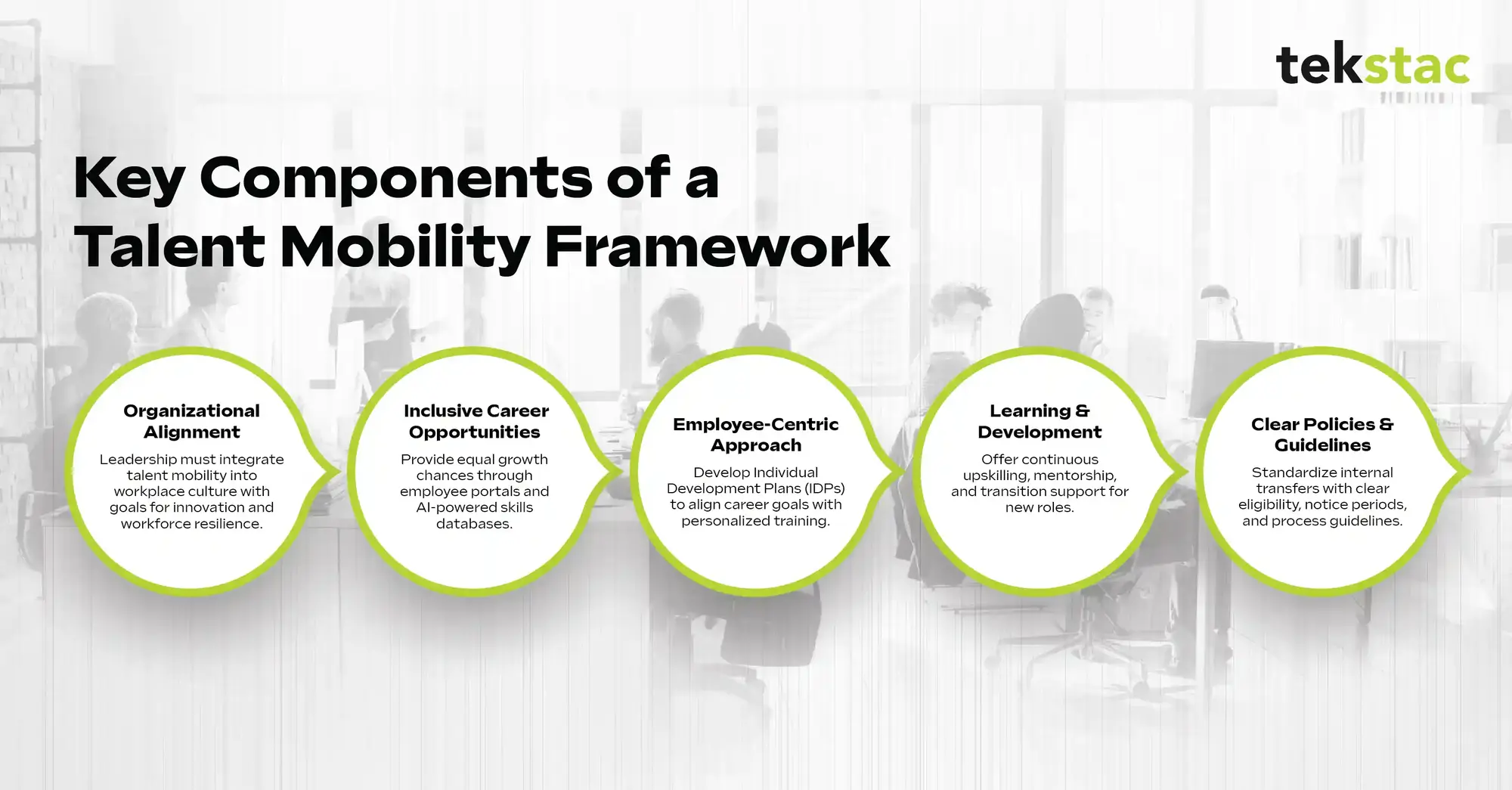
Leadership must prioritize and integrate a Talent Mobility Frameworks into the work culture. This framework should also have an end goal to be met regarding innovation, workforce resilience, and scalability.
Organizations should offer employees equal chances to grow and facilitate this through internal systems like employee portals, where new posts, vacancies, and projects are posted. An AI-powered skills database also helps map employees’ roles in sync with their competencies and career goals.
HR must take steps to create Individual Development Plans (IDPs) to chart career plans with short-and long-term goals, identify skills or roles that the employee seeks, and offer training programs accordingly.
Through continuous learning and development, organizations must offer upskilling programs and mentorship to help employees transition into new roles and develop new competencies.
Establishing clear guidelines and standardizing processes (eligibility criteria, notice periods, etc) helps smooth internal transfers and project assignments.
Through a talent mobility frameworks, organizations can:
Career pathing is a way for employees to fulfill their career aspirations by following a structured path, participating in developmental initiatives, reskilling or upskilling from time to time and meeting goals set by the organization.
Organizations can adapt career pathing to offer personalized learning, identify skills and competencies that support employees’ growth, and track their progress.
The two essential approaches to career pathing are:
For example, Nestlé has a Nestlé Academy program that offers personalized career development programs featuring job rotations and skill training. Through this program, employees can set clear career goals tracked through regular check-ins. Nestle also offers leadership development programs that help meet employee career aspirations and align with organizational growth strategy.
Organizations must first understand their business requirements, growth trajectory and identify leadership and business-critical positions.
Working in sync with employees helps organizations set short-and long-term goals that match their aspirations and meet organizational objectives.
Companies should set up 1:1 meetings to discuss their employees’ ambitions, interests, and values. Then, walk them through the skills and experience levels required to reach their career goals.
It is important to create strategies for acquiring skills, which include training sessions, upskilling and reskilling, shadow sessions, assignments, and mentoring.
Organizations must establish metrics to determine employee performance and hold one-on-one discussions to assess the initiatives’ effectiveness. To boost employee morale, organizations must reward significant progress or milestones with bonuses, salary hikes, or promotions.
Through career pathing, organizations can:
Both approaches are invaluable for an organization’s employee development and retention efforts. Choosing the right approach depends on your company’s culture, business requirements, and goals.
Talent Mobility Frameworks favor organizations focused on cross-functional learning, flexibility, and agility. If your main aim is to encourage employees to obtain diverse experiences and build versatile skills, moving across different departments, internal transfers, this approach would help immensely.
Career Pathing is more suitable for organizations that prefer structured and clear career progression. It is easier to implement in large or mid-sized companies with numerous hierarchical levels, which means moving to higher-level roles and retaining top-performing talent.
Organizations can also take a blended approach, ensuring flexible and structured growth. For example, employees can acquire diverse skill sets through cross-functional roles or lateral moves while working towards defined career goals.
For example – To get the best of both worlds, an organization can create a platform that offers internal job rotations, offshore assignments and short-term projects alongside well-defined career paths with specific milestones and development programs. This dual approach empowers employees with flexibility, helps them achieve long-term goals and create an agile workforce.
Whichever approach you choose, organizations can emerge as forward-thinking and keep reinventing themselves to stay relevant in a dynamic landscape.
Choosing between a talent mobility framework and a career pathing strategy, or building both, requires infrastructure that connects skills data, learning pathways, and performance outcomes in one place. Tekstac is an AI-powered LXP used by enterprise organizations including IBM, PwC, and Capgemini to build role-aligned learning paths, map skills gaps across teams, and track upskilling impact on internal mobility and career progression goals. Whether your organization needs the structured clarity of career pathing or the cross-functional agility of a talent mobility framework, Tekstac gives HR and L&D leaders the data infrastructure to make either approach work. 👉 Request a personalized demo now
1. How do Talent Mobility Frameworks benefit employee retention?
Talent mobility frameworks improve retention by giving employees a visible, credible path to grow without leaving. LinkedIn’s Global Talent Trends Report finds that companies with strong internal mobility programs see twice the employee retention rate. The mechanism is straightforward: when employees can see opportunities inside the organisation, the pull of external roles weakens.
2. Can organizations implement both Career Pathing and Talent Mobility together?
Yes, and for most mid-to-large organizations, a blended approach is the most effective model. Career pathing provides the vertical structure employees need to see a future; talent mobility provides the lateral flexibility to build skills that make them more valuable in that future. The two frameworks reinforce each other when both are supported by a shared skills data infrastructure.
3. What is the difference between a career ladder and career lattice?
A career ladder is a fixed, vertical hierarchy where progression means moving to a higher title within the same function. A career lattice is a more flexible model that supports lateral, diagonal, and vertical movement; allowing employees to grow across functions and build broader capability before moving up. Most modern talent mobility frameworks are built on a lattice model, as it better reflects how organizations need talent to move.
4. How does Career Pathing enhance employee engagement?
Career Pathing provides employees with a transparent growth roadmap, personalized development plans, and regular feedback, which boosts motivation and aligns individual aspirations with business objectives.