
Upskilling and reskilling digital transformation is no longer an HR initiative — it is a business continuity strategy. As AI, cloud computing, and automation reshape every function, organizations that fail to build new capabilities in their existing workforce fall behind competitors who do. Companies must equip their teams with modern capabilities to stay competitive in the evolving digital economy.
Through digital transformation, businesses can minimize costs, achieve data-driven decision-making, increase revenue growth, and enable scalability. For example – Tech giant Amazon has revolutionized its business by using AI-driven robots in warehouses for better inventory management and offering personalized shopping experiences to clientele by incorporating machine learning into its recommendation engine.
Digital transformation is a continuous and long-term journey for organizations, which raises the question of how employees prepare for it. Upskilling and reskilling help navigate digital changes as they facilitate employee engagement and retention, meet industry regulations and compliance, and enhance workforce adaptability. They are also a great way to enhance an organization’s brand value and contribute to being a ‘best place to work’.
Suppose a renowned bank decides to adopt AI-based customer service tools like chatbots — In that case, it can upskill by teaching its customer service agents how to leverage chatbots for handling routine queries while solving the complex problems by themselves. The bank can reskill by shifting tellers and back-office staff into specialized roles that require managing digital financial products or customer relationship management.
Understanding the difference between upskilling and reskilling is key to building a future-ready team.
Both are strategic components of any digital upskilling training plan.
Upskilling and reskilling are invaluable in developing a sense of loyalty among employees, carving new paths, and increasing the chances of promotions and higher pay scales. They are also a great way to attract new talent, as prospective employees would appreciate a workplace that provides training facilities and helps them ease into their roles steadily.
Building a digital upskilling training program requires four steps: assess existing skill gaps using AI-powered tools, build personalised learning paths by role, supplement theory with hands-on project experience, and measure progress through completion rates and performance impact data.
Start your digital upskilling training journey by identifying digital skills gaps through tools like surveys, feedback loops, and AI-powered assessments. This forms the foundation for building personalized development roadmaps for upskilling employees and preparing them for future roles.
Based on the results, companies can create personalized training plans to help employees upskill by adopting new technologies like AI, IoT, or Cloud, improving their project management skills or customer service skills.
Practical experience creates a learning experience amalgamating real-world application, mentorship, and continuous feedback systems. This experience is invaluable in preparing an employee for a different job position. Thus, garnering practical experience is a great way to upskill and reskill.
Here are some ways for organizations to evaluate their employees on their newly acquired skills:
Internal projects are an excellent way to help employees test their understanding of concepts and skills in real-time projects and solve organizational-level problems. Hence, they help develop hands-on experience and boost employees’ confidence by putting theory into practice.
For example, A corporate communications specialist who earns certification in digital marketing can identify new platforms to run ad campaigns, offer creative ideas to social media teams, and generate new leads by collaborating with content marketing teams.
Cross-function roles enable employees to think from fresh perspectives, delivering creative and impactful solutions. They also help develop a holistic overview of how organizations function across teams and optimize resource use. As a result, employees participating in cross-collaboration roles have a broader picture of how technology supports overall business objectives.
For example, an HR team member undergoing reskilling for digital transformation can collaborate with IT to configure cloud-based HR systems—gaining technical know-how while improving workflow efficiency.
While preparing your team for digital transformation, investing in soft-skill training, such as written and verbal communication skills, leadership, Emotional Intelligence (EQ), and negotiation skills, is also important.
Organizations can conduct soft skill training to help with both upskilling and reskilling by partnering with external agencies for interactive workshops and running micro-learning modules. For example, while employees receive training on new technologies, they conduct short learning sessions focusing on specific soft skills like “communicating effectively for remote work” or “resolving conflicts in digital collaborations.”
To embrace digital transformation, organizations need to think differently, which involves encouraging teams to brainstorm, test new tools, and find unique approaches to work. Organizations can also run competitions and innovation-based challenges to offer solutions for issues arising during digital transformation. Follow up these with prototyping initiatives and pilot testing projects to develop hands-on experience and test the viability of innovative solutions through real-time application.
Celebrate your team members’ progression and achievements as they finish training and acquire new skills. Share their success stories and milestones in company newsletters, email campaigns, or company case studies to recognize their contribution to the organization’s digital transformation process.
Platforms like Tekstac’s Skills Insights give L&D teams a real-time view of each employee’s capability gaps, learning velocity, and role-readiness score — enabling truly personalized reskilling paths rather than cohort-based training that treats a cloud engineer and a customer success manager as interchangeable.
Organizations can integrate data analytics into their learning platforms to identify skills gaps, track progress, and forecast learning needs. Here are some ways through which analytics tools help:
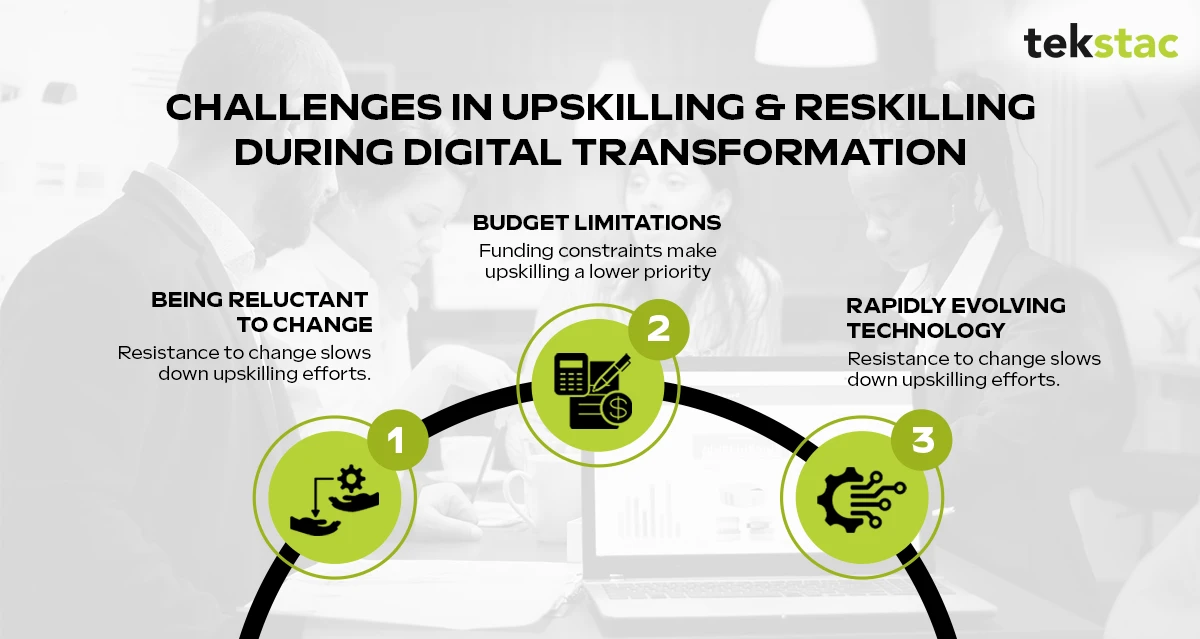
The three core challenges in reskilling employees for digital transformation are: resistance to change driven by fear of obsolescence, budget constraints competing with technology infrastructure spend, and the pace of AI and automation making programs outdated before they are completed. This could be due to several reasons, such as feeling complacent with their existing role and skill set, lack of time, especially while balancing existing workload with training, and a fear of failure.
When organizations undergo digital transformation, a significant portion of their budget is allotted to replacing legacy systems and digitizing operations. It leaves organizations, especially small and medium-sized enterprises, with strained budgets to allocate funds for upskilling and reskilling initiatives.
With the fast emergence of technologies like Artificial Intelligence (AI), Augmented Reality (AR), and cloud computing, employees find it difficult to keep up with the pace at which they must undergo training. Also, skills required for particular tools or technology become obsolete when newer versions are released. These constant changes may overwhelm employees as they try to balance their day-to-day roles and responsibilities with upskilling and reskilling training.
Are you an organization aiming to upskill and reskill to facilitate digital transformation? Here are some organizations that have made the successful transition and an insight into how did they do it:
IBM has since trained over 300,000 employees through its SkillsBuild program (2024), expanding beyond the original New-Collar initiative into generative AI and sustainability-focused roles. This initiative was a game-changer for those without a college degree, as they could still receive training to develop skills in new-age technologies.
They trained their workforce in software development, blockchain, cybersecurity, AI, Data science and analytics, and cloud computing. This was instrumental in creating a diverse and larger talent pool, minimizing the need for external hiring, and meeting the market’s demands.
They transitioned from a traditional sports shoe business to a digitally driven client-centric ecosystem. Nike invested in training its employees on data analytics, predictive analytics, and customer segmentation.
Based on this, the employees worked on user data from apps like Nike Training Club and Nike Run Club to run highly targeted marketing campaigns and offer personalized client experiences. Employees also underwent training in e-commerce platform management, inventory management, and digital payment systems to increase digital revenue.
Leaders were also reskilled in adopting new-age technologies like Augmented Reality (AR) and Blockchain to create digital-first strategies.
Global digital transformation spending reached $2.5 trillion in 2024 and is projected to exceed $3.9 trillion by 2027 (IDC, 2024). This is an excellent indicator for organizations to prepare their leaders to create a sound vision and strategy for digital transformation. The onus lies with the leadership establishing continuous learning that encourages employees to upskill and reskill. Since digital transformation marks a cultural shift in an organization, leaders must guide employees through regular meetings, offer constructive feedback, resolve their concerns, and promote its benefits.
Reskilling and Upskilling benefit employees and the organization, promoting increased job satisfaction, increasing brand reputation, and creating an agile and versatile workforce.
Take an initial step in your digital transformation journey by assessing your employee’s digital skills and empowering them to stand out in a constantly evolving digital landscape.
Ready to see how it works for your organization?
1. How do reskilling programs support digital transformation?
Reskilling programs support digital transformation by equipping employees with new capabilities — such as cloud computing, AI literacy, and data analytics — that are required for roles that did not previously exist. Rather than replacing staff, reskilling redirects existing talent into digital-first functions, reducing hiring costs while accelerating transformation timelines.
2. What is the difference between upskilling and reskilling in digital transformation?
Upskilling improves an employee’s existing skills to match evolving technology demands within their current role. Reskilling trains them in entirely new skills for a different role — typically triggered by automation, AI adoption, or major process change. Both are essential components of any enterprise digital transformation strategy.
3. What is digital upskilling and why does it matter?
Digital upskilling is the process of building modern technology competencies — including AI tools, cloud platforms, data literacy, and digital collaboration — in employees who currently lack them. It matters because digital transformation cannot succeed without a workforce capable of operating, adopting, and innovating with new technology.
4. What are the biggest challenges in reskilling employees for digital transformation?
The three primary challenges are: employee resistance to change, which stems from fear of obsolescence; budget constraints, particularly in mid-sized organizations allocating resources to technology infrastructure; and the pace of technology change, which makes it difficult to build programs that stay current with AI, automation, and cloud developments.
5. What are examples of successful upskilling and reskilling programs?
IBM’s New Collar Jobs initiative reskilled its workforce in AI, blockchain, and cloud computing without requiring traditional degrees — expanding its talent pool and reducing external hiring. Nike reskilled employees in data analytics and e-commerce operations as part of its shift to a digital-first customer model, enabling highly targeted marketing and increased digital revenue.

“For decades, corporate training topics have revolved around content.”
As leading industry analyst Josh Bersin points out, organizations have spent nearly 30 years refining how learning is delivered; shorter modules, mobile access, videos, microlearning, MOOCs. But we have rarely questioned whether the content itself truly works.
This has always been the core challenge of corporate training: content consumption does not equal capability creation.
As we step into 2026, the question for organizations is no longer what courses should we offer?
What capabilities must our workforce demonstrate, and how quickly can we build them?
This blog explores the trending corporate training topics for 2026, not from a content-first lens, but from a capability-first perspective.
Companies annually invest over $350 billion in corporate training. That’s quite an investment, but here’s the shocking reality: 70% of employees still feel they lack the skills to do their job well.
It only gets worse. For example, an ATD study reported that 62% of HR managers said their training programs did not meet the employee’s needs. Quite simply, most corporate training programs with good intentions and big budgets are off target.
To the leaders of L&D in tech, this is not a problem; it’s a challenge. Technology is always in development, and 2026 is going to be a sterner challenge in terms of keeping pace with the latest tech.
Staying relevant despite widespread changes in the corporate sphere is not about spending more on training; it’s about being smart about how you do it.
Are you focusing on the skills that matter most? Are you delivering training that future-proofs your workforce?
How do you ensure your team not just keeps pace but thrives in this ever-changing landscape?
The answer to these questions is prioritizing training topics that matter, beyond theory into real-world impact.
Let’s take a closer look at the top 10 corporate training topics your company should cover in 2026 to close the skills gap and truly empower your workforce.
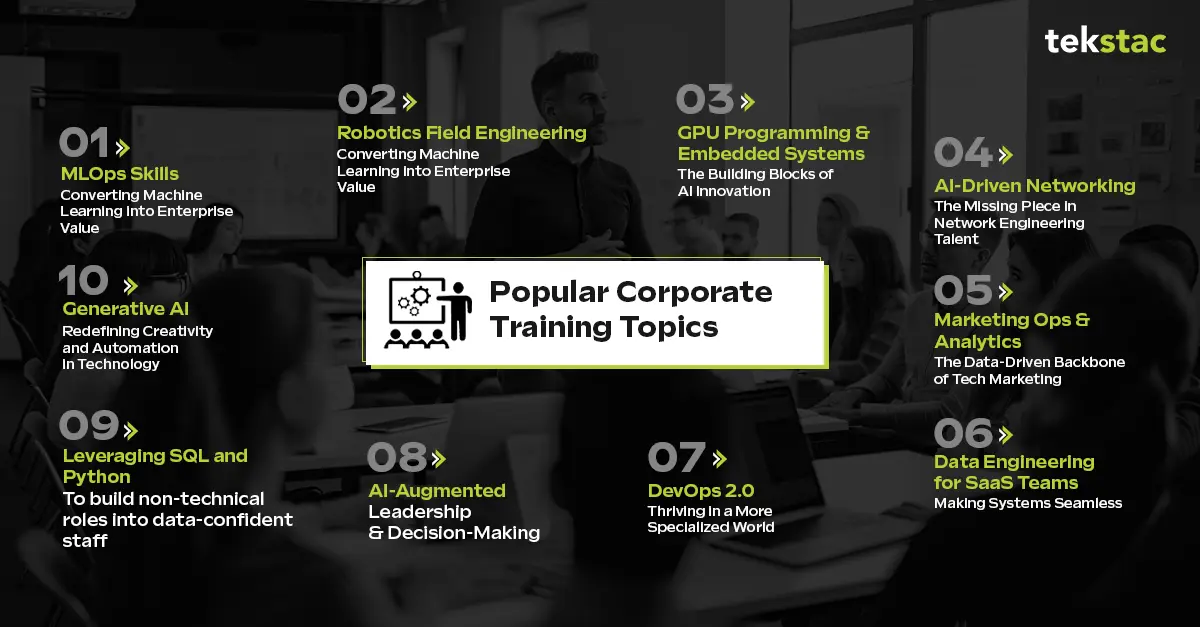
L&D leaders in tech companies must prepare their workforce for the challenges of scaling machine learning models. This is where MLOps comes into the picture.
MLOps is a mix of machine learning, DevOps, and data engineering that helps businesses successfully deploy and manage AI solutions.
A perfect MLOps use case that shows how beneficial training your employees in these skills can be is that of Ocado.
Being one of the largest online supermarkets, Ocado needed robust yet scalable ML solutions for key challenges including fraud detection, supply chain optimization and personalized customer experiences.
Ocado successfully implemented MLOps to deploy and monitor ML models that improved fraud detection, reducing manual review times and securing transactions.
With the help of MLOps, Ocado created daily retraining pipelines for quick adaptability to changing data patterns.
They were also able to make accurate demand predictions, minimize food waste, and optimize delivery routes to ensure freshness while reducing fuel emissions.
Key Challenges this corporate training topic solves:
The industry-wide revolution in robotics will take place in healthcare, logistics, manufacturing, and beyond.
Training employees in robotics goes beyond mere programming; it is geared at nurturing all-around problem solvers capable of dealing with complicated machines and data.
Providing corporate training for employees in embedded systems programming, hardware maintenance, and troubleshooting can groom employees for career positions such as Robotics Operations Manager or Field Engineer and future-proof your organization.
Key challenges this corporate training topic solves:
GPU programming and embedded systems are the driving force behind today’s most advanced technologies, from AI to self-driving cars.
Training in these areas arms employees with what they need to push the needle and prepare for the next wave of AI and high-performance computing.
Proper training can equip your team with the skills needed to manage the robust technologies of the future and derive the best results for your organization in 2026 and beyond.
Key challenges this corporate training topic solves:
Networking is the silent binding force that holds all technology companies together. Everything from a simple flow of data to cloud services and remote teams runs on networking.
Here is where the problem lies: there are simply not enough good network engineers. Inevitably, this lack of people with such a crucial skill is beginning to make things a bit more difficult to manage for businesses as networks get increasingly complex, especially with cloud computing, IoT, and the modern work-from-anywhere approach.
This is a type of training topic for employees that companies should look to have resilient networks that run well, securely, and efficiently.
As the bulk of modern day business relies on technology, network infrastructure has become critical in daily operations and data security.
If you are an L&D leader, your key training focus for this area should be to train employees to use AI-powered network tools.
This will help them proactively identify and address issues before they disrupt operations.
Also, focus on cloud-based networking courses that can train your team to connect hybrid cloud systems with in-house networks for seamless connectivity.
Additionally, train your team to build zero-trust security models to protect sensitive information from leaking through various access points.
Key challenges this corporate training topic solves:
In many tech companies, marketing operations and analytics are unsung heroes. They work in the background, stitching together marketing and sales so that decisions can be data-driven rather than based on gut feeling. This is a very important but commonly overlooked role, especially in B2B tech companies where growing tech stacks and data complexity create chaos.
By training teams in marketing ops and analytics capabilities, technology companies can make informed, data-driven decisions that enhance performance by reducing inefficiencies and improve the alignment between marketing and sales efforts. This not only fosters current growth but positions companies for ongoing success.
Key challenges this corporate training topic solves:
Think of SaaS as the circulatory system of modern tech: data flows are its lifeblood. But when these streams hit blockages or inaccuracies, real-time decision-making goes out of the window, teams lose faith in their tools, and the user experience suffers. Better training will make your employees more self-reliant and confident with regard to handling data pipelines. For example, an operationally competent team of experts can create a custom dashboard themselves that saves them hours of manual reporting. This will increase efficiency by empowering the teams to make wiser decisions faster.
Key challenges this corporate training topic solves:
DevOps has evolved from the “jack-of-all-trades” engineer to a model that embraces specialization. Whereas early DevOps teams depended on one person handling everything from infrastructure through CI/CD pipelines, the complex tech ecosystems of today ask for experts in specific areas, such as Kubernetes or monitoring systems.
Training is of prime importance to help your team adapt to these changes while still collaborating effectively. Think of an application crashing in your tech company just because the underlying infrastructure was unable to support sudden surges in traffic. With the right DevOps training, your team can manage this issue and quickly create spin-ups of new servers using Kubernetes ensuring uptime without glitches. Specialization in key tools will not only avoid downtime but help your team improvise faster and work better.
Key challenges this corporate training topic solves:
AI-augmented leadership can sometimes sound like a futuristic concept, but in reality, it is already shaping how organizations operate today. Let’s imagine a scenario where the organization’s leadership team can access real-time skills insights from platforms like Tekstac. This gives them a measurable competitive edge while reducing guesswork and cognitive overload.
Key challenges this corporate training topic solves:
Data is the backbone of any tech company’s success, but just imagine a situation wherein both your marketing and operations teams don’t need to knock the doors of their data counterparts. By teaching basic skills in SQL and Python within non-technical positions, you make every team more agile, increasing the productivity of specialized manpower and creating an atmosphere where every team is self-sufficient and empowered.
For instance, a marketing professional who can write a simple SQL query to analyze campaign performance doesn’t just save time but contributes to faster, data-driven decisions.
Key challenges this corporate training topic solves:
While GenAI is the talk of the town with every company’s focus honed in on its potential, it’s a corporate training topic worth reiterating in this list. GenAI has become a cornerstone of innovation that allows technology companies to reimagine creativity, productivity, and automation. From content creation to the generation of synthetic data for testing, GenAI lets organizations reimagine workflows and build smarter, faster solutions.
Training teams to leverage GenAI means ensuring your business stays ahead in a rapidly evolving landscape, driving efficiency and innovation at every level. Automation through this technology is less about machines replacing humans; instead, it is more about empowering people, giving them the opportunity to get more done with much less sweat.
Key challenges this corporate training topic solves:
These corporate training topics are at the heart of true talent transformation—helping companies move beyond filling skill gaps to building future-ready teams that can adapt and thrive.
As you navigate through these trending corporate training topics to help your organization in 2026 and beyond, one challenge remains universal: how to ensure practical, on-the-job applicability of these skills? Additionally, how to ascertain that your employees are properly engaging in the training and are preparing ideally for the organizational goals you have in mind? This is where platforms like Tekstac are redefining corporate skilling.
Such platforms deliver real-world based training, assess employees for role-specific competencies, and help you analyze their progress using advanced data. The best part? You can scale your corporate learning programs across large teams without compromising on depth. If you are an L&D leader wanting to deliver result-oriented tech training across various verticals effectively and at scale, consider investing in a corporate training platform like Tekstac.
1. How do corporate training topics improve employee performance?
Corporate training topics boost performance by closing skill gaps, improving confidence, fostering adaptability, and aligning employee abilities with evolving business goals.
2. How to choose the right corporate training topics for my workforce?
Identify current skill gaps, align training with business objectives, consider future industry trends, and prioritize topics offering practical, measurable impact on performance.
3. Which corporate training topics are best for tech companies?
Tech companies benefit most from training in AI, MLOps, DevOps 2.0, data engineering, robotics, and generative AI for innovation, efficiency, and competitiveness.
4. What are the types of corporate training?
The main types of corporate training include onboarding, technical skills, soft skills, compliance, leadership development, product training, and diversity programs.
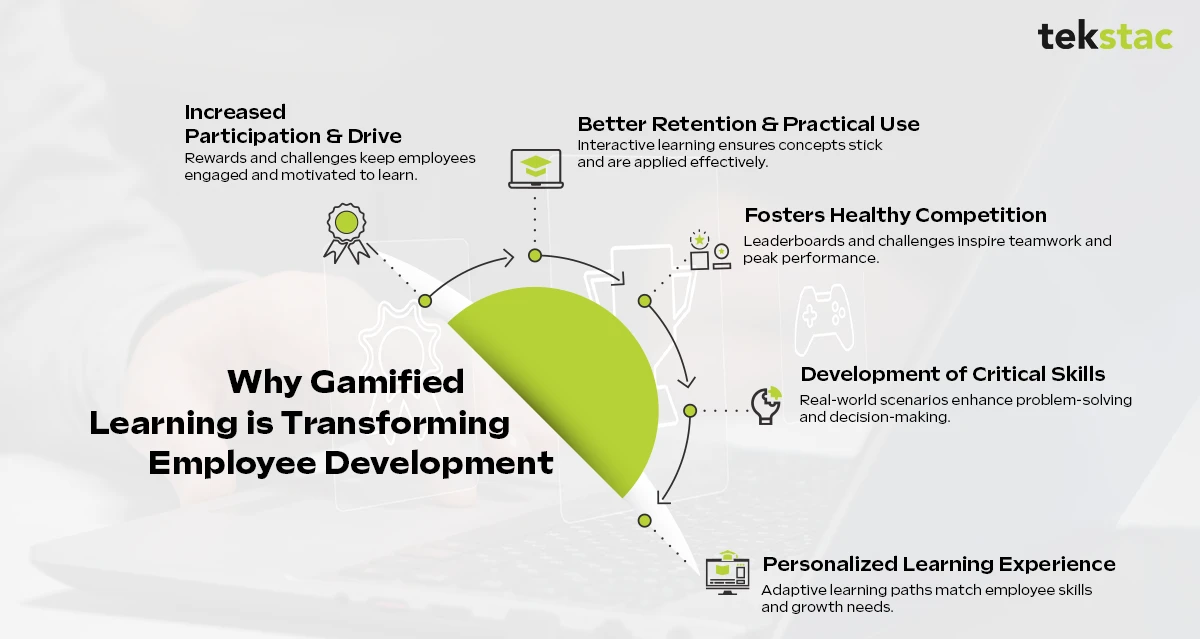
Gamified learning introduces new opportunities for advancing workplace learning by incorporating gaming features into training programs. Organizations reward and motivate their employees by offering engaging lessons that include competition, objectives, and other elements that increase engagement. This approach changes the attitude towards learning, making complex concepts and skills needed for a workplace faster and easier to internalize.
Changing circumstances in workplaces today render standard employee training methods ineffective. Development activities are transformed into engaging and fulfilling experiences. Leaderboards and achievement badges motivate employees to care about their development and work together to achieve results.
Gamified learning is an approach in which gaming mechanics like scores, levels, rewards, and challenges are incorporated into the learning environment. This strategy renders the learner’s interactive experience enjoyable and will likely attract and retain attention. By leveraging natural human motivation instincts, gamified learning makes learning more interesting and less repetitive.
This approach is implemented across various domains to enhance engagement and retention. Gamification enables individuals to acquire key skills more interactively. Recognizing progress through levels or rewards cultivates a sense of achievement, making the learning experience both motivating and effective.
Because it speaks to how we’re wired—everyone loves a little friendly competition, the satisfaction of hitting a goal, and getting feedback right when it matters. That’s what makes gamified learning feel less like training, and more like something you actually want to do.
According to Gallup, employee engagement remains a critical challenge in today’s workplaces, with only 34% of employees being actively engaged. Traditional training methods often fail to capture employees’ attention, leading to low motivation and participation.
Gamified learning has proven to be an effective way to tackle this problem, significantly increasing employee engagement. A recent study revealed that 89% of employees would work harder if their tasks were more gamified.
Gamified learning not only boosts engagement but also enhances knowledge retention. PwC’s study found that 75% of employees are more motivated to learn when training involves game-like elements. According to Learning, it can improve retention by up to 60% compared to traditional methods.
This is largely due to techniques like active recall and spaced repetition, which have proven to be highly effective in helping employees retain information and apply it in real-world situations.
Gamified learning also significantly impacts learning outcomes. A Forbes report found that 83% of employees believe training would be more effective with game elements such as rewards and points. When paired with microlearning, which involves short and focused learning modules, gamification offers employees flexibility and engagement.
According to McKinsey, this combination has become a trend in employee training. It allows learners to access material at their own pace while receiving immediate feedback, which enhances the overall learning experience.
The increasing investment in gamified learning highlights its cost-effectiveness. A report by Global Industry Analysts projects the learning market to grow to $30.7 billion by 2025, as businesses recognize its value. The Brandon Hall Group found that companies implementing gamified learning saw a 14% increase in employee engagement and a 22% boost in performance.
In today’s fast-paced business environment, continuous learning is more important than ever. LinkedIn’s Workplace Learning Report found that 94% of employees would stay longer at a company that invests in their development. Learning supports this by offering engaging, on-demand content that encouraging employees to keep learning.
With the rise of Learning Experience Platforms (LXP), gamified elements like badges and leaderboards are being integrated to keep employees motivated and provide a more personalized learning experience that fosters lifelong development.
As technology evolves, the need for reskilling and upskilling becomes more pressing. Deloitte’s report revealed that 47% of organizations plan to invest in upskilling programs to address this challenge. Learning is a powerful tool for helping employees develop new skills quickly and efficiently.
The World Economic Forum predicts that by 2025, 85 million jobs will be displaced by automation, but 97 million new roles will emerge that require different skill sets. Gamified learning can equip employees with these necessary skills in an interactive, adaptable way at a much faster clip.
Challenges of gamified learning include upfront costs and the problem of translating ‘hard to teach’ content. This is because, on the one hand, rote memorization of facts for subsequent incentives may occur, and on the other hand, not all workers may embrace the technology.
Designing a learning program requires substantial resources, such as time, money, and technical expertise, making it costly, particularly for small businesses. For example, SAP implemented a gamified platform with features like leaderboards and challenges. While the initial investment was high, the program eventually paid off by significantly improving employee engagement and skill development.
In some cases, employees may focus more on earning points, badges, or rewards rather than truly understanding the material. A healthcare organization that introduced gamified training faced this issue, where staff prioritized achieving high leaderboard rankings over absorbing critical patient care concepts. They adjusted the program to emphasize real-world application alongside rewards to resolve this.
Certain types of training, such as those involving highly technical or conceptual topics, may not quickly adapt to gamification. For instance, a multinational bank’s financial compliance training program struggled to gamify complex regulatory topics due to their detailed and structured nature. Instead, they supplemented traditional methods with small gamified elements to keep learners engaged.
Gamified learning systems must accommodate those with disabilities or those in areas with limited access to technology. A global NGO discovered that its e-learning gamification program struggled to reach employees in remote regions due to connectivity issues. By creating simplified offline modules, it ensured inclusivity and broader participation.
Gamified learning offers a fresh and innovative approach to training and development, blending engagement with measurable outcomes. The real value lies in designing gamified programs that align with strategic goals and deliver meaningful skill enhancement.
It’s crucial to strike a balance—integrating game mechanics that motivate employees while ensuring the training content fosters long-term capability development. By focusing on outcomes rather than just rewards, organizations can create impactful training experiences that drive productivity, foster growth, and align with business objectives.
Ready to transform your workforce?
Explore how Tekstac’s gamified learning programs can increase employee engagement and boost performance by up to 22%.
👉 Request a Free Demo and start building smarter teams today.
1. Does gamified learning require expensive technology?
Not necessarily. Gamified learning can be implemented using basic tools like quizzes, points systems, or leaderboards integrated into existing learning platforms. While advanced tools can enhance the experience, effective gamification doesn’t always rely on high-tech solutions.
2. Is gamified learning suitable for all types of learners?
Gamified learning appeals to many learners due to its engaging nature. However, tailoring it to fit the specific audience is essential. Learners have varied preferences for challenges and rewards, so customization is key to maximizing its effectiveness.
3. How can gamified learning measure success?
Success in gamified learning can be measured through learner participation rates, progress tracking, test scores, and feedback. Monitoring engagement levels and retention rates also helps assess the effectiveness of the gamified approach.
4. Make Learning Count with Tekstac?
Elevate skills, boost collaboration, and empower your team with tekstac gamified training solutions. From onboarding to upskilling, we design impactful learning experiences that drive real results. Partner with Tekstac today to build a smarter, stronger workplace!
The World Economic Forum’s Future of Jobs Report predicts that technological advancement will create 69+ million new jobs and displace 83+ million jobs by 2027. This shift presents organizations with an urgent challenge: upskilling and reskilling the workforce with future-ready digital skills.
Gartner’s 2024 HR Leadership Priorities report highlights that 44% of employees lack the digital skills needed for their current and future roles. As the disparity between current capabilities and future demands grows, investing in platforms that deliver scalable, impactful learning solutions is no longer optional—it’s essential.
The rise of remote and hybrid work models has transformed employee learning preferences. Organizations now seek skills development & learning platforms that combine flexibility with measurable impact on both workforce capabilities and business outcomes.
Let’s explore the five critical features that define an effective enterprise upskilling platform, helping decision-makers build future-ready teams.
Any platform that works well has learning content at its core. Employees need to be able to reach a lot of different resources that are relevant to their jobs, industries, and skill sets.
LinkedIn’s 2024 Workplace Learning Report reveals that 91% of L&D leaders prioritize helping employees learn new skills to deal with new problems, with industry-specific training showing the highest impact on employee performance.
Modern platforms must offer:
Business Impact: Tekstac’s customizable learning paths have helped organizations achieve measurable improvements in employee skill acquisition through industry-specific content delivery.
Effective skill development requires practical application. ATD’s 2023 State of the Industry Report indicates that organizations investing in experiential learning see a 42% higher employee proficiency rate compared to traditional training methods.
For example, a cybersecurity sandbox can allow users to:
Tekstac’s integrated upskilling lab environment enables real-time practice across various technologies, from programming languages to cloud infrastructure, ensuring skills transfer directly to work scenarios.
According to Deloitte’s 2023 Human Capital Trends report, organizations using AI-driven learning platforms report 37% higher employee engagement in development programs. Modern upskilling platforms powered by AI can:
Example: An AI-driven system might identify a junior developer’s potential for cloud architecture roles and create a customized learning path incorporating both technical and architectural skills.
Leaders in learning and development (L&D) may find it hard to show stakeholders how well skills development and learning programs work. Enterprise upskilling platforms with advanced analytics dashboards show how employees are growing how they are learning new skills, and how the company is doing. These solutions help people make better decisions by connecting learning results to employees’ productivity and performance.
Research from Deloitte shows that companies that use learning data will see a 30% rise in the productivity of their employees.
Businesses should make sure that the platform does more than just collect data. It should also give them actionable information, like insights on how ready a team is to learn new skills or how engagement has changed over time.
The WEF Future of Jobs Report 2023 indicates that 75% of organizations are accelerating their digitalization plans, requiring platforms that can securely scale while maintaining data protection standards. Key requirements include:
Security Insight: Single-tenant platforms provide dedicated infrastructure for each client, preventing data cross-contamination and enabling customized security policies. This is crucial for sectors like healthcare and finance.
To pick the right workforce upskilling platform, you need to investigate its features and check its ability to scale and meet your company’s needs. “What should I prioritize when investing in an upskilling platform?” is a question that business and L&D leaders often ask.
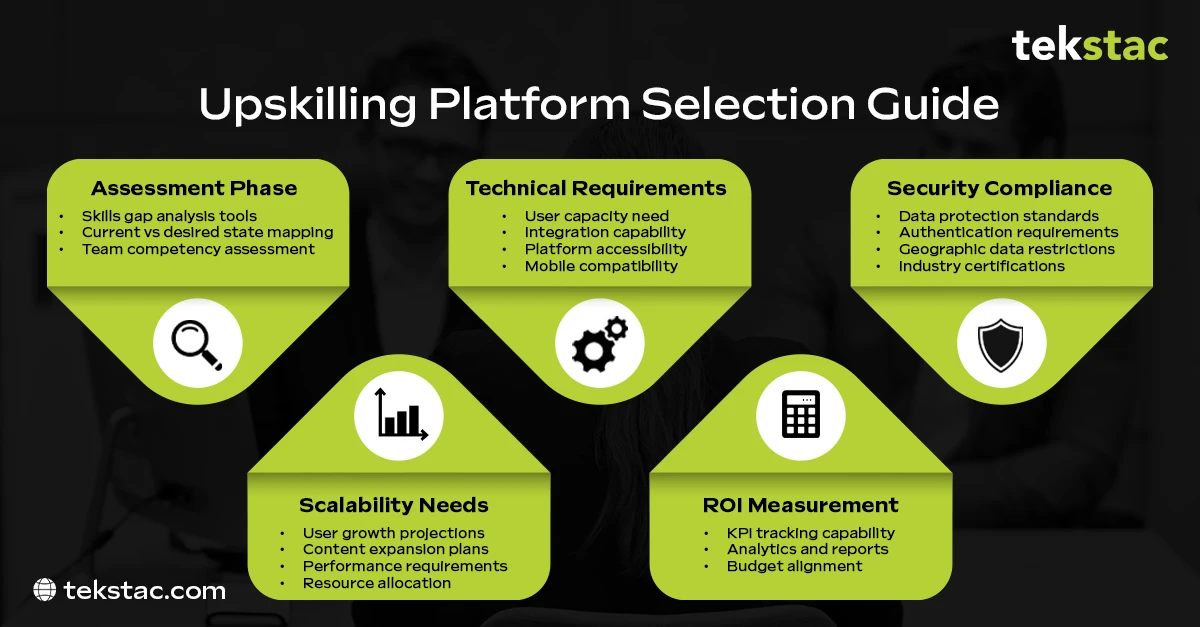
One of the most important steps is to focus on platforms offering comprehensive solutions for technology and soft skills. Such skills as leadership, communication, and emotional intelligence are critical for holistic workforce development.
Do not forget to check for the integration with your existing HR tools and systems. A platform that supports integration with learning management systems (LMS) guarantees a smooth workflow and allows you to track learning outcomes in real time.
Business tip: If you want to get the most out of the money you spend on training, pick options that have strong reporting and integration capabilities. Modern platforms like Tekstac combine these essential features with enterprise-grade security and scalability.
The platform’s comprehensive approach includes rich learning content, hands-on labs, and advanced analytics, enabling organizations to build future-ready teams efficiently.
For many organizations, the question isn’t whether to invest in upskilling but how to measure its return on investment (ROI). When evaluating ROI, consider both tangible and intangible benefits, such as increased employee productivity, reduced turnover, and internal talent mobility to fulfill talent needs.
Platforms with advanced analytics and predictive capabilities help track metrics such as time to competency, post-training performance, and overall engagement. This data supports decision-making and helps secure buy-in from stakeholders by demonstrating measurable impact.
Hint for businesses: Choose platforms with built-in ROI measurement tools to link learning outcomes directly to business goals and performance metrics.
Are you ready to transform your upskilling and reskilling strategy to future-proof your workforce? Contact our experts to discover how Tekstac’s enterprise-grade upskilling platform can accelerate your team’s growth.
Role-based training is no longer a matter of choice for organizations that are aiming to succeed—it’s a cornerstone of growth and efficiency. This approach equips employees with the skills they need to thrive in their specific roles, ensuring they can make meaningful contributions from the very start. When employees’ abilities align with organizational goals, the result is a team that’s not only productive but also genuinely engaged and motivated.
In today’s high-pressure business environment, generic onboarding programs often fall short. They may provide an overview of company policies and values, but they rarely prepare employees for the actual demands of their roles. Imagine hiring a data analyst who learns about company protocols during onboarding but is left clueless when faced with tools needed for that particular role. Without role-specific training, your team members can feel unsupported and overwhelmed, which can quickly lead to lower productivity and frustration.
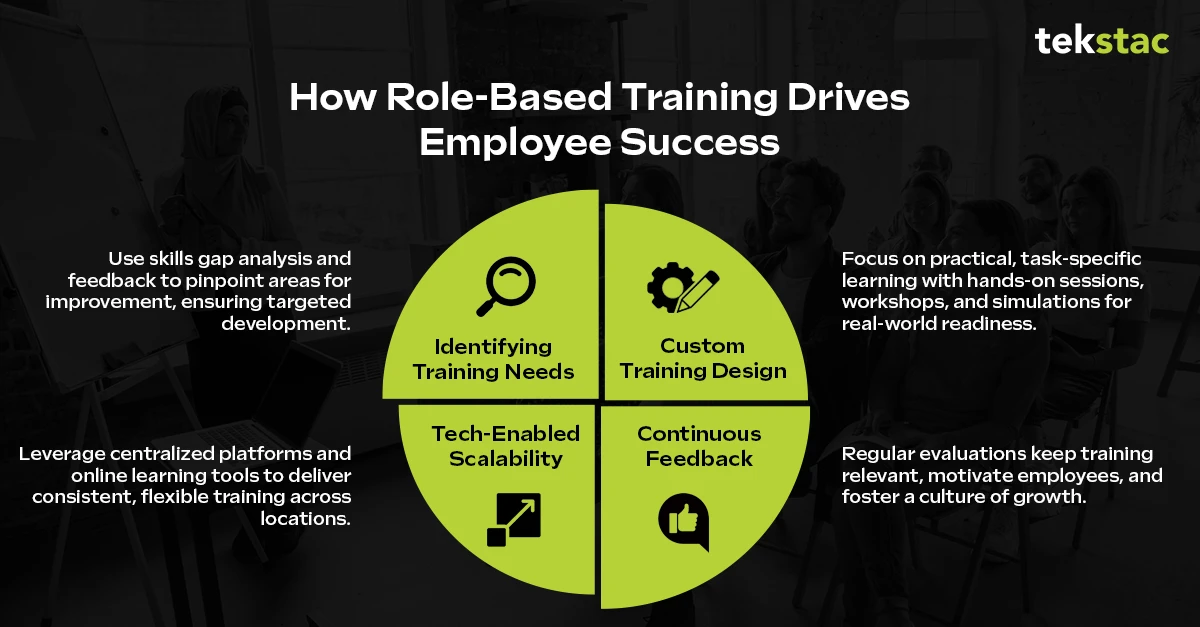
Every effective training program begins with a simple question: what do your employees need to succeed? Understanding these needs is the foundation for building role-based training that delivers real results.
Organizations that invest in training and development strategies are better positioned to anticipate future skills, adapt to change, and ensure long-term employee growth.
By using tools like skills gap analysis, performance reviews, and feedback sessions, organizations can uncover the exact areas where their workforce needs support.
It could be that your technical team is struggling with a new cloud computing platform, or maybe compliance regulations are changing faster than your employees can keep up.
Without targeted training, these gaps can slow down productivity and lead to costly mistakes. Skill gaps analysis provides clarity, showing exactly where development is needed.
Advanced platforms with built-in analytics make the process even smoother, giving you real-time data to craft precise upskilling programs.
Many industries, such as healthcare, will undoubtedly feel the absence of this if they miss out.
Once you know what your employees need, the next step is to create training that actually helps them succeed. The best way to do this is by keeping it practical and focused on tasks they’ll face every day.
With role-based training, companies can address challenges while building confident, capable teams.
A data analytics team practicing financial modeling through hands-on sessions instead of just sitting through lectures. They’d gain real experience, making them better prepared to handle complex projects.
In another scenario, employees dealing with machine errors could benefit from virtual simulations. This model empowers them to practice safely without worrying about real-world mistakes, helping them build the skills they need to perform better on the job.
People learn best when they can put their skills into action. That’s why role-based training is so much more effective when it includes hands-on learning. Whether it’s through workshops, real-world problem-solving, or virtual labs, these methods help employees build confidence and apply their knowledge in practical ways.
Employees learning risk assessment can benefit from simulations that mimic real-life scenarios.
These practical exercises help them practice decision-making in a controlled environment. The more they experience realistic challenges during training, the fewer mistakes they’ll make when it counts.
Training employees across different locations doesn’t have to be complicated. Centralized skilling platforms bring everything together in one place, so every team member gets the same quality training, no matter where they work.
In industries with high-level tech involvement, where tools and processes change quickly, preparing employees early—like teaching them AI skills or data analysis—can make a big difference. Prepared teams handle change with ease, reducing stress and avoiding disruptions.
Online cloud-based learning platforms add even more value. Employees can learn at their own pace, using short and easy-to-digest courses. This keeps them interested and makes learning less overwhelming.
Feedback isn’t just about improving training—it’s a way to show employees that their voices matter. When people feel heard, they stay motivated and connected to their work. Even something as simple as asking for their thoughts can lift their spirits and make them more likely to stick around. Ignoring feedback, however, can leave training feeling outdated and less impactful over time.
Regular updates and honest conversations about what’s working (and what’s not) can turn good training into great training. It’s about keeping things fresh, effective, and meaningful for your team.
Role-based training isn’t just another workplace initiative—it is designed to drive real results across industries. When employees are trained for their specific roles, the outcomes are hard to ignore. Warehouse teams trained to prioritize safety and efficiency see noticeable improvements, such as higher productivity and fewer accidents.
Compliance training designed around team needs keeps employees aligned with regulations, avoiding risks and creating a safer work environment.
But it’s not just about performance metrics. Role-based training has a way of boosting morale and loyalty too. Employees who feel their growth matters to the company are more likely to stay. In fact, 94% of employees say they would stay longer at organizations that invest in their learning and development, as highlighted in LinkedIn’s Workplace Learning Report.
Employee training doesn’t have to be a complex process. The right tools can simplify the entire process, helping employees learn what they need in a way that’s practical and effective.
A modern training platform is designed to make learning feel natural. They create personalized skill-building sessions that focus on real-world skills, ensuring employees get exactly what they need for their roles. Features like hands-on practice labs allow employees to practice in realistic scenarios, turning learning into action.
What makes this approach stand out is how seamlessly it fits into the workday. Instead of feeling like an extra task, training becomes part of the workflow, helping employees grow without added pressure.
A modern training platform, like Tekstac, addresses the core need for focused and practical learning. Employees often struggle with generic training that doesn’t prepare them for real challenges.
Tekstac bridges this gap by offering hands-on practice labs, where employees can apply their skills in real-world scenarios, building confidence and capability.
The result?
Confident teams that are prepared for today’s challenges and ready for what’s next.
When training is practical and well-integrated, it doesn’t just teach—it transforms. Employees learn faster, stay engaged, and feel more prepared to succeed.
1. How does role-based training differ from traditional corporate training?
Unlike generic training programs, role-based training is tailored to meet the unique responsibilities and skill requirements of each job role.
2. Why should companies invest in role-based training?
Because, organizations benefit from improved employee performance, reduced skill gaps, higher retention rates, and more efficient onboarding processes.
3. What industries benefit the most from role-based training?
Industries like IT, healthcare, manufacturing, finance, and customer service rely heavily on role-based training to keep their workforce skilled.
4. What is a role specific training plan?
A role-specific training plan is a structured program designed to equip employees with the skills and knowledge required for their specific job roles.
According to the World Economic Forum’s Future of Jobs Report, nearly 44% of core job skills are expected to change by 2027. This rapid transformation makes it essential for businesses to rethink workforce training. Traditional methods—often lengthy, generic, and disconnected from real-world applications—no longer meet today’s pace of change. Companies need agile, results-driven learning that fits seamlessly into daily routines and delivers measurable outcomes. That’s where microlearning proves invaluable.
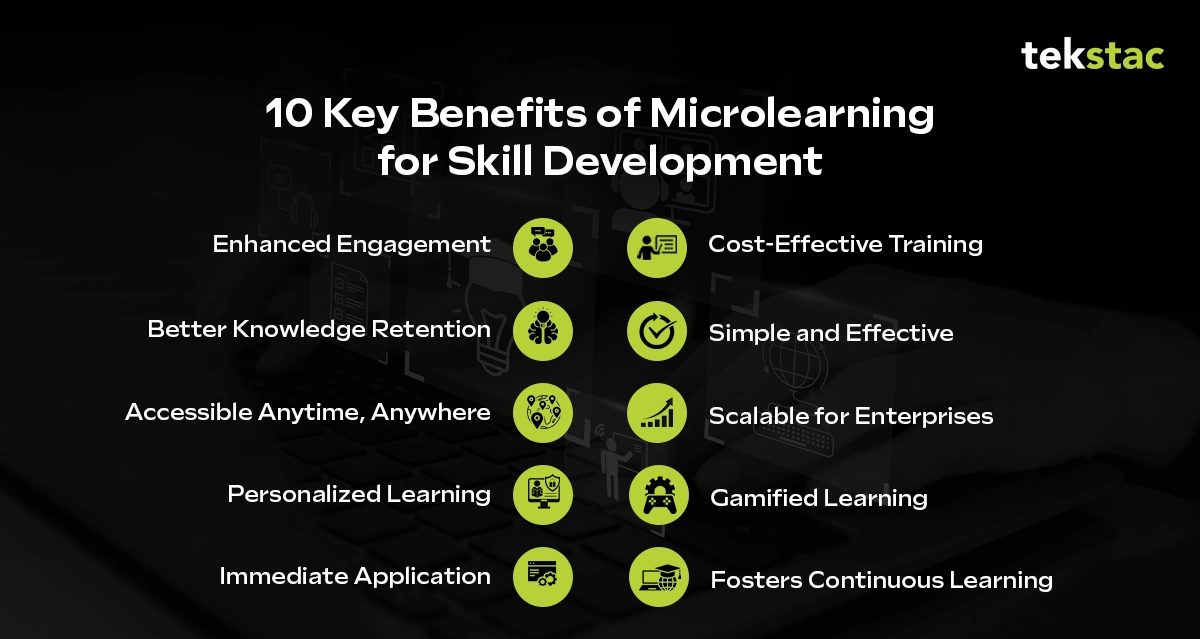
Microlearning breaks training into short, focused lessons that minimize disruption and maximize efficiency. Among the many microlearning benefits, its ability to turn learning into practical, outcome-focused results sets it apart.
Learn how microlearning supports employee retention in our detailed guide:
What Is Microlearning?
Traditional training sessions often involve hours of presentations and discussions that can leave participants feeling disengaged and unclear about the key takeaways.
Rather than a full day of training, short, focused lessons provide precisely the insights needed. Studies show that microlearning enhances employee focus and boosts long-term knowledge retention by up to 80%.
Microlearning offers targeted, practical solutions tailored to specific needs, such as a brief module on negotiation techniques for sales professionals preparing for client pitches.
Small, focused lessons integrate seamlessly into busy schedules, helping learners remain engaged, prioritize essential topics, and develop relevant skills efficiently. This approach transforms training from a task to an integral part of professional growth, making it both practical and impactful.
As learners engage with focused lessons, the next critical step is ensuring that knowledge is retained and effectively applied over time.
Microlearning addresses a common pitfall of traditional training: the forgetting curve. Research shows that learners often forget up to 70% of new information within 24 hours if it isn’t reinforced. Simplifying knowledge retention with microlearning counters this by focusing on singular concepts per session. For example, employees learning a new software tool might complete short modules on specific features, followed by quizzes or interactive simulations to reinforce their understanding.
Platforms designed for microlearning could include built-in mechanisms to reinforce critical points through spaced repetition, quizzes, and real-world simulations.
These systems empower L&D teams to ensure employees periodically revisit key concepts, driving long-term retention and practical application. By emphasizing clarity and repetition, microlearning helps organizations build a workforce with a deeper understanding of critical topics, enabling immediate and effective application in professional scenarios.
As organizations prioritize accessibility, microlearning proves to be a flexible and effective tool for today’s global workforce.
As hybrid and remote work models continue to rise, ensuring accessible and scalable training solutions has become a top priority for organizations. Microlearning addresses this need by offering mobile-friendly platforms that allow employees to engage with training materials anytime and anywhere. Whether during a commute, a quick break, or at the end of a busy day, microlearning seamlessly integrates into daily workflows, minimizing disruption while maximizing efficiency.
Modern skill development platforms take this flexibility a step further with features like offline access and responsive designs. Learning doesn’t have to pause, even when internet access is unreliable.
As accessibility enhances learning experiences, the next logical step is to ensure training paths are personalized for individual growth.
Employees bring unique strengths, challenges, and career objectives to the workplace. Personalized learning for individual growth is achieved through microlearning platforms that leverage AI to develop tailored learning paths, aligning with the specific skills required for their roles and long-term goals.
In the coming years, over 47% of learning management systems (LMS) are projected to incorporate AI technology.
These platforms also provide real-time progress tracking through intuitive dashboards. When employees encounter difficulties, the system recommends alternative modules or customized learning methods to address their needs.
With personalized learning enhancing individual capabilities, the next step is ensuring those skills are applied effectively in real-world scenarios.
One of the key microlearning benefits is its ability to facilitate the immediate application of newly acquired skills. Knowledge transfer through real-world scenarios is achieved by creating practical lessons that align with organizational goals, ensuring that training directly supports workplace requirements. For instance, a brief, focused module on managing challenging customer interactions can empower teams to handle such situations more effectively.
Advanced platforms enhance this process by incorporating features like practice labs and case studies. As organizations seek impactful and efficient training solutions, microlearning offers a significant advantage in cost management and scalability.
Traditional training programs often demand high costs and effort. Companies need to hire trainers, rent venues, and provide printed materials. On top of that, employees lose valuable time away from their daily tasks, which impacts productivity. Cost-effective training solutions are offered through microlearning, which uses short, focused, and digital lessons to save both time and money.
Consider an organization training its customer support team on new AI-powered software. Instead of long, in-person sessions, employees can access quick lessons that guide them through real-world situations they might face while using the software. These lessons are easy to update as the software evolves, so the training always stays current without the need for a complete redesign.
With microlearning platforms, organizations can leverage internal expertise to develop content that directly aligns with their strategic objectives and operational requirements. This approach minimizes reliance on external consultants, ensuring training remains relevant, actionable, and tailored to specific business needs.
Traditional training sessions often give too much information at once, making it harder for learners to remember or use what they’ve learned. Making learning simple and effective is one of the key microlearning benefits, as it breaks lessons into smaller, focused parts that are easy to follow and apply in real-world situations.
Some platforms take this a step further by using AI to monitor progress and adjust the pace of lessons to match the learner’s needs.
Simplified learning becomes even more valuable when it scales effectively to meet the demands of large organizations.
Global organizations face significant challenges in training employees across different time zones and languages. Microlearning addresses these pain points with flexible, self-paced modules that allow employees to learn on their schedules, regardless of location. Additionally, multilingual support ensures consistent, high-quality training delivery in the preferred language of each team member. Combined with robust progress tracking, microlearning provides a scalable, efficient solution to streamline workforce training for large enterprises.
While scalability ensures consistency, gamification takes engagement to the next level by making training enjoyable and rewarding.
Gamification turns training into an enjoyable and competitive experience. Gamified learning enhances engagement by making the learning process more interactive and enjoyable. Features like badges, points, and leaderboards on microlearning platforms add an element of fun and competition, motivating learners to stay actively involved.
These features can be aligned with organizational goals, rewarding employees for completing critical lessons or excelling in assessments.
Microlearning is more than just a way to build skills—it helps create a culture of continuous learning. This principle is at the heart of modern workplace learning strategies, where training is integrated into daily routines and becomes an ongoing habit employees engage with naturally.
Platforms with features like reminders, progress trackers, and team collaboration tools make learning a smooth and natural part of work life. These tools not only keep employees motivated but also align their personal development with company goals, benefiting everyone involved.
Microlearning isn’t just another training method—it’s a smarter, easier way to help employees grow in today’s fast-changing world. By breaking learning into short, focused sessions, it makes picking up new skills simple and manageable. Complex topics are broken down into smaller lessons, keeping employees engaged and encouraging ongoing learning. This approach helps both individuals and the organization move forward together.
A good platform brings everything together seamlessly. Personalized lessons focus on what matters most, real-time feedback shows employees their progress, and practice tools build their confidence before they apply new skills at work. It’s not just about improving training—it’s about making learning practical, enjoyable, and part of everyday work life.
With microlearning, you’re not just equipping your team for today—you’re building a future-ready workforce prepared to handle whatever challenges come next, helping your business grow stronger along the way.
Transform your workforce with Tekstac. Leverage personalized learning paths, gamified modules, and real-time tracking to upskill your teams efficiently. Drive adaptability and build a future-ready workforce with ease.
1. What is microlearning and how does it work in the workplace?
Microlearning is a training method that delivers content in short, focused bursts—usually under 10 minutes. In the workplace, it fits seamlessly into employees’ schedules, allowing them to learn specific skills or concepts on demand without disrupting productivity.
2. Why is microlearning effective for skill development?
Microlearning boosts retention by focusing on one concept at a time. Its bite-sized format encourages active learning and immediate application, making it easier for employees to absorb, recall, and use new skills in real-world scenarios.
3. How does microlearning benefit remote or hybrid employees?
Microlearning is mobile-friendly, flexible, and accessible anytime, anywhere—perfect for remote and hybrid teams. It supports self-paced learning and reduces screen fatigue by offering short, engaging modules that fit varying schedules.
4. Is microlearning cost-effective for large organizations?
Yes, microlearning is highly cost-effective. It reduces training time, minimizes resource use, and scales easily across teams and locations. Companies can update content quickly, keeping training relevant without large re-investments.
In today’s rapidly evolving workplace, the definition of being “skilled” is constantly changing. What was relevant a few years ago may no longer be sufficient, as new technologies, roles, and expectations reshape how work gets done. Insights from World Economic Forum and McKinsey & Company indicate that the lifespan of professional skills is shrinking rapidly, with many technical skills becoming outdated within just 3–5 years.
This is where skill development becomes critical, not as a one-time effort, but as a continuous, evolving process.
But what exactly is skill development, and why does it matter so much for career growth today?
Skill development is the structured, continuous process of building, refining, and applying capabilities that enable individuals to perform effectively in their current roles while preparing for evolving responsibilities. At its core, it goes beyond acquiring knowledge to focus on application, adaptability, and measurable impact.
India’s workforce landscape is undergoing rapid transformation with the forecast about an estimated 3%-5% increase in the GDP of India by the year 2035. As organizations compete to stay relevant, the need for a skilled and adaptable workforce has become more critical than ever. In this context, skill development is no longer just an individual advantage.
With AI and automation, the job market is more volatile than ever. The need of the hour is to be a professional who is agile, flexible, and capable of adapting to technological shifts through continuous skill development. Organizations today value employees with a mix of technical skills, soft skills, and digital fluency, making career upskilling and reskilling essential for long-term success.
For example – In fields like IT and Technology, medicine, and education, it is not just important but mandatory to adopt new skills and learn new programs. Investing one’s time and effort in continuous learning helps professionals stay relevant during accelerated developments and uncertainties.
By developing new skills, professionals can find avenues to new career opportunities and steady growth in their current designation or position. Research shows that those who dedicate time to upskill and reskill achieve faster career progression and are more likely to attain senior positions.
Organizations must consider this and endorse learning and development to help employees get faster promotions and salary growth.
For example – A professional could get new certifications or seek training in some areas to position oneself as an SME or expert in their field and accordingly negotiate for higher salaries.
Enhancing your skills leads to greater efficiency and improved productivity at work. Learning modern tools through skill development reduces manual tasks, allowing professionals to focus on strategic initiatives. In fact, companies that invest in employee training see a 24% higher profit margin than those that don’t, highlighting the direct impact of continuous learning on business success.
For example – developing advanced Excel skills can help a professional in the automation of repetitive tasks, finish complex calculations quickly, save time in decision-making, and perform faster and more detailed analyses.
In terms of boosting efficiency, enhancing their skill set can help professionals make fewer errors, and enhance collaboration at work.
Employers today are looking for professionals with the right skills to drive innovation and efficiency. Backed by the right workforce skills insights, individuals can better understand what the market demands. If you are a professional looking for a job change or aiming to change your career path, then here are some things to do –
In a market inundated with candidates having similar qualifications and educational backgrounds, developing valuable skills can help you stand out.
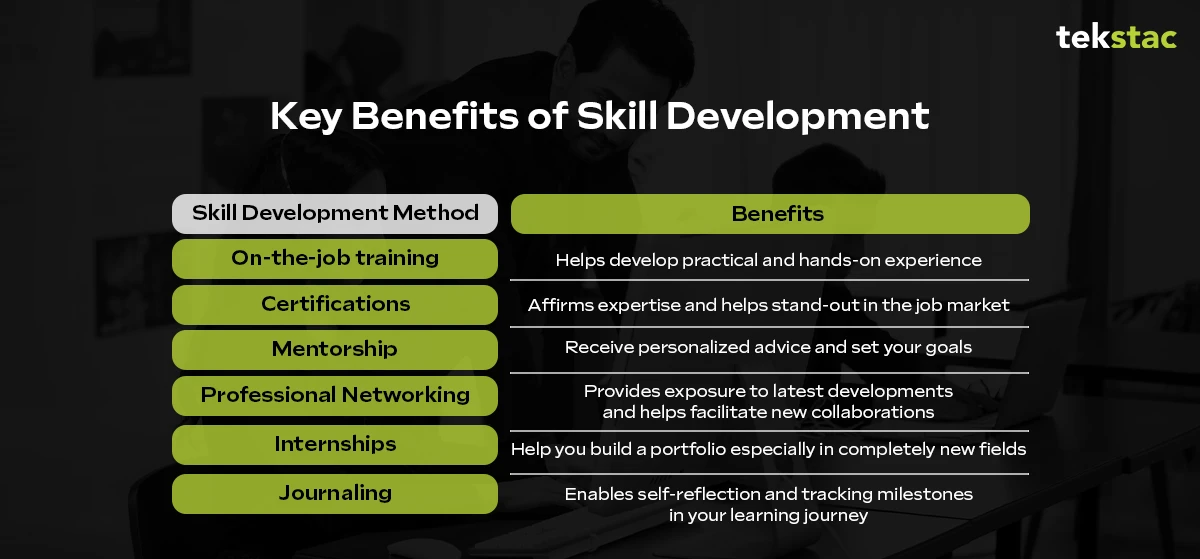
An effective skill development plan goes beyond training; it aligns business needs with workforce capabilities. Here are the key components:
Define clear skill categories and proficiency levels to establish what “good” looks like. This ensures consistency in assessments, development, and role alignment.
Build a current view of workforce capabilities using assessments, performance data, and real work signals. This forms the foundation for accurate skill gap analysis.
Identify critical skill gaps based on business goals and prioritize development efforts that directly impact outcomes.
Create structured learning journeys with hands-on practice, feedback, and real-world application to drive measurable improvement.
Equip managers with tools and accountability to support ongoing learning, feedback, and continuous skill development within teams.
Tekstac transforms skill development from a one-time initiative into a continuous, strategic system that drives real workforce outcomes. It bridges the gap between understanding current capabilities and taking the right actions to build future-ready skills.
By combining structured learning with live demos, real-time feedback, and applied practice, Tekstac enables organizations to identify skill gaps, accelerate upskilling and reskilling, and build job-ready talent at scale.
Skill development is no longer a one-time effort but a continuous process that shapes long-term career growth and organizational success. According to SHRM 2025 L&D Executives Priorities report, 1 in 3 L&D leaders (33%) have identified skills training as a top priority, with a strong focus on role-specific and personalized learning. To truly realize its impact, individuals and organizations must make skill development a consistent habit.
1. What are the top 3 in-demand AI skills to learn in 2026?
The most in-demand AI skills in 2026 go beyond just technical expertise. Key skills include:
These skills are increasingly essential as AI becomes embedded across roles and industries.
2. How can you start skill development and add it to your resume?
Start by identifying relevant skills based on your career goals and industry demand. Focus on building them through structured learning, hands-on projects, and real-world applications.
When adding skills to your resume:
Employers increasingly value applied skills over theoretical knowledge, so demonstrating real impact is key.
3. How can you create a skill development plan that actually works?
An effective skill development plan starts by aligning skills with business goals, followed by assessing current capabilities to identify gaps. It should include targeted learning pathways with hands-on application, enable employees to apply skills through real work opportunities, and involve managers in driving development. Most importantly, success should be measured through outcomes like performance improvement, mobility, and readiness.
4. What are 5 developmental skills?
Five core developmental skills that consistently drive professional growth are:
In the rush to fill a position with the right candidate, many organizations overlook the importance of pre-hiring assessments, leading to costly hiring mistakes. Without proper evaluation methods in place, businesses risk selecting candidates who may not be the right fit for the role.
A bad hire isn’t just someone missing a skill or two; they can be expensive. According to CareerBuilder, a bad hire costs at least $18,700 for executive-level positions and more than $37,150 on average for Indian companies. Beyond financial loss, bad hires contribute to decreased productivity, low morale, and higher turnover rates, which impact overall business performance.
A CareerBuilder survey revealed the top reasons for bad hires:
This data underscores the importance of accurate pre-hiring assessments and pre-employment assessments, which help employers move beyond resumes and focus on proven skills. Organizations often rely on outdated hiring methods, focusing too much on resumes and interviews without truly assessing candidates’ skills. Fortunately, with advancements in technology and the growing adoption of AI, recruiting high-quality candidates has become more efficient and precise.
As of July 2024, 88% of companies globally use Artificial Intelligence (AI) for HR practices, according to LinkedIn’s Future of Recruitment Playbook.
AI can rapidly analyze vast amounts of candidate data—ranging from resumes to assessments—to identify hires that align with top-performing talent already within an organization. Beyond identification, AI enhances pre-hiring and pre-employment assessments by creating skills-based hiring tests that measure both technical expertise and soft skills crucial for workplace success.
Organizations using AI-driven pre-hire assessments are 46% more likely to find successful, skill-fit hires (CareerBuilder, 2024). These assessments are based on real-world job scenarios, ensuring candidates are not only skilled but also ready to perform from day one.
Additionally, AI-driven tools enhance assessment integrity by monitoring for suspicious activities and evaluating cultural fit, significantly reducing turnover.
With AI and recent technologies in the market, pre-hiring assessments are evolving in how candidates are assessed.
Below are the top 10 pre-hiring assessment trends HR must watch out for:
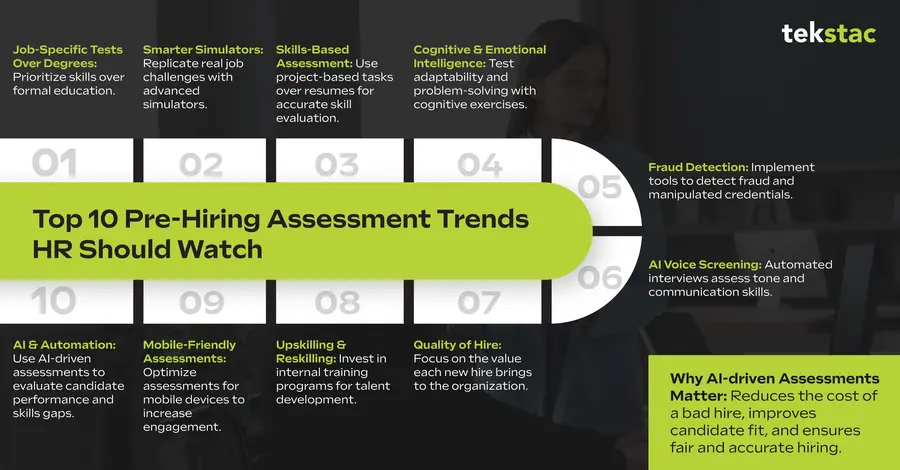
Companies are increasingly prioritizing skills over formal education. According to a recent McKinsey report, organizations are re-evaluating degree requirements and shifting toward skills-first hiring. This means talent acquisition teams will need to invest in job-specific tests that accurately measure the skills necessary for success in a role.
Hiring managers are now leveraging AI-powered competency frameworks that break down required skills for each position, ensuring a precise match between the job description and the candidate’s capabilities. This shift opens doors for non-traditional candidates, enabling companies to tap into a wider and more diverse talent pool.
Advanced simulators are becoming integral in assessing practical skills. They replicate real-world challenges to evaluate candidate performance. For instance, coding simulators test a developer’s debugging abilities, while customer service simulators assess how well candidates handle client inquiries.
Simulations provide a hands-on approach, allowing candidates to showcase their abilities in real-time. This trend is particularly prominent in IT, healthcare, and finance industries, where job performance depends heavily on applied knowledge.
Companies are moving beyond traditional resumes and interviews, favoring skills-based interviews, project-based assessments, and job-focused tasks. This shift reduces reliance on self-reported claims and ensures hiring decisions are based on proven competencies.
HR teams are adopting AI-driven skills assessment platforms that use adaptive testing to evaluate candidates dynamically, adjusting difficulty levels in real-time based on responses.
Employers recognize the importance of hiring candidates with strong cognitive and emotional intelligence. Assessments now include problem-solving tasks, role-playing scenarios, and situational judgment tests to minimize the risk of hiring cultural misfits.
AI-driven cognitive testing evaluates not only logical reasoning but also adaptability, creativity, and emotional intelligence—factors that contribute significantly to job performance and teamwork.
With the rise of AI-generated resumes and fraudulent applications, companies must implement assessment tools with built-in fraud detection. AI-driven hiring platforms can now verify credentials, detect inconsistencies, and prevent hiring mistakes based on manipulated data.
With features like plagiarism detection and remote proctoring, AI ensures that candidates take assessments honestly, making it easier to top talent based on merit.
AI-powered voice screening is revolutionizing initial candidate assessments. These systems analyze communication skills, tone, and response patterns to generate insights for recruiters. However, organizations must ensure these technologies align with DEI (Diversity, Equity, and Inclusion) goals to prevent bias.
With declining global hiring volumes, companies are shifting focus from the number of hires to the value each new hire brings. According to LinkedIn’s Future of Recruitment 2024 Playbook, measuring “quality of hire” through AI-driven analytics and post-hire performance tracking will be a key metric in talent acquisition.
Quality-of-hire metrics are calculated based on onboarding success, performance ratings, productivity levels, and retention rates within the first year of employment.
Companies struggling to find skilled candidates externally increasingly turn to upskilling and reskilling programs for existing employees. Employees must participate in training programs followed by assessments to check their suitability. This approach to building a skilled workforce reduces excessive reliance on external hiring and at the same time, improves employee retention and reduces overall cost.
With mobile devices now dominating internet usage, candidates expect to complete hiring assessments on their smartphones. Companies are optimizing pre-hire tests for mobile accessibility, enabling candidates to participate conveniently.
This shift increases application completion rates and allows companies to reach a wider talent pool, including gig workers and passive candidates.
Along AI tools are enhancing resume screening, automated interview evaluations, and candidate performance analysis. They generate detailed reports highlighting skill gaps and strengths, providing HR teams with data-driven hiring insights.
Automated pre-hire assessments reduce human bias and accelerate the hiring process, allowing recruiters to focus on strategic decision-making rather than administrative tasks.
Training and onboarding costs add an average of $1,252 per employee and 10+ hours of HR time.
Traditional hiring methods no longer suffice. By adopting AI-driven pre-hiring assessments and pre-employment assessments, companies gain accurate insights, reduce costs, and hire talent that delivers measurable business impact.
For organizations hiring tech talent, specialized platforms such as Tekstac are transforming recruitment with competency-based assessments, real-time AI-driven proctoring, and automated candidate evaluation. These platforms offer integrity-focused hiring solutions, ensuring fairness, accuracy, and data-backed decision-making.
With hiring trends evolving rapidly, AI-driven assessments are becoming indispensable. Organizations investing in smart, data-backed hiring solutions will gain a competitive advantage, ensuring they onboard the right talent for long-term success.
To stay ahead, companies must explore AI-powered tools that align with their hiring goals—ushering in a new era of efficient, skills-based recruitment.
1. What are pre-hiring assessments?
Pre-hiring assessments are structured tests that measure a candidate’s skills, personality, and job readiness. Unlike resumes, these evaluations provide real performance insights, making them more reliable than traditional screening methods.
2. How do pre-employment assessments reduce bad hires?
Pre-employment assessments evaluate real-world skills and behaviors, helping recruiters avoid reliance on claims. By testing ability, cultural fit, and integrity, they significantly reduce the risk of costly hiring mistakes.
3. Why are AI-driven pre-hiring assessments important in 2026?
AI-powered pre-hiring assessments use adaptive testing, fraud detection, and performance analytics. They improve hiring accuracy, ensure fairness, and help recruiters select candidates with both technical and soft skills.
4. Are pre-employment assessments better than interviews?
Yes. Unlike interviews that may be biased, pre-employment assessments provide data-backed insights into a candidate’s abilities, ensuring objective and skills-first hiring decisions.
Between busy schedules, finding time often feels like a luxury. Yet it’s in these moments, making space to invest in Learning and Development books helps us reconnect with industry best practices that have stood the test of time.
Because the next meaningful learning idea doesn’t always come from something new. Sometimes, it comes from revisiting proven thinking.
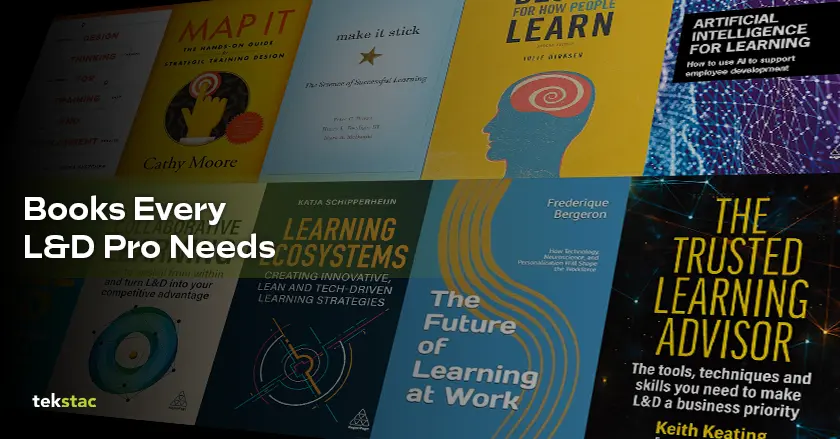
Here are the 10 best L&D books to start with in 2026.
This curated list of professional development books for 2026 features some of the most relevant, action-oriented titles for anyone working in corporate learning. These learning and development books go beyond theory. They offer frameworks, toolkits, and proven strategies you can apply directly to your work.
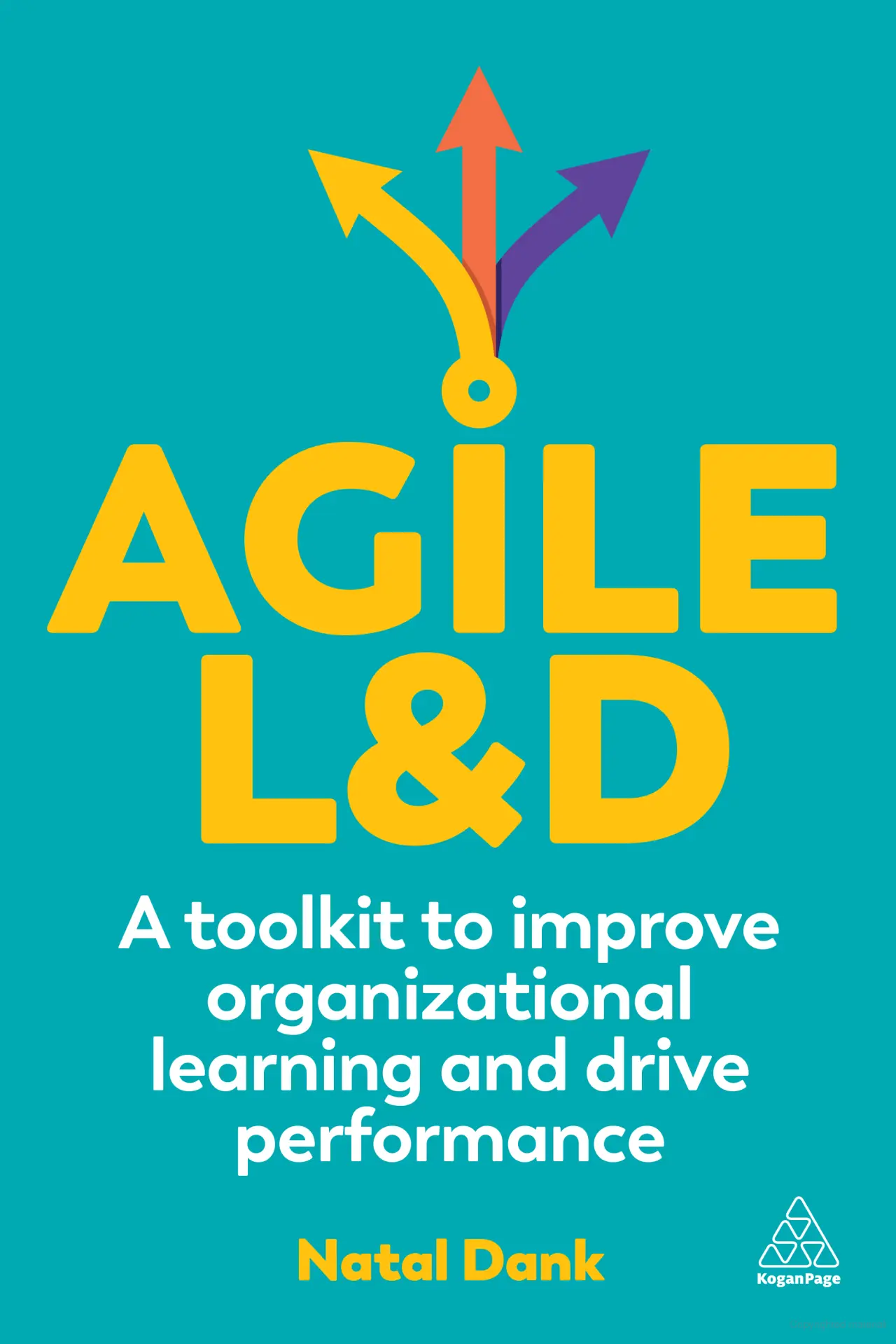
As learning teams deal with constant change, traditional models no longer hold up. This book introduces a modern approach, Agile L&D. It guides you through building adaptable, outcome-focused learning systems that evolve alongside business needs.
The author outlines five foundational design principles: product-led solutions, human-centered design, T-shaped team structures, experimentation, and delivering with impact. Each chapter includes tools and use cases for bringing agility into learning strategies, from onboarding to leadership development.
This book is essential reading for L&D professionals looking to redesign their workflows for speed, relevance, and learner engagement in dynamic organizations.
According to the 2025 LinkedIn Workplace Learning Report, 91% of L&D professionals agree that continuous learning is more important than ever for career success.
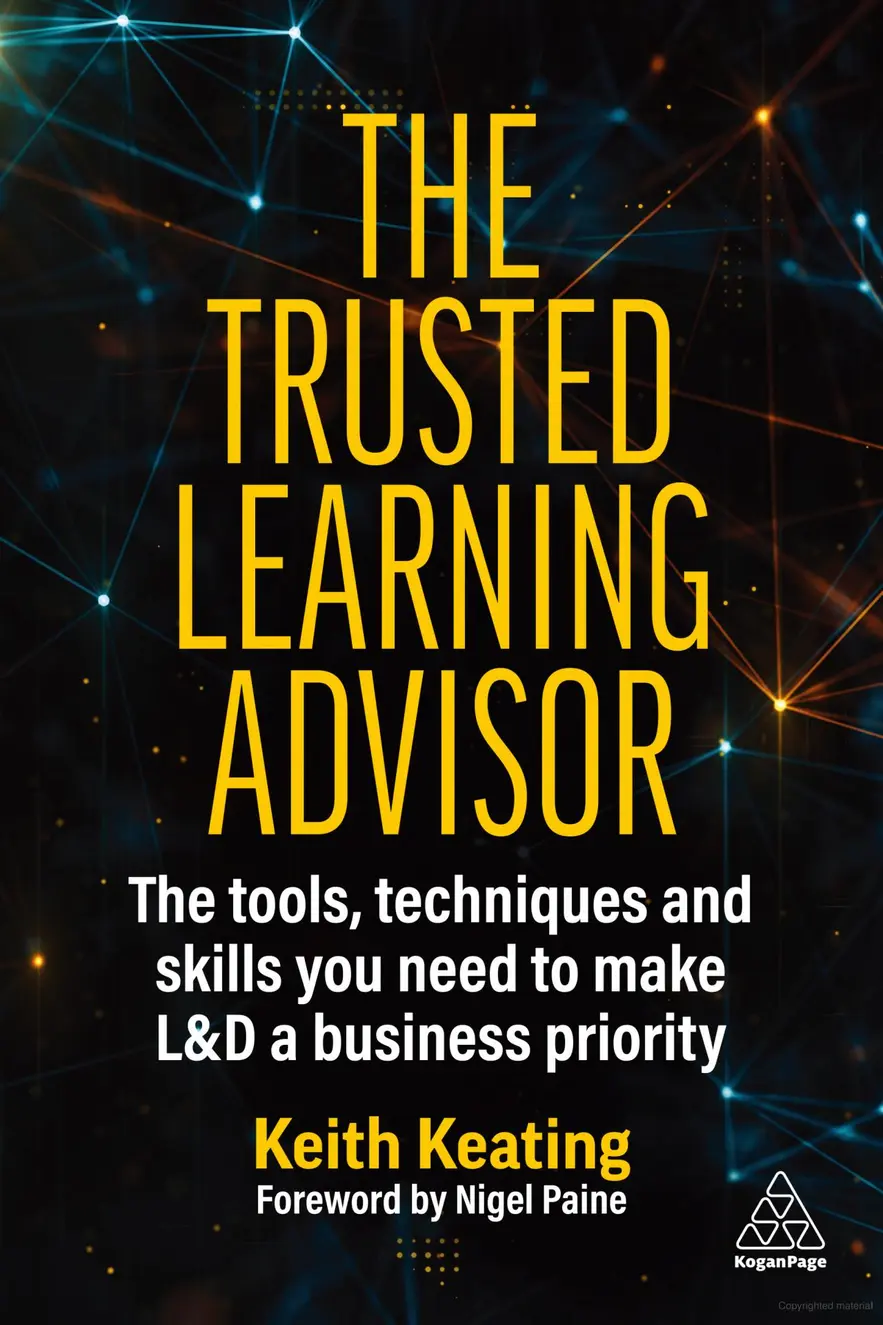
If you want L&D to be taken seriously as a business function, you need to stop being seen as a support team and start acting like a strategic partner. This book shows you how.
Keith Keating lays out a practical roadmap for L&D professionals to gain influence across departments and the C-suite. Through frameworks, real examples, and tips, the book teaches you how to align learning with strategic goals, communicate business value, and adopt a proactive approach to solving organizational problems.
It’s packed with tools to help you lead conversations about ROI, performance impact, and business alignment skills critical for every modern L&D leader.
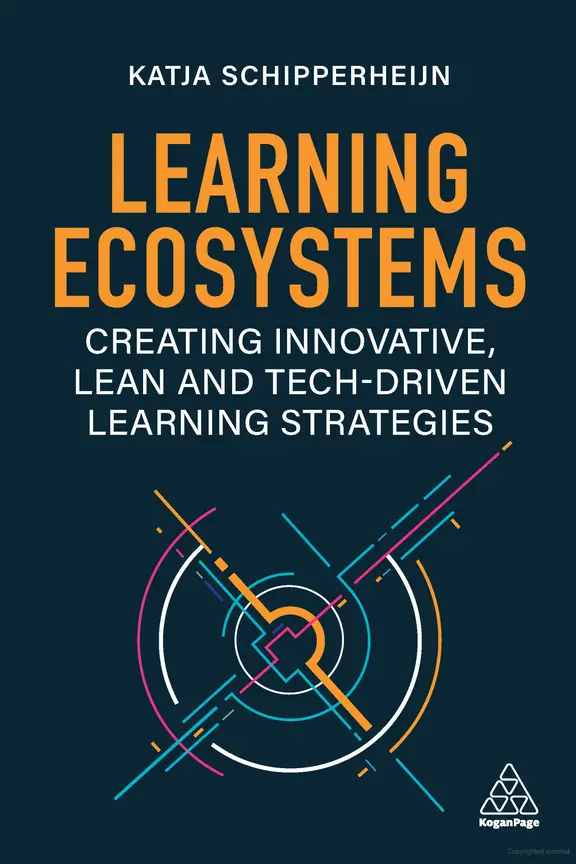
Today’s organizations need to be resilient, agile, and always learning. That’s what this book is all about creating “LearnScapes” that connect social learning, digital platforms, and employee-driven content into a living ecosystem.
Katja Schipperheijn explains how to upskill and reskill continuously by integrating learning into everyday work. The book dives into how you can build a learning architecture that adapts over time, supports cross-functional knowledge sharing, and uses technology to amplify learning outcomes.
For anyone responsible for driving long-term transformation through training and development, this book provides strategic thinking with hands-on execution.
Though short, this book delivers a forward-thinking perspective on how AI, neuroscience, and personalization are changing how people learn at work. It includes insights on adaptive learning platforms, microlearning systems, and the role of brain science in training effectiveness.
Backed by case studies from companies like AT&T, Unilever, and Walmart, it explores the shift toward learner-driven experiences. Bergeron offers actionable ideas for how L&D leaders can meet rising employee expectations and make learning a competitive advantage in fast-moving markets.
If you’re interested in Learning and Development books and how emerging technologies are shaping corporate learning, this one’s worth your time.
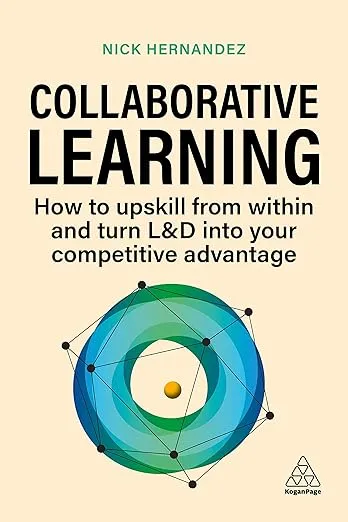
This book explores how collaborative learning can unlock internal knowledge and accelerate skills development across organizations. It shows how peer learning, mentorship, and team-based development create more engaged learners and better business results.
With examples from companies like Slack, Alpha Sights, and Mitsubishi Electric, it covers the mechanics of designing and scaling collaborative learning systems. The book also outlines how to avoid common pitfalls like engagement fatigue and siloed knowledge.
If you’re building a people-first culture, this training and development book can help you embed learning into the day-to-day operations of your teams.
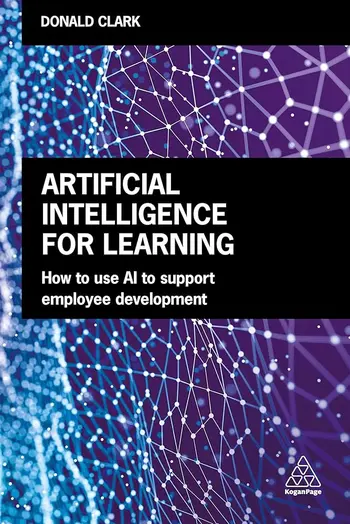
AI is already changing the way we learn at work. Donald Clark’s book shows you how to use AI to personalize content, drive engagement, and scale support through tools like chatbots and smart analytics.
He addresses common myths and concerns about AI while also providing use cases from companies like Netflix, British Airways, and the NHS. Topics include AI-based assessments, automated feedback, and intelligent systems that make learning more adaptive.
This is one of the more technical but accessible L&D books for professionals exploring data-driven approaches to training.
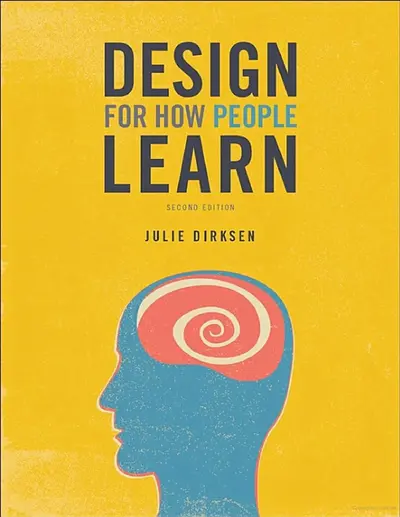
Julie Dirksen’s book remains a favorite among instructional designers and trainers. It takes the science of how people learn motivation, memory, experience and turns it into a practical guide for creating better learning environments.
The book is divided into three parts: understanding how learning works, applying it to design, and adapting to different learners. Each chapter includes real-world examples, models, and simple illustrations that make complex concepts easier to implement.
Whether you’re designing e-learning, workshops, or blended programs, this professional development book will help you create learning experiences that actually stick.
This book offers a strategic guide for L&D leaders, digital learning strategists, and organizational decision-makers on how to thrive as a learning leader in the era of speed. It lays out practical frameworks and approaches for designing learning systems that reduce time-to-proficiency, improve performance outcomes, and accelerate employee development.
This is an ideal pick for L&D professionals who want to push learning beyond compliance and into a competitive advantage for their organizations.
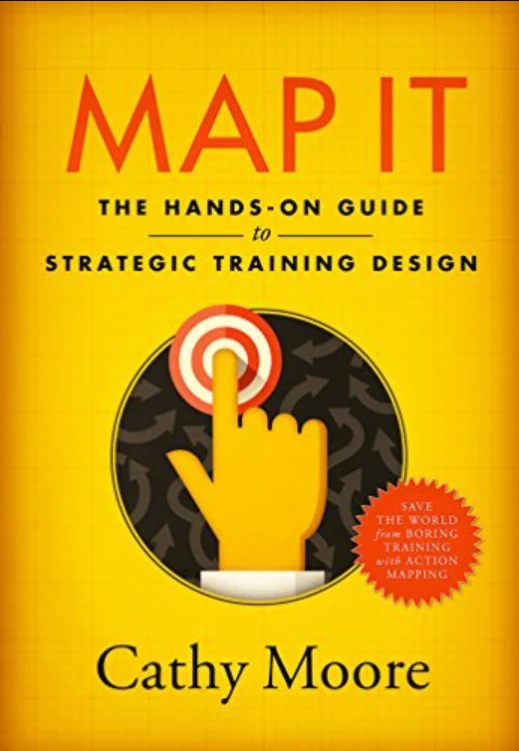
Cathy Moore’s “Map It” introduces action mapping a method for designing learning solutions that directly improve performance. Instead of defaulting to courses or content dumps, Moore teaches you to identify root causes and create activity-first programs that change behavior.
The book walks through every step: performance analysis, decision mapping, delivery methods, and outcome tracking. With templates, examples, and practical exercises, it’s especially helpful for internal L&D teams managing tight timelines and limited budgets.
An essential resource for anyone responsible for training design or learning architecture.
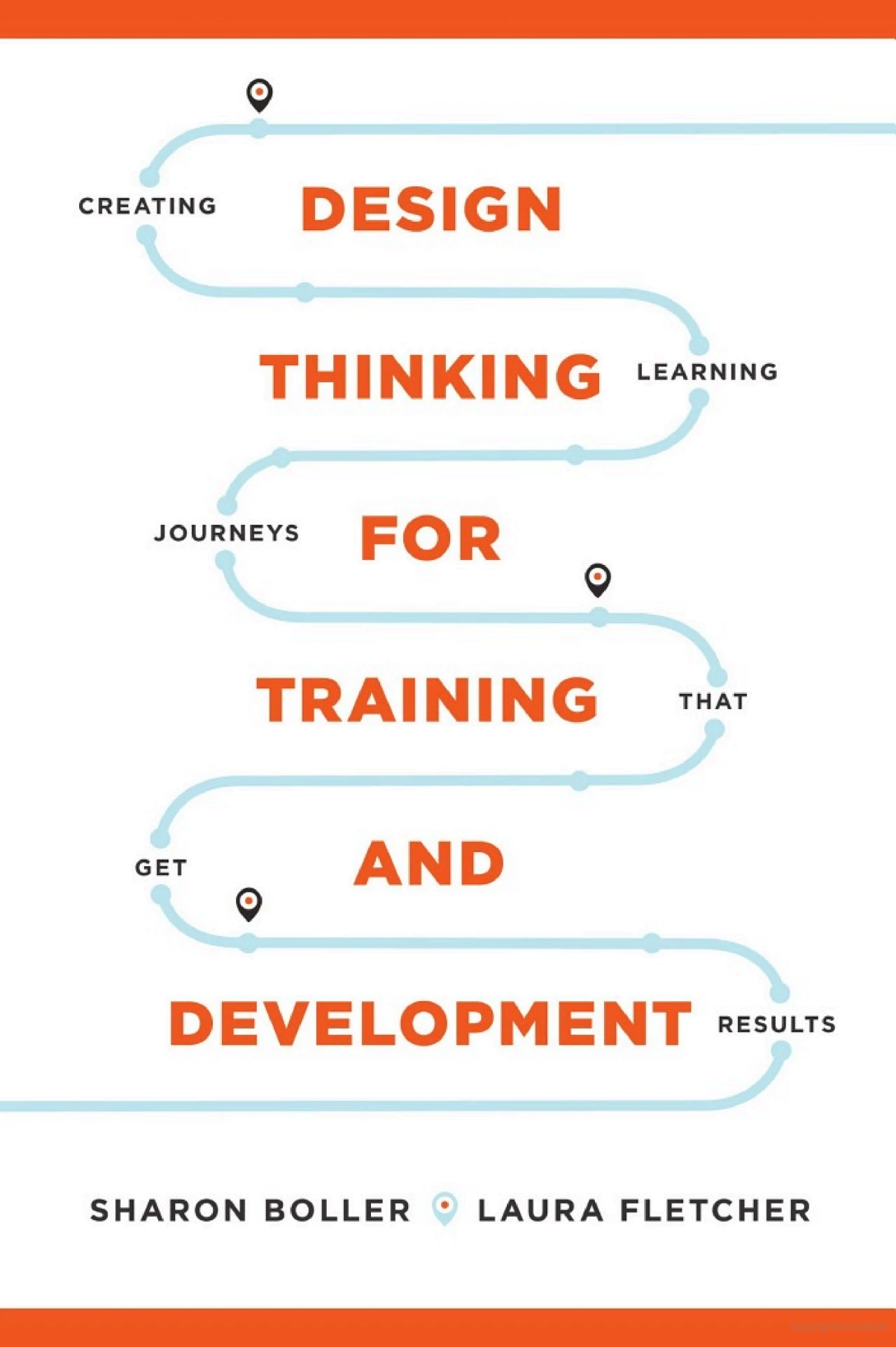
This book adapts design thinking principles for L&D professionals, emphasizing empathy, experimentation, and user-centered learning. You’ll learn how to map learner journeys, prototype solutions, and gather feedback to make iterative improvements.
The authors provide job aids, stakeholder management tips, and detailed case studies showing how design thinking leads to better learning experiences. It’s useful for both in-house and client-facing roles looking to increase the impact of training programs.
If you’re working on culture change, onboarding revamps, or learning product innovation, this book is a practical playbook.
The right learning and development books don’t just teach you—they change the way you lead, influence, and deliver value. The titles in this list are more than just good reads. They’re tools for building smarter teams, better systems, and stronger outcomes.
Whether you’re building your first L&D strategy or rethinking how to make learning matter, these ten professional development books for 2026 will keep you on the front foot.
For more curated lists, how-tos, and strategy insights, keep following the Tekstac blog—your resource for the future of workplace learning.
1. Any credible and recent L&D book to read in 2026?
“L&D Order Taker No More” by Jess Almlie, published in September 2025 is a strong pick for L&D leaders navigating speed, change, and uncertainty in 2026.
2. What books should new Learning & Development professionals start with?
For L&D beginners, it’s recommended to read Design For How People Learn by Julie Dirksen. It’s practical, learner-focused, and a great foundation for building effective learning experiences.
3. Why should L&D professionals and leaders read L&D books? What’s in it for them?
The right L&D books reshape how you lead, influence, and create impact. They serve as practical tools for building stronger teams, smarter learning systems, and measurable business outcomes.

Effective team management is not about choosing one method over another but blending strategies to ensure both immediate performance and long-term growth. Skills management focuses on honing specific abilities critical for current roles, while talent management emphasizes nurturing employees’ overall potential to support future organizational goals. Together, these approaches complement each other, creating a workforce that is resilient, capable, and prepared for the challenges ahead.
Skills management is all about understanding what you and your team need to thrive in your roles and helping everyone grow in those areas. It starts with figuring out the gaps—what’s missing for you or your team to perform your best—and then creating targeted employee training programs to bridge those gaps.
When done right, it doesn’t just boost productivity; it builds stronger, more capable teams that are ready for anything. Take Amazon’s Career Choice program, for example. Amazon equips its employees with the tools to achieve their personal goals while meeting the company’s future needs.
But let’s be honest – it’s not just about sitting through lectures or flipping through manuals. Real learning happens when it’s hands-on. Practical training gives you the confidence and experience to handle real-world challenges. And with regular check-ins, you can see just how far you’ve come and whether the employee training programs are making a difference. This way, your team can adapt quickly to new projects or technologies without wasting any time.
Skills management and talent management aren’t separate ideas—they’re two sides of the same coin. Talent management is all about nurturing your employees’ potential and supporting their long-term growth within your organization. It begins the moment they join your team and continues as they build meaningful careers aligned with your company’s goals.
A great example is Google’s focus on employee development, where programs like mentorship, leadership training, and growth-focused initiatives provide clear paths for career advancement. It’s all about helping your employees grow from their very first day and guiding them to build meaningful careers within your company. These strategies not only retain top talent but also foster innovation within the organization.
Did you know that 52% of employees who leave their jobs say their employer could have done something to stop them? People stay when they feel valued, appreciated, and see chances to grow. When you recognize their efforts and show them support, they’re much more likely to stick around and contribute to your success.
To future-proof your workforce, integrating skills management and talent management is key. Skills management equips your team with the specific capabilities they need right now, ensuring operational efficiency. Talent management, on the other hand, focuses on nurturing long-term potential through mentorship, leadership development, and tailored career plans.
By aligning these strategies, you not only close skills gaps but also empower employees to grow in ways that directly support your business goals. This holistic approach helps you adapt to market changes, foster engagement, and retain top talent in a competitive landscape.
Implementing skills and talent management isn’t easy, especially with the constant change in skills required to perform a role and the rapid evolution of technology. It can be challenging to pinpoint skill gaps and keep training programs relevant. Your employees may also disengage if they don’t see how the learning ties to their growth.
Aligning career advancement with your business goals adds complexity, as mismatches can lead to frustration. By using real-time tools to track trends, creating tailored development plans, and fostering a culture of growth, you can help your team stay prepared and motivated to succeed.
Skills management and talent management share a common goal-building a strong workforce-but they approach it in different ways. Here’s how they compare:
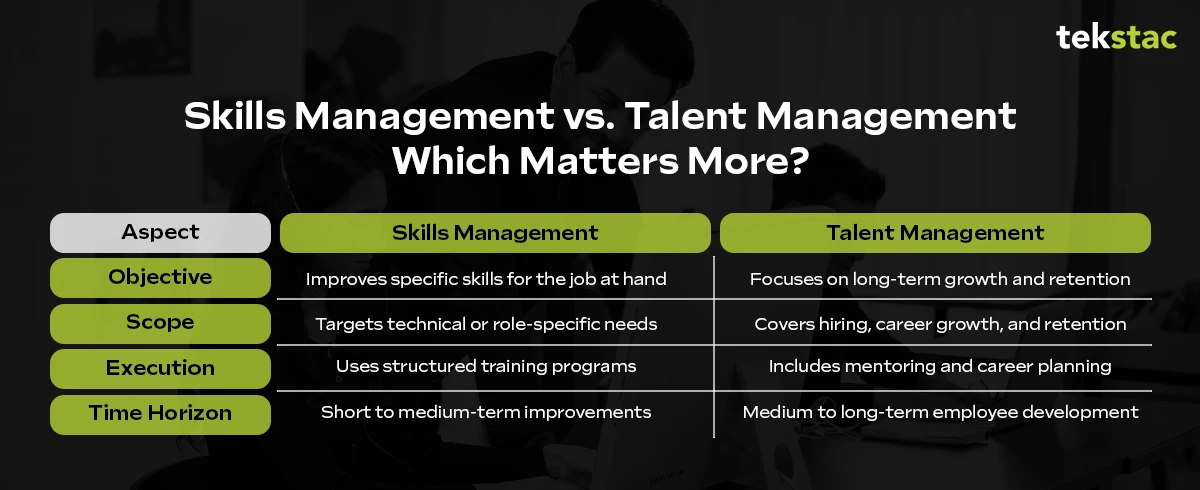
Together, these two approaches form a balanced strategy. Skills management addresses immediate needs, while talent management ensures sustainable, long-term success for both employees and the organization.
Skills-based talent management is changing the way companies think about their workforce. Instead of focusing on job titles, this approach looks at what employees can actually do. This approach prepares teams to navigate challenges and seize opportunities with confidence and agility.
This method helps organizations use their people more effectively. Employees are assigned tasks based on their abilities, not just their roles, which makes projects run smoother and faster. It also brings different talents together, encouraging teamwork and creative problem-solving.
If you want your organization to succeed in today’s fast-changing world, you need a strategy that brings skills management and talent management together. This means using tools that enable effective skills gap analysis to give you a clear picture of what your team can do now and how they can grow. By addressing immediate needs while planning for the future, you’ll set your workforce up for long-term success.
With advanced learning and development systems, it’s easier than ever to create focused employee training programs that actually work. This approach doesn’t just improve productivity; it enhances employee engagement and ensures your organization stays competitive in a rapidly evolving marketplace.
Skills management and talent management are two complementary parts of a unified strategy for building a stronger workforce. Together, they ensure your employees are equipped with the skills they need today while fostering the growth required for tomorrow. Skills management sharpens capabilities for immediate tasks, and talent management aligns personal aspirations with organizational goals, creating a seamless pathway for success.
With tools like Tekstac’s advanced learning platforms, organizations can bridge skill gaps, foster career growth, and build a resilient workforce ready for the future. Take the next step in workforce transformation—explore Tekstac’s solutions today to set your team up for lasting success.
1. What is the difference between talent management and talent development?
Talent management focuses on hiring, retaining and optimizing employees, while talent development enhances employees’ skills through training and mentorship. Talent development is a key part of talent management, ensures long-term growth and success.
2. How can organizations future-proof their workforce with skills and talent management?
By leveraging skills gap analysis, tailored learning programs, and career development initiatives, companies can ensure employees stay adaptable and aligned with evolving business needs.
3. What is the difference between Talent Management and Learning & Development in HRM?
Talent management focuses on hiring, performance, and career growth, while Learning & Development (L&D) enhances skills through training. L&D is a key part of talent management, driving workforce growth and readiness.
4. What tools can help implement skills and talent management effectively?
Platforms like Tekstac’s advanced learning solutions enable organizations to analyze skill gaps, provide personalized training, and drive long-term workforce transformation.
5. How do skills management and talent management work together?
Skills management ensures employees have the right capabilities for immediate tasks, while talent management focuses on long-term growth through mentorship and career planning. Together, they create a balanced workforce strategy.