

Imagine building your dream house, where every brick, wall, and window bears your aspirations. Now, suppose the foundation has cracked because of one tiny, overlooked mistake, it can collapse the entire structure of the house. Similarly, employer branding mistakes can weaken the core reputation of your organization. It defines how your organization is perceived by both existing and potential employees. A well-developed employer brand not only attracts talent but it also shows the values, culture, and leadership effectiveness.
Employer branding is the reputation of a company as a place to work, based on how current and potential employees perceive its culture, values, work environment, leadership, and employee benefits. It reflects whether the employee experience matches what the organization promises during hiring and recruitment.
Even well-intentioned efforts can fail due to commonly overlooked mistakes. Much like a cracked foundation compromises the stability of a house, these common failures can undermine your efforts to win and retain top talent. In 2026, as the competition for talent intensifies, avoiding these mistakes will be more important than ever. This article delves into the top 10 employer branding mistakes to avoid and offers actionable insights to help you strengthen your brand’s foundation.
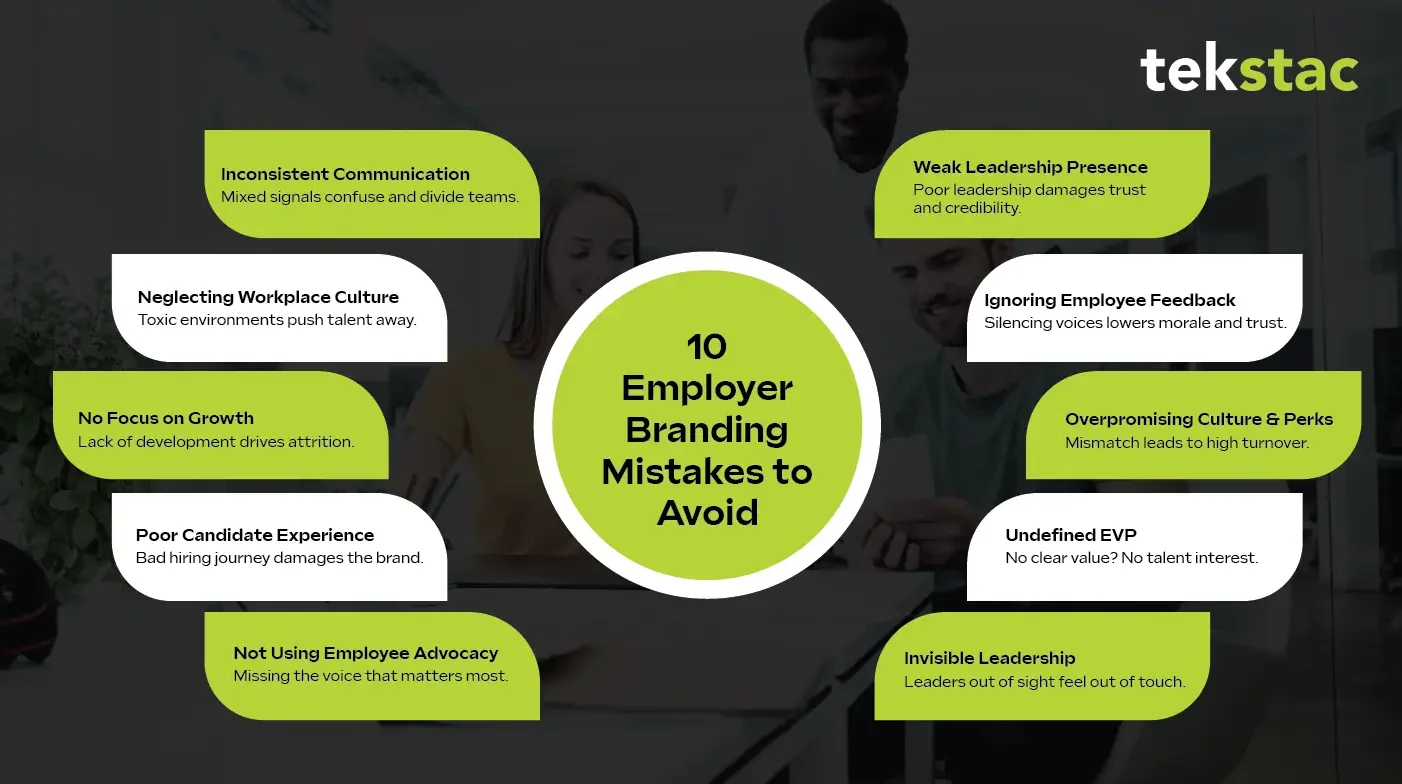
Leadership competence is actually the backbone of any strong employer brand. The lack of trust, unclear communication, and lack of vision lead to poor leadership. Employees seek inspiration, vision, and authenticity from leaders. If these qualities are missing, it makes the organization look disorganized and unreliable to both employees and potential candidates.
Incompetence in leadership often tells of poor decision-making, lack of transparency, and disengagement from the workforce. This has led to dissatisfaction and mistrust culture within the organizations.
How to address it:
Employee feedback is a valuable compass that can guide an organization toward improvement. Not listening to the voices of employees is like ignoring warning signs on a treacherous path. Failure to heed the inner voice of employees makes morale decline, erodes trust, and your employer brand suffers. In time, it comes with enormous turnover rates as well as a difficulty in acquiring the best talent.
Organizations often fail to construct effective feedback mechanisms or even to act on what they hear in the feedback. The lack of follow-up lets everyone know that the opinions of the employees do not matter.
How to address it:
Overselling workplace culture or benefits in recruitment materials is one of the most common employer branding mistakes organizations make. While it may initially attract candidates, it often backfires when the actual employee experience doesn’t match expectations. This gap erodes trust and directly impacts retention.
For example a Glassdoor study found that 58% of employees would not work for a company with a bad reputation, even if it meant a pay cut. This mismatch harms your employer brand and creates a disillusionment cycle with new hires. When employees are let down by what really exists in company culture, they will be more apt to leave, resulting in more turnover and additional recruitment costs.
Often organizations exaggerate some of their strength or overdo the polishing of an image that is way off from the real picture. Such tendencies will result in dissatisfaction and spoil your reputation.
How to address it:
The Employer Value Proposition (EVP) describes what makes your organization special and why people should work for you. An undefined or generic EVP leaves your employer brand without direction or identity. Without a clear and compelling EVP, potential candidates may fail to see the value your organization offers compared to competitors.
A good EVP reflects your culture, mission, and business goals while resonating with the needs and aspirations of your employees.
How to address it:
The invisibility of leadership contributes to a lack of trust and engagement within an organization. The lack of accessibility and engagement from leaders gives an impression of being unattached to employees. Lack of visibility may also weaken employees’ attachment to the mission and values of the organization.
Confident and responsible leaders build confidence. Leaders are not detached; they participate in activities within the workplace. They demonstrate that they are concerned with the success of the organization.
How to address it:
Confusion among employees and candidates occurs from inconsistent communication. Mixed messages, or the failure to make it clear, do not promote trust and thus undermine alignment in teams and departments. Clear and consistent communication can provide a united vision and give employees confidence.
One of the toughest challenges in communication is trying to present cohesive messaging when changes occur or are unsure. Such a lack of consistency undermines the employer brand.
How to address it:
Any organization’s heartbeat is its workplace culture. The best employer branding will be undone by a toxic or neglected culture. Employees want an environment that promotes inclusivity, collaboration, and respect. Not building a good workplace culture leads to low morale, high turnover, and damage to reputation.
A strong culture not only pulls in the talent but also bonds the existing one.
How to address it:
Employees will remain loyal to the organization that develops them professionally. Neglecting employee development conveys a message to employees that the organization is not interested in their future and therefore results in a higher rate of turnover.
Without opportunities for growth, an organization is limited in its capacity to innovate and adjust to changes in the market.
How to address it:
Hiring is a candidate’s first touch point when engaging with your organization. Failure to engage well leads to top talent not being attracted and the loss of your employer’s brand. In essence, long hiring processes, inadequate clarification of some matters, or merely a cold response can move a candidate away.
Candidate experience plays a critical role in employer branding. Research from CareerArc shows that 72% of job seekers share negative hiring experiences publicly or through word of mouth, making it essential for organizations to address gaps in the recruitment process before they affect employer brand perception.
How to address it:
Your most potent internal ambassadors are your employees. Not focusing on their role as promoters of your employer brand amounts to a lost opportunity in the strengthening of your reputation. Happy workers instinctively advocate for their workplace and help attract top talent while building morale.
Employee advocacy builds trust and authenticity and helps make your employer brand more believable and appealing.
How to address it:
Employer branding is not a strategy; it’s the bridge that brings your company’s values to the world. Avoiding these 10 employer branding mistakes will help your employer brand not just survive but truly thrive in 2026 and beyond. Authenticity, transparent communication, and leadership competence will form a brand that resonates both with employees and candidates. Nurturing this foundation and avoiding pitfalls will attract top talent and a workplace where employees are valued. Start your employer brand today—create a brand that draws in and holds the right people for long-term success.

Lean thinking promised a revolution.
Originating in Toyota’s factories, lean thinking has not only shaken up the status quo but also set a global standard for cutting waste and delivering value. It’s a movement that’s changing the way we do business.
Today, companies race to adopt and benefit from it—just like Toyota. They see waste-free processes and responsive workflows that help cut costs and respond quickly to customer demands.
However, implementing “lean” has its own challenges, as evident in the many failed implementations, with failure rates of 60–90%, similar to the 80% failure rate of organizational changes.
In this blog, we will understand the urgent need to overcome these challenges and how to implement lean thinking more effectively.
Despite its immense potential to bring in organizational revolutions through work processes and efficiency, lean thinking fails due to more profound, systemic issues from implementation challenges.
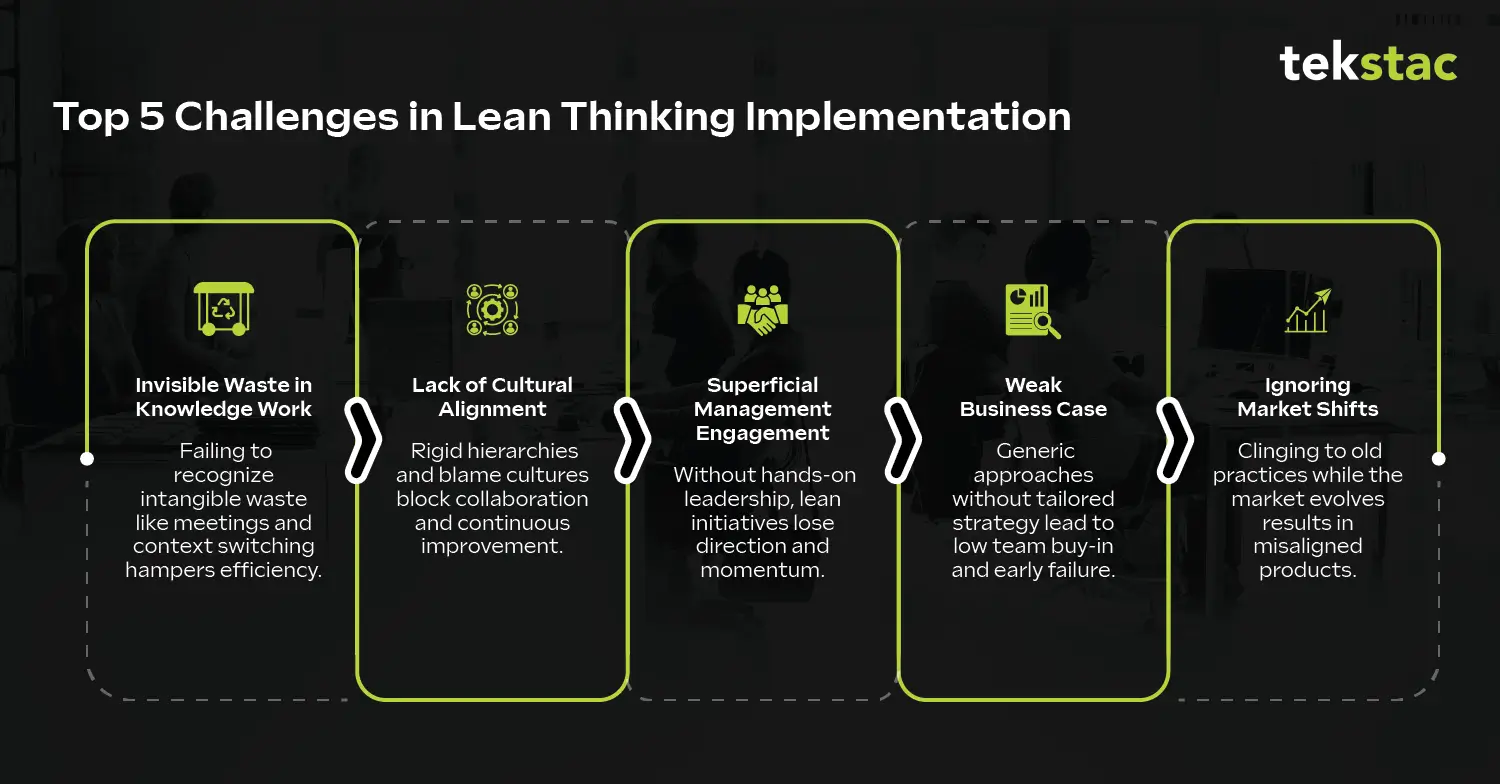
Lean thinking originated from Toyota Production Systems, where waste is tangible, such as extra inventory or defective products. However, in knowledge work, waste is less visible, resulting in inefficiencies like poor communication, context switching, inadequate tools, unnecessary meetings and excessive documentation.
Organizations often struggle to recognize and address these intangible forms of waste, misapplying lean tools designed for manufacturing environments. Without aligning lean practices to the organization’s nuances, companies may amplify inefficiencies and fail to eliminate waste.
For example, a software development company may implement lean thinking to reduce waste by enforcing strict time tracking—believing that the time spent on non-coding activities is wasteful. This approach backfires as brainstorming sessions and peer reviews are essential for knowledge work, and when these elements are discouraged, it may lead to lower-quality code and reduced innovation.
Lean thinking may seem like a set of tools or methodologies, but it’s more than that—it requires cultural transformation. Hence, organizations that are not ready for change and encourage rigid, hierarchical structures fail to create an environment that supports collaboration and continuous improvement— which are needed to implement lean thinking effectively.
For example:
These cultural barriers obstruct the implementation of lean principles like respecting people and creating knowledge.
Lean thinking requires active and continued leadership involvement. Yet many organizations treat it as a one-time initiative rather than a permanent mindset shift. Thus, senior leaders ignore employee engagement, cascade strategies into actionable team objectives, and allocate resources for training.
Imagine a tech startup implementing lean thinking to improve its software development process. However, senior management only announces goals without directly engaging with developers or participating in daily stand-ups. Without a clear understanding, the initiative will ultimately fail because of a lack of clear direction.
Some companies may jump ship to embrace lean implementation without understanding its relevance and context. Traditional lean training often focuses on generic benefits observed in other companies rather than developing a tailored, adjusted business case. Such lack of clarity leads to:
Lean thinking’s principle of deferring commitment focuses on agility, but many stick to rigid planning practices. This results in premature decisions due to outdated information and products failing to meet rising customer demands. Ultimately, this leads to wasted effort and resources.
For instance, a company uses lean thinking to streamline its product development for desktop applications. However, as demand for mobile apps increases, it continues applying lean principles designed for desktop development, ignoring the shift in market trends. This results in slow market response and loss of competition.
While the above challenges obstruct lean thinking implementation, they can be overcome! One key aspect is to keep in mind the principles of lean thinking, which also directly help with the above challenges:
Lean thinking begins by defining value through the lens of the end customer. What exactly does the customer need, when do they need it, and what are they willing to pay for? This understanding will help set a benchmark for work processes. Think of clear communication, usable outputs, or efficient delivery timelines. Activities like context switching or inefficient tools are non-value-adding wastes.
To better implement lean thinking, start by defining what “waste” looks like in the environment. Organizations can begin by mapping out their work processes and looking for points where time is wasted due to poor communication or shifting between tasks. This detailed map, known as the ‘value stream,’ must also include the current and ideal states of the work process, helping visualize the flow of value better.
For example, a project management team might struggle to switch between emails and project boards. One way to cut waste is to encourage using a single, more efficient tool for fast-tracking and reducing unnecessary back-and-forth emails.
Tip: Engage employees to categorize activities as “value-adding,” “necessary but non-value-adding,” or “pure waste.”
Lean thinking also emphasizes eliminating barriers to work. These can be overloaded team members, inefficient reviews, or other bottlenecks like unclear objectives, lack of resources, or poor task prioritization. It’s essential to keep work moving seamlessly from start to finish by identifying and addressing these constraints.
An example would be implementing strategies like Work-In-Progress limits—restrictions on the number of tasks or projects a team works on at any given time—to increase quality and ensure each task flows smoothly through the value stream. A well-managed flow will lead to faster delivery, fewer errors, and higher satisfaction for employees and customers.
It’s similar to keeping traffic on a highway below capacity. When there’s less congestion, work progresses faster.
Lean requires cultural alignment, but organizations with siloed departments and blame cultures may struggle. Respect for people is an essential principle of lean, which promotes trust, collaboration, and ownership of improvements.
Organizations should train managers and teams on lean principles like continuous improvement (Kaizen) and encourage them to identify inefficiencies and implement changes.
For example, in a content creation team, members can be encouraged to suggest process changes during weekly catch-ups, such as reducing revisions or clarifying ownership points.
Lean initiatives must start with a clear business case that links them directly to organizational goals. Without this clarity, achieving buy-in from stakeholders or maintaining long-term efforts can be challenging.
For lean thinking to have an actual impact, initiatives must align with the market’s current and future needs. This ensures that processes are optimized while prioritizing customer value, a core principle of lean thinking.
One of the principles of lean implementation is iterative improvement, which requires continuous feedback. Lean thinking practices must be evaluated regularly to implement changes. One way is to use sprints to identify what worked and what did not. Customer surveys or performance metrics must validate these to drive improvements. Lastly, the focus must be on using lean thinking as a tool for growth rather than for criticism.
It’s important to note that implementing lean thinking can fail when organizations struggle with skills gaps, inefficient processes, and slow adaptation to market demands. Continuous improvement requires real-time feedback and learning. However, traditional training may fall short of amplifying lean success.
AI-powered tools, like Tekstac, close this gap by equipping the workforce with the required skills when they need them while ensuring continuous improvement. With such tools, organizations gain real-time skill assessments, personalized learning paths, and instant feedback loops—all in one solution.
Tekstac is one such solution for tech talent, which can be easily integrated with lean strategies. With features like auto-evaluated labs, on-demand mentorship, and scalable training solutions, Tekstac empowers teams to adapt and stay ahead of market demands.
Hence, organizations can deliver more value faster.
1. Why does lean thinking often fail in modern organizations?
It often fails due to cultural misalignment, lack of leadership support, and misapplying tools not suited for knowledge-based work.
2. How can companies identify waste in knowledge-based work?
By mapping value streams and spotting inefficiencies like context switching, poor tools, or unnecessary meetings.
3. What role does culture play in lean implementation?
A collaborative, blame-free culture enables continuous improvement and is essential for successful lean adoption.
4. How do AI tools like Tekstac support lean implementation?
They deliver real-time skill insights, personalized learning paths, and help teams adapt quickly to changing demands.

AI is not straightforwardly stealing jobs — it is eliminating specific task categories while simultaneously creating new roles that did not exist five years ago. The IMF estimates AI could affect 40% of global jobs globally, with advanced economies seeing up to 60% exposure. But exposure does not mean elimination: most affected roles are being transformed, not deleted. Understanding which jobs are at risk, which are AI-proof, and how to adapt is what this guide covers.
From IT organizations to healthcare, finance, manufacturing, and creative industries, AI is reshaping work and the workforce. Understanding its role and preparing for an AI-driven future is crucial for employees across various sectors.
AI is not just another technology innovation- it’s a game-changer that extends beyond routine task execution. Unlike traditional automation, which focuses on rule-based and repetitive processes, AI introduces cognitive capabilities such as learning, decision-making, and problem-solving. This shift raises concerns about AI replacing human workers, particularly in industries like software development, customer service, data management, and much more.
The International Monetary Fund (IMF) reports that AI could affect 40% of global jobs, with advanced economies seeing up to 60% exposure—through both automation and job transformation.
A study by McKinsey Global Institute estimates that nearly 30% of jobs worldwide could be automated by 2030.
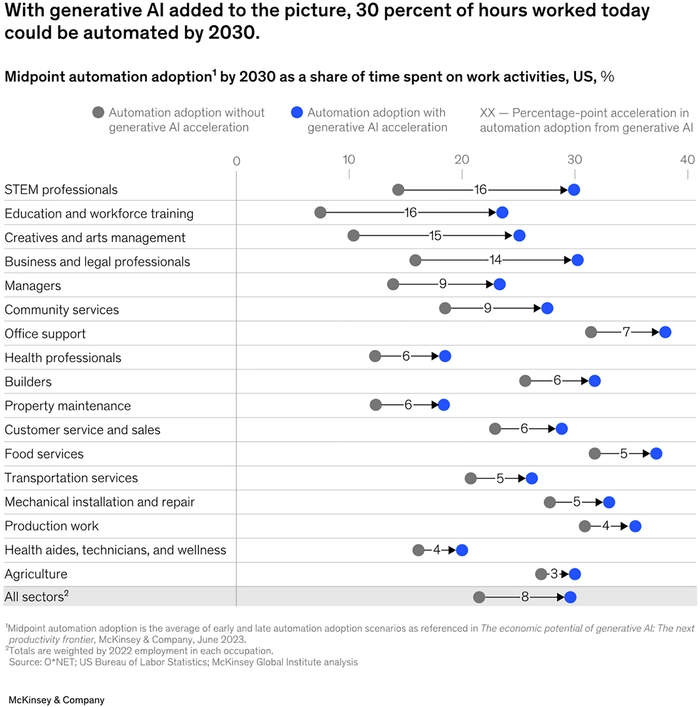
Source: McKinsey & Company
Roles such as manual testers in IT, basic customer service representatives, data entry clerks, and factory line workers are at high risk. AI-powered platforms can now generate code, perform automated testing, analyze customer inquiries, and even handle supply chain logistics faster than human workers.
However, history has shown that technological advancements often eliminate some jobs while creating new ones. The rise of e-commerce disrupted traditional retail but created new opportunities in logistics, digital marketing, and online customer experience. Similarly, AI is expected to generate demand for roles in AI ethics, machine learning operations (MLOps), AI-driven cybersecurity, and AI- product management.
Instead of simply replacing workers, AI is evolving as a tool that enhances human productivity- it actively redefines how industries operate by introducing intelligence, adaptability, and decision-making capabilities. Unlike traditional automation, which primarily focuses on efficiency, AI introduces adaptive learning, predictive intelligence, and cognitive reasoning, enabling businesses to operate at an entirely new level.
AI is transforming industries by combining speed, intelligence, and adaptability. Here are key examples of human-AI collaboration in action:
These examples highlight that AI is not inherently a threat but a complement to human expertise.
This shift highlights the importance of integrating AI into workforce strategies. Organizations that act proactively; building structured upskilling programs before displacement occurs — consistently outperform reactive peers on retention and productivity. See how leading enterprises are structuring this with our AI in HR strategy and transformation guide.
The key lies in reskilling and adapting to an AI-first world with humans in the loop. Professionals who embrace AI and learn how to work alongside it will find new opportunities.
While AI excels at automating structured processes and is increasingly capable of mimicking critical thinking and creativity, it still struggles with deeper cognitive reasoning, emotional intelligence, and human intuition. Some roles that AI cannot easily replace include:
By focusing on these uniquely human qualities, professionals across industries can position themselves in roles that AI cannot easily replace.
As AI continues to evolve, professionals must develop new skills to remain relevant in the job market. Reskilling and upskilling will be essential for those seeking to transition into AI-driven roles. Some ways professionals and organizations can prepare include:
Companies must also invest in upskilling programs, AI training, and certification courses to help employees adapt to these new demands.
Although AI will undoubtedly change the job landscape, it will also create new opportunities. Emerging roles that are growing due to AI advancements include:
As AI continues to advance, professionals who stay ahead of these trends will secure their place in the evolving workforce.
AI is not here to steal jobs but to transform them. Human-AI collaboration offers a promising future where technology enhances efficiency while humans continue to provide creativity, strategic thinking, and leadership. The key to success lies in adaptation and lifelong learning, ensuring that we harness AI’s potential while preserving the irreplaceable qualities of human workers.
AI is reshaping industries by redefining job roles and skill requirements. Those who embrace AI and develop skills that complement technological advancements will thrive in the evolving job market. Instead of fearing AI, professionals across industries should focus on leveraging its capabilities to build a more innovative, efficient, and resilient future in a technology-driven world.
Ready to future-proof your workforce? Explore how Tekstac’s hands-on labs, real-world assessments, and AI-driven learning pathways help teams build in-demand skills and stay ahead of disruption. Book a demo today and see how your organization can turn AI transformation into a competitive advantage. 🚀
1. Is AI going to steal my job?
AI is not stealing jobs—it is transforming them. Most roles are being redesigned as AI automates repetitive tasks, allowing employees to focus on problem-solving, creativity, and decision-making.
The real risk is not AI itself, but the lack of upskilling to work alongside AI tools.
2. How are AI technologies impacting job availability in Indian IT sector?
AI is reshaping the Indian IT sector by reducing demand for routine coding and support tasks while increasing demand for advanced skills like AI, data science, and cloud computing.
Entry-level roles are evolving, and professionals must adapt to AI-assisted workflows and higher-skill responsibilities.
3. What are the most vulnerable jobs to AI automation in India?
Jobs that involve repetitive and rule-based tasks are most vulnerable to AI automation.
These include:
4. List of jobs expected to grow with AI advancement?
AI is driving growth in high-skill and hybrid roles that combine technical and human capabilities.
Examples include:

Your employees are drowning.
Not in work, but in information.
Every training session feels like a firehose aimed straight at their heads—too much, too fast, and impossible to absorb.
Most organizations spend a fortune on upskilling and reskilling programs, yet only 30% of employees found the training ‘exceptionally rewarding.’
The problem isn’t the training itself; it’s how the information is served and how engaged employees feel. Overloaded minds don’t learn, they shut down. However, with content chunking, organizations can make every lesson stick and turn it into actual performance.
Content chunking is the process of breaking down information into smaller, bite-sized pieces that stick in the learner’s mind. It ensures learners focus on one concept at a time, reducing information overload and improving comprehension. When information is organized into logical sections, the learning is more effective, engaging, and memorable.
Example:
Imagine you’re creating a training on cybersecurity basics. Without chunking, it may look like this:
Cybersecurity refers to practices for protecting systems, networks, and data from cyber threats. These include firewalls, anti-virus software, multi-factor authentication, data encryption, intrusion detection systems, and regular software updates.
The above might take two or three takes before completely digesting it. Now, here’s the chunked version:
The information is the same but easier to understand, retain, and apply. This reduces the time spent on repeated training sessions and keeps learners focused, thereby boosting the Learning ROI of upskilling or reskilling programs.
By focusing on the “need-to-know” information, organizations can present it in accessible chunks, enabling learners to achieve better outcomes. Furthermore, content chunking increases the effectiveness of reskilling and upskilling programs in the following ways:
Learners may face time constraints when upskilling and reskilling. Content chunking focuses on the most important information, eliminating irrelevant details. Core concepts are presented on screen with optional links for deeper information. For example, in a coding upskilling program, main syntax rules are displayed upfront, while examples and edge cases are accessible as hyperlinks.
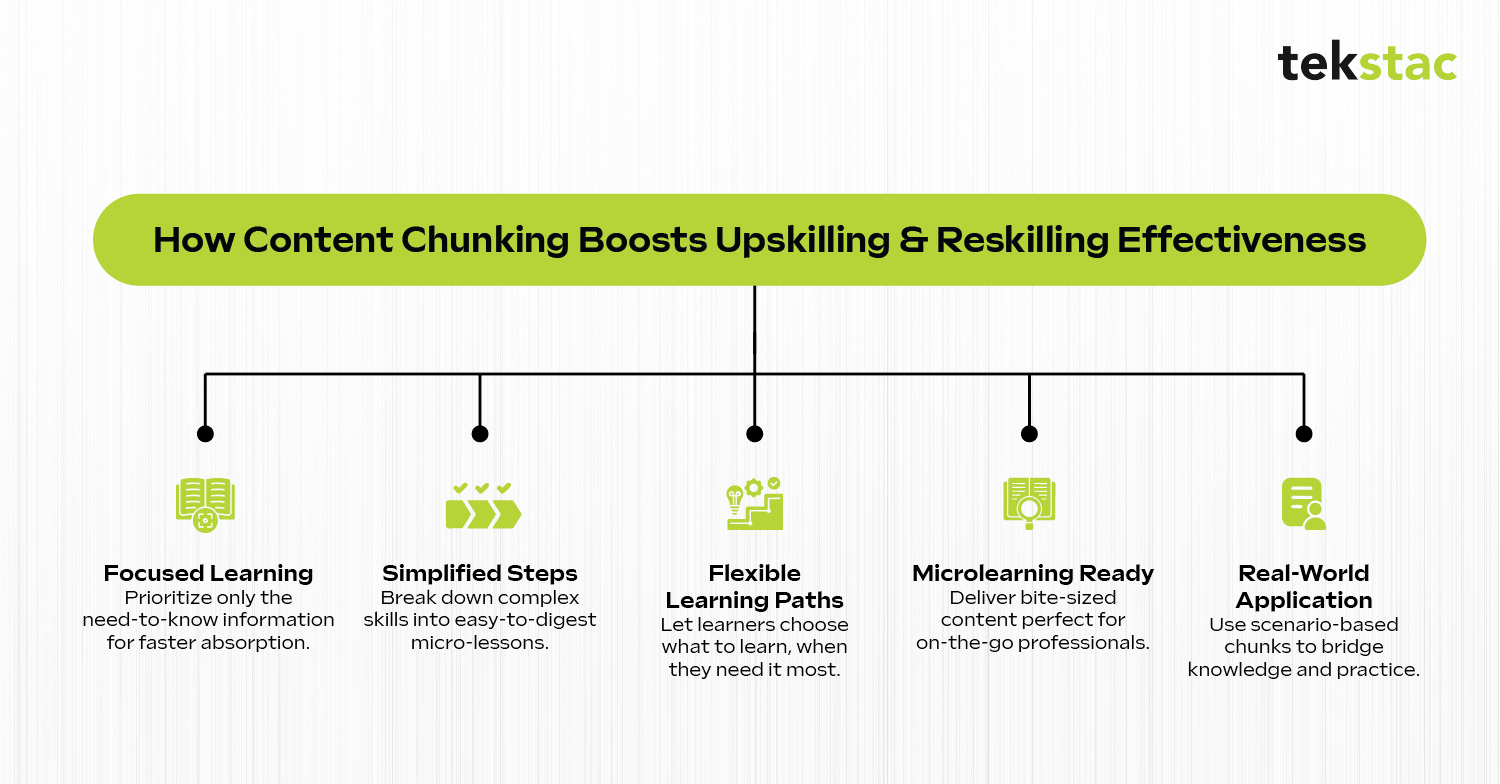
It’s overwhelming when employees focus on a large skill set to learn within a stipulated time. Content chunking breaks learning tasks into micro-lessons, where employees can easily comprehend each chunk of content. For example, instead of delivering an entire module on “Advanced Data Analysis,” chunk the content into specific sections like “Introduction to Data Tools,” “Using Formulas Effectively,” and “Visualizing Data Insights”. Use clear progress indicators to guide learners step by step.
Chunked content creates modular learning experiences that can be consumed in any order. This allows learners to focus on the areas they need most, which is essential for personalized reskilling. For instance, a digital marketing reskilling program may have independent modules on SEO, content, PPC, and so on, allowing learners to start with their most immediate need.
Microlearning delivers focused, short bites of learning ideal for busy professionals. Chunked content aligns perfectly with these approaches, ensuring each piece of information is highly targeted and digestible.
Reskilling often involves switching to unfamiliar roles or industries. Contextualized examples and learning methods make new skills more relatable and memorable. Such real-world scenarios help employees connect theory to practice. Imagine a learning reskilling for customer service. Content is chunked into micro-lessons like “Handling Difficult Customers,” “Using CRM Tools,” and “Upselling Techniques,” each with relevant, bite-sized simulations.
| Before Content Chunking | After Content Chunking |
|---|---|
| Long, text-heavy training modules that overwhelm learners | Bite-sized lessons with clear focus areas |
| Employees struggle to remember complex concepts | Learners retain and recall information more easily |
| One-size-fits-all training path | Modular, personalized learning paths |
| Low learner engagement and participation | Higher engagement with micro-lessons and interactive chunks |
| Repeated training sessions needed | Faster comprehension and reduced training time |
| Minimal ROI from training spend | Measurable ROI with better skill application |
Content chunking includes various methods to deliver practical learning experiences for reskilling and upskilling. Each method listed below caters to different learning styles, goals, and organizational needs.
Here, topics are broken down into short, independent modules that learners can complete within 10 minutes. Each module focuses on a single concept, skill, or task. It aligns well with adults’ need for immediate relevance.
Example:
For upskilling in digital marketing, microlearning modules could include:
Did you know? Research from the Dresden University of Technology shows that chunked microlearning boosts retention by nearly 80% versus old-school training.
Spaced learning involves breaking up learning lessons with rest intervals or other activities. The main goal is to reinforce memory and retention. Spaced repetition combats the “forgetting curve” by revisiting main concepts periodically.
Example:
For upskilling in data analysis, you might:
Visual chunking involves presenting information using videos, infographics, or charts. It helps process information faster, especially for visual learners and helps present concepts better visually.
This is an approach where you break content into actionable tasks that can be performed as learners move through the content material. It ensures hands-on practice. For example, for upskilling in project management, organizations can chunk tasks as follows:
Layered chunking introduces foundational concepts and adds difficult ones as learners gain proficiency. For reskilling, it bridges knowledge gaps, builds confidence with basics first and reduces overwhelm. Upskilling deepens expertise as the employee progresses through the learning material.
With AI, organizations must rethink skilling. Traditional skilling methods may become slow, disconnected, and unprepared to meet the pace skills gap. Tekstac redefines upskilling and reskilling with its all-in-one 360° skilling platform. It empowers businesses to create a skills-based organization through.
1. What is contextual chunking?
Contextual chunking organizes learning into meaningful, real-world scenarios, helping learners connect theory with practice for better retention.
2. What are chunking techniques?
Chunking techniques include microlearning, spaced learning, task-based chunking, visual chunking, and layered chunking for effective training.
3. What is chunking up and chunking down?
Chunking up means generalizing ideas broadly, while chunking down breaks them into detailed, specific, actionable parts.
4. How does semantic chunking work?
Semantic chunking groups related ideas by meaning, enabling learners to understand, remember, and apply information more effectively.
Increasingly rapid technology changes make it hard for businesses to keep up. It’s still imperative to increase revenue, foster employee engagement, and drive brand awareness—but now, there’s the added need to stay up to date with the latest technology advancements and find a way to use them to your business’s advantage. But how?
The key is leadership competence. With strong leaders at the helm, you’ll not only keep your business running in the digital age, but you’ll grow and thrive.
Here, we detail why leadership competence is so important in today’s digital environment and how your leaders can leverage change management, people leadership, vision, and technical savvy to lead the charge.
The stakes have never been higher. According to McKinsey’s 2025 workplace AI report, the single biggest barrier to successful AI adoption is not technology; it’s leadership. Meanwhile, Gallup’s State of the Global Workplace 2025 found that employee engagement has fallen to 21% globally, costing the economy an estimated $438 billion in lost productivity. The leaders who bridge this gap, technically literate, people-first, and strategically agile, will define which organizations thrive.
Leadership competence is a term that refers to one’s ability to lead effectively; this may include a combination of experience, knowledge, behaviors, skills and traits. Put simply, leadership competence is the difference between a strong leader and one that doesn’t live up to expectations.
Such competence is required from all leaders, but it’s even more important in the digital age. The continual advancements mean leaders must bring along the team and ensure they understand and adapt to changes. Plus, as digital changes lead to more opportunities for remote, distributed, and global workforces, they’ll need a strong leader to keep up morale and productivity. Finally, it’s important to keep up—remaining a competitive business requires staying on top of innovations and making your own.
Competent leaders don’t simply succeed in their roles. Instead, their impacts are broader, reaching and benefiting companies at large. There are several ways leadership competencies can positively impact an organization.
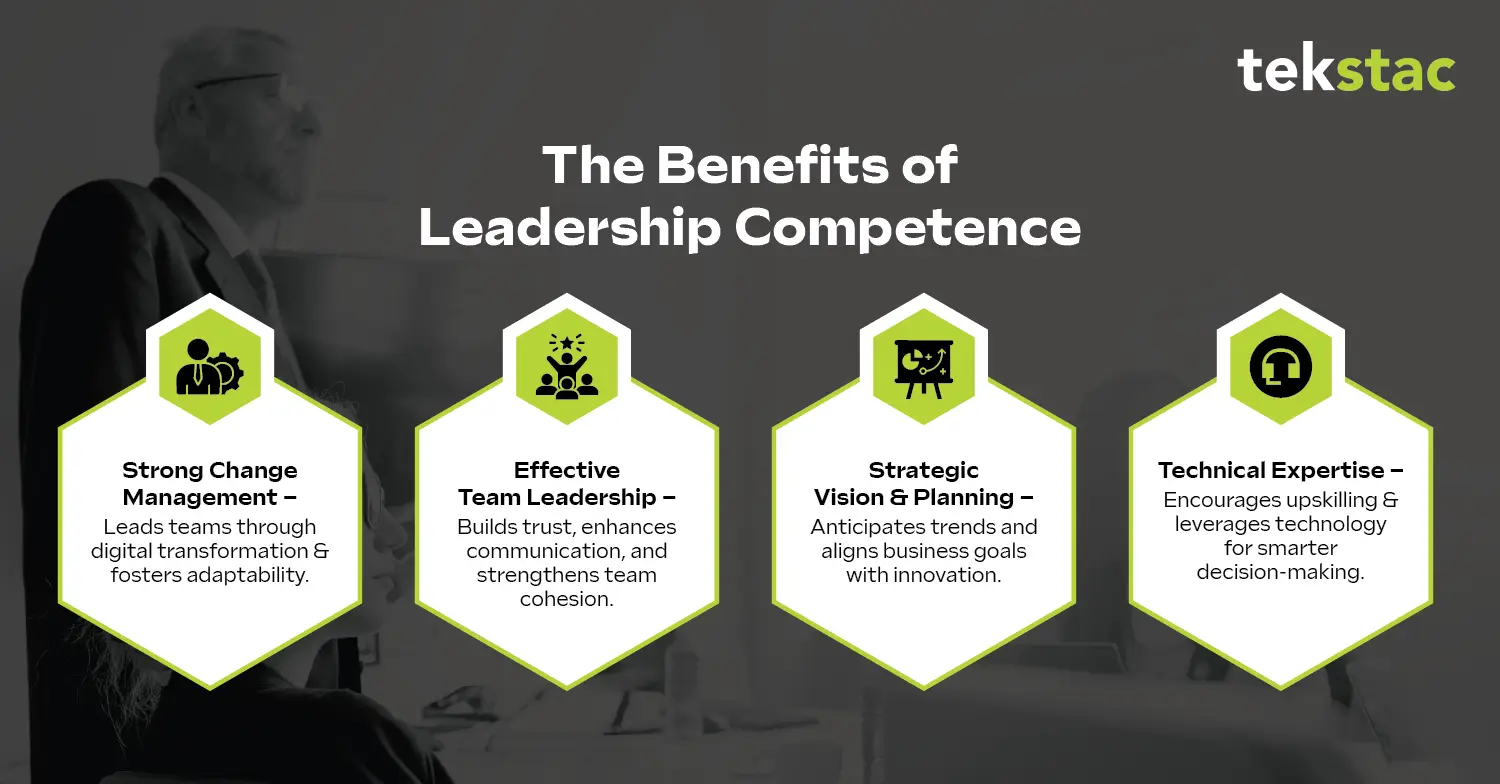
Rapid change is a major part of the digital age, but it can be difficult for employees to keep up. They may struggle to learn new tools or systems or feel anxious about the impact of AI and automation on their jobs. However, business leaders must bring along their staff and drive pivots as needed.
Consider how global consulting and professional services firms have integrated AI research and writing assistants into their analyst workflows. Rather than replacing junior analysts, forward-thinking leaders retrained them to prompt, validate, and apply human judgment on top of AI outputs, turning a potential threat into a productivity multiplier.
Practically, leaders can foster a culture of adaptability—and manage change among their teams—by encouraging teams to collaborate and cross-train, ultimately cultivating a strong growth mindset. In fact, a Harvard Business School survey found that 71% of respondents named adaptability the most important quality of a leader in the digital age.
While technology is a major part of workers’ daily lives, the human element is no less important. In fact, it may even be more important than ever. Strong leaders must show up with empathy and strong emotional intelligence and focus on clear communication with their teams.
Global engagement has dropped to 21%, the sharpest decline since COVID-19 lockdowns, driven largely by a 9-point drop in manager engagement since 2022.
This is especially important in a distributed or remote environment. Without employees working together from the same location, there’s more chance for miscommunication and a loss of team cohesion. To successfully manage this in the digital age, leaders can rely on digital tools like video conferencing, training platforms, and messaging systems.
A strong leader is always looking around the corner at what’s coming next and then determining the best path forward. The digital age makes this even more imperative. Leaders must set clear strategies and objectives that take into consideration the business’s needs, but also how the organization may need to change as technology does.
Without this type of strategic mindset, you could miss upcoming trends in your industry, finding yourself playing catchup rather than leading the charge to innovate.
At the same time, a strategic leader won’t simply jump to the latest trend without understanding its benefits and drawbacks. Rather than asking ‘what can AI replace?’, strategically competent leaders ask ‘where can AI amplify human strengths?.
Technical literacy is a must-have for competent leaders, but that doesn’t mean everyone must be an engineer. Instead, leaders should continually upskill and build their technical competence, then encourage their teams to do the same. According to McKinsey 2025 report, C-suite leaders estimate only 4% of employees use gen AI daily; the real figure is 13%. 63% of employees attribute leadership’s AI reluctance to “digital illiteracy”.
Currently, some of the major digital trends include generative AI, security, and big data, so those are a great place to start. As leaders become more fluent in today’s technological innovations, they can start using this understanding to make strategic decisions—or pivots, if needed.
Moreover, leaders should cultivate a culture of upskilling and training, investing in tools or programs that will help bolster their teams’ technical literacy and address employee skill gaps.
McKinsey’s 2025 research found that only 57% of employees say their company has an AI strategy, while 89% of C-suite leaders believe they do. Nearly half of employees report ‘lots of talk about AI but no action.’
Even with strong leadership, challenges abound in the digital workplace. Teams may resist AI adoption due to fears around job displacement, while others may independently adopt unauthorized AI tools without organizational oversight. This growing risk, known as “Shadow AI,” has become a major change management concern in 2025, with Zendesk’s CX Trends Report noting significant growth in unsanctioned AI usage across industries.
Leaders must balance change management with empathy by creating clear, safe, and governed AI adoption frameworks that help employees feel supported while encouraging responsible innovation. At the same time, with a rapidly evolving technology landscape, leaders must stay focused on business-critical priorities instead of getting overwhelmed by constant change and information overload.
It’s challenging for any company, regardless of digital advancements, to succeed without strong leaders. However, with the rise of new technologies and tools, competent leadership is even more imperative than ever.
Such leadership competencies include the ability to lead through change and foster adaptability, strong people management, a strategic mindset, and continued technological literacy—for both the leaders themselves and their teams. It takes intentional effort to focus on these areas, but it will pay off.
To further foster digital literacy and leadership, consider Tekstac. With over 500+ learning paths available, you can ensure your teams and leaders are trained and ready for whatever comes next.
1. Why do so many leadership competency models fail to get used?
Many leadership competency models fail because they are too generic, difficult to apply in real business situations, and disconnected from development or succession planning. Without validation or integration into day-to-day leadership decisions, organizations often struggle to use them consistently or confidently.
2. Do leadership competencies need to be customized for each organization?
Yes. Effective leadership competency frameworks should reflect an organization’s strategy, culture, business priorities, and leadership expectations. The strongest models balance research-backed structure with organization-specific relevance.
3. What are the four leadership competencies?
The four key leadership competencies are change management, people leadership, strategic vision, and technical literacy. Together, these skills empower leaders to guide organizations through transformation and thrive in today’s digital business environment.
4. How can leaders develop leadership competence?
Leaders can develop competence by continuous learning, upskilling in digital tools, practicing emotional intelligence, and seeking mentorship. Regular training programs and feedback loops also help strengthen leadership skills and adaptability.
5. How do leadership competencies connect to leadership development programs?
Leadership competencies define the skills and behaviors leaders need to demonstrate, while development programs help build those capabilities. Clear competencies make leadership development more focused, measurable, and aligned with real capability gaps and business goals.
6. How do you choose a leadership competency development vendor?
Organizations should look for vendors that combine research-backed frameworks, validation methods, customization capabilities, and measurable business alignment. Platforms like Tekstac help translate leadership competencies into practical development, assessment, and workforce strategies.
Job architecture is a structured framework that organizes an organization’s roles into defined job families, levels, and career paths, creating a consistent, transparent system for titles, responsibilities, compensation, and progression. It answers three foundational workforce questions: what roles exist, how they relate to each other, and what it takes to advance from one to the next. Without it, organizations default to ad hoc hiring decisions, inconsistent pay structures, and career paths that exist only in managers’ heads.
According to Gartner, 86% of HR leaders believe career paths at their organizations are unclear for many employees; and a well-designed job architecture framework is the structural fix that makes career paths visible, credible, and consistent at scale.
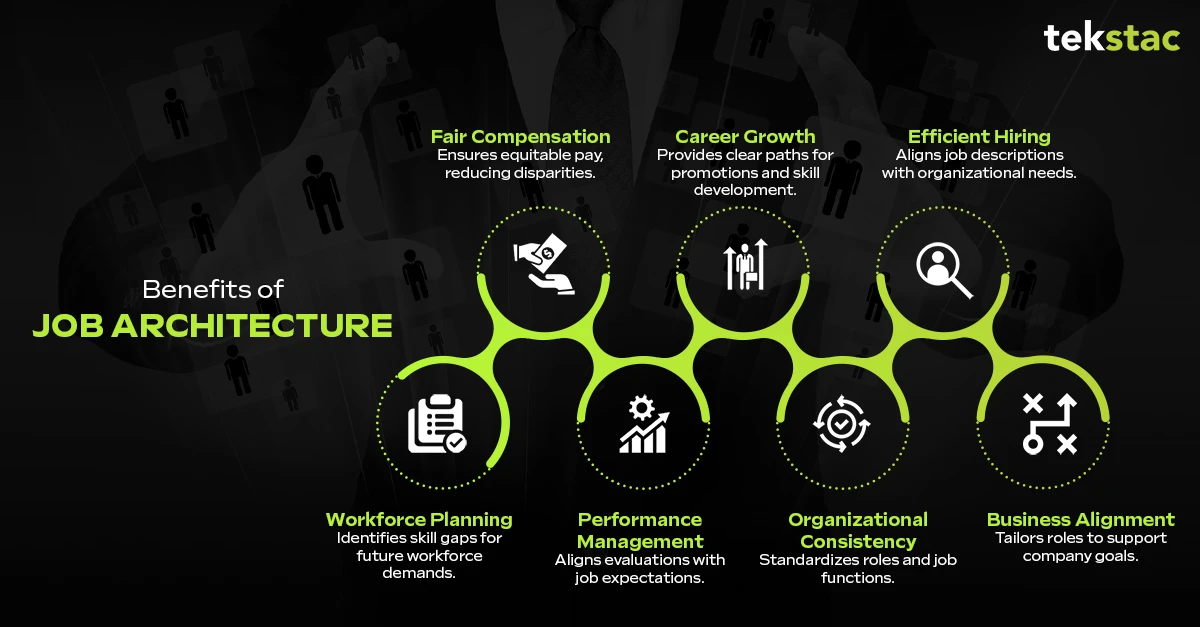
Job architecture matters because the absence of it creates compounding, measurable problems. Without a standardized framework, compensation becomes inconsistent; similar roles get paid differently based on which manager hired them. Career paths become invisible; employees cannot see how to advance, so they look elsewhere.
Workforce planning becomes reactive — HR fills vacancies rather than building capability pipelines. Gartner research shows that 44% of companies do not provide career paths that encourage or compel employees, and 75% of those employees are actively looking at positions at other companies’ Training Orchestra. Job architecture directly addresses this: by defining job families, levels, and the skills required at each stage, it creates the visible career infrastructure that keeps employees engaged and gives HR the data to plan rather than react.
The need for a clear and equitable organizational structure. Leaders should practice real-time mapping toward career progression to promote such conversations. For potential employers, it streamlines hiring and performance management and salary benchmarking.
A job architecture framework is the complete operational structure built on top of job architecture principles ; it includes the job family taxonomy, the levelling criteria for each family, the skills and competency requirements at each level, the compensation bands mapped to each level, and the governance process for maintaining the framework as the organization evolves.
Where “job architecture” describes the concept, a “job architecture framework” describes the working system. A functional framework typically covers four layers: job families (broad groupings of related roles such as Engineering, Sales, or People Operations), job functions (sub-groupings within each family), job levels (individual contributor, senior, lead, principal, director and above), and career tracks (specialist vs. management paths within each function).
According to SHRM’s 2025 Talent Trends data, over the past three years the average job has seen 32% of its skills change; which means a job architecture framework without a regular review cycle becomes outdated faster than most organizations realize. Build in a quarterly review cadence as standard.
A good place to begin is by researching the company’s strategic position regarding its mission, vision, and scope of strategic objectives. This step is rather important because the job architecture should correspond to and also stimulate the organization’s direction.
For instance, when a company targets innovation, the jobs must generate positions responsible for research and creativity. Awareness of these goals helps ensure the framework can foster development, optimization, and overall compliance with major strategic objectives.
Take a comprehensive review of the organization’s existing roles, job descriptions, and reporting structures. Look for discrepancies among the levels, areas where responsibilities are closed or missing, and hierarchy gaps.
In some cases, there may be several job titles that are similar or critical roles that are not clearly defined. This assessment is an important part of reorganization and an effective way to avoid not including an important task.
Organize jobs with activities or tasks in clusters of their day-to-day activities, responsibilities or skills needed. For example, assigning customer assistance, sales, and marketing jobs can be placed categorically under a broader function.
This classification helps identify duplications of work and match positions with the company’s functional needs It also helps employees visualize their relationships to other positions within the company.
Explain the purpose and responsibilities, the requirements of the job, and the skills essential for the job. This stage ensures that the job descriptions prepared are well defined, accurate, and oriented toward achieving the firm’s objectives.
It will also involve tasks such as campaign planning, team leadership, performance evaluation, some degree of strategic thinking, and, last but not least, communication skills.
After finalizing the job architecture, release it to the organization. Describe the new framework’s impact, advantages, and goal. Provide training sessions to help managers understand how to implement it in their departments. For instance, they could require instructions on how to use job descriptions for promotions or performance assessments.
An effective job architecture is dynamic. Make sure the structure is still appropriate when the business expands or changes by reviewing it regularly. For instance, if a sector is reshaped by new technology, some jobs might need new skills or new positions would need to be created.
Maintaining the framework guarantees that it will continue to provide a solid basis for organizational success.
Job architecture is the foundation of a well-run, effective company. It promotes openness, equity, and alignment with corporate objectives by precisely outlining positions, duties, and career pathways. Employers may streamline operations, from workforce planning to recruitment, using this systematic method, improving employee engagement and retention.
A solid job architecture lays the foundation for long-term success by promoting staff retention and supporting effective organizational change. It also helps businesses find new opportunities with confidence. This approach creates a structured and goal-oriented work environment where motivation thrives and teams are empowered to drive sustainable growth.
1. What does a job architecture framework include?
A job architecture framework includes four core components: a job family taxonomy (broad groupings of related roles), job functions (sub-groupings within each family), job levels (from individual contributor through to executive), and career tracks (specialist vs. management paths). Each level has defined skills, responsibilities, and compensation bands attached to it.
2. How does job architecture support fair compensation?
Job architecture supports fair compensation by grouping similar roles into defined levels and attaching salary bands to each level. This removes the inconsistency of manager-by-manager negotiation and creates a defensible, auditable pay structure, reducing pay equity risk, and improving employee trust in how compensation decisions are made.
3. How often should job architecture be updated?
Job architecture frameworks should be reviewed at a minimum annually — and quarterly for organizations in fast-changing sectors. Role skill requirements are evolving rapidly: SHRM’s 2025 Talent Trends data shows the average job has seen 32% of its skills change over the past three years. A framework that is not regularly updated becomes a liability rather than an asset.
4. How does Tekstac support job architecture design and implementation?
Tekstac is an AI-powered LMS that helps HR and L&D teams centralize role data, map skills against job levels, and connect learning programmers to the specific competency requirements of each level in the job architecture framework. Enterprise organisations including IBM, PwC, Capgemini and Zensar use Tekstac to align workforce development with defined career paths at scale.

Workforce capacity planning is the key to ensuring your organization has the right people in the right roles at the right time. Strategically aligning the workforce with objectives helps businesses stay agile, meet demands, and achieve long-term goals.
Whether managing seasonal demand, launching a new product, or preparing for future growth, an effective capacity plan ensures you have the resources needed to succeed.
In this guide, we’ll explore why workforce capacity planning is crucial and walk you through four essential steps to make it a success.
Workforce capacity planning is a process in which the organization determines the number and type of workers needed to support its current and future needs.
According to Fortune, around 82% of employees are at risk of burnout this year, but only half of employers consider well-being when designing work.
The goal is to ensure the organization has the right people in the right roles at the right time to support operations and achieve its mission. This includes fostering upskilling and reskilling initiatives to drive digital transformation.
Workforce capacity planning may seem challenging, but companies that implement it effectively can unlock significant advantages that improve both employee well-being and business efficiency.
1. Minimizing Burnout: By monitoring employee workloads and ensuring tasks are evenly distributed, managers can prevent burnout, reduce turnover, and maintain a healthier, more engaged workforce.
2. Better Decision-Making: With tools to identify skill gaps and allocate resources strategically, leaders can ensure high-priority projects are assigned to the right people, maximizing team potential through inclusive leadership programs.
3. Saving Time and Money: Effective capacity planning reduces the need for frequent hiring and its associated costs. By optimizing its workforce planning processes, Schneider Electric saved over $15 million and unlocked 200,000 productivity hours.
Workforce capacity planning is vital for ensuring your business has the talent to meet current and future demands. Following a structured approach, you can optimize resources, reduce costs, and align your workforce strategy with organizational goals.
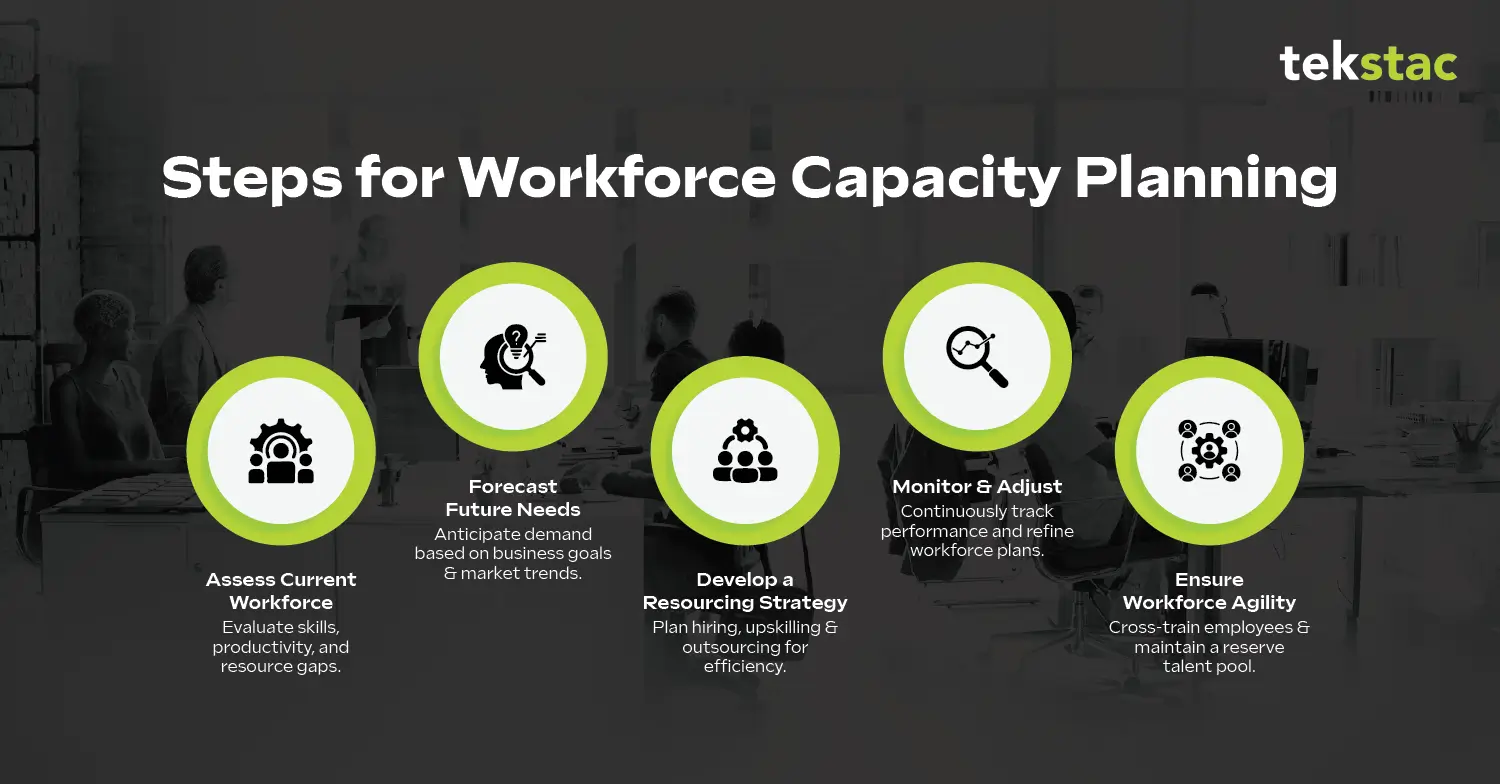
Understanding your current workforce is the foundation of effective capacity planning. This step ensures you know where your team stands and identifies gaps that must be addressed.
Planning for the future requires anticipating workforce demands based on market trends, business goals, and potential challenges.
After analyzing current capacity and forecasting future needs, create a comprehensive strategy to bridge gaps and meet demand.
An effective workforce plan involves an ongoing process of continual evaluation as well as refinement.
Workforce capacity planning is a critical tool for achieving business success. By assessing current capacity, forecasting future needs, and implementing a strategic resourcing plan, you can ensure your organization is prepared for challenges and opportunities.
As workforce dynamics and technology evolve, capacity planning will only grow in importance. Embracing innovation and agility helps businesses stay ahead and secure long-term success.
But planning alone isn’t enough—building the right skills matters too. To discover how employee training and development can strengthen your workforce and future-proof your business, explore our guide on The Future of Employee Training and Development.
1. What is the main goal of workforce capacity planning?
The main goal of workforce capacity planning is to align employee skills and availability with business needs, ensuring the right people are in place to boost efficiency, prevent burnout, and support growth.
2. How does workforce capacity planning help prevent employee burnout?
By monitoring workloads and balancing tasks, capacity planning prevents employee overload, improves well-being, and supports long-term engagement.
3. What are the key steps in workforce capacity planning?
The process typically includes assessing current workforce capacity, forecasting future needs, developing a resourcing strategy, and continuously monitoring and adjusting plans.
4. How can technology improve workforce capacity planning?
Tools like HR analytics, AI-driven forecasting, and workforce management software provide real-time insights into capacity, utilization, and skills gaps, making planning more accurate and efficient.

We are in 2026, and one may ask, “Are IT certifications still credible?”. A thought-provoking example surfaced recently: someone with the title “Specialist in Digital Transformational Technology” proudly shared completing a basic AI prompting course. Sounds odd, right?
This highlights a growing challenge in IT upskilling: too many professionals chase easy online certificates just to look credible on paper.
A smart IT professional focuses on certifications that strengthen their foundation, broaden their capabilities, and prepare them for real-world challenges. Employers are increasingly able to distinguish between superficial credentials and actual competency.
Choosing the right certifications becomes easier when guided by skill insights that highlight the most in-demand capabilities and evolving workforce needs.
With that in mind, here are 10 top paying IT certifications in demand for 2026.
IT certifications are professional designations offered by organizations and companies to validate your expertise in specific skills, tools, and IT knowledge areas. They provide structure to learning and upskilling, ensuring that professionals gain the confidence to apply their knowledge in real-world scenarios.
IT certifications show employees’ commitment to continued learning by upholding industry standards and professionalism. This helps IT professionals immensely in 2026 due to other significant reasons:
Remote work has made the tech job market more competitive. With talent pools now competing from across the globe, employers are flooded with applications. IT certifications offer a way to rise above the crowd of professionals and organizations. A study by CompTIA also found that 80% of HR professionals rely on certifications when evaluating candidates.
Along with skills, IT certifications also improve paychecks. Professionals with certifications in high-demand fields like cybersecurity and cloud computing also command top-tier salaries.
Even if a job doesn’t require certifications, earning one can increase the chances of promotions compared to peers or help employees land their dream role. Organizations can also ensure that employees possess the right skills to adapt to new IT trends.
According to IDC, the overall Indian public cloud services market is expected to reach $30.4 billion by 2029. This shows that cloud computing is a skill in high demand. Being certified in this area builds expertise in managing and optimizing enterprise-grade cloud solutions, increasing the value of a role focused on scalable infrastructure and cloud migrations. Some of the cloud certifications one can do include,
The below certifications position employees as the go-to experts for designing and managing interconnected on-premises and cloud systems. These are important for businesses embracing hybrid setups for flexibility.
This IT certification provides the necessary skills and hands-on experience to streamline data workflows and enable seamless application integration. Organizations undergoing digital transformation highly demand such skills.
The following certifications in AI data privacy and security validate a person’s capability to safeguard sensitive AI-driven processes, a critical skill as companies face increasing regulatory scrutiny over data protection and compliance.
AI and Machine Learning have become the norm, and being certified in this field enables employees to lead challenging projects involving deep learning, NLP, or predictive analytics in high-demand industries.
Certifications in this area validate the ability to manage enterprise risk, design security strategies, and align cybersecurity initiatives with business goals.
Pro tip: This isn’t something to rush. The scope is wide and the depth is real. A six-to-twelve-month preparation window allows for steady progress.
With stricter regulations and growing focus on accountability, organizations need professionals who understand governance frameworks, audits, and compliance requirements. These IT certifications demonstrate expertise in evaluating IT controls, managing risk, and ensuring regulatory alignment—making them valuable for senior and advisory roles.
Despite the rise of cloud and AI, strong networking fundamentals remain critical. Certifications in this area validate the ability to design, manage, and troubleshoot enterprise networks that support large-scale digital operations and hybrid environments.
Project and program management certifications validate leadership skills in planning, coordination, risk management, and delivery.
Enterprise architecture plays a critical role in aligning technology with long-term business strategies. Certifications in this domain validate a professional’s ability to design scalable systems, guide digital transformation initiatives, and make architecture-level decisions that impact the entire organization.
Earning these certifications provides several benefits, especially for employee career development, in the following ways:
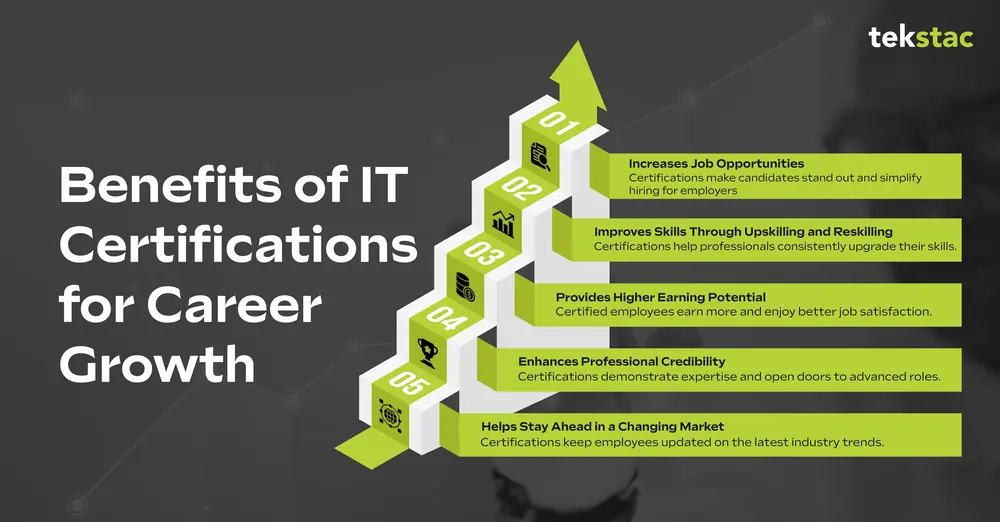
Employers are always looking for candidates with IT certifications because it shows they’re competent and ready for specific roles. It further helps recruiters identify top talent, especially in a competitive market where 82% of employers face a skill gaps. Ultimately, hiring certified professionals will reduce the time spent training new employees.
For employees, 16% of IT professionals reported landing a new job because of their certifications, while 35% of IT decision-makers acknowledged that certified staff add value by simplifying the hiring process.
Most IT certifications validate an employee’s ability to solve real challenges. With 75% of professionals pursuing certifications to increase technical expertise, employers benefit from a workforce that consistently upgrades its skills.
Certified professionals help reduce skill gaps within teams and increase the organization’s overall competency.
This makes it easier to implement new technologies and maintain a competitive edge in the market.
Certified professionals earn 20% more annually than their non-certified peers, and 60% report an improvement in the quality of their work after obtaining certification. Organizations offering better pay to certified employees also benefit from increased loyalty, retention, and job satisfaction.
Earning IT certifications helps employees demonstrate their expertise and projects.
For example, certifications like Microsoft Azure Solutions Architect Expert or Cisco CCNP demonstrate proficiency and open opportunities for advanced roles.
These include positions like Cloud Architect, Network Engineer, or Cybersecurity Specialist, where specialized knowledge is essential.
Certifications help employees stay current on the latest tools and techniques, ensuring they’re always in tune with industry changes. This means certified professionals bring fresh, updated insights to the workplace, helping organizations stay ahead.
For employers, this expanded network and knowledge base translate into better service, increased customer satisfaction, and increased innovation. It is a win-win for both the employee and the organization.
When do IT certifications become essential for your employees? These specific challenges listed below are a clear sign to explore IT certifications:
If your organization is having trouble completing projects on time or dealing with recurring technical issues, it may be a sign that employees lack the required skills. IT certifications address these gaps by equipping your team with up-to-date cybersecurity, cloud computing, or software development knowledge.
The IT industry is being reshaped at a pace never seen before, and organizations that cannot keep up may be left behind. If your teams struggle to adopt or leverage emerging technologies, certifications can bridge the gap. Certified professionals gain an in-depth understanding of industry best practices and provide solutions to organizational challenges.
Certifications can prove your team’s expertise if you’re losing business or struggling to build trust with clients. These certifications, along with experience, can be highlighted on your website, LinkedIn, or marketing materials to reassure clients that your workforce is capable and qualified to handle their needs.
Certified team members make it much easier to shift to new specialist areas such as machine learning, DevOps, or cloud computing. This ensures that the employees have clear learning paths with hands-on practice when resolving new, complex domains.
Opportunities for professional development are valued among employees. If your organization struggles to retain talent, providing support for certifications, such as reimbursing costs or providing study time, would also increase employee satisfaction. Such initiatives would not only enhance individual performance but also prove that your organization is committed to the career growth of its employees.
Traditional learning and training methods may not tie the learning to business outcome. To bridge the skills gap smarter, organizations need a platform packed with industry-relevant IT certifications and skill development programs. Tekstac has successfully upskilled 1 million+ professionals with 500+ learning paths.
Its customizable library of certifications and training resources ensures your workforce possesses the required skills in 2026 and beyond. You can also enjoy AI-driven personalization, real-world projects, and performance tracking. Learn more about how Tekstac has got you covered.
1. What are the top certifications for career growth in 2026?
For career advancement in 2026, certifications in cloud platforms, hybrid cloud architecture, AI/ML, data integration, and cybersecurity are in high demand. Credentials like AWS Solutions Architect, Google Cloud Professional ML Engineer, and CCSP help professionals stand out, unlock leadership roles, and command higher salaries across industries.
2. How can Tekstac help with IT certifications and upskilling?
Tekstac offers a curated library of 500+ learning paths with AI-personalized learning, performance tracking, and real-world projects tailored to employee roles and business outcomes.
3. How do IT certifications benefit organizations?
They help close skills gaps, improve team performance, reduce onboarding time, and boost client trust by proving the team’s capability through verifiable credentials.
4. Do certifications really improve job performance?
Yes. Over 60% of certified professionals report improved work quality, and many employers observe faster project delivery and innovation from certified staff.
According to SHRM 76% of HR leaders agree that they risk falling behind in the next two years without AI.
As Generative AI (GenAI) and workforce digitization sweep across industries, HR transformation has become a critical priority. From digital HR strategy to next-gen workforce management, these technologies are reshaping traditional HR functions—adding both complexity and opportunity.
For organizations ready to adapt, the benefits of AI and automation in HR transformation are boundless: faster hiring, smarter decisions, and personalized employee growth. But for those who resist, the gap will only widen, making it essential to embrace these innovations today.
This article explores 6 HR transformation strategies powered by AI and automation, highlighting how organizations can modernize HR operations, improve employee experiences, and build a future-ready workforce.
HR transformation is the process of modernizing HR strategies, processes, technology, and workforce practices to better support business goals. It can include AI-powered automation, digital HR systems, workforce analytics, skills-based talent management, and personalized employee development.
It matters because modern HR teams need to respond faster to changing workforce needs, improve employee experiences, close skills gaps, and make data-driven decisions. By combining AI, automation, and human expertise, organizations can build more agile and future-ready HR functions.
According to SHRM, about 1 in 4 organizations are currently using AI to support HR tasks. Nearly half of HR professionals said using AI to support HR has become a priority over the last year.
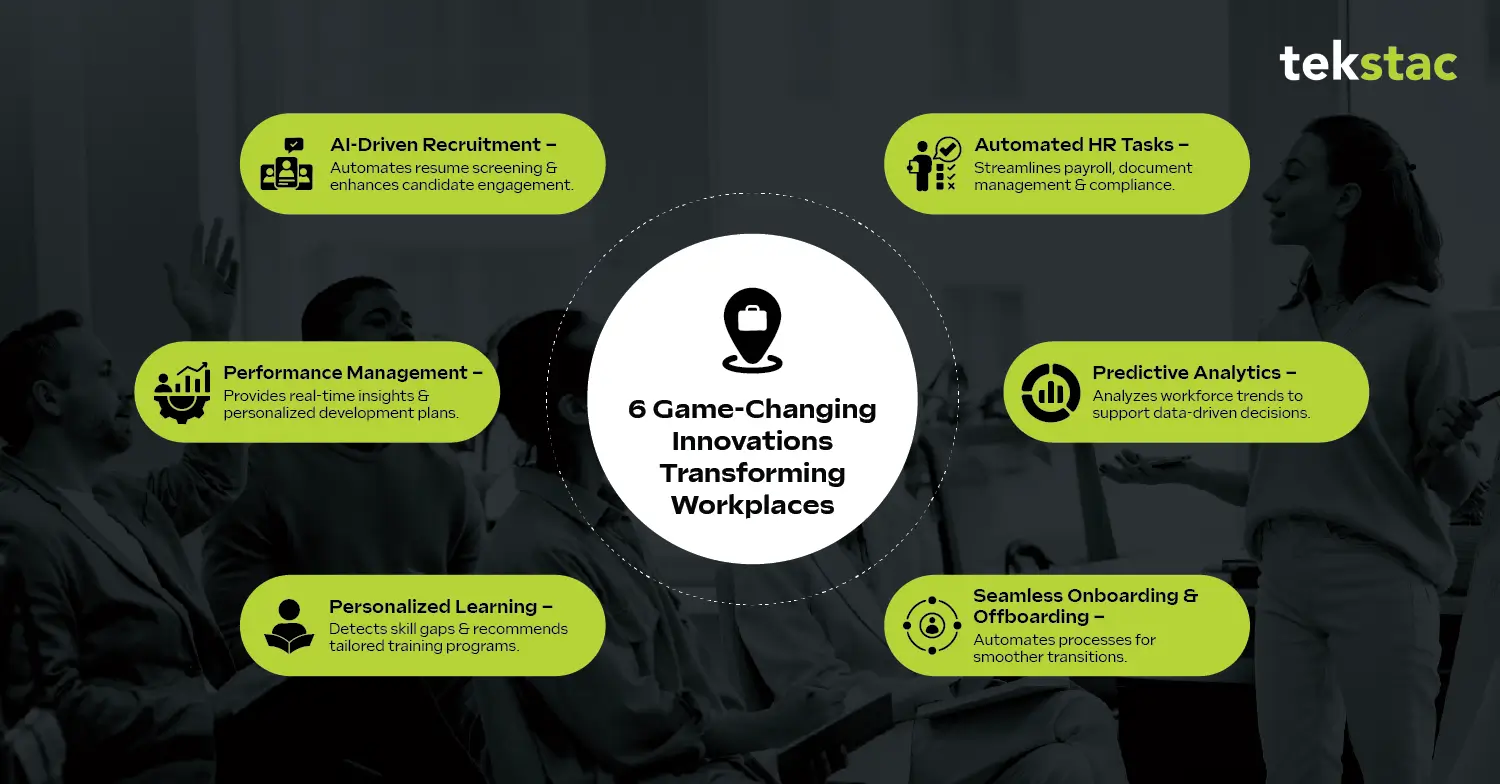
Here are six ways AI is transforming HR:
Recruitment comes with inefficiencies for HR as they must review countless resumes while keeping candidates engaged throughout the hiring process. AI-powered applicant tracking systems (ATS) and talent intelligence platforms can now handle resume screening, ensuring that only the right fit reaches HR’s desk. This form of AI-powered talent management accelerates workforce planning and supports a digital-first HR transformation strategy.
Predictive analytics identify top talent faster, while AI chatbots maintain communication with candidates, keeping them engaged. Generative AI platforms also create personalized job descriptions and postings, tailored to each role.
Traditional performance reviews and management are prone to bias and subjectivity, sometimes failing to reflect an employee’s work. AI now brings objectivity by analyzing employee performance in real-time. Machine learning algorithms identify performance patterns and suggest development plans for each employee. Repetitive tasks such as data collection are also automated, ensuring managers focus on employee career growth and meaningful conversations.
With the rise of AI, HR can now customize learning journeys and track individual performance metrics to recommend training modules or upskilling initiatives. Any skills gaps are detected to provide targeted growth plans, ensuring employees grow in ways that benefit themselves and the organization. In the near future, AI has the potential to become a personal mentor for employees, providing invaluable career guidance.
HR teams are burdened by repetitive tasks like payroll processing, data management, and document management, leaving little time to interact with employees. AI-driven solutions automate these processes while being highly accurate and saving countless hours. For instance, payroll systems calculate and disburse salaries accurately, while document workflows ensure compliance without human intervention.
AI can process and analyze data via predictive analytics, even presenting trends in areas like employee satisfaction, turnover rates, and diversity metrics. This empowers HR to anticipate challenges before they become devastating, and with seamless reporting features, HR can inform leaders to make data-driven decisions on workforce planning and management, thereby driving significant organizational change.
Onboarding can feel like finding your way through a maze of forms, policies, and processes, while offboarding has its challenges in compliance and security. AI simplifies both.
AI tailors workflows for each new hire during onboarding, automates benefits enrollment, and provides required training resources. It can also act as a virtual assistant, guiding end to end in onboarding . For offboarding, AI protects company data by managing automated equipment retrieval and ensuring smooth transitions with personalized communication.
Here’s how automation streamlines and transforms HR processes:
HR automation has transformed recruitment processes, enabling posting job ads across platforms in seconds, tracking applications in real-time, and even screening resumes effectively. Tasks like candidate ranking and interview scheduling are automated, enabling HR teams to focus on candidate experiences and finding the perfect fit.
From generating e-signed forms to granting access to essential tools and devices, automation creates a seamless journey for new hires. Automated workflows ensure nothing is missed—whether IT setups or mandatory training sessions—setting employees up for success from day one.
Submitting expenses is universally dreaded, and 1 in 5 manual expense reports are incorrect. Automation and AI-powered systems allow employees to snap a photo of their receipts, automatically extracting the necessary details like amount, date, and vendor. Approval workflows are initiated instantly, saving hours of back-and-forth emails. With countless hours of processing time saved, and errors practically eliminated, companies gain real-time expense visibility.
Manually managing payroll is prone to human errors, but automation brings accuracy and transparency to the forefront. It calculates from work hours to deductions and taxes, automating the entire payroll system to ensure that every paycheck is accurate and compliant. Not only does this save time, but it also builds trust among employees.
Forget tedious spreadsheets and inconsistent performance reviews. Automated systems now track employee performance metrics, offering real-time insights that empower managers to make informed decisions. Automation ensures unbiased evaluations, clear goal-setting, and actionable feedback loops.
As organizations embrace automation across HR processes, the need for more personalized solutions will arise—especially in learning and development.
The future of L&D lies in data-driven approaches that adapt to individual needs while driving organizational growth. AI-powered learning platforms like Tekstac offer game-changing features that help organizations evaluate and track skills effectively to empower employee growth.
With features like customizable assessments, dashboards with real-time analytics, and data-driven insights, these platforms simplify tracking skills progression and development plans. For instance, Tekstac provides:
Ready to accelerate your HR transformation? Book a Tekstac demo to discover how AI-powered learning can build a future-ready workforce.
1. How is HR transformation different from HR digital transformation?
HR transformation focuses on redesigning HR strategy, processes, and workforce practices, while HR digital transformation specifically uses digital technologies such as AI, automation, analytics, and cloud platforms to modernize HR operations.
2. What is the Dave Ulrich HR transformation model?
The Dave Ulrich HR transformation model emphasizes aligning HR with business strategy through strategic HR roles, efficient processes, and employee-focused services, helping organizations shift HR from an administrative function to a strategic business partner.
3. How does HR transformation improve employee experience?
HR transformation enhances employee experience by enabling personalized learning, streamlined onboarding, faster services, and data-driven decisions that build engagement, productivity, and long-term retention.
4. What role does learning and development play in HR transformation?
Learning and development fuels HR transformation by closing skills gaps, creating personalized growth paths, and aligning workforce capabilities with organizational goals for sustainable success.
5. What’s a realistic HR transformation roadmap or timeline?
A realistic HR transformation roadmap typically takes 12–24 months, depending on organizational size and complexity. It usually involves assessing current capabilities, defining priorities, implementing technology, developing skills, and continuously measuring outcomes.
Organizations invest heavily in employee training programs to enhance skills, productivity, and growth. However, having programs is never enough; value needs to be measured, and this is where the concept of Learning ROI (Return on Investment) comes in.
Learning ROI is a metric that compares the benefits of training programs against their costs, showing how effectively learning initiatives contribute to business outcomes. When measured correctly, it reflects the actual effect of training on organizational goals and ensures resources are used to maximize impact and success.
Learning ROI is one of the important metrics organizations require to ensure measurable results from their training. Connecting training results to other organizational objectives makes it possible for leaders to analyze the success of the programs.
It will be used to allocate resources and maximize the impact of the training programs by achieving tangible results.
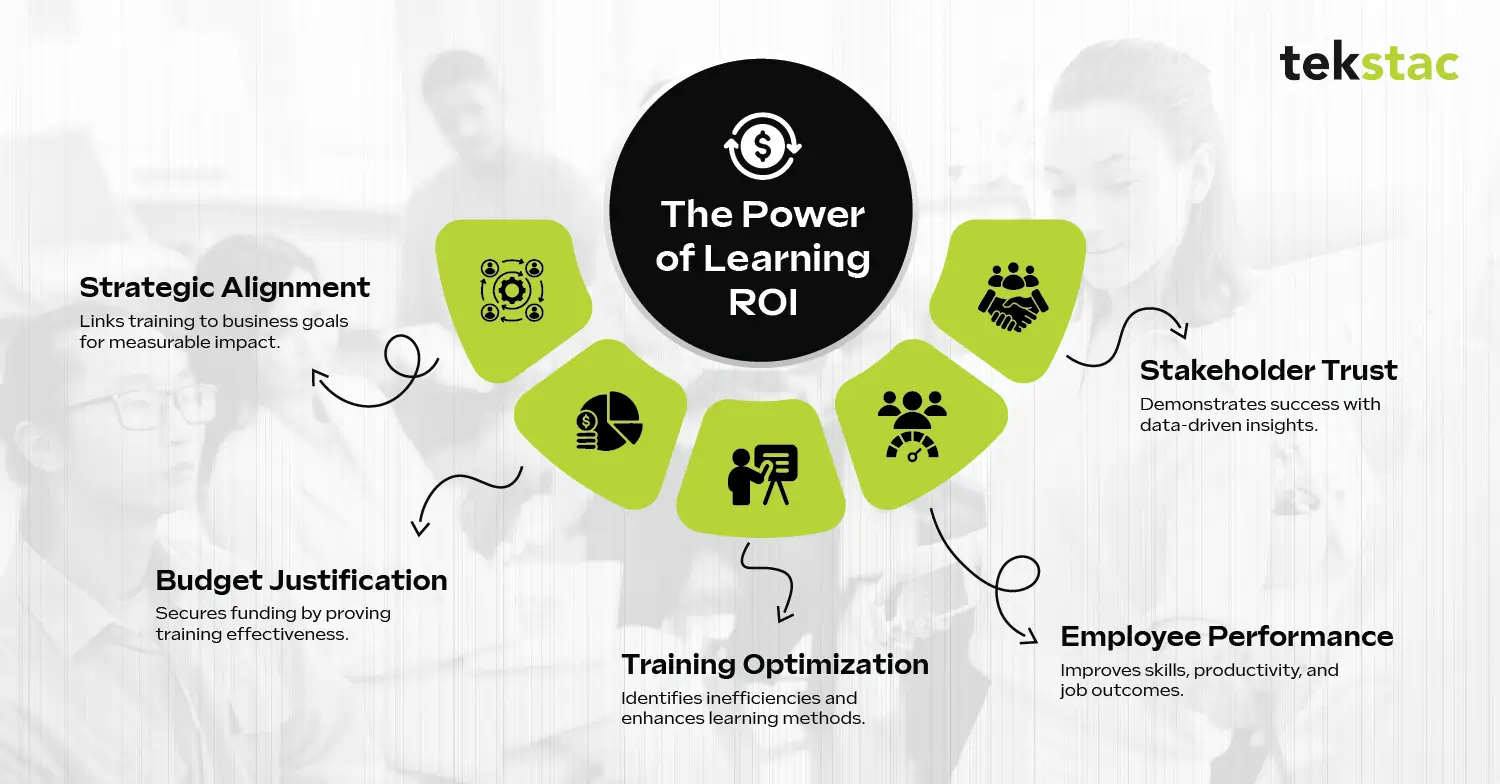
Below are five reasons why Learning ROI is vital to L&D programs’ success:
Training programs must be in line with organizational priorities to create real value. ROI ensures that the learning initiative is designed to meet strategic objectives. In other words, linking training outcomes with business goals will allow an organization to establish a direct connection between employee development and success.
This will mean that every dollar spent on training is contributing to measurable results.
The biggest challenge that L&D performance metrics leaders face is budgeting for training programs. Stakeholders always question the return on investment. With Learning ROI, leaders can present clear evidence of value creation from their initiatives. This justification secures funding for impactful training programs.
It ensures resources are spent in areas with the greatest potential for success.
Sometimes, training programs may not be efficient and waste a lot of time and resources. Through ROI evaluation, one is able to identify the inefficiencies of the training content and the methods of delivery. These are the areas that leaders use to optimize programs, streamline processes, and increase overall efficiency.
This is bound to reduce costs and also improve the quality of training to ensure that employees meet their needs.
Training programs are most effective when they translate into noticeable improvements in employees’ performance. Focusing on ROI will help organizations be sure that their training initiatives are designed to deliver results that are practical and actionable. Employees who apply the skills and knowledge gained from training can improve their job performance.
This improvement increases productivity and positively impacts organizational outcomes.
Stakeholders want accountability for the resources spent on L&D programs. Learning ROI offers quantifiable evidence of success, thus boosting the confidence of decision-makers. With clear data-driven results, L&D leaders can strengthen their trust in their strategies and demonstrate their value to the organization. This confidence translates into continued support for learning initiatives.
Measuring the Learning ROI is a structured and systematic process. It has both a direct and indirect effect, which needs to be gauged on individual employees and also on the organization.
L&D leaders can measure the learning ROI by following these main steps:
Set clear and simple goals to match the training with business needs and measure its results accurately. The objectives must be in sync with business priorities to make sure that the training supports the organizational goals.
Kirkpatrick Model: This model is widely accepted and can be applied in four levels: reaction, learning, behavior, and results. This is considered an appropriate model for making training results connected with business outcomes.
Calculate the total cost of the training program that is, its development and delivery and the employees’ time spent in the learning process. Compare them with financial benefits, such as revenue gain or savings in costs, to evaluate the ROI.
In fact, an Accenture study found that training can deliver an average ROI of 353% — meaning every $1 invested generates $4.53 in return. This highlights the powerful business case for carefully analyzing cost versus benefit in learning initiatives.
Determine whether the employees’ job performance improved after attending the training. Compare their job performance before and after the training using KPIs, surveys, and assessment tools will capture these changes before and after the training.
Use LMS and analytics tools that can measure participation, completion rates, and the outcomes from training. With these tools, gathering data is easier and they also help to measure the ROI.
Measuring training effectiveness is one of the vital aspects of ensuring that L&D initiatives deliver real value. It involves checking whether the training objectives have been met and where there is room for improvement. Training effectiveness is also closely related to continuous improvement.
Regular evaluation helps organizations to adapt to changing demands, remain competitive, and deliver better results. Ultimately, in the final analysis, effectiveness measurement ensures that the efforts of training are well aligned with broader business goals and hence maximized.
There are many tools and techniques L&D leaders can use to measure the effectiveness of training programs.
Among these are four key tools as listed below:
Surveys are an excellent method of gaining direct insight from the trainees. They can measure levels of satisfaction and help track areas where the training is weak.
Skills Assessments taken before and after training sessions give leaders a clear picture of learning outcomes. Comparing results lets leaders know how much participants have learned.
Dashboards are very useful tools for tracking performance trends over time. They provide a visual presentation of key metrics, helping leaders monitor the impact of training programs.
This feedback method involves gathering input from peers, managers, and team members. It offers a comprehensive evaluation of behavioral changes resulting from training.
Learning ROI demonstrates how training contributes to business goals and acts as a key measure to evaluate the success of learning programs.
In short, measuring outcomes will allow L&D leaders to develop a clearer, more refined strategy that accurately allocates resources to eventually bring about sustained growth.
ROI-driven decisions ensure that organizations maximize the impact of their training programs and thrive in a competitive business environment.
1. How to measure coaching ROI?
Coaching ROI is measured by comparing program costs against outcomes like performance improvement, productivity gains, employee retention, and overall business impact.
2. What does ROI stand for in the context of learning and development initiatives?
In learning and development, ROI stands for Return on Investment, showing how training initiatives create measurable business value relative to costs.
3.What does ROI stand for in education?
In education, ROI means Return on Investment, reflecting how learning efforts or programs improve student outcomes and institutional effectiveness compared to expenditures.