
Skill building in enterprises demands innovative approaches. Traditional, often unengaging training is giving way to gamification—using game mechanics to accelerate skill building and learning.
Strategies like interactive modules, leaderboards, simulations, feedback systems, and team challenges make training engaging and practical. These methods not only boost employee participation and skill retention but also align learning with business goals. Gamification transforms skill building into an effective, enjoyable process, ensuring organizations stay competitive in a fast-evolving market.
One of the biggest hurdles in training programs is the difficulty in transferring theoretical knowledge to practical tasks. Gamification helps employees build their skills through experiences designed to reflect real-world work scenarios.
Research indicates that companies implementing hands-on learning see significant improvements in retention rates and real-world application of skills. For instance, interactive lab setups allow IT professionals to practice tasks such as coding or system configurations in safe and controlled settings.
In specialized industries, training programs designed with a one-size-fits-all mindset often fall short. Gamification helps give each employee the right training for their job by creating learning paths that fit their needs.
Tailored programs reduce redundancy and keep employees motivated. Studies highlight a significant increase in engagement and productivity when workers perceive training as directly contributing to their career progression. Gamification is just the start. Want to see how continuous upskilling and reskilling can future-proof your workforce? → [Read the full guide]
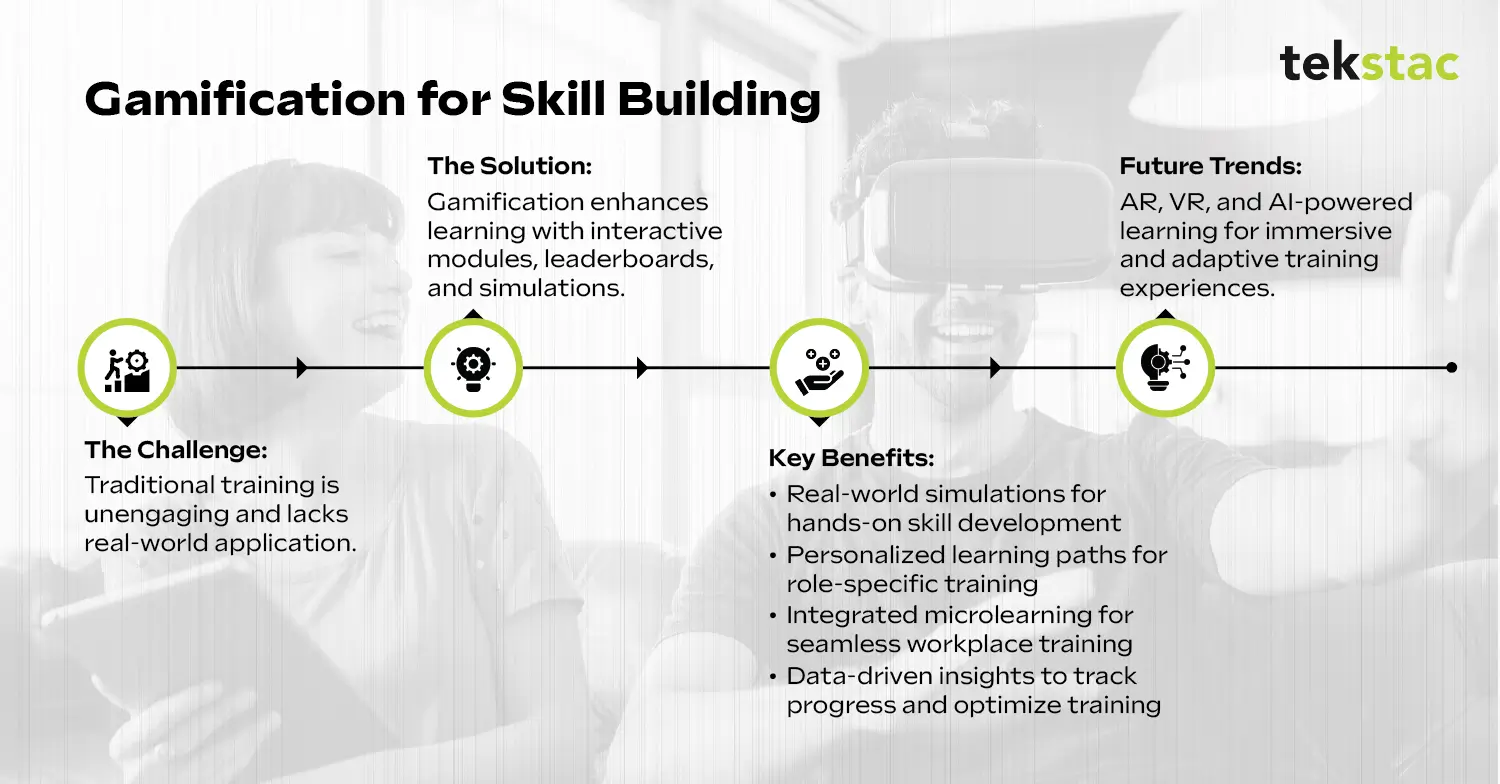
Workplace training often struggles to balance educational needs with the demands of daily operations. Embedding learning opportunities into employees’ workflows ensures minimal disruption and promotes the practical application of new skills.
For example, sales professionals might complete a brief training module on product features while using their CRM, immediately applying the knowledge in customer interactions.
Incorporating data analytics into training programs ensures that organizations can monitor effectiveness and make informed adjustments. Gamified systems often include metrics that track progress and measure outcomes, providing insights into individual and organizational performance.
Platforms offering detailed dashboards empower leadership to refine learning approaches continuously, ensuring alignment with broader business strategies.
While personalized learning is vital, collaborative approaches enhance engagement and promote innovation. Gamification encourages team-based problem-solving and knowledge-sharing, driving collective growth.
Research shows that collaborative learning methods are among the most impactful, especially when peers can engage in structured activities that challenge and develop their skills.
As technology evolves, gamification in skill building will become increasingly sophisticated. The use of advanced tools like augmented reality (AR) and virtual reality (VR) is already creating immersive training environments, while AI-powered personalization offers dynamic learning paths tailored to individual progress. To stay ahead, organizations must also keep an eye on the future of skill building in L&D, where emerging innovations will continue to reshape how employees acquire and apply skills.
Gamified learning transcends employee engagement, serving as a strategic asset to enhance organizational capabilities. By accelerating skill acquisition, promoting innovation, and aligning development with business goals, it equips enterprises with a competitive edge. To elevate your training programs, partner with specialized platforms and design a gamification strategy tailored to your needs. Make learning a catalyst for business growth today.

What will define a company’s success in attracting talent in 2026? The answer lies in a compelling Employer Value Proposition (EVP).
In a world where the workplace is evolving faster than ever, a well-articulated EVP is no longer optional—it’s the key to standing out in a competitive job market.
As we step into 2026, having a clear and authentic EVP is emerging as a critical strategy for attracting and retaining top talent. Employees are no longer satisfied with salaries and perks alone—they expect meaningful support in areas like:
According to a Pew Research study, only 1 in 2 employees are satisfied with their employer’s benefits, while just a third of them feel they have adequate opportunities for advancement. With such low satisfaction rates, it’s absolutely clear now that having a strong EVP is essential.
There’s no doubt left about its importance.
This article explores major trends reshaping EVPs in the near future. From embedding purpose-driven work to embracing hybrid models, these insights reveal how companies can build EVPs that meet employee expectations and secure a competitive edge in the evolving job market.

In today’s workforce, employees are no longer content with just a paycheck—they yearn for a sense of purpose. A purpose-driven approach has become the cornerstone of a competitive employer value proposition (EVP), helping organizations connect employees to something far greater than their daily tasks.
This alignment with purpose has a profound impact on talent retention and engagement. Employees increasingly gravitate toward roles that reflect their personal values. Whether it’s contributing to sustainability efforts, advocating for social justice, or participating in impactful community programs, purpose-driven companies hold a unique appeal.
Paying attention to employer branding ensures that this purpose is clearly communicated to both current and prospective employees.
The numbers are compelling: employees who find passion and purpose in their work are 300% more likely to stay with their organization.
But crafting a meaningful employer value proposition takes more than words—it demands authenticity. Employees need to see purpose embedded in leadership decisions and reflected in the organizational culture.
Embedding purpose is just the beginning. As employee expectations continue to evolve, organizations must dig deeper. Purpose must fit smoothly with personalized employee engagement plans. This helps create a workplace where people feel valued and driven.
When done right, this alignment not only boosts satisfaction but also cements loyalty in the long run.
While purpose creates the foundation of an EVP, personalization ensures it resonates with diverse employee needs.
In today’s fast-paced job market, the era of one-size-fits-all Employer Value Propositions (EVPs) is behind us. Employees now look for more—opportunities that align with their values, aspirations, and career ambitions. A carefully designed EVP can help your organization stand apart by addressing these deeper needs.
Personalization is at the core of a standout EVP. When you take the time to craft messages that resonate with specific groups—whether it’s tech professionals or sales teams—you’re not just hiring for skills. You’re creating connections with people who share your mission and vision. It’s about finding ways to show candidates that their unique goals matter to your company.
Beyond recruitment, a strong EVP plays a key role in strengthening company culture. When your core values and objectives are seamlessly reflected in your messaging, employees feel a deeper sense of purpose. They’re more likely to understand how their work contributes to something bigger, which builds loyalty and reduces turnover.
Authenticity makes all the difference. Involve employees across all levels to shape your EVP, listen to their feedback, and ensure your messaging reflects their needs and aspirations. When your approach is honest and relatable, it naturally resonates with both current employees and potential hires.
Your EVP should also echo the values that define your brand. Companies that embrace respect, inclusion, and innovation attract like-minded individuals, building teams that thrive together and drive long-term success.
The era of rigid 9-to-5 workdays is fading fast. Flexibility and hybrid work models are becoming indispensable to any forward-thinking employer value proposition. Employees want autonomy over where and when they work, and companies offering this freedom are reaping the rewards.
Research reveals hybrid work positively impacts productivity, with 61% of surveyed HR professionals affirming this as per a Sloan review article. However, measuring productivity remains complex, as traditional metrics often miss human factors like energy, collaboration, and focus.
Hybrid models also advance diversity, equity, and inclusion (DEI) efforts. They enable companies to accommodate a wider range of employee needs, from working parents to those living in high-cost areas. This inclusivity expands access to top talent, building a workforce as diverse as the customers they serve.
But flexibility isn’t without its challenges. Teams must navigate communication gaps, and managers need training to lead hybrid teams effectively. The key is designing systems that foster collaboration while giving employees the freedom they crave.
Flexibility sets the stage for a thriving workforce, but it’s not enough on its own. A strong EVP also requires a focus on holistic well-being.
A thriving workforce is a well-supported workforce. In recent years, companies have recognized the importance of holistic well-being as a critical pillar of their employer value proposition. This means addressing employees’ mental, physical, and financial health in a cohesive strategy.
Mental health support is now non-negotiable. Companies are offering services like counseling, mental health days, and stress management workshops to combat burnout. At the same time, physical wellness programs—ranging from fitness subsidies to wellness challenges—are helping employees stay healthy and energized.
Financial well-being is equally important. Employees face rising costs and mounting debt, making financial planning tools, debt relief programs, and retirement savings plans essential. Here’s a telling stat: 3 out of 5 employees feel more loyal to companies that actively support their financial well-being.
According to Keyia Burton, Senior Principal at Gartner, “Communication is the biggest barrier for HR leaders when it comes to EVPs.” Effective EVP strategies must focus on understanding, connecting to, and trusting the promises throughout the employee journey.
Companies that invest in holistic well-being see significant returns. When employees feel genuinely supported, they are more engaged, perform better, and are more likely to recommend their employer to others. But creating a well-rounded EVP doesn’t stop here. Organizations are increasingly turning to technology to take their strategies to the next level.
Technology is transforming the employee value proposition (EVP), becoming essential for attracting, engaging, and retaining top talent. AI and chatbots optimize the recruitment process, offering candidates a seamless, personalized, and efficient experience.
Innovations such as generative AI and no-code platforms empower employees to customize solutions, boosting productivity and satisfaction. Furthermore, technology enhances onboarding and professional development with data-driven insights and personalized learning pathways.
AI also drives inclusivity by eliminating hiring biases and supporting diverse workforces. Ethical implementation, including transparency and data privacy, is crucial for building trust. Ultimately, technology unifies the EVP, enabling purpose, personalization, and well-being.
The impact of a strong Employer Value Proposition is more than just cultural—it’s measurable. Research from leading sources highlights why EVPs are becoming a cornerstone of workforce strategy:
Key benefits of a strong EVP include 1.18 times higher organizational performance, 1.16 times greater innovation, and 1.23 times more employees reporting a sense of purpose in their work.
As you step into 2026, the time to act is now. Each of these trends builds on the others, creating a cohesive framework that attracts talent, engages employees, and drives long-term success.
Looking to craft an EVP that positions your company as a future-ready leader? Let us help you build strategies that connect purpose, innovation, and employee satisfaction seamlessly.
1. What is an Employer Value Proposition?
An Employer Value Proposition (EVP) is a company’s unique promise of culture, benefits, and opportunities that attract, retain, and engage employees.
2. Why is EVP important in 2026?
In 2026, EVP is crucial as employees seek purpose, flexibility, and growth beyond pay, driving talent attraction, engagement, and long-term retention.
3. What are the 5 pillars of the EVP?
The five EVP pillars are: purpose-driven work, personalization, flexibility and hybrid models, holistic well-being, and technological innovation supporting career growth.
4. What is the difference between EVP and employer branding?
EVP defines the core promise to employees, while employer branding communicates that promise externally to attract, engage, and inspire potential talent.
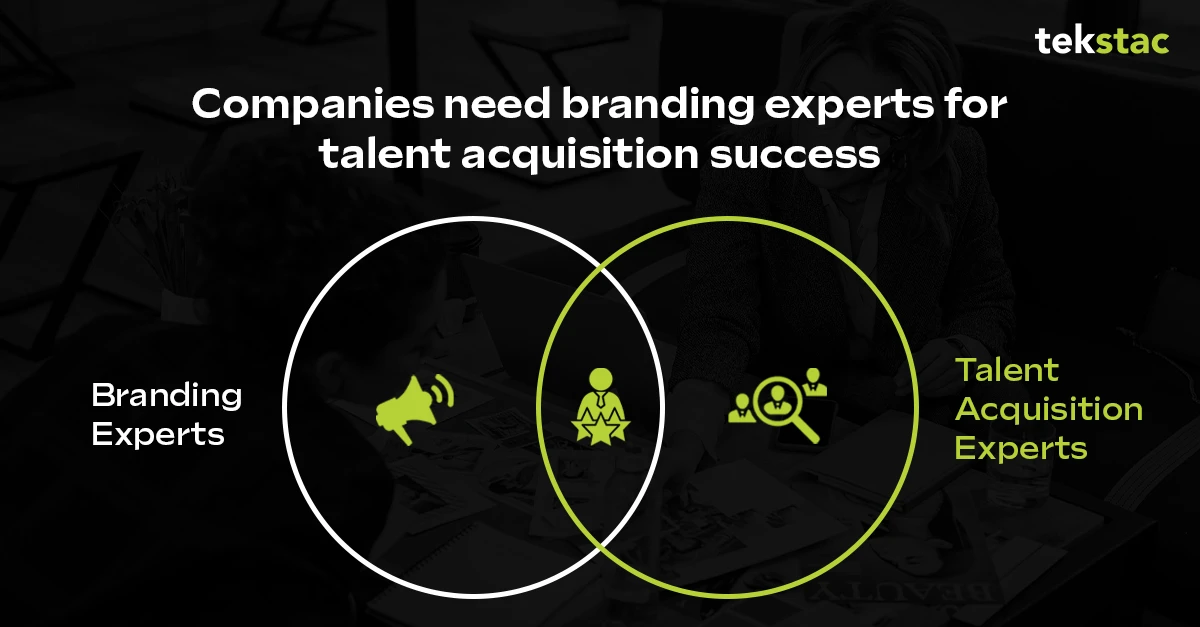
In a competitive job market, companies need branding expert to achieve talent acquisition success. The problem with talent attraction is about something other than a good package deal; it is about creating a culture or a unique image. A well-developed employer brand enhances a company’s image of culture, policies and goals. Any person who applies for a job at that company would be inclined to join that company.
Branding experts play a vital role in shaping this identity. They help craft messages that resonate with the right candidates and emphasize what makes a workplace special. By showcasing a company’s strengths and fostering a positive reputation, branding experts make it easier to attract talented professionals and retain them for long-term success.
A branding expert specializes in creating and managing a business’s identity to make it recognizable, relatable, and memorable. They define what makes a company unique by analyzing its values, mission, and target audience. This involves designing consistent visuals like logos and color schemes, shaping how customers, employees, and stakeholders perceive the business.
Branding experts play a strategic role in building trust and credibility. They align a company’s branding efforts with its goals, ensuring it stands out in a competitive market. Whether working on an employer brand to attract talent or enhancing customer loyalty through meaningful engagement, branding experts create a cohesive image that reflects the company’s strengths and fosters long-term success.
A great brand is more than simply a logo or memorable tagline in today’s fiercely competitive industry; it is the foundation of your company’s identity. A branding expert can help in this situation.
It’s easy for business owners to become engrossed in the day-to-day activities, which makes it challenging to stand back and consider your brand with objectivity. A branding expert helps you identify what makes your company special by providing an outsider’s viewpoint. Their area of expertise lies in comprehending market trends, your target audience, and how to effectively position your business.
Many firms are silently destroyed by inconsistent branding. Everywhere your brand is used, from social media to product packaging, it must convey the same message. Making sure your message, images, and tone are all consistent helps gain prospective employee’s trust and recognition.
Understanding your target audience’s needs, preferences, and pain points is no small task. Branding experts are skilled at researching and identifying the perfect approach to connect with your ideal audience. They help craft messaging that speaks directly to them, making your brand memorable.
Even though it could seem like an extra cost, hiring a branding specialist is a long-term investment in building a talented workforce.
A strong employer brand doesn’t just look good—it delivers measurable results. Companies with well-managed branding attract 50% more qualified applicants, making it easier to find the right cultural fit. By clearly communicating your values and strengths, you can also cut your cost-per-hire by up to 50% and make your hiring process 1–2× faster. That means less time wasted on trial-and-error recruitment and more time focusing on growing your team.
Consumers purchase from companies they trust. A branding specialist aids in creating a polished image that gives your audience confidence. Their experience guarantees that everything is in line to promote credibility, whether it’s your website design, brand voice, or customer experience.
Branding experts add clarity and emphasis to your brand by assisting you in defining what your firm genuinely represents. They may create a distinct brand that distinguishes you from competition while also guaranteeing that your message reaches your intended audience. With their help, your brand will become more unified, consistent, and recognizable across all platforms, gradually increasing trust and recognition.
Another significant advantage is their capacity to save time and effort. Instead of depending on guessing, branding experts use their experience to develop effective methods that will help you avoid costly blunders. A well-executed brand not only attracts the correct customers, but it also develops loyalty, making your company more sustainable in the long term.
In a current business environment, branding experts are instrumental in leading talent acquisition efforts and far beyond. With the right talent branding experts, it becomes easier for businesses to find the best talent and keep the best employees within the organization on board with their culture and values.
Becoming a branding expert requires a strong foundation in marketing, communication, and design, built through education and practical experience. Work on real-world branding projects to develop creative strategies and understand consumer behavior.
A branding expert helps businesses stand out by creating a unique, consistent identity that builds trust and recognition. They ensure the company’s values and strengths are effectively communicated, making it more appealing to customers, employees, and stakeholders.
A strong brand can help small businesses attract customers and grow their presence in the market.
Strengthen skills, improve teamwork, and empower your team with tekstac branding experts. From onboarding to skill-building, we create meaningful learning experiences that drive real results.
Imagine you’re preparing for a big family gathering. You would ensure that there’s enough food, drinks, and entertainment for everyone. If you don’t prepare well, you might end up scrambling at the last minute to guess what everyone likes or needs.
However, if you had access to a few years’ data—knowing which of the dishes were popular the year before, how many drinkers of soda versus juice attend, and what games or activities get everyone engaged—a lot more planning would occur because you could proactively consider everyone’s preferences and things just would go smoothly and become enjoyable.
This is the power of talent intelligence for HR leaders: leveraging data and analytics to make better decisions, anticipate future needs, and proactively manage your workforce. It is somewhat like planning for that family gathering; to anticipate problems, optimize strategies, and ensure the organization’s preparedness for the future. This article delves into 8 key talent intelligence trends shaping the HR landscape.
Artificial intelligence transforms human resources leaders’ talent management approaches. It allows organizations to automate data collection and analysis across the workforce, from employee skills and performance metrics to engagement levels, providing a comprehensive view of the talent landscape.
HR leaders are increasingly using AI for deeper insights into the capabilities of their workforce, predicting turnover, and making specific areas for improvement. Such AI-powered platforms aid not only in streamlining hiring but also in seeing whether talent strategies are moving hand-in-hand with the overall business goals. They use these tools to make the decision-making process data-informed, thereby improving employee performance while reducing bias in recruiting.
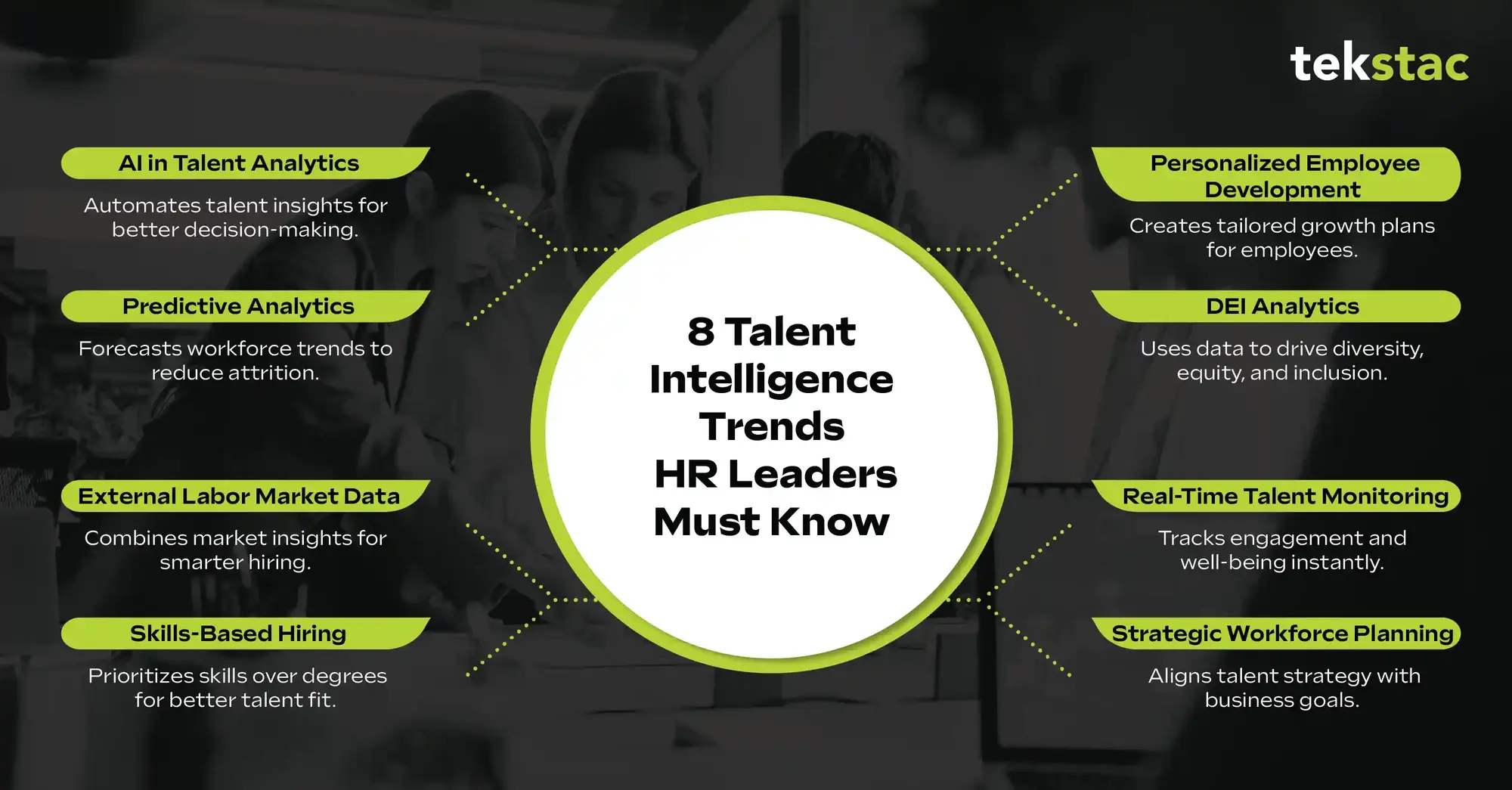
Predictive analytics will enable the HR leader to foresee future challenges in the workforce before they happen. By analyzing past performance, historical data, and current trends, predictive tools enable HR teams to spot early signs of issues such as rising employee attrition, skills shortages, or workforce imbalances.
This proactive approach enables HR to take action before problems escalate, ensuring that business operations remain smooth and employee morale stays high. With predictive analytics, HR teams can also forecast future hiring needs and create strategies to fill gaps in skills and leadership, all while boosting overall workforce engagement.
Organizations are no longer relying on internal workforce data to make talent decisions. Integration of external labor market data is becoming increasingly important for HR leaders who need a full picture of talent availability, salary benchmarks, and emerging skills in the market.
Leaders will be able to understand and comprehend the local hiring pattern, compensation level, and shifting skills, bringing together internal analytics and external labor market insight. This ability helps in constructing competitive acquisition strategies for talent and further helps in revising retention policies to the real-life market perspective.
The job market is a thing of the past, migrating towards skills-based hiring against degrees-based hiring. Hands-on practical experience is now prioritized over academics because there are talent intelligence tools now helping HR leaders sort applicants by skills rather than on educational degrees.
HR leaders can use assessments, simulations, and other performance-based metrics for fair and effective evaluations. The shift in skill-based hiring is actually allowing organizations to build a diverse and effective workforce as they get the right people into the right jobs according to their competencies.
Talent intelligence transforms how organizations approach employee development, taking it from one-size-fits-all learning and growth. With talent intelligence tools now, HR leaders are using their understanding to develop tailored and personal plans for each employee on growth. It considers each person’s strengths, weaknesses, and career goals to advise training, mentorship, and growth opportunities tailor-made to fit the individual employee’s needs.
Personalized development plans have an impact on boosting engagement for employees as well as ensuring that individual growth is tied to the goals of an organization. Consequently, businesses are observing improved retention rates and greater satisfaction by employees; therefore, they possess a more robust workforce better suited for handling future scenarios.
The most important need for organizations has become DEI efforts, and talent intelligence is increasingly playing a very significant role in driving DEI efforts with the help of data used by HR leaders to gauge the diversity of their workforce, monitor hiring practices, and measure the success of their DEI programs.
HR leaders may be able to identify weaknesses in their organization’s ability to attract, retain, or foster diversity, equity, and inclusion by analyzing recruitment and retention data. Corrective action should begin with the elimination of biases within hiring processes, diverse candidate pools, and an inclusive culture that will attract a broader range of talent.
As hybrid and remote work continue to rise, real-time talent monitoring becomes crucial for HR leaders. Today, modern talent intelligence platforms offer real-time insights into employee performance, engagement, and well-being.
Such practices enable HR leaders to monitor trends from quick-burnout signs, to potential skills gap, or disengagement. This data puts HR in a position where they can take timely responses to support employees through, for example, workload balance, resource enhancement, and mental health support. Hence, real-time monitoring will support HR leaders in keeping staff health and productivity levels irrespective of the location of the workers.
Strategic workforce planning becomes necessary for HR leaders to strategically take care of the long-run and sustainable success of the business venture. Talent intelligence platforms currently assist in providing data-based answers that help HR leaders predict workforce needs across marketplace trends, employee demographics, and organizational goals.
Understanding the changing talent landscape enables HR leaders to formulate responsive workforce development strategies that will help get the right people in their organization at the right moment. By making data-driven decisions for build-buy-borrow, talent intelligence is helping organizations discover anticipated talent gaps and prepare for forthcoming disruptions, such as the technology revolution or economic crunch. This powers a well thought out succession and skill development planning exercise
In a changing market where competitive pressure on organizations continues to grow, talent intelligence is now a business necessity for every HR leader. AI-driven analytics, predictive insights, and real-time monitoring empower the HR professionals to better plan for their workforce, boost engagement of the employees, and get their organization the right talent that will stick.
By keeping ahead of these trends, HR leaders can stay on top of their industry as opposed to just waiting to react to challenges; hence, they can build an effective workforce ready for tomorrow. By embracing current and future trends, leaders can build agile, diverse, and high-performing teams that drive long-term business success.
Coaching underperforming employees is one of the highest-leverage skills a manager can develop, and one of the most neglected. Nearly two-thirds of HR professionals report that fewer than half of managers at their organizations effectively address underperformance, according to SHRM (2024). The result: performance issues compound, team morale drops, and organizations absorb the cost. The good news is that with the right coaching strategies root cause analysis, clear goal setting, structured feedback, and targeted development, most underperformance is fixable. This guide covers 10 strategies that work.
A leader’s ability to coach employees struggling to meet expectations is one of their most essential skills. This ability can significantly impact individual and team performance, helping low-performing employees overcome challenges and contribute effectively to the organization.
According to research from Culture Amp, underperforming employees make up an average of 4% of an organization’s workforce. However, this percentage can range from 0% to 20% depending on industry type, organizational culture, and performance evaluation criteria.
An organization that can identify and support these employees will increase both performance and overall productivity, employee engagement, and workplace morale.
Different experts propose strategies to support employees in overcoming challenges and building the confidence necessary to excel in their roles.
10 Strategies to Coach Underperforming Employees
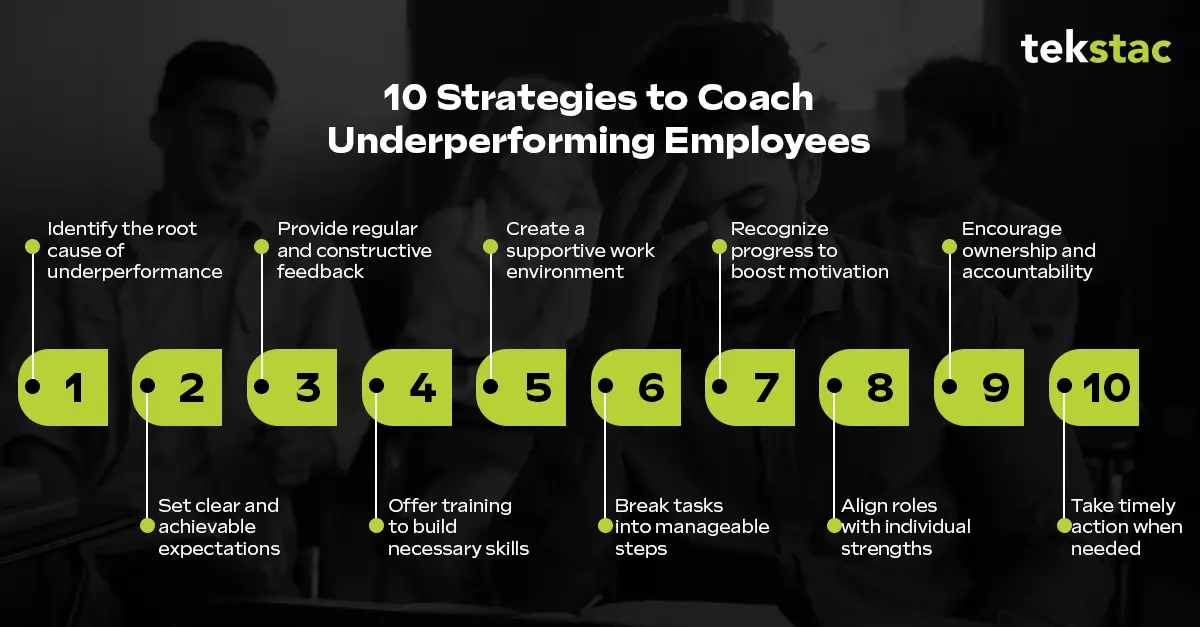
To help an underperforming employee, you must first understand what is causing the issue. Once you know why, it’s easier to tailor your approach to suit the individual’s needs; for example, if the problem is a skills gap, consider offering upskilling and reskilling opportunities to ensure the employee has the necessary skills to succeed.
Clear, measurable goals are essential to guide employees back on track. Goals prevent you and the employee from wondering what is expected and how success is measured.
Coaching is generative, and feedback is a powerful tool. Employees struggling to meet expectations greatly benefit from regular and constructive feedback, which helps them identify areas of improvement and take corrective action. Supporting low-performing employees with clear guidance can drive meaningful progress and growth.
Managers can play a crucial role when employees face a skills gap by offering targeted feedback and support to help bridge the gap effectively. This guide lists the most critical skills gaps employers prioritize in 2026 and provides actionable strategies for addressing them.
At times, those who underperform fail to have the skills or knowledge. Training and development opportunities boost morale and bridge the skills gap in employees, and over time, they can boost performance. This training could take the form of formal classes, online sessions, mentoring, or hands-on workshops.
Better employee performance is a function of a supportive work environment. When employees are given value, respect, and support they are able to overcome obstacles and are more likely to perform at their best.
Employees facing performance challenges may procrastinate or feel overwhelmed by large tasks or projects. Breaking these tasks into smaller, more manageable steps can reduce stress, clarify priorities, and foster a sense of achievement with each completed step.
One of the most powerful ways to increase performance is by motivating employees through positive reinforcement. Verbal or tangible rewards are only two forms of motivation out of many.
Every employee has their strengths to help them succeed. You can achieve better performance by aligning your tasks and responsibilities with the strengths.
Empowering employees to own their work is one way to improve performance. Accountability creates a feeling of responsibility and motivates people to reach their full potential.
Sometimes, coaching will help resolve underperformance; sometimes, it won’t. If an employee’s performance doesn’t improve after coaching, you may need to use a performance improvement plan (PIP) or other alternatives.
Not every underperforming employee responds to coaching. If performance hasn’t measurably improved after 60-90 days of structured coaching with documented check-ins, the next step is a formal Performance Improvement Plan (PIP).
A PIP is a written agreement that defines the specific performance gap, the required improvement standard, a defined timeline (typically 30-90 days), and the consequence if the standard is not met. It is not a precursor to termination; it is a structured accountability framework. Beyond the PIP, consider whether the role itself is a mismatch. Gallup research shows 42% of employee turnover is preventable, which means investing time in a structured PIP before making a separation decision is almost always the smarter move.
Coaching underperforming employees requires patience, a deep understanding of their challenges, and the ability to guide them toward effective solutions.
Remember that there are reasons the team underperforms, and fixing them early on will do wonders for keeping the team productive and in a reasonable frame of mind. By continually adapting and changing your coaching methods to suit the needs of your employees, you will simultaneously see performance and satisfaction improve.
What strategies have worked for you when coaching underperforming employees? Share your tips, experiences, or insights in the comments below! If you’re looking for leadership and employee development support, consider checking out Tekstac.
1. How do you coach an underperforming team member step by step?
Start by documenting specific performance gaps with dates and examples before any formal conversation. Schedule a private two-way discussion focused on understanding, not judgment. Walk through four things: what the expected standard is, where the gap currently sits, what barriers the employee is facing, and what support you can provide. Set a 30-day milestone with a defined success metric. Follow up consistently. The difference between a coaching conversation and a disciplinary one is intent; the employee should leave the room feeling supported, not threatened.
2. When should coaching shift to a Performance Improvement Plan (PIP)?
If documented coaching over 60-90 days produces no measurable improvement, a PIP is the appropriate next step. A PIP defines the performance gap, the required standard, a timeline (typically 30-90 days), and the consequences of non-improvement. It is a structured accountability tool, not an automatic path to termination.
3. What is the difference between coaching and managing poor performance?
Coaching is developmental; it builds capability and confidence through structured conversation, goal setting, and feedback. Managing poor performance is correct; it uses formal tools like PIPs, written warnings, or role reassignment. Effective managers use coaching first, escalating to formal performance management only when coaching has not produced improvement.
4. How long does it take to see results from coaching an underperforming employee?
Most managers see early indicators of improvement within 30 days of consistent, structured coaching; clearer communication, improved attendance at check-ins, or proactive progress updates. Meaningful performance change typically takes 60-90 days. If no improvement is visible after 90 days of documented coaching, escalate to a PIP.
When hiring, retaining, and managing top talent, the bar is being raised higher for organizations.
This is a part of turning into a skills-based organization, where employers move away from traditional job titles and rigid roles. Instead, they focus on the actual skills employees bring to the table.
With the new technology tools sprouting and the increasing nature of remote work, businesses focus on people who could immediately add value with applicable, practical skills, aside from background or previous experiences.
To find and retain such talent, organizations must transform into skills-based organizations poised to dominate in 2026 and beyond.
A skills-based organization is one that prioritizes the skills employees possess over traditional job titles or fixed roles. It structures teams and projects around the competencies required to drive business results. This allows employees to contribute based on their strengths and expertise.
Beyond hiring, a skills-based organization focuses on career development, promotions, or project management. Employees are assessed and advanced based on their skills and contributions rather than seniority.
For example, consider a company with defined roles, such as “Marketing Manager” or “Sales Representative.” Promotions are based on seniority, and employees are expected to stay in their roles for many years before moving up the ladder. For instance, a Marketing Associate role can only get promoted to Marketing Manager if the person has worked at the company for at least 5 years, regardless of whether they have mastered new marketing techniques or additional skills.
In contrast, a skills-based organization would recognize the value of new skills over years of experience or education. If the person possesses the right skills and knowledge, they would be promoted to leadership after demonstrating results with their abilities.
The transition to a skills-based model is a foundational shift that aligns with the evolving future of work, where agility, adaptability, and innovation drive success. Organizations must rethink traditional approaches to hiring, training, and talent development to stay competitive.
Becoming a skills-based organization requires businesses to adopt a mindset emphasizing the importance of employees’ abilities and talents rather than background or experience. This helps focus on continuous learning and skill development to build high-performing teams.
Here are the top 7 factors that will drive organizations to turn into skills-based organizations in 2026:
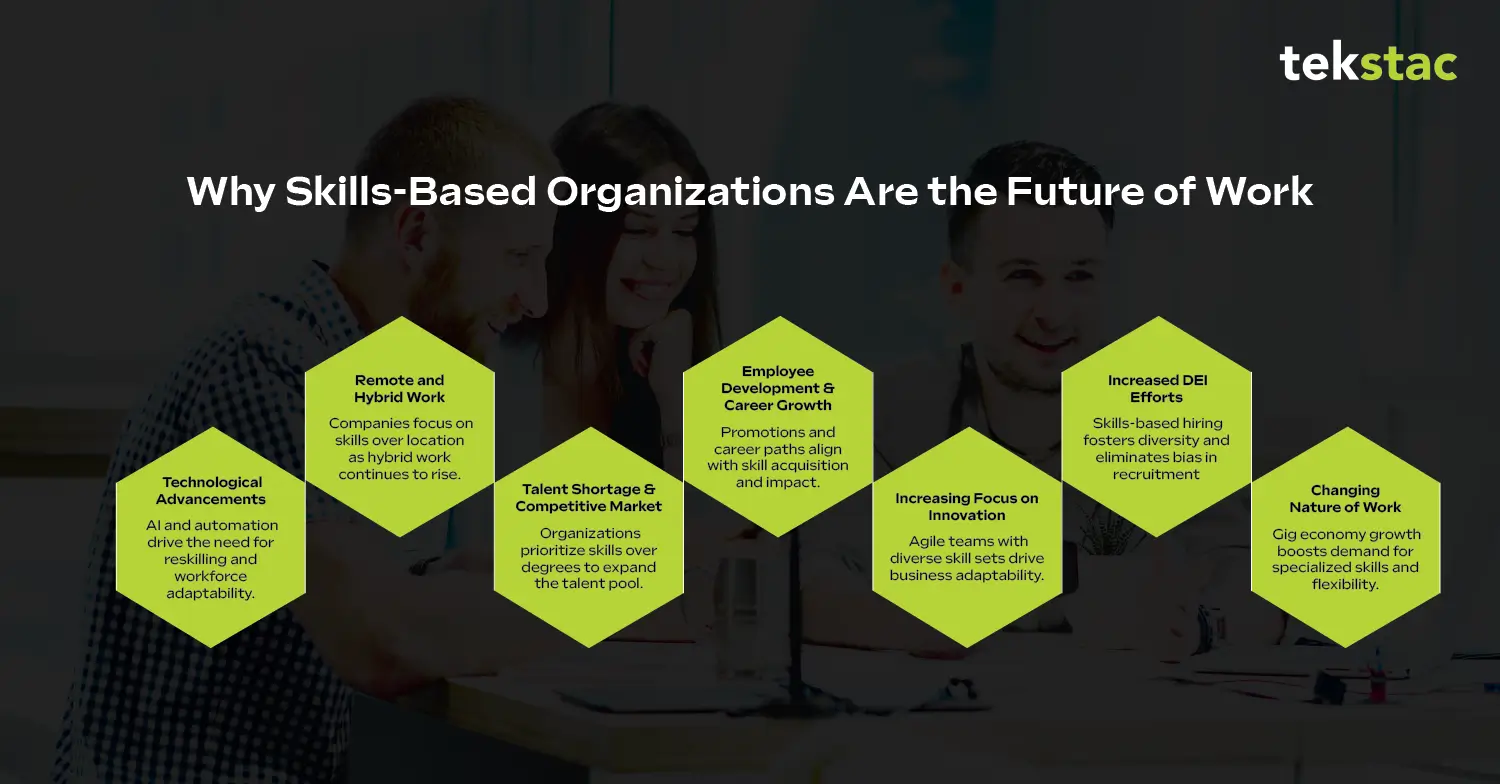
Technology is rapidly changing industries, with businesses integrating automation, AI, and other digital tools into their operations. An IBM report found that India will be the biggest adopter of AI in 2024, with 59% of large IT organizations deploying AI and 27% exploring this technology. 74% of this group is actively using AI in the following areas:
With AI handling repetitive tasks, humans are needed for creativity and problem-solving. This has shifted the focus to specific skills employees need to work alongside these emerging technologies. Also, organizations increasingly use these technologies for reskilling and development, ensuring the workforce has the required skills and is ready for the tech-driven future.
AI is also being embedded into employee training programs, helping tailor learning experiences and provide real-time feedback, thereby accelerating the learning curve for both new hires and existing talent.
Since the pandemic, flexible work arrangements have become mainstream, with hybrid and remote roles continuing to expand across industries. In India, about 12.7% of full-time employees currently work fully from home, while 28.2% are in hybrid work models, reflecting a significant shift toward flexible work preferences. Almost 41% of the workforce now embraces hybrid or remote arrangements, showing how work location flexibility has become a structural part of modern employment. Additionally, nearly 20% of job postings in India now explicitly offer remote or hybrid opportunities, up sharply from less than 1% in 2020, highlighting the sustained growth in flexible job openings.
As people work from different locations, companies focus on the specific skills employees bring to the table, regardless of where they are.
As per a Manpower report, nearly 4 in 5 employers in India found difficulty in finding the right talent in 2024. As observed, a growing demand for skilled workers makes recruitment highly competitive. To attract and retain talent, organizations must drop formal educational requirements and leave behind factors like location, background, race, and so on to hire talent that aligns with organizational needs. This mindset will help tap into a broader talent pool and retain skilled employees.
A skills-based organization’s approach also promotes talent mobility by allowing employees to move laterally across departments or take on cross-functional roles based on their skills, not just tenure. This increases engagement and retention while unlocking hidden potential within the workforce.
With 55% implementing new technologies to reskill and support workforce development, the emphasis is moving away from career growth based on skills employees acquire and their ability to drive value. This means promotions, appraisals, and career paths will be tailored to individual skill sets and their impact on the organization.
With the changing nature of work, companies now require teams that can adapt quickly to new needs. The need for agility and innovation has grown in response to market disruptions, such as global pandemics, economic shifts, and technological advancements. To quickly innovate, organizations must create flexible teams of employees with diverse and evolving skill sets to adapt to this fast environment.
A 2025 industry report found that 78% of employees consider diversity and inclusion important for job satisfaction, while 56% say they would leave an employer with weak DEI efforts, highlighting strong employee demand for inclusive workplaces. Additionally, 61% of organizations report higher employee engagement from DEI initiatives, and 81% of hiring managers say DEI influences how they source and evaluate talent.
Focusing on skills rather than background, a core principle of skills-based organizations helps broaden hiring criteria, reduce bias, and ensure decisions are driven by capability and potential rather than demographic or educational factors.
During the festive season, India witnessed a 23% increase in gig employment opportunities compared to 2023. With work changing, more project-based, freelance, or contract roles will require specialized skills. With talent shortages and competition, companies may shift to gig employment to leverage talent for specific skills. This also allows for more flexible work arrangements and quicker scaling of specialized teams.
As businesses continue to transform at a higher pace, adopting a skills-based organization is emerging as an essential factor for organizational adaptability and innovation in 2026 and beyond. This forward-thinking approach will allow companies to prioritize employee capabilities, even in the face of technological disruptions and workforce expectations.
Traditional models that still rely on rigid hierarchies, predefined job titles, and tenure-based career paths will continue to witness challenges in DEI, utilization of talent, work-life balance, skill development, and career growth.
Organizations must implement efficient systems to evaluate and track skills effectively to adopt and maintain a skills-based culture. This requires skills-based assessments that focus on:
To support this shift, organizations must refine their L&D strategy, making it more agile, data-driven, and aligned with evolving business needs.
This is where Tekstac can step in for organizations, whether pre-hiring assessments, upskilling and reskilling, or career development for IT professionals. It offers a comprehensive curriculum that can be fully personalized to meet organizational needs, ensuring employees acquire the skills necessary to succeed. Its solutions go beyond theoretical training by providing the following:
They lay the foundation for building and scaling a skills-based organization.
1. How is a skills-based organization different from a job-based model?
Traditional models focus on fixed roles and qualifications, while skills-based organizations focus on skills, potential, and continuous development. This allows employees to move across roles and projects based on evolving business demands.
2. Why are skills-based organizations important for the future of work?
They help organizations adapt faster to change, close skill gaps efficiently, and support hybrid work models. By focusing on skills, companies stay resilient amid rapid technological and market shifts.
3. What are the key benefits of a skills-based organization?
Key benefits include improved workforce agility, better internal mobility, reduced hiring bias, stronger employee engagement, and clearer alignment between learning initiatives and business outcomes.
4. What role does L&D play in a skills-based organization?
L&D enables skills-based organizations by identifying skill gaps, delivering targeted learning, tracking progress, and connecting skill development directly to performance, mobility, and business impact.
How often have you been handed a lengthy PowerPoint deck for training and thought, When am I supposed to find time for this?
That’s where microlearning comes in. But what is microlearning exactly? It’s a modern learning method that delivers bite-sized, targeted lessons—perfect for busy employees adapting to changing work demands.
They take too much time, aren’t easy to retain, and can be dull.
That’s why microlearning is gaining popularity. It’s a more modern, efficient way of learning that focuses on bite-sized, targeted lessons designed to fit busy schedules. With today’s demanding employees mastering new tools and adapting to changing work environments, microlearning is the perfect solution!
Microlearning is a method that breaks down learning into small, bite-sized modules. It helps employees to acquire skills quickly, effectively, and in a way that fits into their busy workdays.
These bite-sized modules are brief, spanning from a few minutes to 15 minutes. They can take various forms, including short videos, interactive quizzes, infographics, or quick-read articles—often accessible through digital platforms.
Microlearning begins with identifying a specific learning objective or a skill gaps. Instead of teaching a broad or complex topic all at once, it focuses on a single concept, skill, or task that needs immediate attention.
The learning journey is then broken into small, focused modules that can be completed independently. Each module builds upon the previous one (if necessary) or serves as a standalone unit. Learners can move at their own pace.
Each module concludes with a clear takeaway or action point. Learners are given a quick assessment to ensure they have grasped the material. This evaluation reinforces learning in applying the skill on the job.
Organizations have long struggled with employee retention, and one primary reason is the need for meaningful learning opportunities.
As per LinkedIn’s 2024 Workplace Learning Report, 90% of organizations are heavily concerned about employee retention and promote learning opportunities as their number one retention strategy.
Here are five ways how microlearning improves employee retention.
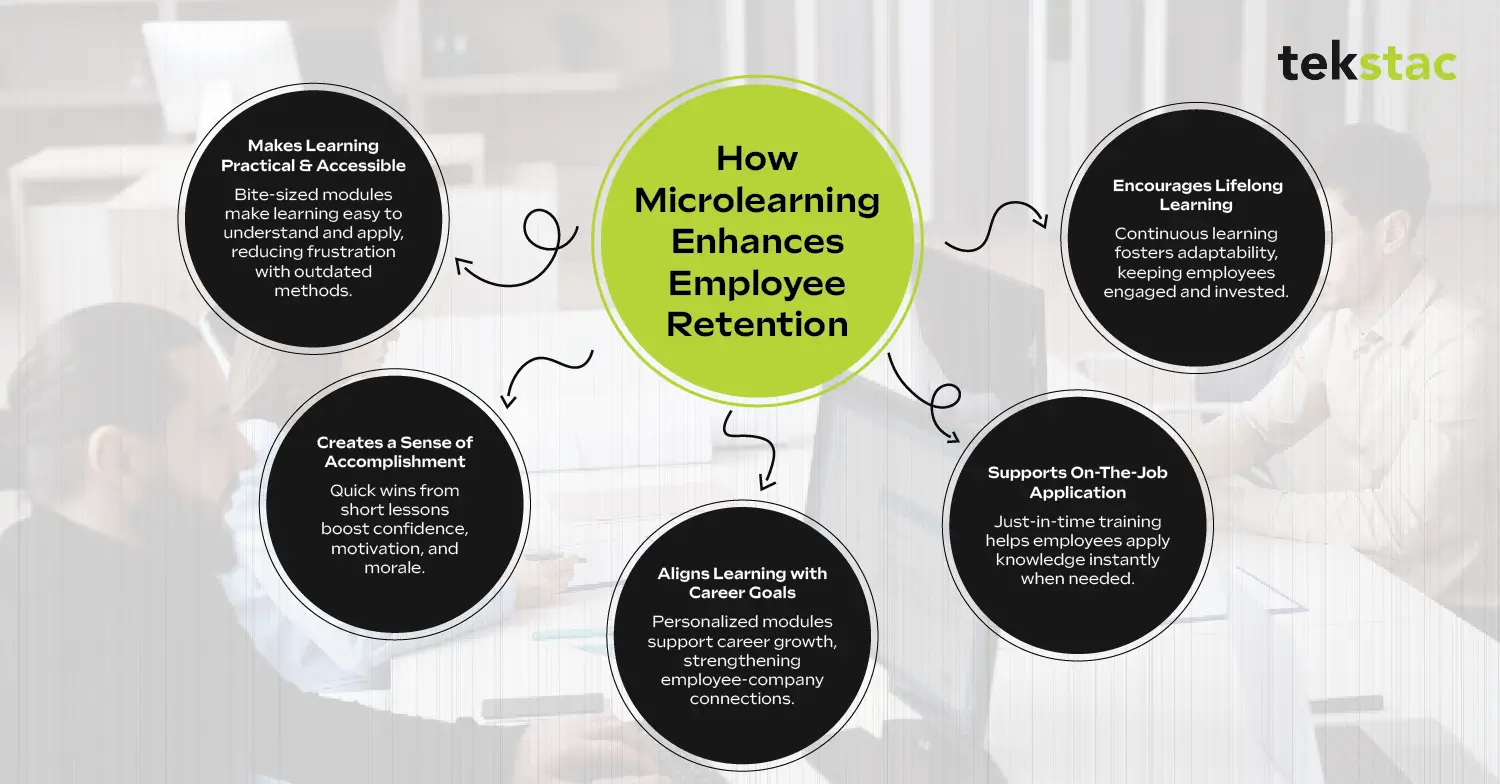
Since microlearning breaks down topics into easily understandable modules, employees engage with the information positively and apply knowledge. This reduces frustration with outdated learning methods and shows employees that the organization values their time.
When employees complete short, actionable lessons, they experience quick wins. With practical information, employees will begin to implement their learnings, also creating opportunities for achievements. This continued sense of progress motivates them to continue learning, improving morale and loyalty.
Microlearning focuses on designing personalized learning modules that directly support career progress. Employees are also more likely to participate in L&D programs, creating a stronger connection between the employee and the company. This also shows that the organization is invested in employee growth.
Microlearning delivers just-in-time training, providing employees with the exact information they need when they need it.
For example, imagine a sales representative preparing for a negotiation call. Instead of going through lengthy company manuals or attending a half-day workshop, they can quickly access a 5-minute microlearning module on effective negotiation techniques. This allows employees to apply what they’ve learned immediately.
Traditional training programs sometimes operate on a “once-and-done” model, where employees undergo long sessions once or twice a year.
Microlearning emphasizes ongoing learning as an integral part of an employee’s work life. It ensures that employees constantly update their skills and knowledge without feeling overwhelmed. As a result, employees will stay with an organization as it creates a culture of growth and adaptability.
Microlearning is a perfect learning method that appeals to the modern learner’s fast-paced work environment and suits the short attention span of the current generation. These bite-sized, goal-oriented modules offer the following five benefits:
When information is delivered in small, digestible chunks, employees can absorb and recall details more effectively than other methods. With higher retention rates, organizations will see a greater return on their learning and development investments as employees apply new skills more effectively. Employees also reduce cognitive overload and stress associated with information-heavy training programs.
Since microlearning’s content is interactive or gamified with multimedia elements, it keeps learners engaged. Other extended training programs can feel monotonous, whereas microlearning is more enjoyable. Hence, companies will observe higher participation rates and lower training abandonment.
Much has changed since the pandemic nearly five years ago. Every year, new skill set requirements keep evolving. Microlearning helps organizations quickly create or adapt learning content to address skill gaps per business needs. With quicker upskilling or reskilling, businesses can stay competitive and address skill gaps.
Focused, job-specific microlearning content allows employees to learn and apply skills to their tasks quickly. This “just-in-time” learning improves on-the-job problem-solving.
For instance, The Journal of Applied Psychology found that leadership training alone can increase learning capacity by 25% and performance by 20%. These results show the impact of a well-designed training program on employee performance.
Microlearning’s flexibility and convenience allow employees to learn anytime, anywhere—promoting an ongoing learning habit rather than random training sessions. Organizations that promote continuous learning see better employee retention rates and attract top talent.
To get started with microlearning, organizations can take the following steps:
Conduct skills gap analysis to check for specific competencies employees need to develop. Collaborate with department stakeholders and team leaders to define the most critical knowledge areas aligning with organizational goals and workforce needs.
Once identified, map out the most essential learning objectives for microlearning content. This ensures that the training is relevant and addresses high-priority areas immediately.
Develop microlearning modules that are at most 5-10 minutes each. Each module must focus on a topic or skill to allow employees to absorb information in a manageable size. Use existing training materials, videos, or tutorials as building blocks to reformat them into microlearning-friendly content. As always, ensure the content is interactive.
Adopt a platform that supports personalized, microlearning content. It should also offer advanced analytics to monitor learner progress, assess knowledge retention, and track how well learners are engaged.
Following the initiative’s deployment, analyze performance metrics to improve and optimize content and delivery methods. The platform’s real-time data and feedback loops or interventions can refine the learning experience.
When a company embraces microlearning, it should be designed in a way that maximizes learning impact. The following best practices ensure that each learning module is purposefully designed for maximum employee performance:
Organizations must stay agile and aware of the changing world and required skills. This process involves regularly assessing industry trends, workforce demands, and future skills to ensure that the learning initiatives align with organizational goals and external market requirements. Regularly revisiting learning goals in response to changing needs is also essential.
Microlearning isn’t just about imparting information; it’s about making sure that the knowledge sticks and can be practically applied.
This requires a deliberate focus on retention techniques like spaced repetition. Employees should also be able to apply it to their daily tasks immediately. Use scenario-based learning or simulations to help them practice in a more realistic environment.
Not all employees learn at the same pace or have the exact needs. People retain information differently, and microlearning strategies should be flexible enough to meet these needs.
Personalization should include skill gaps, learning styles, and career goals. One way to quickly achieve this is to use learning data to create targeted training paths that focus on areas where employees need the most improvement.
Microlearning thrives when the content is visually engaging and diverse. Given the variety of learning preferences, some individuals may prefer visual learning, while others benefit more from auditory or hands-on methods. Make sure to blend videos, infographics, animations, and interactive elements. Consider polls, quizzes, and gamified components to make it more fun!
Design content that is easily accessible on mobiles, tablets, or laptops. When employees can access training material on the go, between meetings or during a commute, it reduces barriers to participation. It fits into their busy schedules, allowing them to learn quickly. This on-demand learning ensures that training becomes a part of an employee’s workflow.
Organizations need tools that combine flexibility, scalability, and advanced analytics to achieve a smoother microlearning strategy. Such platforms must design content delivery with features like AI-driven personalization, real-time performance tracking, and assessments.
Look for solutions that integrate modular course creation, gamified learning paths, and detailed dashboards to design training that aligns with business goals. One such skilling solution is Tekstac, which supports these needs. It’s an ideal choice for organizations looking to transform their training or skill development initiatives for tech talent.
A talent mobility framework and a career pathing strategy are the two primary approaches organizations use to develop internal talent; but they solve different problems, suit different cultures, and require different infrastructure to run well.
A Gartner survey of 3,375 employees found that one in three feel they could have a bigger impact on a different role within their own organization; yet fewer than one in five organizations can effectively move talent to where it is needed. That gap is what both frameworks are designed to close. This guide explains what each approach is, how they compare, and how to decide which one or which combination is right for your organization.
Here’s an insight into what Talent Mobility Frameworks and Career Pathing are and how they can help your organization.
| Dimension | Talent Mobility Framework | Career Pathing Strategy |
|---|---|---|
| Primary goal | Move talent across roles, teams, and projects | Define structured advancement within a function |
| Movement type | Lateral, diagonal, cross-functional | Vertical (ladder) or flexible (lattice) |
| Best for | Agile, fast-changing organizations | Structured, hierarchical organizations |
| Key tool | Internal talent marketplace, skills database | Individual Development Plans (IDPs), role maps |
| Timeframe | Short-to-medium term, project-based | Long-term, milestone-based |
| Risk | Talent hoarding by managers | Rigidity, limits non-linear growth |
| Outcome | Workforce agility, skills diversification | Retention, structured promotion pipelines |
A talent mobility framework is a strategic approach organizations take to help employees move across departments, roles, and projects in line with their career aspirations and meet business objectives.
By maintaining a talent mobility frameworks, organizations offer employees tools, resources, and processes that aid them in skill development, succession planning, and career progression. It encompasses internal transfers, cross-functional training, upskilling and reskilling, and internal transfers.
For example, Google offers an internal job board called “Google Jobs,” which showcases all the company’s open positions to its employees. It also provides career coaching and leadership development programs to facilitate employee transition into new roles. They also have a “gTwo” program that gives employees the opportunity to work in a different department or location.
An internal mobility framework is the operational execution layer of a broader talent mobility strategy; defining the processes, eligibility criteria, and infrastructure that enable employees to move into new roles internally. For a full breakdown of how to build one, see our complete guide to Internal Mobility Framework.
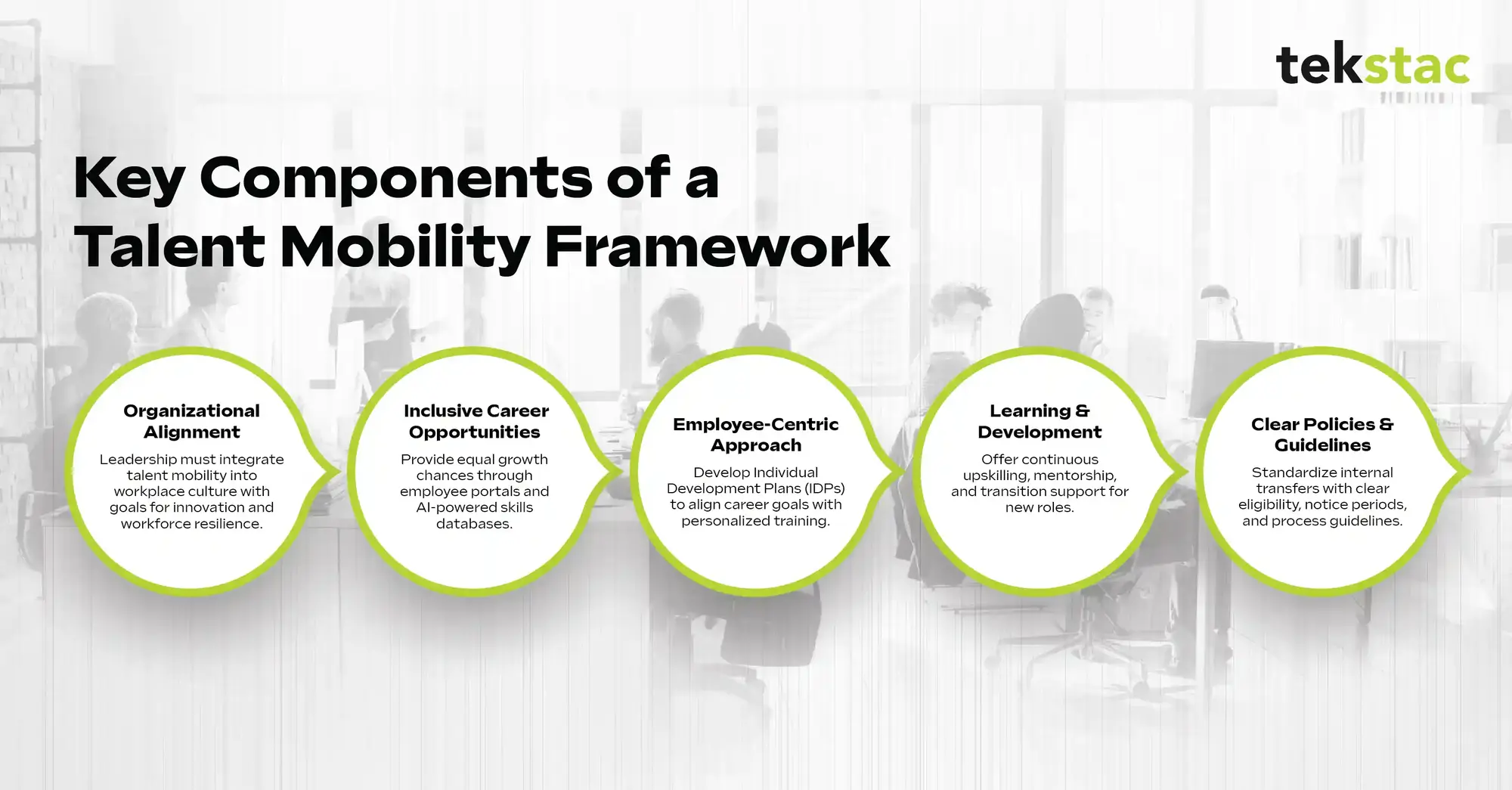
Leadership must prioritize and integrate a Talent Mobility Frameworks into the work culture. This framework should also have an end goal to be met regarding innovation, workforce resilience, and scalability.
Organizations should offer employees equal chances to grow and facilitate this through internal systems like employee portals, where new posts, vacancies, and projects are posted. An AI-powered skills database also helps map employees’ roles in sync with their competencies and career goals.
HR must take steps to create Individual Development Plans (IDPs) to chart career plans with short-and long-term goals, identify skills or roles that the employee seeks, and offer training programs accordingly.
Through continuous learning and development, organizations must offer upskilling programs and mentorship to help employees transition into new roles and develop new competencies.
Establishing clear guidelines and standardizing processes (eligibility criteria, notice periods, etc) helps smooth internal transfers and project assignments.
Through a talent mobility frameworks, organizations can:
Career pathing is a way for employees to fulfill their career aspirations by following a structured path, participating in developmental initiatives, reskilling or upskilling from time to time and meeting goals set by the organization.
Organizations can adapt career pathing to offer personalized learning, identify skills and competencies that support employees’ growth, and track their progress.
The two essential approaches to career pathing are:
For example, Nestlé has a Nestlé Academy program that offers personalized career development programs featuring job rotations and skill training. Through this program, employees can set clear career goals tracked through regular check-ins. Nestle also offers leadership development programs that help meet employee career aspirations and align with organizational growth strategy.
Organizations must first understand their business requirements, growth trajectory and identify leadership and business-critical positions.
Working in sync with employees helps organizations set short-and long-term goals that match their aspirations and meet organizational objectives.
Companies should set up 1:1 meetings to discuss their employees’ ambitions, interests, and values. Then, walk them through the skills and experience levels required to reach their career goals.
It is important to create strategies for acquiring skills, which include training sessions, upskilling and reskilling, shadow sessions, assignments, and mentoring.
Organizations must establish metrics to determine employee performance and hold one-on-one discussions to assess the initiatives’ effectiveness. To boost employee morale, organizations must reward significant progress or milestones with bonuses, salary hikes, or promotions.
Through career pathing, organizations can:
Both approaches are invaluable for an organization’s employee development and retention efforts. Choosing the right approach depends on your company’s culture, business requirements, and goals.
Talent Mobility Frameworks favor organizations focused on cross-functional learning, flexibility, and agility. If your main aim is to encourage employees to obtain diverse experiences and build versatile skills, moving across different departments, internal transfers, this approach would help immensely.
Career Pathing is more suitable for organizations that prefer structured and clear career progression. It is easier to implement in large or mid-sized companies with numerous hierarchical levels, which means moving to higher-level roles and retaining top-performing talent.
Organizations can also take a blended approach, ensuring flexible and structured growth. For example, employees can acquire diverse skill sets through cross-functional roles or lateral moves while working towards defined career goals.
For example – To get the best of both worlds, an organization can create a platform that offers internal job rotations, offshore assignments and short-term projects alongside well-defined career paths with specific milestones and development programs. This dual approach empowers employees with flexibility, helps them achieve long-term goals and create an agile workforce.
Whichever approach you choose, organizations can emerge as forward-thinking and keep reinventing themselves to stay relevant in a dynamic landscape.
Choosing between a talent mobility framework and a career pathing strategy, or building both, requires infrastructure that connects skills data, learning pathways, and performance outcomes in one place. Tekstac is an AI-powered LXP used by enterprise organizations including IBM, PwC, and Capgemini to build role-aligned learning paths, map skills gaps across teams, and track upskilling impact on internal mobility and career progression goals. Whether your organization needs the structured clarity of career pathing or the cross-functional agility of a talent mobility framework, Tekstac gives HR and L&D leaders the data infrastructure to make either approach work. 👉 Request a personalized demo now
1. How do Talent Mobility Frameworks benefit employee retention?
Talent mobility frameworks improve retention by giving employees a visible, credible path to grow without leaving. LinkedIn’s Global Talent Trends Report finds that companies with strong internal mobility programs see twice the employee retention rate. The mechanism is straightforward: when employees can see opportunities inside the organisation, the pull of external roles weakens.
2. Can organizations implement both Career Pathing and Talent Mobility together?
Yes, and for most mid-to-large organizations, a blended approach is the most effective model. Career pathing provides the vertical structure employees need to see a future; talent mobility provides the lateral flexibility to build skills that make them more valuable in that future. The two frameworks reinforce each other when both are supported by a shared skills data infrastructure.
3. What is the difference between a career ladder and career lattice?
A career ladder is a fixed, vertical hierarchy where progression means moving to a higher title within the same function. A career lattice is a more flexible model that supports lateral, diagonal, and vertical movement; allowing employees to grow across functions and build broader capability before moving up. Most modern talent mobility frameworks are built on a lattice model, as it better reflects how organizations need talent to move.
4. How does Career Pathing enhance employee engagement?
Career Pathing provides employees with a transparent growth roadmap, personalized development plans, and regular feedback, which boosts motivation and aligns individual aspirations with business objectives.
Traditional classroom training is fading fast. To stay competitive, companies must rethink how their teams learn and grow. Business leaders across industries report significant skill gaps in their workforce, making the evolution of learning programs a critical priority. The key challenge lies in creating engaging learning environments that effectively bridge the gap between theoretical knowledge and practical business applications.
Let’s explore five proven workplace learning strategies that empower learning and development (L&D) leaders to transform routine training into engaging, performance-driven workplace learning experiences.
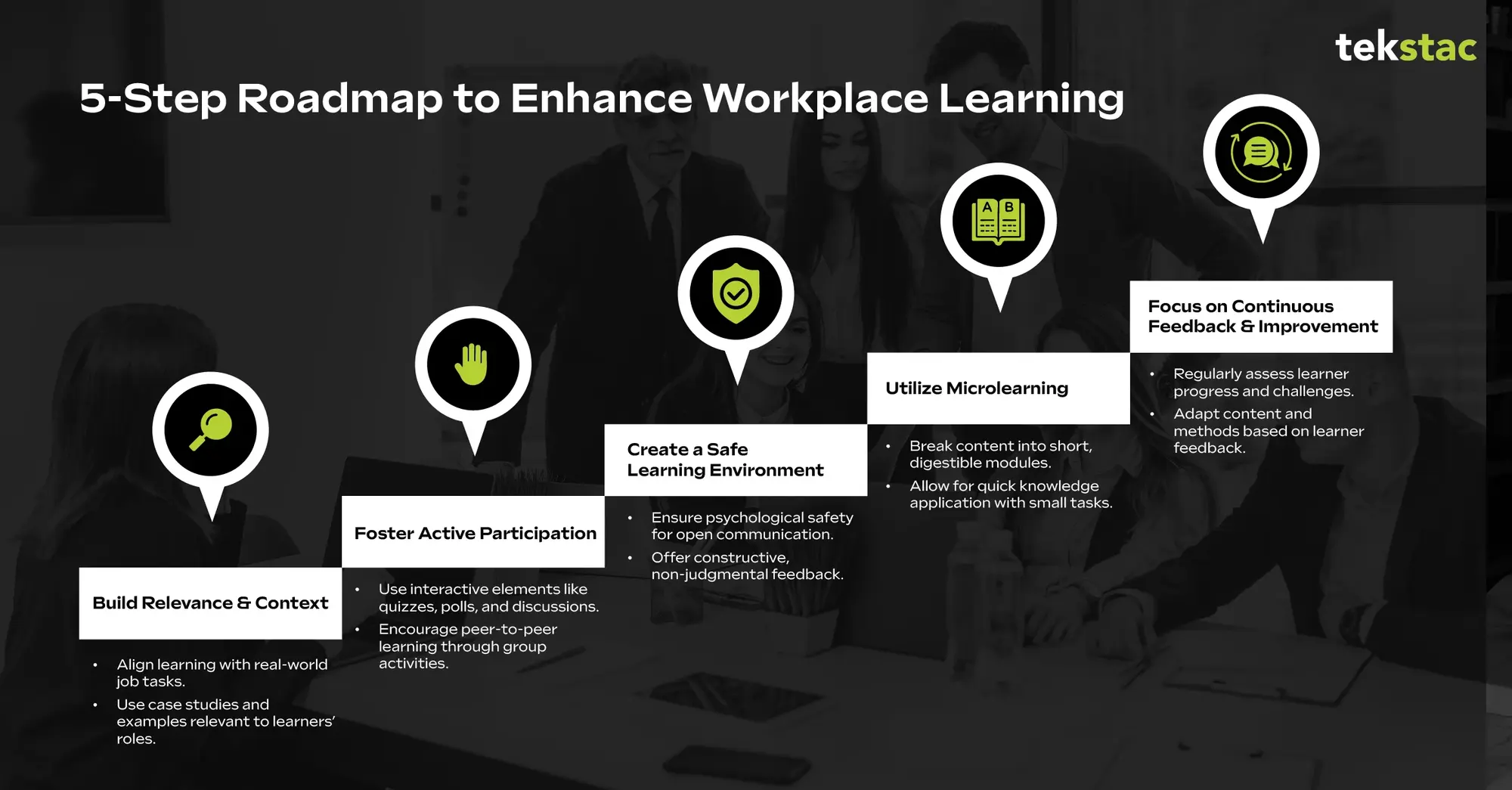
The disconnect between theory and practice frequently causes poor skill memory. Companies that implement experiential learning programs enjoy a 55% higher rate of skill acquisition than those that use standard training techniques, says the Josh Bersin Company’s Corporate Learning Report 2024.
Professionals may practice everything from cloud infrastructure to programming languages in real-time with Tekstac’s integrated lab environment, for instance, guaranteeing that abilities translate seamlessly to real-world work situations.
One-size-fits-all training plans are becoming obsolete. Learning in the modern workplace requires large-scale customization. IDC’s recent research shows that companies that use AI-driven learning systems see a 30% reduction in training time and a 45% increase in employee participation in development programs.
Making learning feel more like a customized path to mastery rather than a required task is crucial.
When workplace learning is smoothly incorporated into routine responsibilities, it is most successful. For example, a sales representative might access quick microlearning modules about new product features while updating their CRM entries, or a software developer could review code optimization techniques through integrated IDE plugins while writing code.
This method, which is frequently referred to as “learning in the flow of work,” enables staff members to apply newly acquired knowledge to actual problems right away.
Organizations can improve engagement and knowledge retention by providing easy access to learning materials in real-world work scenarios.
Modern L&D leaders require quantitative and qualitative data to measure learning effectiveness. While data analytics dashboards track measurable outcomes like completion rates, skill assessments, and performance improvements, qualitative feedback through surveys and team leader observations helps evaluate behavioral changes and practical application of new skills
Dashboards for advanced analytics make it easier to monitor program impact as well as individual progress. Businesses that successfully use learning analytics report a 41% boost in employee productivity and a 53% increase in employee retention, according to research from Brandon Hall Group’s Learning Strategy Study.
Organizations may track these KPIs in real time with Tekstac’s extensive analytics dashboard, which aids L&D leaders in making data-driven choices regarding their educational initiatives.
Creating chances for peer learning and information sharing can greatly increase engagement, even though individual learning routes are still vital. According to the Enterprise Learning Annual Report 2024 by Fosway Group, 94% of L&D leaders now place a high priority on collaborative learning strategies, with peer-to-peer learning having the greatest influence on skill development.
It takes considerable preparation and execution to turn traditional training into engaging workplace learning. Employee expectations and corporate goals must be met by contemporary workplace learning solutions.
How do you implement learning in the workplace?
Organizations frequently run across a number of challenges while implementing new learning methodologies.
Here’s how to deal with typical workplace learning obstacles:
You can handle time constraints with the use of contemporary workplace learning technology by:
Boost L&D involvement by:
Workplace learning is the integration of continuous, personalized, and collaborative training directly into daily workflows. It enables employees to build skills faster, apply them immediately, and drive measurable business performance.
The capacity to provide effective, engaging learning experiences is becoming increasingly important as firms continue to navigate the rapid changes in technology. According to McKinsey’s latest State of Organizations Report, 87% of executives report existing or expected skills gap in their workforce, indicating that transforming learning programs is a top priority.
The age of static, one-size-fits-all training is over. Next-gen corporate learning is agile, personalized, and immersive.
Beyond merely imparting knowledge, workplace learning aims to provide life-changing experiences that enable staff members to develop their abilities in the context of their regular jobs.
Effective workplace learning methods must be a top priority for firms if they want to remain competitive in today’s quickly changing business landscape. L&D leaders can establish learning environments that produce quantifiable business results by implementing the five strategies mentioned above and utilizing cutting-edge learning platforms like Tekstac.
Want to future-proof your workforce? Book a strategy session with Tekstac today and see how our workplace learning platform delivers results.
1. What is the future of workplace learning?
The future is agile, immersive, and personalized, leveraging technologies like AI, VR, and AR, and aligning learning initiatives more closely with business strategy to foster innovation and adaptability.
2. How can companies get started with transforming workplace learning?
Start with pilot programs, gather feedback, track engagement and outcomes with analytics, and iteratively refine learning strategies to align with both employee and business needs.
3. What is the 80/20 rule for learning?
The 80/20 rule for learning means that 80% of results come from 20% of focused effort. In workplace learning, it highlights prioritizing the most valuable skills and training activities that drive the biggest performance impact.
4. How does workplace learning impact employee engagement?
Engaging workplace learning links skill development directly to daily tasks, making employees feel more competent, confident, and connected to business outcomes.
Over the next few years, more than 50% of the world’s workforce will need to develop or improve upon skills in order to remain competitive amidst technological and economic changes.
Unfortunately, the majority of organizations relegate reskilling and upskilling to one of many roles that fall upon HR, with only 13% including other managers in the development of these programs. However, prioritizing Inclusive Leadership is crucial—when only HR is in charge, it often lacks the specific knowledge of a team’s unique needs or challenges. This risks you designing learning programs that don’t align with real-world requirements or resonate with your employees. By embedding Inclusive Leadership into skills development, organizations can ensure their reskilling efforts are both relevant and impactful for every team member.
There’s a better way—by incorporating all leaders and fostering a culture of inclusive leadership, your reskilling and upskilling programs will not just grow workers’ skills, but will meet each employee’s individual needs.
Inclusive leadership is the process of company leaders empowering employees and valuing diverse perspectives. An inclusive leader can cultivate a culture full of trust and collaboration if they are open to new ideas and inclusive of all backgrounds.
This often shows up in the form of a commitment to diversity initiatives, a focus on collaborative decision making, and a culture of empathy and psychological safety. For example, this may include leaders establishing and advising employee resource groups or driving feedback sessions to amplify underrepresented voices.
To foster a culture of inclusive leadership, survey employees to understand their needs and goals. Remain open to—and solicit—continuous feedback with an eye toward iteration and improvement. Incorporate diversity and inclusion into company trainings and initiatives.
Upskilling and reskilling are both essential to addressing the skills gap, but they are not the same thing. Upskilling refers to improving the skills one already holds, leading to better performance in a current position. Reskilling means providing employees with new skills that may enable them to take on an entirely new role.
Both reskilling and upskilling are paramount for companies hoping to grow amidst technological advances and a changing workforce. Whether that means teaching your team to leverage new AI technologies or helping them bolster their existing technical expertise, this type of retraining can keep your employees adaptable and engaged while driving toward company goals.
However, in addition to many companies lacking a focus on these programs, there may be other barriers. For instance, some employees may feel such programs interfere with their work time, while others may find them inaccessible due to logistical or language barriers. Focusing on inclusive leadership can remove these barriers.
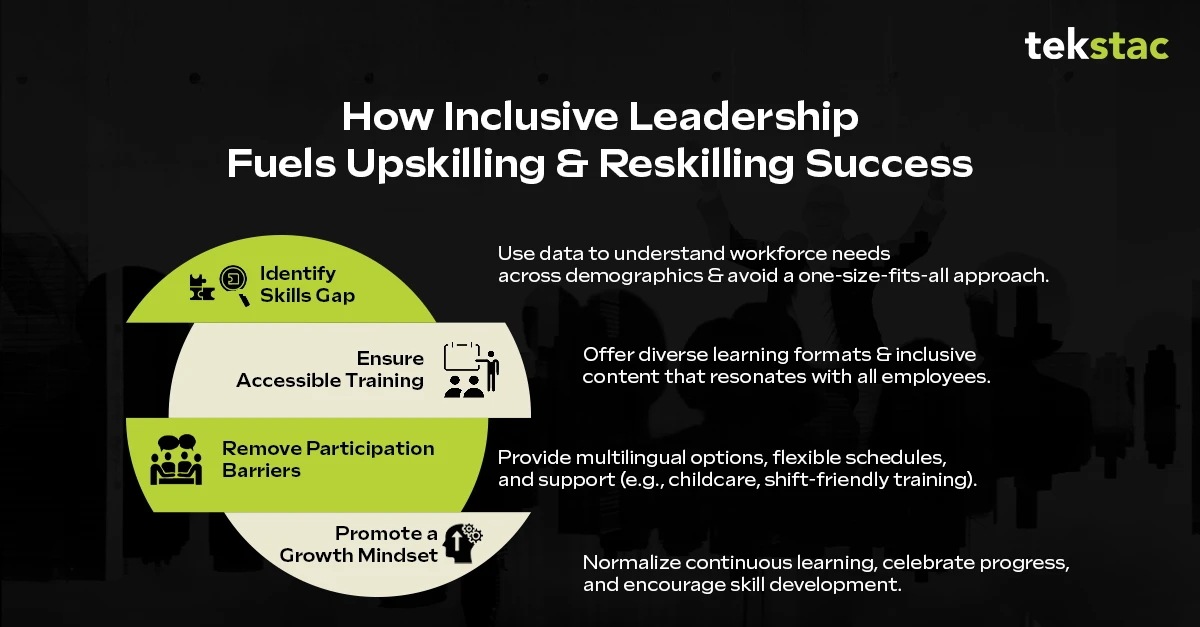
Inclusive leadership can contribute to successful retraining programs in several ways.
As leaders prove their commitment to inclusion, they’ll inspire employee trust, making workers more likely to see the benefit of and engage in learning opportunities. Plus, the more a culture fosters the inclusion of new viewpoints, the more everyone can learn from each other. This can also lead to more innovative training and development approaches, like gamification or training led by subject-matter-expert peers.
To stay aware of your progress, keep an eye on metrics like employee participation across various demographics, employee engagement scores (which can also be analyzed by demographic), and how well performance or promotion rates improve after the training sessions.
Combined, these metrics will paint a picture of how included your employees feel and how beneficial the upskilling or reskilling courses are, ensuring the programs equitably benefit all demographics and allowing you to discover and resolve any gaps. Consider using a comprehensive learning platform that tracks this data and provides insight into the ROI of your training programs.
Over time, upskilling or reskilling programs led by inclusive leadership practices should result in a stronger talent base with a better pipeline for new or higher-level roles, which should also position you with a higher competitive advantage against competitors.
As the working world transforms with the continuous advent of new technology, your company must change along with it. One of the surest ways to stay competitive in a changing landscape is through a continued focus on upskilling and reskilling of employees.
However, trying to create a single program that meets every worker’s needs is likely to result in barriers and low adoption. Inclusive leadership is the answer. By striving to understand the needs of diverse demographics and design programs that meet each employee where they are, you’ll break down barriers, increase participation, and future-proof your team.
If you’re an inclusive leader looking to get started with upskilling and reskilling, check out a Tekstac demo. With 500+ unique learning paths and assessments, there’s a way to meet every employee’s skill development needs.
1. What is the difference between inclusive leadership and transformational leadership?
Inclusive leadership focuses on diversity, equity, and ensuring every voice is heard. Transformational leadership inspires and motivates teams to achieve vision-driven goals.
2. Why is inclusive leadership important in the workplace?
It drives diversity, innovation, and employee engagement by creating a culture where everyone feels valued, boosting collaboration and business performance.
3. What are the most important traits of an inclusive leader?
Inclusive leaders show empathy, practice active listening, embrace cultural awareness, ensure fairness, and foster an environment where all voices are respected.
4. How do you measure inclusive leadership in an organization?
It can be measured through employee surveys, 360-degree feedback, and diversity metrics, along with tracking engagement, retention, and representation rates.