

HR leaders spend the entire year recognizing others, building workplace culture, and helping employees succeed. During this season, it’s the perfect time to show appreciation for their hard work with thoughtful holiday season gifts for HR leaders.
Finding the right gift, however, isn’t always easy. Whether you’re shopping for an HR manager, People Operations leader, Talent Development professional, or CHRO, here are ten holiday gift ideas they’ll truly appreciate.
We’ve curated 10 unique gift ideas that combine thoughtfulness with practicality to help you show your gratitude this holiday season.
Sounds like a lifesaver, right? Let’s dive in!

A desk is more than just a workspace; it’s where HR leaders manage countless tasks, plan initiatives, and brainstorm ideas.
So why not give their workspace a touch of personality and functionality?
Unique custom desk accessories can spruce up any workspace. Whether it’s a name tag or a stylish leather desk organizer, these gifts are both practical and thoughtful. A monogrammed pen set, or personalized planner adds a touch of elegance to their desk & can make their daily tasks feel a little more special.
Why they’ll love it!
Tech-savvy corporate holiday gifts for HR leaders are always a hit. Consider gadgets that make their busy lives easier, such as wireless charging station, AI voice recorder for meetings, smart notebook, or noise-cancelling earbuds. These tools cater to their need for efficiency and convenience. For an extra special touch, go for premium tech brands or customizable options.
Why they’ll love It!
HR leaders are lifelong learners, always striving to improve their skills and lead their teams better. A book on leadership, team dynamics, or personal growth can provide them with fresh insights and inspire them in the year ahead. Bestsellers like The CEO Mindset by Shiv Shivakumar, Co-Intelligence by Ethan Mollick, The Culture Code by Daniel Coyle, The Five Dysfunctions of a Team by Patrick Lencioni, and Dare to Lead by Brené Brown Leaders Eat Last by Simon Sinek are great choices.
Why they’ll love It!
For eco-conscious leaders, consider gifts like bamboo organizers, solar-powered gadgets, or zero-waste kits. A personalized reusable water bottle or stylish tote bag can also align with their values.
Why they’ll love It!
The holiday season is the perfect time for a well-deserved getaway. Thoughtful travel accessories like a premium travel organizer, neck pillow, passport holder, packing cubes, or a stylish weekender bag can make every trip more comfortable and enjoyable. Whether they’re planning a family vacation or a quick weekend escape, these gifts are both practical and thoughtful.
Why they’ll love It!
AI has become an essential part of the modern workplace, helping HR leaders save time and streamline everyday tasks. A subscription to an AI writing assistant, meeting transcription tool, or productivity platform can simplify everything from drafting job descriptions to summarizing meetings and creating presentations. It’s a thoughtful gift that supports the way they work every day.
Why they’ll love It!
A subscription service can be a deeply thoughtful gift, offering your HR leader consistent value over time. Instead of a one-off present, a subscription becomes a gift that keeps giving.
A thoughtfully chosen subscription delivers value long after the holiday season. Whether it’s a subscription to MasterClass, Harvard Business Review, or Audible, recurring experiences often become the most memorable gift. For U.S. teams, popular picks like Starbucks gift cards or Amazon Prime subscriptions make versatile holiday season gifts.
Whether it’s for professional growth or personal enjoyment, a subscription offers flexibility and shows you’ve considered their unique preferences.
Why they’ll love it:
Everyone loves a little indulgence, and a gourmet snack or coffee basket is a safe bet. Fill it with artisanal chocolates, premium coffee blends, or organic snacks that they can enjoy during their downtime. This becomes a great corporate holiday gift for HR leaders. Add a personal note, and you’ve got a thoughtful gift that feels both festive and practical.
Why they’ll love it:
Nothing speaks more deeply than a piece crafted with care and artistry. Gift unique, handcrafted items like hand-thrown mugs, vases, pottery, woven blankets, or artisanal wall art. Supporting local or global artisans adds a layer of meaning and originality to your gift.
Why they’ll love It!
Sometimes, the best gifts are experiences. Gift your HR leader an experience-based present like a voucher for a fancy dinner, a fun activity, or a ticket for a music concert. In the U.S., favorites include NBA or NFL game tickets, Broadway shows, or a wine tasting tour in Napa Valley.
Whether they’re into fine dining, wine tasting, or learning a new skill gifting them with an experience allows them to create new memories. Some more options to consider are spa voucher, tickets to a sporting event, or an online cooking class they can enjoy at their own pace.
Why they’ll love it:
The most meaningful corporate holiday gifts aren’t always the most expensive; they’re the ones that show genuine appreciation. Whether it’s a workspace upgrade, a learning opportunity, a wellness experience, or a sustainable choice, thoughtful gifts can go a long way in recognizing the HR leaders who make workplaces stronger every day.
This holiday season, take time to celebrate the people who spend all year supporting everyone else, with a gift they’ll truly remember.
1. What is the holiday season in the UK?
In the UK, the holiday season typically spans from mid-December to early January, covering Christmas, Boxing Day, and New Year celebrations.
2. How do I choose the right holiday gift for an HR leader?
Focus on practicality, personalization, and values—gifts that support their lifestyle, wellness, or leadership growth work best.
3. What are the best holiday season gifts for HR leaders?
Personalized desk accessories, wellness kits, sustainable items, gourmet baskets, and experience vouchers are thoughtful and practical choices.
4. What should you include in a holiday gift hamper for women employees?
A thoughtfully curated gift hamper for women can include a mix of self-care, wellness, and practical items that employees genuinely appreciate. Holiday makeup gifts such as skincare essentials and wellness products are also a great choice. You can also add a handwritten thank-you note or a customized keepsake to make the hamper feel more personal and memorable.
5. What should HR leaders include in a Diwali gift hamper for men?
Popular choices include a premium grooming kit, gourmet snacks or chocolates, coffee or tea, a stylish notebook, a stainless-steel tumbler, a wallet or card holder, and wellness essentials.
6. What are the best budget-friendly corporate gifts for HR leaders?
The best budget-friendly corporate gifts for employees are thoughtful, practical, and useful in everyday life. Popular options include personalized notebooks, reusable water bottles, coffee mugs, desk organizers, wireless phone stands, mini desk plants, gourmet snack boxes, gift hampers, wellness kits, tote bags, and gift cards.
Imagine if a young Serena Williams stopped tracking her performance. Would she have become a legend? Just like athletes, employees need ongoing skills tracking to grow in a fast-paced business environment. Employee development is not a one-time affair but a journey. Tracking skills is a critical requirement that helps in tracking growth, skill gaps, and learning that is aligned with the goals of the organization.
Effective skill tracking systems would enable personalized learning paths, real-time feedback, and eventually shape the culture of ongoing learning to meet the organizational goals and contribute towards the success of a business with professional growth.
76% of employees are looking for upskilling and reskilling opportunities for career development. Skill progress tracking enables the tracking of employees’ continuous development. It ensures that after onboarding, employees are still progressing. Organizations can track where skills gaps exist, adjust their training efforts, and tailor learning interventions to meet business and employee needs by tracking skills.
Technology plays a very important role in tracking skills by making it easier to monitor and improve skills. It automates the tracking process through learning management systems, AI-driven assessments, and other platforms, which provide real-time updates on progress. These applications recommend courses relevant to the individual’s needs. Data analytics helps in the delivery of insights regarding employee strengths and weaknesses, hence allowing organizations to make informed decisions on training and development.
Continuous feedback and performance measurement are also made possible, keeping employees on track. This simplified skill-tracking process enables organizations to ensure constant learning, better performance among employees, and align workforce development with organizational goals.
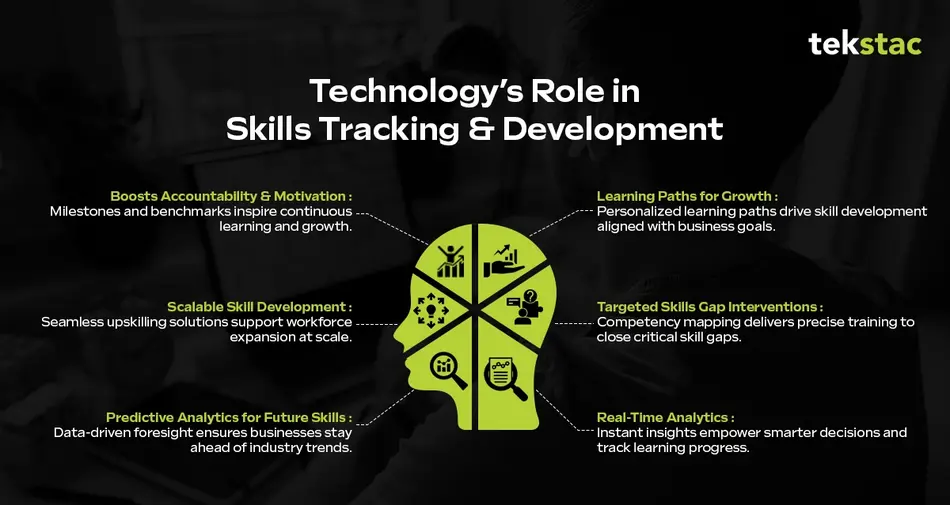
Skill tracking is not only about measuring progress but it is an opportunity for constant growth. With active tracking and assessment of skill development, it is possible to develop meaningful improvement paths for organizations. Tekstac’s customizable learning paths take this concept further by ensuring the development of skills that fit organizational goals and individual competencies of employees. Such customized journeys keep the employees motivated and engaged to improve their skills and abilities.
Competency mapping helps determine the areas where skills gaps are present, so the employee receives targeted training based on their job. Immersive practice labs, live sessions, and expert mentoring are a few resources organizations can use to close those gaps effectively.
Real-time analytics makes tracking skills easier because, within a few minutes, it provides an update on where employees are learning and improving. It gives organizations the rationale for training decisions based on how these employees are progressing. For managers, this information allows them to change plans, facilitate support, and utilize organizational resources more effectively. Employees see instant feedback, which helps them to stay focused and finish goals more quickly.
Tools with real-time analytics allow both employees and organizations to know clear results and take action promptly. This way, skill development stays on track and promotes growth for the organization and the individual.
Tracking skills not only supports employee growth but also creates responsibility. Employees can see their development and compare it to a standard benchmark. Skill tracking motivates employees to improve and learn continuously. Some tools have features that enable setting up milestones and tracking employee development toward specific predetermined goals, therefore motivating them toward engagement. Such a system will then go on to promote a sense of accomplishment as well as a culture of continuous learning. Employees will eventually take charge of their growth; the better organizations are going to have a more skilled and more engaged workforce.
Scaling skill development across an organization ensures that the organization is growing and ready to face the evolving business challenges. Training thousands of employees for large-scale programs and assuring that each gets attention is a challenge in itself. Tekstac counters this challenge with scalable solutions handling thousands of simultaneous learning journeys.
This scalability of an enterprise level could enable organizations to track the development of a large team’s skill progress, whether it is tracking upskilling existing staff members or new hires in the development process. Some platforms are designed with security and high levels of performance in mind to meet the demands of growing businesses.
Predicting the future need for skills through analytics will keep organizations ahead of the game in a rapidly changing market. Organizations must operate several steps ahead of the trends within an industry. Through the integration of progress tracking with predictive analytics, organizations can predict future needs for their workforce and thus prepare the right workforce for their business.
Businesses use these insights to create focused training programs, align talent strategies with goals, and optimize workforce readiness. In this way, an organization enhances its competitiveness while improving the engagement of employees and, more importantly, creates a culture of continuous growth and innovation.
In short, skill tracking is key to making employee growth post-onboarding thrive. It equips the organization with the tools to track performance, close gaps, and design personalized developmental plans. An all-in-one platform like Tekstac makes tracking easier for organizations, allowing for maximum support for their workforce. Being offered a gamut of features ranging from real-time analytics to hands-on practice labs by Tekstac facilitates business learning and development, leading to long-term success.
By incorporating competency mapping into the employee growth strategy, organizations are assured to be evolving, adapting, and thus contributing toward their overall business success. In fact, Tekstac is bringing innovative solutions which enable organizations to further scale their talent development efforts, through total employee empowerment so that an employee can see the full scope of his potential.
Get started with Tekstac today and empower your workforce to grow, adapt, and succeed. Contact us to learn more about how we can support your team’s skill development journey.
A skills gap occurs when there’s a mismatch between the skills employees currently have and those needed to meet business objectives. It can negatively affect productivity, growth, and innovation—especially in fast-evolving fields like AI, cybersecurity, and data analytics.
A recent survey by the American Staffing Association (ASA) reveals that many employers are struggling to find talent with the right skill sets.
Identifying and addressing these gaps through a structured skills gap analysis is essential to building a future-ready workforce. By using tools like competency assessments, performance reviews, and employee feedback, organizations can pinpoint deficiencies and develop targeted upskilling strategies that truly move the needle.
Explore our full article: What Are the Skills Gaps Employers Are Looking to Close in 2026?
“72% of employers are struggling to find employees with the right skills” says a report from Deloitte on workforce challenges.
Understanding and addressing skills gaps is crucial for designing effective upskilling programs. A thorough skills gap analysis allows organizations to focus on priority areas, ensuring resources are allocated where they can have the most significant impact.
With a clear understanding of these gaps, it becomes possible to develop targeted strategies that strengthen workforce capabilities and enhance adaptability to future challenges. Structured approaches to skills gap analysis and upskilling not only identify areas for improvement but also guide the selection of relevant programs. Aligning these efforts with industry trends ensures the workforce stays competitive and prepared for evolving demands.
Organizations can follow various methods to do a skills gap analysis. These strategies double as a practical approach to skill gap identification — spotting the gap is step one of any skills gap analysis.
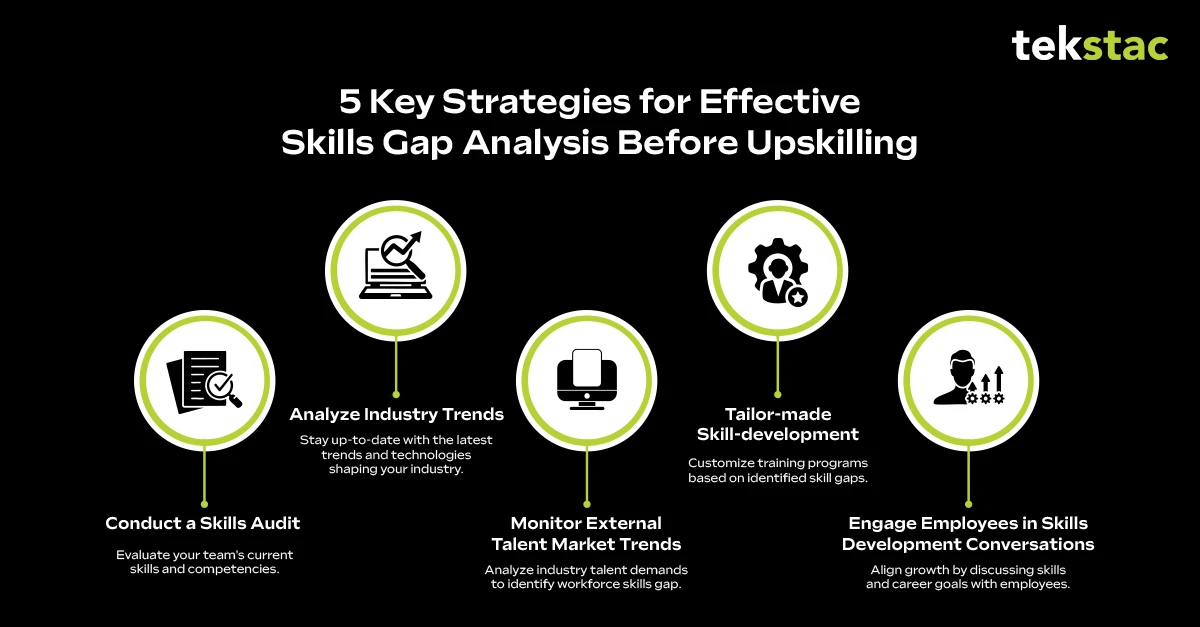
A skills audit is conducted to assess the current skill set of the workforce and determine whether it is up-to-date. It should be performed periodically to verify the capabilities of each employee and the overall skills of the team.
Consider the following points to do a skills gap analysis using a skills audit strategy.
To effectively identify skills gap, it’s crucial to stay attuned to the evolving needs of the industry. As industries rapidly embrace digital transformation, emerging technologies such as AI, machine learning, and blockchain are reshaping job roles and required skill sets. Understanding these shifts enables employers to anticipate future skills demands and align training programs accordingly.
Keeping track of industry reports, market forecasts, and competitor developments also provides valuable insights into which skills will be vital in the coming years, allowing organizations to proactively address the gaps before it becomes too late.
By analyzing the talent pool outside your organization, you can gain a clearer understanding of the skills that are currently in demand. Reviewing job postings from competitors and industry leaders offers a valuable benchmark to compare the capabilities of your existing workforce. This comparative analysis helps highlight areas where your employees may be lacking.
Additionally, understanding the skills required by external candidates ensures that your team remains competitive and aligned with market standards. Monitoring talent marketplace platforms, recruitment reports, and industry salary surveys can provide further insights into the evolving skill demands within your industry.
The skills audit identifies the difference between current skills and skills required for the new role. By tracking the employees’ performances with KPIs and regular assessments organizations can identify areas for improvement.
AI-powered skilling platforms offer customized skill development solutions tailored to the specific needs of each department and role. Integrating GenAI capabilities within the learning platform has made it easier to design and implement effective upskilling programs that align with individual and organizational needs.
Regular assessments and reports help design personalized training programs. This approach specifically addresses the skills required for each role because a one-size-fits-all approach cannot address the unique skill requirements of different job roles.
Engaging employees in regular career development conversations is essential to identifying skills gaps that might not be evident through formal assessments alone. Many organizations now recognize the value of listening to their employees’ aspirations and career goals. These conversations provide critical insights into where employees feel they need further development.
When employees are asked about their professional growth, they often point to skill gaps that may not be visible through performance metrics. This helps to ensure that upskilling efforts are aligned with what employees actually need, which can increase engagement and motivation.
Moreover, it promotes a culture of continuous learning, as employees take ownership of their growth, and the organization can adjust its upskilling initiatives to support both individual and company-wide goals.
In today’s workplace, identifying skills gap and empowering your team is important to succeed. By adopting the right strategies you can build a workforce that is ready to face future challenges.
Tekstac’s skill insights dashboards map each employee’s current proficiency against role requirements, so gaps surface automatically instead of relying on manual review. Leveraging the tools and proactive approaches, businesses can implement effective upskilling programs that promote a continuous learning environment and ensure employees grow with the company.
Remember, upskilling is an ongoing journey.
As the skills and job roles continue to evolve, organizations must remain agile and proactive in identifying emerging trends and adapting their workforce strategies to stay ahead of the curve.
So, don’t wait any further.
Build a capable and resilient future-ready workforce with Tekstac!
1. How often should skills gap analysis be done?
Organizations should conduct a skills gap analysis at least once or twice a year. However, businesses undergoing digital transformation, AI adoption, or rapid growth may benefit from more frequent assessments to keep workforce capabilities aligned with evolving needs.
2. Why is skills gap analysis important before upskilling?
Skills gap analysis ensures that upskilling efforts focus on the most critical capability gaps rather than generic training. This helps organizations improve learning ROI, optimize training investments, and build a workforce aligned with future business requirements.
3. What is skill gap identification, and how is it different from a skills gap analysis?
Skill gap identification is the diagnostic first step — pinpointing where employee skills fall short of role or business requirements. A skills gap analysis is the broader process that follows: comparing identified gaps against organizational goals and turning them into a structured upskilling plan.
4. How do you conduct a skills gap analysis step by step?
A skills gap analysis generally follows four steps: define the skills required for current and future roles, assess employees’ existing skill levels through competency reviews or self-assessments, compare the two to surface gaps, then prioritize each gap and assign it to a targeted training program.
5. What emerging skill trends should a skills gap analysis account for?
Industry reports consistently point to AI and machine learning fluency, cybersecurity awareness, data literacy, and cloud platform skills as areas where demand is outpacing current workforce capability. Building these into a skills gap analysis keeps upskilling plans aligned with where roles are heading, not just where they are today.
Personalized learning is an adaptive, employee-focused training method that tailors development programs to each individual’s needs, learning style, and skill level. Unlike traditional approaches, it allows employees to learn at their own pace, leading to deeper engagement and better knowledge retention.
By aligning learning objectives with personal and professional goals, personalized learning ensures that employees not only gain relevant skills but also apply them effectively in their roles.
Powered by AI and advanced analytics, this approach leverages smart platforms to deliver customized learning paths, targeted assessments, and real-time feedback. The result? A more agile, future-ready workforce equipped for the demands of tomorrow.
Due to evolution of technology and changing business requirements, the need to bridge skills gap intensifies on a daily basis. This rapid change magnifies the existing skills gap, leaving traditional, standardized training methods struggling to keep pace.
As a result, employees may find themselves left behind, unable to meet new demands despite the training they receive. If the pace of upskilling isn’t fast enough, it may not just slow individual progress but also impacts team productivity, stifles innovation, and affect overall company performance.
These limitations highlight the need for a tailored approach-one that recognizes each learner’s unique background, skill set, and preferred learning style.
Here, personalized learning emerges as a powerful solution that not only responds to the need for different learning preferences but also fills the skills gap, boosts individual improvement, and enhances team productivity.
A recent PwC survey found that 70% of CEOs believe that personalized learning contributes to greater innovation within their organizations.
As industries become increasingly technology-driven, job requirements are constantly evolving, which widens the skills gap across multiple sectors.
The term “skills gap” refers to a disparity between an employee’s existing skills profile and the skills that are needed for effective performance in current or future positions. When ignored, these gaps may lead to lower productivity, limited creativity and innovation, and increased employee turnover.
These challenges are magnified within a diverse workforce. This is due to generational differences Gen Z, Millennials and Gen X, who have different dynamics of comfort with technology, learning preferences, and career goals.
Furthermore, cultural diversity creates different ways of problem-solving, communication, and teamwork styles. Therefore, a one-size-fits-all training program often falls short.
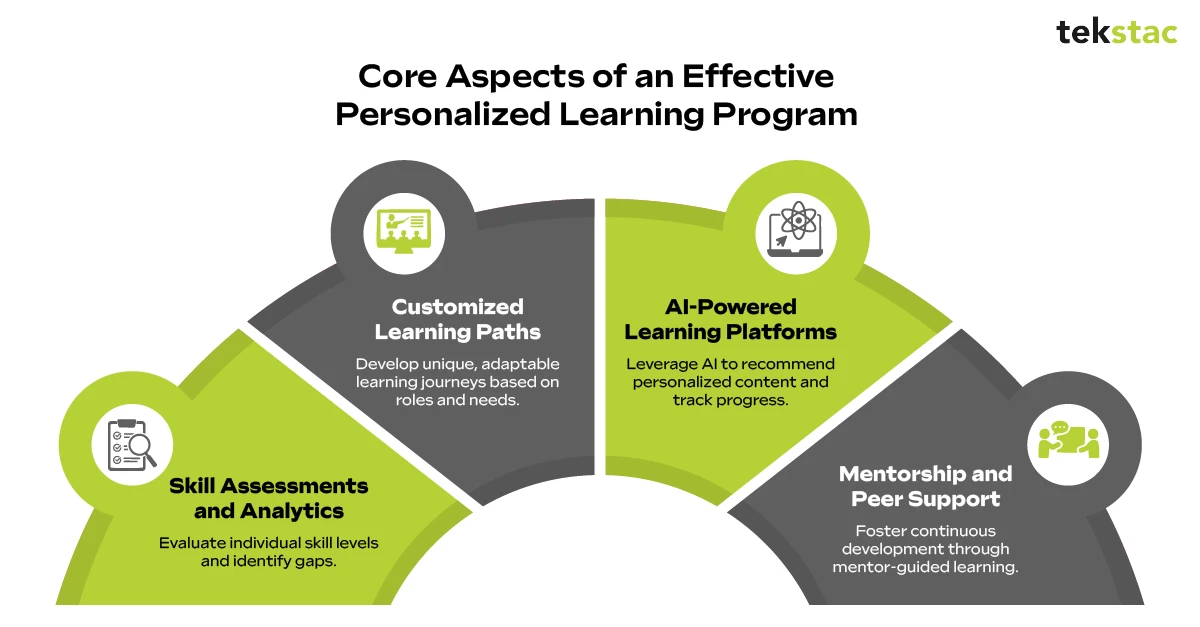
Designing an impactful personalized learning program requires meticulous planning & execution. Here are some key factors to consider.
The initial process for implementing personalized learning starts with identifying individual skill gaps. Regular evaluations and data analytics offer insights into each employee’s present skill level, thus enabling organizations to create targeted learning curves. This insight also helps senior-level managers oversee progress and refine learning agendas as necessary.
Some of the strategies that should be incorporated in personalizing learning include tailored paths that align with individual roles, career goals, and skill levels. These pathways can feature a combination of content types, like video guides, interactive modules, articles, and case studies to accommodate different learning styles.
Advanced AI technology can process data from employee evaluations and learning engagements and recommend customized content that suits each learner’s requirements. AI platforms can dynamically adjust learning paths dynamically thus providing a highly personalized experience and minimizing the need for human intervention.
Mentorship and peer support add more value to personalized learning. When employees are allowed to participate in peer-to-peer learning and build connections with mentors, it can drive knowledge sharing, cultivate a sense of community, and foster continuous improvement.
While the advantages of the personalized learning approach cover a wide range of aspects, successfully integrating it into a diverse organization involves overcoming potential challenges.
According to Gartner, 70% of employees report not mastering the skills needed for their current jobs.
Designing a personalized learning program to suit an individual’s needs requires substantial resources. Organizations that plan to maximize ROI should initially start by focusing on essential skills gap and then gradually expand the program.
Personalized learning is highly dependent on technology, such as artificial intelligence and data analytics. Incorporating these tools into an organization’s current framework demands strategic planning & investment.
Upskilling platforms like Tekstac are revolutionizing this process by providing a seamless, scalable solution for companies looking to implement personalized learning paths without the technological hurdles.
Tekstac’s platform uses advanced AI to create customized learning journeys for employees, aligning content with their skill levels, career aspirations, and specific job requirements. This integration simplifies the deployment of personalized learning, ensuring that technology becomes an enabler rather than a barrier.
Personalized learning programs are effective only if employees completely engage with them. Organizations need to highlight these programs’ advantages and help employees understand how personalized learning can advance their career growth.
Employees are more likely to participate in learning programs that resonate with their personal interests and career aspirations. Personalized learning enhances motivation by offering learning that aligns with an employee’s position, growth potential, and challenges.
A study by LinkedIn Learning revealed that 94% of employees would prefer to remain with a company that actively invests in career advancement, thus underscoring the critical role of immersive, tailored learning experiences in retaining talent.
Personalized learning allows employees to concentrate on specific skills related to their current job role, thus helping them learn new competencies more effectively. By utilizing AI-driven platforms and data-based assessments, personalized learning programs can detect and target each individual’s skills gap, thus refining the learning process.
For instance, if an employee wants to enhance their digital proficiency for a new position, a customized program can skip unnecessary learning content and focus on high-priority topics relevant to their responsibilities.
Based on a report by Deloitte, organizations using personalized learning are 58% more likely to report that their workforce’s skills align with business goals.
Allowing employees to advance at their own pace, personalized learning provides a refreshing alternative to traditional, rigid training programs. This flexibility is particularly helpful in a multifaceted team where each individual has different levels of experience or prior knowledge in specific areas.
Dynamic learning platforms can track an employee’s learning pace and modify content as needed to ensure that each learner grasps the required skills without feeling hurried or left behind. This approach prevents the learner from getting frustrated and sustains the learner’s confidence.
Regular evaluations and feedback cycles allow employees to monitor their progress and recognize areas for improvement. Continuous feedback helps employees rectify mistakes and strengthen their abilities, thus fostering ongoing skill enhancement.
For instance, an employee who is learning a new programming language can get immediate feedback in real-time on their coding exercises, thus allowing them to consistently hone their skills rather than waiting for formal reviews.
According to the National Training Laboratory report, personalized, adaptive learning methods lead to 60% higher retention rates compared to traditional lecture-based training.
Within a diversified workforce, employees contribute unique strengths & viewpoints. Personalized learning platforms offer peer-to-peer learning, motivating knowledge exchange across generations and cultural backgrounds.
Through discussion boards, collaborative projects, or mentorship programs, employees can benefit from each other’s experience and expand their skill sets. This approach helps close skills gap by leveraging the shared knowledge & expertise within the organization.
A study by McKinsey revealed companies that invest in personalized learning report a 20-25% increase in productivity.
Personalized learning goes beyond a mere trend; it is a proactive approach that addresses the needs of a diverse and rapidly evolving workforce. From boosting employee engagement and retention to improving productivity, the advantages of personalized learning are evident.
According to a study by Training Industry, employees in personalized learning programs reach competency 34% faster than those in traditional training programs.
As businesses invest in such programs, they become ready to embrace future challenges, building an environment where each employee is equipped with the right tools & support to succeed.
1. What is personalized learning in corporate training?
Personalized learning in corporate training tailors development programs to each employee’s needs, skill level, and learning style. It allows individuals to learn at their own pace, improving engagement and knowledge retention.
2. How does personalized learning help close the skills gap?
By aligning training with each employee’s specific skill gaps and goals, personalized learning ensures faster, targeted upskilling. This approach boosts individual and team performance while addressing evolving business demands.
3. What are the benefits of AI-powered personalized learning?
AI-powered personalized learning delivers adaptive content, instant feedback, and customized learning paths. It enhances learning efficiency, supports continuous development, and reduces the need for manual oversight.
4. What challenges do organizations face when implementing personalized learning?
Organizations often struggle with resource allocation, technology integration, and securing employee buy-in. Strategic planning and AI-powered platforms can help overcome these hurdles efficiently.
Recruiting the right employees has become increasingly complex in 2026. Instead, forward-thinking companies are strengthening their internal mobility strategy as a core pillar of their broader talent mobility strategy.
According to LinkedIn’s 2025 Workplace Learning Report, 44% of companies offering structured internal mobility programs identify it as a leading career-building practice that directly improves employee retention.
Rather than viewing mobility as occasional promotions or transfers, leading organizations treat it as a long-term workforce strategy. By aligning mobility and talent development, companies build resilient and future-ready teams.
This is precisely why a solid talent mobility strategy is no longer optional; it is the foundation of sustainable workforce growth. We will delve deeper into this in the upcoming sections.
Internal mobility refers to the structured movement of employees across roles, departments, projects, and career levels within the same organization. It includes promotions, lateral moves, cross-functional assignments, mentorships, and project-based gigs.
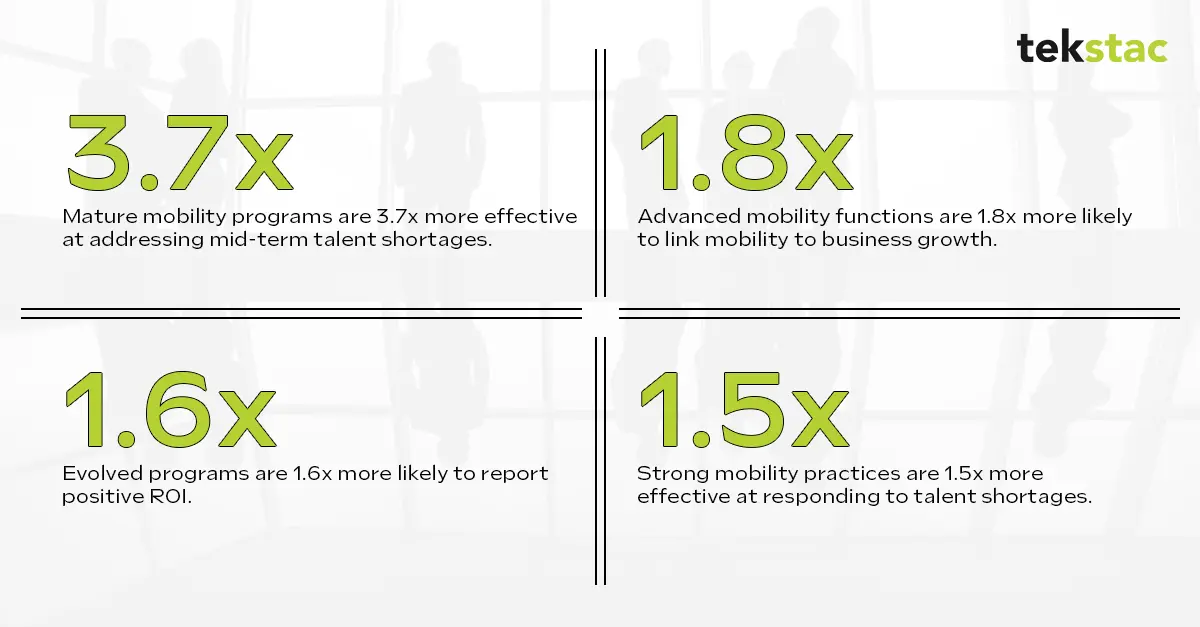
Source: EY
Today, organizations worldwide are facing a talent deficit for in-demand technology skills that is getting worse due to continuous advancements in technology.
According to the World Economic Forum’s Future of Jobs Report 2025, about 39% of workers’ core skills are expected to change by 2030, reflecting a significant ongoing shift in the capabilities businesses need.
As companies go through digital transformations, the requirement for new and specialized skills rises, causing businesses to struggle to keep pace.
The rise of generative AI has accelerated the need for agile workforce planning. Organizations are rethinking how mobility and talent development intersect.
Organizations are now focused on building agile, AI-ready workforces that align with both technological advancements and evolving workforce preferences. This shift has redefined talent management strategies to prioritize skill development in AI and adaptability.
As a result of this, many organizations shifted to external recruitment to fill these vacancies. However, this approach proved to be time-consuming & very expensive.
That number will rise faster for senior or technical positions. Meanwhile, internal employees seem to be cost-effective, more accessible to recruit, and more likely to fit the company culture.
However, cost efficiency is just one factor behind the company’s focus on strengthening its internal business environment.
There is also an ever-increasing demand for upskilling, development, and career progression.
Today’s workforce is not just seeking jobs but growth opportunities. Organizations that don’t offer internal mobility in HRM risk losing their human resources, especially to competitors who provide them.
Turn talent mobility trends shaping 2026 into measurable outcomes. Discover how Tekstac helps you build a skills-driven internal mobility strategy that accelerates growth.
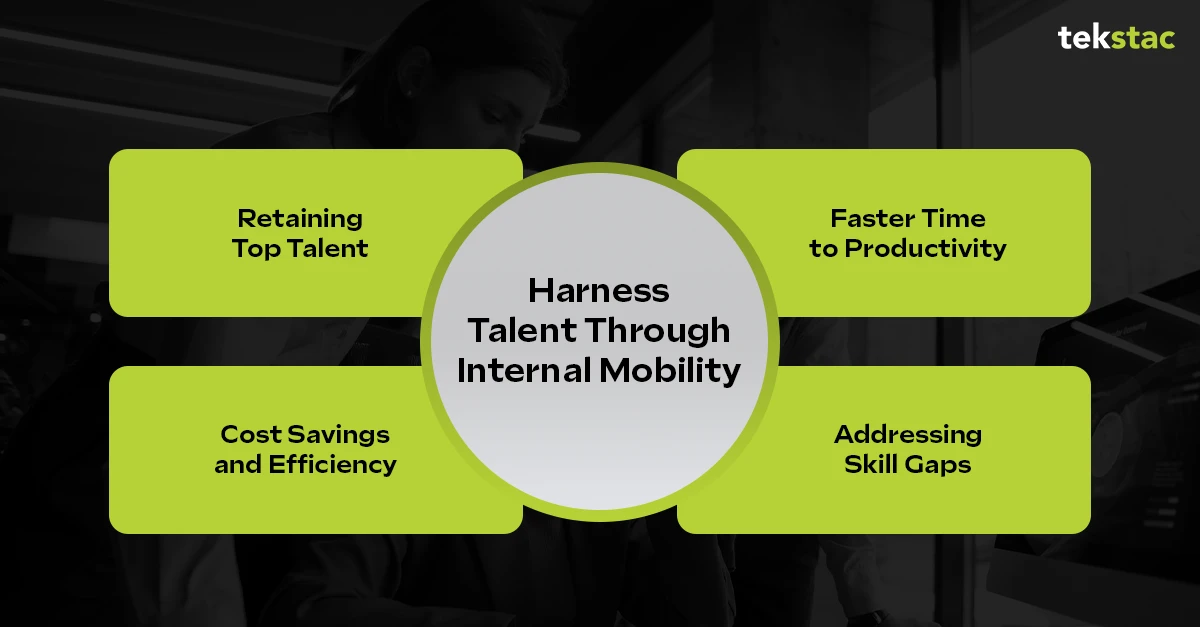
A well-designed internal mobility strategy plays a critical role in retaining high-performing employees. When employees have career development opportunities, they are more likely to stay with the organization.
Moreover, companies with high internal talent mobility rates keep their employees on average for 5.4 years compared with 2.9 years in companies with low internal mobility rates.
According to Gallup reports, 87% of millennials state that they consider development a vital factor when selecting a job.
Employees are likely to move to new organizations when they don’t see any career advancements.
Internal mobility is a perfect solution that shows employees there are options to explore new roles & projects within the organization, thus ensuring that top talents don’t have to move to another company.
External hires usually take a long time to reach peak productivity.
According to the National Bureau of Economic Research (NBER) survey, external recruits take 18-24 months to reach the performance level of internal hires.
On the other hand, in-house talents are always in tune with the firm’s operations, values, objectives, and strategy, thus progressing much faster.
Furthermore, internal employees have many organizational skills that external candidates cannot match. They are well aware of the company’s goals, internal team dynamics, and client base.
This allows employees to smoothly transition to other roles, particularly managerial and even cross-functional ones, driving quick business results.
Beyond retention and productivity, the benefits of internal mobility include measurable cost efficiencies. Internal hires require less ramp-up time, reduce dependency on external recruitment pipelines, and preserve institutional knowledge. Over time, this strengthens workforce stability and improves ROI on learning investments.
The increasing advancements in AI are transforming industries, and organizations are constantly using AI-driven platforms to assess employees’ skills and suggest relevant skilling programs.
Achieving this solely through external hiring can be very challenging. However, through internal mobility, organizations can enhance their existing workforce with the right skills and knowledge to succeed in new positions.
Based on LinkedIn data, 73% of learning and development leaders expressed that internal mobility has a positive impact on an organization’s capacity to address crucial skill gaps.
By combining structured upskilling with AI-driven internal mobility platforms, organizations can proactively match employees to emerging opportunities.
To maximize the benefits of internal mobility, organizations should integrate it into their culture and processes. Let’s see how
It is crucial to build a system that promotes internal mobility.
Employees need to feel empowered to look for new challenges at work without worrying about the consequences.
This demands clear communication from top management and systems that facilitate career shifts and internal job postings.
Learning and development are the key factors driving internal mobility in an organization.
Upskilling employees for new positions ensures that they are ready for the transformation.
In addition, companies that offer diverse development programs, such as leadership training and technical skill building, encourage the workforce to face new challenges head-on.
Data-driven insights are essential to identifying employees’ readiness for internal transitions.
With internal mobility in HRM taking center stage, HR teams can tap into talent analytics to better understand employee strengths, gaps, and goals. It’s about more than filling roles—it’s about helping people grow in the right direction.
Celebrating employees who take on new positions promotes a culture that values growth.
Performance incentives, public acknowledgment, and promotions associated with internal mobility lead to employee loyalty and great engagement.
Organizations that embed a structured internal mobility strategy into their workforce planning not only retain top performers but also build agile, future-ready teams capable of adapting to evolving industry demands. By fostering a culture of mobility, companies can create sustainable competitive advantages and ensure long-term business resilience.
Here comes the question!
How can organizations find the right platform to effectively upskill their workforce to support internal mobility?
Tekstac is the answer – a 360° skilling platform that provides tailored learning programs and resources, thereby ensuring employees are equipped with the right skills to confidently take on new roles.
1. What are the types of internal mobility?
Internal mobility includes promotions (upward mobility), lateral or role-to-role moves, intradepartmental and interdepartmental transfers, project-based mobility, mentorship opportunities, geographical transfers, and internal talent marketplaces that match employees to new roles or gigs within the organization.
2. What are the benefits of internal mobility programs?
Internal mobility programs improve employee retention, reduce recruitment costs, accelerate time-to-productivity, close skill gaps, strengthen cross-functional collaboration, and preserve institutional knowledge.
3. How do GCCs drive internal mobility strategy?
Global Capability Centers (GCCs) support internal mobility strategy by enabling geographical career movement, aligning global talent deployment with business expansion, and offering international assignments that enhance employee engagement, retention, and organizational flexibility.
Workplace learning is no longer a background function — it is a strategic lever. According to LinkedIn’s Workplace Learning Report, organizations where L&D is integrated into business strategy are 24% more likely to retain employees and significantly outperform peers on innovation metrics.
But knowing which voices to follow — and why they matter for your specific context — is the challenge. This list of 25 talent development leaders and L&D influencers is not a generic ranking. Each name has been selected based on their visible impact on how organizations build capability in 2026: through technology, inclusion, behavioral science, and on-the-job learning design.
Whether you are an L&D manager building your team’s curriculum, a CHRO rethinking your talent strategy, or an HR professional looking for frameworks that work — these are the practitioners and thinkers whose ideas are shaping what effective learning looks like right now.
A talent development leader is a professional responsible for designing, implementing, and measuring learning strategies that grow an organization’s human capability. Unlike a traditional L&D manager focused on training delivery, a talent development leader operates at a strategic level — connecting workforce skills to business outcomes, anticipating future capability gaps, and building cultures where continuous learning is the default.
In 2026, the role has expanded significantly. Talent development leaders now work at the intersection of HR technology, organizational psychology, DEI strategy, and AI-powered learning tools. The 25 leaders on this list represent the full spectrum of that expanded mandate.
This is a carefully selected list of 25 talent development leaders who will be driving change in 2026.
Josh Bersin is the most-cited analyst in enterprise HR and talent development. In 2025-26, his focus has shifted decisively toward AI-powered talent intelligence and skills-based organizations — his research shows companies with strong internal mobility programs outperform peers by 2x on retention. If you are a CHRO or L&D director setting strategy for 2026, his weekly briefings function as an industry early-warning system.
LinkedIn – https://www.linkedin.com/in/bersin/
Abhijit Bhaduri brings rare cross-context credibility — he has led L&D at both Microsoft and Wipro, advised Fortune 100 companies, and teaches at the University of Pennsylvania. What sets him apart in 2026 is his framing of ‘Career 3.0‘: the idea that employees must be coached to navigate AI-disrupted roles proactively, not reactively. His million-plus LinkedIn following reflects genuinely original thinking, not broadcast noise.
LinkedIn – https://www.linkedin.com/in/abhijitbhaduri/
A leader in diversity and inclusion, Amber Cabral is the founder of Cabral Co. She focuses on cultural change and fostering inclusive learning environments. Her deep understanding of how diversity enhances L&D makes her a critical voice in the space.
LinkedIn – https://www.linkedin.com/in/ambercabral/
Tiffany Stevenson, Chief People Officer at Patreon, is known for championing diversity and inclusion. Her work at both Box and Patreon has focused on creating people-first cultures, with an emphasis on belonging and engagement—key factors for driving productivity and innovation through L&D.
LinkedIn – https://www.linkedin.com/in/tiffany-stevenson-3298b813/
As L&D Manager at Netflix, Naphtali Bryant is behind some of the company’s most innovative learning programs. His focus on leadership development and motivation has made him a must-follow for HR and L&D leaders interested in building dynamic employee development initiatives.
LinkedIn – https://www.linkedin.com/in/naphtalibryant/
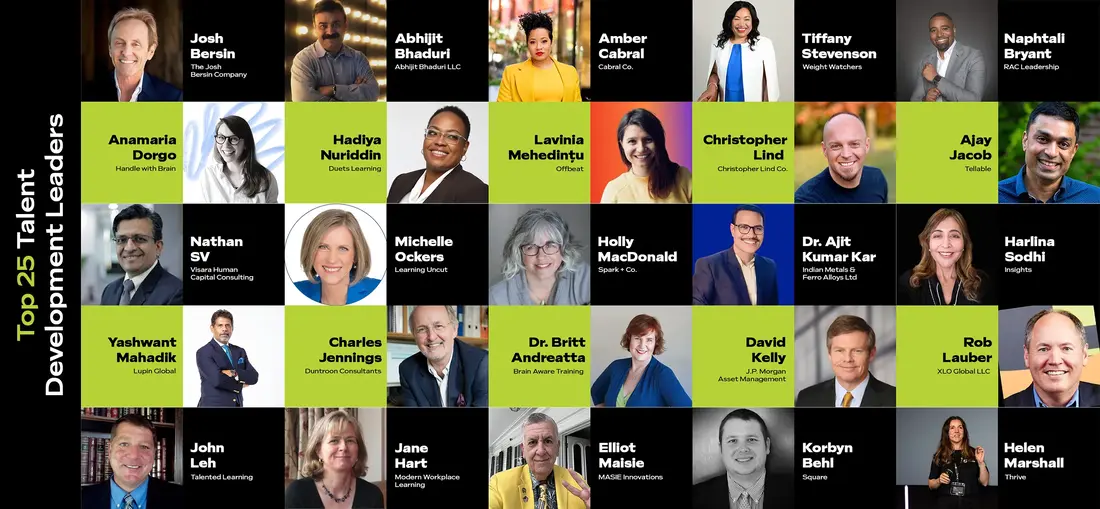
Founder of the L&D Shakers community, Anamaria Dorgo has pioneered peer-driven learning. She is a champion for social learning and community engagement, making her a leader in fostering collaborative, inclusive learning environments.
LinkedIn – https://www.linkedin.com/in/anamariadorgo/
An award-winning author and founder of Focus Learning Solutions, Hadiya Nuriddin is a force in instructional design. With over 20 years of experience, her workshops and practical strategies provide valuable insights for overcoming real-world L&D challenges.
LinkedIn – https://www.linkedin.com/in/hadiyanuriddin/
Lavinia Mehedințu, co-founder of Offbeat, is at the forefront of L&D innovation. She offers a forward-thinking perspective on behavioral change and social learning, helping organizations adapt their learning strategies to meet modern demands.
LinkedIn – https://www.linkedin.com/in/laviniamehedintu/
Christopher Lind is the Chief Learning Officer at ChenMed and host of Learning Tech Talks. He expertly combines learning strategies with technology, offering insights into the future of tech-driven learning ecosystems.
LinkedIn – https://www.linkedin.com/in/christopherlind/
Ajay Jacob is a learning strategist with a unique ability to align learning initiatives with business goals. His storytelling approach simplifies complex L&D concepts, making his expertise crucial for those aiming to create impactful learning environments.
LinkedIn – https://www.linkedin.com/in/ajaytj/
Nathan is the co-founder and chairman of Visara Human Capital Consulting, with over 30 years of experience in HR across industries like Manufacturing, IT, Telecom, and Professional Services. Previously, he served as the Chief Talent Officer at Deloitte India and was a member of the firm’s Executive Leadership and Deloitte’s Global Talent Council. Nathan is a respected leader, mentor, and advocate of ethical leadership, known for building high-performance teams and developing future leaders. He is also a trained coach with extensive expertise in talent management.
LinkedIn – https://www.linkedin.com/in/nathansv/
Michelle Ockers, host of the Learning Uncut podcast, offers strategies that bridge the gap between theory and practice. Her work focuses on aligning L&D with business outcomes, ensuring that learning initiatives drive tangible results.
LinkedIn – https://www.linkedin.com/in/michelleockers/
Holly MacDonald, learning strategist at Spark + Co, is known for her practical approach to solving business challenges through learning design. Her insights are a go-to for anyone looking to create high-impact, results-driven learning strategies.
LinkedIn – https://www.linkedin.com/in/hollymacdonald/
Dr. Ajit Kumar Kar specializes in digital learning and corporate training, with a focus on integrating technology into L&D environments. His expertise in e-learning and digital transformation is critical for organizations navigating the shift to digital-first learning ecosystems.
LinkedIn – https://www.linkedin.com/in/drajitkar/
Harlina Sodhi is a top HR influencer and expert on social media, known for her thought leadership in the HR field. She is the Co-Founder and CEO of Believe in Yourself, helping companies build high-performance cultures. With extensive experience in shaping company culture, developing leadership programs, and setting up D&I practices, Harlina is a sought-after speaker at HR events. Active on LinkedIn and Twitter, she shares valuable insights on human resources, making her a must-follow for those in the industry.
LinkedIn – https://www.linkedin.com/in/harlinasodhi/
Yashwant Mahadik (Yash) is a global HR leader with over 30 years of experience in multinational corporations across Technology, Consumer, and Healthcare sectors, with a presence in India, the UK, Japan, the USA, ASEAN, and Europe. His expertise includes HR strategy, leadership development, organizational transformation, and executive coaching, having led major initiatives at companies like J&J, Philips, Sun Pharma, and Lupin. Recognized as one of India’s top 50 HR professionals, Yash is an active thought leader on social media. He is passionate about social causes, particularly education for the underprivileged, and is also an avid golfer, traveler, and photographer, focusing on his venture, “Yash Mahadik Photography,” dedicated to wildlife conservation.
LinkedIn – https://www.linkedin.com/in/yashmahadik/
Charles Jennings created the 70:20:10 model that is now the default reference framework for modern L&D design. What remains underappreciated is that he continues to refine and defend the model against misapplication — in 2024-25, he has been particularly vocal about organizations using 70:20:10 as a budget-cutting excuse rather than a learning architecture principle. If you are designing learning ecosystems rather than training catalogues, Jennings is essential reading.
LinkedIn – https://www.linkedin.com/in/charlesjennings/
Dr. Britt Andreatta combines psychology and neuroscience to revolutionize how people learn. Her brain-based approach to training helps organizations design more effective learning programs that align with how the brain learns best.
LinkedIn – https://www.linkedin.com/in/brittandreatta/
David Kelly leads The Learning Guild, the largest community of practice for L&D professionals globally. His value in 2026 is practical: he cuts through technology hype to focus on what learning tools actually improve performance outcomes, not just engagement metrics. If you are evaluating LMS platforms, authoring tools, or AI-powered learning systems, Kelly’s frameworks provide a vendor-neutral lens.
LinkedIn – https://www.linkedin.com/in/drdavidkelly/
Rob Lauber led the digital transformation of learning at McDonald’s — an operation that trains hundreds of thousands of frontline workers across 100+ countries. His work on mobile-first, app-delivered microlearning at enterprise scale provides a model for any large-scale workforce training challenge. In 2026, his insights on measuring learning ROI through operational metrics (not just completion rates) are directly applicable for L&D leaders under budget scrutiny.
LinkedIn – https://www.linkedin.com/in/rob-lauber/
John Leh is Founder and CEO of Talented Learning, an industry analysis and consulting firm that provides fiercely independent guidance through research, podcasts and other resources for learning systems buyers and sellers. His work in tech-driven L&D is reshaping how corporate learning is delivered.
LinkedIn – https://www.linkedin.com/in/johnleh/
Jane Hart, founder of C4LPT, is a digital transformation expert who advises organizations on how to improve their L&D strategies. Her work is at the forefront of helping businesses adopt modern learning technologies.
LinkedIn – https://www.linkedin.com/in/c4lpt/
Elliott Maisie is one of the longest-serving voices in corporate learning, with over 40 years of practice. What makes him worth following in 2026 specifically is his continued skepticism of L&D fads — he applies a rigorous ‘does this actually change behavior?‘ lens to AI-generated learning content, microlearning hype, and skills frameworks. His annual Learning conference remains a benchmark for serious L&D executives.
LinkedIn – https://www.linkedin.com/in/elliottmasie/
As Global Manager of Learning Delivery at Expedia, Korbyn Behl is recognized for his innovative approach to L&D. His experience in performance consulting and people leadership has made a profound impact on learning strategies at Expedia.
LinkedIn – https://www.linkedin.com/in/korbyn-behl/
Helen Marshall is an award-winning Learning and Development professional, honored as the Leader of the Year 2024 at The British Training Awards for her contributions to the L&D community. She frequently shares her insights on workplace trends as a guest on BBC Radio 4’s The Bottom Line, where she contributes to discussions about the evolving landscape of work. With a passion for fostering meaningful conversations, Helen continues to inspire others in the field of Learning and Development.
LinkedIn – https://www.linkedin.com/in/helearning/
These 25 Talent Development Leaders are shaping the future of workplace learning by championing innovation, inclusivity, and technology, and by following them you gain access to the latest insights, trends, and proven strategies to strengthen your L&D approach in 2026 and beyond — and if you want to go deeper into applying these ideas within your organization, you can also read our detailed Talent Development Strategy blog for a step-by-step blueprint to put them into action.
1. What is the difference between a talent development leader and an L&D leader?
L&D leader typically refers to the head of a Learning and Development function focused on training delivery and program management. Talent development leader implies a broader mandate: succession planning, skills architecture, leadership pipelines, and workforce transformation. In practice, senior practitioners in 2026 work across both domains.
2. Who are the leading talent development experts in India?
India’s most influential talent development leaders include Abhijit Bhaduri (former CLO at Microsoft and Wipro, author of Career 3.0), Nathan SV (former Chief Talent Officer at Deloitte India), Harlina Sodhi (Co-Founder of Believe in Yourself), and Yashwant Mahadik (former HR executive at J&J, Philips, and Lupin). Each brings global experience with deep insight into India’s talent development landscape.
3. How were these 25 talent development leaders selected?
Leaders were selected based on their demonstrated impact across five dimensions: contribution to learning innovation and methodology, influence on industry practice through writing, speaking, or research, commitment to inclusive and equitable talent development, engagement with technology and digital learning transformation, and active presence sharing insights with the broader L&D community in 2025-26.
4. What is the best L&D podcast to follow?
For practitioner case studies with no vendor bias, Learning Uncut by Michelle Ockers is the most consistently trusted. For technology decisions, Learning Tech Talks by Christopher Lind is essential. For learning systems buyers and sellers, The Talented Learning Show by John Leh provides fiercely independent analysis.

Tekstac is an AI-powered learning and development platform designed and delivered upskilling programs for one of the world’s largest Fortune 500 technology companies: a 300,000+ person global workforce requiring 40,000 fresh graduate hires every year.
The outcomes: 1,100,000+ learners trained across pre-hiring, pre-onboarding, and post-onboarding stages. Retention rates increased by 33%. Hiring costs reduced through automated assessment pipelines eliminating manual screening of 30,000+ graduate candidates annually.
This case study covers the three upskilling program stages, the design decisions behind each, and the measurable results Tekstac delivered.
The traditional recruiting techniques were slow, expensive, and inefficient as they often failed to deliver the right qualified candidate.
In December 2019, Tekstac was engaged by the company to develop customized programs to address skill and assessment at various talent acquisition phases. These programs targeted three key learner categories:
The initiative aimed to upskill over 1,100,00+ learners globally.
Tekstac’s upskilling programs are end-to-end learning systems covering three stages of the talent lifecycle: pre-hiring assessment, pre-onboarding preparation, and post-onboarding skill development. Each program combines self-paced digital learning content, hands-on technical labs, automated assessments, and real-time dashboards — designed to run at an enterprise scale without proportional increases in trainer headcount or cost.
For Fortune 500 companies managing cohorts of 10,000+ learners simultaneously, Tekstac’s programs deploy across technology domains including Java, .NET, Python, and niche engineering roles, with 100+ learning paths covering the full range of graduate-to-specialist progression.
Navigating the complexities of talent acquisition and onboarding posed significant hurdles for the company. Below are the key challenges identified in the engagement with Tekstac:
It required a fast method to screen out highly suitable candidates from a pool of more than 30,000+ pre-final year graduates from affiliated colleges.
Conventional recruitment and selection approaches were expensive and time-consuming, and employers were frequently unable to reach the best talents for positions in product creation and specialized technology fields.
As 40,000+ students pass pre-onboarding yearly, it was important for the client to verify that the candidates were equipped with the required skills before joining the organization.
The challenge was to develop an integrated, self-paced learning process for the graduates to acquire skills in key technologies such as Java,.NET and Python.
The company employed 40,000 fresh graduates every year & managing them proved to be a massive task. This particular client asked us to develop an affordable model for training these graduates, without compromising the value or efficiency of the training program.
Maintaining high-quality training across different learning streams requires higher costs. The client needed a well-managed efficient program to drive the control of expenses across its business units without compromising performance.
Tekstac met these challenges through a range of customized, self-paced programs that were carefully designed to enhance learning outcomes, improve learner interest, and optimize expenses.
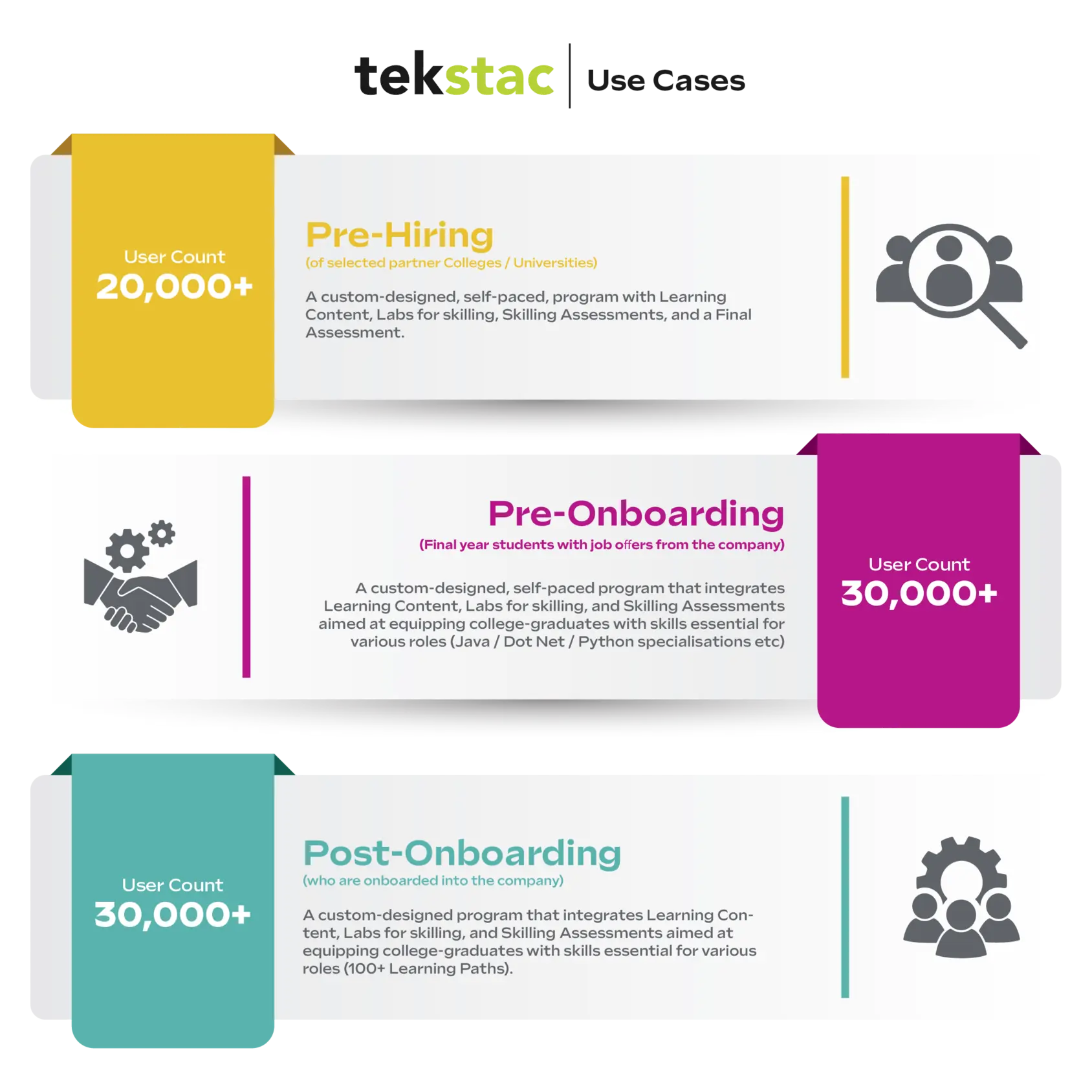
For the final year graduates of universities, Tekstac developed a custom-designed, self-paced program that included:
Outcome:
With this tailored program the client was able to identify high-potential talents early, which led to premium offers for selected roles. The micro-certifications that have been developed increased the interest of the partner college graduates since they could now secure job offers with better pay.
For the pre-onboarding phase, Tekstac created a custom-designed, self-paced program for 40,000+ fresh graduates who had received job offers from the client. This program integrated:
Outcome:
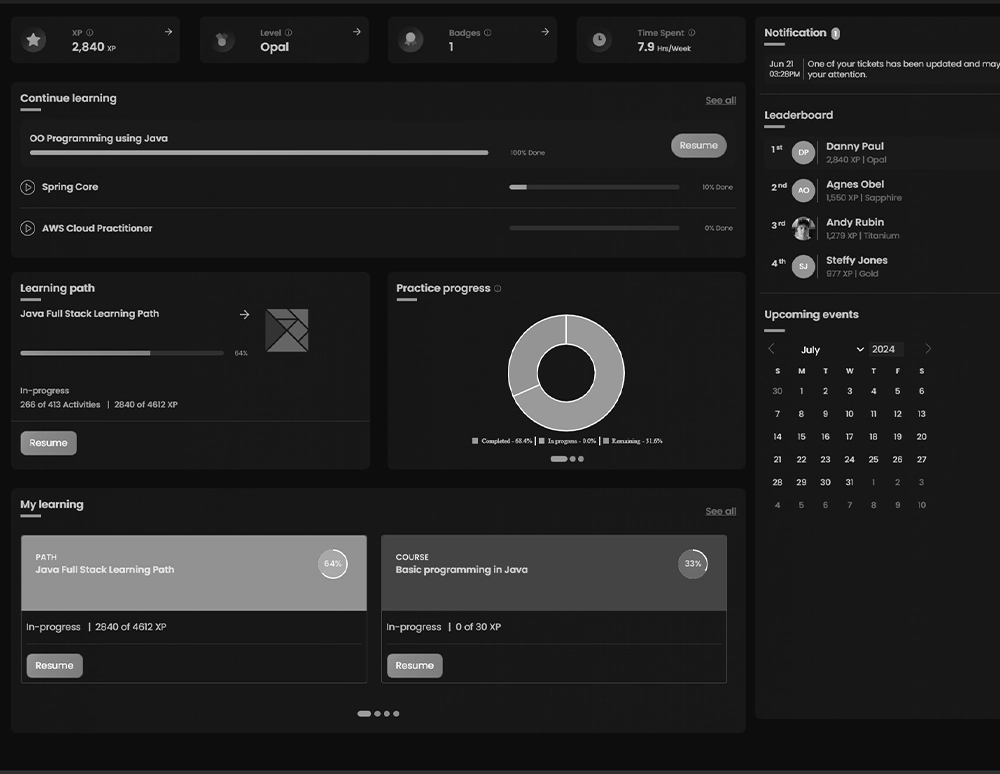
The program allows the graduates to complete a lot of basic training before having an official start. Real-time progress dashboards ensure stakeholders are updated, thus keeping the results aligned with the goals set. It also improved the intern preparedness across the various business sectors.
For fresh graduates who were yet to onboard into the company, Tekstac developed a customized program that included:
Outcome:
This approach enables our clients to maintain top-quality standards while optimizing trainer engagement and cost. The program surpassed the performance goals established by business units, which meant that new hires were equipped to start contributing from day one.
Through automated assessments and a three-stage upskilling pipeline, Tekstac eliminated manual screening across 30,000+ graduate candidates annually — directly reducing recruiter time-to-shortlist and cost-per-hire.
Retention rates increased by 33% due to early identification of top talent and better engagement with pre-onboarding and fresh graduate learners. This led to a faster time-to-productivity and effectively aligned everyone with organizational goals.
The result achieved with a combination of micro-certifications, personalized learning paths, and hands-on, was a highly engaged and well-prepared talent pool.
Thousands of learners across different regions highly benefited from the scalable and flexible programs Tekstac offered, without compromising on the quality.
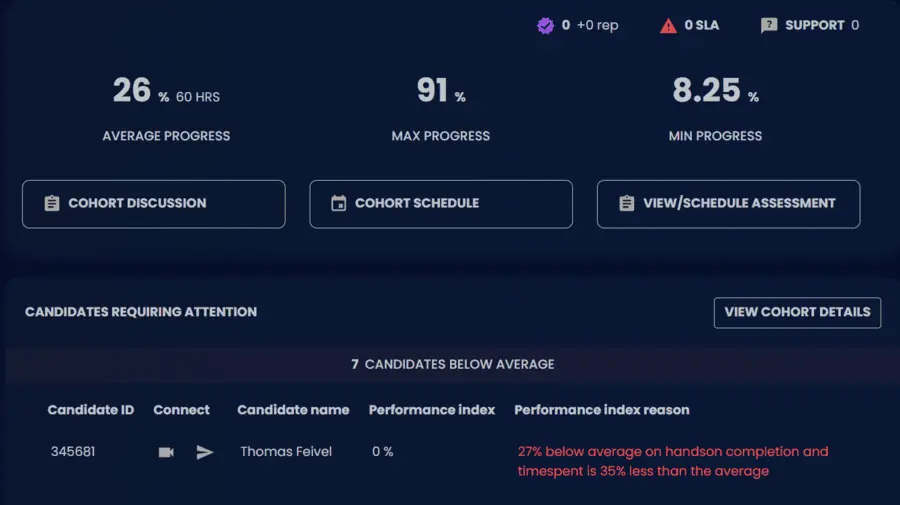
Tekstac’s real-time dashboards for the HR and training teams allowed them to monitor and make data-driven modifications to the programs based on the desired outcomes.
The client was able to overcome all the challenges in talent identification, skilling, and onboarding with Tekstac’s innovative & customizable solutions.
The efficient & engaging programs enhanced the return on investment in employee recruitment and ensured a constant stream of highly skilled talent, thus making the company maintain its competitive advantage amidst international trends in the global technology sector.
1. Who offers scalable employee upskilling programs for Fortune 500 firms?
Tekstac offers scalable employee upskilling programs for Fortune 500 companies. Tekstac is an AI-powered learning and development platform that delivers end-to-end upskilling programs covering pre-hiring assessment, pre-onboarding preparation, and post-onboarding skill development at cohort sizes of 10,000+ learners simultaneously. The platform combines hands-on technical labs, self-paced content, automated assessments, and real-time analytics dashboards.
2. What do enterprise upskilling programs typically include?
Enterprise upskilling programs typically include structured learning content across technical domains, hands-on lab environments for practical skill development, automated assessments to measure progress and readiness, and dashboards giving HR and L&D teams real-time visibility. Tekstac’s programs add 100+ learning paths covering Java, .NET, Python, and niche technology roles mapped to three stages of the talent lifecycle.
3. What results can a Fortune 500 company expect from structured upskilling programs?
Based on Tekstac’s Fortune 500 engagement: 1,100,000+ learners trained, a 33% increase in employee retention rates, 40,000+ fresh graduates onboarded annually, and 30,000+ candidates screened through automated pre-hiring assessments reducing manual recruiter effort and cost-per-hire across the pipeline.
4. What is the difference between pre-onboarding and post-onboarding upskilling programs?
Pre-onboarding upskilling programs equip new hires with required technical skills before their official start date reducing ramp-up time and day-one skill gaps. Post-onboarding upskilling continues development after joining, building depth across role-specific learning paths. Tekstac delivers both integrated programs with shared dashboards and aligned progression assessments.
5. How do upskilling programs scale across 40,000+ employees per year?
Upskilling programs scale at enterprise volume through automated assessment pipelines, self-paced digital content, and programme management tools that reduce reliance on individual trainer capacity. Tekstac managed 40,000+ fresh graduate hires annually for a Fortune 500 client through structured pre-onboarding and post-onboarding programs maintaining quality across multiple business units and geographies without proportional cost increases.
Employee training and development is the structured process of building job-relevant skills, closing capability gaps, and preparing employees for future roles — aligned to both individual growth and business objectives.
In 2026, the practice has moved well beyond scheduled classroom sessions. Organizations are combining AI-driven personalization, microlearning, and skills analytics to create continuous development program that adapt in real time to each employee’s performance. This guide covers the strategies, technologies, and trends reshaping how HR and L&D teams invest in workforce capability.
This blog delves into the future of workforce training and development on a macro level, breaking down emerging practices, technologies, and strategies influencing how organizations invest in human capital.
Employee training and development is a structured, continuous process that helps employees build job-relevant skills, enhance performance, and prepare for future roles. It combines targeted training programs, digital learning tools, and career-focused development initiatives to align individual growth with organizational goals and long-term business success.
Unlike one-off training events, a mature employee training and development program is ongoing integrating onboarding, role-based upskilling, leadership development, and reskilling into a single, connected capability-building system.
Out of all the transitions in employee training & development, nothing has had such a huge impact as shifting to digital platforms. ‘These shifts collectively define the future of training and development for enterprise organizations. Employees can gain access to various online resources, video tutorials, interactive simulations, etc., and they can do so anytime and from anywhere. Its built-in flexibility and accessibility allow employees to learn on their own time, which makes finding a balance between work and personal development much easier.
In addition, digital platforms allow companies to track employee training progress with learning management systems (LMS) and gain insights that can help leadership better understand knowledge retention and successful completion rates of their employees. This data-driven approach aids in tailoring future training programs to be more efficient and in accordance with the organization’s goals.
To make these decisions more precise, organizations rely on skills analytics to convert training data into actionable insights for workforce planning and capability building.
Here are some key trends that are transforming the landscape.
Over the next few years, personalized training programs will be more accurate. The one-size-fits-all, traditional model of training has been ineffective because every employee has different learning styles, career goals, and skill gaps. With the help of data analytics and artificial intelligence (AI), organizations can create and deploy customized learning pathways, tailored to the specific needs of every employee on a larger scale.
Personalized learning ensures that employees are not wasting time on irrelevant content and instead concentrate on the learning path they need to follow to succeed in their respective roles. This approach results in higher engagement and effective learning outcomes, leading to a workforce containing more skilled employees solving bigger challenges.
Case Study: IBM saw a 40% reduction in training time by implementing microlearning strategies while improving knowledge retention among employees.
Did you know?
Some AI-driven learning platforms are experimenting with virtual “coaches” that take the form of characters like a wise wizard or a tough but fair superhero to guide employees through their learning journey.
Traditional training courses with long sessions are now being replaced by microlearning benefits, where training is delivered in small, focused doses. Microlearning typically consists of 5-10 minute modules, designed to tackle specific competencies.
This method suits present-day learners who want something flexible and portable, which also improves retention rates. Additionally, microlearning in corporate training solutions enables employees to learn new information even without detaching from their organizational tasks, meaning that learned skills can easily be applied to their tasks.
Gamified learning experiences are among the emerging trends in the area of training and personal development of employees. Organizations can incorporate features like scores, leaderboards, points, badges, and challenges into training activities to improve engagement and motivation among employees.
Consequently, employees are more inclined to attend and complete courses if the training appears fun and rewarding. Gamification enhances employee engagement through training and fosters a competitive but collaborative learning environment.
Want a smarter approach to employee training and development? Explore the latest Learning and Development Trends shaping 2026 and beyond.
Technology is at the forefront of the future of workplace learning strategies. Here are some ways in which technology is reshaping the learning landscape:
Present-day LMS for corporate training act as comprehensive platforms for managing and delivering training content. These systems include features like tracking progress, evaluation, and reporting, helping organizations monitor and evaluate employee development.
AI in employee training is one of the most influential trends reshaping workforce development. A study by Deloitte found that AI-driven training improves skill acquisition efficiency by 40%. AI-driven training solutions can analyze large datasets to determine skill gaps and create curriculum-based corporate training solutions. Moreover, they help build adaptive learning environments that change content based on learners’ performance in real time.
AI-driven learning platforms make it easier for employees to access diverse online courses and resources. Many of these platforms include interactive simulations, quizzes, and video-based lessons, improving learning engagement.
The importance of data analytics in training programs cannot be overstated. Organizations can make data-driven decisions to improve training strategies by analyzing employee performance, engagement levels, and feedback.
For upskilling the workforce with digital training, organizations need to implement effective strategies that align with business objectives. Here are a few key strategies:
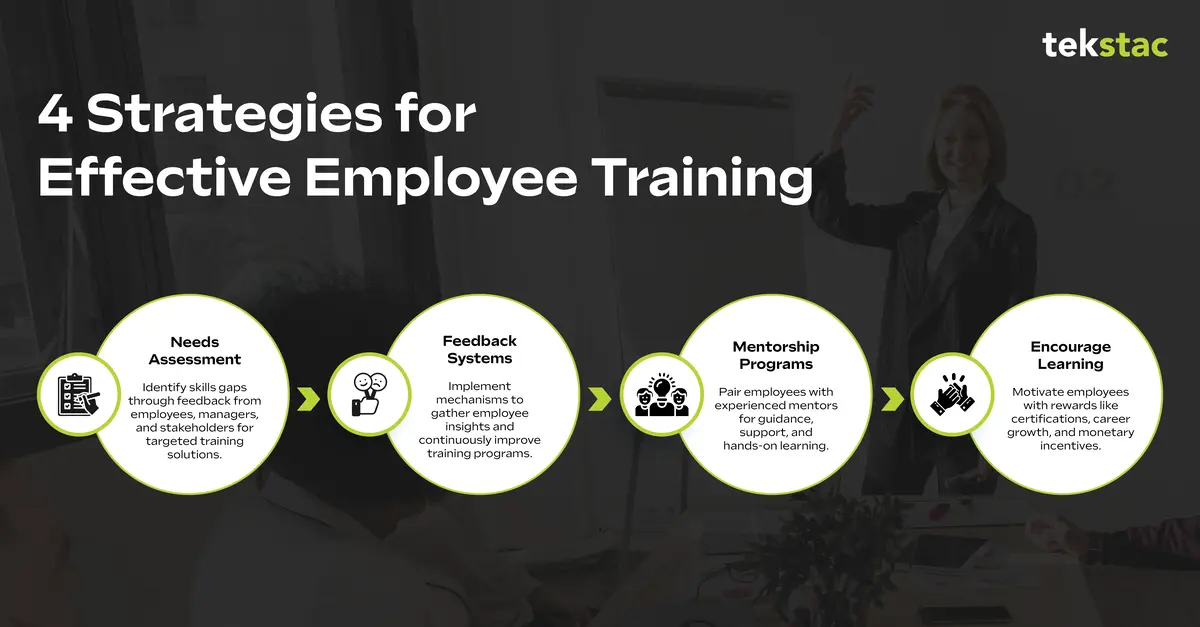
Conducting a thorough needs assessment is essential for pinpointing skill gaps and identifying employee training requirements. Gathering feedback from employees, managers, and stakeholders ensures corporate training solutions are relevant and effective.
Implementing consistent feedback mechanisms helps organizations refine training interventions and keep them aligned with employee expectations.
Connecting employees with experienced professionals fosters guidance, support, and hands-on learning. Personalized training programs with mentorship can significantly boost workforce development.
To enhance employee engagement through training, organizations can offer rewards such as certifications, career advancement opportunities, or monetary bonuses.
The future of training and development belongs to organizations that adopt targeted, technology-led strategies aligned to business outcomes.
The future of training and development is being shaped by AI, data analytics, and the demand for continuous, personalized learning. As technology continues to advance, organizations must stay ahead by embracing innovative workplace learning strategies. By investing in employee development and implementing effective training strategies, companies can build a skilled, adaptable, and motivated workforce ready to tackle the challenges of tomorrow.
1. What are the best employee training and development methods in 2026?
The best employee training and development methods in 2026 include AI-powered personalized learning, microlearning, skills-based training pathways, immersive simulations, and data-driven LMS platforms that support continuous, role-aligned workforce development.
2. What are the key trends in employee training and development in 2026?
The defining trends in 2026 include: AI-driven personalized learning paths that adapt content based on individual performance data; microlearning modules (5–10 minutes) replacing long-form training sessions; gamification elements — badges, leaderboards, and challenges — that improve completion rates by 40–60%; and skills-based development frameworks that replace generic course catalogues with role-specific capability maps. Data analytics is now standard practice for connecting training investment to measurable business outcomes.
3. What should organizations look for in an employee training and development platform?
The most effective platforms in 2026 combine four capabilities: skills assessment tools to benchmark current proficiency by role; LMS functionality for structured, compliance-driven programmes; LXP features for self-directed, personalized learning paths; and analytics that surface individual skill gaps and connect training completion to performance KPIs. For tech-intensive industries, hands-on labs and coding challenge environments are critical additions that generic content platforms do not support.
4. How do you measure the ROI of employee training and development?
Measure ROI across three dimensions: efficiency (reduction in time-to-proficiency per role), performance (OKR or KPI attainment pre- and post-training), and retention (turnover rate in teams with high learning engagement vs low). IBM’s internal data demonstrates a strong benchmark: employees who engaged with structured learning credentials showed measurable improvement in sales target attainment and career advancement rates. The critical rule: establish your baseline metrics before deployment — without pre-implementation benchmarks, post-training ROI claims are unverifiable.
In today’s corporate world, training programs are often viewed as a necessary but uninspiring task. With long presentations, endless modules, and monotonous content, employee engagement during learning/upskilling can take a hit.
But what if we could inject some excitement and motivation into the process?
Enter gamification: the strategic use of game elements—like levels, rewards, and friendly competition—that are now revolutionizing employee training. These tools not only captivate attention but also turn passive learners into active participants. With gamification, businesses are discovering a powerful way to enhance learning engagement and make training not just bearable but enjoyable.
Here’s a fun fact!
The word “gamification” was first coined in 2002, but it didn’t gain widespread popularity until 2010. Today, nearly every sector uses gamification techniques to drive engagement—from fitness apps to marketing campaigns!
Employees compete for top spots on a leaderboard as they race through compliance modules, or teams collaborating to solve business challenges in a simulated environment. Gamification makes training interactive, fun, and competitive, all while reinforcing key learning outcomes. It’s no surprise that more and more companies are weaving game elements into their training programs to help employees stay focused, motivated, and invested in their learning.
Research highlighted by Columbia Business School found that gamified training can improve learning outcomes and business performance, including higher client retention and revenue growth when implemented effectively.
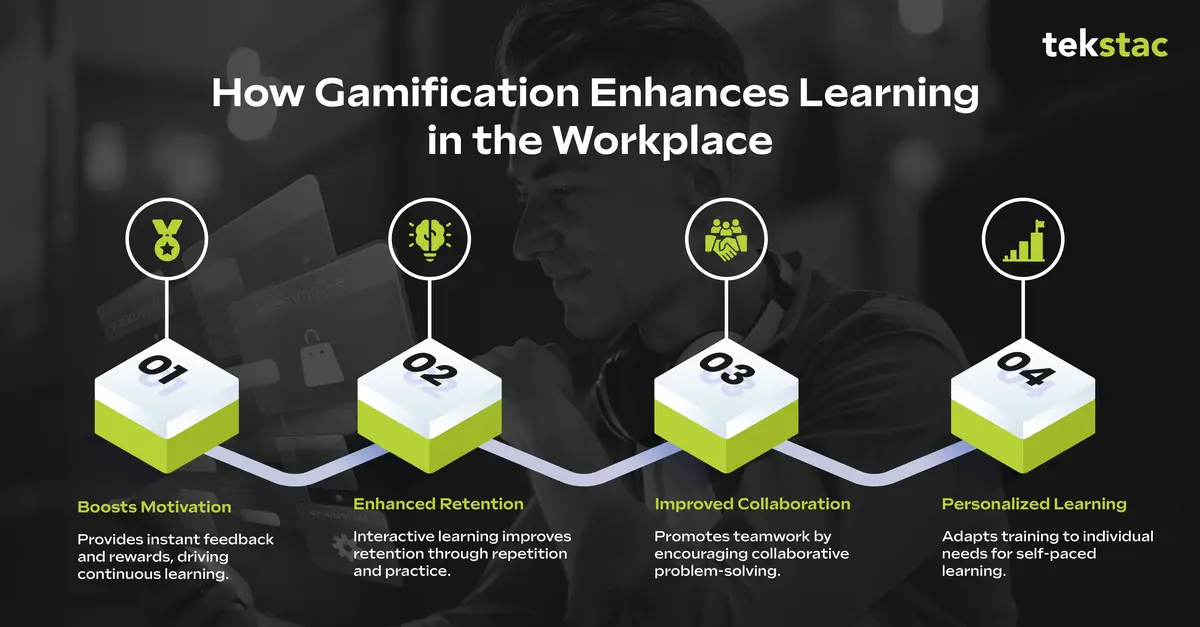
Gamification taps into employees’ intrinsic motivation by providing immediate feedback and rewards. This helps to create a sense of accomplishment and encourages employees to continue learning.
Interactive and immersive learning experiences help employees retain information better. Gamified training activities often involve repetition and practice, which are crucial for memory retention.
Many gamified training platforms encourage collaboration and teamwork. Employees can work together to solve problems, complete challenges, and achieve common goals, fostering a sense of community and cooperation.
Gamification allows for personalized learning experiences. Employees can progress at their own pace, and the training activities can be tailored to their individual needs and preferences.
Gamifying corporate training doesn’t require turning every training session into a full-scale video game. Even small elements of gamification in learning can make a big difference. Here are a few strategies businesses can use to bring gamification to life in their training programs:
Imagine earning points for completing tasks, badges for mastering key skills, and unlocking new levels as employees advance through the training. Points and badges offer a simple yet powerful way to motivate employees by creating visible milestones. These rewards give employees a sense of accomplishment and encourage them to continue learning.
Leaderboards can introduce a healthy dose of competition into training. Employees see how they’re stacking up against their peers and are motivated to improve their performance. For companies that emphasize teamwork, team-based leaderboards can encourage collaboration, as employees work together to climb the ranks.
Turning training modules into quests or challenges makes learning feel like an adventure. Employees might embark on a “mission” to solve a customer problem, complete a complex project, or achieve specific KPIs. By adding a narrative to the learning process, these challenges can make the material feel more engaging and relevant.
One of the biggest advantages of gamification is the ability to create simulations that mimic real-world challenges. For instance, sales teams could practice negotiating with a difficult customer, or marketing teams might be tasked with developing a new product launch strategy. These real-life scenarios make learning more meaningful and provide employees with a safe space to practice their skills.
While gamification in learning brings plenty of benefits, it’s important to recognize that not all employees are motivated by competition or external rewards. Some may find leaderboards or badges distracting or irrelevant to their personal learning style.
Therefore, it’s crucial for companies to offer a variety of gamified elements that appeal to different learning preferences, ensuring that every employee can engage with the training in a way that works best for them. Moreover, companies need to ensure that gamification doesn’t overshadow the primary learning objectives.
The focus should remain on mastering skills and retaining knowledge, not just accumulating points or badges. Successful gamified training programs find a balance between fun, engagement, and educational outcomes.
As companies continue to look for ways to boost employee engagement and performance, gamification is poised to play an even bigger role in corporate training programs. With advances in technology such as virtual reality (VR) and artificial intelligence (AI), gamified learning will become even more immersive and personalized.
Imagine donning a VR headset to step into a virtual sales meeting, or having AI customize your training path based on your progress and learning style. The possibilities are endless, and the future of corporate learning looks more exciting than ever.
Gamification has the power to transform corporate training from a mundane task into an engaging, interactive, and highly effective learning experience. By incorporating game elements like points, leaderboards, badges, and real-world challenges, companies can enhance learning engagement, improve knowledge retention, and boost employee performance.
As businesses continue to innovate, gamification will play a critical role in creating training programs that employees not only complete but genuinely enjoy.
1. What is gamification in learning?
Gamification in learning involves using game-like elements such as points, badges, leaderboards, and challenges to make the learning process more engaging, interactive, and fun. It motivates learners by incorporating rewards and recognition into their educational journey.
2. How effective is gamification in learning?
Gamification boosts learning engagement by up to 60% and improves retention by 25% to 60%. This approach motivates learners, enhances participation, and deepens their understanding of the material for real-world application.
3. Is gamification suitable for all types of learners?
While gamification appeals to many learners due to its interactive and fun nature, it’s important to customize it to the audience. Different learners respond to different types of challenges and rewards, so personalizing gamification elements is key to its success.
4. Can gamification be effectively used in corporate training?
Absolutely! Gamification is particularly effective in corporate training, as it encourages employees to learn new skills in a fun, interactive way, making the training process more engaging and memorable.