
Reid Hoffman’s book ‘Superagency: What Could Possibly Go Right with Our AI Future’ asks a provocative question: what if AI expands human capability instead of replacing it? That question now defines the reality of AI in HR.
Across boardrooms in every corner of the world, AI is no longer experimental; it is operational. CHROs are not asking whether AI belongs in HR. They are asking how fast they can deploy it without losing control.
During HR roundtables we conducted across India in 2025, several CHROs shared that their organizations reduced hiring timelines by up to 47% after implementing AI-driven recruitment systems. That number isn’t incremental. It’s structural. This blog walks through the frameworks, implementation models, real-world impact metrics, and leadership decisions shaping that shift in 2026 so HR leaders can move from experimentation to enterprise transformation.
At its foundation, artificial intelligence in HR refers to the integration of machine learning, predictive analytics, generative AI, conversational systems, and intelligent automation into core HR processes.
This includes:
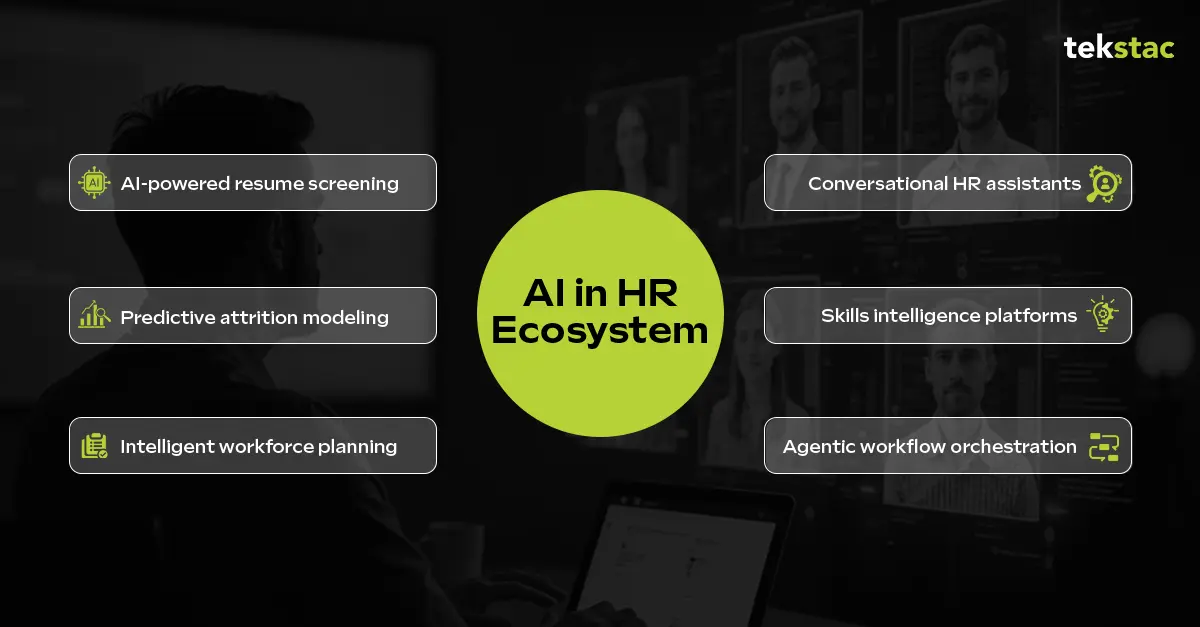
Unlike traditional HR automation, which focused on digitizing forms and workflows, AI introduces cognition into systems. It enables pattern recognition, forecasting, personalization, and adaptive decision-making.
This marks the shift from process digitization to digital HR transformation.
Instead of asking what happened last quarter, HR can now ask:
The urgency around AI adoption in HR is not theoretical. Let’s see some actual numbers.
According to McKinsey & Company – Global AI Survey, 65% of professionals report their organizations use AI in at least one business function. Yet within HR specifically, maturity remains uneven.
43% of organizations now use AI in HR, up from 26% in 2024. 45% of Indian organizations have already integrated Generative AI into HR, with 93% reporting increased efficiency.
And yet 93% of employees say AI is underutilized. 55% of HR leaders say their tech stack does not meet evolving needs. 60% of business leaders admit they lack a clear AI implementation vision.
This is the paradox of the current moment: High investment. Low clarity.
The organizations delaying implementation are not saving money. They are widening the capability gap.
The Future of Work with AI will not wait for organizations to feel ready. To remain competitive, organizations must focus on helping employees outskill AI, building capabilities that complement AI technologies rather than lag behind them.
Josh Bersin describes the current phase of AI in human resources as enthusiastic but immature. Many companies are experimenting, but few have identified high-impact, scalable use cases.
He emphasizes that AI deployment is not like ERP rollouts. It requires iteration, trust-building, and continuous governance, particularly in hiring and performance evaluation.
At the same time, one of the leading reports in 2026 projects that the global AI in HR market will grow from $4.3 billion to $25 billion by 2031.
Drivers of this growth include:
Much of this momentum is being shaped by emerging AI trends in L&D, as organizations rethink how skills are built, measured, and scaled across the enterprise.
The following case studies highlight how AI is transforming HR from an administrative function into a strategic growth engine.
A global retail enterprise deployed an AI-powered hiring assistant. Due to this, application completion rates increased from 50% to 85%. Hiring timelines reduced from 12 days to just 4.
Result? Efficiency improved and more importantly, candidate experience improved.
In another remarkable instance, Unilever implemented AI-driven assessments in early hiring stages and reported improved diversity in candidate pipelines while reducing time-to-hire. As former CHRO Leena Nair stated:
“Technology should remove bias and enable meritocracy, not reinforce existing patterns.”
On the contrary, AI in HR also had some negative results. Take, for instance, Amazon’s AI recruiting tool, which showed gender bias in training data that resulted in eradicating the tool itself.
These examples illustrate both the power and responsibility of AI and automation in HR.
Agentic AI represents a major leap beyond rule-based automation. HR adoption of Agentic AI currently sits at 15%, but Salesforce projects it will reach 64% within two years.
Unlike isolated tools, Agentic AI systems can plan, reason, and execute multi-step workflows across systems. At Advanced Micro Devices (AMD), an AI-powered HR service orchestration agent was deployed to handle high-volume employee support across systems like SAP SuccessFactors and Microsoft Teams. Instead of routing every request to a human helpdesk, the agent interprets employee intent, retrieves context from HR systems, initiates workflows, routes approvals, and escalates complex issues when needed. The result for AMD was an 80% reduction in time to resolve inquiries, 50% of requests handled via self-service.
The impact of AI in HR isn’t limited to automation. Its value unfolds across three powerful layers: operational efficiency, strategic intelligence, and employee experience.
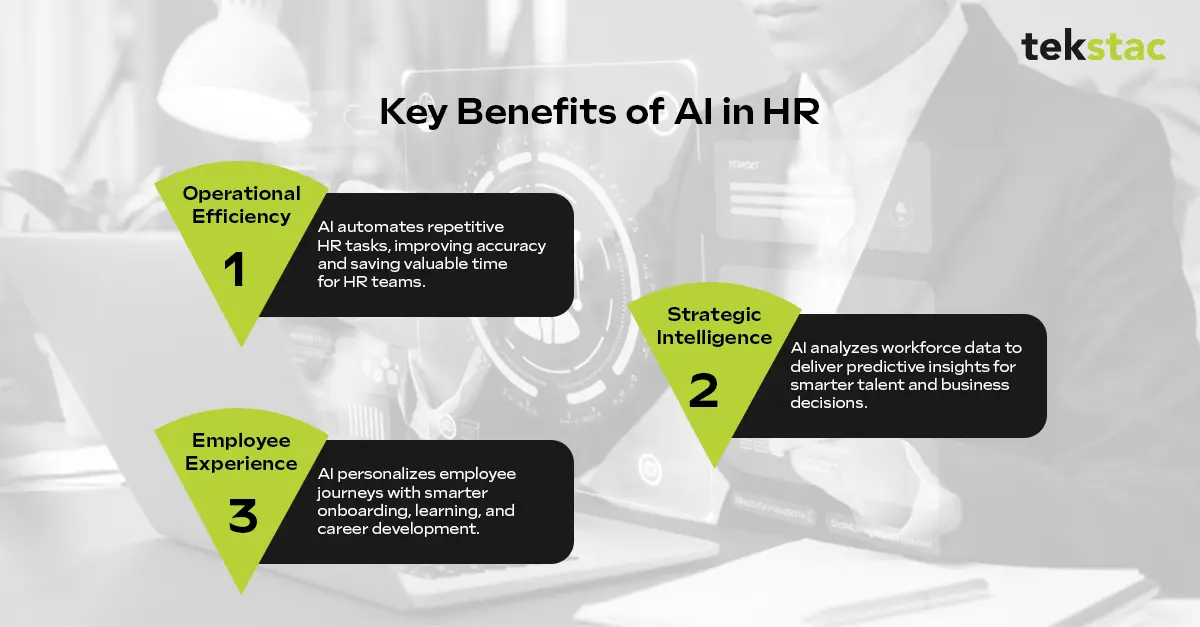
At the foundational level, AI streamlines everyday HR operations. From resume screening and interview scheduling to payroll validation and helpdesk queries, repetitive and time-intensive tasks can now be automated with precision.
In fact, as per ETHR, 68% of companies say AI improves job accuracy in HR processes, while 72% report enhanced productivity and time savings.
Beyond efficiency, AI elevates HR from administrative execution to predictive strategy. Machine learning models analyze workforce data to identify patterns and generate forward-looking insights.
Organizations are using AI for:
Instead of relying on reactive reports, HR leaders can anticipate risks, model future scenarios, and make data-backed talent decisions aligned with business goals.
AI also plays a critical role in personalizing the employee journey. It enables:
As organizations shift toward skills-first talent models, AI-powered workforce upskilling becomes essential. Today, 88% of organizations report active upskilling programs, and companies investing in reskilling are 2.5 times more likely to achieve positive business outcomes from AI initiatives.
AI is increasingly helping HR teams work smarter, not harder, by automating routine tasks, improving decision-making, and enhancing employee experiences. Here are five standout AI tools that are shaping the future of HR:
AI transformation is not an IT initiative. It is a people transformation.
More than 70% of enterprises are investing in AI, yet many struggle to extract value due to skill gaps and change resistance.
CHROs must lead in three critical areas:
As Prabir Jha, leading HR advocate in India, has consistently articulated in his writings and leadership conversations, digital transformation succeeds only when capability transformation precedes technology adoption.
The top HR leaders in India are already demonstrating what proactive AI leadership looks like, integrating technology with talent strategy.
AI’s greatest value emerges when strategy and talent are synchronized.
CHROs must build AI literacy, embed ethical guardrails, and champion cross-functional partnerships.
AI’s greatest value emerges when strategy and talent are synchronized.
CHROs must build AI literacy, embed ethical guardrails, and champion cross-functional partnerships.
The most effective HR leaders are not reacting to AI. They are orchestrating it.
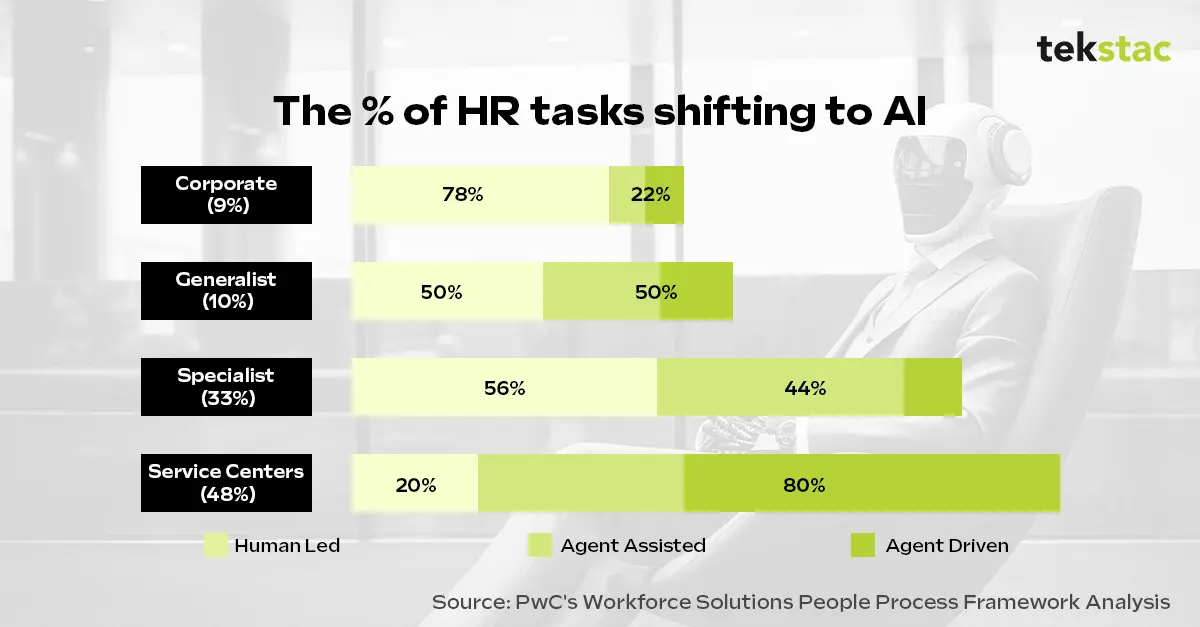
When discussing AI implementation in HR, Dave Ulrich, widely known as the Father of Modern HR has discussed recently about an analysis from PwC’s Workforce Transformation Team, which examined how AI is likely to reshape the four core elements of the HR operating model. The central idea is powerful. AI should not sit as a separate HR initiative.
It should be embedded into the HR operating model to increase stakeholder value.
AI implementation succeeds when it is structured, intentional, and aligned with business outcomes. While many organizations begin with isolated pilots, sustainable impact comes from a clear framework that connects technology, people, and processes.
Identify high-impact processes. Evaluate tech stack readiness. Assess data quality and governance models.
Many companies fail here by rushing implementation without clarity.
Start with high-volume workflows like recruitment or onboarding. Measure KPIs such as time-to-hire, cost-per-hire, and satisfaction.
68% of companies report improved job accuracy during AI pilots.
Scale gradually with governance, bias audits, and structured change management.
AI deployment must be iterative, not disruptive.
Disciplined scaling differentiates strategic transformation from fragmented tool adoption.
Despite rapid momentum, adoption is far from universal. 17% of organizations still have no plans to implement AI in HR, reflecting hesitation around risk, readiness, and ROI clarity. Even among adopters, concerns remain significant. This signals a critical leadership gap: technology is advancing faster than organizational capability.
For CHROs, the real challenge is not whether to use AI, but how to implement it responsibly at scale. AI systems influence hiring decisions, performance evaluations, compensation modeling, and employee monitoring. Without strong guardrails, the same systems designed to drive efficiency can amplify bias, compromise privacy, or erode employee trust.
This is why forward-looking HR leaders are prioritizing:
“AI will not replace humans — but humans who use AI will replace those who don’t.” — Sam Altman, CEO, OpenAI
The fear isn’t new. Every technological leap has sparked the same question: Will machines take over? The broader debate around AI stealing jobs often frames the future of work as a zero-sum game: humans versus machines. In HR, that anxiety feels personal. But here’s the reality: AI doesn’t replace HR. It reshapes it.
AI can screen thousands of resumes in seconds. It can flag skill gaps, predict attrition risk, and automate interview scheduling. What it cannot do is read nuance in a candidate’s life story, sense cultural alignment in a conversation, or coach a struggling employee through uncertainty. The future of HR is not “AI vs Humans.” It is AI-powered Humans. As Alim Dhanji, Chief People Officer at TD SYNNEX puts it, “AI is an enabler; it cannot replace the human element in HR. Judgment, empathy and understanding context are areas where AI falls short.”
One of the most searched queries around AI in HR is simple: “How do we measure ROI?” Because experimentation is exciting. But leadership cares about outcomes. According to IDC, 92% of organizations plan to increase their AI investments, with AI spending projected to grow at 1.7x the rate of overall digital technology spending in the next three years.
Organizations investing in AI and automation in HR are increasingly tracking impact across four dimensions:
A global enterprise reduced recruiter screening time by 42% after implementing AI-assisted shortlisting. That translated to thousands of hours saved annually.
AI-driven candidate matching improves role-skill alignment.
This directly impacts:
With strong talent analytics, organizations can now correlate hiring inputs with performance outcomes, something impossible at scale before.
AI-based skill mapping identifies who can move where.
Instead of external hiring, organizations now redeploy internal talent. That reduces hiring costs, onboarding time, and cultural friction.
This is where AI workforce planning becomes strategic, not administrative.
Companies adopting AI powered workforce upskilling report:
A product head from an enterprise client once said: “Earlier, we were guessing who might fit a future role. Now we can see it. Skills tell the story.”
That visibility is ROI.
While many organizations talk about implementing AI in HR, very few know where to begin.
This is where Tekstac’s GenAI Labs bridges the gap between experimentation and enterprise-ready execution. Instead of introducing AI as a standalone tool, Tekstac approaches HR automation as a structured capability-building journey.
Let’s take a closer look at how this works.
Inside Tekstac’s GenAI Lab, HR teams learn how to build AI-assisted resume shortlisting workflows that:
One of the overlooked areas of AI in HR is candidate communication. Generic outreach emails often result in low response rates and weaker employer branding.
Through our GenAI Lab, HR teams learn how to:
This dramatically improves candidate experience, a key metric in modern digital HR transformation.
Interview scheduling may seem operational, but at scale it becomes a coordination challenge across recruiters, hiring managers, and candidates often across time zones.
Inside Tekstac’s GenAI Labs, HR teams simulate AI-driven scheduling workflows that:
What makes this powerful is the simulation layer. This reduces risk during full-scale
The measurable impact typically includes:
The AI in HR market is projected to reach $25 billion by 2031. Agentic AI adoption will accelerate dramatically. The transformation is structural.
Organizations that approach AI with clarity, governance, and human-centered leadership will not just modernize HR, but they will redefine it.
The next wave of AI in HR will include:
AI in HR 2026 is not about tools. It is about redesigning how organizations hire, develop, engage, and scale talent. On one side are fragmented pilots and unclear governance. On the other hand, organizations are executing disciplined AI-driven workforce transformation with measurable ROI. The divide is widening. Artificial intelligence in HR will not define the future; how leaders implement it will.
If you’re looking to turn AI strategy into measurable outcomes, explore Tekstac’s platform demo.
1. What are the top AI in HR certifications for CHROs and HR leaders?
Here are some of the most recognized AI certifications suitable for senior HR leaders:
2. Is AI going to eliminate HR jobs or finally prove HR’s value?
This question often misses one critical point: AI isn’t just another HR tech tool. It’s built on machine learning, which means it improves over time. Many industry leaders anticipate a shift from partial automation to near-full workflow automation within the next 5 years. That doesn’t mean humans disappear. It means humans focus on approval, judgement, and complex decisions. HR teams will likely become leaner operationally, but stronger strategically.
3. How to implement AI responsibly in HR?
Responsible AI in HR means using AI in ways that are ethical, transparent, and aligned with organizational values. Before adopting any AI tool, CHROs should ensure it’s evaluated and approved, safeguarding security and compliance. AI use must respect privacy and data protection, with internal policies that prevent input of sensitive or confidential information. Organizations should be transparent about how AI is used, maintain clear documentation for traceability, and have oversight to catch errors, bias, or risk.
For decades, human resources was viewed as a company’s administrative backbone. Today, it is the central nervous system. As the corporate landscape shifts toward a skills-first approach, talent strategy has become the most critical infrastructure for sustainable company growth. Leading this transformation are women leaders in India who are redefining what modern HR looks like.
We aren’t just measuring representation; we are measuring impact. Across India’s rapidly scaling tech ecosystems and Global Capability Centres (GCCs), women leaders are no longer just participating in the dialogue around diversity and talent; they are rewriting the entire playbook.
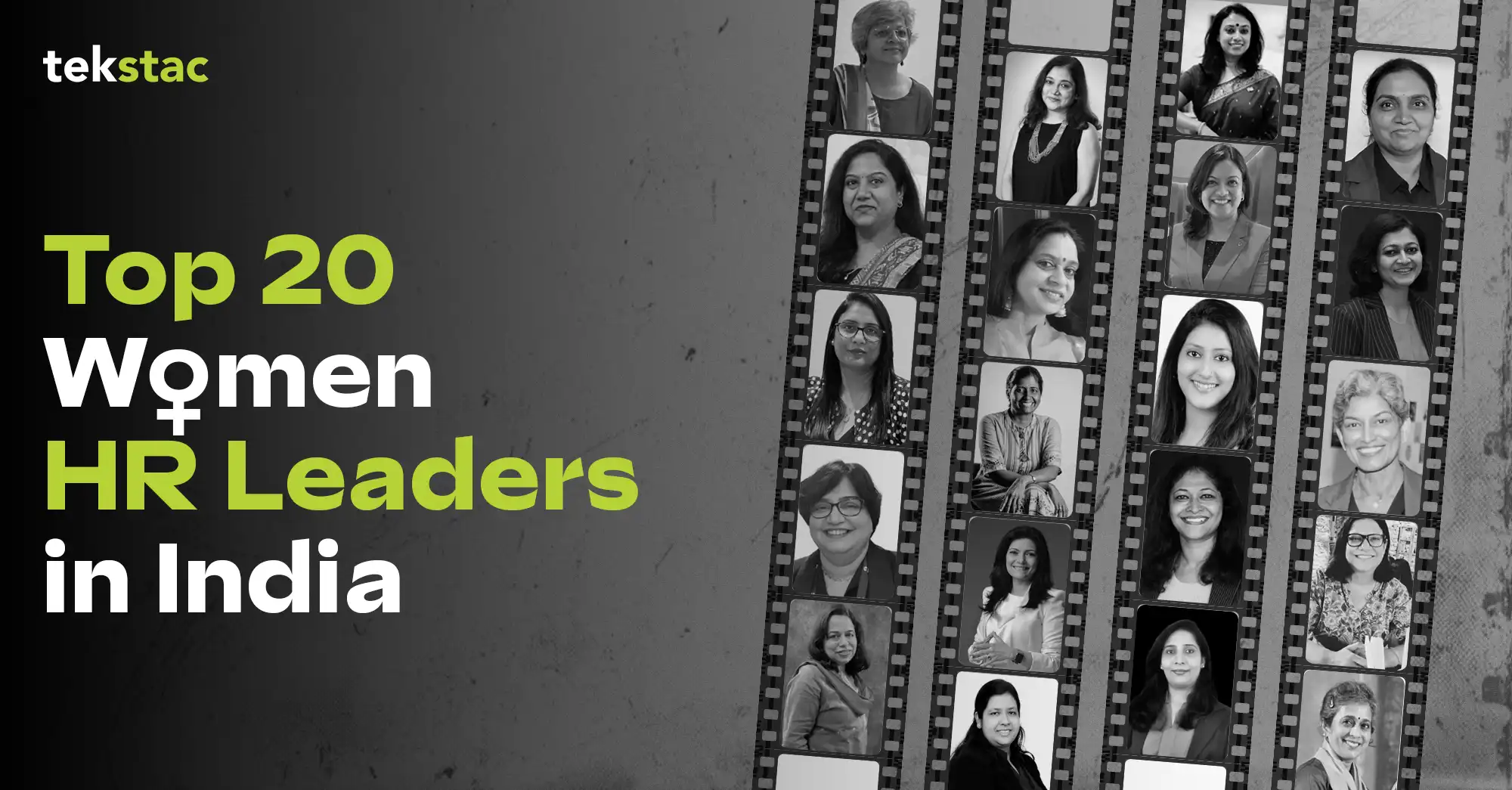
As American author Harriet Beecher once said, “Women are the real architects of society.” In today’s corporate ecosystem, HR leaders are the architects of culture.” In this blog, we are spotlighting 20 women leaders in India transforming HR narrative.
The push for gender parity and inclusive leadership is no longer just an initiative; it is a macroeconomic imperative.
We are witnessing a remarkable rise of women ascending to leadership roles specifically within Global Capability Centres. Leaders in these environments bring unique perspectives that are reshaping the corporate landscape, fostering innovation, and driving agile work cultures. By combining technological efficiency with human sensitivity, they are ensuring that the future of tech is built on a foundation of diverse, skills-first capabilities.
Here are 20 inspiring women leaders in India who are breaking the mold and redefining talent strategy: be it from IT, Pharma or GCC sectors.
MD, SAP Labs India
Rising from a software developer in 1999 to the first woman to lead SAP Labs India as MD, Sindhu is a global tech visionary. She serves as the Chairperson of NASSCOM and sits on the boards of Siemens India and Titan, blending deep technical capability with human-centric leadership.
IT Country Head, Merck IT India
With roughly 17 years of experience steering digital innovation, Anuprita leads one of Merck’s most critical global digital hubs. Her strategic push for skills intelligence recently empowered her teams to deliver breakthrough AI-driven lab solutions, proving that modern HR is directly tied to tech infrastructure.
Associate Vice President – Global Head Technical Learning CoE, Zensar
Priya spearheads global talent acquisition and technical learning with a focus on capability building. She is known for developing robust talent pipelines and creating safe spaces for cross-functional leadership, acting as a strong advocate for women navigating the tech industry. Her leadership has been associated with several marquee achievements, including CEO Excellence Award 2024, Brandon Hall Gold & Silver Awards – 2022, 2023, among many others.
Head of Learning & Talent Development, KPMG
As one of the renowned women leaders in India, Anindita brings over 25 years of experience and focuses on enterprise talent and developing robust learning architectures designed to foster continuous professional growth and dynamic skills intelligence. She develops robust learning architectures designed to foster continuous professional growth and dynamic skills intelligence.
VP – Learning, Talent & Organization Development, AXA Global Business Services
Amrita brings over 18 years of strategic HR leadership, functioning as an ICF-ACC certified coach and NLP Practitioner. She is renowned for driving large-scale HR automation and technology adoption to ensure workforce capabilities directly support global business goals. As a Gartner Peer Ambassador, she actively contributes to global HR communities, staying ahead of evolving workforce trends and sharing insights on building human-centric HR ecosystems.
HR Director – Head of L&OD, Rakuten
A key driver of technological upskilling in high-paced SaaS environments, Shree cultivates an internal culture heavily focused on continuous improvement and building an agile talent infrastructure for the modern tech landscape.
Senior VP, Indium Software
With over 20+ years of experience, Mangala designs and executes highly impactful learning initiatives, seamlessly equipping engineering and product teams with cutting-edge, future-focused capabilities. She was awarded Learning Leader of the Year 2024 in L&D Event conducted by UBS Forums and awarded Under 40 Trailblazer by Business World.
VP – Global Technical Training Head, L&D, HR, Mphasis
With over 25 years in the learning space, including major stints at Accenture and Infosys—Jyothi is dedicated to bridging the technical skills gap. She leads global training programs that drive technological excellence and future-proof engineering workforce.
Senior VP – Capability, Culture & Leadership Transformation, NAB
With over two decades of shaping executive talent, Dr. Singh has established massive Learning & Development Centers of Excellence. Her data-backed strategies and impact have earned her multiple Brandon Hall and Ragan Platinum Awards, establishing her as a heavyweight in global operational capability.
Head – Human Resources, Delta Technology and Management Services Pvt. Ltd
With a robust career spanning more than 25 years, Vijayalakshmi has led HR initiatives across the US, Europe, and Asia. She is a respected thought leader in building highly competitive employee value propositions and seamlessly integrating human capital systems.
Global L&D Head, Sonata Software
A prominent voice in modern HR, Shubhra architects agile, global learning strategies. A frequent speaker on leadership transformation, she champions continuous learning, adaptability, and emotional intelligence to accelerate holistic business transformation.
CEO & MD, Lloyds Technology Centre India
A powerhouse engineer with prior leadership stints at JP Morgan and Mastercard, Sirisha is a recognized trailblazer for women in tech. Her exceptional impact on the industry is highlighted by recent top-tier accolades, including the NASSCOM Trailblazing Women in Tech Award (2024), Impact Leader of the Year at the GCC Summit (2025), and Winner of Trailblazer GCC (2024).
HR Professor, IIM Kozhikode
With over 35 years of combined industry and academic experience, she is currently shaping future leaders as faculty at IIM Kozhikode. A former Sr VP at Schneider Electric and an ICF-certified executive coach, she frequently publishes impactful research in the Harvard Business Review.
VP, People & Culture, Zafin
Bringing over 25 years of HR expertise to the table, Divya drives a people-centric, high-growth culture in the SaaS space. An IIM Calcutta alumna recognized among the Top 250 Great Managers in India, she excels at aligning talent infrastructure with global business objectives.
CHRO, USV Private Ltd
With over 25 years of strategic HR experience across Fortune 500 companies and startups, Aparna has earned accolades like the ‘Iconic Women Award’ (2020) and the ‘Top 101 HR Minds in India’ (2019). She is instrumental in aligning talent infrastructure with long-term organizational scaling.
Deputy Vice President – Global Head – L&D, Tata Technologies
With 24 years of work experience, Tracy drives the global learning infrastructure, focusing heavily on continuous upskilling in emerging areas like GenAI and software-defined vehicles. She plays a critical role in ensuring legacy workforces remain agile and future-ready during rapid industry transformations.
Director – Global Learning and Talent Development, Fime
Bringing over 20 years of expertise in HR transformation, Annapurna orchestrates global learning frameworks. She is also the founder of Emotionalytics & Co. and is highly regarded as a certified OD professional for her focus on emotional intelligence and leadership development.
Transformational Coach | Advisor | Speaker
An ICF-ACC certified coach and Chief Customer Officer at RippleHire, Keerthi brings over two decades of experience, including heading Customer Success at LinkedIn India. She leverages deep coaching to drive cultural shifts and authentic leadership growth.
Founder, HRGurukul
Founder of HRGurukul and a former Employer Branding Lead at IBM, Ruchi brings 25 years of industry experience to the table. This IIM-C alumna is repeatedly recognized as a Top 100 Future of Work Influencer and a leading voice in talent strategy.
Group CHRO, Sterlite EdIndia Foundation
With two decades of experience across diverse sectors, Ruhie is an ICF-certified coach holding an MSc in Occupational Psychology from Birkbeck, London. She is frequently recognized among India’s most influential HR leaders for her data-driven empathy and strategic focus on D&I.
As we celebrate International Women’s Day, it is vital to recognize women leaders in India, within all sectors. They are the architects of our future workforce. By blending high emotional intelligence with data-driven decision-making, and by prioritizing continuous upskilling, they are ensuring that our organizations are not only high-performing but genuinely inclusive.
At Tekstac, we understand that building a transformative, skills-first organization requires diverse perspectives at the helm. We are incredibly proud of the strong representation of women leaders within our own ranks who continuously drive our company growth.
As organizations accelerate through AI adoption, evolving business models, and continuous disruption, one reality is becoming clear: skills, not roles, are now the true currency of work. Traditional talent models built around static job descriptions, rigid hierarchies, and tenure-based progression are struggling to keep pace with rapid technological and market shifts. In this environment, skills-first leadership have emerged as critical leaders driving skills-first transformation, bringing a clear mindset to workforce transformation.
Skills-first talent leaders go beyond implementing new tools or learning platforms. They drive a fundamental shift in how talent is understood, developed, and valued. For these future-ready leadership India exemplars, hiring moves from pedigree to potential.
As Josh Bersin, global HR and L&D thought leader, explains:
“Skills are becoming the new organizational currency. Companies that understand, develop, and deploy skills dynamically will outperform those still managing jobs and titles.”
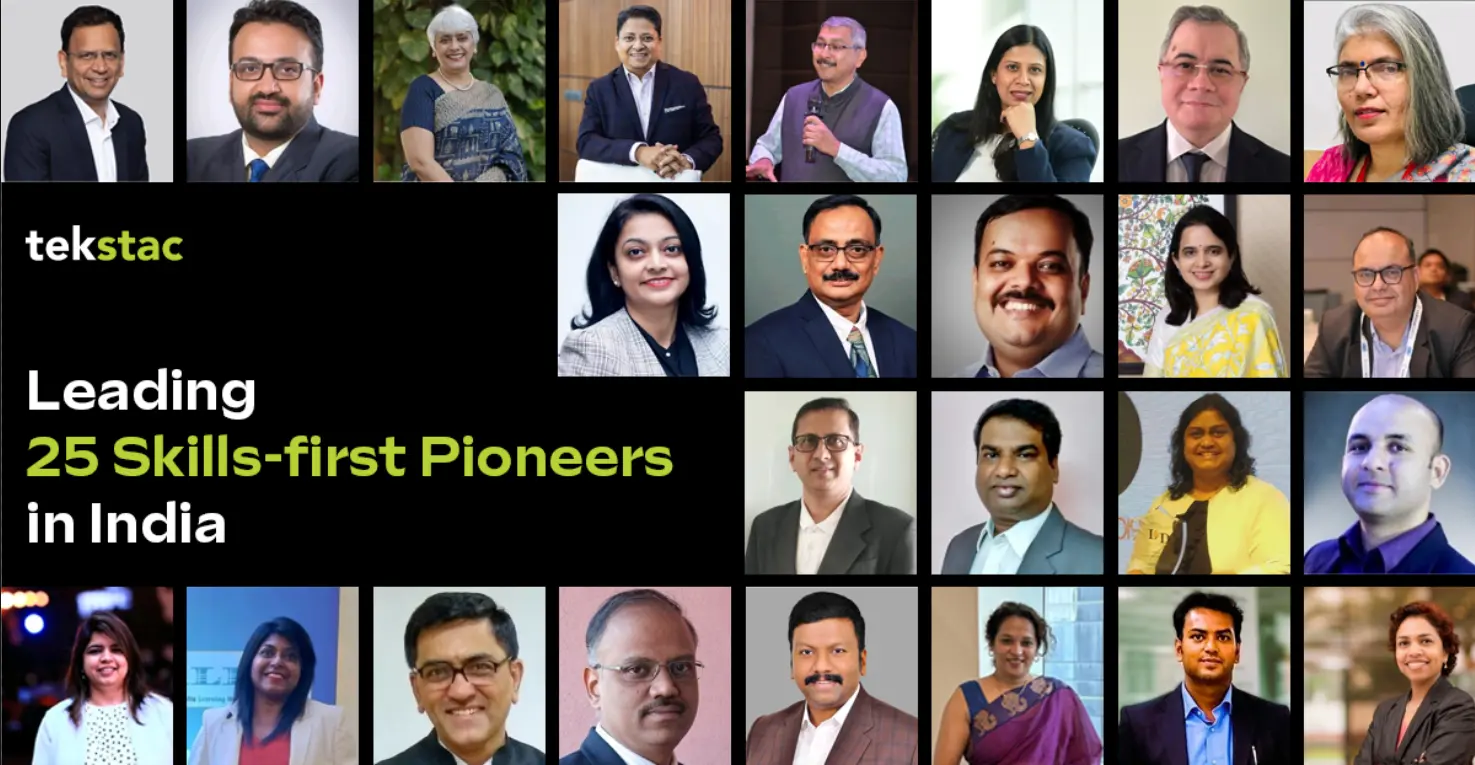
Building on this shift, Tekstac presents the Top 25 skills-first leadership champions in India, who are translating intent into impact. Together, these workforce transformation leaders are shaping up a workforce model designed for resilience and relevance.
CHRO, Zensar
With over 26 years of global HR leadership experience, he has led diverse workforces, scaled businesses, and built high-performance cultures across geographies. As Zensar’s CHRO, he leads global HR transformation, cultivating a distinctive culture to evolve into a fully skills-based powerhouse. His earlier career includes 12 years in the UK, where he built and scaled European HR operations for multinational IT organizations, delivering best-in-class employee experiences.
Global HR Head, Coforge
Ankur Berry brings 23+ years of global HR leadership, managing 10,000+ workforces across 25 countries. His integrity-driven approach emphasizes inclusive upskilling, building skills-first cultures that prioritize capability over credentials. Recognized as a Top 50 Influential HR Tech Leader, he champions humane talent development for multinational agility.
Former Global Chief People Officer, Cipla
Raju Mistry is a widely recognized HR leader whose work has been acknowledged across platforms such as Forbes Best Employers and ETHRWorld Top 50. She combines strong L&D strategies with data-led people analytics, an approach that also earned her recognition as a SHRM 2025 award winner. Her inclusive people practices have consistently contributed to Great Place to Work certifications.
CEO, Tesco Business Solutions & Tesco India
A visionary leader with over 20 years of experience, Dr. Sumit Mitra oversees a global workforce of 20,000+ colleagues across India, Hungary, and Central Europe. He is renowned for transforming Global Capability Centers (GCCs) into engines of innovation and strategic value. Under his leadership, Tesco’s global operations have integrated cutting-edge AI and data-led retail solutions, setting benchmarks for excellence in the retail-tech landscape.
Director – Human Resources, Bosch Global Software Technologies (BGSW)
With a career spanning over three decades, Dr. Mohan Bellur is a specialist in navigating large-scale organizational transformations and cultural shifts. He leads HR strategy for one of the world’s largest software hubs, focusing on the intersection of technology, talent, and leadership. His expertise in industrial relations and strategic workforce planning has been pivotal in scaling Bosch’s engineering excellence and fostering a culture of continuous learning.
Head of People & Culture, India, SAP
With 23 years of expertise, Shweta Mohanty leads SAP India’s HR, pioneering initiatives to build a skills-based organization. Her D&I advocacy (Girls Power Tech) builds diverse, skilled talent pools. She expands learning models enterprise-wide.
CHRO, Mphasis
Leading global HR for 25+ years, Ayaskant integrates talent management, L&D, and analytics for performance breakthroughs. As Executive Council member, he operationalizes skills-first strategies worldwide. He elevates people as strategic assets.
Director of Learning and Development, APAC, CGI
With over 25 years of cross-functional expertise, Srilata leads the L&D strategy for the APAC region, driving talent transformation for a massive, diverse workforce. She specializes in building high-performance cultures through agile learning frameworks and leadership development initiatives. Her work focuses on bridging the gap between digital disruption and human capability, ensuring talent readiness across one of the world’s most dynamic markets.
EVP (Former CHRO), L&T Technology Services
Having transitioned from a strong foundation in the public sector to executive leadership at L&T, he excels at engineering skills-focused transformations. A recognized NHRDN leader and keynote speaker, he is dedicated to building future-ready workforces that bridge the gap between traditional engineering and digital innovation.
AVP and Global Head of Learning and Development, LTIMindtree
A seasoned leader with over 25 years of experience, Ritu orchestrates global learning strategies that align with large-scale organizational priorities. Having held leadership roles at Wipro and Accenture, she is a specialist in navigating complex IT talent ecosystems. She was named one among the Top 50 UK Woman Leaders by Santander and a recipient of global awards from ATD and Brandon Hall.
CHRO, R Systems
A dynamic HR leader with 20+ years of experience, Satyadeep specializes in driving organizational transformation across global tech and product engineering firms. Previously a core leader at Reliance Jio and Bajaj Finserv, he is an expert in scaling digital talent, performance management, and building robust leadership pipelines. At R Systems, he leads the people strategy for a global workforce, focusing on high-growth culture and tech-driven HR innovation.
Director & India Lead – Learning, Talent and OD, Publicis Sapient
With over 2 decades of experience across the IT and digital business transformation sectors, Varun spearheads the talent development strategy for Publicis Sapient in India. He is a specialist in crafting high-impact “Power Skill” frameworks and leadership development programs that align with rapid technological shifts. His expertise lies in building agile, learner-centric cultures and leveraging data-driven insights to enhance organizational performance and employee experience.
Senior Director, PwC
A 25-year HR veteran, Priya fosters “Diversity in Thought” via data-driven L&D, championing women’s empowerment and cultural agility. Her transformative initiatives integrate business strategies with talent upskilling. She coaches teams for excellence.
Vice President – Head Learning & Development, Birlasoft
With 28 years of experience across giants like Capgemini and Genpact, Deepak is a veteran architect of global learning ecosystems. He specializes in re-engineering L&D strategies through mergers and divestitures, integrating AI-powered coaching and NextGen learning platforms. At Birlasoft, he leads the “Early Edge” initiative, focusing on transforming first-generation talent and building “human-centric” leadership capabilities, emphasizing empathy and resilience as the ultimate superpowers in an AI-driven world.
Global Head – Learning & Development, Persistent Systems
A PhD-holding leader with a unique background in testing quality management and process engineering, Dr. Manoj Apte brings a rigorous, analytical approach to talent transformation. At Persistent Systems, he has engineered high-impact learning journeys that bridge the gap between technical expertise and leadership excellence. He recently received the ‘Transformative L&D Leader’ award from ETHR part of the ETHCA.
Vice President – Talent Development, Goldman Sachs
With 23+ years across 10 countries, Divya designs learning ecosystems for 200,000+ employees, coaching BU leaders on $400M+ accounts. Her Train-the-Trainer programs build skills at scale across 129 nationalities. She engineers organization-wide proficiency.
Executive Vice President – People & Talent, Indium Software
Mahendran advances skills-first frameworks in software innovation, optimizing talent for testing and engineering excellence. His operational expertise builds adaptive teams ready for digital shifts. He bridges skills gaps with precision.
Strategic L&OD Leader, Rakuten
Mahesh is a high-impact architect of organizational capability, currently leading a global L&D ecosystem for 8,000+ employees across 12 countries. With 22+ years of experience, he built Rakuten’s first internal digital university, improving skill proficiency by 40%. Recognized as one of the “100 Most Talented Training & Development Leaders in Asia,” he is a specialist in creating “Tech Bridge” programs that align engineering excellence with business innovation.
Vice President – People Experience & Talent Transformation, Infogain
A strategic HR leader with over 18 years of experience across IT, Consulting, and FMCG, Hemant leads large-scale HR modernization for a global workforce of 5,000+. Previously a leader at EY, he is an expert in leveraging data science and people analytics to design future-ready talent ecosystems. His work at Infogain focuses on building “human-first” digital engineering cultures, integrating AI-enabled HR technology, and spearheading global leadership hiring.
Global Head Learning and Development, Mastek
With over 30 years of experience, Madhavi is a strategic L&D leader known for building scalable talent engines in the IT services sector. Having held key roles at Mastek for the last 26 years, she specializes in aligning global competency frameworks with business growth. At Mastek, she drives digital-first learning initiatives, focusing on hyper-personalization and GenAI upskilling to ensure the workforce remains agile.
President & CHRO, Inspira
With 24+ years of strategic leadership across the IT and BFSI sectors, Lalith is a powerhouse in HR transformation and change management. Having spent 17 years at Sify Technologies, where he rose to CHRO, he is an expert in integrating AI and digital solutions into employee experience. At Inspira, he oversees global human capital across India, USA, ASEAN, and MEA, focusing on business-aligned workforce planning and building resilient, high-performance cultures for the cybersecurity and data analytics industry.
Associate Vice President – Global Talent Leader, Sutherland Global Services
With over two decades of experience, Mary is a highly decorated L&D strategist and certified Master Facilitator. A specialist in building end-to-end learning ecosystems, she is renowned for co-curating full-stack digital technology training and high-impact executive coaching programs. Her career is marked by prestigious industry recognition, including L&D Leader of the Year 2024 (6th CHRO Confex, Bangalore), Next Gen L&D Luminary (GWFM & People Decode, August 2023) and Top 20 L&D Transformation Leaders (Transformance Forums, December 2022).
AVP, Head – Learning and Development, Hexaware Technologies
With 20+ years in the IT industry, Tanuja is a future-focused leader at the intersection of tech fluency and human-centered design. At Hexaware, she architects data-driven learning ecosystems that integrate directly with business agility. She is renowned for building specialized Centers of Excellence (CoEs) in Cloud, AI/ML, and Agile, leveraging strategic partnerships with giants like AWS, Microsoft, and Google.
Sr. VP – Global Head – Talent Acquisition, L&D, Happiest Minds Technologies
A powerhouse leader with a over 3 decades of overall experience, Rajesh brings 14 years of sales and P&L experience into the heart of HR. This commercial lens allows him to lead Talent Acquisition and L&D at Happiest Minds with a sharp focus on business growth and quality of hire. He is an expert in AI-based automation and process enablement, specializing in workforce management and large-scale IT recruitment.
Group Executive & Head Human Resources, Axis Bank
With 27+ years of experience across premier financial institutions, Rajkamal is a transformational leader known for reimagining traditional banking HR. Since joining Axis Bank in 2015, she has pioneered industry-leading initiatives like “Gig-A-Opportunities” (alternate work models), “Come As You Are” (LGBTQ+ inclusion), and “HouseWorkIsWork” (valuing homemakers’ skills).
Embracing skills-first leadership at the organizational core isn’t optional, it’s survival in India’s talent tsunami. These leaders driving skills-first transformation offer actionable blueprints: invest in micro-learning, analytics-driven upskilling, and diverse pipelines. Follow their LinkedIn wisdom, replicate their wins, and position your team for 2030 dominance.
What’s your next skills initiative? Tag a skills-first talent leader below and spark the conversation!
India’s talent or human resources is powering a $5T digital economy. To harness this opportunity, organizations must become AI-ready, and this critical shift is being driven by HR and L&D leaders who are at the forefront of preparing people for an AI-first future.
These HR and L&D leaders occupy a pivotal role because they influence how organizations reskill employees, cultivate agile mindsets, and embed AI fluency into everyday work. They are shaping new talent strategies, pioneering innovative learning models, and fostering cultures that embrace continuous transformation.
What sets these leaders apart is their commitment to testing emerging approaches, sharing knowledge openly, and leading change with real-world impact. They act as catalysts and role models, driving adoption of AI-powered talent development through bold vision and practical execution.
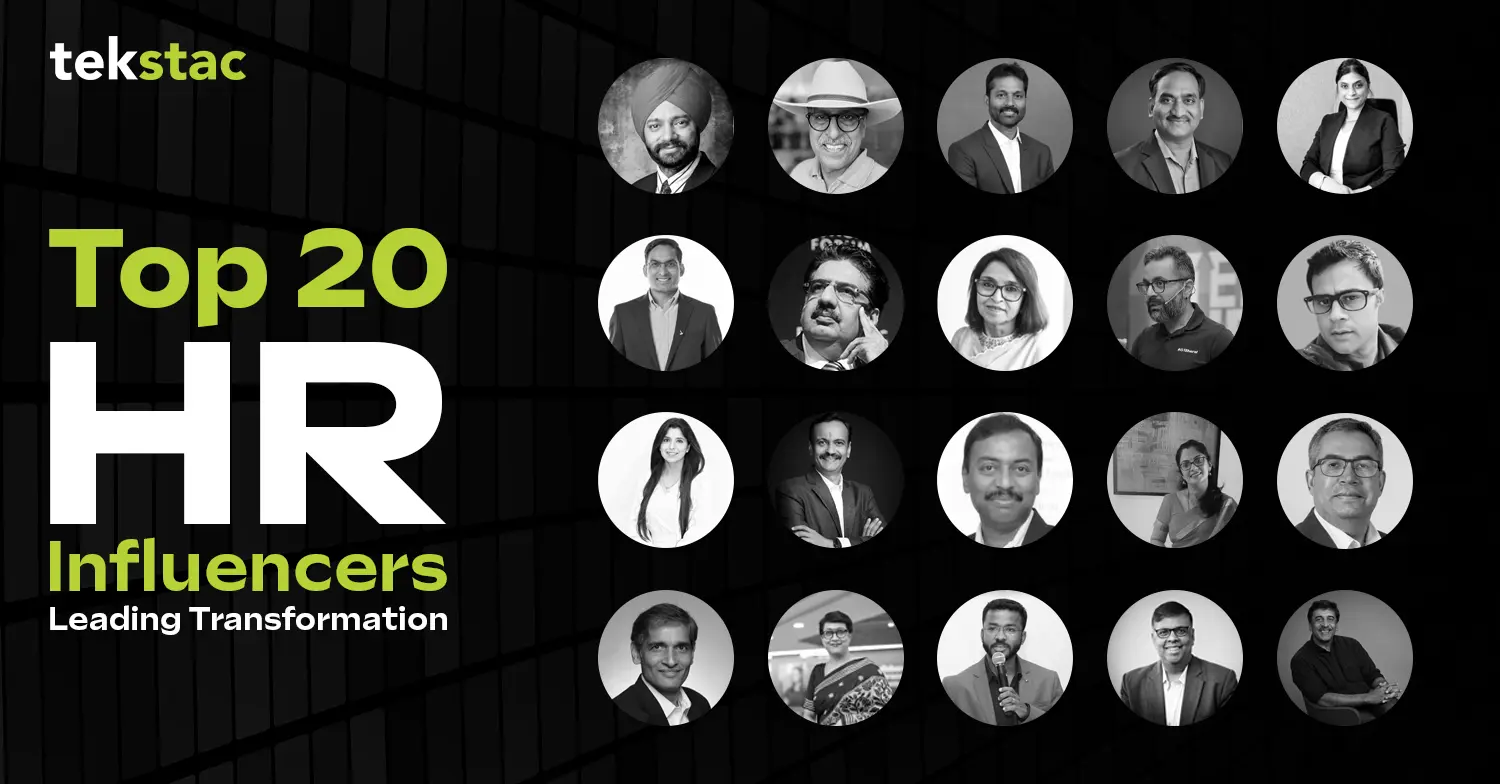
This curated list highlights 20 influential CHROs, L&D pioneers, and HR tech advocates who are leading India’s workforce transformation in 2026. Following their journeys offers valuable lessons on navigating the complexities of AI readiness while empowering people to thrive.
Below is an overview of who they are, how they are influencing the future of work, and why organizations should look to them as inspiration for their own AI and talent transformation strategies.
These leaders offer valuable insights into how organizations are adapting to AI-driven change and workforce transformation. To understand the strategies, tools, and frameworks behind this shift, explore our AI in HR guide.
Reliance Jio | Sr. VP HR
Harjeet Khanduja is an author of seven books on HR and leadership, a TEDx speaker, and holds multiple patents in HR technology. He has been honored with awards such as the Economic Times Top 20 HR Influencers in 2023, named among the Top 200 Global Leadership Voices in 2022, and featured among Thinkers360’s Top 50 Global Thought Leaders on HR.
Prabir Jha People Advisory | Founder & CEO
Prabir Jha is a seasoned HR influencer on LinkedIn, TEDx speaker, and active commentator with diverse industry experience, having served as CHRO for two New York Stock Exchange-listed companies and two Fortune 500 firms.
Infosys | CHRO
As CHRO of Infosys and Group companies, leads global HR strategy, leadership development, and education/training for 250K+ employees while serving as Trustee of Infosys Foundation driving impactful CSR initiatives. Governance Board member at IIIT Bangalore and CII National Committee on Leadership & HR.
Cognizant | Chief Learning Officer
Heads the world’s largest corporate university serving 250K+ employees. Arohi brings over three decades of experience and is known for building scalable learning ecosystems and driving innovation in digital education.
Trinity Life Sciences | Head of People (India)
Seasoned HR professional who drives healthcare sector talent excellence strategies. She is recognized consecutively as Top 100/101 HR Minds in India (World HRD Congress 2018-2019) and Asia’s Top 100 Power Leaders (2022), among other prestigious accolades.
Persistent Systems | Chief People Officer
Visionary HR leader driving organizational transformation through “Employee First” strategies. Youngest Country/Region/Global HR Head at GlobalLogic, Dassault Systèmes, and Infogain; recipient of CEO Awards and Asia’s Best Employer Brands “Young HR Professional of the Year.”
Sampark Foundation | Founder & CEO
Management visionary who transformed HCL from $0.7B to $4.7B global tech services leader. Author of bestselling Harvard Business Press book; Fortune’s first “Executive Dream Team” 2012 and Thinkers 50 list member; Forbes’ 48 Heroes of Philanthropy 2016 for Sampark Foundation’s education innovation impacting millions.
Tech Mahindra | Chief People Officer
Global HR leader with 25+ years transforming people functions and strategically aligning talent to drive business growth in complex environments. Recognized as Economic Times HR Leader of 2023. Active CII/NASSCOM contributor and mentor nurturing future leaders through teaching at top management institutes.
Grant Thornton Bharat LLP | Chief Learning Officer
Chief Learning with 17 years of experience, delivering business impact. TEDx speaker, certified coach, clinical hypnotherapist, and author of 10 books on personal/professional growth.
Atos | Group Head L&D
Prasanna transforms global tech services learning ecosystems. He is also a “Future Learning Leader” 2024 awardee pioneering digital reskilling.
CIGNEX | Chief People Officer
Ankita Singh leads CIGNEX Datamatics’ HR, Administration, Travel, and Resource Management teams, driving a performance-driven culture that earned multiple “Great Place to Work” certifications. She is recognized with Forbes India’s Top 100 Great People Managers and numerous accolades including CHRO of the Year (2017-2020) and Femina’s Women Personality of the Year (2018-2019).
ElasticRun | CHRO
Featured in “HR 100: People Leaders Shaping the Future of Startups,” Salil brings 28 years of HR and general management experience across organization strategy, talent/leadership development, employee engagement, global HR, labor relations, and M&A. Consistently high performer leading diverse HR functions in fast-paced unicorn environments, creating thriving workplaces that drive growth and culture.
Bennett Coleman & Co. Ltd. (Times Group) | Director HR & CHRO
Strategic HR leader with 35+ years across MNCs like Tata Motors, Vodafone, Britannia, Taj Hotels, and Reliance Group, spanning diverse sectors and global geographies. Board/Governing Council member for corporate and educational entities; key Think Tank advisor to Central/State Government ministries driving transformational growth.
Newage Software & Solutions | HR Director
An HR Director who oversees Quality and HR functions, with Lean Six Sigma Black Belt, focused on process excellence and automation. Exemplifies the “never-give-up” mindset and recognized with The Global Excellence Awards – Edition 09.
SHRM India, APAC & MENA | CEO
Dynamic leader with 30+ years across diverse industries, serving as CEO of SHRM for India, APAC, and MENA region, driving global HR transformation and inclusive workplaces. Recipient of prestigious “Best Women Executive in India” award. She is a board member at Ascentios Advisors and MPS Limited, championing women’s empowerment, company culture, and leadership development.
Microsoft | Human Resources Leader
Seasoned HR leader driving business strategy, culture, and organization capability at Microsoft India. Expert in leadership development, high-performing teams, and strategic change management across global tech and manufacturing sectors.
Accenture India | CHRO
With 20+ years in HR leadership roles at Accenture and prior experience at iGate and Nestle, Lakshmi champions equal, empowering cultures and mentors diverse young talent, especially women. Lakshmi co-chairs FICCI’s HR & Skills Committee and serves on XLRI’s advisory board for Gender Equality & Inclusive Leadership.
Nokia | Talent Attraction Leader
Influential HR leader at Nokia with expertise in workforce trends, policy, and business alignment, fostering integrity-based employee-organization relationships. Recognized as Economic Times Top 20 HR Influencers 2020, official SHRM Influencer, People Matters Authors Squad, rise.global Top 100 Global HR Influencer, and Glassdoor Top Contributor at Employer Branding Summit 2015.
Wipro | President & CHRO
Saurabh Govil leads Wipro’s entire HR function, including talent acquisition, engagement, and learning & development programs. With over two decades in HR, he has driven key people, processes, and structural initiatives fueling Wipro’s growth. He serves on SHRM India’s advisory board, speaks regularly at NASSCOM HR summits, and contributes to NHRDN’s journal.
Genpact | CHRO & Country Manager India
Piyush Mehta leads global HR for Genpact, driving talent strategy, employer branding, and Data-Tech-AI transformation while representing the company with key India stakeholders. Key leadership council member with 20+ years of experience. NASSCOM Executive Council member and SHRM global certification commissioner.
These 20 popular HR voices represent the future of India’s talent transformation landscape. Their pioneering work across technology, pharma, manufacturing, and services is driving scalable, AI-powered workforce strategies crucial for succeeding in today’s digital economy.
Explore more insights from India’s HR leaders in our in-depth analysis. Check out this blog.
👉 https://www.tekstac.com/hr-insights-from-leaders/

For decades, organizations structured workforce strategies around jobs, and skill insights were rarely a priority. That model is now under pressure. According to research by Microsoft and LinkedIn, the skills employers require are expected to change by 50% by 2030 compared to 2016, with Generative AI potentially accelerating the shift to 68%.
Yet many organizations still struggle to answer a fundamental question: What skills actually exist within our workforce today? This visibility gap is pushing companies to rethink how they track and develop workforce capabilities, making skills intelligence a critical part of modern talent strategy. At the center of this shift is the concept of skill insights, which helps organizations make more informed, data-driven workforce decisions.
Skill Insights are comprehensive, analytics-driven evaluations of workforce capabilities. They combine multiple sources of data, such as assessments, certifications, project outcomes, and performance feedback, to create a dynamic understanding of employee skills.
Unlike traditional skills inventories that rely heavily on self-reported information, Skill Insights are continuously updated through workforce skills analytics and validated through learning activity and performance signals..
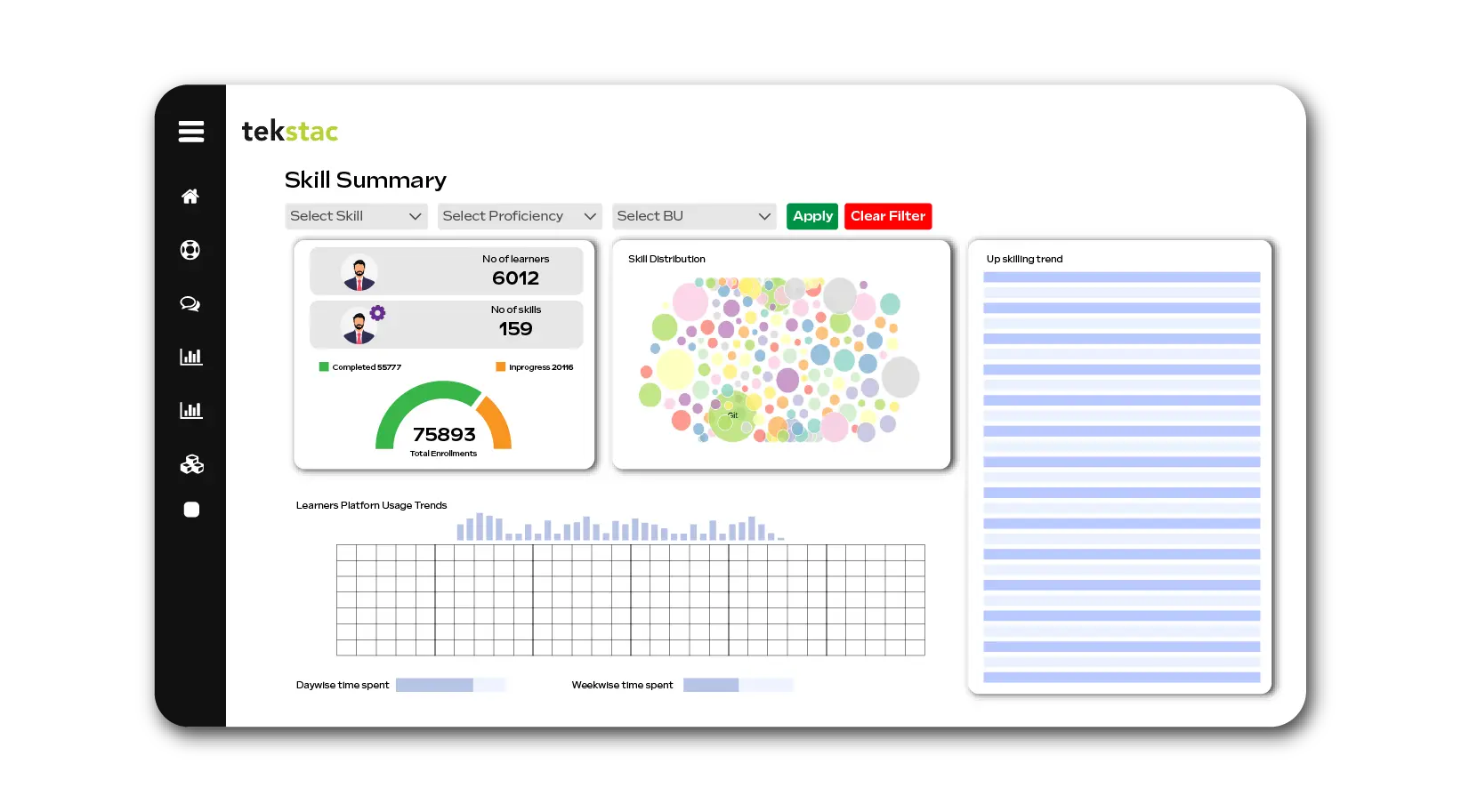
This approach enables organizations to move beyond tracking training participation and instead understand how capabilities evolve across teams and roles.
Through structured employee skills assessment, Skill Insights help organizations:
In practical terms, Skill Insights transform learning data into actionable talent analytics that inform workforce decisions.
47% of leaders list upskilling existing employees as a top workforce strategy for the next 12–18 months.
Organizations today face an unprecedented rate of capability change. Mere certifications will not suffice to prove we have skills- workforce. While IT certifications provide a strong foundation, organizations increasingly need hands-on labs to truly understand workforce capabilities.
According to the SHRM Talent Trends Report, 28% of organizations now require candidates to possess new skills for full-time roles, and 47% of those roles are existing positions that now demand updated capabilities.
This means that workforce transformation is not only about creating new roles; it’s also about redefining existing ones.
Meanwhile, the World Economic Forum’s Future of Jobs Report 2025 highlights another challenge: 63% of organizations cite skills gaps as the primary barrier to business transformation.
These trends are driving organizations toward skills-based workforce planning, where decisions about hiring, learning, and mobility are guided by skills data rather than static job titles.
When organizations lack visibility into workforce capabilities, strategic decisions become harder.
Skilling programs may target the wrong skills. Hiring strategies may overlook internal talent. Workforce planning may rely on assumptions rather than evidence.
The cost of this invisibility can be significant.
According to McKinsey research, 87% of organizations globally are already experiencing or expect to experience a skills gap within the next few years.
At the same time, the World Economic Forum estimates that nearly six out of ten workers will require substantial reskilling or upskilling by 2030 in order to keep pace with evolving job demands.
Without reliable workforce skill insights, organizations risk making workforce investments that fail to address the real capability gaps that affect performance and growth.
To generate meaningful Skill Insights, organizations typically build a structured workforce capability framework that integrates skills data, performance signals, and role requirements.
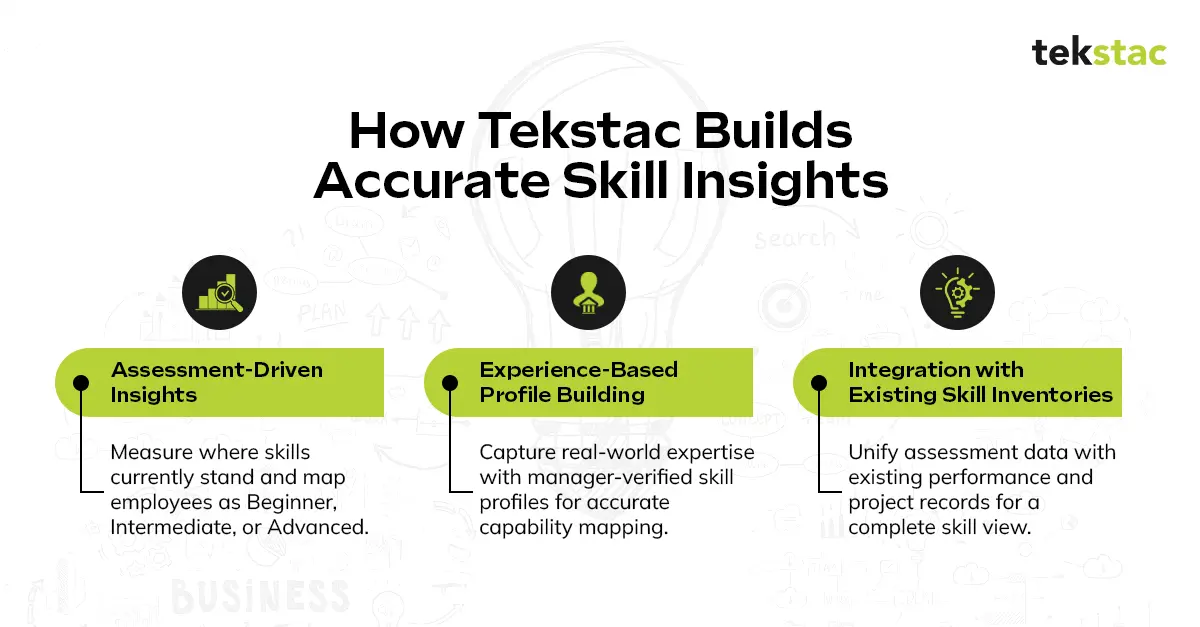
Skill Insights framework combines three powerful methods:
Assessment-Driven Insights
This allows employees to gauge their proficiency levels across specific skills. The results categorize individuals as beginner, intermediate, or advanced, providing a clear foundation for the organization’s skill inventory.
Experience-Based Profile Building
Not all expertise can be measured through assessments alone. For experienced professionals, we can enable the creation of skill profiles based on self-declared data, verified by managers, or cross-referenced with organizational records. This ensures that practical experience and institutional knowledge are accurately represented.
Integration with Existing Skill Inventories
Many organizations already maintain some level of skill tracking through performance reviews or project data. It can be integrated with insights from the pre-held assessments and learning modules.
Two key metrics often form the backbone of this framework.
The Skill Match Score evaluates how closely an employee’s current capabilities align with the requirements of their role.
This metric functions as a workforce “fitness indicator.” It shows whether employees possess the competencies necessary to perform their responsibilities effectively.
Beyond operational reporting, the skill match score can also support skills-based workforce planning. Employees with high match scores may be ready for expanded responsibilities, leadership roles, or more complex projects.
The Skill Gap Metric builds upon the skill match score by identifying capability deficiencies.
For example, if an employee’s match score falls below a defined threshold, the system flags this as a development need.
Aggregated across teams and roles, these insights allow organizations to conduct targeted skill gap analysis and design focused upskilling and reskilling strategies.
Our ultimate goal is to create a dynamic and evolving database of skill profiles, which we refer to as ‘SkillTag’. The idea behind SkillTag is to track and reflect the continuous development of skills over time, offering a comprehensive, real-time view of an individual’s expertise and growth.
Krishnan Unni, Chief Business Officer, Tekstac
Organizations rarely adopt Skill Insights all at once. Instead, they typically begin with one part of the talent lifecycle and gradually expand toward a more comprehensive skills-based model.
In our experience working with organizations embarking on this journey, they typically take one of three different approaches mentioned below.
Many organizations begin by redesigning L&D programs around skills rather than jobs.
One Fortune 500 Services Company, for example, began by shifting its skilling recommendations away from job-based training toward skills-based development pathways.
Courses were mapped to specific capabilities instead of job titles, allowing employees to develop targeted competencies aligned with business needs.
As the company expanded this approach to hiring and internal mobility initiatives, leaders realized that they needed a centralized workforce capability framework to support the transformation. This led to the development of an enterprise-wide skills hub that used skills as the core unit for managing workforce capabilities.
Other organizations start by creating the underlying infrastructure for skills management.
One of our IT clients began by developing a shared language for describing workforce capabilities that defined categories, proficiency levels, and relationships between skills.
This framework allowed the organization to map skills across roles and learning resources, identify high demand “hot skills,” and design more targeted development pathways.
Over time, the skills framework became the foundation for broader talent analytics, influencing recruitment, workforce planning, and compensation strategies.
A third approach focuses on the work itself rather than the structure of jobs, encouraging employees to demonstrate a willingness to learn at work. Some organizations are introducing internal talent marketplaces where projects and short-term assignments are matched to employees based on skills.
This allows employees to gain experience in new domains while organizations deploy talent more flexibly. Through structured skills insights, employees can assess their current capabilities, explore future roles, and develop plans to close skill gaps.
One of the biggest challenges in building a skills-based workforce is the portability of verified skills data. At the same time, structured skills development is increasingly becoming the foundation for sustainable career progression in modern organizations.
Some organizations are beginning to address this gap. For example, a defense organization introduced a platform that allows service members and veterans to record skills gained through training, education, and operational experience. By linking these records to a common framework, individuals can better understand how their capabilities translate to civilian roles and where further development is needed.
As organizations gain better visibility into workforce skills, career structures are evolving from traditional career ladders to more flexible career lattices, where employees build capabilities through cross-functional and cross-skilling opportunities. According to the ACCA Global Talent Trends Survey, 58% of employees expect their next career move to be outside their current organization, highlighting the importance of workforce skills analytics in supporting talent development and retention. These shifts are supported by workforce skills analytics, which help organizations identify adjacent skills and potential career transitions.
Skill Insights are increasingly shaping several core workforce strategies. Here are some of the ways in which they play a significant role.
By analyzing workforce capability insights, organizations can match employees to roles or projects based on their capabilities rather than their job titles.
This improves talent utilization while reducing reliance on external hiring.
Learning leaders use employee skills assessment data to design more targeted development programs.
Rather than delivering broad training programs, organizations can prioritize learning initiatives that address the most critical capability gaps.
Research from Gallup shows that 41% of employees say lack of time is their biggest obstacle to participating in training programs.
Skill Insights help organizations ensure that learning time is invested where it will deliver the greatest impact.
Skill Insights also support long-term workforce planning. Through structured skills intelligence, organizations can decide when to:
This decision model enables organizations to respond more effectively to evolving skill demands.
The impact of Skill Insights becomes clearer when organizations apply them to real workforce challenges.
Challenge:
The client, with a 300,000+ global workforce, wanted to accelerate workforce mobility and efficiency through lateral training programs. But they faced multiple hurdles: limited visibility into skill gaps, generic learning programs, and an inability to link training efforts with performance outcomes.
Our Solution:
Challenge:
Graduates were arriving with low Day-1 readiness, forcing extended onboarding programs that increased training costs and delayed time-to-billable deployment.
Our Solution:
Impact:
Objective:
Create a structured talent pipeline to identify, skill, and onboard large volumes of graduates efficiently across product development and niche technology roles.
Challenges:
Our Solution:
Implemented a three-stage skilling framework covering the entire talent lifecycle.
Impact:
The future of workforce strategy will increasingly be defined by skills rather than jobs. The employee development trends are shifting toward continuous learning, internal mobility, and skills-first talent strategies. That’s where skill insights come into the picture. In a world where skills change rapidly, the ability to understand and act on workforce capabilities will become one of the most important strategic advantages an organization can possess.
1. What is Skill Insights? Why are they important for the future of work?
Skill Insights are analytics-driven evaluations of workforce capabilities derived from assessments, learning activity, and performance signals. They allow organizations to adapt to rapidly evolving skill requirements and build effective upskilling and reskilling strategies.
2. What is the difference between Skill Insights, Skill Gap Analysis and Talent Analytics?
Workforce Skill Insights provide a comprehensive understanding of workforce capabilities through integrated skills data.
Skill Gap Analysis focuses specifically on identifying the difference between current skills and required capabilities.
Talent Analytics represents a broader category of HR analytics that includes workforce metrics related to hiring, engagement, and retention.
3. What are some of the skills gap analysis tools organizations can use?
Organizations today use a combination of skills intelligence platforms, talent analytics tools, and learning management systems to identify and address workforce skill gaps. Some commonly used skills gap analysis tools include Tekstac. These platforms perform skills gap analysis to provide organizations with deeper visibility into workforce capabilities.
4. How can workforce skill insights improve employee training programs?
Workforce skill insights help organizations design more effective employee training programs by identifying real skill gaps and aligning learning initiatives with business needs. With better visibility into workforce capabilities, organizations can:
When a critical tech project came up, one of our client organizations was confident their team could deliver. The talent was experienced, the processes were in place, and the skills seemed sufficient.
But when the project required newer AI, cloud, and data integration capabilities, performance dropped. The team needed immediate reskilling—and external hiring became the only short-term fix.
This is not an isolated story. It’s a reminder that tech capability doesn’t scale on its own. In reality, future-ready talent isn’t hired—it’s built through deliberate design. That design is what we call a tech talent pipeline.
In today’s fast-changing digital economy, continuous upskilling has become the backbone of enterprise competitiveness.
Technology evolves faster than job roles, and without a structured system to build capabilities, even strong teams risk obsolescence.
While most enterprises recognize this, many still rely on ad-hoc training. What’s needed instead is a data-driven, AI-enabled talent framework that continuously builds, tracks, and sustains skill readiness across functions and technologies.
At Tekstac, we’ve seen this gap firsthand. Traditional training programs can’t keep pace with new tech stacks, agile workflows, and the speed of AI adoption.
That’s where Tekstac’s AI-driven learning platform transforms how organizations develop tech capability—aligning skill development with measurable performance outcomes.
Tekstac’s learning ecosystem is built around one idea: Tech readiness should be business-aligned, continuous, and measurable.
Our platform helps enterprises operationalize tech talent pipelines that move beyond certifications and one-time bootcamps—into a system of lifelong learning and performance-linked growth.
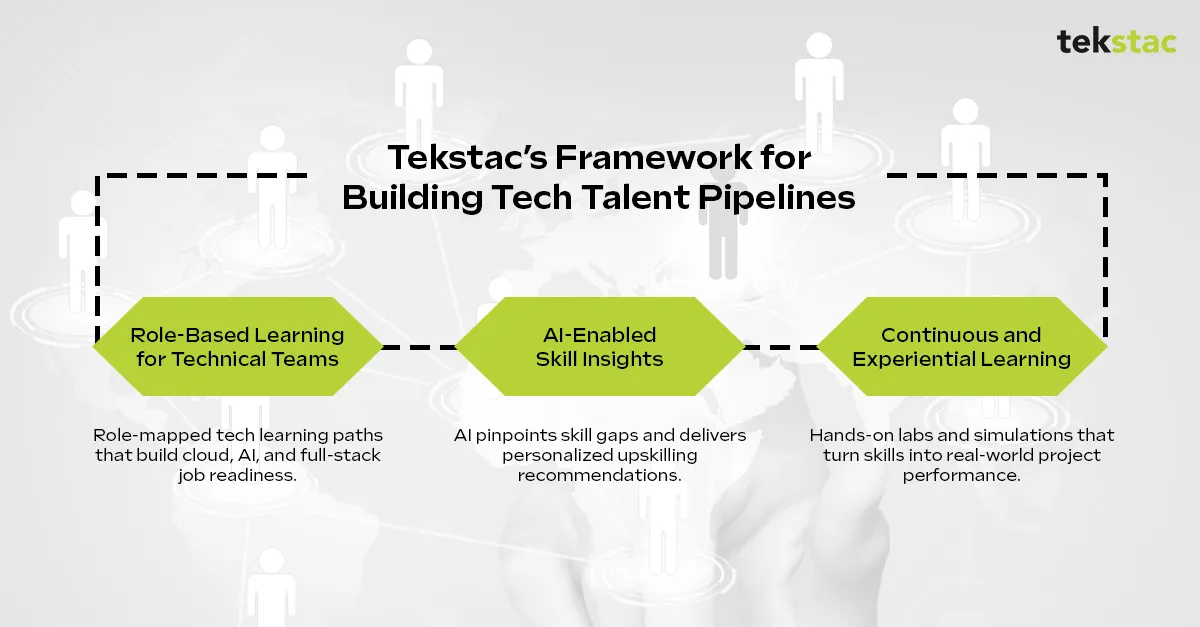
Here’s how it works:
Tekstac’s role-based learning structure maps every module to real-world project needs—whether that’s cloud migration, full-stack development, or AI implementation.
Each pathway blends course modules with hands-on coding labs, simulations, and project assessments, building real world application ready, deep technical mastery for each role.
AI in talent development is no longer a nice-to-have—it’s mission-critical.
Tekstac uses AI-powered analytics to identify skill gaps, benchmark capabilities, and recommend personalized learning paths.
This approach helps enterprises proactively develop internal talent—reducing dependency on external hiring and ensuring readiness for emerging technologies.
Technical skills evolve every quarter. Tekstac integrates experiential learning that helps teams apply what they learn immediately in the flow of work.
This gives L&D and business leaders data-backed visibility into skill progress, role readiness, and workforce ROI.
When new technology initiatives arise, organizations often default to hiring externally. But a recent Forbes research report shows that 58% of companies are now focused on building a culture of continuous learning, and 69% believe every employee needs technical upskilling opportunities.
External hires, meanwhile, often struggle with culture fit, take longer to reach peak productivity, and increase cost per hire.
Building a tech talent pipeline helps organizations develop talent that already understands the systems, culture, and clients they serve.
At Tekstac, tech learning isn’t just course-driven—it’s experience-led. Each program simulates real-world engineering challenges.
Learners progress through interactive, structured modules, hands-on labs, and instant feedback for performance improvement.
Key platform highlights:
By the end of each program, learners earn a SkillTag—a verified record of competencies that reflects job readiness and tech mastery.
Tech skills now have shorter half-lives than ever before.
In the AI era, the future workforce must be capable of re-skilling, adapting, and integrating new technologies continuously.
Skill gaps don’t appear overnight—they grow silently when learning is reactive. A well-structured tech talent pipeline changes that narrative. It ensures readiness at every level, continuity in every transformation, and a workforce that grows as fast as technology does.
Tekstac’s Learning Platform helps organizations move from reactive hiring to proactive capability design—enabling HR and L&D leaders to build, measure, and sustain the tech talent their businesses need for the future.
Book a Tekstac demo today and start building your tech talent pipeline.
2026 is almost here, and the L&D function is gearing up for another year of transformation. From AI-powered upskilling to skills-first workforce planning, learning and development events are becoming the spaces where our industry resets, rethinks, and realigns.
Across India, several L&D events in India are lined up for 2026, bringing together practical case studies, future-skills frameworks, and discussions on talent transformation in GenAI era. Whether your focus is immersive learning or building employee learning programs at scale, these events offer high-value insights for every stage of growth.
Here are seven high-impact workplace learning conferences in India you should consider attending. Each one offers something unique, strategy playbooks, peer conversations, tech showcases, and fresh inspiration for your next phase of talent transformation.
Date: 28 January 2026
Venue: Radisson Blu Mumbai International Airport
Visit: https://lndleadershipsummit.com/
Synopsis:
A long-standing industry favorite, this summit brings together CHROs, CLOs, and talent leaders to decode what’s next for capability building. Expect conversations around leadership transformation, digital academies, skill mobility, and scaling training and development events across enterprise teams.
Date: 13 February 2026
Venue: Mumbai
Visit: https://futurelnd.com/
Synopsis:
With the theme of Engage – Empower – Elevate, this conference offers deep dives into immersive learning, hybrid architectures, and AI-enabled skilling. It’s a must-attend for teams redesigning employee learning programs for long-term impact and agility.
Date: 13 February 2026
Venue: Hotel The Den, Bengaluru
Visit: https://www.ibcinfo.com/events-details/event/asia-ld-employer-branding-conference-awards-2nd-edition/
Synopsis:
This event combines L&D strategy with culture and communication. Expect discussions on learning experience design, reskilling frameworks, employee value propositions, and capability building. Emphasizing strong identity and talent transformation in GenAI era, this event recognizes a crucial theme across skill development conferences.
Date:18–19 February 2026
Venue: The Leela Ambience, Gurugram
Visit: https://hr.economictimes.indiatimes.com/nextech
Synopsis:
Themed Minds & Machines: Shaping Tomorrow, NexTech explores how India can advance as a global talent capital. With its strong focus on automation, workforce readiness, and scalable skilling, it’s a core event for organizations investing in future skills summits and digital transformation.
Date: 17 April 2026
Venue: Radisson Blu, Outer Ring Road, Bengaluru
Visit: https://summit.bestfirm.aim.media/
Synopsis:
Designed for leaders building AI-driven workplaces, this summit covers automation-integrated talent ecosystems, capability academies, and intelligence-driven workforce planning. Perfect for teams working at the intersection of AI and enterprise learning.
Date: 11 July 2026
Venue: Chennai Trade Centre, Chennai
Visit: https://vanakkamhrd.com/events.php/
Synopsis:
HR Festival 2026 brings together HR leaders, CHROs, talent professionals, and industry experts for a day of learning, networking, and future-focused conversations. The event explores AI-powered workplaces, leadership in a borderless world, and the evolving role of HR in shaping future-ready organizations. Ideal for professionals seeking practical insights, community-driven learning, and innovative people strategies.
Date: 15–16 July 2026
Venue: Hyderabad International Convention Centre (HICC), Hyderabad
Visit: https://www.shrmconference.org/unconference
Synopsis:
As the top learning conference in India, SHRM UnConference 2026 combines peer-led discussions, hands-on learning labs, workplace innovation showcases, and cross-disciplinary experiences. The event explores talent strategy, leadership, workforce design, culture, and HR technology through highly interactive sessions designed to spark fresh thinking and practical innovation.
Date: 6–7 August 2026
Venue: Yashobhoomi Convention Centre, New Delhi
Visit: https://india.techhrconference.com/
Synopsis:
Asia’s largest HR & work-tech conference, TechHR is one of the prestigious learning events where L&D meets the future of work. From behavioral analytics to next-gen platforms and capability intelligence systems, this is the place for organizations prioritizing upskilling and reskilling and talent transformation in GenAI.
Date: 26–27 November 2026
Venue: Taj Palace, New Delhi
Visit: https://www.shrmconference.org/iac
Synopsis:
One of India’s most influential HR and L&D industry events, SHRMIAC brings global experts, masterclasses, and research-backed insights. Expect future-skills playbooks, capability frameworks, GenAI strategies, and case studies from high-performing enterprises.
Date: 12 December 2026
Venue: Sterlings Mac, HAL Airport Road, Bengaluru
Visit: https://www.hrsummit.co.in/
Synopsis:
Organized by the Institute of HRD, the Bangalore HR Summit 2026 brings together HR leaders, business executives, learning professionals, and talent strategists to explore the future of people management. The agenda focuses on digital-age talent strategies, learning and development innovation, leadership development, talent analytics, and technology-enabled workforce transformation.
Across all seven learning and development events, a few powerful themes consistently emerge:

GenAI is moving from pilots to enterprise-scale adoption. Learning teams are overhauling content operations, personalization engines, and taxonomies using AI.
Organizations are shifting to agile skill architectures, prioritizing skills mapping, adjacent skills, skills-based career pathing, and internal mobility.
Simulations, microlearning, practice labs, and mentor interventions drive higher retention and provide real-world application-based learning.
L&D is now directly tied to business outcomes. Leaders want clearer impacts such as faster deployment readiness, reduced cost of hiring, better build vs buy vs borrow talent decisions, skills insights to build proactive talent pipeline that helps in measurable ROI.
As tool fatigue rises, L&D must re-design people-first systems that feel simple, intuitive, and human by default. A powerful theme that propagates talent transformation in the GenAI era.
Throughout 2026, Tekstac will actively participate in these learning and development events, conducting roundtables, working on new research, unveiling capability frameworks, and hosting demos. These interactions help us stay deeply connected to the evolving challenges of learning teams, enabling us to co-create solutions with the industry.
Learning and Development Events are no longer passive industry gatherings; they’re catalysts for transformation, capability building, and meaningful collaboration. As 2026 brings a new wave of innovation, these seven conferences offer the insights, networks, and frameworks to help L&D teams stay ahead of rapid change.
Whether you’re refining your skilling strategy, rethinking systems, or preparing your workforce for the future, these learning events offer everything you need to accelerate talent transformation in the GenAI era.
1. What are the top learning and development conferences to attend in India in 2026?
India will host several leading learning and development conferences in 2026, including People Matters TechHR India, SHRM India Annual Conference, SHRM UnConference, HR Festival 2026, the Future of Learning & Development Summit, and the L&D & Talent Management India Summit. These events cover AI-powered learning, skills development, workforce transformation, leadership, and future-ready talent strategies.
2. What makes L&D events valuable for business leaders, not just learning teams?
These events provide insights into workforce productivity, talent development, organizational transformation, and business strategies that directly impact long-term growth and competitiveness.
3. Which L&D topics are expected to dominate conferences over the next five years?
Topics likely to remain prominent include Agentic AI in learning, skills intelligence, workforce transformation, learning analytics, leadership development, employee experience, and future-ready talent strategies.
4. What are the key benefits of attending Learning and Development events in India?
Learning and Development events offer more than networking opportunities. They provide access to industry research, emerging learning technologies, expert insights, and real-world case studies from leading organizations. Attendees can learn how companies are addressing challenges such as skill shortages, workforce transformation, leadership development, and AI adoption.
Fewer than one in three corporate training programs directly improve business KPIs, according to the LearnOps Industry Report (2024). L&D managers who want a seat at the leadership table need to measure training ROI, not just completions. That requires a clear skills gap analysis, SMART KPI frameworks, and technology that connects learning outcomes to workforce performance, which is exactly where an AI-powered upskilling platform like Tekstac is designed to help.
While most of them still measure the traditional surface-level metrics such as:
These numbers still don’t answer the most important question: Did skill development actually change performance?
Tekstac is an AI-first skill development and intelligence used by enterprise clients including IBM, PwC, Capgemini, Zensar and Cognizant. It connects training delivery to measurable business outcomes through real-time analytics, skills gap analysis, and role-aligned learning paths. With over 1 million professionals upskilled across 27 million+ learning hours, Tekstac is built for L&D teams that need to prove ROI to leadership.
Traditional L&D metrics, completion rates, attendance numbers, and assessment scores are easy to report but impossible to connect to business performance.
The core problem is activity tracking masquerading as impact measurement. A sales team can complete a negotiation program with 95% attendance and strong quiz scores. If quarterly revenue stays flat, the program delivered activity, not capability. The same logic applies to leadership development, onboarding, and compliance training.
Replacing surface-level metrics with skills gap analysis means mapping current team capabilities against the skills required to hit specific business goals, identifying the gaps, and building training interventions with a measurable success criterion, before launch not after.
It means mapping current skills to business goals, finding critical gaps, and creating focused upskilling programs to close them.
This shifts L&D from spotting problems to solving them, building the right skills, in the right people, at the right time.
L&D business KPIs help organizations move from measuring participation to measuring performance change. Remember to identify the right KPIs for your L&D.
The role of KPIs in L&D:
Did you know? According to the LearnOps Industry Report (2024) 33% of organizations don’t measure L&D success at all, leaving most training budgets unaccountable to leadership.
Listed below are some of the common challenges faced in tracking business KPIs
One of the biggest hurdles for L&D managers is convincing leadership, that training delivers value. Without robust data, learning is seen as a “nice-to-have” rather than a strategic growth driver.
Attendance numbers and retention rates are simple to report, but they don’t tell the full story. True measurement requires both quantitative data (scores, completions, proficiency levels) and qualitative insights (employee satisfaction, perceived value, behavioral change).
Overcoming these challenges requires the right employee performance KPIs, the right measurement approach, and the right technology.
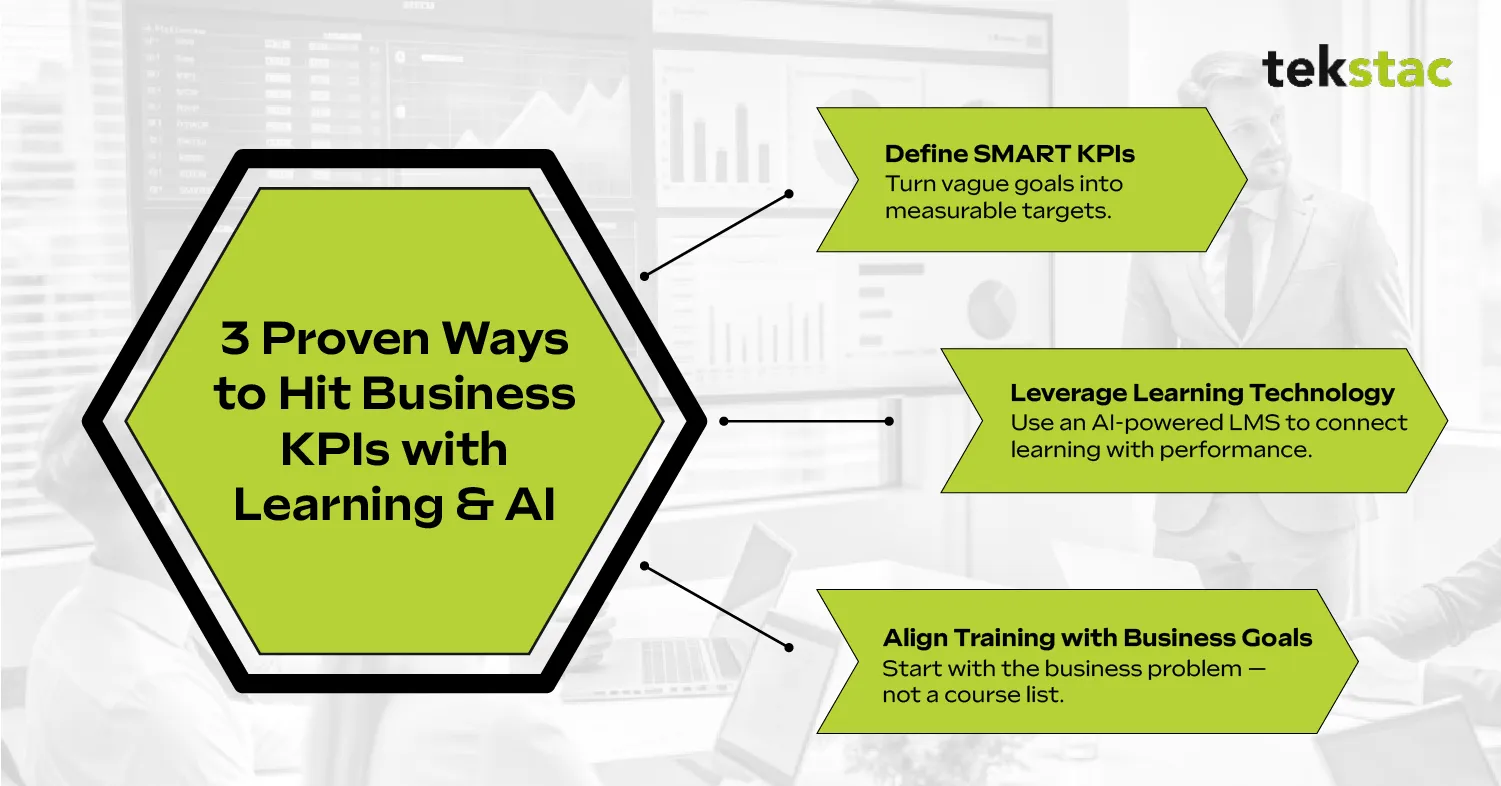
Instead of “Improve onboarding,” a SMART KPI would be “Reduce new hire ramp-up time by 20% within six months.”
To truly measure and maximize the impact of learning, organizations need more than just training delivery—they need visibility, precision, and scalability. This is where an AI-powered Learning Management System (LMS) makes the difference and tracks upskilling impact on KPIs.
A AI-powered LMS can:
This shifts L&D from being reactive to proactively shaping workforce performance.
Training should always start with a business problem, not a course catalog. Ask upfront:
When learning initiatives are designed with these questions in mind, they not only engage employees but also prove their impact to stakeholders.
Tekstac empowers L&D managers to link training directly to business performance through powerful learning analytics and management tools.
Skills gap analysis at scale
Tekstac maps each learner’s current proficiency against role-specific skill requirements, automatically surfacing gaps and assigning targeted content. L&D managers see a real-time dashboard of team capability, not just who completed what, but who is ready to perform.
Training ROI measurement built in
Unlike traditional LMS platforms that stop at completion of tracking, Tekstac links learning activity to business metrics. L&D leaders can show leadership in which programs improved time-to-competency, productivity benchmarks, or retention rates, in the same reporting interface.
Beyond L&D success measurement, Tekstac powers learning delivery with:
With 1 million+ professionals upskilled, 27 million+ learning hours, and enterprise clients like IBM, PwC, Capgemini, Zensar and Cognizant, Tekstac is proven at scale.
It’s time to stop tracking skill development for just the numbers. Instead of asking “Did employees finish the course?”, L&D managers must ask “What business KPI did this program improve?”
Track what matters and focus more on metrics stakeholders already value. Identify the employee performance KPIs before launching a program.
Need assistance with all this?
Tekstac transforms L&D from tracking hours and completions to driving measurable performance, stronger KPIs, and a future-ready workforce.
1. What is the most important L&D business KPIs to track?
The five most measurable L&D business KPIs are:
2. How do L&D teams prove training ROI to leadership?
Establish a measurable baseline before launch, define which business metric the training should move, then track that metric for 60–90 days post-training. An AI-powered LMS like Tekstac automates this linkage, connecting learning data to business performance dashboards in real time.
3. How does an AI-powered LMS improve L&D KPI tracking?
An AI-powered LMS improves L&D KPI tracking by automating skills gap analysis, personalizing learning paths, and providing real-time dashboards that connect training data to business performance indicators, removing the manual data work that prevents most L&D teams from building a credible ROI case.
4. What are the 4 pillars of KPI?
The four pillars of KPIs typically include strategic alignment, measurable metrics, accountability, and continuous monitoring. These pillars ensure that key performance indicators are clearly linked to business goals, can be tracked with data, have responsible owners, and are regularly reviewed to improve performance.
Imagine this: You’re leading L&D and need to decide how to spend your training budget. But you’re not sure how to measure if the programs are working. Sounds tricky, right? Actually, it’s not as hard as it seems. That’s where ROI comes in.
Every L&D leader today is looking at the cost v/s benefit of learning platforms to create a sustainable plan for the upcoming years.
Hence, choosing the right skilling platform that aligns with your goals becomes paramount. Here is a detailed ROI comparison between the two top-rated skilling platforms Tekstac and Pluralsight, to help you choose the right one.
When comparing Tekstac vs. Pluralsight, it’s crucial to understand their differences in content, certification, pricing, and learner focus. Both platforms cater to learners, but they differ in measuring corporate training ROI metrics.
Tekstac is an enterprise tech skilling platform with learning content, hands-on practice labs, assessments, ROI measurement dashboards and skills inventory tracking.
In contrast, Pluralsight specializes in 6,500+ tech-focused courses, tailored for IT professionals, developers, and engineers.
Tekstac is best suited for enterprises and learning leaders who need a 360-degree skilling platform to enable large-scale talent transformation. It is designed for organizations that want to upskill employees, accelerate role readiness, and track ROI on learning investments.
Plural-sight is best for programmers, data scientists, data analysts, software engineers, computer engineers, IT professionals, and anyone in the tech workforce.
Here is the concise comparison table:
| Tekstac Features | Pluralsight Features |
|---|---|
The all-in-one platform features:
|
Prominent features include:
|
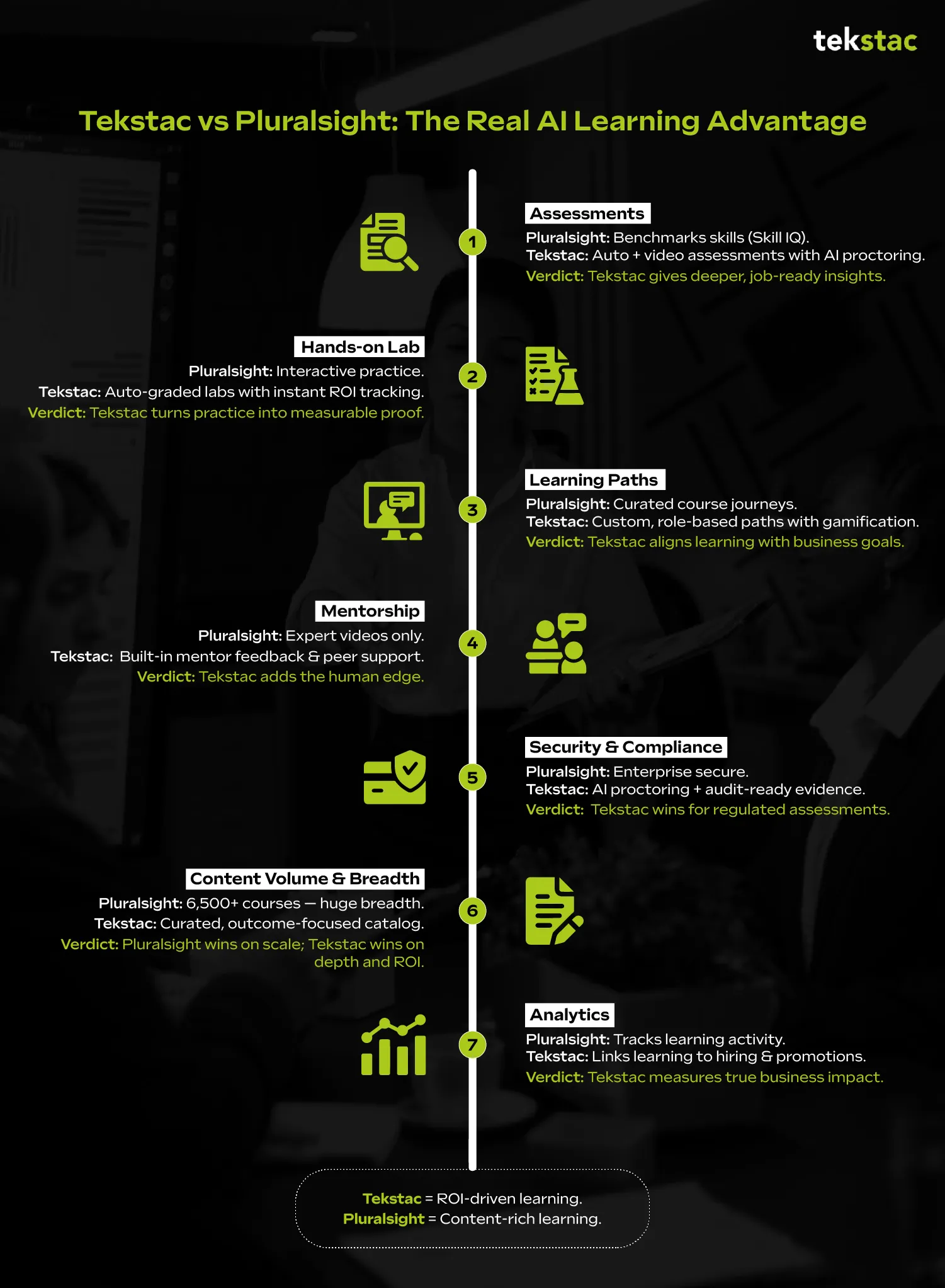
Pluralsight offers structured skill assessments (Skill IQ/Role IQ) to benchmark knowledge and recommend learning paths; these are useful for quickly measuring where a learner stands and for driving recommended content.
Tekstac, however, approaches assessment as a two-layered capability: instant, auto-evaluated assessments that gamify learning and deliver granular analytics, plus video assessments that evaluate communication, problem-framing, and applied thinking.
For companies doing a training ROI analysis, Tekstac provides a clearer picture of learner readiness and impact.
Verdict: Pluralsight’s Skill IQ provides a good benchmark, but Tekstac’s mix of auto-evaluated scoring, video responses, AI proctoring and mentor rubrics gives a richer, hire-ready assessment signal.
Pluralsight has invested heavily in hands-on experiences: interactive labs, sandboxes, and in-browser code labs that let learners practice with cloud and desktop environments. These labs are great for isolated practice and platform familiarity.
Tekstac’s Auto-Evaluated Labs take it a step further, offering instant grading, personalized feedback, and corporate training ROI metrics by tracking skills acquisition in real time. Every submission is auto graded against test cases and performance metrics, with step-by-step personalized feedback and cohort analytics.
Tekstac’s labs are positioned as part of a continuous learning lifecycle, which reduces manual grading load and makes lab results usable as hiring or promotion evidence
Verdict: Pluralsight’s labs are excellent for practice; Tekstac’s auto-evaluation and integrated analytics convert practice into defensible proof of ability that clearly influences L&D ROI comparison.
Pluralsight’s core strength is a mature, searchable catalog and curated learning paths that guide learners from fundamentals to advanced topics, and the platform surfaces tailored recommendations based on assessment results.
Tekstac takes a different tack: instead of only offering pre-built paths, Tekstac promises 100% customizable, role-aligned learning journeys, LTI integration so existing third-party content can be unified, and gamified milestones to drive engagement. This ensures learning outcomes are directly tied to training ROI analysis.
Verdict: The combination of role mapping, gamification, and live dashboards means Tekstac’s paths can be tuned to business outcomes rather than just course completion.
Pluralsight primarily scales through expert-authored video content and automated assessments; while it does offer guided learning experiences, direct mentoring/rubric-driven mentor review is not a core platform differentiator in the same way Tekstac makes mentoring part of the learning flow.
Tekstac’s Mentor Connect couples one-on-one and group mentoring, structured rubric feedback, and peer forums so learners get timely human guidance tied directly to assessment outputs. That human loop is especially valuable for borderline cases, candidate interviews, or nuanced technical topics where automated feedback can’t capture judgment or communication.
Verdict: Mentorship is blended into Tekstac’s product design, contributing to a higher Tekstac ROI, whereas Pluralsight focuses more on self-paced content and automated benchmarking.
Pluralsight markets enterprise features and governance for teams, and it’s widely used across companies for secure upskilling. But when it comes to integrated, assessment-level proctoring, that is not the headline differentiator Pluralsight promotes.
Tekstac’s Secure Proctoring Hub is designed natively into the assessment flow: AI monitors for impersonation, tab switching, unusual audio, produces confidence scores, and generates concise evidence packages for mentor review.
For regulated assessments, hiring decisions, or certification-grade testing, Tekstac’s approach reduces risk and administrative overhead while preserving learner experience. This level of compliance demonstrates the cost vs benefit of learning platforms in highly regulated environments.
Verdict: For high-stakes assessments and auditability, Tekstac’s native AI proctoring and reporting are stronger.
Here Pluralsight’s strength is indisputable: the platform advertises access to 6,500+ courses and thousands of hands-on labs and sandboxes, covering an exceptionally wide range of tech domains and vendors. For individual learners or teams who need breadth, Pluralsight’s catalogue is a compelling advantage.
Tekstac intentionally focuses on curated learning paths, role-aligned journeys and integrated assessment rather than quantity of discrete courses. If your priority is access to the largest possible library and immediate on-demand topic variety, Pluralsight gives more in volume
Verdict: Pluralsight has the upper hand here, when sheer scale and variety of course content are the deciding factor.
Pluralsight provides analytics and enterprise reporting (usage, skill gaps, role IQs) that help teams measure progress, but those analytics are principally consumption and assessment-level signals.
Tekstac layers skill-inventory analytics, cohort trend analysis, growth path analyzers, and ties assessment outputs (auto-graded labs + video rubrics + proctoring signals) to role readiness and hiring/upskilling decisions. The result is a product that not only shows who watched what, but shows who is demonstrably ready for a particular role or responsibility — and why.
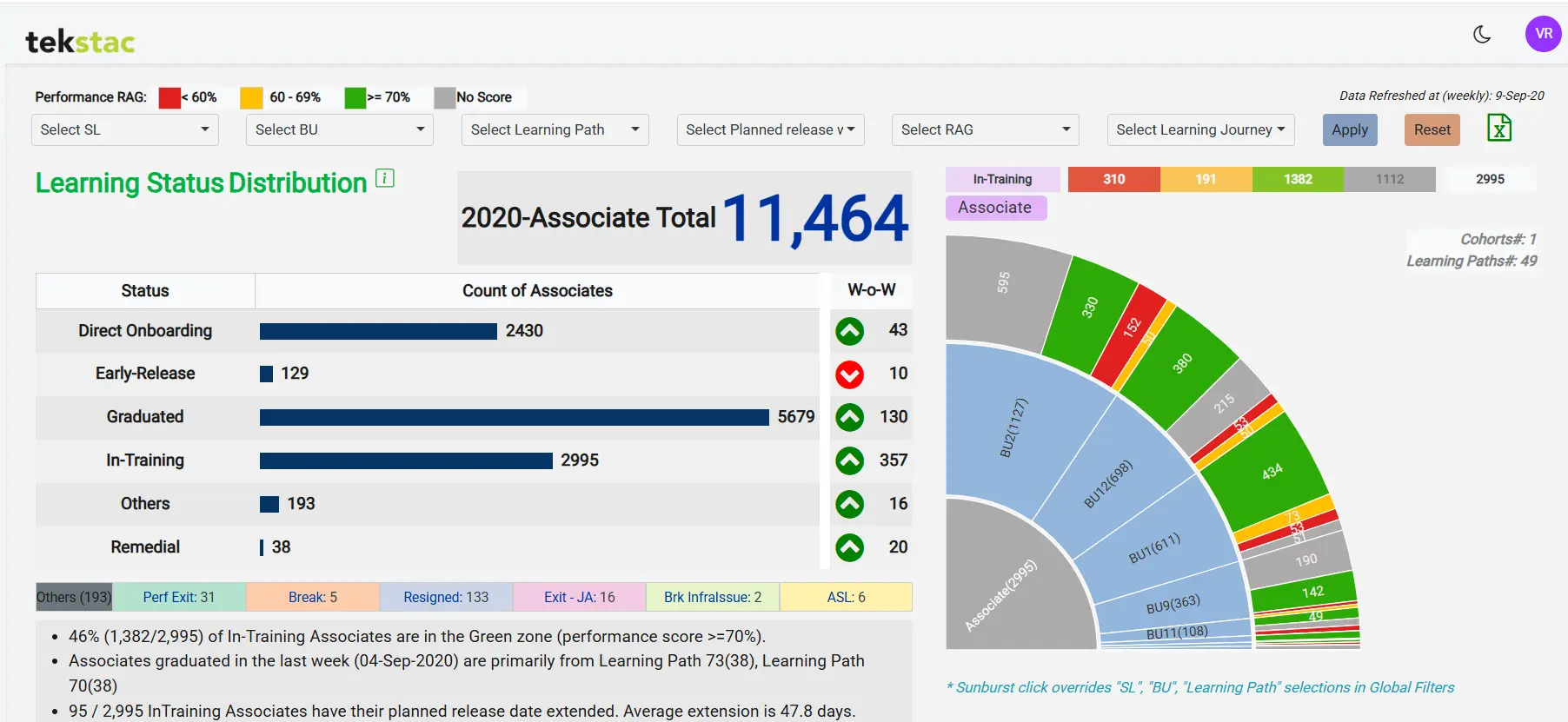
Verdict: Tekstac’s analytics are explicitly designed to drive HR and L&D decisions (hiring, promotions, targeted reskilling), not just measure activity.
ROI measurement is not a cakewalk in L&D. You need to answer a lot of questions. How do enhanced skills impact the organization’s financial strength? How does the company scale with other competitors in L&D ROI comparison? And so on.
Tekstac v/s Pluralsight ROI comparison will give insights on how they compare to one another in one of the most crucial metrics.
Pluralsight training ROI analysis suggests that a 295% return on investment (ROI) over three years, with organizations seeing full payback in under six months, according to a Forrester Total Economic Impact™ study.
The ROI is driven by faster onboarding, improved employee retention, and accelerated product development, resulting in millions in productivity gains.
Unlike Pluralsight’s ROI comparison, Tekstac measures learning impact through skills outcomes, productivity, retention, and alignment with business goals.
Tekstac supported 110,000+ learners for one of its leading tech clients, improving talent identification, reducing hiring and training costs, accelerating productivity, boosting engagement, optimizing program management, and improving ROI.
Tekstac builds evolving, real-time skill profiles (“SkillTag”) per learner, integrating assessments and workplace data to inform talent strategies.
Both Pluralsight and Tekstac are top upskilling platforms—Pluralsight with expert-led learning, and Tekstac with real-world coding practice.
So, what’s right for you?
Pluralsight remains an industry leader for individuals and teams looking for an expansive, expertly authored course library with hands-on practice options. If your top priority is content breadth and immediate access to thousands of tech topics, Pluralsight is the safer pick.
But for organizations that is looking not just content but a comprehensive skill development platform that includes assessments to mean something (beyond “course complete”), want labs that act as verifiable proof of capability, require low-friction, enterprise-grade proctoring, and value human mentoring tied directly to analytics and role outcomes, Tekstac is the more outcome-oriented platform. Most importantly, Tekstac empowers the organization’s L&D teams with proven ROI that is clear and actionable.
1. What is ROI in L&D?
ROI in Learning & Development is a way to measure how much value your organization gets from investing in employee training and development.
2. What factors influence L&D ROI comparison in companies?
Several factors impact L&D ROI comparison, including relevance of learning content, engagement levels, skill application on the job, and alignment with career progression or internal mobility goals. Platforms that integrate assessments, mentorship, and analytics, like Tekstac, provide richer insights for comparing ROI and making informed talent decisions, including promotions and lateral hiring.
3. How can organizations measure training ROI effectively?
Training ROI can be measured by tracking improvements in employee performance, time-to-competency, internal mobility readiness, and impact on business outcomes.
The HRTech 2026 conference, a gathering of global HR leaders and innovators, highlighted the trends, challenges, and breakthroughs shaping the future of work. We’ve compiled 26 key HR insights from sessions, panels, and conversations with leading voices.
These insights are organized into seven themes that capture the latest trends shaping HR. Let’s take a look.
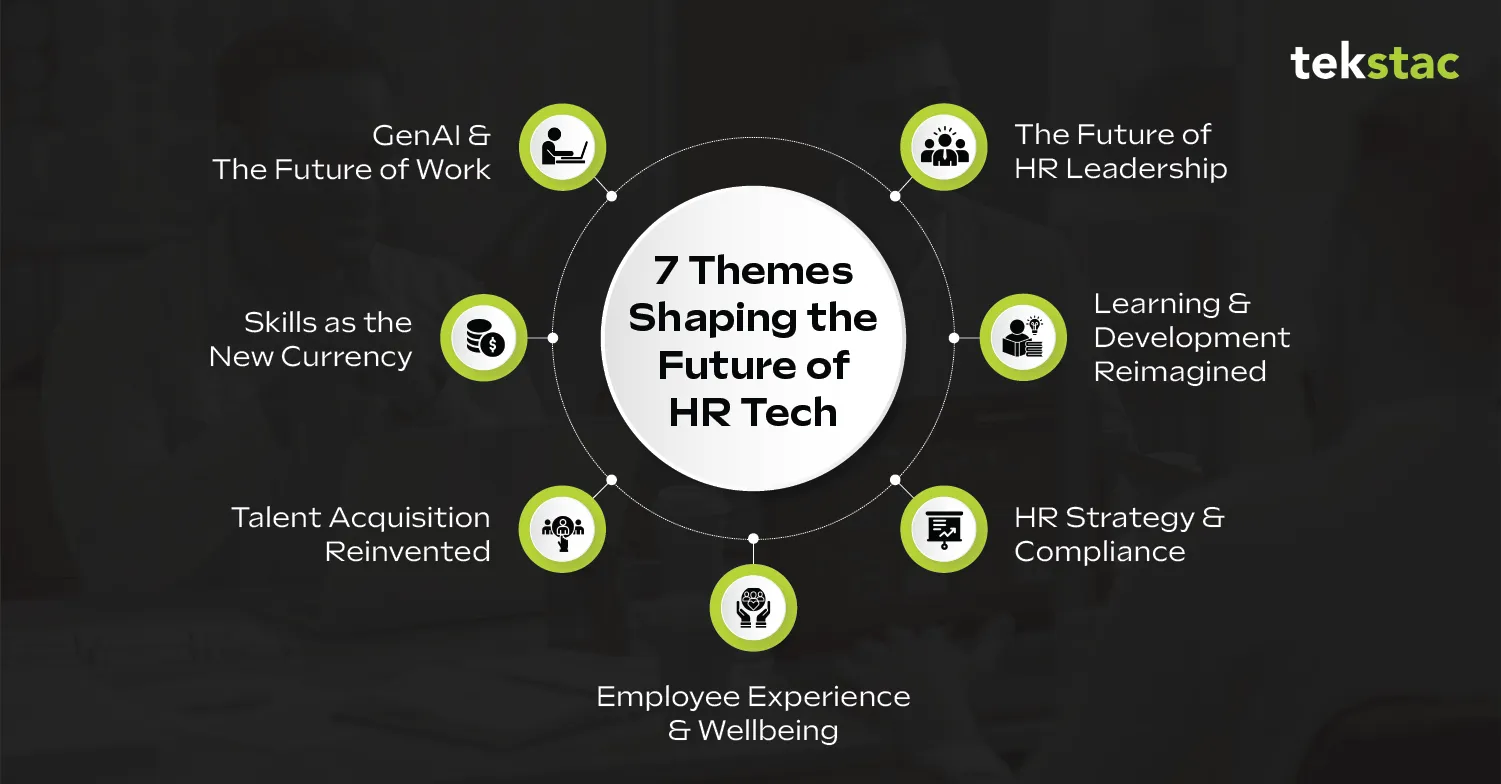
Discovery: Phenom and Paradox showcased GenAI-powered candidate communication—automated but personalized.
Why it matters: Candidate drop-offs happen when the process feels impersonal or slow. AI can help close that gap.
Action: Audit your candidate journey for speed, personalization, and human touch.
Quote: As Yvette Cameron (Oracle) noted, “The future of AI in enterprise software will become more conversational,” fundamentally changing how candidates and employees interact with HR systems.
Quote: “The talent shortage isn’t about numbers — it’s about skills alignment.”
Why it matters: Recruiting strategies must focus on quality hires and internal mobility, not endless sourcing.
Action: Build “talent intelligence” dashboards that connect hiring with performance.
Added insight: Kathi Enderes (Josh Bersin Company) challenged, “How can we make every person count more?” emphasizing outcomes over sheer headcount.
Discovery: Platforms like SHL, Pymetrics, etc., are using adaptive AI-driven assessments to personalize difficulty and reduce bias.
Why it matters: Fairness and scalability in hiring depend on intelligent assessment tools.
Action: Replace one-size-fits-all assessments with adaptive, feedback-driven models.
Quote: Robin Barbacane (Rackspace) said, “When you first create your AI tool, talk to it like an intern,” highlighting practical ways to integrate AI safely.
Stat: 65% of companies invest in improving manager and employee mobility experiences (Aptitude Research).
Why it matters: Moving people internally is more cost-effective and improves morale.
Action: Create internal job boards and mobility marketplaces.
Quote: Josh Gosliner (SAP) reminded us, “HR data can’t live in silos anymore,” reinforcing the need for connected internal talent strategies.
Stat: 58% of companies prioritize skills-based hiring and internal mobility.
Discovery: Platforms like Eightfold, Gloat, and SkyHive showcased live skills graphs linking learning to career paths.
Action: Start with a skills baseline; Platforms like Tekstac make this easier by capturing learning performance data that reflects actual skill growth, helping organizations keep their skills business aligned.
Quote: Heidi Barnett (isolved, Talent Acquisition) advised, “Think about complementary skills and help describe who a job would be perfect for.”
Quote: Madeline Laurano noted, “Employees don’t want a static career ladder—they want dynamic growth journeys based on skills.”
Why it matters: Retention improves when employees see a personalized path forward.
Action: Use platforms that visualize “if you learn X, you can move into Y role.”
Discovery: Vendors like Visier, CompXL link pay to skills, not just job titles.
Why it matters: It’s a fairness and DEI issue—and reduces bias in compensation.
Action: Explore skills-based compensation frameworks.
Quote: Heather Kruger (Salary.com) reminded, “Compensation is the foundation—organizations won’t get to higher-order culture dynamics if they don’t get the foundation right.”
Discovery: Platforms like Tekstac, Cornerstone, and Docebo embed adaptive learning journeys that adjust pacing, difficulty, and content.
Why it matters: Personalized learning improves retention, satisfaction, and outcomes.
Action: Shift toward adaptive learning paths tailored to performance and career goals.
Quote: Sandra Loughlin, PhD observed, “Real learning happens in practice, feedback, and flow—not just through structured content.”
Discovery: Tools like Degreed, Credly, and blockchain-based platforms offer verifiable skill credentials.
Why it matters: Employers want proof of capability, not just course completion.
Action: Incorporate verifiable assessments into programs.
One of the panelists quoted: “The ROI black hole is closing AI gives us real business outcome tracking.”
Why it matters: Learning is expected to drive promotion, performance, and retention.
Action: Tie learning outcomes to business metrics.
Quote: Jason Averbook emphasized, “In 2025-26, HR needs a reset. Otherwise, we’re putting digital lipstick on an analog pig.”
Discovery: ServiceNow, Qualtrics, and Microsoft integrate surveys, workflows, and learning.
Why it matters: Employees expect consumer-grade experiences at work.
Action: Invest in EX platforms that unify communications, HR tasks, and career tools.
Gartner found that among HR decision-makers, leader and manager development remains the number one priority.
Action: Give managers AI copilots for feedback, coaching, and visibility.
Quote: Bill Pelster, Amber Grewal, and Jaclyn Zhuang shared that managers may lead both people and digital agents, emphasizing hybrid leadership skills.
Discovery: Vendors like Modern Health and Spring Health integrate AI for personalized well-being nudges.
Why it matters: Burnout is a top turnover driver.
Action: Embed well-being into daily workflows.
Quote: Ami Graves said, “Without trust and strong leadership skills in our companies, the technology and AI implementations that we want to implement will fail.”
Discovery: ADP and CloudPay offer real-time pay and AI-driven anomaly detection.
Why it matters: Payroll errors erode trust quickly.
Action: Evaluate tools for speed, fairness, and reliability.
Quote: Pim Altena (Remote) warned, “Trust has a timestamp,” highlighting the link between accuracy and credibility.
Quote: Josh Bersin emphasized, “Without trust, none of this tech matters.”
Action: Communicate openly about AI and data usage.
Stat: 75% of companies plan to increase HR tech budgets.
Action: Build a strong ROI narrative.
Discovery: Big HR tech players are expanding fast: Workday acquired Sana, Deel bought Assemble, Paychex snapped up Paycor, Dayforce went private with Thoma Bravo, and HiBob added Pento and Mosaic—while startups keep innovating in niche areas like payroll, AI, and skills taxonomies.
Action: Pilot with smaller players when innovation matters.
Discovery: Workday, Phenom, and Eightfold showcased enterprise-ready GenAI features.
Why it matters: 64% of HR leaders see GenAI as essential.
Action: Start with low-risk, high-impact areas.
Quote: Nickle LaMoreaux (IBM) said, “It’s HR’s moment in the sun,” urging leaders to seize AI opportunity proactively.
Quote: Josh Bersin: “Transparency, bias management, and trust will define which vendors win.”
Action: Audit AI explainability.
Discovery: Microsoft Copilot in Viva, Workday’s AI agent features.
Action: Train teams to collaborate with AI as a partner.
Quote: Kyle Forrest emphasized, “You can’t slap AI solutions on top of existing processes,” underlining the need for integration.
Action: Upskill HR teams on data literacy, AI fluency, change management.
Quote: Patrick Leddin, PhD, asked, “Do I move towards the change, or do I move towards stability?”—guiding leaders to embrace uncertainty.
Discovery: Textio, Unitive, and certain ATS platforms integrate inclusive language and bias detection.
Action: Audit tools for bias.
Discovery: Microsoft, Zoom, Slack show hybrid tools as core utility.
Action: Invest in tech that supports hybrid collaboration.
Action: Collaborate with legal and IT; secure sensitive employee data.
Discovery: Platforms show employees their skill gaps and potential career paths.
Action: Give employees access to their own skills data.
Quote: Josh Bersin: “This is HR’s time. Don’t wait for tech vendors to define the future — build it yourself.”
Why it matters: Being proactive shapes culture, tools, and strategy.
Quote: Sarah Hodges (UKG) added, “HR tech is the bridge between ideas and outcomes,” reinforcing the strategic impact of HR.
At Tekstac, we see HR Tech 2026 as more than an event; it’s a reflection of how innovation, skills, and strategy are converging. And that’s exactly where our focus lies. The conference brought together industry’s best minds, covering HR insights, innovations, and technology to help organizations stay ahead of change and build the future-ready workforce of tomorrow.
1. What are HR Insights?
HR insights are data-driven, strategic understandings derived from workforce, talent, and performance data that help organizations improve hiring, learning, engagement, productivity, and business outcomes.
2. What are the 7 pillars of HR?
The 7 pillars of HR include talent acquisition, learning and development, performance management, employee engagement, compensation and benefits, workforce planning, and HR analytics, all working together to drive organizational growth.
3. What are the 4 types of HR analytics?
The four types of HR analytics are descriptive (what happened), diagnostic (why it happened), predictive (what will happen), and prescriptive (what should be done), enabling data-driven HR strategies.
4. How do HR insights impact business strategy?
HR insights help organizations align talent, skills, and leadership with business goals, enabling faster decision-making, improved productivity, and sustainable workforce transformation.