
Companies are investing more than ever in employee training programs. Yet, for many HR and L&D teams, answering a basic question remains frustrating: ‘Is it working?
Despite billions of dollars invested in upskilling and workforce training each year, 61% of training leaders still do not measure the ROI of employee training programs, per a LearnUpon survey of training leaders. Even when training outcomes are evaluated, Even when training outcomes are evaluated, they’re often reduced to surface-level metrics, such as completion rates, smiley-face surveys, or test scores. While these are useful, they are neither sufficient nor adequate.
Many organizations cite lack of clear goals, insufficient resources, and uncertainty about where to start as the top challenges in measuring training ROI.
Let’s take a realistic approach and a practical step-by-step process that covers actual training costs, integration with business goals, and how to use the data you already have.
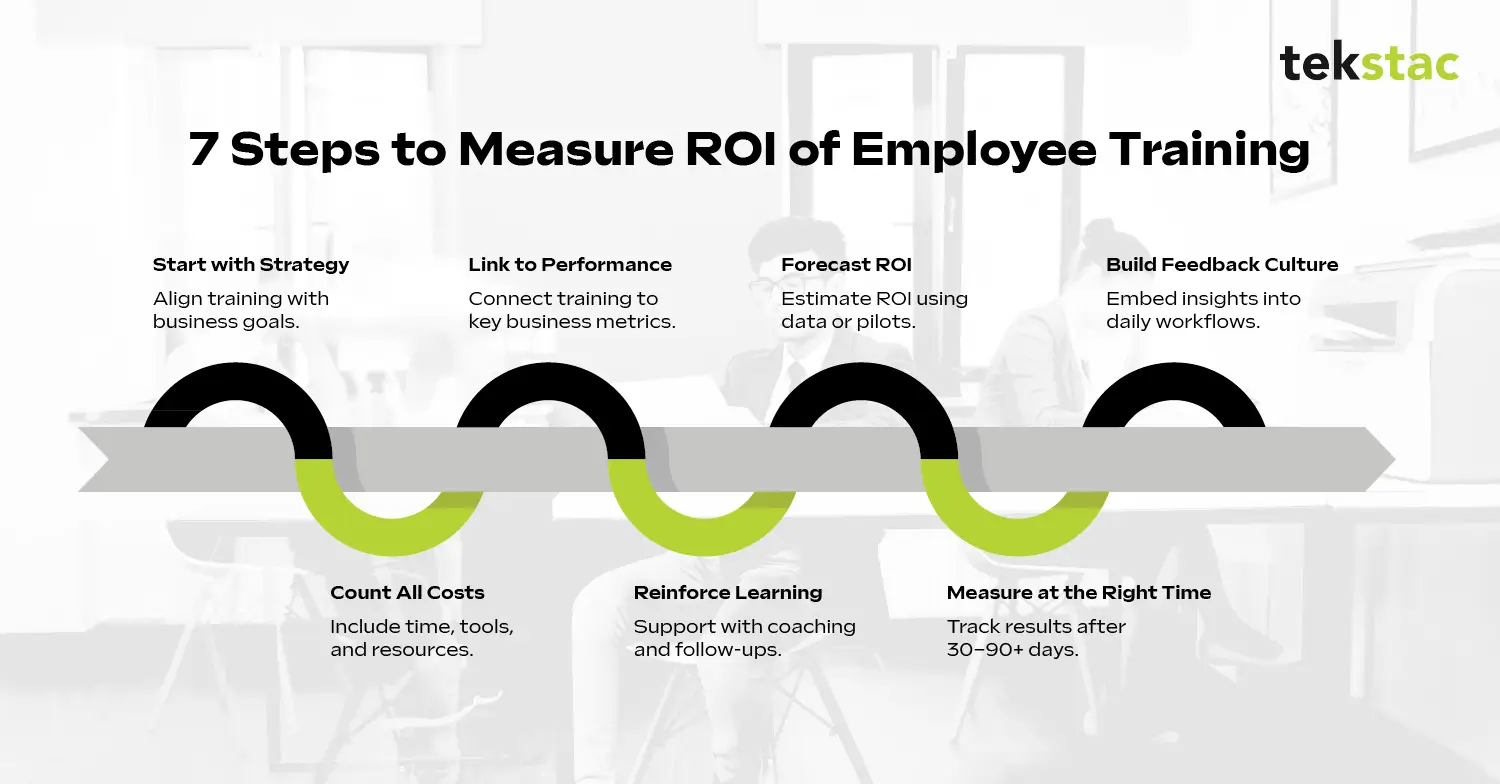
Most organizations begin their workplace training by identifying skill gaps, those missing competencies or technical skills employees lack. Focusing solely on skill gaps is a limited view that misses alignment with the company’s broader strategic goals and outcomes.
If L&D efforts fail to connect to what the business is trying to achieve, measuring learning impact becomes ineffective. Hence, without this strategic intent, most organizations fall prey to measuring ineffective ROI metrics like course completions or quiz scores but not outcomes such as increased revenue, improved customer satisfaction, faster product launches, etc.
To do this practically, begin every training program with a conversation beyond HR or L&D. Bring in stakeholders from business units, operations, sales, and leadership. Ask questions like:
From there, create learning objectives that tie directly to these priorities. This sets the foundation for meaningful ROI measurement. Determining learning success through business KPIs rather than just learning KPIs allows you to identify the right metrics upfront.
For example, instead of “improve negotiation skills,” a strategic intent might be to “reduce average sales cycle time by 15% through improved negotiation.”
Training budgets are generally calculated based on platform licenses, facilitator fees, or travel expenses. However, this approach does not capture the full cost of ownership of workplace training programs. Here’s how to ensure a more accurate cost baseline:
Employee time: Every hour spent in training is not spent on other productive work. This opportunity costs scales quickly across large cohorts.
Manager involvement: This includes conducting follow-ups, assigning pre-work, or leading on-the-job practice sessions, as they dedicate time and energy that needs to be accounted for.
Post-training reinforcement: Job aids, nudges, simulations, or coaching continues long after completing a course.
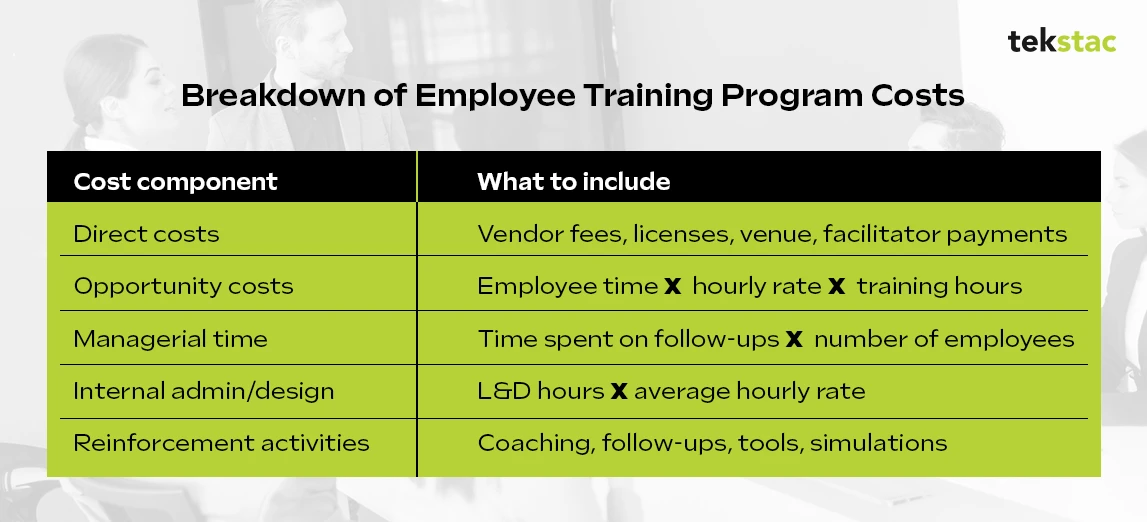
Many companies hesitate to investigate these costs out of fear they’ll seem too high, but being honest about the real cost of training actually strengthens credibility when showing impact, as leaders need an accurate number rather than a lower one.
Connect training outcomes with relevant performance data, sales figures, error reduction, customer satisfaction scores, or productivity rates. Start by identifying which business metrics your training will influence, then collaborate with data owners in departments like sales, customer success, or operations. They often track these metrics regularly and can provide historical data for comparison.
Now, create a simple data dashboard or report that overlays training participation data with these business KPIs over time. Look for patterns like improvements in key metrics following the training rollout—segment data by employee groups who took the training versus those who didn’t to isolate the impact.
For example, if average sales increase by 10% post-training in your trained group compared to untrained peers, that’s a clear signal of positive ROI. You can then translate that uplift into dollar values for your ROI formula.
Some employee training programs fail because of what happens after the session ends. Per Hermann Ebbinghaus’s Forgetting Curve research, as much as 90% of learning is forgotten within a month if not reinforced. As we observe, most L&D programs still operate on a “one-and-done” model.
Training is not a single event; it’s a process of behavioral change. Without reinforcement, there’s no lasting change, hence no real ROI. This means measuring training ROI must include structured reinforcement. Here’s what to include:
Tip: When planning your program, allocate at least 20-30% of your training budget or timeline to reinforcement.
A simple way to measure ROI with reinforcement in place would be to use this formula:
ROI of training programs (%) = (Total Benefit – Total Cost)/Total Cost x 100
Let’s break this down:
Total benefit = Business gains because of the training (e.g., time saved, revenue increased, increase in resolution times, etc.)
Total cost = Training costs + time + reinforcement tools or coaching
Predicting ROI upfront helps align expectations and secure stakeholder buy-in. Many organizations skip this step, making it harder to justify investments or set realistic goals. You can estimate the potential business impact your training can have based on historical data, benchmarks, or pilot programs. Forecast the costs involved so you have a clear picture of the investment
Predicted ROI (%) = (Expected Benefit – Cost)/Cost x 100
You can use smaller pilot groups to test training impact quickly before wider rollout and gather early performance signals, like knowledge application or behavior change, to adjust predictions. While predictive ROI isn’t perfect, it sets a proactive foundation for tracking and optimizing training success.
Measuring ROI too soon can be the biggest trap. True business impact from training often takes time to materialize. Behavior changes, productivity gains, or revenue improvements rarely appear overnight. It’s important to recognize that a training program might initially show a negative ROI or no measurable benefit—not because it failed, but because you haven’t yet reached the break-even point where benefits outweigh costs. To measure employee training ROI right:
If, after the appropriate measurement window, ROI remains negative, don’t see it as a failure but as a sign to dig deeper. It could mean the training wasn’t aligned with business priorities, the delivery method ineffective, or the benefits are harder to quantify. Use this insight to reassess training goals, refine the training content, improve reinforcement strategies, or adjust your metrics.
Training effectiveness depends heavily on how well it aligns with organizational culture, leadership support, and employee readiness to change. If the culture resists new behaviors or lacks reinforcement mechanisms, ROI will suffer despite great content or delivery. Factors like peer influence, manager involvement, and workplace norms shape whether learning turns into performance improvements.
Create channels to collect feedback not only immediately after training but throughout the learning journey. This includes:
The key here is to partner with managers to embed learning checkpoints into regular workflows, leverage technology platforms that allow real-time feedback and data integration, and communicating changes periodically.
Want practical strategies and future trends in employee development?
👉 Explore more in our full blog.
To actually measure training impact, the preparation work starts much earlier, with how you design your training ecosystem. There’s a need for a tool that not only delivers content but effectively tracks, connects, and analyzes every learning touchpoint against actual business KPIs.
Tekstac’s learning analytics and management modules help perfectly:
The platform also powers your learning experience with custom learning paths, mentor marketplace, virtual sessions, auto-evaluated practice labs, AI-proctored assessments, and many more. With over 1 million professionals upskilled, 24 million+ learning hours, and enterprise customers like IBM, PwC, Capgemini, and Cognizant, Tekstac is built for organizations that want to transform how they train and upskill. See Tekstac in action.
1. Why is ROI significant in training evaluation?
ROI is significant in training evaluation because it helps organizations determine whether training investments deliver measurable business value. By tracking outcomes such as productivity, performance, retention, and cost savings, companies can justify learning budgets, improve training effectiveness, and make more informed workforce development decisions.
2. How can we measure ROI from employee development programs beyond just satisfaction surveys?
Go beyond satisfaction surveys by tying training to measurable business KPIs — sales performance, error rates, productivity, or customer satisfaction — rather than completion rates. Segment performance data by who took the training versus who didn’t, then translate any uplift into dollar terms using the ROI formula: (Total Benefit – Total Cost) / Total Cost × 100.
3. What is the formula for calculating training ROI?
The standard formula is ROI (%) = (Total Benefit – Total Cost) / Total Cost × 100, where Total Benefit reflects business gains like time saved or revenue increased, and Total Cost includes delivery, employee time, and reinforcement. A Predicted ROI version — (Expected Benefit – Cost) / Cost × 100 — can be used before rolling out.
4. How do you measure employee training impact and ROI together?
Track leading indicators (knowledge retention, behavior change, engagement) soon after training, and lagging indicators (sales performance, error rates, customer satisfaction) over a longer 30–90 day window, then compare trained versus untrained groups to isolate the training’s actual effect.
5. What tools help measure training ROI?
Effective training ROI tools combine learning data with business KPIs in one view — look for custom dashboards with real-time progress tracking, predictive analytics to anticipate outcomes before rollout, and skill inventory monitoring, rather than tools that only report completion rates.
The world of work isn’t just changing; it’s evolving faster than most companies can keep up. What used to work ten years ago, scheduled training sessions, fixed job descriptions, manual performance reviews, is now dangerously outdated.
In this environment, a business is only as strong as the adaptability of its people.
This is where Talent Development Programs come into the picture. These aren’t just employee workshops or onboarding checklists anymore. They are enterprise engines.
Engines that build skill, enhance judgement, and turn employees into contributors capable of facing the unknown with confidence.
According to a 2025 McKinsey report, 60% of executives now say their company’s competitive edge depends on how quickly they can reskill their people.
That’s not HR fluff.
That’s a strategic priority for business growth.
And yet, most organizations are still treating talent development like a cost center, not the profit multiplier it actually is.
The real problem is that training is still reactive. It’s not aligned to the job. It’s not intelligent. And in many cases, it’s not even reaching the right people at the right time.
That’s why businesses lose talent, productivity, and in the long run, relevance.
There’s a better way. One that treats talent like a living system, not a static resource. The new standard for Talent Development Programs is adaptability.
Not just what employees know, but how quickly they can learn something new when the rules change.
This is where AI in learning and development becomes mission-critical. AI/ML based HRTech tools now enable companies to tailor learning paths for each individual, not just based on their role, but on performance patterns, their career aspirations, business requirements, learning style, and growth trajectory.
Take a look at what this unlocks
In a recent LinkedIn Workplace Learning report, companies that invested in AI-enabled talent development platforms reported a 23% increase in internal mobility and a 30% reduction in turnover.
That’s how powerful smart development can be.
And don’t ignore Upskilling through automation. When machines handle repetitive tasks, human workers must step into higher-order thinking roles, negotiation, decision-making, leadership. But they can only do that if they have the necessary skills.
Let’s break this down through a practical lens.
Unilever, one of the world’s top consumer brands, completely reshaped its approach to talent development by dismantling traditional roles and replacing them with task-based assessments.
Instead of promoting based on time served, employees were assessed based on project complexity, agility, and learning speed.
With AI embedded in its learning system, Unilever enabled every employee to build their own career map, automatically updated based on skill growth and business needs.
This shift didn’t just improve retention, it unlocked hidden talent across the entire organization.
Or consider Genpact, a global services company. When GenAI exploded onto the scene, they immediately created AI-driven employee development tracks focused on prompt engineering and LLM literacy.
Over 75,000 employees completed their AI foundation module in under 6 months, leading to a 3x increase in total learning hours over the past four years.
These aren’t edge cases. They’re the new standard.
Now here’s what every business needs to start doing immediately
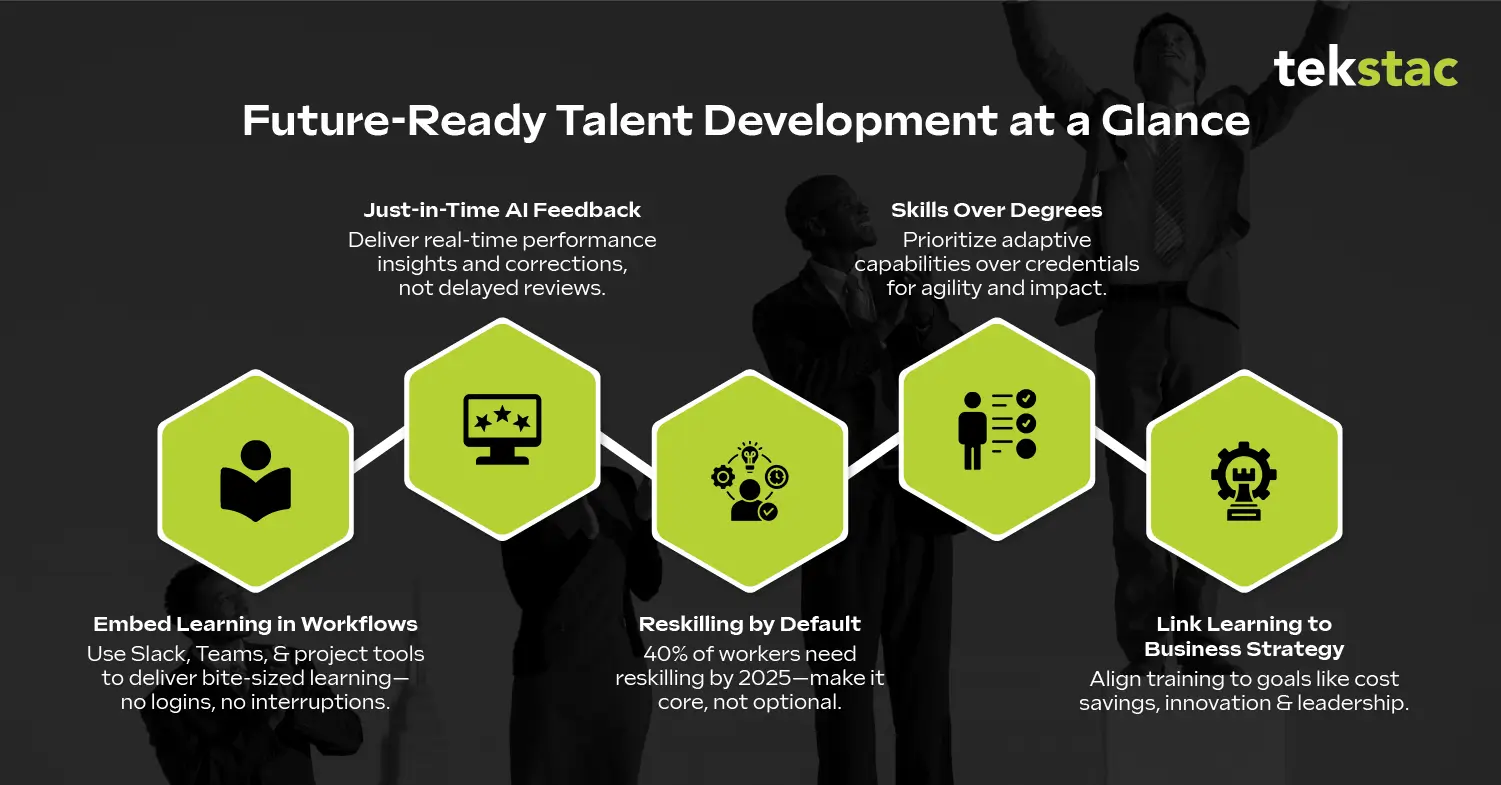
People won’t engage in training if it interrupts their work. That’s why modern Talent Development Programs embed learning into tools already being used — Slack, Teams, project management software. Microlearning modules triggered by real work tasks.
No separate login.
No off-site seminar.
Learning must happen when it matters most. With AI in learning and development, systems can now evaluate an employee’s real-time performance, detect errors or gaps, and offer corrective content instantly.
No need to wait for the next quarterly review.
A 2025 World Economic Forum study found that over 40% of all workers will need reskilling within the next three years.
That means Upskilling through automation isn’t a nice-to-have. It’s a survival plan. Companies must fund, incentivize, and promote reskilling pathways by default.
Credentials are no longer the main currency of value. The ability to adapt, learn, and apply new knowledge rapidly is what counts. AI systems can assess these traits better than any traditional resume scan.
A recent SAP SuccessFactors case study showed that companies adopting skill-first development models saw a 26% increase in project delivery speed and a 15% improvement in leadership pipeline efficiency.
This is where too many get it wrong. Learning is treated as an HR metric, not a revenue enabler. True AI-driven employee development maps every learning track to a clear business objective — cost reduction, faster innovation, customer satisfaction, leadership capacity. Training must be an investment that pays back.
Every company is sitting on a goldmine. Their people. But talent without development is just potential, not performance. The companies that win in this next decade won’t be the ones with the most capital, but the ones with the most adaptable workforce.
Talent Development Programs are no longer optional. They are the core infrastructure. As critical as cloud servers or cybersecurity. And when powered by AI, they don’t just train workers. They evolve them.
The time to act is now. The longer the delay, the wider the skills gap becomes.
And here’s the truth. Implementing this doesn’t have to be hard. Not with the right partner. There are platforms today that can deploy these capabilities out of the box — from smart learning paths to performance-linked coaching to skill analytics that make HR feel like strategy.
It’s a different game now.
Static roles have been replaced by skill clusters. One-size-fits-all training is obsolete.
And AI isn’t just automating tasks — it’s building talent.
There’s no turning back. The choice for organizations is simple.
Keep relying on outdated training systems, lose people, fall behind.
Or, switch to intelligent, data-driven, personalized development and build a workforce ready for anything.
If there’s one place to start, it’s with a smart platform that aligns learning, performance, and business goals.
One that offers everything from skill taxonomies to AI-powered coaching, from role-based content curation to real-time feedback — all personalized, scalable, and integrated
Try Tekstac today and experience what intelligent talent growth can really look like
👉Get Started Now
1. What are the key benefits of AI-powered talent development platforms?
AI-powered platforms improve internal mobility, reduce turnover, accelerate reskilling, and provide data-driven insights into workforce readiness. They help organizations build future-ready talent while turning learning investments into measurable business impact.
2. How does AI improve learning and development programs?
AI improves learning and development by delivering personalized, just-in-time content, automating skill assessments, and providing real-time feedback. It helps organizations scale training efficiently while increasing engagement, retention, and measurable performance outcomes.
3. How does AI-driven talent development support business growth?
AI-driven talent development aligns employee skills with strategic objectives such as innovation, operational efficiency, and leadership readiness. By reducing skill gaps and improving workforce agility, companies achieve faster execution, better retention, and long-term competitive advantages.
4. What business outcomes can talent development solutions deliver?
Talent development solutions improve productivity, accelerate time-to-skill, strengthen leadership pipelines, reduce hiring costs, and support faster innovation by aligning workforce capabilities with strategic business priorities.
If more than 90% of employees say they’d stay longer at a company that invests in their career, why are so many still leaving?
The answer is simple. Most workforce development strategies are not working. They’re well-intentioned, but too generic, reactive, or completely disconnected from what employees need to grow—and what the business needs.
Organizations are spending time and money on learning initiatives. Over half of them list upskilling and reskilling as a top priority. However, only 21% believe their efforts are practical. While this internal pressure causes misalignment, external pressure is mounting.
With AI and automation expected to disrupt nearly half of all jobs in the coming years, most organizations still lack access to the right resources.
This is the gap companies need to close, and in this blog, we’ll discuss exactly how, with the most effective employee upskilling strategies.
If we look at the root cause of most ineffective workforce development strategies, we find they’re performative. A few courses here, a new platform there, perhaps some annual compliance training—they rarely drive any change on the ground.
According to the LinkedIn Workplace Learning Report, 94% of employees would stay longer at a company that invests in career development — yet most organizations still struggle to offer structured, measurable workforce development.
In 2026, a good workforce development strategy is built with intention. Let’s see how.

Just because employees are learning something doesn’t mean it’s moving the needle. A solid strategy focuses on the adoption and practical use of future-forward skills. The goal isn’t to train for training’s sake. It’s to ensure your workforce is equipped for the shifts across your industry.
Throwing generic content at employees and hoping it sticks is not a strategy. A meaningful employee upskilling strategy personalizes learning to the employee’s role, growth path, and learning style, while ensuring every resource serves a clear purpose. Whether self-paced modules, peer mentoring, or live sessions, every touchpoint should move the learner (and the business) forward.
Learning in isolation won’t drive results. The strongest strategies are mapped directly to business goals: increasing customer satisfaction, enabling digital transformation, or closing leadership gaps.
As always, a good employee development strategy must be measurable. If you can’t track skill development, impact, and progress, you’re just guessing. Additionally, development shouldn’t be a separate activity employees do when they “find the time.” The best strategies are embedded into everyday workflows through feedback, real projects, coaching, and collaboration.
As we often notice, some development strategies die quietly after a while, even after allocating training budgets or launching an LMS. If you’re wondering why nothing’s changing on the floor or if you want to take a more innovative approach to workforce development, below are the top 7 workforce development strategies.
If your workforce development strategy starts with you looking at current roles and asking, “What’s missing?” you’re already going backward. The smarter question is, “What roles and skills will we need in two years—and how do we build for that now?” Future-back skill planning starts with forecasting future capabilities based on business goals, market shifts, and industry evolution. It requires a partnership between HR, L&D, and leadership to identify skill adjacencies, define learning paths, and bake them into career journeys.
With the rise of AI, most companies are excited to invest in GenAI or piloting chatbots. However, employees may still be unaware how exactly it embeds into their work. For example, does your payroll team know how AI affects them? Does your customer service team understand how it’ll change how they work?
AI literacy can’t be just for the IT crowd or the early adopters. Everyone in your company needs to know what AI means for their job — what it automates, what it makes easier, and what it demands from them now.
Most learning strategies assume people are all starting from the same point, learning in the same way, and aiming for the same goal. This usually ends up in choosing a same course or a learning platform that leave high performers bored and struggling folks overwhelmed.
A better approach would be to build learning journeys like real paths based on where someone actually is, rather than assuming where the employee stands, knows, or wants to go.
Ask people how to grow in their company, and most will shrug. Very few know what leads to a promotion or a role switch. This is a big problem. Career paths are usually vague, unspoken, or left to chance. And when there’s no clarity, the same types of people keep getting promoted while others get stuck.
Make growth feel intentional. Start by mapping out what success looks like in each role. Be specific. What skills, outcomes, and behaviors are needed to level up? Don’t keep it locked in a PDF either, bring it into everyday conversations. Managers should reference these paths in check-ins.
Some traditional L&D strategies run like a school timetable, involving annual plans, quarterly workshops, and calendars. But work doesn’t wait for Q3 to teach you something. It throws new tools, priorities, and challenges at you out of nowhere. When learning doesn’t show up in those moments, people either wing it or stall.
A better way would be to make learning immediate by using microlearning. If someone’s stepping into a new project, give them a quick how-to guide right then. Learning has to move at the speed of change. Otherwise, it’s already too late.
Solely looking at whether the employee has completed the course doesn’t help determine if they learned anything. Hence, measure impact. If someone took a negotiation course, are they actually closing deals better? If they were trained on giving feedback, is their team communicating more clearly? Tie learning to actual outcomes — better performance, fewer errors, stronger collaboration.
As we often notice, workforce development gets boxed into L&D or HR. However, real growth happens in the flow of work, driven by managers, shaped by teams, owned by employees. That shift only happens when everyone sees development as their job. Give employees visibility into skill paths. Equip managers to enable growth, not just review it. And get leaders to invest in learning as a lever for business impact. Ultimately, when employee development becomes a shared ownership, it scales.
In many organizations, managers are expected to drive both project outcomes and team development. However, without the right tools, they often struggle to provide consistent, personalized growth opportunities for their teams. This gap can lead to disengagement and high turnover.
The right tools, like Tekstac, address this challenge by offering an AI-powered, end-to-end skilling platform that automates and personalizes the learning journey for each employee.
With over 500+ curated learning paths covering in-demand tech areas like data analytics, cloud computing, and cybersecurity, Tekstac ensures that employees have access to relevant, up-to-date content.
The platform’s integrated lab environment enables real-time, hands-on practice across various technologies, allowing employees to apply new skills in a controlled setting. Additionally, AI-driven personalization analyzes skill assessments to identify knowledge gaps and recommends tailored learning paths aligned with individual career goals.
Tekstac provides real-time insights into team progress through intuitive dashboards and analytics. This visibility allows managers to track development, plan interventions, and make informed decisions without micromanaging the learning process.
Ultimately, managers and organizations can focus on strategic leadership and team engagement, confident that their teams are progressing along personalized, goal-oriented learning paths.
Want to apply these workforce development strategies inside your organization? Book a free strategy consultation with our L&D experts.
Create a workforce development plan by assessing current skills, identifying future skill needs, building training paths to close gaps, assigning ownership, and tracking progress with measurable outcomes.
The most effective global strategies emphasize continuous learning, skills-based career paths, digital skilling, remote-friendly learning platforms, and culturally adaptable training content that support diverse teams.
Success is measured using KPIs like skill assessments, project outcomes, goal achievement, time-to-productivity, promotion rates, and employee engagement.
Learning outcomes define what learners should know, understand, or be able to demonstrate after completing a course, certification, or corporate training program. Unlike learning objectives, which focus on what instructors intend to teach, emphasize measurable learner achievements. They help organizations evaluate training effectiveness, identify skill gaps, improve employee performance, and demonstrate learning ROI. Whether you’re designing an employee training program or evaluating workforce readiness, clearly defined learning outcomes provide the foundation for measurable business success.
Learning outcomes are the specific skills, knowledge, attitudes, and competencies that a learner is expected to acquire as a result of a learning experience. Unlike learning objectives, which describe what the instructor aims to teach, learning outcomes describe what the learner can do after the training. These outcomes are measurable and actionable, making them essential for evaluating learning effectiveness.
Examples of learning outcomes include:
Although the terms learning outcomes and learning objectives are often used interchangeably, they serve different purposes in education and corporate training. Learning objectives describe what instructors intend to teach, while learning outcomes focus on what learners can demonstrate after completing the training. Understanding this distinction helps organizations design measurable training programs, assess learner performance, and align learning initiatives with business goals.
| Learning Objectives | Learning Outcomes |
|---|---|
| Instructor-focused | Learner-focused |
| Broad | Measurable |
| Course design | Performance evaluation |
| Teaching plan | Demonstrated skills |
Bloom’s Taxonomy is a widely recognized framework for creating measurable learning outcomes. It helps educators and L&D professionals use clear, action-oriented verbs to define what learners should know, understand, and demonstrate after training. By aligning learning outcomes with Bloom’s Taxonomy, organizations can design more effective assessments, accurately measure skill development, and connect training outcomes to business performance and ROI.
Organizations invest millions in learning and development each year. But without concrete measurement, these initiatives risk becoming superficial. Here are some key reasons why measuring learning outcomes is critical:
Measuring outcomes helps determine whether a training initiative led to improved skills or behavior change. This validation ensures that learning is meaningful, not just procedural.
Assessment of learning outcomes helps identify skill gaps, enabling personalized learning paths. For instance, if a learner struggles with a certain concept, targeted content or support can be introduced. Over time, this leads to continuous improvement in both learning content and learner performance.
When learning outcomes are tied to business objectives (like improved customer satisfaction, increased productivity, or reduced error rates), it creates alignment between individual development and organizational success.
In today’s data-driven world, L&D departments are increasingly accountable for delivering measurable results. Outcomes-based measurement offers transparency and builds credibility with stakeholders.
You can’t demonstrate ROI without data. Measuring learning outcomes provides the metrics needed to correlate learning interventions with business impact, making it possible to justify or even expand the L&D budget.
Traditional learning measurement methods, such as tracking attendance and course completion, are giving way to more sophisticated, data-rich approaches. Organizations now leverage data analytics to capture granular insights into learner performance, progression, and engagement.
This shift is fueled by the increasing availability of digital learning platforms and AI-driven tools that collect, process, and analyze learning behavior in real-time. Predictive analytics, adaptive assessments, and learning experience platforms (LXPs) are transforming how we measure success. By using data to continuously evaluate and refine learning interventions, organizations ensure that every learning dollar is spent strategically.
According to a Deloitte survey, 61% of high-performing organizations use data analytics to support learning strategy development- more than double the rate of their lower-performing peers.
The ultimate goal of measuring learning outcomes is to prove—and improve—return on investment (ROI). Here’s how outcomes data directly impacts ROI:
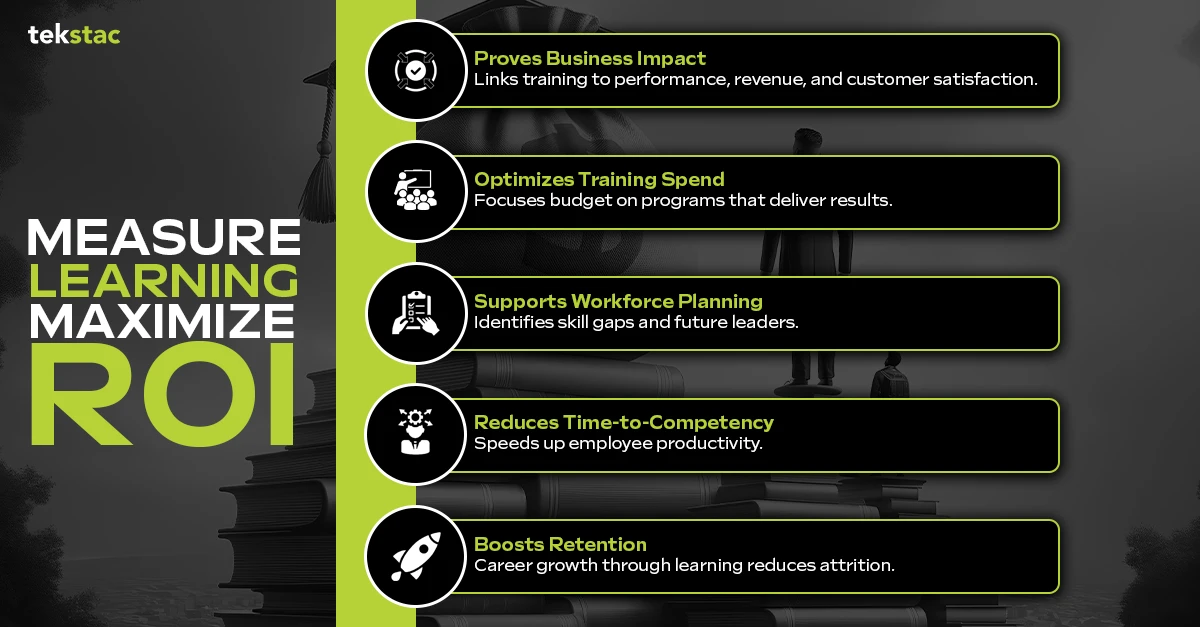
Clear outcomes link learning efforts to key business metrics such as employee performance, customer satisfaction, and innovation speed. For example, improved sales training outcomes can be measured against increased revenue or shorter sales cycles.
Outcome data helps identify high- and low-performing programs, enabling better budget allocation. By cutting ineffective initiatives and scaling successful ones, organizations maximize learning ROI.
By measuring outcomes, organizations can identify future leaders, skill shortages, and team strengths. This enables proactive talent management and succession planning.
Effective training backed by measurable outcomes shortens the time it takes for employees to reach full productivity, accelerating ROI.
Employees who see real career progression through skill development are more engaged and less likely to leave, significantly reducing attrition costs.
Many organizations still rely on traditional methods like attendance tracking, course completion rates, or post-training feedback forms. While useful for gauging engagement or satisfaction, these methods do not assess skill application or knowledge retention.
Modern approaches include:
When you have clear data on what works and what doesn’t, you can make better decisions about content, delivery methods, and resource allocation.
Learners who see a direct link between their efforts and career growth are more motivated. Measurable outcomes act as milestones that validate progress.
A McKinsey study reveals that only 40% of companies align learning strategies with business objectives, underscoring the need for clearer measurement frameworks that connect learning outcomes to performance and ROI.
A Harvard Business Review report shows that companies that effectively measure and act on learning data are 24% more profitable than their peers.
In a fast-changing market, the ability to rapidly upskill or reskill talent is a competitive advantage. Measuring learning outcomes helps build this agility.
According to a LinkedIn Learning report, 73% of L&D professionals say their leadership wants them to connect learning to business outcomes. Accurate measurement makes this possible.
Despite its importance, outcome-based measurement is not without challenges:
This is where intelligent learning platforms like Tekstac come into the picture.
Tekstac is a 360° skilling platform that integrates learning, assessments, and analytics to provide a holistic view of learner development. Unlike traditional LMS or LXPs, Tekstac is designed to focus on outcomes, not just activities. Its learning engine is built to simulate real-world scenarios and projects that mirror actual workplace challenges.
Tekstac assessments cover multiple formats, including auto-evaluated coding tasks, case-study evaluations, scenario-based MCQs, and AI-proctored video assessments. Each assessment is role-mapped, which ensures that learners are tested on job-relevant skills. This results in more precise measurement of learning outcomes and more actionable insights.
Tekstac’s assessment engine generates deep insights into skill proficiency, growth trajectory, and role readiness. For organizations, this means they can:
Ultimately, Tekstac doesn’t just help you assess what learners know- it helps you understand what they can do. And when learning outcomes are that clear, ROI follows naturally.
Turn learning outcomes into measurable business results with Tekstac. Discover how our AI-powered skills assessments, learning analytics, and role-based learning paths help organizations validate workforce capabilities and maximize training ROI. Book a demo to see how Tekstac can transform your learning and development strategy.
1. What is the purpose of measuring learning outcomes?
Measuring learning outcomes helps organizations evaluate training effectiveness, identify skill gaps, and link learning to business results and ROI.
2. What are the best platforms for tracking learning outcomes in online courses?
The best platforms for tracking learning outcomes in online courses include learning management systems (LMS), learning experience platforms (LXP), and skills assessment platforms such as Tekstac. These platforms provide assessments, analytics dashboards, progress tracking, and measurable insights into learner performance and skill development.
3. What is the difference between learning objectives and learning outcomes?
Learning objectives describe what training intends to teach; learning outcomes define what learners can actually do afterwards.
4. How do learning outcomes impact ROI?
They provide measurable evidence of performance improvement, enabling better budget allocation and business impact analysis.
5. Which companies offer software solutions to measure learning outcomes in corporate training?
Several companies offer software solutions to measure learning outcomes in corporate training, including Tekstac, Degreed, Cornerstone, Docebo, and other enterprise learning platforms. These tools combine assessments, analytics, skill tracking, and performance insights to help organizations evaluate training effectiveness and business impact.
A talent development strategy is the system that closes the gap between the skills your business needs and the capabilities your people currently have. Without one, organizations train reactively spending on programs that don’t connect to business priorities, losing talent that sees no growth path, and falling behind competitors who treat capability building as a strategic function.
49% of learning and talent leaders admit their executives are worried employees cannot deliver on business strategy. The problem is not ambition, it is architecture.
The most innovative companies are doing more than upskilling and reskilling. They’re building internal ecosystems for growth, including coaching, leadership training, internal mobility, etc.
These “career development champions,” organizations that are pulling ahead on profitability, retention, and AI readiness through employee development, are 42% more likely to be Generative AI frontrunners, as per LinkedIn’s Workplace report.
And yet, only 36% of organizations qualify as champions. This means 64% of companies haven’t even started. There is no roadmap, no commitment—just scattered programs.
Let’s be honest—many organizations are still in the early stages of developing a strong talent development strategy. They don’t know what it looks like. This is exactly where we begin.
A talent development strategy fails when it is designed around content rather than business outcomes. The organizations that close the gap between training investment and measurable performance treat development as a strategic function, not an HR program connecting every learning initiative to a specific business priority, role requirement, or succession need. A true talent development strategy starts with a business problem, and ends with measurable impact. Career development champions connect employee development strategy to outcomes that actually matter:
Now, here’s what the champions are doing differently:
These organizations don’t train for its own sake. The strategy builds AI fluency if the business is shifting to AI-powered tools. If a growth market opens, they groom internal talent to lead that charge.
Career development should never be a one-time conversation. It’s designed into jobs, into culture, into how managers lead. Champions make growth visible, expected, and tracked. To truly grow employees, career development must be built into your performance management processes. That means development goals are set alongside business goals. Managers talk about growth in regular 1:1s. People know what skills they’re expected to build, and how that ties into the next role or project.
Employees need more than a new title; they need new challenges as well. The best organizations move talent laterally, vertically, and even across geographies. It’s less about hierarchy and more about exposure and stretch.
Budgets are focused on critical roles, high-potential employees, and future skills. These companies treat talent development like product R&D.
The biggest secret isn’t more content—it’s better managers. Champions are more likely to provide their managers with training to support career development because if they aren’t on board, your strategy won’t land.
Most companies miss the mark by treating employee training and development as a series of disconnected programs instead of a cohesive strategy. They focus on content, assuming more training equals better performance, without aligning learning to business goals. This step-by-step process helps avoid this:
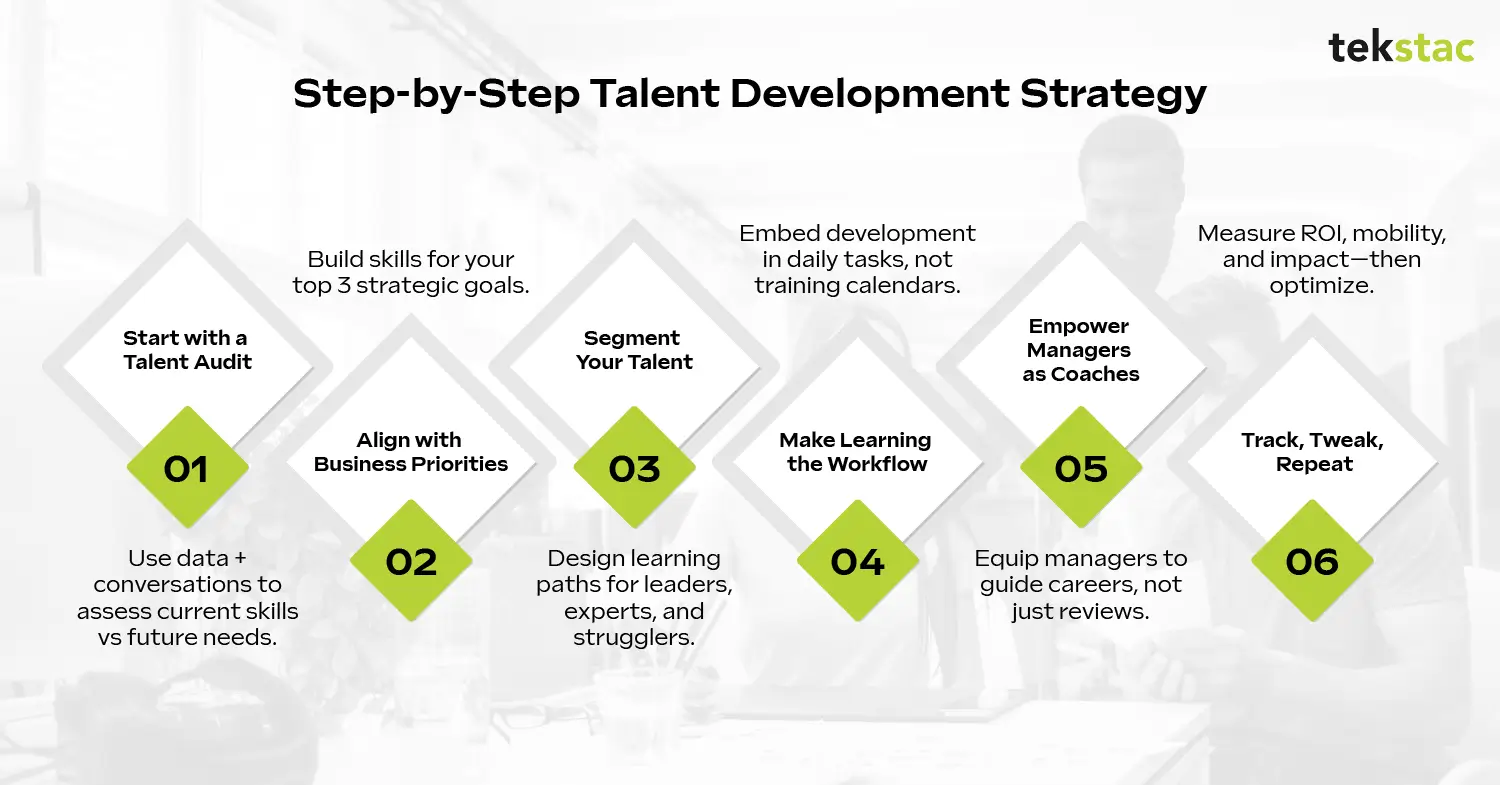
A talent audit is the mandatory first step in any talent development strategy because without it, every subsequent investment is guesswork. It assesses current employee skills, identifies capability gaps versus business requirements, and reveals which roles are most at risk from attrition, AI disruption, or market change, giving L&D teams a prioritized, evidence-based starting point rather than a training calendar.
Before jumping into upskilling, take stock of what you actually have. Conduct a talent audit to assess employees’ current skills, roles, and potential or your workforce against where the business is headed.
Tools like Tekstac’s skills insights give L&D teams a real-time view of capability gaps across roles, departments, and levels — replacing pulse surveys and spreadsheet audits with continuous, AI-driven skills intelligence.
Start by asking:
Pull in hard data (performance, exits, skill gaps), but don’t stop at dashboards. Run pulse conversations, interview managers, and look at internal mobility patterns. These don’t just help diagnose skill gaps but also in predicting future failure points.
Champions are 49% more likely to use internal data to identify skill gaps and 48% more likely to build career paths with aligned skills and courses. Most organizations are flying blind. Don’t be one of them.
Anchoring talent development to business priorities means translating your organization’s top strategic bets directly into capability requirements. If the business is shifting to AI-powered workflows, the development strategy builds AI fluency. If a new market is opening, it grooms internal talent to lead that expansion. The strategy reads like a GTM plan — not a policy document.
Then, think of the capabilities that these bets would demand. Build talent around these moves, be it expanding into new markets, implementing new tech, or overhauling operations. Your talent development strategy must read like a GTM plan rather than a policy document. That’s what gets executive buy-in as well.
Your employees are not one audience. They’re high potentials, legacy SMEs, restless Gen Zs, and mid-level managers stuck in the middle. So why offer them the same workshops?
Prioritize your development paths:
Champions offer 33% more tactics than non-champions: internal job postings, cross-functional gigs, career plans, gig-based work, and peer learning—all tailored.
Most organizations still treat learning like a perk. But in top companies, learning is the workflow. They embed it to create a continuous learning culture through:
Building this kind of infrastructure requires more than content — it requires AI-powered workforce upskilling solutions that adapt to each employee’s role, pace, and capability level in real time.
For instance, instead of sending new team leads to a generic leadership training, you could create a shadowing sprint where new leads spend their first month observing senior leaders in action, paired with weekly feedback reviews. This leads to faster ramp-up and fewer early missteps.
Champions are 88% more likely to offer career-enhancing project work, and 32% more likely to deploy AI training.
Managers make or break development. Yet only 15% of employees say their manager helped them build a career plan in the last six months. This is because managers are underequipped. They’re drowning in operations and rarely trained to discuss growth.
What you can do:
No company would leave a marketing campaign untracked, so why treat employee development like a static initiative? Make sure to track:
This helps ensure if your talent development strategy is growing fast enough to match market shifts and if people are moving into critical roles, or out of the company.
Workforce development plans shouldn’t depend on annual budgets or which HRBP’s leading the charge this year. If it does, your development plan is already fragile and may be forgotten by Q3.
Career development champions build infrastructure—systems that outlast people, roles, and restructures. Here’s how:
Career development plans should be company-wide mandates. Executives define the bets, HR turns them into critical capabilities, and managers translate them into meaningful conversations about growth.
Internal mobility starts with visibility. Employees must see what’s possible across teams, roles, and business units. Then comes normalization, where you reward managers who let talent move instead of hoarding it. Finally, automation and AI can match people’s skills with real opportunities.
When asking employees to grow, organizations must clearly define what growth means.
If you build talent development strategies on spreadsheets, siloed platforms, and scattered learning content:
Organizations need a comprehensive talent development platform, like Tekstac, built for companies serious about capability building. It’s a full-stack skills development program trusted by IBM, PwC, Cognizant, Accenture, and many more to build a competent, future-ready workforce.
It directly plugs into your organizational infrastructure:
A development initiative on its own won’t solve the bigger problem. Without a solid system in place, processes will inevitably fall apart. An infrastructure, or system, ensures every initiative is connected, repeatable, and scalable. And that’s precisely how Tekstac integrates learning into your broader business strategy.
Ready to change how your team learns, grows, and performs? [Request a Tekstac Demo]
1. Why is Talent Development Important in 2026?
Talent development is important in 2026 because AI and automation are reshaping the majority of roles faster than traditional hiring can compensate. A 2024 AI-Enabled ICT Workforce Consortium report found 91.5% of ICT jobs face high or moderate AI-driven transformation. Organizations that build continuous development infrastructure retain institutional knowledge, reduce external hiring costs, and adapt to market shifts without restructuring — giving them a measurable competitive advantage over those that treat development as a periodic initiative.
2. What is the difference between HR strategy and talent strategy?
An HR strategy manages people operations — payroll, policies, compliance, and workforce planning. A talent strategy goes further: it connects skill development, succession planning, and internal mobility directly to business goals and future growth requirements. HR strategy asks ‘do we have the right number of people?’. Talent strategy asks: ‘Do our people have the capabilities our business strategy demands — and are we building those capabilities faster than the market changes?’.
3. How to develop a talent acquisition strategy?
Start by defining your ideal talent profile, then align recruitment with your long-term skill needs. Use data, employer branding, and talent pipelines to attract, evaluate, and retain high-performing employees.
4. What does a talent development plan guide include?
A talent development plan guide includes six components: a talent audit identifying current skill gaps and future capability requirements; business-aligned development priorities mapped to strategic goals; segmented learning paths differentiated by employee role, potential, and career stage; embedded learning mechanisms integrated into daily workflows rather than offsite programs; manager enablement tools and coaching frameworks; and measurement systems tracking skill progression, internal mobility, and leadership pipeline readiness against business KPIs.
5. What is an effective talent assessment strategy?
An effective talent assessment strategy combines quantitative data (performance metrics, skill gap scores, exit patterns) with qualitative input (manager interviews, pulse conversations, internal mobility patterns) to build a complete picture of workforce capability versus business requirements. Champions are 49% more likely to use internal data to identify skill gaps and 48% more likely to build career paths with aligned skills and courses. The output is a skills map that identifies critical role gaps, high-potential employees, and development investment priorities.
Did you know that companies with strong learning cultures are 92% more likely to innovate and 52% more productive? Training isn’t just a box to tick- it’s a catalyst for growth, agility, and retention.
But here’s the problem: 72% of employees say they don’t get the training they need to succeed in their roles. Why? Because the method doesn’t match the moment.
That’s where strategic, well-timed employee training methods come in.
What if your team could learn something valuable in the time it takes to grab a coffee?
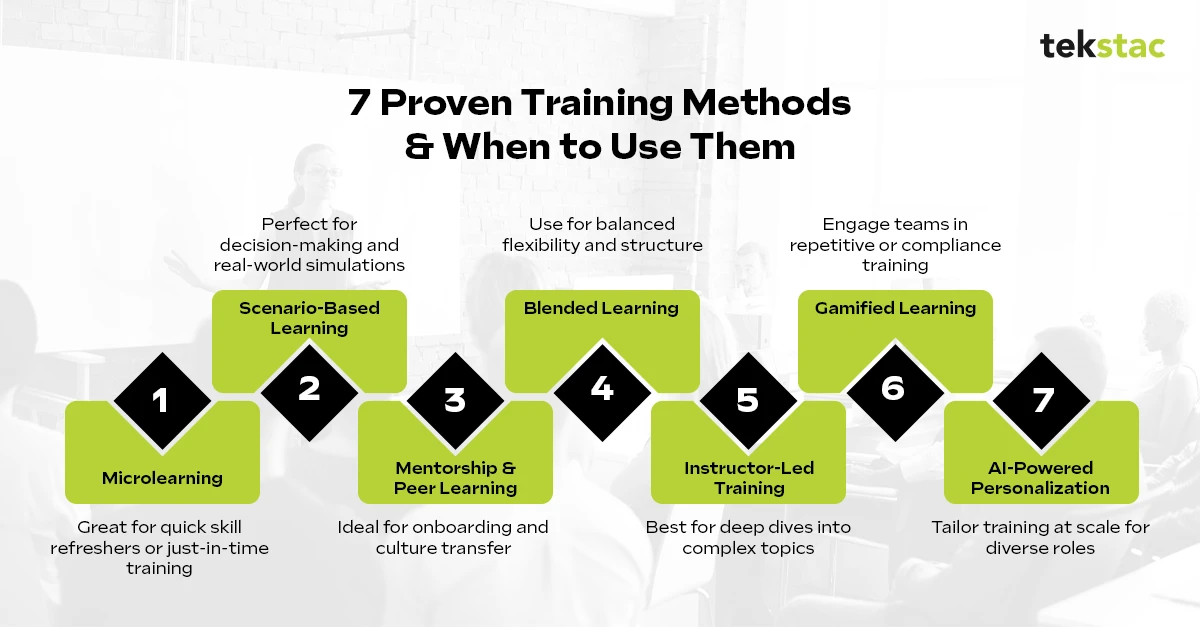
That’s the promise of microlearning- short, focused learning modules designed to fit seamlessly into the flow of work.
Whether it’s a quick how-to video, a flashcard-based quiz, or a mobile-friendly infographic, microlearning breaks down complex topics into digestible formats that stick. It’s accessible, time-efficient, and perfect for modern learners juggling multiple priorities.
When to Use It:
According to a 2025 report by Gitnux, microlearning can improve knowledge retention by up to 80% over traditional training methods.
Scenario-based learning places employees in realistic, job-relevant situations that challenge their decision-making, problem-solving, and emotional intelligence. Instead of passive content consumption, learners are required to act and see the consequences of their choices.
Think of a customer service rep navigating a complaint or a healthcare worker handling a patient emergency in a simulated environment. This method makes learning experiential, memorable, and context-rich.
When to Use It:
Sometimes, the best way to learn isn’t through a course- it’s through conversation. Mentorship and peer learning foster organic knowledge transfer, collaboration, and emotional support in the workplace.
Whether it’s a formal mentorship program or casual peer-to-peer learning sessions, this method nurtures a culture of openness, curiosity, and mutual growth. It also builds internal networks and drives retention.
When to Use It:
A 2024 report by WorldMetrics.org indicates that companies with structured onboarding programs improve new hire retention by 82%
Blended learning combines the convenience of digital content with the human touch of instructor-led sessions. This approach caters to diverse learning styles- allowing some to learn by watching videos, others through hands-on practice, and still others by engaging in group discussions.
It’s one of the most versatile training methods, ideal for multi-stage learning journeys where theoretical knowledge needs to be paired with real-world application.
When to Use It:
This hybrid approach ensures consistency without compromising flexibility, an essential trait in hybrid or remote-first workplaces.
Despite the digital shift, Instructor-Led Training (ILT) still holds incredible value, especially when the stakes are high. Whether conducted in-person or virtually, ILT brings experts directly to the learners, offering real-time guidance, personalized feedback, and an interactive format.
This method is ideal for collaborative activities like workshops, group roleplay, or troubleshooting sessions. It encourages questions, builds confidence, and fosters team cohesion.
When to Use It:
ILT works best when used strategically, supported by pre-reads or eLearning, followed by post-session exercises or assessments.
Gamification adds fun, motivation, and healthy competition to training by using elements like badges, points, leaderboards, and progress bars. But beyond just “fun,” gamification taps into intrinsic motivators- such as achievement, status, and recognition.
It’s one of the most engaging employee training methods, particularly effective in building consistency and driving behavior change.
When to Use It:
Gamified platforms can also track learning progress in real time, giving L&D teams valuable data on engagement and gaps.
One-size-fits-all training doesn’t work anymore, especially in organizations with diverse roles, career goals, and skill sets. Enter AI-powered personalized learning.
By analyzing an employee’s current skills, behavior, and performance, AI can recommend customized learning paths, adjust difficulty levels, and even predict what topics they’ll need next. It’s like having a personal tutor for every employee, at scale.
When to Use It:
According to a 2024 report by Virtasant, integrating AI into corporate training programs has led to a 57% increase in learning efficiency, significantly boosting employee productivity.
Organizations that treat training as a strategic tool- not a checkbox- build resilient, skilled, and engaged workforces. They retain top talent, respond to change faster, and outperform competitors.
And it all starts with choosing the right employee training methods for the right moments.
So, the next time you plan a training rollout, ask yourself: Is this the right method for this moment? Because how you train may just determine how far your people, and your company can go.
While we’ve explored specific training methods here, understanding how these fit into a broader organizational strategy is crucial
Discover the bigger picture of how modern organizations are revolutionizing employee training and development – at scale, with speed, and strategic intent.
1. What is the best training method for strength?
The best method for building strength is progressive resistance training, focusing on gradually increasing weight, intensity, or difficulty over time.
2. How can AI improve employee training methods?
AI enhances training by personalizing learning paths, predicting skill gaps, and providing real-time feedback to boost engagement and retention.
3. Why should companies invest in modern employee training methods?
Modern training methods increase productivity, reduce turnover, and future-proof workforce skills, aligning learning with business goals.
4. Which training method is most effective?
The most effective method depends on goals — but blended and AI-powered learning deliver the best results by combining flexibility with personalization.
In 2026, the pace of change has exploded. Emerging AI trends in L&D are redefining every aspect of workplace operations and learning. Yet, many organizations are still training like it’s 2010.
The world of Learning and Development (L&D) is at a turning point, as outdated systems clash with the urgent need for workplace upskilling with AI, and companies struggle to keep pace with the demands of digital transformation in L&D.
While AI promises hyper-personalization, real-time insights, and automation at scale, the uncomfortable truth is that most businesses are stuck delivering cookie-cutter training that satisfies no one.
The rise of AI trends in learning tech has made it clear: generic learning paths are obsolete. Workers demand training that reflects their roles, goals, and learning styles. Instead, they’re handed recycled slide decks and linear modules that neither engage nor empower.
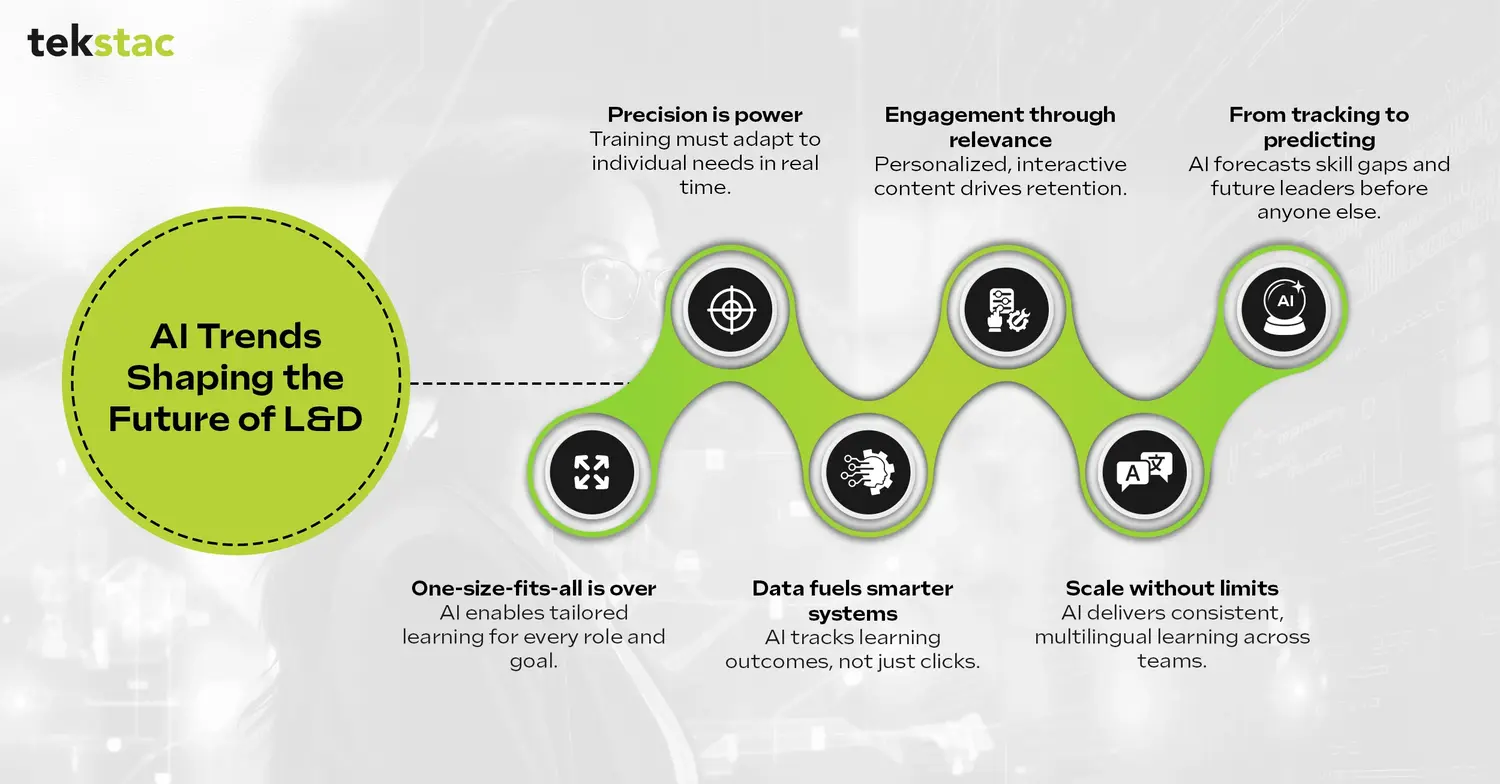
AI Trends in L&D refer to the emerging ways artificial intelligence is transforming workplace learning. They include hyper-personalized learning paths, predictive analytics, adaptive content, skill intelligence, and AI-powered coaching that improve performance, retention, and training efficiency across the organization.
To understand how these trends fit into a broader workforce strategy, explore our AI in HR strategy and transformation.
This article explains the six most important AI trends shaping corporate learning in 2026, backed by industry research and real-world insights. You’ll learn about:
Let’s start with the cold reality: most L&D systems are failing.
According to LinkedIn’s Workplace Learning Report, 71% of L&D professionals are exploring, experimenting with, or already integrating AI into their work — though turning that activity into measurable business outcomes remains the harder, less-solved part.
This hesitation has consequences. When 70% of training programs fail to deliver measurable outcomes, it’s not a user problem. It’s a system problem.
Current systems offer little more than completion data. They can tell you who clicked “Next,” but not who actually learned, retained, or applied anything.
Meanwhile, over half of learners abandon online courses midway, citing poor alignment with their roles. And with automation reshaping industries, job requirements evolve faster than most training teams can respond.
The result?
Disengaged employees, wasted budgets, and unmet business goals.
In a world moving at the speed of light, delivering personalized training isn’t just a “nice to have” anymore. It’s mandatory. L&D systems must know more than job titles.
They need to understand learning behaviors, career goals, and real-time performance data.
In companies that have embraced it, training time has dropped, skill application has soared, and employee retention has improved.
Organizations using AI in L&D commonly report measurable gains in both productivity and employee retention. At its core, this is transformation, not just tech.
Here’s what legacy systems don’t do: connect learning to business outcomes. AI-powered platforms, on the other hand, don’t just deliver content, they learn from it. They track not just engagement but impact.
Leveraging AI, modern systems can track how skills evolve over time, pinpoint where progress stalls, and identify who’s ready for a promotion—exactly what AI Trends in workplace learning are now shaping across forward-thinking organizations.
By year two of using these systems, organizations report smarter decision-making, less rework, and clearer succession planning.
By year three, AI-powered learning starts surfacing insights that no spreadsheet ever could: like which departments are overperforming, which skills correlate with project success, or where burnout is brewing.
This isn’t hypothetical.
This is happening now.
People don’t hate learning.
They hate irrelevant learning.
AI fixes this by making training feel personal, and customized for each individual so they feel it’s relevant for them but not forced.
It gives instant feedback, transforms lessons into interactive stories, and builds safe simulations where employees can practice without fear of failure.
Platforms like Tekstac are already using this approach.
With adaptive learning paths, localized content, and role-based recommendations, learners don’t just consume content, they experience it.
Learners increasingly favor AI-assisted training formats over traditional ones, and engagement data backs this up.
Traditional L&D hits a ceiling fast. More people means more facilitators, more costs, more logistics. But with AI, scaling is seamless.
Whether you’re training 10 or 10,000, the experience remains consistent and high-quality.
Companies using AI for training report meaningfully lower delivery costs while simultaneously increasing reach and effectiveness.
Multilingual support, auto-translation, and real-time content adaptation mean global teams can access the same content, tailored to their needs and context.
This levels the playing field and ensures inclusivity, a critical but often neglected component of enterprise learning strategies.
It’s no longer enough to ask whether someone completed a course.
The real question is: did it make a difference?
With AI, you no longer have to guess. You can see skill proficiency rising, time-to-productivity falling, and internal promotions accelerating.
Industry research from groups like Brandon Hall Group consistently links AI-based learning to higher retention and faster skill acquisition.
In forward-thinking companies, L&D leaders don’t chase KPIs, they shape them.
Predictive dashboards now alert managers to emerging leaders, identify team-level skill gaps, and recommend training before performance dips. The next step beyond prediction is action — agentic AI takes it further by autonomously assigning the right learning path or escalating a skill gap to a manager, without anyone first having to ask it to.
It marks a shift from learning to strategic talent development.
AI Trends in L&D are not just about better tools — they are redefining how organizations measure productivity, skill growth, and talent readiness.
At the center of this transformation is Tekstac.
It’s not just another learning platform, it’s a complete AI-driven learning intelligence system.
Built for scale, flexibility, and performance, Tekstac integrates content creation, real-time analytics, and adaptive delivery into one seamless experience.
From SHRM-aligned learning paths to auto-generated content and knowledge checks, Tekstac personalized every aspect of training.
It identifies where each learner stands, maps growth paths, and shows HR and leadership where the talent pipeline is headed. It connects every learning act to a real business outcome, be it faster onboarding, increased internal mobility, or improved customer results.
And the impact is measurable. Companies using Tekstac report up to 48% reduction in learning cycle time and 65% improvement in content relevance for high-skill roles like software development.
Whether you’re a tech giant, a healthcare provider, or a logistics firm, Tekstac adapts to your needs, your teams, and your goals.
The companies winning in 2026 are those who stopped viewing training as a checkbox and started seeing it as a growth engine.
They moved from one-size-fits-all to one-path-for-each. From passive completion to active transformation. And from static dashboards to living, predictive maps of workforce capability.
So here’s the truth: if your training platform can’t personalize, can’t scale, and can’t connect to business outcomes, it’s not slowing you down, it’s keeping you behind.
The shift to AI-powered learning isn’t just smart.
It’s inevitable.
Make the move to a platform that sees your people not just as learners, but as your competitive edge.
A platform that doesn’t just keep up with the future, but creates it.
Tekstac isn’t the next step. It’s the leap forward.
Want to adopt AI Trends in your L&D strategy? See a live demo of Tekstac’s AI-driven learning platform in action.
1. How is AI improving workplace learning outcomes?
AI boosts learning outcomes through hyper-personalized learning paths, adaptive content, and real-time feedback. Employees learn faster and retain more because training aligns with their roles and skill gaps.
2. What’s the next big AI trend in learning and development?
Skill intelligence platforms — systems that map role-based skills, predict future gaps, and auto-recommend upskilling paths. They shift L&D from delivering content to building workforce readiness.
3. What is the ROI for adopting AI in corporate training?
Organizations see higher retention, faster onboarding, and reduced training costs. AI turns L&D into a measurable business growth driver by improving productivity and workforce performance.
4. Which industries benefit from AI-driven L&D?
Industries with fast-changing skills need — tech, BFSI, healthcare, logistics, manufacturing, telecom, and retail. Any sector requiring rapid onboarding or upskilling gains from AI learning.
5. What are the latest AI trends in learning and development?
The leading AI trends in L&D right now are hyper-personalized learning paths, predictive analytics for skill and performance gaps, adaptive content delivery, AI-powered coaching and feedback, and skill intelligence platforms that map role-based skills to future business needs.
6. What are the most effective corporate AI talent development strategies?
The most effective strategies connect AI-driven learning directly to business outcomes — using predictive analytics to anticipate skill needs before rollout, tracking skill proficiency rather than just course completion, and tying training data to real metrics like time-to-productivity and internal mobility.
A new chapter of work is unfolding, one where intelligence isn’t just human anymore. Automation is no longer limited to manufacturing lines; it is now influencing decisions in boardrooms, creating efficiencies in customer service, and powering the tools we use to design, write, market, and build. Amid this digital surge, organizations are under immense pressure to future-proof their workforce, and those that fail to adapt risk falling irreversibly behind.
AI workforce planning, once centered around static job descriptions and annual headcount forecasting, has evolved into a living, breathing discipline. Today, it requires a sharp lens into market disruptions, a granular understanding of skill demand, and the foresight to align talent with transformation.
AI isn’t coming- it’s already here. The real question is.
How do we plan for a workforce that’s ready for it?
Workforce planning is the strategic process of aligning an organization’s talent supply with its future business needs. In the AI era, it involves analyzing skill gaps, predicting future roles, and integrating automation insights to ensure the right people, with the right skills, are in the right place at the right time.
For decades, companies operated on predictable cycles. Job roles stayed the same, learning happened in classrooms, and promotions followed tenure. But with AI integrating into core business processes, change has become exponential. Roles like “AI Trainer,” “Prompt Engineer,” and “Ethical Technologist” didn’t exist five years ago. Now, they’re critical.
According to the World Economic Forum’s Future of Jobs Report 2025, employers anticipate that 39% of workers’ core skills will change by 2030.
This shift is expected to result in the displacement of 92 million jobs, while simultaneously creating 170 million new roles, leading to a net increase of 78 million jobs globally.
Organizations clinging to legacy workforce planning models are struggling. These models assume that tomorrow’s roles will look like today’s—and they won’t. Roles will continue to dissolve, combine, or morph into hybrid jobs that require human judgment alongside machine intelligence.
Planning for static roles has become planning for obsolescence. The modern approach must center on capabilities, adaptability, and ecosystem thinking.
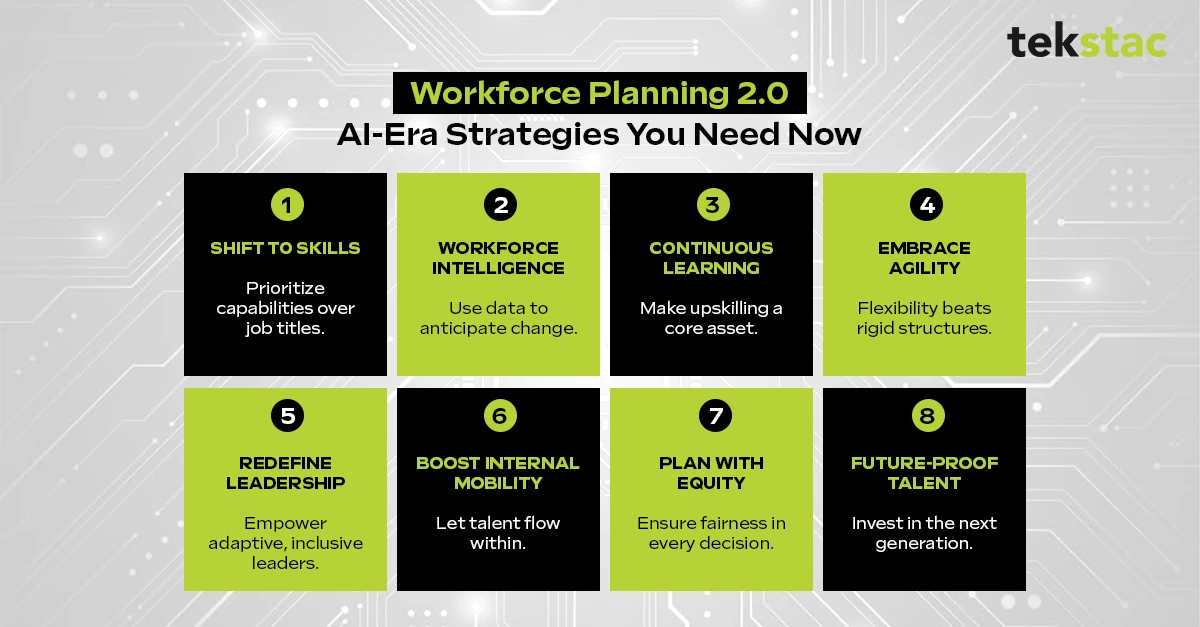
The future doesn’t speak in job titles, it speaks in skills. The shift from role-based to skill-based planning is one of the most defining features of workforce transformation.
According to a McKinsey Global Survey, 87% of executives say they are experiencing skill gaps in the workforce or expect them within a few years.
Companies that once hired for predefined roles are now deconstructing them into component skills. A “Sales Manager” may need a blend of customer empathy, data analysis, CRM automation, and generative AI knowledge. These skill clusters enable flexible deployment across multiple use cases, transforming people into assets who evolve as fast as the business does.
The most resilient organizations are building detailed skill taxonomies, continuously analyzing gaps, and fueling internal mobility by aligning learning pathways with emerging demand.
This is not about filling vacancies- it’s about future-proofing talent at the molecular level.
In an AI-dominated landscape, information is power, but insight is everything. Advanced workforce planning now relies on real-time data, AI-driven forecasting models, and skill heatmaps that predict where growth or decline is likely to happen.
This new skills intelligence helps organizations look beyond the next quarter and plan for the years ahead. It allows leaders to anticipate disruptions, identify at-risk functions, and act before the market does.
Workforce planning isn’t reactive anymore. It’s anticipatory, strategic, and deeply integrated with how organizations approach innovation, mergers, technology upgrades, and global expansion.
Data-backed planning doesn’t just reduce risk, it creates a competitive advantage.
In the age of AI, learning agility has become the new corporate currency. Companies that embed continuous learning into their DNA are building workforces that can pivot, scale, and lead through uncertainty.
The learning paradigm is also changing. No longer confined to annual workshops or lengthy courses, the future of learning is fast, flexible, and integrated into the flow of work. Microlearning modules, AI-recommended content, skill simulations, and just-in-time knowledge delivery are becoming the new norm.
Organizations that prioritize learning are no longer asking, “What should we train our people on?” but rather, “How do we create an environment where learning never stops?”
This cultural shift redefines talent strategy—from acquiring skills externally to cultivating them internally.
Stability used to be the hallmark of successful planning. Today, agility reigns supreme. Workforce planning in the AI age demands the ability to reconfigure teams, redeploy talent, and rethink structures with speed.
Cross-functional teams, project-based work, and skill-sharing networks are replacing rigid hierarchies. The gig economy, freelance platforms, and talent clouds are allowing organizations to dynamically tap into external capabilities when needed.
Success now lies in how quickly a company can reassemble its talent around an opportunity.
This shift isn’t just structural, it’s psychological. It means fostering a mindset across leadership and the workforce that embraces ambiguity, experimentation, and reinvention.
Workforce planning cannot thrive without leaders who understand transformation. In the AI era, leadership is no longer about control, it’s about navigation.
Leaders must guide their teams through ethical dilemmas, reskilling initiatives, AI adoption fears, and complex change cycles. They must inspire confidence while acknowledging uncertainty. And perhaps most importantly, they must lead with empathy.
AI may enhance performance, but only humans can drive culture. Leaders who understand this balance are not just technology champions, they’re people architects.
Future-ready leadership isn’t technical; it’s transformational.
In a market where skill shortages are the new normal, internal mobility is one of the most underutilized tools in workforce planning. Companies already sit on goldmines of untapped potential, employees who, with the right upskilling, could transition into high-demand roles.
Progressive organizations are building talent marketplaces that allow employees to self-navigate toward growth. AI algorithms suggest internal opportunities based on skill fit, career aspirations, and business need, creating a dynamic ecosystem of movement, growth, and engagement.
This isn’t just good HR, it’s good economics. It reduces hiring costs, boosts retention, and cultivates a more future-ready workforce from within.
As AI reshapes work, inclusion must be non-negotiable. Historical biases in data, unequal access to learning, and algorithmic decision-making can all exacerbate existing workplace inequities if left unchecked.
Strategic workforce planning in the AI era must be intentionally inclusive. That means designing systems that account for fairness, ensuring diverse perspectives in AI training datasets, and democratizing access to upskilling programs.
Organizations that embed equity into their planning are not only doing the right thing, they are creating environments where innovation thrives, talent flourishes, and risk is reduced.
The future must be fair or it won’t be sustainable.
The implications of AI-driven workforce planning don’t stop with current employees. They extend to schools, colleges, and the way we prepare our children for careers that don’t yet exist.
The OECD estimates that 1.1 billion jobs are liable to be radically transformed by technology in the next decade.
The next generation must be equipped not just with coding skills but with curiosity, adaptability, ethical reasoning, and creative problem-solving. Parents, educators, and companies alike have a role to play in bridging the skills of today with the possibilities of tomorrow.
The career ladder has been replaced by a career lattice. Students of today will not have a single job for life, they’ll likely have multiple careers, across domains, augmented by machines, but driven by human values.
If workforce planning is the compass for organizations, career readiness is the compass for individuals.
The rise of AI isn’t just an industrial revolution- it’s a human one. And like every revolution, it requires bold thinking, new tools, and a reimagined vision for how we build and sustain workforces.
Effective workforce planning in the AI era is about more than numbers on a spreadsheet. It’s about enabling people to grow, adapt, and lead in a world where change is constant. It’s about creating alignment between business ambition and human capability. And above all, it’s about ensuring that as machines rise, so too does our collective capacity for innovation, empathy, and progress.
The future of work is not being built in the future. It’s being built now. And those who plan wisely will shape it.
1. Why do we do workforce planning?
Workforce planning helps organizations align talent supply with future business goals. It ensures that the right people, with the right skills, are in place to meet changing market demands and strategic priorities.
2. How is AI changing workforce planning?
AI enables real-time skill analysis, predictive forecasting, and smarter talent deployment. It transforms workforce planning from reactive headcount management into a proactive, data-driven strategy.
3. How does AI help in strategic workforce planning?
AI analyzes large volumes of talent, market, and performance data to predict future skill requirements and guide smarter hiring, training, and mobility decisions.
4. What are the challenges in AI workforce planning?
Common challenges include data quality issues, bias in AI models, limited integration across HR systems, and lack of workforce analytics skills.
It’s no longer a theory. In 2026, the crisis of employee retention has become the defining challenge of the modern workplace. While market fluctuations and digital disruption still demand attention, they are increasingly overshadowed by a deeper threat: human disengagement.
Gallup’s latest workplace report sounds the alarm with a single statistic one in two U.S. employees is actively considering an exit from their current role. This signals an urgent employee retention crisis, where organizations that fail to address it are not just risking turnover—they’re risking collapse from the inside out.
The crisis deepens when you realize that it is not industry-specific. Healthcare, tech, finance, and education are all experiencing record-breaking turnover.
Employees are not just checking out. They are burning out, making employee retention harder than ever. Employees attribute their mental health struggles directly to their workplace. Poor managers and toxic cultures are cited more often than any other factor.
AI Insight: Predictive analytics can now forecast employee attrition up to 6 months in advance based on behavioral and engagement data.
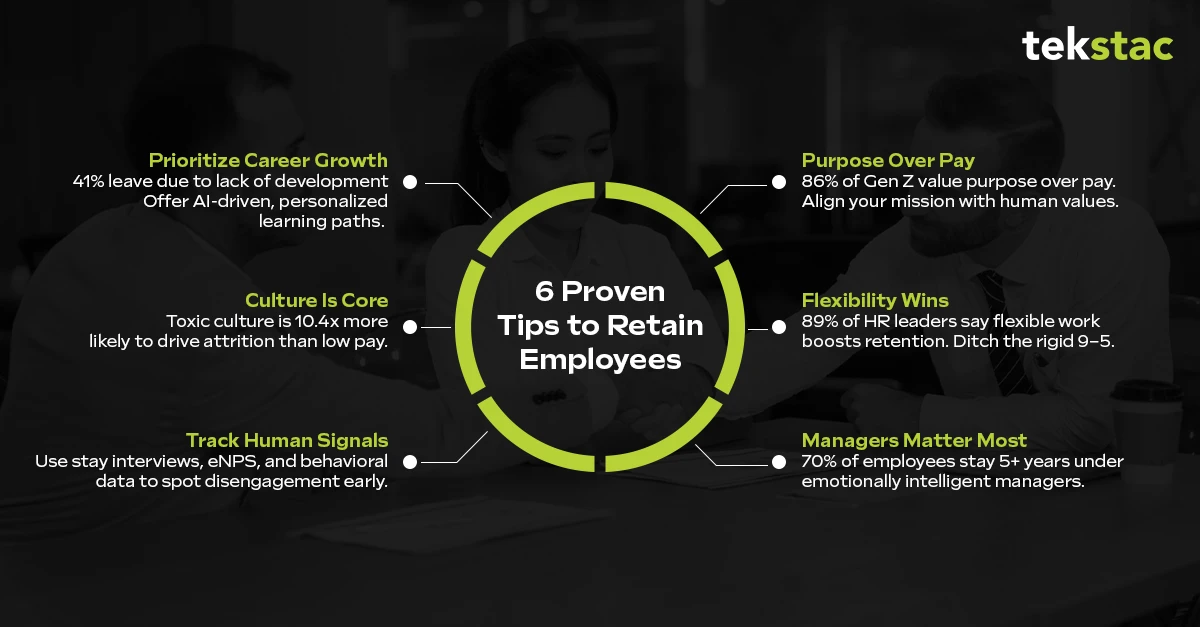
The smartest leaders in 2026 know one truth. People no longer work just to survive, they work to matter. You cannot build loyalty or ensure employee retention with salaries alone. People want to be part of something that reflects who they are.
If your company stands for nothing beyond revenue, you will attract mercenaries. But if it stands for something meaningful, you will build an army of believers.
The traditional 9-to-5 office model has become obsolete. Rigid work policies are no longer sustainable, as they contribute to higher attrition rates.
Consider these key insights:
In 2025, the role of managers has evolved beyond traditional oversight. They are now pivotal in shaping employee experiences and retention. Emotionally intelligent leadership is no longer a luxury but a necessity.
Leadership must transition from authority-based models to empathy-driven approaches. Managerial KPIs should encompass team well-being alongside performance metrics.
In today’s workplace, effective leadership and employee retention are intrinsically linked.
Investing in personalized development strategies not only enhances employee satisfaction but also significantly reduces attrition rates.
In 2026, culture isn’t a side note. It’s the core strategy. You can’t patch a toxic environment with perks or pay raises.
When people sense distrust, bias, or disconnection, they leave.
A toxic workplace is 10.4 times more predictive of attrition than low compensation.
In 2025, data doesn’t just belong to customers. It belongs to employees too. Smart organizations are using behavioral analytics and AI to identify disengagement before it becomes departure.
Use data for
Retention isn’t a mystery. It’s a model. And Tekstac is the platform turning this model into results. Tekstac enables organizations to personalize growth, identify skill gaps, and align learning with business outcomes through AI-powered career mapping, immersive Practice Labs, and performance dashboards that connect development with delivery.
Tekstac stands at the forefront of AI trends in skilling, bringing the latest innovations in adaptive learning, personalized upskilling, and real-time skills tracking into the corporate environment.
It supports the broader digital and talent transformation in L&D, helping organizations shift from static training modules to dynamic, scalable, and employee-centered learning ecosystems.
Tekstac is not just a training solution. It is a talent ecosystem. With intelligent analytics, it gives leaders real-time clarity on performance, progression, and potential.
The game has changed. Employees are no longer waiting for your strategy. They are evaluating it. If your systems are rigid, if your managers are untrained, if your culture is performative, your best people will walk.
Now is not the time for temporary fixes. It’s the time for transformation
These are not trends. These are the new table stakes. If you want to retain, you need to become worthy of retention.
1. How do I calculate employee retention?
Employee retention is calculated by dividing the number of employees who remain at the end of a period by the number at the start, then multiplying by 100. A higher percentage indicates stronger retention.
2. How can AI improve employee retention?
AI helps predict attrition risks, personalize learning paths, and identify disengagement early enabling leaders to act proactively and improve employee retention.
3. What drives employee retention?
Key drivers include purpose-driven work, flexible policies, career growth, supportive managers, and a positive company culture that values employee well-being.
4. How can company culture reduce turnover?
A healthy culture that promotes trust, inclusion, and recognition creates belonging—reducing burnout, boosting engagement, and naturally improving retention.
We’re long past asking whether Artificial Intelligence (AI) matters, it’s now central to how industries operate and innovate. For startups, the AI revolution is both an opportunity and a challenge, a landscape filled with possibilities yet demanding strategic foresight. As we step into 2026, the question is not whether AI will shape the startup ecosystem, but how startups can harness AI revolution to carve a competitive edge.
For startups, AI levels the playing field. Unlike legacy enterprises burdened with outdated infrastructure, startups can adopt AI-first strategies from day one. Cloud computing, open-source models, and AI-powered automation allow small teams to compete with industry giants.
The democratization of AI tools means that even a two-person startup can deploy sophisticated machine learning models without extensive resources. AI is not just a tool, it is an enabler of innovation, efficiency, and scalability.
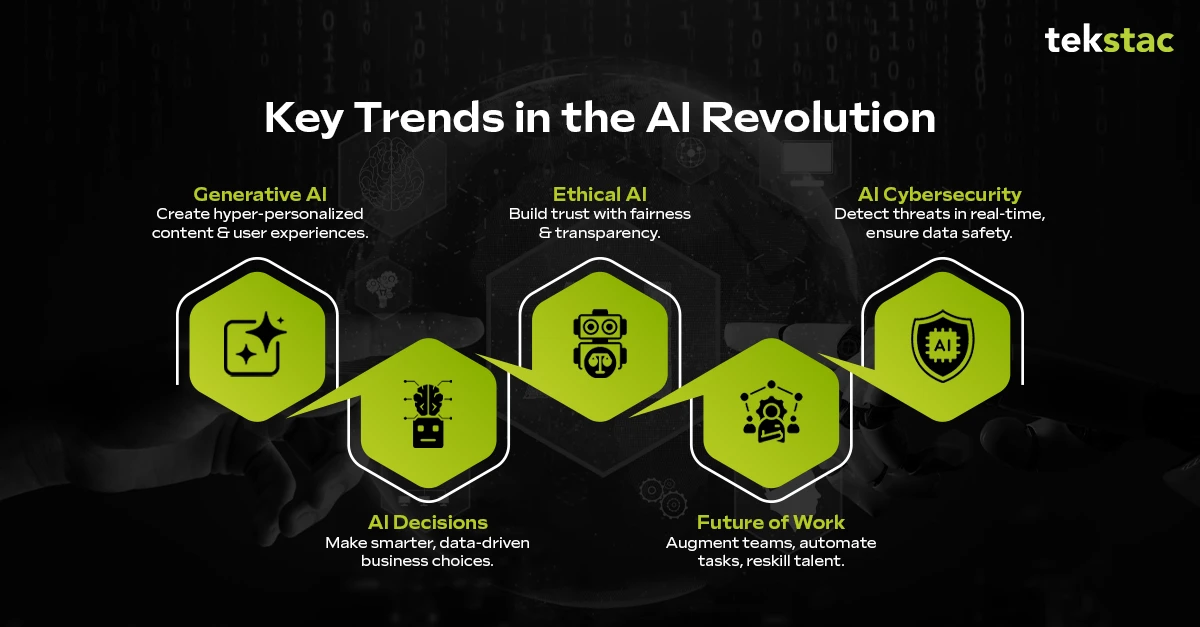
AI is no longer just about automation; it’s about creativity. Startups leveraging the Generative AI revolution can build personalized user experiences, from custom marketing content to AI-driven product recommendations.
Businesses that prioritize AI-driven personalization will not only improve engagement but also foster deeper customer loyalty. Companies in e-commerce, media, and digital marketing will see a surge in AI-driven customization, allowing brands to speak directly to their audience’s needs- a key advantage in the ongoing AI revolution.
Startups can harness AI for strategic insights, risk assessment, and predictive analytics. With AI-powered decision-making, founders can move beyond intuition and make data-backed choices, reducing failure rates and improving operational efficiency.
AI-driven business intelligence platforms are allowing startups to analyze vast amounts of market data, enabling them to pivot strategies with precision. From customer sentiment analysis to financial forecasting, AI-driven insights are becoming indispensable navigating the AI revolution.
As AI adoption grows, so does the need for ethical AI practices. Startups must prioritize transparency, fairness, and data security to build trust. Ethical AI will not just be a compliance requirement but a key differentiator in an increasingly scrutinized market.
Responsible AI practices, including bias mitigation and explainability, will be essential in maintaining credibility and securing long-term growth.
AI is reshaping workforce dynamics, automating repetitive tasks, and augmenting human intelligence. Startups that embrace AI-driven work models, such as AI-assisted customer support or intelligent project management, can enhance productivity without inflating operational costs.
AI’s integration into daily workflows will free up human potential, shifting the focus from repetitive execution to critical thinking and creativity. This transition underscores the urgent need for upskilling and reskilling, as the future of work will demand a blend of technical fluency and adaptive problem-solving.
As cyber threats become more sophisticated, startups must leverage AI for real-time threat detection and mitigation. AI-driven cybersecurity solutions will be essential in safeguarding sensitive data and ensuring business continuity. With increasing cyberattacks targeting small and mid-sized businesses, AI-powered security tools will become a necessity rather than a luxury.
While AI offers unprecedented opportunities, startups must navigate key challenges:
AI thrives on data, but startups must ensure compliance with evolving regulations like GDPR, CCPA, and upcoming AI governance laws. Companies that proactively implement privacy-first AI strategies will be better positioned to build consumer trust and avoid regulatory penalties.
AI expertise remains in high demand. Startups must invest in upskilling their teams or partner with AI specialists. Hiring data scientists and AI engineers can be expensive, making AI upskilling programs essential for non-technical teams. Platforms offering AI education and training will see growing adoption in startup ecosystems.
Unchecked AI models can reinforce biases, leading to ethical concerns and reputational damage. Responsible AI development will be crucial for long-term credibility. Startups must ensure their AI algorithms are trained on diverse datasets and implement fairness checks to mitigate biases.
While AI adoption is becoming more accessible, advanced AI solutions can still be expensive. Startups need to strike a balance between innovation and cost-effectiveness, leveraging AI-as-a-Service (AIaaS) platforms to deploy scalable AI solutions without hefty upfront investments.
AI is poised to revolutionize multiple industries, with startups leading the charge in:
“The next wave of startup innovation will be powered by AI that learns, adapts, and scales alongside human creativity.”
— Google Cloud, Future of AI: Perspectives for Startups 2025
The future of AI in startups is not just about technology, it’s about vision, adaptability, and responsible innovation. Startups that leverage AI strategically, prioritize ethical considerations, and embrace continuous learning will be the frontrunners of the AI revolution.
AI is the new frontier, and startups that embrace it will define the next decade of innovation. Whether it’s optimizing operations, improving customer experiences, or driving product innovation, AI is no longer optional, it’s essential.
As AI continues to evolve, startups have a unique advantage: agility. In a world where AI-powered disruption is the norm, the most successful startups will be those that stay ahead of the curve, embrace AI-driven transformation, and reimagine what’s possible in the digital age.
Will your startup be a disruptor or a follower in the AI era? The choice is yours.
Based on insights from Google Cloud’s ‘The Future of AI: Perspectives for Startups 2025′ report.
1. What is the AI revolution?
The AI Revolution refers to the rapid adoption of artificial intelligence across industries, transforming how businesses innovate, automate, and make data-driven decisions. It marks a shift toward smarter, more efficient digital ecosystems.
2. How can startups benefit from the AI Revolution in 2026?
Startups can leverage the AI Revolution to scale faster, personalize customer experiences, optimize operations, and gain a competitive edge through data intelligence and automation-driven innovation.
3. What challenges do startups face in the AI Revolution?
The main challenges include AI talent shortage, cost of implementation, ethical risks, and data privacy compliance.
4. Who will survive the AI Revolution?
Organizations that adapt quickly, invest in AI skills, and embrace ethical, data-driven innovation will thrive. Startups and businesses that blend human creativity with AI intelligence will lead to the future.