
The ADDIE model is one of the most widely used frameworks for designing effective learning and development programs. It provides a structured, five-step approach to building training that aligns with business goals and evolving workforce needs.
In 2026, this matters more than ever. Nearly half of today’s workforce skills are expected to become outdated within just a few years, driven by rapid advancements in AI, automation, and digital transformation.
Yet most organizations still take a reactive approach to talent development. They address skill gaps only after performance drops, leading to delays, higher costs, and missed opportunities.
This is where the ADDIE model stands out.
It offers a systematic, repeatable process to design learning programs that are not only aligned with current business needs but also adaptable to future skill demands.
In this guide, you’ll learn:
The ADDIE model is a five-step phase for designing and implementing learning programs. It is an acronym for Analyze, Design, Develop, Implement, and Evaluate, representing five unique phases that walk you through from recognizing a learning need to measuring its business consequence.
By 2030, 40% of today’s core skills will no longer be relevant, according to the World Economic Forum, as AI and automation reshape the workforce. Meanwhile, L&D budgets are increasing, as 85% of employers intend to implement upskilling approaches between 2026–2030. This goes on to explain that organizations are betting heavily on talent development but require established, systematic models such as ADDIE that ensure desired results.
In the ADDIE model, each step forms the building block for the subsequent step, making a pathway from business needs identification to the delivery of effective learning solutions.
Make sure not to skip any stage, as the whole process gets compromised. For instance, if you don’t examine the correct problem, your training and development program will be off the target, and you will end up with training that fails to address performance gaps. This also results in wasted resources, unmotivated learners, and no measurable effect. Any workforce upskilling method must follow a structured approach to be effective.
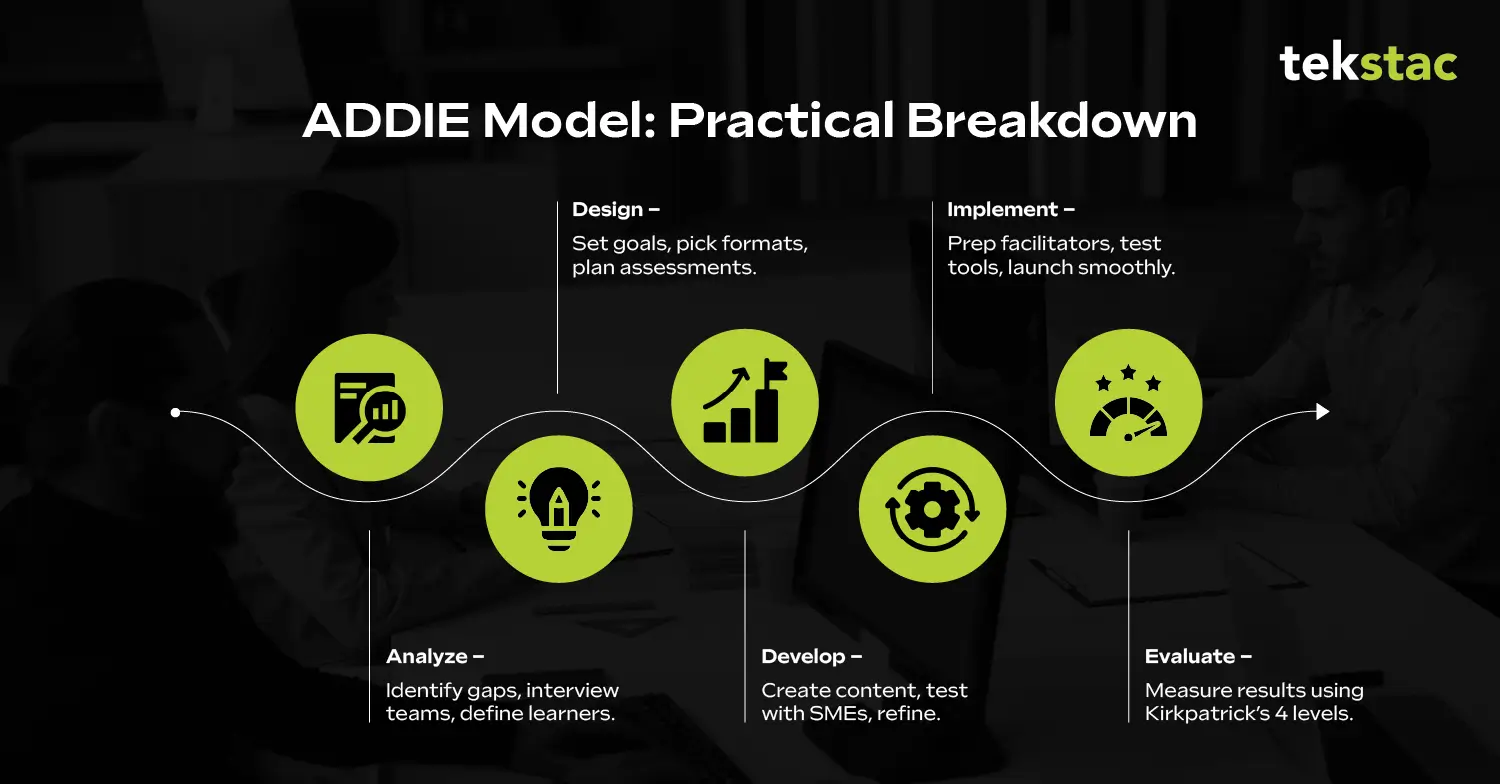
Here’s a practical phase-by-phase ADDIE model breakdown so you can implement practically:
Before you build anything, you need to know what business problem your learning program is solving. The Analyze phase anchors your learning intervention to a real-world business problem. It pinpoints the exact performance gap your employees face and why it exists. In other words, you’re diagnosing a business problem that learning might help fix.
In most organizations, performance gaps show up subtly. Whatever the case, the problem is always reflected in business metrics: attrition, ramp-up time, NPS, conversion, quality scores, and so on. This phase helps you trace those symptoms to specific skills, behaviors, or knowledge gaps.
Start with the business problem: The first step is identifying the problem. This step aims to understand why performance is lagging and whether a learning intervention is the right response. The more straightforward your diagnosis, the more focused and effective your solution will be.
Talk to stakeholders: Interview stakeholders, such as managers, high performers, underperformers, and cross-functional teams to identify the challenges and behaviors that are causing the issue.
Understand who you’re designing for: Consider your audience’s real work context. Consider their roles, daily challenges, tools, and learning preferences. Create a simple learner profile that highlights their pain points and blockers.
According to Deloitte, companies that follow structured learning models like ADDIE are 3.6x more likely to report measurable improvements in employee performance.
This stage transforms the findings gathered in Phase 1 into a roadmap that directs the creation of training and development materials. The intention here is to develop an elaborate map that links learning outcomes to changes in behavior and measurable business outcomes. Prepare yourself for providing answers to questions such as:
Define clear learning objectives: Start by crafting your business problem into well-articulated, measurable learning goals. These need to be precise, actionable, and geared toward behavior or skills that have a direct influence on performance.
Choose the right learning strategies and formats: Select instructional methods that fit the audience’s preferences, context, and learning goals. Look at microlearning strategies, application based learning, workshops, simulations, or blending learning. Consider accessibility, time constraints, and resource availability. Make sure to sequence learning to progress smoothly from foundational knowledge to mastery along with practical applications.
Plan assessment and success metrics: Design formative assessments to reinforce learning during the program and plan summative assessments to validate skill adoption at the end. Ensure to align assessment criteria with business success metrics established earlier.
The development phase is where your learning solution comes to life. In this production stage, you create and assemble all training materials. This demands collaboration to ensure content quality, relevance, and consistency with learning objectives. It’s also the time to integrate tools and technology that will help deliver the program smoothly. Build drafts, test them internally, gather feedback, and refine them before launch. This cycle helps catch gaps early.
After your learning materials are refined and approved, it’s time to implement the learning program in real life. This step guarantees the training launch is smooth and that learners can interact optimally. Therefore, it calls for extensive planning and coordination to prevent glitches
Prepare trainers and facilitators: Provide thorough briefings, detailed facilitator guides, and rehearsals if needed.
Set up the learning environment: Ensure that your LMS, virtual classroom, or physical space is fully prepared before launch. Test all technical elements, including access, multimedia playback, and interactive tools. Confirm that learners have the right permissions and resources.
Communicate early with learners: Share program objectives, schedules, and how learners can access materials or sessions. Provide clear instructions and support contacts for any technical or content questions.
Evaluation is the vital last step in the ADDIE model, where you compare the success of your learning program against initial objectives. This step makes sure you are aware of the influence on the learner performance as well as the larger business goals. Without evaluation, all your work may be wasted or incorrect.
You need to assess whether learners have acquired the intended skills or knowledge and, more importantly, if their behavior or performance has improved on the job. This data guides future iterations and helps justify training investments. Use a combination of quantitative and qualitative methods to gather comprehensive insights. Look beyond immediate reactions and track long-term changes wherever possible.
Focus on multiple levels of evaluation: Kirkpatrick’s model is a proven framework here:
Collect data methodically: Use surveys, quizzes, interviews, performance metrics, and observation to collect data. Evaluate at multiple points, such as immediately post-training, 30 days after, and ideally after 90 days to track sustained impact.
Keep in mind that Phase 5 is not a one-time activity. Use your findings to identify gaps, refine content, enhance delivery, and scale successful elements.
Here is one company that successfully implemented the ADDIE model for talent development:
In the late 1990s, IBM felt a vanishing sense of leadership readiness. The business diversified across borders and business units, yet first-line managers were unprepared. The transition from individual contributor to leader was shaky, and managers lacked a shared understanding of good leadership. That’s when IBM rolled up its sleeves and brought in an old and sharp framework, the ADDIE model, turning it into its own Basic Blue training program. The fourth tier of the program was defined as the Evaluation phase of ADDIE.
Analyze: IBM recognized that first-line managers were unprepared for leadership roles. Too often, they emerged from individual contributor roles lacking key managerial skills. Their audit revealed critical gaps in delegation, feedback, and team management.
Design: IBM designed Basic Blue as a 4-tier e-learning blended program, with three online tiers being articles, simulations, and job aids. This was followed by a final in-person “Learning Lab” classroom session.
Develop: IBM produced multimedia-rich content, Manager QuickViews (editable Q&A databases), and simulations.
Implement: Basic Blue was delivered globally. First, online tiers were completed, followed by a week-long classroom experience. Completing digital tiers was mandatory before attending the Learning Lab.
Evaluate: IBM measured performance impact by identifying outcomes like better team management.
Ultimately, based on its early deployment, IBM achieved an ROI of 2,284% in 2001. After launching Basic Blue in 2000, IBM also generated $16 million in savings, and broader e‑learning programs saved $200 million that same year.
At the heart of every successful talent development strategy lies one core truth: structure. Just like IBM followed a clear, methodical framework when designing its Basic Blue program, every organization must begin with a solid foundation. This involves identifying skill gaps, structuring focused learning interventions, and ultimately putting in place mechanisms for monitoring and measuring impact.
Having a proper system, like Tekstac, is essential for L&D teams, especially those managing tech teams. Leading enterprises like IBM, PwC, and Accenture have embraced Tekstac to add more content and build repeatable, scalable, and trackable capability-building programs.
With the features below, Tekstac empowers HR and L&D teams to run talent development initiatives confidently at scale.
Ready to apply the ADDIE Model to your organization? See how Tekstac helps design, deliver, and measure talent development programs with real ROI. → Book a demo
1. What are the five phases of the ADDIE Model?
The ADDIE model consists of five phases: Analysis, Design, Development, Implementation, and Evaluation. Each phase ensures training programs are structured, effective, and measurable.
2. What is the ADDIE model in HR and HRM?
The ADDIE model in HR and HRM is used to design structured training and talent development programs. It helps HR teams identify skill gaps, create targeted learning interventions, and measure employee performance improvements.
3. How is the ADDIE model used in learning and development (L&D)?
In learning and development, the ADDIE model provides a step-by-step framework to design, deliver, and evaluate training programs. It ensures that learning initiatives align with business goals and workforce skill needs.
4. How does the ADDIE model compare to the Kirkpatrick model?
The ADDIE model focuses on designing training programs, while the Kirkpatrick model evaluates training effectiveness across four levels: reaction, learning, behavior, and results. They are often used together for a complete learning strategy.
5. What are the advantages and limitations of the ADDIE model?
The ADDIE model provides a structured, goal-oriented approach to training design, ensuring alignment with business objectives and measurable outcomes. However, it can be time-consuming and less flexible in fast-changing environments where iterative learning models are preferred. As a result, organizations often combine ADDIE with agile approaches for better adaptability.
Did you know that companies with strong learning cultures are 92% more likely to innovate and 52% more productive? Training isn’t just a box to tick- it’s a catalyst for growth, agility, and retention.
But here’s the problem: 72% of employees say they don’t get the training they need to succeed in their roles. Why? Because the method doesn’t match the moment.
That’s where strategic, well-timed employee training methods come in.
What if your team could learn something valuable in the time it takes to grab a coffee?
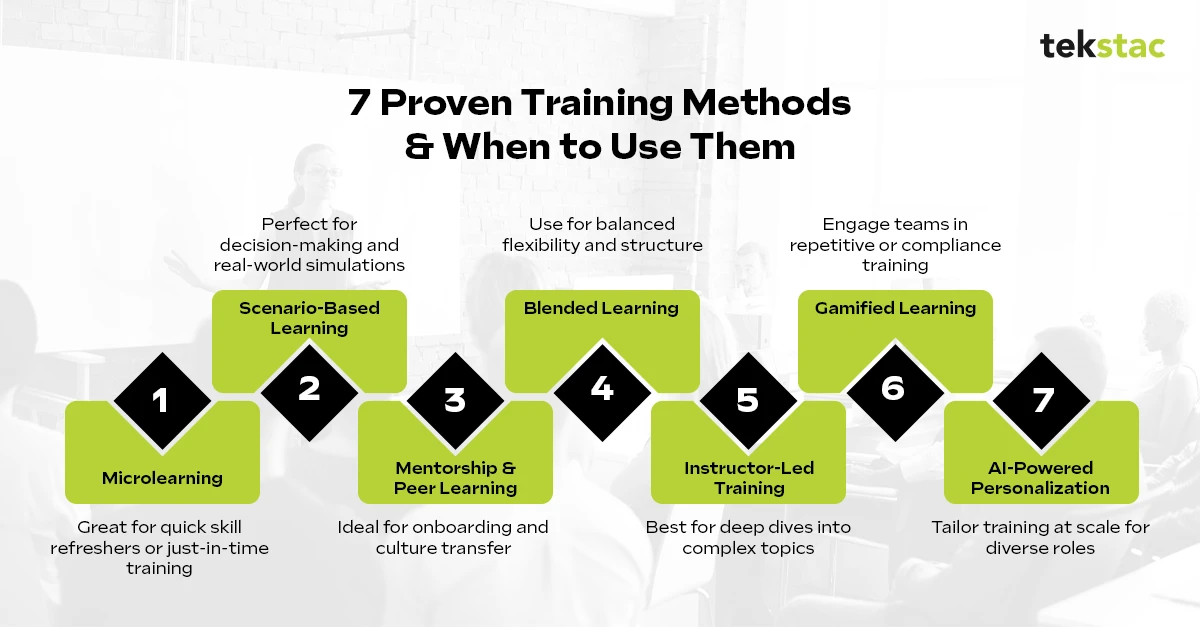
That’s the promise of microlearning- short, focused learning modules designed to fit seamlessly into the flow of work.
Whether it’s a quick how-to video, a flashcard-based quiz, or a mobile-friendly infographic, microlearning breaks down complex topics into digestible formats that stick. It’s accessible, time-efficient, and perfect for modern learners juggling multiple priorities.
When to Use It:
According to a 2025 report by Gitnux, microlearning can improve knowledge retention by up to 80% over traditional training methods.
Scenario-based learning places employees in realistic, job-relevant situations that challenge their decision-making, problem-solving, and emotional intelligence. Instead of passive content consumption, learners are required to act and see the consequences of their choices.
Think of a customer service rep navigating a complaint or a healthcare worker handling a patient emergency in a simulated environment. This method makes learning experiential, memorable, and context-rich.
When to Use It:
Sometimes, the best way to learn isn’t through a course- it’s through conversation. Mentorship and peer learning foster organic knowledge transfer, collaboration, and emotional support in the workplace.
Whether it’s a formal mentorship program or casual peer-to-peer learning sessions, this method nurtures a culture of openness, curiosity, and mutual growth. It also builds internal networks and drives retention.
When to Use It:
A 2024 report by WorldMetrics.org indicates that companies with structured onboarding programs improve new hire retention by 82%
Blended learning combines the convenience of digital content with the human touch of instructor-led sessions. This approach caters to diverse learning styles- allowing some to learn by watching videos, others through hands-on practice, and still others by engaging in group discussions.
It’s one of the most versatile training methods, ideal for multi-stage learning journeys where theoretical knowledge needs to be paired with real-world application.
When to Use It:
This hybrid approach ensures consistency without compromising flexibility, an essential trait in hybrid or remote-first workplaces.
Despite the digital shift, Instructor-Led Training (ILT) still holds incredible value, especially when the stakes are high. Whether conducted in-person or virtually, ILT brings experts directly to the learners, offering real-time guidance, personalized feedback, and an interactive format.
This method is ideal for collaborative activities like workshops, group roleplay, or troubleshooting sessions. It encourages questions, builds confidence, and fosters team cohesion.
When to Use It:
ILT works best when used strategically, supported by pre-reads or eLearning, followed by post-session exercises or assessments.
Gamification adds fun, motivation, and healthy competition to training by using elements like badges, points, leaderboards, and progress bars. But beyond just “fun,” gamification taps into intrinsic motivators- such as achievement, status, and recognition.
It’s one of the most engaging employee training methods, particularly effective in building consistency and driving behavior change.
When to Use It:
Gamified platforms can also track learning progress in real time, giving L&D teams valuable data on engagement and gaps.
One-size-fits-all training doesn’t work anymore, especially in organizations with diverse roles, career goals, and skill sets. Enter AI-powered personalized learning.
By analyzing an employee’s current skills, behavior, and performance, AI can recommend customized learning paths, adjust difficulty levels, and even predict what topics they’ll need next. It’s like having a personal tutor for every employee, at scale.
When to Use It:
According to a 2024 report by Virtasant, integrating AI into corporate training programs has led to a 57% increase in learning efficiency, significantly boosting employee productivity.
Organizations that treat training as a strategic tool- not a checkbox- build resilient, skilled, and engaged workforces. They retain top talent, respond to change faster, and outperform competitors.
And it all starts with choosing the right employee training methods for the right moments.
So, the next time you plan a training rollout, ask yourself: Is this the right method for this moment? Because how you train may just determine how far your people, and your company can go.
While we’ve explored specific training methods here, understanding how these fit into a broader organizational strategy is crucial
Discover the bigger picture of how modern organizations are revolutionizing employee training and development – at scale, with speed, and strategic intent.
1. What is the best training method for strength?
The best method for building strength is progressive resistance training, focusing on gradually increasing weight, intensity, or difficulty over time.
2. How can AI improve employee training methods?
AI enhances training by personalizing learning paths, predicting skill gaps, and providing real-time feedback to boost engagement and retention.
3. Why should companies invest in modern employee training methods?
Modern training methods increase productivity, reduce turnover, and future-proof workforce skills, aligning learning with business goals.
4. Which training method is most effective?
The most effective method depends on goals — but blended and AI-powered learning deliver the best results by combining flexibility with personalization.
AI in Action refers to the practical application of artificial intelligence to solve real-world business challenges, automate workflows, improve decision-making, and create measurable business value. Rather than remaining in the experimental stage, organizations are embedding AI into core operations to transform industries, accelerate innovation, and gain a competitive advantage.
Artificial Intelligence (AI) is no longer a futuristic concept; it is actively transforming industries, redefining business models, and becoming a catalyst for economic growth. The recently published report from World Economic Forum – AI in Action: Beyond Experimentation to Transform Industry, provides an in-depth analysis of how AI is transitioning from experimental phases to large-scale implementation across diverse sectors.
The findings highlight how AI is reshaping businesses, enhancing operational efficiencies, and fostering innovation at an unprecedented scale.
The report underscores that AI is moving beyond isolated pilot programs to full-scale enterprise-wide deployment. Companies across manufacturing, healthcare, financial services, and retail are leveraging AI-driven solutions to enhance productivity, optimize decision-making, and improve customer experiences. Notably, 73% of organizations that have scaled AI initiatives report significant improvements in operational efficiency, demonstrating its tangible business benefits.
AI is revolutionizing manufacturing by integrating smart automation, predictive maintenance, and quality control measures. AI-driven predictive maintenance has reduced machine downtime by up to 30%, minimizing disruptions and ensuring cost savings. Automated production lines powered by AI have also improved overall manufacturing efficiency by streamlining workflows and reducing human errors.
The healthcare sector is experiencing a paradigm shift with AI-powered innovations. AI-driven diagnostic tools have improved diagnostic accuracy by over 20%, leading to early disease detection and better patient outcomes. AI applications in medical imaging, drug discovery, and personalized treatment plans are enhancing healthcare services, making them more precise and accessible. Furthermore, AI-powered chatbots and virtual health assistants are improving patient engagement and streamlining administrative tasks.
The financial industry has embraced AI to enhance security, reduce fraud, and provide personalized banking experiences. AI-based fraud detection systems have improved accuracy rates by 40%, helping financial institutions mitigate risks and prevent cyber threats. Additionally, AI-driven robo-advisors are offering customized investment strategies, reshaping the wealth management sector by providing real-time data-driven insights.
Retailers are leveraging AI to optimize inventory management, personalize customer interactions, and drive sales growth. AI-powered recommendation engines analyze customer preferences, enabling businesses to offer tailored product suggestions and improve customer engagement. AI-driven chatbots and virtual assistants enhance customer support, ensuring quick query resolution and personalized shopping experiences.
Despite its promising advantages, businesses still face several hurdles in scaling AI. The report identifies key barriers such as:
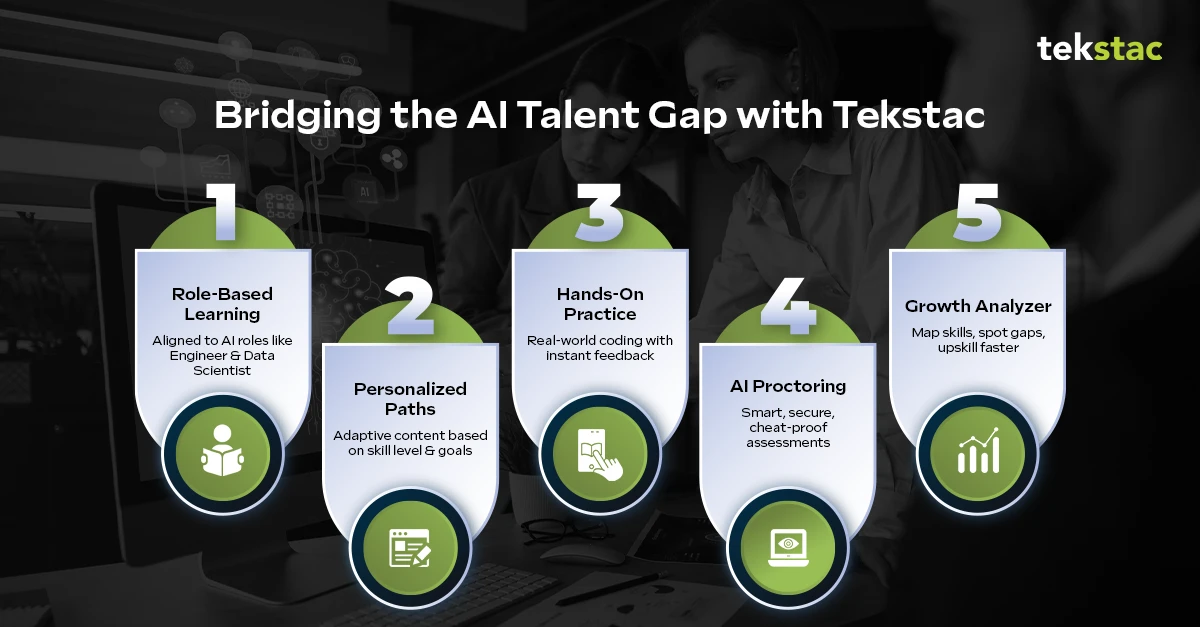
Tekstac aligns learning journeys with specific industry roles like AI Engineer, Data Scientist, and ML Developer. Each role comes with clearly defined skills and mapped content to ensure job-ready outcomes.
Tekstac uses adaptive learning models to tailor content, assessments, and pacing to each learner’s existing skill level and career goals—making learning more effective and engaging.
Learners gain practical experience through real-world coding challenges, labs, and scenarios. Tekstac’s auto-evaluation engine provides instant feedback and grading, speeding up the learning loop.
To maintain assessment integrity, Tekstac uses AI-based proctoring that detects tab-switching, user movement, and attempts to copy-paste or use unauthorized tools—ensuring credible, cheat-proof evaluations.
Tekstac’s AI-driven Growth Path Analyzer helps learners visualize their current skill fitment, identify gaps, and explore targeted upskilling opportunities to advance into desired AI roles.
Successful companies are addressing these obstacles by investing in AI literacy programs, fostering cross-functional collaborations, and implementing robust data governance strategies. Many organizations are also adopting AI ethics frameworks to ensure transparent and responsible AI deployment.
As AI continues to evolve, businesses must focus on long-term AI strategies to remain competitive. The report suggests that organizations invest in:
Additionally, governments and regulatory bodies play a crucial role in shaping AI policies that ensure fair, transparent, and inclusive AI adoption. Collaborative efforts between the private sector, policymakers, and academia will be essential in shaping the future of AI.
AI’s transformative potential is evident, with real-world implementations delivering substantial benefits across industries. As businesses move beyond experimentation, embracing AI-driven solutions will be essential for future growth, efficiency, and sustainability.
The insights from the AI in Action: Beyond Experimentation to Transform Industry 2025 report make it clear that AI is not just an option; it is a necessity for businesses to thrive in the digital era. Organizations that proactively integrate AI will unlock new opportunities, drive innovation, and build a competitive advantage in an increasingly AI-driven world.
Don’t let the AI talent gap slow down your transformation. Book a Tekstac demo today and discover how AI-powered skills intelligence can prepare your workforce for the future of work.
1. Which city will host the AI Action Summit in 2026?
The 2026 AI Action Summit will be hosted in New Delhi, India, bringing together global leaders, policymakers, researchers, and enterprises to advance responsible AI adoption, governance, innovation, and international collaboration.
2. What are the key takeaways from the AI in Action report?
The report highlights that AI success depends on moving beyond experimentation through workforce upskilling, strong governance, high-quality data, scalable implementation, and measurable business outcomes that deliver long-term enterprise value.
3. What are the biggest barriers to AI adoption, according to the AI in Action report?
The biggest barriers include AI skill shortages, poor data readiness, governance challenges, legacy systems, security concerns, and difficulty scaling pilots into enterprise-wide AI initiatives with measurable ROI.
4. Why is workforce upskilling critical for AI adoption?
AI adoption succeeds when organizations equip employees with practical AI skills. Continuous upskilling helps bridge talent gaps, improve AI implementation, accelerate innovation, and maximize returns from enterprise AI investments.

Imagine a workplace where employees aren’t restricted to their job titles but can explore opportunities that align with their passions, skills, and career aspirations. What if your organization could tap into hidden talent, boost productivity, and reduce turnover, all through a single AI-powered platform? A talent marketplace is more than an HR tool: it’s a skills-based workforce marketplace that drives career mobility, reskilling, and agility at scale.
In today’s competitive business landscape, companies need to be agile, ensuring that talent is utilized effectively, and employees remain engaged. A Talent Marketplace transforms traditional workforce management by connecting employees with the right internal opportunities, whether it’s a new project, mentorship, skill-building course, or even a lateral career shift. This innovative approach not only enhances internal mobility but also future-proofs organizations by fostering continuous learning and professional growth.
So, what exactly is a Talent Marketplace, and how can it revolutionize your organization? Let’s dive in.
A Talent Marketplace is a core component of the AI-powered talent intelligence ecosystem. Platforms like Tekstac leverage predictive analytics and machine learning to align employee skills, roles, and business goals — driving real-time workforce agility and internal mobility. These opportunities can include:
Unlike traditional workforce planning, which follows a rigid hierarchical structure, a Talent Marketplace promotes a fluid, skills-based approach, allowing employees to move across teams, projects, and roles dynamically.
Today, many Talent Marketplaces are powered by AI & data analytics to match employees’ skills, interests, and career aspirations with available opportunities. The system typically functions as follows:
A well-designed Talent Marketplace should offer the following features:
Personalized suggestions for roles, projects, and learning paths based on employees’ skills, goals, and aspirations.
Live dashboards and insights help HR and managers track workforce trends, skill supply-demand gaps, and engagement metrics.
Empowers employees to own their growth journey by exploring and applying for internal opportunities that match their goals.
Seamlessly connects to internal or external learning systems, enabling targeted upskilling based on opportunity requirements.
Facilitates short-term assignments, projects, and side gigs within the organization, boosting agility and cross-functional exposure.
Enables clear visibility into employee contributions and outcomes, helping guide development and recognition decisions.
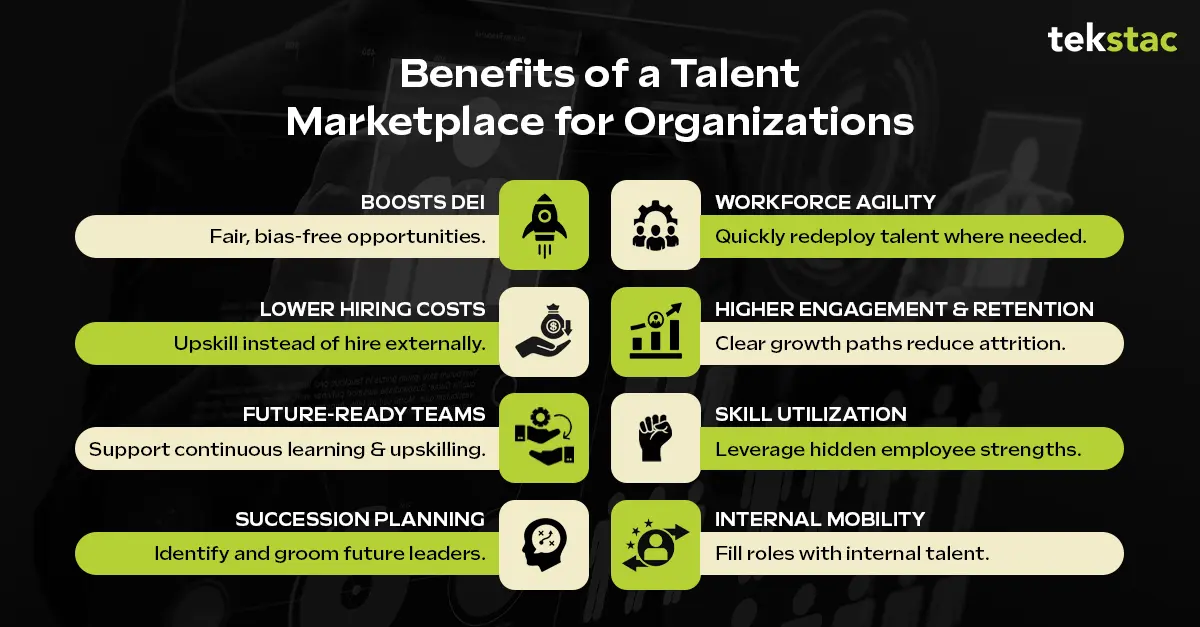
A Talent Marketplace enables organizations to quickly redeploy talent where it is most needed. Whether it’s filling urgent project gaps or responding to market shifts, this platform ensures that employees are effectively utilized.
When employees see clear career growth opportunities within the organization, they are more likely to stay engaged. A Talent Marketplace helps in creating a transparent career path, reducing attrition rates significantly. According to Gartner, companies using talent intelligence platforms report a 30% increase in internal mobility and 25% lower hiring costs.
Many organizations underutilize employee skills due to a lack of visibility. A Talent Marketplace provides a structured way to identify and leverage hidden talents, ensuring employees work in areas that align with their strengths.
Instead of looking externally to fill roles, organizations can focus on internal talent mobility. Employees can transition between departments and roles, leading to a more flexible workforce and reducing hiring costs.
A Talent Marketplace promotes fair access to opportunities by removing biases in hiring and promotions. AI-driven recommendations ensure employees are matched based on skills rather than personal connections or subjective criteria.
Finding external talent is expensive and time-consuming. With a Talent Marketplace, organizations can identify and upskill existing employees, reducing dependency on external hiring.
With technology and industry trends evolving rapidly, organizations must ensure their workforce remains future-ready. A Talent Marketplace fosters continuous learning and upskilling, allowing employees to adapt to new roles and responsibilities seamlessly.
By analyzing internal talent, organizations can identify high-potential employees and groom them for leadership roles, ensuring business continuity.
Unilever adopted an AI-driven talent marketplace to enhance internal mobility and reskilling initiatives. The platform enabled employees to take on short-term assignments, upskill, and explore new career paths within the company, leading to increased engagement and retention.
Schneider Electric used a Talent Marketplace to match employees with projects and training programs. This resulted in better workforce agility and a significant reduction in recruitment costs.
Nestlé implemented an AI-driven Talent Marketplace that provided employees with clear internal growth opportunities while also launching an internal gig marketplace. This empowered employees to take on cross-functional projects, which not only improved satisfaction and retention but also reduced external hiring costs.
Growing adoption in India and Singapore as organizations prioritize digital reskilling and AI readiness.
To successfully implement a Talent Marketplace, consider these key steps:
There are various Talent Marketplace solutions available, such as Gloat, Eightfold AI, and Workday Talent Marketplace. Choose one that aligns with your organization’s goals and infrastructure.
A Talent Marketplace thrives when employees actively engage. Organizations should promote awareness through training sessions and leadership support.
Ensure that your Talent Marketplace is linked with learning platforms so employees can upskill based on career opportunities available within the system.
Encourage managers to embrace a skills-based approach and support employees in moving across teams and departments.
Regularly analyze data from the Talent Marketplace to refine matching algorithms, improve employee experience, and optimize workforce planning.
As AI and automation continue to shape the workplace, Talent Marketplaces will become even more sophisticated. Future trends may include:
A Talent Marketplace is a game-changer for organizations aiming to boost agility, employee engagement, and internal mobility. By leveraging AI-powered internal talent solutions, businesses can create a future-ready workforce, maximize skill utilization, and enhance employee satisfaction. Investing in a Talent Marketplace today will drive long-term success for both employees and the organization.
At Tekstac, we empower organizations to adopt a skills-first approach by enabling seamless talent discovery, role fitment, and growth mapping. Our intelligent platform supports internal mobility, continuous learning, and AI-powered recommendations—making your workforce future-ready.
Are you ready to unlock the full potential of your workforce? An enterprise talent marketplace platform can transform your talent strategy, drive workforce agility, and prepare your people for the future of work. By embracing a skills-based career marketplace, organizations can reduce costs, improve retention, and ensure they remain future-ready.
1. How do I access a Talent Marketplace?
Employees can access their organization’s Talent Marketplace through an internal HR portal or platform like Tekstac to explore roles, gigs, and learning paths.
2. How does a Talent Marketplace benefit employees?
It helps employees discover new roles, projects, and upskilling opportunities, fostering career growth and internal mobility.
3. What is a Talent Experience Platform?
A Talent Experience Platform integrates learning, performance, and internal mobility tools to deliver personalized, AI-driven career journeys for employees.
4. What is the future of Talent Marketplaces?
Talent Marketplaces will evolve with AI, predictive analytics, and skills intelligence—enabling continuous learning, agile workforce deployment, and future-ready organizations.
Based on PwC India’s Report on “Powering Automation with Agents”
Automation has come a long way- from simple task automation to AI-driven intelligent systems. Now, we are entering a new era: Agentic Powered Automation (APA), a revolutionary approach that combines Generative AI (GenAI) with automation tools to create self-learning, adaptive business processes. A recent report by PwC India sheds light on how APA is reshaping industries, enhancing efficiency, and paving the way for a smarter, AI-driven future.
At its core, APA integrates AI-powered agents (the ‘brain’) with intelligent automation tools (the ‘hands’) to create dynamic, responsive business workflows. These AI agents don’t just follow predefined rules, they understand context, make decisions, and collaborate with other agents to execute complex tasks with minimal human intervention.
This shift from traditional automation to AI-driven decision-making marks a significant transformation in how businesses operate. Instead of static workflows, APA enables real-time adaptability, making businesses more resilient and efficient.
Agentic automation is rapidly being adopted across industries. The PwC report highlights several key areas where APA is making a significant impact:
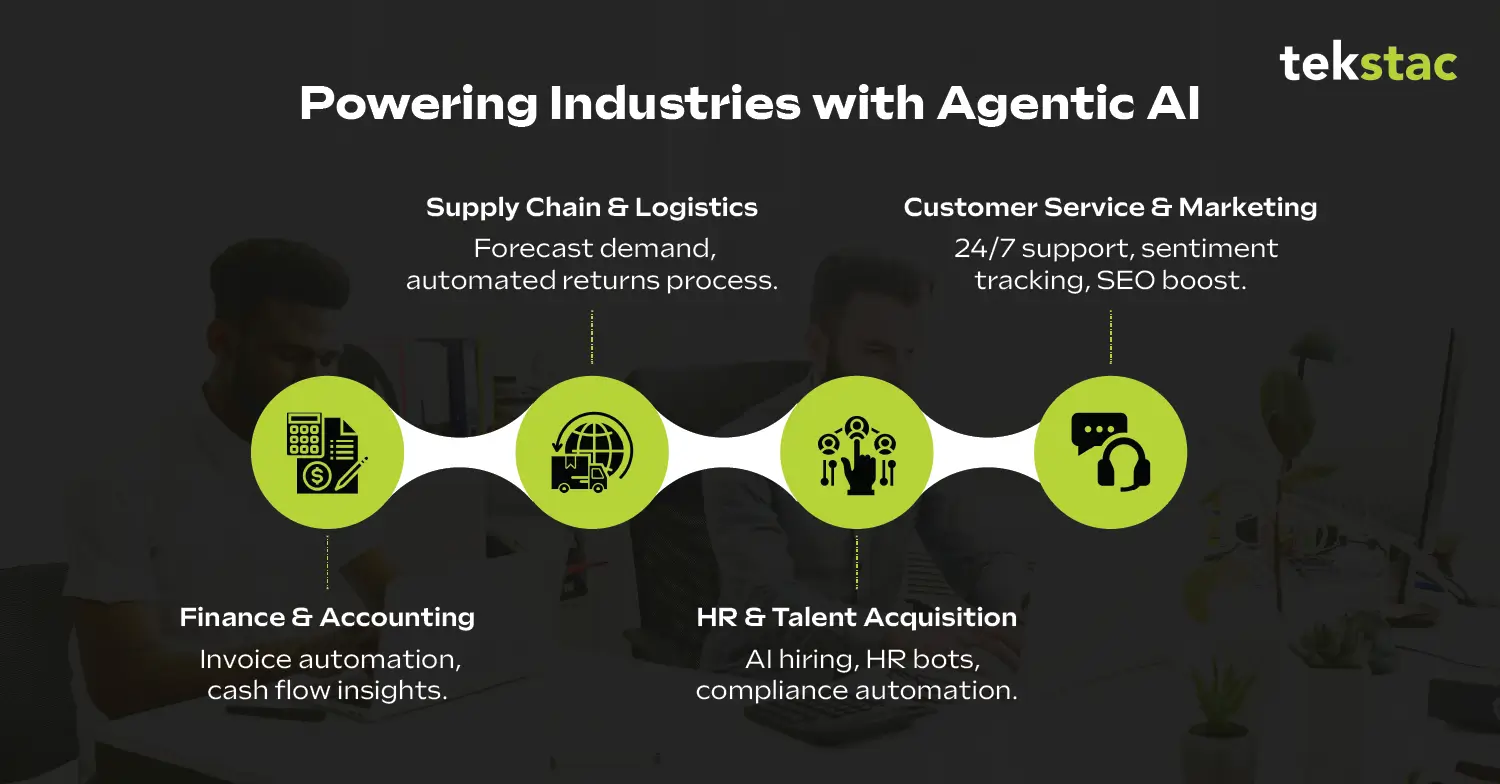
These examples illustrate how APA is enhancing business operations by reducing manual intervention, minimizing errors, and accelerating decision-making processes.
📊 Industry Adoption Snapshot (PwC Survey Data)
A recent PwC Digital Commerce Survey shows that Agentic AI adoption is rapidly accelerating across enterprises:
These numbers highlight that Agentic AI is no longer experimental—it is actively driving business outcomes across finance, HR, supply chain, customer service, and operations.
One of the biggest concerns surrounding automation is job displacement. However, APA does not aim to replace human workers; rather, it empowers them by taking over repetitive, time-consuming tasks. This allows professionals to focus on more strategic, creative, and decision-making roles.
For instance:
Financial analysts can leverage AI-generated insights to make more informed investment decisions.
Thus, APA fosters a symbiotic relationship between humans and AI, where technology amplifies human capabilities instead of replacing them.
With great power comes great responsibility. As organizations integrate APA into their ecosystems, they must address key challenges:
Companies must establish clear AI governance frameworks to mitigate risks and build trust among employees, customers, and stakeholders.
PwC’s report highlights that the future of business lies in seamlessly blending human expertise with AI-powered automation. Organizations that adopt APA today will gain a competitive edge by:
As the world moves toward an AI-driven future, embracing APA is no longer an option, it’s a necessity. Businesses that integrate AI-driven agents into their workflows will unlock new growth opportunities, drive efficiency, and reshape industries for years to come.
Agentic Powered Automation is more than just a technological advancement; it’s a paradigm shift in how businesses operate. As organizations prepare for this transformation, they must adopt AI responsibly, ensuring that technology serves as an enabler of human potential rather than a replacement.
The question is no longer whether businesses should embrace Agentic Powered Automation (APA) but how quickly they can adapt to stay ahead in an increasingly competitive landscape. The future of work is here, are we ready to embrace it?
1. How does Agentic AI differ from traditional automation?
Traditional automation follows predefined rules, while Agentic AI adapts in real time, understands context, and makes autonomous decisions.
2. What are the top business use cases of Agentic AI?
Finance automation, supply chain optimization, HR workflows, talent acquisition, customer support, marketing automation, and compliance.
3. Will Agentic AI replace human jobs?
No. Agentic AI automates repetitive tasks while enabling humans to focus on strategic, creative, and leadership roles.
4. Why should enterprises adopt Agentic AI now?
It increases efficiency, reduces costs, accelerates decision-making, and helps businesses stay competitive in an AI-first economy.
Employee skill assessments help organizations measure the knowledge, technical abilities, and job readiness of their workforce. They help employers identify skill gaps, validate competencies, evaluate candidates, and determine which employees need targeted upskilling or reskilling.
Traditional assessments often rely on generic tests or manual evaluation. Modern employee skill assessments can combine practical assessments, real-world scenarios, automated evaluation, analytics, and AI-powered insights to provide a more complete view of employee capabilities.
In the tech-driven world we live in right now, there’s a gap between available talent and needed skills. A Robert Half survey shows that 95% of tech managers struggle with finding skilled talent, 69% face difficulties backfilling existing roles, and 29% have difficulty hiring new roles.
Companies are desperately searching for ways to discover and grow the best people, but traditional employee skill assessment methods just aren’t cutting it. Companies now need more than screening tools; they need platforms to assess, build, and drive talent for tomorrow.
Here, tools like Tekstac step in as innovative talent development platforms that transform how organizations assess talent. Organizations like PWC, Accenture, and others have utilized Tekstac to streamline their skill development strategies with measurable results at scale. Tekstac has upskilled over 1+ million professionals with an impressive 100% customer retention rate.
Let’s discover how Tekstac is transforming worker skill evaluations through generative AI.
Employee skill assessments are all about understanding what your team truly excels at. They evaluate a person’s knowledge, technical abilities, and how ready they are for their job. Unlike old tests, today’s AI-powered versions, like Tekstac’s, dig deeper to see how someone solves problems, applies their skills, and their potential for real-world performance. It’s about getting a clear, practical picture of each individual’s strengths.
Traditional employee skill assessments can tell you whether a person is able to remember information.
But can they predict job performance? Can they reveal hidden talent? Can they sift through thousands of applicants without sacrificing quality, time, and resources?
Tekstac’s approach addresses these challenges. It employs end-to-end generative AI in the assessment process, allowing the platform to generate meaningful tests.
At the core of Tekstac’s system are four interconnected components:
Not only does the platform check answers, but it also checks approach and problem-solving style. Unlike conventional multiple-choice tests, these skill tests adapt to test theoretical and practical applications – giving you a 360-degree picture of each candidate’s skill.
Tekstac maintains test integrity without the dread of on-premise monitoring. The platform checks facial recognition, browser activity, and typing behavior to ensure objective results, even when testing 400,000+ candidates simultaneously.
With advanced algorithms, Tekstac identifies suspicious patterns in code, written responses, and even problem-solving methodologies that may indicate shortcuts.
Finally, they transform raw test data into actionable insights. Hiring managers no longer have to wait weeks for results. They can now see performance trends develop as skill tests are taken. This allows decisions to be made faster and with greater certainty.
Finding, developing, and retaining the best people is an ongoing journey. Through advanced employee skill assessments powered by generative AI, Tekstac enables organizations to accurately evaluate, upskill, and transform their talent pool.
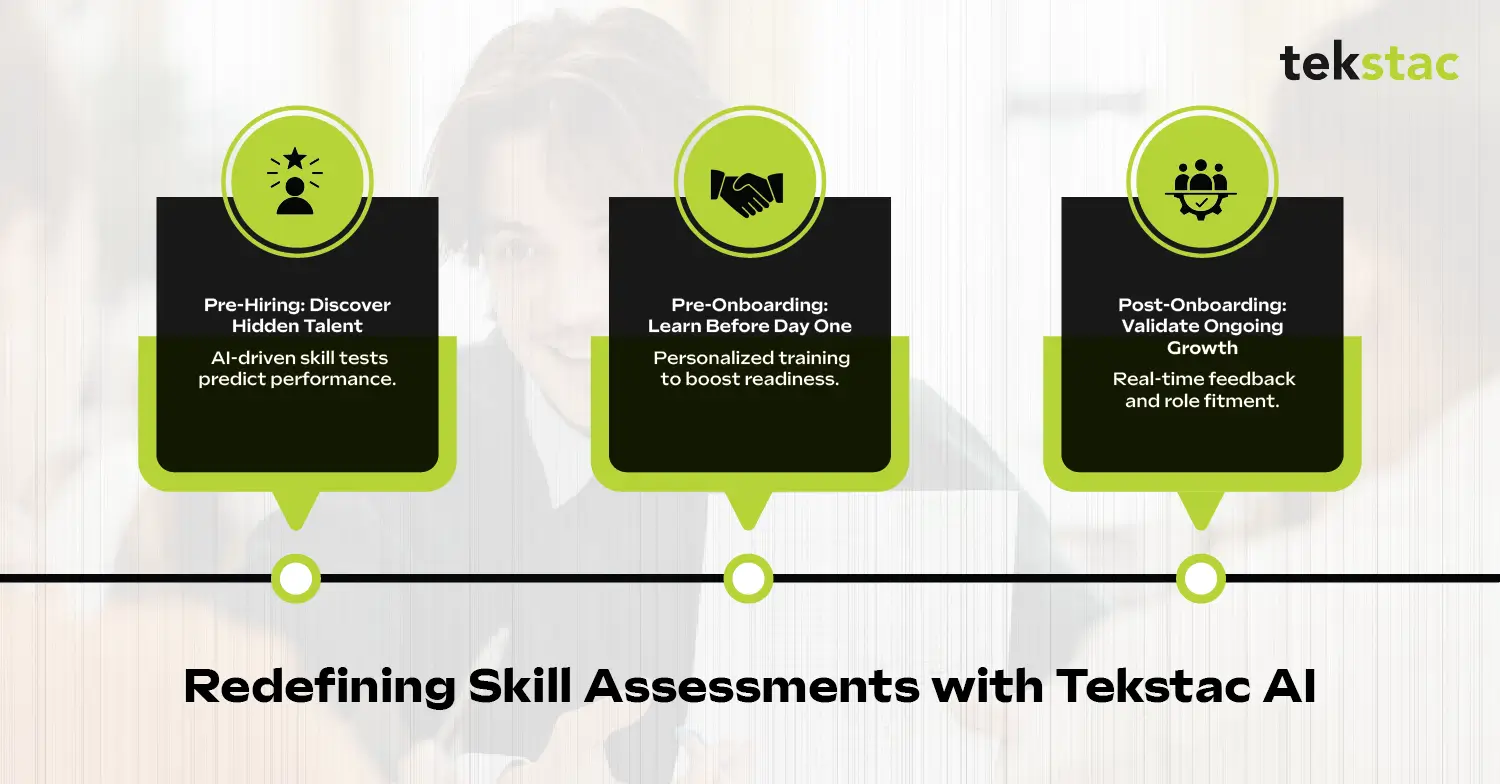
With thousands of applicants before you, how do you identify real potential? Traditional methods and tools fall short, focusing too much on qualifications and keywords rather than capability.
Tekstac’s customized tests employ generative AI to see beyond qualifications on the surface. For technical roles, the platform employs expert assessments that conduct knowledge and application tests. Candidates resolve real issues such as what they will face in their workplace, with generative AI analyzing their approach, code quality, and effectiveness of the solution.
For enterprise clients handling massive hiring initiatives, this model provides what was once considered impossible: objective, measurable skill assessment that actually predicts job success.
A top tech company shortlisting 30,000+ pre-final year students was struggling with manual recruitment processes that were high in cost and effort. After implementing Tekstac’s AI-driven employee skill assessments, they were able to identify high-potential candidates early on and make premium hires for chosen roles. The micro-certifications acquired through this process also piqued the interest of partner college graduates to secure better employment opportunities.
For example, the Head of ESG and Analytics states, “Gramener has been leveraging the Tekstac platform for the last 5 years for its internal skilling and hiring. Recently, about 100 graduates, hired for our data science practice, underwent a five-week self-paced online learning program on Tekstac. The platform’s auto-evaluated practice labs, deep assessments and program management ensured better than expected ROI.”
The time between offer acceptance and reporting to work results in significant lost productivity. Tekstac converts waiting time into constructive skill development through generative AI-based learning courses.
New starters are given personalized learning courses in technologies like Java, .NET, and Python based on initial competency tests. Generative AI examines their code outputs and provides customized feedback to improve faster.
A Fortune 500 IT service provider bringing in 40,000+ new graduates annually launched Tekstac’s pre-onboarding solution. The self-paced, bespoke program offered fundamental skills to the graduates before the initial day. Progress tracking in real-time dashboards kept stakeholders in the know, with results aligning with the objectives.
Employee skill development doesn’t stop at day one. Tekstac’s role-based learning paths include in-built checks for skill validation in real time, and to identify knowledge gaps.
Compared to classic training in which completion is measured, employee skills assessments powered by generative AI focus on competency—showing not just what employees know, but what they can apply in real-world scenarios. Generative AI examines solution methods and provides context-based insights to learners and managers, highlighting both areas of proficiency and skill gaps.
A 300,000+ employee strong Fortune 500 Global IT Consulting Colocation employed Tekstac’s lateral reskilling solution for middle and senior-level employees. The results were mind-boggling: 80% reduction in time to role transition, 90% role skill fitment, 95% training completion rate, and 20% improvement in operational efficiency.
“What sets Tekstac apart is not only its technical superiority but also its people,” explains a Senior Manager in L&D at PWC. “Thanks to their dedication, we now rely on Tekstac to train over 5000 students across diverse disciplines.”
Employee skill assessments help organizations understand the difference between the skills employees currently have and the capabilities required for their roles. This visibility allows L&D and HR teams to prioritize targeted learning, reskilling, and internal mobility initiatives.
As businesses keep competing to implement generative AI and other technologies, the skills gap will widen. Tekstac’s employee skills assessment approach helps organizations determine current employee skills and systematically build future required capabilities. With over 500+ learning journeys, 1M+ professionals upskilled, and 27M+ learning hours delivered, Tekstac continues to develop talent in scale. Building a future-proof workforce begins with understanding where you stand.
Take the first step with Tekstac – transform employee skill assessments, training, upskilling and reskilling initiatives today for your tech workforce. Start bridging the employee skill gaps that matter – get started today.
1. Why are employee skills assessments important for businesses?
Employee skill assessments help organizations identify gaps, validate training effectiveness, improve hiring accuracy, and build a future-ready workforce aligned with evolving business needs.
2. Can employee skills assessments support employee upskilling?
Yes. Modern employee skill assessments not only evaluate current competencies but also recommend personalized learning paths, enabling targeted upskilling and reskilling across enterprises.
3. Why should companies use employee skill assessment tools?
Employee skill assessment tools reduce hiring bias, speed up recruitment, validate training ROI, and help L&D teams close skill gaps effectively for sustained workforce growth.
4. Why choose Tekstac’s AI skill assessment tools?
Tekstac’s AI skill assessment tools go beyond testing—using generative AI to deliver adaptive labs, auto-evaluated assessments, AI proctoring, plagiarism detection, and personalized learning journeys at enterprise scale.
References:

Lean thinking promised a revolution.
Originating in Toyota’s factories, lean thinking has not only shaken up the status quo but also set a global standard for cutting waste and delivering value. It’s a movement that’s changing the way we do business.
Today, companies race to adopt and benefit from it—just like Toyota. They see waste-free processes and responsive workflows that help cut costs and respond quickly to customer demands.
However, implementing “lean” has its own challenges, as evident in the many failed implementations, with failure rates of 60–90%, similar to the 80% failure rate of organizational changes.
In this blog, we will understand the urgent need to overcome these challenges and how to implement lean thinking more effectively.
Despite its immense potential to bring in organizational revolutions through work processes and efficiency, lean thinking fails due to more profound, systemic issues from implementation challenges.
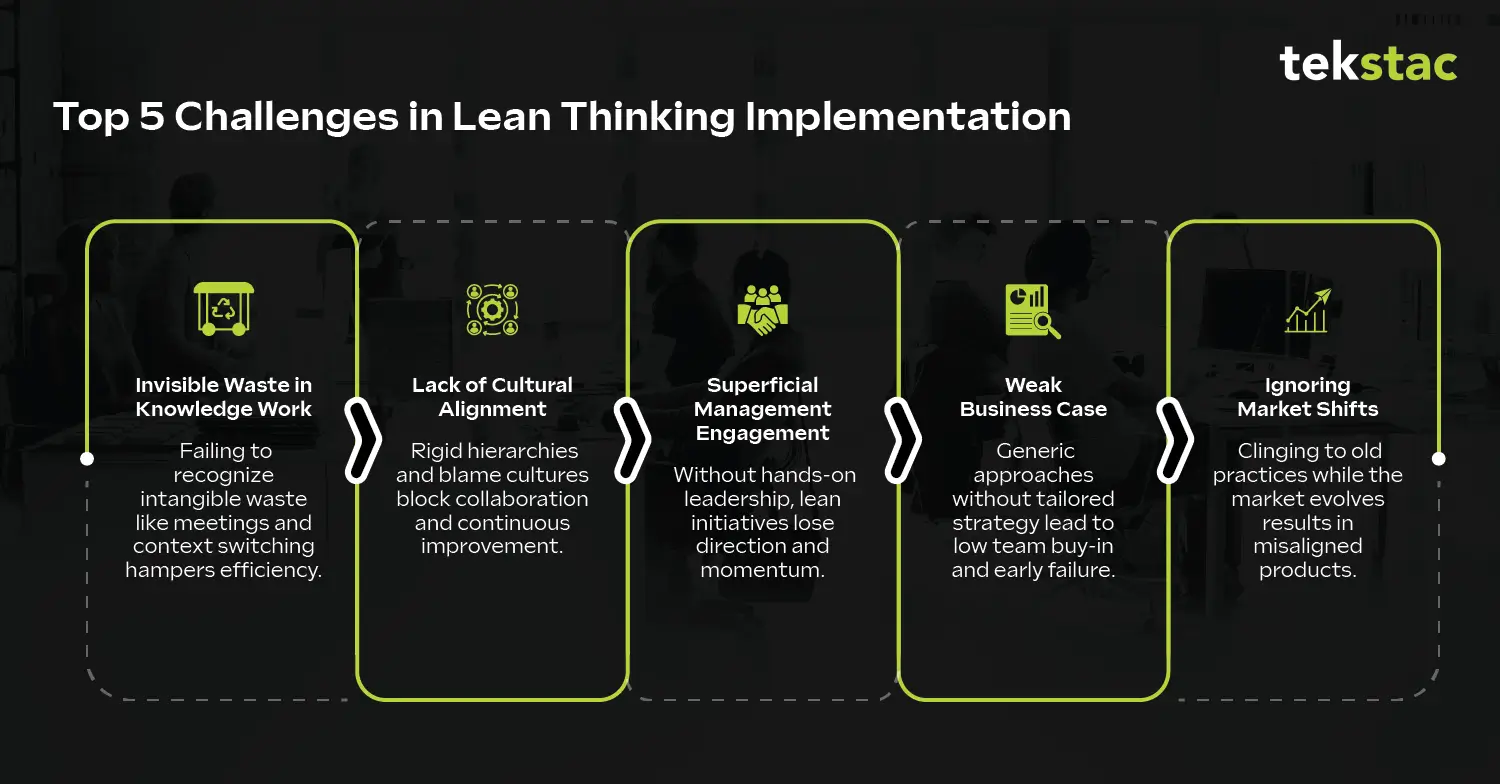
Lean thinking originated from Toyota Production Systems, where waste is tangible, such as extra inventory or defective products. However, in knowledge work, waste is less visible, resulting in inefficiencies like poor communication, context switching, inadequate tools, unnecessary meetings and excessive documentation.
Organizations often struggle to recognize and address these intangible forms of waste, misapplying lean tools designed for manufacturing environments. Without aligning lean practices to the organization’s nuances, companies may amplify inefficiencies and fail to eliminate waste.
For example, a software development company may implement lean thinking to reduce waste by enforcing strict time tracking—believing that the time spent on non-coding activities is wasteful. This approach backfires as brainstorming sessions and peer reviews are essential for knowledge work, and when these elements are discouraged, it may lead to lower-quality code and reduced innovation.
Lean thinking may seem like a set of tools or methodologies, but it’s more than that—it requires cultural transformation. Hence, organizations that are not ready for change and encourage rigid, hierarchical structures fail to create an environment that supports collaboration and continuous improvement— which are needed to implement lean thinking effectively.
For example:
These cultural barriers obstruct the implementation of lean principles like respecting people and creating knowledge.
Lean thinking requires active and continued leadership involvement. Yet many organizations treat it as a one-time initiative rather than a permanent mindset shift. Thus, senior leaders ignore employee engagement, cascade strategies into actionable team objectives, and allocate resources for training.
Imagine a tech startup implementing lean thinking to improve its software development process. However, senior management only announces goals without directly engaging with developers or participating in daily stand-ups. Without a clear understanding, the initiative will ultimately fail because of a lack of clear direction.
Some companies may jump ship to embrace lean implementation without understanding its relevance and context. Traditional lean training often focuses on generic benefits observed in other companies rather than developing a tailored, adjusted business case. Such lack of clarity leads to:
Lean thinking’s principle of deferring commitment focuses on agility, but many stick to rigid planning practices. This results in premature decisions due to outdated information and products failing to meet rising customer demands. Ultimately, this leads to wasted effort and resources.
For instance, a company uses lean thinking to streamline its product development for desktop applications. However, as demand for mobile apps increases, it continues applying lean principles designed for desktop development, ignoring the shift in market trends. This results in slow market response and loss of competition.
While the above challenges obstruct lean thinking implementation, they can be overcome! One key aspect is to keep in mind the principles of lean thinking, which also directly help with the above challenges:
Lean thinking begins by defining value through the lens of the end customer. What exactly does the customer need, when do they need it, and what are they willing to pay for? This understanding will help set a benchmark for work processes. Think of clear communication, usable outputs, or efficient delivery timelines. Activities like context switching or inefficient tools are non-value-adding wastes.
To better implement lean thinking, start by defining what “waste” looks like in the environment. Organizations can begin by mapping out their work processes and looking for points where time is wasted due to poor communication or shifting between tasks. This detailed map, known as the ‘value stream,’ must also include the current and ideal states of the work process, helping visualize the flow of value better.
For example, a project management team might struggle to switch between emails and project boards. One way to cut waste is to encourage using a single, more efficient tool for fast-tracking and reducing unnecessary back-and-forth emails.
Tip: Engage employees to categorize activities as “value-adding,” “necessary but non-value-adding,” or “pure waste.”
Lean thinking also emphasizes eliminating barriers to work. These can be overloaded team members, inefficient reviews, or other bottlenecks like unclear objectives, lack of resources, or poor task prioritization. It’s essential to keep work moving seamlessly from start to finish by identifying and addressing these constraints.
An example would be implementing strategies like Work-In-Progress limits—restrictions on the number of tasks or projects a team works on at any given time—to increase quality and ensure each task flows smoothly through the value stream. A well-managed flow will lead to faster delivery, fewer errors, and higher satisfaction for employees and customers.
It’s similar to keeping traffic on a highway below capacity. When there’s less congestion, work progresses faster.
Lean requires cultural alignment, but organizations with siloed departments and blame cultures may struggle. Respect for people is an essential principle of lean, which promotes trust, collaboration, and ownership of improvements.
Organizations should train managers and teams on lean principles like continuous improvement (Kaizen) and encourage them to identify inefficiencies and implement changes.
For example, in a content creation team, members can be encouraged to suggest process changes during weekly catch-ups, such as reducing revisions or clarifying ownership points.
Lean initiatives must start with a clear business case that links them directly to organizational goals. Without this clarity, achieving buy-in from stakeholders or maintaining long-term efforts can be challenging.
For lean thinking to have an actual impact, initiatives must align with the market’s current and future needs. This ensures that processes are optimized while prioritizing customer value, a core principle of lean thinking.
One of the principles of lean implementation is iterative improvement, which requires continuous feedback. Lean thinking practices must be evaluated regularly to implement changes. One way is to use sprints to identify what worked and what did not. Customer surveys or performance metrics must validate these to drive improvements. Lastly, the focus must be on using lean thinking as a tool for growth rather than for criticism.
It’s important to note that implementing lean thinking can fail when organizations struggle with skills gaps, inefficient processes, and slow adaptation to market demands. Continuous improvement requires real-time feedback and learning. However, traditional training may fall short of amplifying lean success.
AI-powered tools, like Tekstac, close this gap by equipping the workforce with the required skills when they need them while ensuring continuous improvement. With such tools, organizations gain real-time skill assessments, personalized learning paths, and instant feedback loops—all in one solution.
Tekstac is one such solution for tech talent, which can be easily integrated with lean strategies. With features like auto-evaluated labs, on-demand mentorship, and scalable training solutions, Tekstac empowers teams to adapt and stay ahead of market demands.
Hence, organizations can deliver more value faster.
1. Why does lean thinking often fail in modern organizations?
It often fails due to cultural misalignment, lack of leadership support, and misapplying tools not suited for knowledge-based work.
2. How can companies identify waste in knowledge-based work?
By mapping value streams and spotting inefficiencies like context switching, poor tools, or unnecessary meetings.
3. What role does culture play in lean implementation?
A collaborative, blame-free culture enables continuous improvement and is essential for successful lean adoption.
4. How do AI tools like Tekstac support lean implementation?
They deliver real-time skill insights, personalized learning paths, and help teams adapt quickly to changing demands.
Increasingly rapid technology changes make it hard for businesses to keep up. It’s still imperative to increase revenue, foster employee engagement, and drive brand awareness—but now, there’s the added need to stay up to date with the latest technology advancements and find a way to use them to your business’s advantage. But how?
The key is leadership competence. With strong leaders at the helm, you’ll not only keep your business running in the digital age, but you’ll grow and thrive.
Here, we detail why leadership competence is so important in today’s digital environment and how your leaders can leverage change management, people leadership, vision, and technical savvy to lead the charge.
The stakes have never been higher. According to McKinsey’s 2025 workplace AI report, the single biggest barrier to successful AI adoption is not technology; it’s leadership. Meanwhile, Gallup’s State of the Global Workplace 2025 found that employee engagement has fallen to 21% globally, costing the economy an estimated $438 billion in lost productivity. The leaders who bridge this gap, technically literate, people-first, and strategically agile, will define which organizations thrive.
Leadership competence is a term that refers to one’s ability to lead effectively; this may include a combination of experience, knowledge, behaviors, skills and traits. Put simply, leadership competence is the difference between a strong leader and one that doesn’t live up to expectations.
Such competence is required from all leaders, but it’s even more important in the digital age. The continual advancements mean leaders must bring along the team and ensure they understand and adapt to changes. Plus, as digital changes lead to more opportunities for remote, distributed, and global workforces, they’ll need a strong leader to keep up morale and productivity. Finally, it’s important to keep up—remaining a competitive business requires staying on top of innovations and making your own.
Competent leaders don’t simply succeed in their roles. Instead, their impacts are broader, reaching and benefiting companies at large. There are several ways leadership competencies can positively impact an organization.
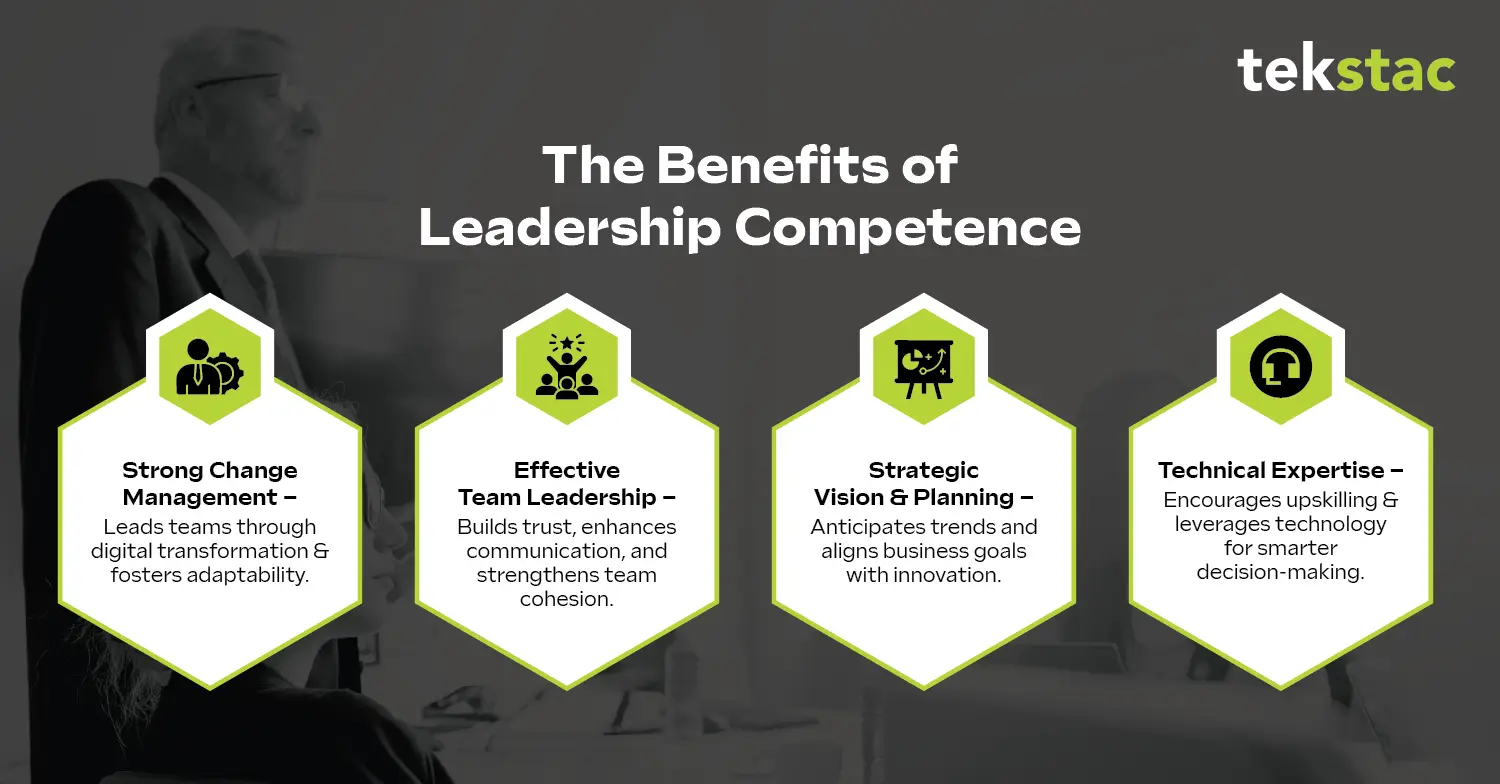
Rapid change is a major part of the digital age, but it can be difficult for employees to keep up. They may struggle to learn new tools or systems or feel anxious about the impact of AI and automation on their jobs. However, business leaders must bring along their staff and drive pivots as needed.
Consider how global consulting and professional services firms have integrated AI research and writing assistants into their analyst workflows. Rather than replacing junior analysts, forward-thinking leaders retrained them to prompt, validate, and apply human judgment on top of AI outputs, turning a potential threat into a productivity multiplier.
Practically, leaders can foster a culture of adaptability—and manage change among their teams—by encouraging teams to collaborate and cross-train, ultimately cultivating a strong growth mindset. In fact, a Harvard Business School survey found that 71% of respondents named adaptability the most important quality of a leader in the digital age.
While technology is a major part of workers’ daily lives, the human element is no less important. In fact, it may even be more important than ever. Strong leaders must show up with empathy and strong emotional intelligence and focus on clear communication with their teams.
Global engagement has dropped to 21%, the sharpest decline since COVID-19 lockdowns, driven largely by a 9-point drop in manager engagement since 2022.
This is especially important in a distributed or remote environment. Without employees working together from the same location, there’s more chance for miscommunication and a loss of team cohesion. To successfully manage this in the digital age, leaders can rely on digital tools like video conferencing, training platforms, and messaging systems.
A strong leader is always looking around the corner at what’s coming next and then determining the best path forward. The digital age makes this even more imperative. Leaders must set clear strategies and objectives that take into consideration the business’s needs, but also how the organization may need to change as technology does.
Without this type of strategic mindset, you could miss upcoming trends in your industry, finding yourself playing catchup rather than leading the charge to innovate.
At the same time, a strategic leader won’t simply jump to the latest trend without understanding its benefits and drawbacks. Rather than asking ‘what can AI replace?’, strategically competent leaders ask ‘where can AI amplify human strengths?.
Technical literacy is a must-have for competent leaders, but that doesn’t mean everyone must be an engineer. Instead, leaders should continually upskill and build their technical competence, then encourage their teams to do the same. According to McKinsey 2025 report, C-suite leaders estimate only 4% of employees use gen AI daily; the real figure is 13%. 63% of employees attribute leadership’s AI reluctance to “digital illiteracy”.
Currently, some of the major digital trends include generative AI, security, and big data, so those are a great place to start. As leaders become more fluent in today’s technological innovations, they can start using this understanding to make strategic decisions—or pivots, if needed.
Moreover, leaders should cultivate a culture of upskilling and training, investing in tools or programs that will help bolster their teams’ technical literacy and address employee skill gaps.
McKinsey’s 2025 research found that only 57% of employees say their company has an AI strategy, while 89% of C-suite leaders believe they do. Nearly half of employees report ‘lots of talk about AI but no action.’
Even with strong leadership, challenges abound in the digital workplace. Teams may resist AI adoption due to fears around job displacement, while others may independently adopt unauthorized AI tools without organizational oversight. This growing risk, known as “Shadow AI,” has become a major change management concern in 2025, with Zendesk’s CX Trends Report noting significant growth in unsanctioned AI usage across industries.
Leaders must balance change management with empathy by creating clear, safe, and governed AI adoption frameworks that help employees feel supported while encouraging responsible innovation. At the same time, with a rapidly evolving technology landscape, leaders must stay focused on business-critical priorities instead of getting overwhelmed by constant change and information overload.
It’s challenging for any company, regardless of digital advancements, to succeed without strong leaders. However, with the rise of new technologies and tools, competent leadership is even more imperative than ever.
Such leadership competencies include the ability to lead through change and foster adaptability, strong people management, a strategic mindset, and continued technological literacy—for both the leaders themselves and their teams. It takes intentional effort to focus on these areas, but it will pay off.
To further foster digital literacy and leadership, consider Tekstac. With over 500+ learning paths available, you can ensure your teams and leaders are trained and ready for whatever comes next.
1. Why do so many leadership competency models fail to get used?
Many leadership competency models fail because they are too generic, difficult to apply in real business situations, and disconnected from development or succession planning. Without validation or integration into day-to-day leadership decisions, organizations often struggle to use them consistently or confidently.
2. Do leadership competencies need to be customized for each organization?
Yes. Effective leadership competency frameworks should reflect an organization’s strategy, culture, business priorities, and leadership expectations. The strongest models balance research-backed structure with organization-specific relevance.
3. What are the four leadership competencies?
The four key leadership competencies are change management, people leadership, strategic vision, and technical literacy. Together, these skills empower leaders to guide organizations through transformation and thrive in today’s digital business environment.
4. How can leaders develop leadership competence?
Leaders can develop competence by continuous learning, upskilling in digital tools, practicing emotional intelligence, and seeking mentorship. Regular training programs and feedback loops also help strengthen leadership skills and adaptability.
5. How do leadership competencies connect to leadership development programs?
Leadership competencies define the skills and behaviors leaders need to demonstrate, while development programs help build those capabilities. Clear competencies make leadership development more focused, measurable, and aligned with real capability gaps and business goals.
6. How do you choose a leadership competency development vendor?
Organizations should look for vendors that combine research-backed frameworks, validation methods, customization capabilities, and measurable business alignment. Platforms like Tekstac help translate leadership competencies into practical development, assessment, and workforce strategies.
Imagine you’re preparing for a big family gathering. You would ensure that there’s enough food, drinks, and entertainment for everyone. If you don’t prepare well, you might end up scrambling at the last minute to guess what everyone likes or needs.
However, if you had access to a few years’ data—knowing which of the dishes were popular the year before, how many drinkers of soda versus juice attend, and what games or activities get everyone engaged—a lot more planning would occur because you could proactively consider everyone’s preferences and things just would go smoothly and become enjoyable.
This is the power of talent intelligence for HR leaders: leveraging data and analytics to make better decisions, anticipate future needs, and proactively manage your workforce. It is somewhat like planning for that family gathering; to anticipate problems, optimize strategies, and ensure the organization’s preparedness for the future. This article delves into 8 key talent intelligence trends shaping the HR landscape.
Artificial intelligence transforms human resources leaders’ talent management approaches. It allows organizations to automate data collection and analysis across the workforce, from employee skills and performance metrics to engagement levels, providing a comprehensive view of the talent landscape.
HR leaders are increasingly using AI for deeper insights into the capabilities of their workforce, predicting turnover, and making specific areas for improvement. Such AI-powered platforms aid not only in streamlining hiring but also in seeing whether talent strategies are moving hand-in-hand with the overall business goals. They use these tools to make the decision-making process data-informed, thereby improving employee performance while reducing bias in recruiting.
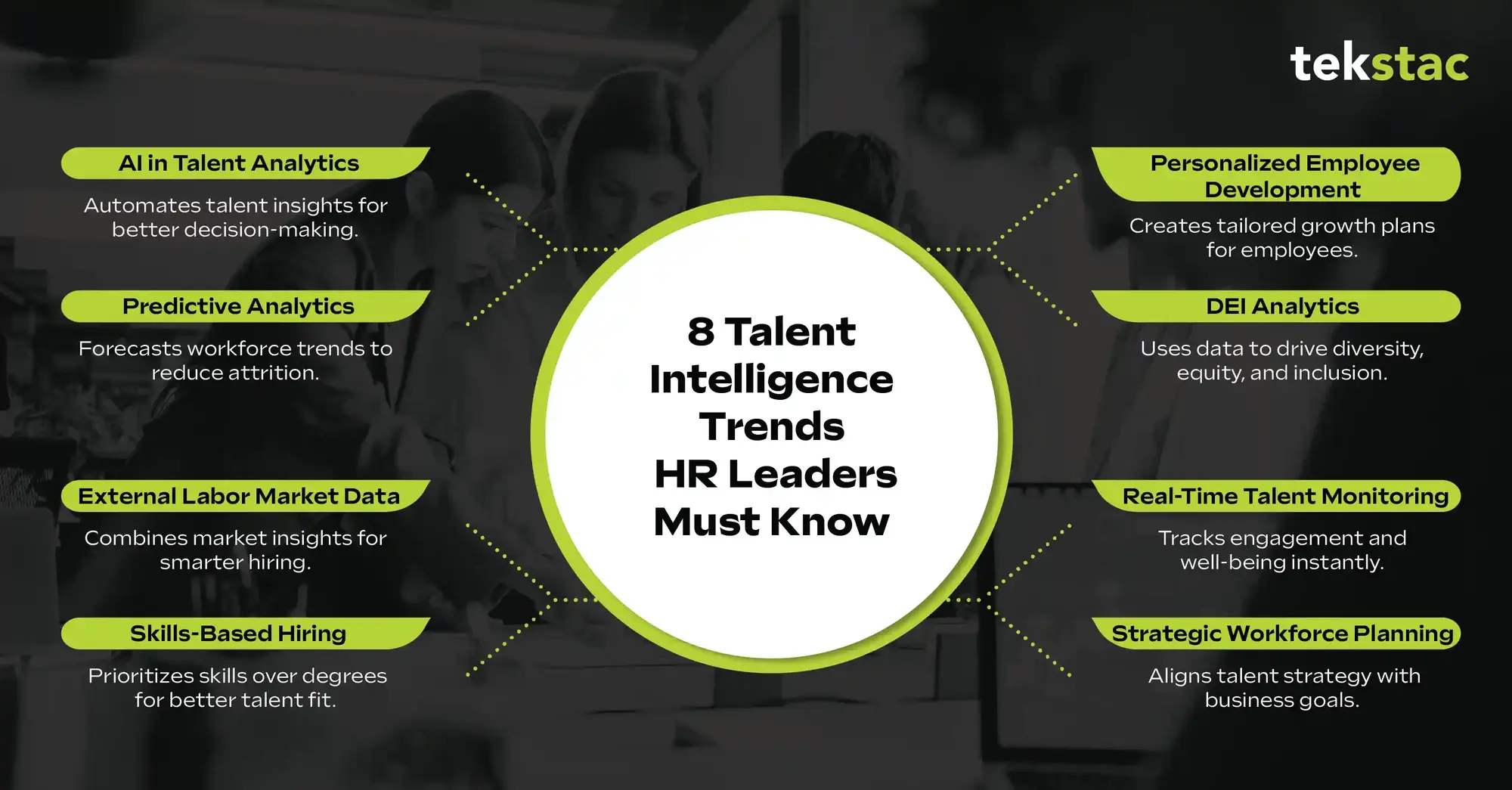
Predictive analytics will enable the HR leader to foresee future challenges in the workforce before they happen. By analyzing past performance, historical data, and current trends, predictive tools enable HR teams to spot early signs of issues such as rising employee attrition, skills shortages, or workforce imbalances.
This proactive approach enables HR to take action before problems escalate, ensuring that business operations remain smooth and employee morale stays high. With predictive analytics, HR teams can also forecast future hiring needs and create strategies to fill gaps in skills and leadership, all while boosting overall workforce engagement.
Organizations are no longer relying on internal workforce data to make talent decisions. Integration of external labor market data is becoming increasingly important for HR leaders who need a full picture of talent availability, salary benchmarks, and emerging skills in the market.
Leaders will be able to understand and comprehend the local hiring pattern, compensation level, and shifting skills, bringing together internal analytics and external labor market insight. This ability helps in constructing competitive acquisition strategies for talent and further helps in revising retention policies to the real-life market perspective.
The job market is a thing of the past, migrating towards skills-based hiring against degrees-based hiring. Hands-on practical experience is now prioritized over academics because there are talent intelligence tools now helping HR leaders sort applicants by skills rather than on educational degrees.
HR leaders can use assessments, simulations, and other performance-based metrics for fair and effective evaluations. The shift in skill-based hiring is actually allowing organizations to build a diverse and effective workforce as they get the right people into the right jobs according to their competencies.
Talent intelligence transforms how organizations approach employee development, taking it from one-size-fits-all learning and growth. With talent intelligence tools now, HR leaders are using their understanding to develop tailored and personal plans for each employee on growth. It considers each person’s strengths, weaknesses, and career goals to advise training, mentorship, and growth opportunities tailor-made to fit the individual employee’s needs.
Personalized development plans have an impact on boosting engagement for employees as well as ensuring that individual growth is tied to the goals of an organization. Consequently, businesses are observing improved retention rates and greater satisfaction by employees; therefore, they possess a more robust workforce better suited for handling future scenarios.
The most important need for organizations has become DEI efforts, and talent intelligence is increasingly playing a very significant role in driving DEI efforts with the help of data used by HR leaders to gauge the diversity of their workforce, monitor hiring practices, and measure the success of their DEI programs.
HR leaders may be able to identify weaknesses in their organization’s ability to attract, retain, or foster diversity, equity, and inclusion by analyzing recruitment and retention data. Corrective action should begin with the elimination of biases within hiring processes, diverse candidate pools, and an inclusive culture that will attract a broader range of talent.
As hybrid and remote work continue to rise, real-time talent monitoring becomes crucial for HR leaders. Today, modern talent intelligence platforms offer real-time insights into employee performance, engagement, and well-being.
Such practices enable HR leaders to monitor trends from quick-burnout signs, to potential skills gap, or disengagement. This data puts HR in a position where they can take timely responses to support employees through, for example, workload balance, resource enhancement, and mental health support. Hence, real-time monitoring will support HR leaders in keeping staff health and productivity levels irrespective of the location of the workers.
Strategic workforce planning becomes necessary for HR leaders to strategically take care of the long-run and sustainable success of the business venture. Talent intelligence platforms currently assist in providing data-based answers that help HR leaders predict workforce needs across marketplace trends, employee demographics, and organizational goals.
Understanding the changing talent landscape enables HR leaders to formulate responsive workforce development strategies that will help get the right people in their organization at the right moment. By making data-driven decisions for build-buy-borrow, talent intelligence is helping organizations discover anticipated talent gaps and prepare for forthcoming disruptions, such as the technology revolution or economic crunch. This powers a well thought out succession and skill development planning exercise
In a changing market where competitive pressure on organizations continues to grow, talent intelligence is now a business necessity for every HR leader. AI-driven analytics, predictive insights, and real-time monitoring empower the HR professionals to better plan for their workforce, boost engagement of the employees, and get their organization the right talent that will stick.
By keeping ahead of these trends, HR leaders can stay on top of their industry as opposed to just waiting to react to challenges; hence, they can build an effective workforce ready for tomorrow. By embracing current and future trends, leaders can build agile, diverse, and high-performing teams that drive long-term business success.
When hiring, retaining, and managing top talent, the bar is being raised higher for organizations.
This is a part of turning into a skills-based organization, where employers move away from traditional job titles and rigid roles. Instead, they focus on the actual skills employees bring to the table.
With the new technology tools sprouting and the increasing nature of remote work, businesses focus on people who could immediately add value with applicable, practical skills, aside from background or previous experiences.
To find and retain such talent, organizations must transform into skills-based organizations poised to dominate in 2026 and beyond.
A skills-based organization is one that prioritizes the skills employees possess over traditional job titles or fixed roles. It structures teams and projects around the competencies required to drive business results. This allows employees to contribute based on their strengths and expertise.
Beyond hiring, a skills-based organization focuses on career development, promotions, or project management. Employees are assessed and advanced based on their skills and contributions rather than seniority.
For example, consider a company with defined roles, such as “Marketing Manager” or “Sales Representative.” Promotions are based on seniority, and employees are expected to stay in their roles for many years before moving up the ladder. For instance, a Marketing Associate role can only get promoted to Marketing Manager if the person has worked at the company for at least 5 years, regardless of whether they have mastered new marketing techniques or additional skills.
In contrast, a skills-based organization would recognize the value of new skills over years of experience or education. If the person possesses the right skills and knowledge, they would be promoted to leadership after demonstrating results with their abilities.
The transition to a skills-based model is a foundational shift that aligns with the evolving future of work, where agility, adaptability, and innovation drive success. Organizations must rethink traditional approaches to hiring, training, and talent development to stay competitive.
Becoming a skills-based organization requires businesses to adopt a mindset emphasizing the importance of employees’ abilities and talents rather than background or experience. This helps focus on continuous learning and skill development to build high-performing teams.
Here are the top 7 factors that will drive organizations to turn into skills-based organizations in 2026:
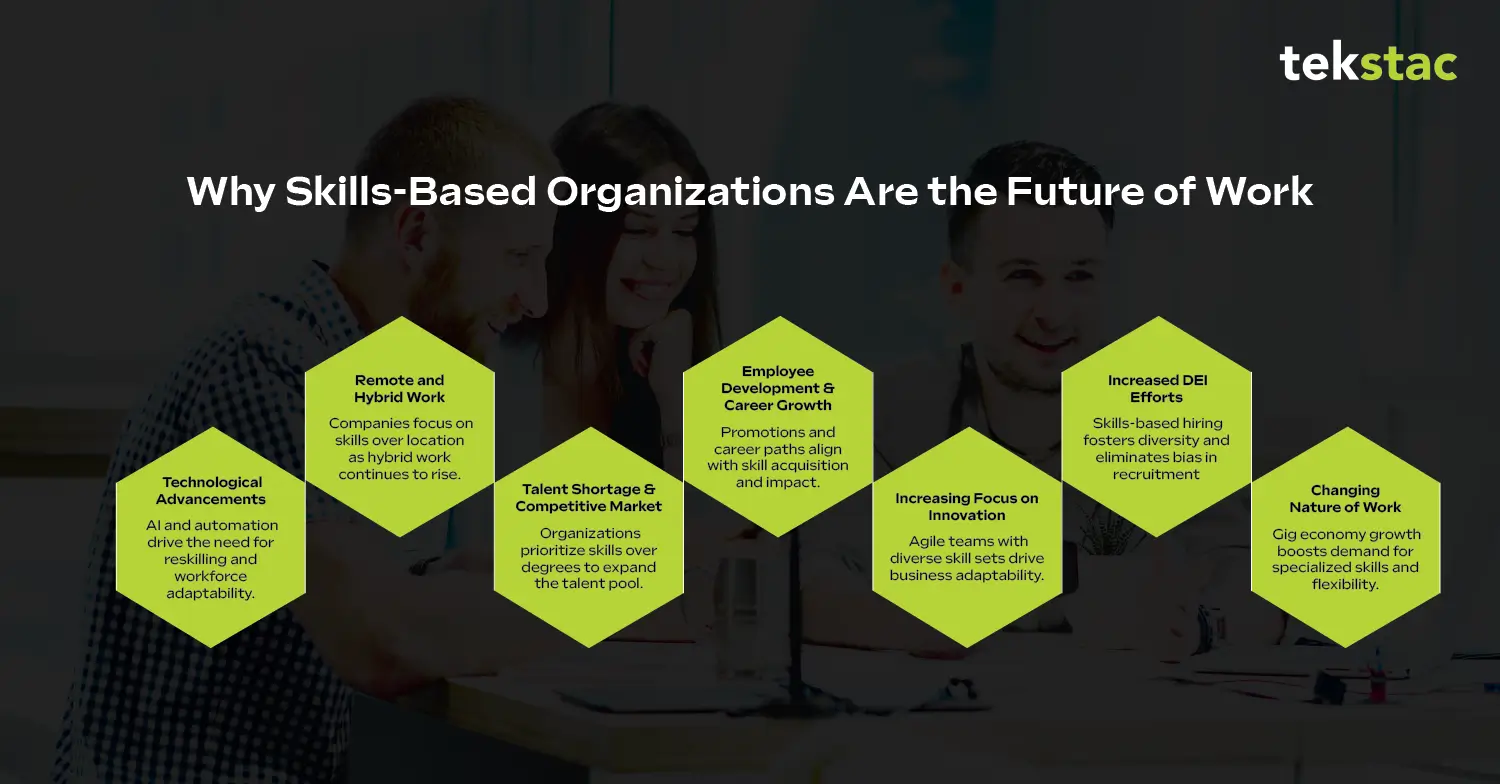
Technology is rapidly changing industries, with businesses integrating automation, AI, and other digital tools into their operations. An IBM report found that India will be the biggest adopter of AI in 2024, with 59% of large IT organizations deploying AI and 27% exploring this technology. 74% of this group is actively using AI in the following areas:
With AI handling repetitive tasks, humans are needed for creativity and problem-solving. This has shifted the focus to specific skills employees need to work alongside these emerging technologies. Also, organizations increasingly use these technologies for reskilling and development, ensuring the workforce has the required skills and is ready for the tech-driven future.
AI is also being embedded into employee training programs, helping tailor learning experiences and provide real-time feedback, thereby accelerating the learning curve for both new hires and existing talent.
Since the pandemic, flexible work arrangements have become mainstream, with hybrid and remote roles continuing to expand across industries. In India, about 12.7% of full-time employees currently work fully from home, while 28.2% are in hybrid work models, reflecting a significant shift toward flexible work preferences. Almost 41% of the workforce now embraces hybrid or remote arrangements, showing how work location flexibility has become a structural part of modern employment. Additionally, nearly 20% of job postings in India now explicitly offer remote or hybrid opportunities, up sharply from less than 1% in 2020, highlighting the sustained growth in flexible job openings.
As people work from different locations, companies focus on the specific skills employees bring to the table, regardless of where they are.
As per a Manpower report, nearly 4 in 5 employers in India found difficulty in finding the right talent in 2024. As observed, a growing demand for skilled workers makes recruitment highly competitive. To attract and retain talent, organizations must drop formal educational requirements and leave behind factors like location, background, race, and so on to hire talent that aligns with organizational needs. This mindset will help tap into a broader talent pool and retain skilled employees.
A skills-based organization’s approach also promotes talent mobility by allowing employees to move laterally across departments or take on cross-functional roles based on their skills, not just tenure. This increases engagement and retention while unlocking hidden potential within the workforce.
With 55% implementing new technologies to reskill and support workforce development, the emphasis is moving away from career growth based on skills employees acquire and their ability to drive value. This means promotions, appraisals, and career paths will be tailored to individual skill sets and their impact on the organization.
With the changing nature of work, companies now require teams that can adapt quickly to new needs. The need for agility and innovation has grown in response to market disruptions, such as global pandemics, economic shifts, and technological advancements. To quickly innovate, organizations must create flexible teams of employees with diverse and evolving skill sets to adapt to this fast environment.
A 2025 industry report found that 78% of employees consider diversity and inclusion important for job satisfaction, while 56% say they would leave an employer with weak DEI efforts, highlighting strong employee demand for inclusive workplaces. Additionally, 61% of organizations report higher employee engagement from DEI initiatives, and 81% of hiring managers say DEI influences how they source and evaluate talent.
Focusing on skills rather than background, a core principle of skills-based organizations helps broaden hiring criteria, reduce bias, and ensure decisions are driven by capability and potential rather than demographic or educational factors.
During the festive season, India witnessed a 23% increase in gig employment opportunities compared to 2023. With work changing, more project-based, freelance, or contract roles will require specialized skills. With talent shortages and competition, companies may shift to gig employment to leverage talent for specific skills. This also allows for more flexible work arrangements and quicker scaling of specialized teams.
As businesses continue to transform at a higher pace, adopting a skills-based organization is emerging as an essential factor for organizational adaptability and innovation in 2026 and beyond. This forward-thinking approach will allow companies to prioritize employee capabilities, even in the face of technological disruptions and workforce expectations.
Traditional models that still rely on rigid hierarchies, predefined job titles, and tenure-based career paths will continue to witness challenges in DEI, utilization of talent, work-life balance, skill development, and career growth.
Organizations must implement efficient systems to evaluate and track skills effectively to adopt and maintain a skills-based culture. This requires skills-based assessments that focus on:
To support this shift, organizations must refine their L&D strategy, making it more agile, data-driven, and aligned with evolving business needs.
This is where Tekstac can step in for organizations, whether pre-hiring assessments, upskilling and reskilling, or career development for IT professionals. It offers a comprehensive curriculum that can be fully personalized to meet organizational needs, ensuring employees acquire the skills necessary to succeed. Its solutions go beyond theoretical training by providing the following:
They lay the foundation for building and scaling a skills-based organization.
1. How is a skills-based organization different from a job-based model?
Traditional models focus on fixed roles and qualifications, while skills-based organizations focus on skills, potential, and continuous development. This allows employees to move across roles and projects based on evolving business demands.
2. Why are skills-based organizations important for the future of work?
They help organizations adapt faster to change, close skill gaps efficiently, and support hybrid work models. By focusing on skills, companies stay resilient amid rapid technological and market shifts.
3. What are the key benefits of a skills-based organization?
Key benefits include improved workforce agility, better internal mobility, reduced hiring bias, stronger employee engagement, and clearer alignment between learning initiatives and business outcomes.
4. What role does L&D play in a skills-based organization?
L&D enables skills-based organizations by identifying skill gaps, delivering targeted learning, tracking progress, and connecting skill development directly to performance, mobility, and business impact.