
According to Deloitte’s 2025 “State of Generative AI in the Enterprise” report, the Generative AI Revolution is no longer theoretical—it’s redefining how businesses innovate, automate, and grow. Organizations across industries are integrating GenAI models into their core strategies to enhance productivity, reduce risk, and accelerate decision-making.
The Generative AI Revolution refers to the rapid adoption of AI systems capable of creating original content, insights, and automation workflows across industries. It marks a shift from traditional AI, which analyzes data, to generative models that create, simulate, and innovate, transforming how enterprises operate and compete.
The adoption of GenAI marks one of the most significant technological advancements of the decade. From enhancing business operations to driving innovation, the generative AI revolution is reshaping industries at an unprecedented pace. The Deloitte report emphasizes that organizations are no longer merely exploring GenAI; they are actively integrating it into their core business strategies. However, the speed at which AI is evolving far outpaces the ability of enterprises to fully harness its potential, leading to a crucial gap between innovation and execution.
Despite the excitement around GenAI, its widespread adoption faces several hurdles. Deloitte’s research identifies key barriers that organizations must overcome to maximize AI’s value:
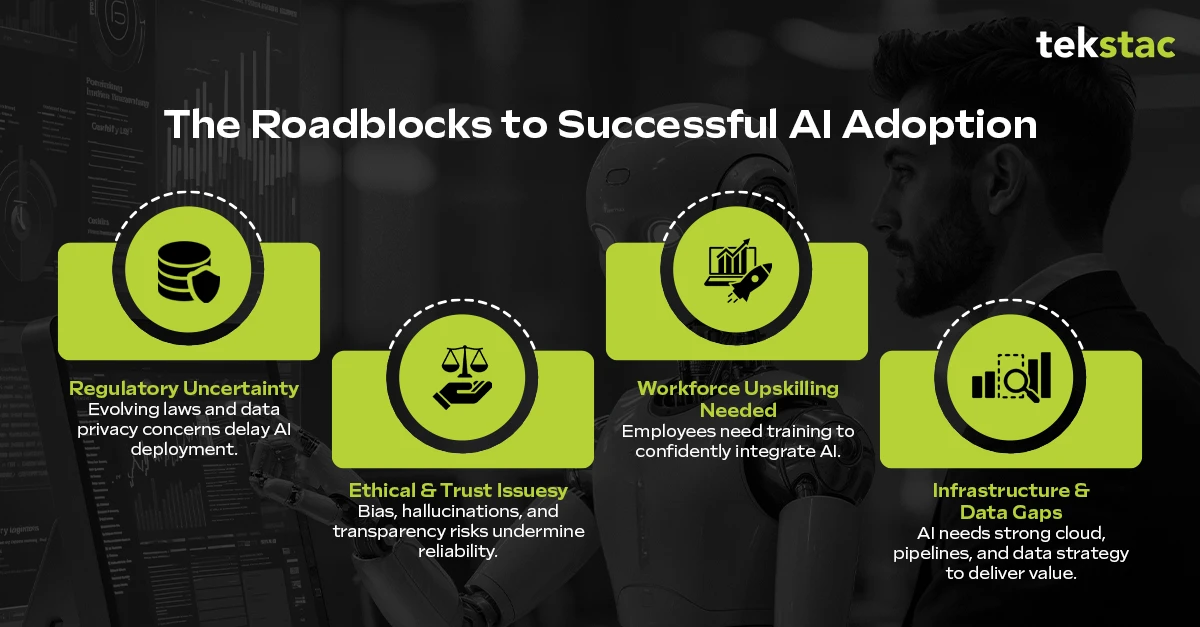
The legal landscape surrounding AI is still evolving, and organizations must navigate complex regulations to ensure compliance. Many business leaders hesitate to fully deploy GenAI due to concerns about data privacy, intellectual property rights, and ethical AI usage. Governments worldwide are working on frameworks to regulate AI, but the uncertainty slows down enterprise adoption.
AI-generated content, while impressive, is not infallible. Issues such as bias, hallucinations (incorrect AI outputs), and lack of transparency pose significant risks. Organizations must invest in robust risk management frameworks and governance models to ensure AI reliability and maintain stakeholder trust.
While many employees have access to AI tools, a significant percentage are not yet leveraging them effectively. Integrating AI into business workflows requires comprehensive training programs to upskill employees, ensuring they can utilize AI tools to their full potential rather than viewing them as threats to job security.
A strong technical foundation is critical for successful AI deployment. Enterprises need scalable cloud solutions, high-quality data pipelines, and seamless integration between AI models and existing business applications. Without a well-structured data strategy, even the most advanced AI models will struggle to deliver meaningful value.
Enterprises in North America, Europe, and Asia-Pacific are leading the Generative AI Revolution, with cross-industry adoption accelerating in manufacturing, BFSI, and healthcare.
While adoption varies by industry and function, certain areas are experiencing rapid and substantial benefits from GenAI:
AI-driven automation is transforming software development, threat detection, and system monitoring. Security teams are leveraging GenAI to analyze vast amounts of threat data, proactively preventing cyberattacks and reducing response times.
Predictive analytics powered by AI is helping companies optimize inventory, reduce waste, and improve supply chain resilience. AI-generated insights are enabling real-time decision-making, minimizing operational disruptions.
Personalized content creation, AI chatbots, and automated customer interactions are enhancing engagement and efficiency. GenAI’s ability to analyze consumer behavior and generate targeted marketing strategies is revolutionizing brand positioning.
From accelerating drug discovery to improving patient diagnostics, GenAI is making significant contributions to healthcare. AI models are analyzing vast datasets to uncover patterns, assisting in clinical trials, and even predicting disease outbreaks.
Deloitte’s findings reveal that while ROI on GenAI investments is generally positive, some areas outperform expectations while others lag.
The report also highlights that 76% of organizations are willing to wait at least a year before expecting substantial financial returns, reflecting confidence in AI’s long-term potential.
As businesses move beyond GenAI’s initial capabilities, the next frontier is Agentic AI autonomous AI systems that can execute tasks, make decisions, and coordinate workflows with minimal human intervention.
These AI agents are poised to transform:
Despite their promise, AI agents come with new challenges, including ethical considerations, data security risks, and the need for even more sophisticated governance structures. Organizations must lay the groundwork now by investing in scalable AI frameworks and developing responsible AI policies.
Deloitte’s report provides strategic recommendations for organizations looking to maximize GenAI’s potential:
CxOs must shift from being AI cheerleaders to AI champions, actively guiding their organizations through the transformation process. Senior leadership must bridge the gap between technical and business teams to ensure AI investments align with strategic goals.
Rather than chasing multiple AI experiments, organizations should focus on high-impact use cases that drive measurable value. Layering AI onto existing workflows, rather than overhauling entire processes, can accelerate adoption and results.
GenAI is not a replacement for human workers but a tool to augment their capabilities. Companies must invest in training programs to build AI literacy, foster employee trust, and drive innovation from within.
Regulatory compliance, data security, and ethical AI deployment should be central to any GenAI strategy. Establishing clear guidelines for responsible AI use will be critical as AI continues to evolve.
The businesses that succeed in the AI era will not be those that simply deploy the latest tools, but those that integrate AI into their long-term vision, driving innovation, enhancing efficiency, and redefining what’s possible in the digital age. The future of AI is unfolding now, and the time to act is today.
To understand how the broader AI Revolution is driving creativity, innovation, and new business models beyond automation, explore our in-depth analysis in The AI Revolution: What’s Next for Businesses in 2026.
1. How is Generative AI transforming business operations?
Generative AI is automating complex workflows, accelerating decision-making, and personalizing customer experiences. It helps enterprises cut costs, enhance productivity, and innovate faster by generating insights, content, and simulations at scale.
2. Which industries are leading the Generative AI Revolution?
Technology, BFSI, healthcare, and manufacturing are at the forefront of the Generative AI Revolution. These sectors use AI to optimize supply chains, strengthen cybersecurity, improve diagnostics, and deliver intelligent digital experiences.
3. What challenges do enterprises face in AI adoption?
Key challenges include regulatory uncertainty, data privacy concerns, ethical governance, and workforce readiness. Many organizations still lack the infrastructure and upskilling needed to scale AI responsibly across business functions.
4. Who will survive the AI revolution?
Enterprises that align AI strategy with business goals, invest in workforce upskilling, and adopt responsible governance will lead the next phase. Success depends on combining innovation with ethical, data-driven execution.
A course building platform is software that helps organizations create, manage, deliver, and track digital learning programs. It includes content authoring, assessments, learner analytics, certifications, and integrations.
Online learning is booming, with the global e-learning market projected to reach $457.8 billion by 2026 (Statista). Businesses, educators, and entrepreneurs are leveraging digital learning to expand their reach, enhance engagement, and boost revenue.
The right platform can enhance learner engagement, streamline content delivery, and boost revenue. However, with so many options available, choosing the right Course Building Platform is critical.
| Feature | Traditional LMS | Course Building Platform |
|---|---|---|
| Course Creation | Basic content upload | Advanced drag-and-drop builder |
| Assessments | Limited | Built-in quizzes, coding tests, proctoring |
| AI Personalization | Rare | Adaptive learning & recommendations |
| Analytics | Basic reports | Deep learner analytics & skill insights |
| Engagement | Static | Gamification, labs, discussions |
| Enterprise Scalability | Medium | High |
Tekstac, a leading AI-powered upskilling solution, offers a comprehensive Course Building Platform tailored to modern learning needs. Before making an investment, ask yourself these five key questions to ensure you select the best platform for your needs.
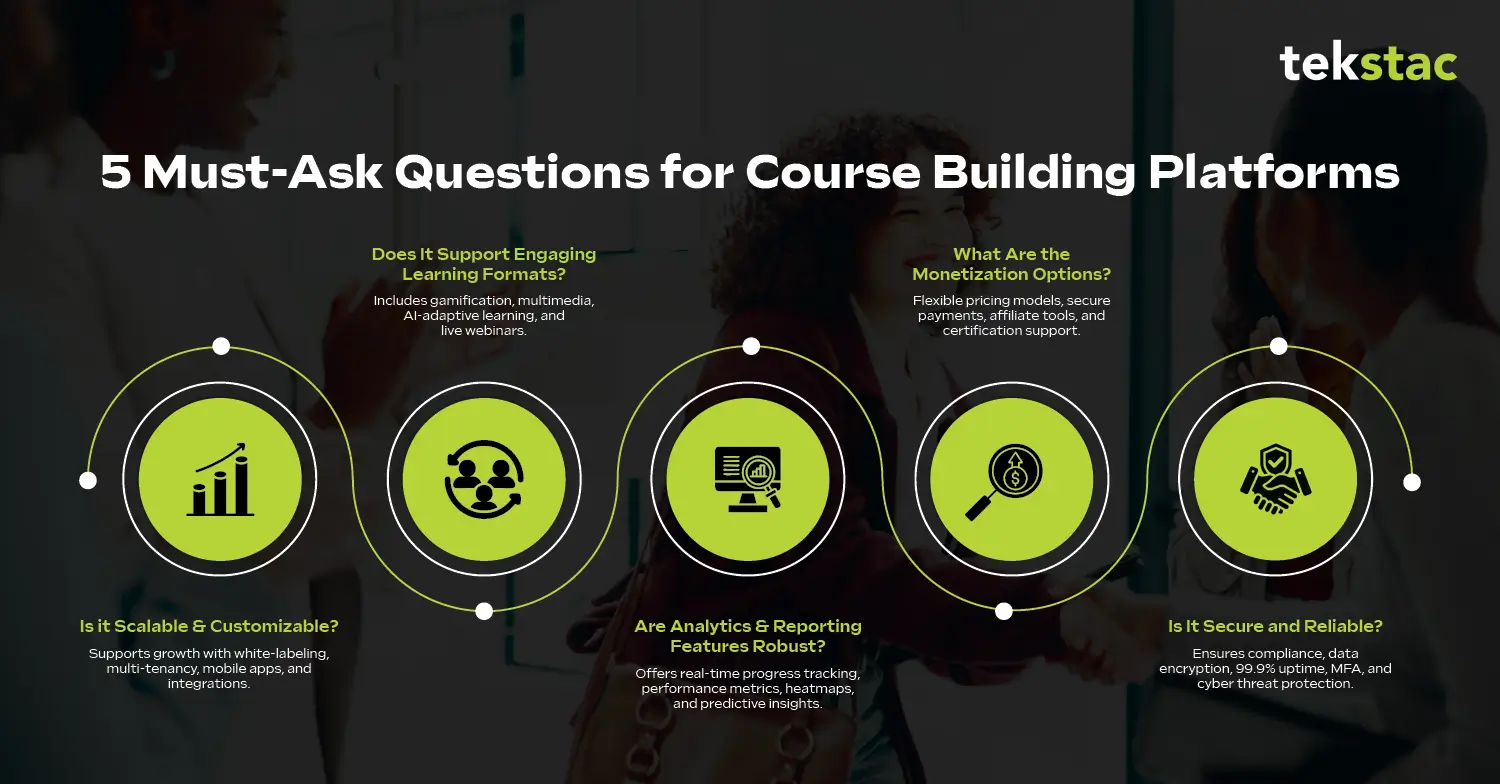
As your business or educational program grows, your Course Building Platform should scale with you. A rigid platform can quickly become a bottleneck, limiting your ability to expand course offerings, accommodate a growing learner base, or integrate new technologies. To ensure long-term success, evaluate the following:
Customization Options
The ability to tailor branding, themes, course layouts, and user interfaces ensures your platform aligns with your brand identity and learning goals. Look for platforms that allow advanced customization, such as white-labeling, custom domain usage, and personalized dashboards for learners.
Scalability
A good platform should handle an increasing number of learners and courses without compromising performance. Check if the platform offers cloud-based infrastructure, load balancing, and automatic scaling to support growth.
Integration Capabilities
Seamless integration with Learning Management Systems (LMSs), Customer Relationship Management (CRM) software, and marketing automation tools can streamline operations. Platforms that support API access and integrations with tools like Zapier, HubSpot, and Salesforce offer added flexibility.
Multi-Tenancy Support
If you plan to offer courses to different groups, such as corporate clients, educational institutions, or internal teams, multi-tenancy support allows you to manage multiple learning environments under one system.
Mobile and Multi-Device Accessibility
With an increasing number of learners accessing content on mobile devices, a scalable platform should provide a responsive design and dedicated mobile applications.
A scalable platform allows for continuous growth without switching systems, which can be costly and disruptive. Future-proofing your investment ensures that your platform remains relevant and efficient as your needs evolve.
“A study found that 64% of organizations prioritize scalability when selecting an LMS or Course Building Platform”.
Different learners engage with content in various ways, making diverse learning formats essential. The effectiveness of a Course Building Platform depends on how well it supports different learning styles. Look for a platform that includes:
Multimedia Content
The ability to incorporate video, audio, interactive quizzes, and infographics is crucial for engagement. Studies show that video-based learning increases retention rates by 25-60% compared to text-based content (Forrester Research).
Gamification Features
Incorporating elements such as badges, point systems, and leaderboards can significantly boost learner motivation and drive interaction. According to a recent report, such gamified strategies have the potential to elevate learner engagement by as much as 50%.
Community Engagement
Built-in discussion forums, live Q&As, and peer collaboration features create a sense of community and encourage knowledge sharing.
AI-Powered Adaptive Learning
AI-driven platforms personalize course content based on individual learner progress, improving retention and learning outcomes.
Live Learning & Webinars
The ability to conduct live classes or one-on-one sessions via Zoom or Microsoft Teams integration adds flexibility and real-time interaction.
Engagement tools enhance the learning experience, ensuring students stay motivated and complete their courses successfully.
“A report by the World Economic Forum estimates that 44% of workers’ core skills will change within five years, increasing the demand for adaptive and engaging course building platforms”.
Data-driven insights are key to improving course effectiveness and learner outcomes. A well-designed Course Building Platform should provide:
Learner Progress Tracking
Monitor course completion rates, quiz scores, and time spent on modules to identify engagement patterns and areas for improvement. Detailed tracking helps instructors intervene early if learners struggle.
Performance Metrics
Analyze learner performance through assessment scores, feedback surveys, and participation rates to refine content. Performance analytics highlight strengths and weaknesses, enabling content adjustments for better comprehension.
Custom Reports
Generate in-depth insights based on learner behavior, engagement, and assessment results, enabling data-driven decision-making. Customizable dashboards allow educators to focus on key performance indicators (KPIs) specific to their goals.
AI-Based Recommendations
Some platforms use AI to suggest content improvements and personalized learning paths based on user data, improving retention and engagement. TekBuddy, the AI learning companion from Tekstac, intelligently monitors your learning journey, identifies skill gaps and strengths, and delivers real-time support to enhance both speed and quality of learning.
Heatmaps and Engagement Analytics
Track which parts of a course are most engaging and where learners tend to drop off, helping instructors optimize course flow. Heatmaps visually highlight areas of high and low interaction within a course module.
Predictive Analytics
Advanced platforms leverage predictive analytics to foresee learner challenges, recommend intervention strategies, and enhance user experience. Predictive insights help educators proactively address learning gaps and provide targeted support.
Having access to comprehensive analytics enables course creators to refine their offerings and maximize learner success.
“Research by Training Industry states that organizations using advanced learning analytics improve employee performance by 23%”.
Choosing a Course Building Platform with diverse monetization features is essential. Consider the following:
Flexible Pricing Models
A robust upskilling platform should offer multiple pricing structures, including corporate subscriptions, enterprise licensing, and team-based enrollments. This allows tech organizations to choose a model that aligns with their budget and training goals, ensuring cost-effectiveness while maximizing learner participation.
Secure Payment Gateway Integration
The platform should support multiple secure payment gateways, such as PayPal, Stripe, and Razorpay, ensuring seamless transactions for enterprises. It should also enable recurring payments, invoicing, and customized billing solutions to support large-scale IT upskilling programs.
Affiliate and Marketing Support
Built-in referral programs, discount coupons, and promotional tools can help increase enrollments. Tech skilling providers can leverage these features to attract more learners and enhance brand reach through targeted marketing campaigns.
Certification Programs
Industry-recognized certifications validate Tech professionals’ skills and enhance credibility. These certifications should be customizable to align with enterprise training needs and recognized by hiring managers and recruiters.
Freemium & Trial Features
Offering free trials allows learners to explore courses before committing. This feature improves conversion rates by giving IT professionals a firsthand experience of the learning platform’s value.
According to Grand View Research, the global e-learning market revenue is expected to grow at a CAGR of 19.0% from 2025 to 2030 making monetization features crucial for long-term success.
Data security and reliability should be top priorities when selecting an upskilling platform for tech professionals and programmers. A secure platform ensures:
Data Encryption & Compliance
Adherence to global security standards, including GDPR, SOC 2, and ISO 27001, ensuring data privacy and regulatory compliance.
Regular Backups & Recovery
Automated backups conducted frequently reduce the risk of data loss and ensure business continuity for IT organizations.
99.9% Uptime Guarantee
A cloud-based infrastructure ensures minimal downtime, providing uninterrupted access to training programs.
Role-Based Access & MFA
To protect sensitive data and prevent unauthorized access, platforms implement multi-factor authentication (MFA) and role-based access controls.
Fraud Protection & Secure Payments
Advanced fraud detection mechanisms and encrypted payment processing prevent unauthorized transactions, ensuring financial security.
DDoS & Cyber Threat Protection
Integration of intrusion detection systems, advanced firewalls, and real-time threat monitoring safeguards against cyberattacks and unauthorized access.
“According to a report by Cybersecurity Ventures, the Global cybersecurity spending from 2021-2025 will exceed $1.75 trillion cumulatively”
Investing in the right upskilling platform is a strategic decision that impacts workforce capabilities, organizational efficiency, and business growth. Tekstac stands out as a cutting-edge platform that offers:
Whether you’re a Tech manager, corporate trainer, or learning and development leader, selecting the right platform ensures long-term success in building a highly skilled workforce.
See how Tekstac helps enterprises build scalable, AI-powered learning programs with assessments, labs, and skill analytics. Request a personalized demo now!
1. How is a course building platform different from an LMS?
A course building platform focuses on creating interactive learning experiences with multimedia, assessments, and learner engagement tools, while a traditional LMS mainly handles learner administration, tracking, and reporting. Modern enterprise platforms often combine both workforce training and skill development.
2. What features should a course building platform have?
A strong course building platform should include course authoring tools, assessments, gamification, analytics, certifications, AI-powered personalization, and integrations with business systems. These features help organizations improve learner engagement, measure skill progress, and deliver scalable training programs effectively.
3. Does a course building platform include assessments and certifications?
Most advanced course building platforms include quizzes, coding assessments, proctoring, and certification tools to measure learner progress and validate skills.
4. Which is the best course building platform for enterprises?
The best course building platform for enterprises depends on factors like scalability, security, analytics, AI capabilities, and workforce skill mapping. Platforms like Tekstac are designed to support employee upskilling, assessments, hands-on labs, and role-based learning at scale.
Skilling in AI is no longer just a learning initiative; it’s a business strategy. But the real differentiator won’t be who deploys AI first, but who learns to work with it best.
Yet as algorithms grow smarter, one truth remains constant: technology’s value depends on the people who wield it.
This blog explores how AI advantage takes shape, and how organizations are turning AI into an invisible yet powerful force for performance, driven not by code, but by capability.
In banking and financial services, we often talk about the next wave of AI cutting-edge models, predictive analytics, conversational interfaces. Yet, the most consequential AI applications aren’t the flashy ones. They’re the invisible capabilities woven into the daily flow of risk management, compliance checks, and customer engagement decisions. These capabilities don’t call attention to themselves, but they quietly outmanoeuvre the competition by catching small signals of change and acting before anyone else.
Beneath the surface of this transformation lies a critical truth: no algorithm can deliver its full value unless people know how to use it. Tools can be copied or bought off the shelf, but a well-trained workforce—one that intuitively applies AI-driven insights at the right moment—is nearly impossible to replicate. This is where the real battle is being fought.
Take fraud detection as an example. Many banks invest in sophisticated models to flag suspicious transactions. But the difference between an automated alert and a decisive, pre-emptive intervention often comes down to human expertise. A fraud analyst who understands the nuances of emerging schemes can override or refine an AI recommendation, catching anomalies that a generic algorithm might miss. That analyst isn’t simply following a script; they’re applying domain knowledge and pattern recognition developed over time.
The same holds true for risk officers who rely on predictive analytics or AI-driven early warning systems or relationship managers who use AI cues to personalize outreach. The banks that stand apart are those whose employees can interpret these cues and turn them into action—before the competition even knows an opportunity or threat exists.
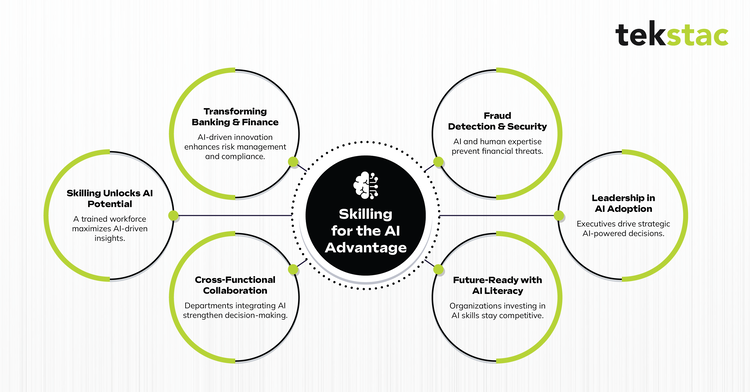
To build this level of skill, organizations need more than classroom training on “AI 101.” They require a cultural shift where continuous learning is embedded into everyone’s job. Instead of seeing AI as a black box, people need to understand how AI adoption takes place, how models are developed, and where they might fail.
A Deloitte survey found that 67% of high-performing companies cite a culture of continuous learning as the foundation of their AI success.
That means creating environments where it’s acceptable to question AI outputs, run parallel checks, and propose alternative theories.
One way to make this happen is to encourage cross-functional rotations: let a credit underwriter spend time with the data science team, or a compliance officer rotate through the fraud unit. When employees see how each part of the organization uses AI, they develop a richer mental model of both the tools and the risks involved. Over time, this cross-pollination makes room for human-AI collaboration that breaks down silos and unearths opportunities no single department could spot alone.
Mentorship programs can further accelerate this process. A veteran risk analyst who has navigated multiple market cycles can coach younger colleagues on what subtle signals to watch for in AI-driven dashboards. That institutional wisdom, paired with cutting-edge analytics, becomes a powerful edge that can’t be copied by a competitor simply purchasing the same software.
At the leadership level, executives play a pivotal role in signaling the importance of AI governance and human oversight in AI decisions. Instead of treating models as the final word, they should champion the idea that AI augments, rather than replaces, professional judgment. When a compliance manager or relationship banker sees leaders regularly engage with AI outputs—asking tough questions, challenging assumptions, interpreting findings—they learn that curiosity and rigorous thinking aren’t just tolerated but actively encouraged.
Over time, these behaviors create a workforce that doesn’t passively accept predictions but proactively looks for gaps in the data, biases in the model, or new patterns of fraud. The result is an organization whose AI capabilities remain largely invisible to the outside world—there’s no flashy rollout, but the performance gains are undeniable.
Customers may notice fewer hiccups and a smoother experience, but they won’t see the invisible engine that keeps fraud at bay, compliance strong, and offerings finely tuned to their needs. Rivals, meanwhile, will struggle to pin down what makes this bank or insurer so consistently agile.
In this new era, skilling is the linchpin of AI success—and the true source of AI advantage. Infact surprisingly. By 2027, 80% of the AI workforce will need reskilling; because let’s face it, coding skills alone won’t cut it anymore.
Traditional training programs and vendor-led implementations aren’t enough. True competitive advantage demands a workforce that thinks and reacts in concert with AI, forming a quietly unstoppable partnership. Whether it’s thwarting fraud attacks before they surface or reading subtle market cues that others overlook, the organizations that invest seriously in upskilling and cultural transformation will outpace those that treat AI as a technology project alone.
And that is the essence of the unseen war: the real battle lines are drawn around the workforce. As soon as you embed AI literacy and a questioning mindset into every level of your organization, you’ll find yourself not just meeting the market’s demands but predicting them—often before anyone else even knows those demands exist.
1. What are the advantages of AI?
AI offers a range of advantages that go beyond automation or cost savings. At its core, AI enhances how organizations detect change, make decisions, and deliver value.
2. How does workforce skilling enhance AI advantage?
Workforce skilling is what turns AI from a tool into a true differentiator. Technology can process data and make predictions—but it’s people who give those insights, meaning and momentum.
3. What is the golden rule of gaining AI advantage?
The golden rule of gaining AI advantage is simple: invest in people as much as in technology.
4. Can AI replace humans?
AI can replicate certain tasks—but it can’t replace human judgment, creativity, or context.
It’s another hectic Monday morning. Your inbox is overflowing with training requests, three departments are waiting for their learning needs analysis, and you’ve got a stack of course completion data that needs to be analyzed quickly.
Meanwhile, your team is already stretched thin trying to create personalized learning paths for 2000 employees.
Now imagine handling all of this while you’re focusing on what matters most – strategizing your organization’s learning journey. This is the reality AI agents are bringing to HR right now.
As corporate practices evolve, faster and smarter responses are no longer optional—they’re essential. HR can’t afford to spend valuable hours on repetitive, manual tasks.
This is where AI agents step in: intelligent systems designed to automate, adapt, and support HR functions in real time.
AI agents are intelligent systems that perceive their environment, process information, and take actions to achieve specific goals. They operate as per set rules, adaptive learning, or a combination of both, allowing them to handle information and make judgments to meet goals.
You can think of AI agents like computer capable staff that assist you and work autonomously. They not only do as they’re told; they make decisions, make things more efficient, and get better at getting things done as time passes.
AI agents can appear high-tech, but they are basically four straightforward components: sensors, processors, actuators, and memory. They are the ears and eyes, the brain, the hands, and the long-term memory of the AI.
Understanding these components will help grasp how AI agents respond to their environment, process information, take action, and learn over time. This is especially helpful for those planning to design AI systems, use them in businesses, or simply curious.
Let’s walk through each of them in action, with some examples:
Before AI can make decisions, it needs information. Sensors are the ears and eyes of the AI agent, sensing information from every potential source.
Sensors, for example, track completion rate, quiz score, lesson time, and sentiment on feedback in L&D. Whenever learners rewind or miss one lesson segment over and over, the AI can understand that it could be the area where learning can occur, a likely knowledge gap in their understanding.
Data is then inputted into the processor of the AI agent once gathered. The processor translates raw HR data into actionable insights as it has the ability to read between the lines, predict, and learn from experience.
For example, when it gathers learning data, the AI translates it to provide recommendations according to individual requirements. If a person is weak in one skill area but strong in another, the system offers specialized learning paths rather than standard training.
Sensors are fed data, processors weigh it, and actuators act. That is how an AI agent gains knowledge and makes it useful. While simple to say, modern AI actuators are systems that are capable of performing even the most complex, sequence-based tasks but, simultaneously, react to shifting needs or circumstances.
In L&D settings, after the AI has suggested a learning path, it performs the necessary action steps: enrolling employees in relevant courses, reserving live sessions, reminding, and adjusting content presentation formats (videos, quizzes, or interactive scenarios).
Unlike traditional computing memory storage systems, which merely saves and retrieves data, AI memory and learning is acquired from experience over a period of time. It keeps making it wiser in realizing the learners’ progress, interests, and needs in the future. Think of an AI system that only grows valuable over time!
In total, the AI holds what is optimal for every learner. When an employee utilizes microlearning as opposed to lengthy content, subsequent training recommendations favor bite-sized modules.
AI in HR is no longer limited to chatbots answering FAQs. AI agents are now leading the way ahead as actual team members.
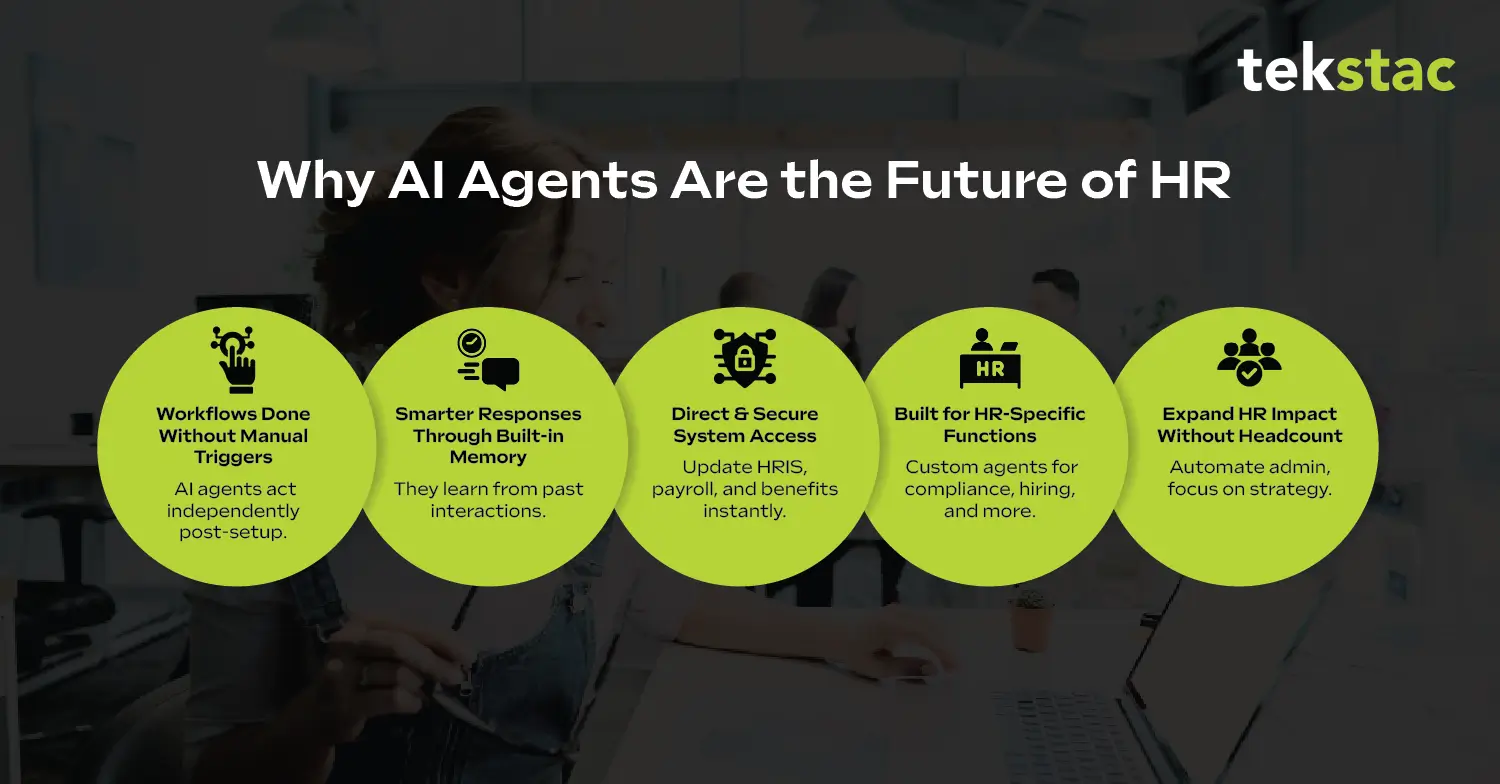
Below are the major benefits of AI agents in HR:
Nearly every AI solution asks you to start with the first input. You ask, and they answer. You ask them to do something, and they produce. But AI agents don’t need you to take the first step. With up-front setup, they act on their own, simplifying multi-step processes that need HR assistance. Unconsciously, without your help, they automate end-to-end workflows, like candidate filtering or benefits enrollment management.
Same old questions by staff; same old policies being re-worded over and over again in HR offices are possibly the most blatant HR headache. AI systems learn in “chunking and chaining” approach, where they break down conversation, remember important information, and build contextually over time.
For instance, a typical AI will provide a one-size-fits-all policy response when an employee has only a single benefits package. An AI agent memorizes the exception from past experience and adjusts its response accordingly. Such memory is necessary in HR, where personalization is necessary due to the existence of exceptions.
Most AI solutions operate outside of your HR systems. They can recommend what to do but cannot make it occur within your systems themselves. AI agents have entitlement-based access, pulling information and updating HRIS, payroll, and benefits platforms securely.
For example, whenever the employees modify the tax data, AI agents automatically update, verify compliance, and authenticate change. This significantly differs in eliminating bottlenecks and speeding up the administrative process.
AI general tools are designed to be general. They can handle many questions but may not necessarily be the best for handling HR-specific nuances. You can also customize AI agents for specific HR functions like recruitment, compensation, compliance, or employee relations.
For instance, you can use an AI compliance-specialized agent entirely to monitor labor legislation, detect outdated company policies and prepare compliance reports before audits.
Scaling HR has traditionally meant hiring more people. Instead of hiring headcount, companies can employ AI agents to automate routine tasks so that HR can focus on people, strategy, and employee engagement instead. For example, an HRBP with AI agents for onboardings, benefits, and payroll reminders can handle twice the number of employees efficiently.
Did you know?
HR teams that integrate AI-driven automation save an average of 14 hours per week on repetitive tasks like payroll, benefits, and onboarding. (Source: Deloitte Human Capital Trends 2024).
AI is transforming HR from automating routine tasks to data-driven decision-making. Not all that claims to be a system, however, is equally acceptable. To use AI agents correctly, you need to know the different types of AI agents and how they operate.
They are the most basic AI systems, completely reliant on pre-programmed “if-then” rules. They do not learn or get better as they gain experience; they respond to given input.
Use Cases for HR:
These are somewhat intelligent agents. They act and possess a critical memory of experiences so that they can be context-sensitive and make improved decisions.
Use Cases for HR:
These are goal-based AI agents. Instead of giving an answer, they take many possible actions and choose the best one to reach a goal.
Use Cases for HR
And now, AI becomes smart. Learning agents learn by observing patterns, improving their actions, and making improved decisions with each new input.
Use Cases for HR:
Such agents work towards a goal and consider multiple factors to optimize decisions, weighing trade-offs for the best possible outcome.
HR Use Case Applications:
Organizations that started using AI to analyze their talent saw a fantastic improvement in employee retention – a 26% increase in just the first year. This shows how powerful AI can be in helping businesses understand and hold onto their valuable employees, according to PwC’s Future of Work 2024 report.
What you require is the right AI agent for HR based on what you wish to do. If the goal is automating mundane work like responses to the most frequent questions asked or leaves approval, then reflex agents are your choice. Model-based and goal-based agents are complex but if the AI must learn from experience so that it improves in making decisions, they are the way to go.
For HR activities that require continuous learning and adjustment – such as improving staff morale or eliminating discrimination during recruitment – learning agents work well. When HR is required to solve more than one issue simultaneously, utility-based agents are able to offer efficient data-driven, strategic guidance.
AI agents can automate repetitive HR tasks, improve decision-making, and personalize employee learning. But the right AI is only effective when paired with the right learning ecosystem. That’s where Tekstac’s 500+ learning paths help HR leaders build future-ready talent. Whether new graduate talent is being hired or skilled workers are being equipped with next-generation tech capabilities, an AI-first workforce starts with the right learning strategy.
1. What are AI agents in HR?
AI agents are intelligent systems that automate HR tasks, analyze data, and personalize employee experiences, helping HR teams save time and improve workforce outcomes.
2. How do AI agents benefit HR leaders?
They reduce administrative workload, provide data-driven insights, ensure compliance, and personalize training—allowing HR leaders to focus on strategy, employee engagement, and long-term workforce planning.
3. How powerful are AI agents?
AI agents are powerful because they act autonomously, learn from experience, optimize decisions, and manage complex HR tasks like recruitment, compliance, and learning—scaling workforce support beyond human capacity.
4. What’s the difference between AI and AI agents?
AI is the broader technology enabling machines to mimic intelligence, while AI agents are specialized systems that sense, decide, and act within environments to achieve specific HR or business goals.
AI is not straightforwardly stealing jobs — it is eliminating specific task categories while simultaneously creating new roles that did not exist five years ago. The IMF estimates AI could affect 40% of global jobs globally, with advanced economies seeing up to 60% exposure. But exposure does not mean elimination: most affected roles are being transformed, not deleted. Understanding which jobs are at risk, which are AI-proof, and how to adapt is what this guide covers.
From IT organizations to healthcare, finance, manufacturing, and creative industries, AI is reshaping work and the workforce. Understanding its role and preparing for an AI-driven future is crucial for employees across various sectors.
AI is not just another technology innovation- it’s a game-changer that extends beyond routine task execution. Unlike traditional automation, which focuses on rule-based and repetitive processes, AI introduces cognitive capabilities such as learning, decision-making, and problem-solving. This shift raises concerns about AI replacing human workers, particularly in industries like software development, customer service, data management, and much more.
The International Monetary Fund (IMF) reports that AI could affect 40% of global jobs, with advanced economies seeing up to 60% exposure—through both automation and job transformation.
A study by McKinsey Global Institute estimates that nearly 30% of jobs worldwide could be automated by 2030.
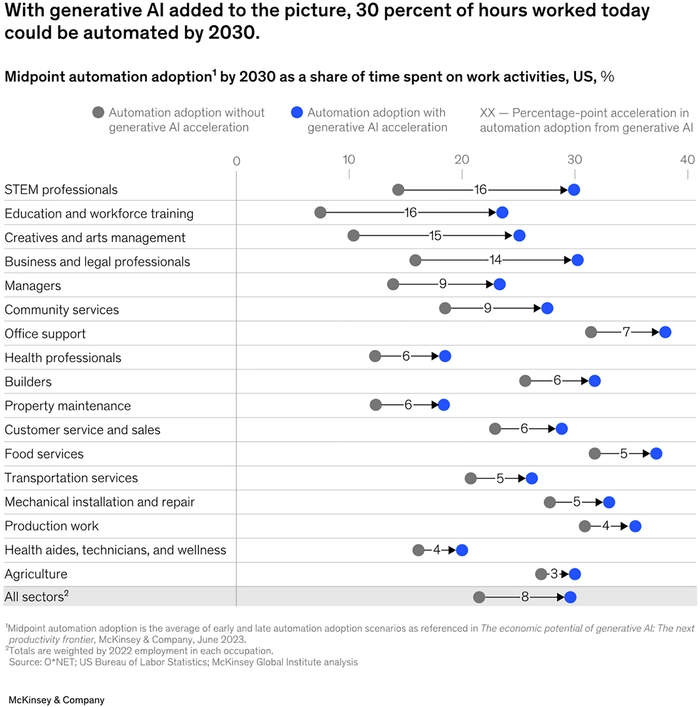
Source: McKinsey & Company
Roles such as manual testers in IT, basic customer service representatives, data entry clerks, and factory line workers are at high risk. AI-powered platforms can now generate code, perform automated testing, analyze customer inquiries, and even handle supply chain logistics faster than human workers.
However, history has shown that technological advancements often eliminate some jobs while creating new ones. The rise of e-commerce disrupted traditional retail but created new opportunities in logistics, digital marketing, and online customer experience. Similarly, AI is expected to generate demand for roles in AI ethics, machine learning operations (MLOps), AI-driven cybersecurity, and AI- product management.
Instead of simply replacing workers, AI is evolving as a tool that enhances human productivity- it actively redefines how industries operate by introducing intelligence, adaptability, and decision-making capabilities. Unlike traditional automation, which primarily focuses on efficiency, AI introduces adaptive learning, predictive intelligence, and cognitive reasoning, enabling businesses to operate at an entirely new level.
AI is transforming industries by combining speed, intelligence, and adaptability. Here are key examples of human-AI collaboration in action:
These examples highlight that AI is not inherently a threat but a complement to human expertise.
This shift highlights the importance of integrating AI into workforce strategies. Organizations that act proactively; building structured upskilling programs before displacement occurs — consistently outperform reactive peers on retention and productivity. See how leading enterprises are structuring this with our AI in HR strategy and transformation guide.
The key lies in reskilling and adapting to an AI-first world with humans in the loop. Professionals who embrace AI and learn how to work alongside it will find new opportunities.
While AI excels at automating structured processes and is increasingly capable of mimicking critical thinking and creativity, it still struggles with deeper cognitive reasoning, emotional intelligence, and human intuition. Some roles that AI cannot easily replace include:
By focusing on these uniquely human qualities, professionals across industries can position themselves in roles that AI cannot easily replace.
As AI continues to evolve, professionals must develop new skills to remain relevant in the job market. Reskilling and upskilling will be essential for those seeking to transition into AI-driven roles. Some ways professionals and organizations can prepare include:
Companies must also invest in upskilling programs, AI training, and certification courses to help employees adapt to these new demands.
Although AI will undoubtedly change the job landscape, it will also create new opportunities. Emerging roles that are growing due to AI advancements include:
As AI continues to advance, professionals who stay ahead of these trends will secure their place in the evolving workforce.
AI is not here to steal jobs but to transform them. Human-AI collaboration offers a promising future where technology enhances efficiency while humans continue to provide creativity, strategic thinking, and leadership. The key to success lies in adaptation and lifelong learning, ensuring that we harness AI’s potential while preserving the irreplaceable qualities of human workers.
AI is reshaping industries by redefining job roles and skill requirements. Those who embrace AI and develop skills that complement technological advancements will thrive in the evolving job market. Instead of fearing AI, professionals across industries should focus on leveraging its capabilities to build a more innovative, efficient, and resilient future in a technology-driven world.
Ready to future-proof your workforce? Explore how Tekstac’s hands-on labs, real-world assessments, and AI-driven learning pathways help teams build in-demand skills and stay ahead of disruption. Book a demo today and see how your organization can turn AI transformation into a competitive advantage. 🚀
1. Is AI going to steal my job?
AI is not stealing jobs—it is transforming them. Most roles are being redesigned as AI automates repetitive tasks, allowing employees to focus on problem-solving, creativity, and decision-making.
The real risk is not AI itself, but the lack of upskilling to work alongside AI tools.
2. How are AI technologies impacting job availability in Indian IT sector?
AI is reshaping the Indian IT sector by reducing demand for routine coding and support tasks while increasing demand for advanced skills like AI, data science, and cloud computing.
Entry-level roles are evolving, and professionals must adapt to AI-assisted workflows and higher-skill responsibilities.
3. What are the most vulnerable jobs to AI automation in India?
Jobs that involve repetitive and rule-based tasks are most vulnerable to AI automation.
These include:
4. List of jobs expected to grow with AI advancement?
AI is driving growth in high-skill and hybrid roles that combine technical and human capabilities.
Examples include:
According to SHRM 76% of HR leaders agree that they risk falling behind in the next two years without AI.
As Generative AI (GenAI) and workforce digitization sweep across industries, HR transformation has become a critical priority. From digital HR strategy to next-gen workforce management, these technologies are reshaping traditional HR functions—adding both complexity and opportunity.
For organizations ready to adapt, the benefits of AI and automation in HR transformation are boundless: faster hiring, smarter decisions, and personalized employee growth. But for those who resist, the gap will only widen, making it essential to embrace these innovations today.
This article explores 6 HR transformation strategies powered by AI and automation, highlighting how organizations can modernize HR operations, improve employee experiences, and build a future-ready workforce.
HR transformation is the process of modernizing HR strategies, processes, technology, and workforce practices to better support business goals. It can include AI-powered automation, digital HR systems, workforce analytics, skills-based talent management, and personalized employee development.
It matters because modern HR teams need to respond faster to changing workforce needs, improve employee experiences, close skills gaps, and make data-driven decisions. By combining AI, automation, and human expertise, organizations can build more agile and future-ready HR functions.
According to SHRM, about 1 in 4 organizations are currently using AI to support HR tasks. Nearly half of HR professionals said using AI to support HR has become a priority over the last year.
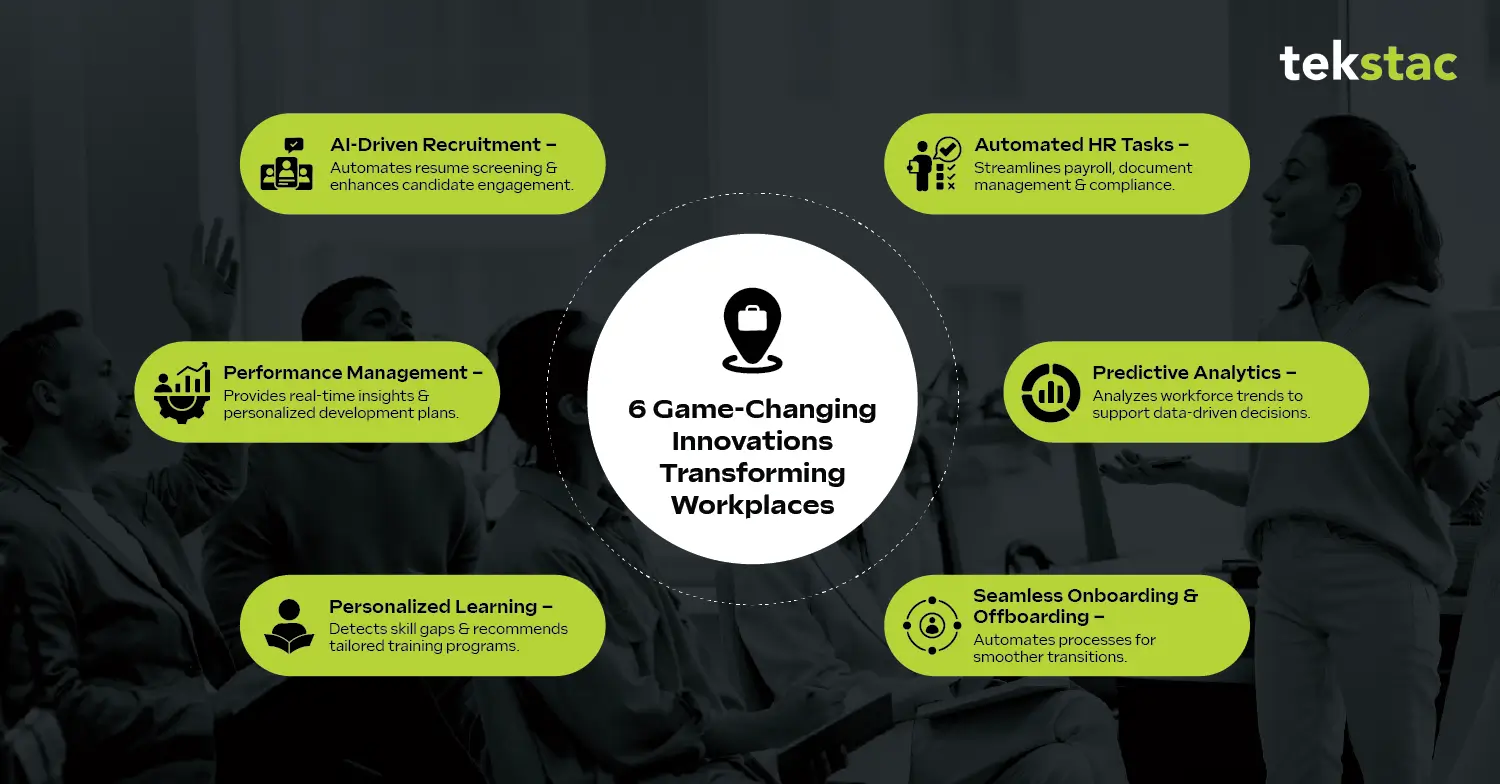
Here are six ways AI is transforming HR:
Recruitment comes with inefficiencies for HR as they must review countless resumes while keeping candidates engaged throughout the hiring process. AI-powered applicant tracking systems (ATS) and talent intelligence platforms can now handle resume screening, ensuring that only the right fit reaches HR’s desk. This form of AI-powered talent management accelerates workforce planning and supports a digital-first HR transformation strategy.
Predictive analytics identify top talent faster, while AI chatbots maintain communication with candidates, keeping them engaged. Generative AI platforms also create personalized job descriptions and postings, tailored to each role.
Traditional performance reviews and management are prone to bias and subjectivity, sometimes failing to reflect an employee’s work. AI now brings objectivity by analyzing employee performance in real-time. Machine learning algorithms identify performance patterns and suggest development plans for each employee. Repetitive tasks such as data collection are also automated, ensuring managers focus on employee career growth and meaningful conversations.
With the rise of AI, HR can now customize learning journeys and track individual performance metrics to recommend training modules or upskilling initiatives. Any skills gaps are detected to provide targeted growth plans, ensuring employees grow in ways that benefit themselves and the organization. In the near future, AI has the potential to become a personal mentor for employees, providing invaluable career guidance.
HR teams are burdened by repetitive tasks like payroll processing, data management, and document management, leaving little time to interact with employees. AI-driven solutions automate these processes while being highly accurate and saving countless hours. For instance, payroll systems calculate and disburse salaries accurately, while document workflows ensure compliance without human intervention.
AI can process and analyze data via predictive analytics, even presenting trends in areas like employee satisfaction, turnover rates, and diversity metrics. This empowers HR to anticipate challenges before they become devastating, and with seamless reporting features, HR can inform leaders to make data-driven decisions on workforce planning and management, thereby driving significant organizational change.
Onboarding can feel like finding your way through a maze of forms, policies, and processes, while offboarding has its challenges in compliance and security. AI simplifies both.
AI tailors workflows for each new hire during onboarding, automates benefits enrollment, and provides required training resources. It can also act as a virtual assistant, guiding end to end in onboarding . For offboarding, AI protects company data by managing automated equipment retrieval and ensuring smooth transitions with personalized communication.
Here’s how automation streamlines and transforms HR processes:
HR automation has transformed recruitment processes, enabling posting job ads across platforms in seconds, tracking applications in real-time, and even screening resumes effectively. Tasks like candidate ranking and interview scheduling are automated, enabling HR teams to focus on candidate experiences and finding the perfect fit.
From generating e-signed forms to granting access to essential tools and devices, automation creates a seamless journey for new hires. Automated workflows ensure nothing is missed—whether IT setups or mandatory training sessions—setting employees up for success from day one.
Submitting expenses is universally dreaded, and 1 in 5 manual expense reports are incorrect. Automation and AI-powered systems allow employees to snap a photo of their receipts, automatically extracting the necessary details like amount, date, and vendor. Approval workflows are initiated instantly, saving hours of back-and-forth emails. With countless hours of processing time saved, and errors practically eliminated, companies gain real-time expense visibility.
Manually managing payroll is prone to human errors, but automation brings accuracy and transparency to the forefront. It calculates from work hours to deductions and taxes, automating the entire payroll system to ensure that every paycheck is accurate and compliant. Not only does this save time, but it also builds trust among employees.
Forget tedious spreadsheets and inconsistent performance reviews. Automated systems now track employee performance metrics, offering real-time insights that empower managers to make informed decisions. Automation ensures unbiased evaluations, clear goal-setting, and actionable feedback loops.
As organizations embrace automation across HR processes, the need for more personalized solutions will arise—especially in learning and development.
The future of L&D lies in data-driven approaches that adapt to individual needs while driving organizational growth. AI-powered learning platforms like Tekstac offer game-changing features that help organizations evaluate and track skills effectively to empower employee growth.
With features like customizable assessments, dashboards with real-time analytics, and data-driven insights, these platforms simplify tracking skills progression and development plans. For instance, Tekstac provides:
Ready to accelerate your HR transformation? Book a Tekstac demo to discover how AI-powered learning can build a future-ready workforce.
1. How is HR transformation different from HR digital transformation?
HR transformation focuses on redesigning HR strategy, processes, and workforce practices, while HR digital transformation specifically uses digital technologies such as AI, automation, analytics, and cloud platforms to modernize HR operations.
2. What is the Dave Ulrich HR transformation model?
The Dave Ulrich HR transformation model emphasizes aligning HR with business strategy through strategic HR roles, efficient processes, and employee-focused services, helping organizations shift HR from an administrative function to a strategic business partner.
3. How does HR transformation improve employee experience?
HR transformation enhances employee experience by enabling personalized learning, streamlined onboarding, faster services, and data-driven decisions that build engagement, productivity, and long-term retention.
4. What role does learning and development play in HR transformation?
Learning and development fuels HR transformation by closing skills gaps, creating personalized growth paths, and aligning workforce capabilities with organizational goals for sustainable success.
5. What’s a realistic HR transformation roadmap or timeline?
A realistic HR transformation roadmap typically takes 12–24 months, depending on organizational size and complexity. It usually involves assessing current capabilities, defining priorities, implementing technology, developing skills, and continuously measuring outcomes.
Organizations invest heavily in employee training programs to enhance skills, productivity, and growth. However, having programs is never enough; value needs to be measured, and this is where the concept of Learning ROI (Return on Investment) comes in.
Learning ROI is a metric that compares the benefits of training programs against their costs, showing how effectively learning initiatives contribute to business outcomes. When measured correctly, it reflects the actual effect of training on organizational goals and ensures resources are used to maximize impact and success.
Learning ROI is one of the important metrics organizations require to ensure measurable results from their training. Connecting training results to other organizational objectives makes it possible for leaders to analyze the success of the programs.
It will be used to allocate resources and maximize the impact of the training programs by achieving tangible results.
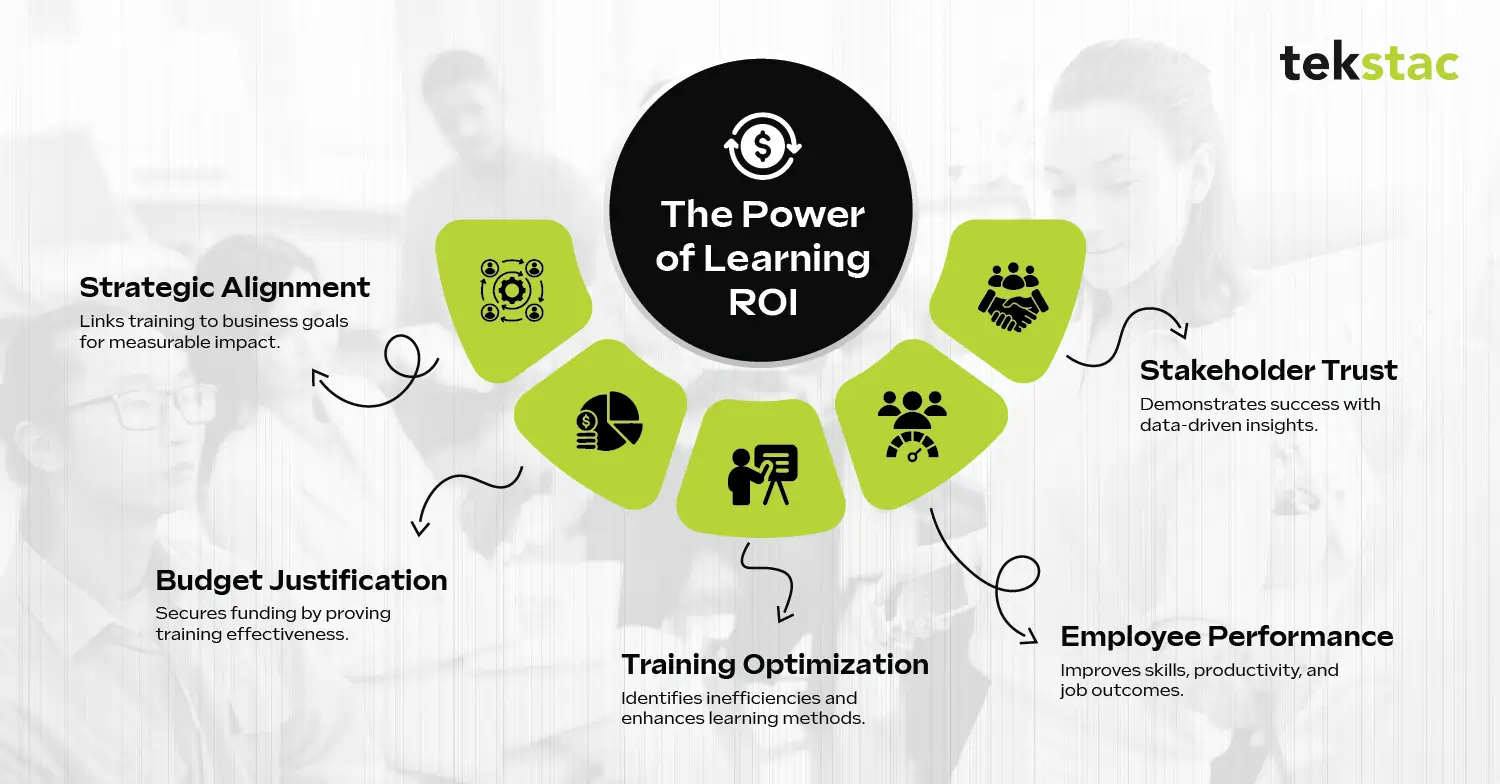
Below are five reasons why Learning ROI is vital to L&D programs’ success:
Training programs must be in line with organizational priorities to create real value. ROI ensures that the learning initiative is designed to meet strategic objectives. In other words, linking training outcomes with business goals will allow an organization to establish a direct connection between employee development and success.
This will mean that every dollar spent on training is contributing to measurable results.
The biggest challenge that L&D performance metrics leaders face is budgeting for training programs. Stakeholders always question the return on investment. With Learning ROI, leaders can present clear evidence of value creation from their initiatives. This justification secures funding for impactful training programs.
It ensures resources are spent in areas with the greatest potential for success.
Sometimes, training programs may not be efficient and waste a lot of time and resources. Through ROI evaluation, one is able to identify the inefficiencies of the training content and the methods of delivery. These are the areas that leaders use to optimize programs, streamline processes, and increase overall efficiency.
This is bound to reduce costs and also improve the quality of training to ensure that employees meet their needs.
Training programs are most effective when they translate into noticeable improvements in employees’ performance. Focusing on ROI will help organizations be sure that their training initiatives are designed to deliver results that are practical and actionable. Employees who apply the skills and knowledge gained from training can improve their job performance.
This improvement increases productivity and positively impacts organizational outcomes.
Stakeholders want accountability for the resources spent on L&D programs. Learning ROI offers quantifiable evidence of success, thus boosting the confidence of decision-makers. With clear data-driven results, L&D leaders can strengthen their trust in their strategies and demonstrate their value to the organization. This confidence translates into continued support for learning initiatives.
Measuring the Learning ROI is a structured and systematic process. It has both a direct and indirect effect, which needs to be gauged on individual employees and also on the organization.
L&D leaders can measure the learning ROI by following these main steps:
Set clear and simple goals to match the training with business needs and measure its results accurately. The objectives must be in sync with business priorities to make sure that the training supports the organizational goals.
Kirkpatrick Model: This model is widely accepted and can be applied in four levels: reaction, learning, behavior, and results. This is considered an appropriate model for making training results connected with business outcomes.
Calculate the total cost of the training program that is, its development and delivery and the employees’ time spent in the learning process. Compare them with financial benefits, such as revenue gain or savings in costs, to evaluate the ROI.
In fact, an Accenture study found that training can deliver an average ROI of 353% — meaning every $1 invested generates $4.53 in return. This highlights the powerful business case for carefully analyzing cost versus benefit in learning initiatives.
Determine whether the employees’ job performance improved after attending the training. Compare their job performance before and after the training using KPIs, surveys, and assessment tools will capture these changes before and after the training.
Use LMS and analytics tools that can measure participation, completion rates, and the outcomes from training. With these tools, gathering data is easier and they also help to measure the ROI.
Measuring training effectiveness is one of the vital aspects of ensuring that L&D initiatives deliver real value. It involves checking whether the training objectives have been met and where there is room for improvement. Training effectiveness is also closely related to continuous improvement.
Regular evaluation helps organizations to adapt to changing demands, remain competitive, and deliver better results. Ultimately, in the final analysis, effectiveness measurement ensures that the efforts of training are well aligned with broader business goals and hence maximized.
There are many tools and techniques L&D leaders can use to measure the effectiveness of training programs.
Among these are four key tools as listed below:
Surveys are an excellent method of gaining direct insight from the trainees. They can measure levels of satisfaction and help track areas where the training is weak.
Skills Assessments taken before and after training sessions give leaders a clear picture of learning outcomes. Comparing results lets leaders know how much participants have learned.
Dashboards are very useful tools for tracking performance trends over time. They provide a visual presentation of key metrics, helping leaders monitor the impact of training programs.
This feedback method involves gathering input from peers, managers, and team members. It offers a comprehensive evaluation of behavioral changes resulting from training.
Learning ROI demonstrates how training contributes to business goals and acts as a key measure to evaluate the success of learning programs.
In short, measuring outcomes will allow L&D leaders to develop a clearer, more refined strategy that accurately allocates resources to eventually bring about sustained growth.
ROI-driven decisions ensure that organizations maximize the impact of their training programs and thrive in a competitive business environment.
1. How to measure coaching ROI?
Coaching ROI is measured by comparing program costs against outcomes like performance improvement, productivity gains, employee retention, and overall business impact.
2. What does ROI stand for in the context of learning and development initiatives?
In learning and development, ROI stands for Return on Investment, showing how training initiatives create measurable business value relative to costs.
3.What does ROI stand for in education?
In education, ROI means Return on Investment, reflecting how learning efforts or programs improve student outcomes and institutional effectiveness compared to expenditures.
Coaching underperforming employees is one of the highest-leverage skills a manager can develop, and one of the most neglected. Nearly two-thirds of HR professionals report that fewer than half of managers at their organizations effectively address underperformance, according to SHRM (2024). The result: performance issues compound, team morale drops, and organizations absorb the cost. The good news is that with the right coaching strategies root cause analysis, clear goal setting, structured feedback, and targeted development, most underperformance is fixable. This guide covers 10 strategies that work.
A leader’s ability to coach employees struggling to meet expectations is one of their most essential skills. This ability can significantly impact individual and team performance, helping low-performing employees overcome challenges and contribute effectively to the organization.
According to research from Culture Amp, underperforming employees make up an average of 4% of an organization’s workforce. However, this percentage can range from 0% to 20% depending on industry type, organizational culture, and performance evaluation criteria.
An organization that can identify and support these employees will increase both performance and overall productivity, employee engagement, and workplace morale.
Different experts propose strategies to support employees in overcoming challenges and building the confidence necessary to excel in their roles.
10 Strategies to Coach Underperforming Employees
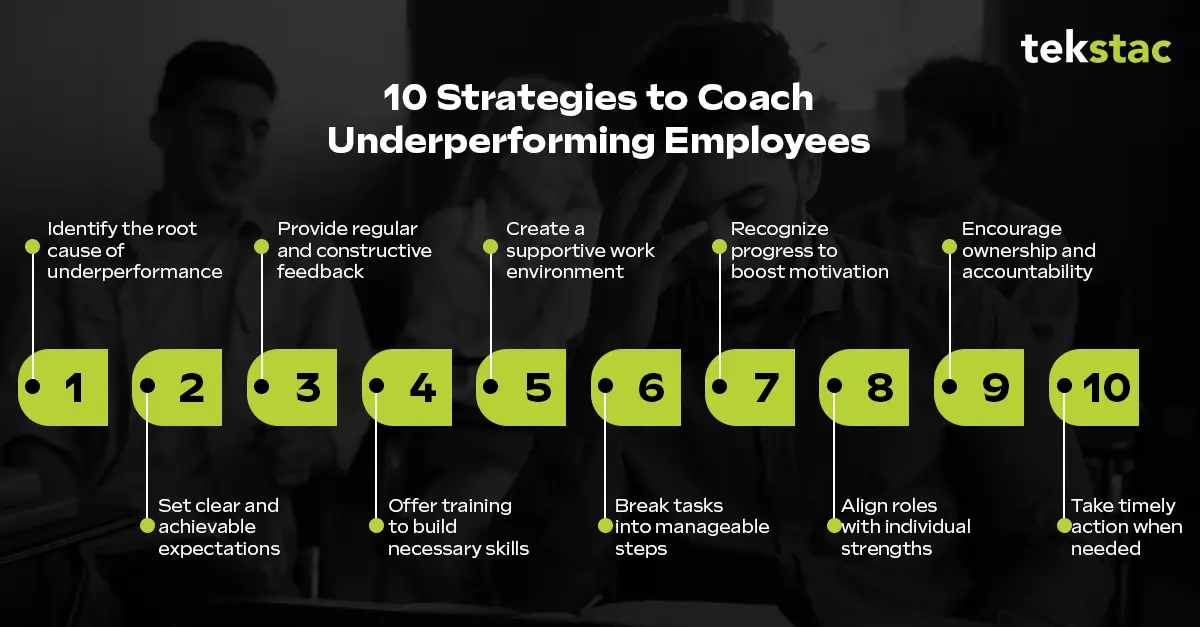
To help an underperforming employee, you must first understand what is causing the issue. Once you know why, it’s easier to tailor your approach to suit the individual’s needs; for example, if the problem is a skills gap, consider offering upskilling and reskilling opportunities to ensure the employee has the necessary skills to succeed.
Clear, measurable goals are essential to guide employees back on track. Goals prevent you and the employee from wondering what is expected and how success is measured.
Coaching is generative, and feedback is a powerful tool. Employees struggling to meet expectations greatly benefit from regular and constructive feedback, which helps them identify areas of improvement and take corrective action. Supporting low-performing employees with clear guidance can drive meaningful progress and growth.
Managers can play a crucial role when employees face a skills gap by offering targeted feedback and support to help bridge the gap effectively. This guide lists the most critical skills gaps employers prioritize in 2026 and provides actionable strategies for addressing them.
At times, those who underperform fail to have the skills or knowledge. Training and development opportunities boost morale and bridge the skills gap in employees, and over time, they can boost performance. This training could take the form of formal classes, online sessions, mentoring, or hands-on workshops.
Better employee performance is a function of a supportive work environment. When employees are given value, respect, and support they are able to overcome obstacles and are more likely to perform at their best.
Employees facing performance challenges may procrastinate or feel overwhelmed by large tasks or projects. Breaking these tasks into smaller, more manageable steps can reduce stress, clarify priorities, and foster a sense of achievement with each completed step.
One of the most powerful ways to increase performance is by motivating employees through positive reinforcement. Verbal or tangible rewards are only two forms of motivation out of many.
Every employee has their strengths to help them succeed. You can achieve better performance by aligning your tasks and responsibilities with the strengths.
Empowering employees to own their work is one way to improve performance. Accountability creates a feeling of responsibility and motivates people to reach their full potential.
Sometimes, coaching will help resolve underperformance; sometimes, it won’t. If an employee’s performance doesn’t improve after coaching, you may need to use a performance improvement plan (PIP) or other alternatives.
Not every underperforming employee responds to coaching. If performance hasn’t measurably improved after 60-90 days of structured coaching with documented check-ins, the next step is a formal Performance Improvement Plan (PIP).
A PIP is a written agreement that defines the specific performance gap, the required improvement standard, a defined timeline (typically 30-90 days), and the consequence if the standard is not met. It is not a precursor to termination; it is a structured accountability framework. Beyond the PIP, consider whether the role itself is a mismatch. Gallup research shows 42% of employee turnover is preventable, which means investing time in a structured PIP before making a separation decision is almost always the smarter move.
Coaching underperforming employees requires patience, a deep understanding of their challenges, and the ability to guide them toward effective solutions.
Remember that there are reasons the team underperforms, and fixing them early on will do wonders for keeping the team productive and in a reasonable frame of mind. By continually adapting and changing your coaching methods to suit the needs of your employees, you will simultaneously see performance and satisfaction improve.
What strategies have worked for you when coaching underperforming employees? Share your tips, experiences, or insights in the comments below! If you’re looking for leadership and employee development support, consider checking out Tekstac.
1. How do you coach an underperforming team member step by step?
Start by documenting specific performance gaps with dates and examples before any formal conversation. Schedule a private two-way discussion focused on understanding, not judgment. Walk through four things: what the expected standard is, where the gap currently sits, what barriers the employee is facing, and what support you can provide. Set a 30-day milestone with a defined success metric. Follow up consistently. The difference between a coaching conversation and a disciplinary one is intent; the employee should leave the room feeling supported, not threatened.
2. When should coaching shift to a Performance Improvement Plan (PIP)?
If documented coaching over 60-90 days produces no measurable improvement, a PIP is the appropriate next step. A PIP defines the performance gap, the required standard, a timeline (typically 30-90 days), and the consequences of non-improvement. It is a structured accountability tool, not an automatic path to termination.
3. What is the difference between coaching and managing poor performance?
Coaching is developmental; it builds capability and confidence through structured conversation, goal setting, and feedback. Managing poor performance is correct; it uses formal tools like PIPs, written warnings, or role reassignment. Effective managers use coaching first, escalating to formal performance management only when coaching has not produced improvement.
4. How long does it take to see results from coaching an underperforming employee?
Most managers see early indicators of improvement within 30 days of consistent, structured coaching; clearer communication, improved attendance at check-ins, or proactive progress updates. Meaningful performance change typically takes 60-90 days. If no improvement is visible after 90 days of documented coaching, escalate to a PIP.

How often have you been handed a lengthy PowerPoint deck for training and thought, When am I supposed to find time for this?
That’s where microlearning comes in. But what is microlearning exactly? It’s a modern learning method that delivers bite-sized, targeted lessons—perfect for busy employees adapting to changing work demands.
They take too much time, aren’t easy to retain, and can be dull.
That’s why microlearning is gaining popularity. It’s a more modern, efficient way of learning that focuses on bite-sized, targeted lessons designed to fit busy schedules. With today’s demanding employees mastering new tools and adapting to changing work environments, microlearning is the perfect solution!
Microlearning is a method that breaks down learning into small, bite-sized modules. It helps employees to acquire skills quickly, effectively, and in a way that fits into their busy workdays.
These bite-sized modules are brief, spanning from a few minutes to 15 minutes. They can take various forms, including short videos, interactive quizzes, infographics, or quick-read articles—often accessible through digital platforms.
Microlearning begins with identifying a specific learning objective or a skill gaps. Instead of teaching a broad or complex topic all at once, it focuses on a single concept, skill, or task that needs immediate attention.
The learning journey is then broken into small, focused modules that can be completed independently. Each module builds upon the previous one (if necessary) or serves as a standalone unit. Learners can move at their own pace.
Each module concludes with a clear takeaway or action point. Learners are given a quick assessment to ensure they have grasped the material. This evaluation reinforces learning in applying the skill on the job.
Organizations have long struggled with employee retention, and one primary reason is the need for meaningful learning opportunities.
As per LinkedIn’s 2024 Workplace Learning Report, 90% of organizations are heavily concerned about employee retention and promote learning opportunities as their number one retention strategy.
Here are five ways how microlearning improves employee retention.
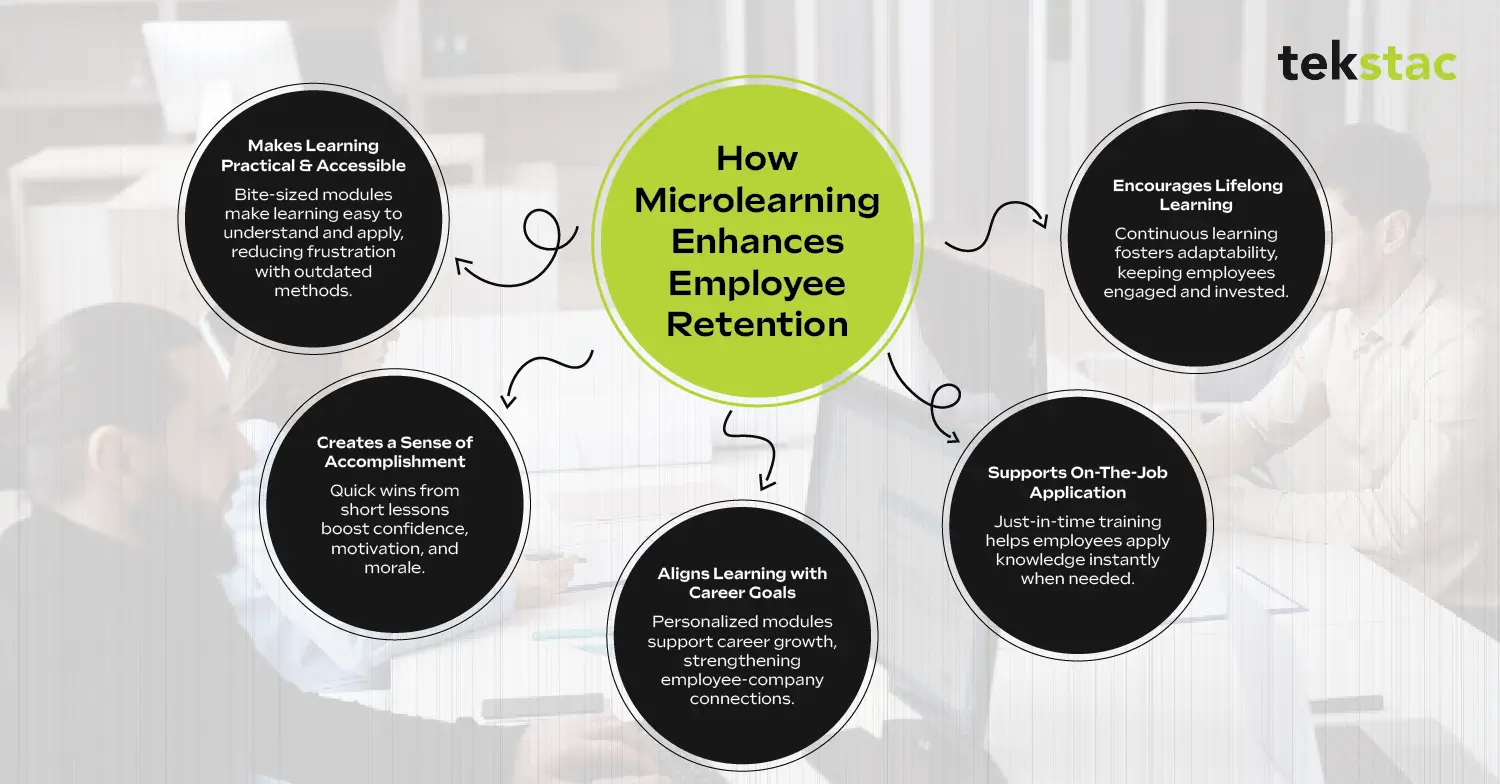
Since microlearning breaks down topics into easily understandable modules, employees engage with the information positively and apply knowledge. This reduces frustration with outdated learning methods and shows employees that the organization values their time.
When employees complete short, actionable lessons, they experience quick wins. With practical information, employees will begin to implement their learnings, also creating opportunities for achievements. This continued sense of progress motivates them to continue learning, improving morale and loyalty.
Microlearning focuses on designing personalized learning modules that directly support career progress. Employees are also more likely to participate in L&D programs, creating a stronger connection between the employee and the company. This also shows that the organization is invested in employee growth.
Microlearning delivers just-in-time training, providing employees with the exact information they need when they need it.
For example, imagine a sales representative preparing for a negotiation call. Instead of going through lengthy company manuals or attending a half-day workshop, they can quickly access a 5-minute microlearning module on effective negotiation techniques. This allows employees to apply what they’ve learned immediately.
Traditional training programs sometimes operate on a “once-and-done” model, where employees undergo long sessions once or twice a year.
Microlearning emphasizes ongoing learning as an integral part of an employee’s work life. It ensures that employees constantly update their skills and knowledge without feeling overwhelmed. As a result, employees will stay with an organization as it creates a culture of growth and adaptability.
Microlearning is a perfect learning method that appeals to the modern learner’s fast-paced work environment and suits the short attention span of the current generation. These bite-sized, goal-oriented modules offer the following five benefits:
When information is delivered in small, digestible chunks, employees can absorb and recall details more effectively than other methods. With higher retention rates, organizations will see a greater return on their learning and development investments as employees apply new skills more effectively. Employees also reduce cognitive overload and stress associated with information-heavy training programs.
Since microlearning’s content is interactive or gamified with multimedia elements, it keeps learners engaged. Other extended training programs can feel monotonous, whereas microlearning is more enjoyable. Hence, companies will observe higher participation rates and lower training abandonment.
Much has changed since the pandemic nearly five years ago. Every year, new skill set requirements keep evolving. Microlearning helps organizations quickly create or adapt learning content to address skill gaps per business needs. With quicker upskilling or reskilling, businesses can stay competitive and address skill gaps.
Focused, job-specific microlearning content allows employees to learn and apply skills to their tasks quickly. This “just-in-time” learning improves on-the-job problem-solving.
For instance, The Journal of Applied Psychology found that leadership training alone can increase learning capacity by 25% and performance by 20%. These results show the impact of a well-designed training program on employee performance.
Microlearning’s flexibility and convenience allow employees to learn anytime, anywhere—promoting an ongoing learning habit rather than random training sessions. Organizations that promote continuous learning see better employee retention rates and attract top talent.
To get started with microlearning, organizations can take the following steps:
Conduct skills gap analysis to check for specific competencies employees need to develop. Collaborate with department stakeholders and team leaders to define the most critical knowledge areas aligning with organizational goals and workforce needs.
Once identified, map out the most essential learning objectives for microlearning content. This ensures that the training is relevant and addresses high-priority areas immediately.
Develop microlearning modules that are at most 5-10 minutes each. Each module must focus on a topic or skill to allow employees to absorb information in a manageable size. Use existing training materials, videos, or tutorials as building blocks to reformat them into microlearning-friendly content. As always, ensure the content is interactive.
Adopt a platform that supports personalized, microlearning content. It should also offer advanced analytics to monitor learner progress, assess knowledge retention, and track how well learners are engaged.
Following the initiative’s deployment, analyze performance metrics to improve and optimize content and delivery methods. The platform’s real-time data and feedback loops or interventions can refine the learning experience.
When a company embraces microlearning, it should be designed in a way that maximizes learning impact. The following best practices ensure that each learning module is purposefully designed for maximum employee performance:
Organizations must stay agile and aware of the changing world and required skills. This process involves regularly assessing industry trends, workforce demands, and future skills to ensure that the learning initiatives align with organizational goals and external market requirements. Regularly revisiting learning goals in response to changing needs is also essential.
Microlearning isn’t just about imparting information; it’s about making sure that the knowledge sticks and can be practically applied.
This requires a deliberate focus on retention techniques like spaced repetition. Employees should also be able to apply it to their daily tasks immediately. Use scenario-based learning or simulations to help them practice in a more realistic environment.
Not all employees learn at the same pace or have the exact needs. People retain information differently, and microlearning strategies should be flexible enough to meet these needs.
Personalization should include skill gaps, learning styles, and career goals. One way to quickly achieve this is to use learning data to create targeted training paths that focus on areas where employees need the most improvement.
Microlearning thrives when the content is visually engaging and diverse. Given the variety of learning preferences, some individuals may prefer visual learning, while others benefit more from auditory or hands-on methods. Make sure to blend videos, infographics, animations, and interactive elements. Consider polls, quizzes, and gamified components to make it more fun!
Design content that is easily accessible on mobiles, tablets, or laptops. When employees can access training material on the go, between meetings or during a commute, it reduces barriers to participation. It fits into their busy schedules, allowing them to learn quickly. This on-demand learning ensures that training becomes a part of an employee’s workflow.
Organizations need tools that combine flexibility, scalability, and advanced analytics to achieve a smoother microlearning strategy. Such platforms must design content delivery with features like AI-driven personalization, real-time performance tracking, and assessments.
Look for solutions that integrate modular course creation, gamified learning paths, and detailed dashboards to design training that aligns with business goals. One such skilling solution is Tekstac, which supports these needs. It’s an ideal choice for organizations looking to transform their training or skill development initiatives for tech talent.
Over the next few years, more than 50% of the world’s workforce will need to develop or improve upon skills in order to remain competitive amidst technological and economic changes.
Unfortunately, the majority of organizations relegate reskilling and upskilling to one of many roles that fall upon HR, with only 13% including other managers in the development of these programs. However, prioritizing Inclusive Leadership is crucial—when only HR is in charge, it often lacks the specific knowledge of a team’s unique needs or challenges. This risks you designing learning programs that don’t align with real-world requirements or resonate with your employees. By embedding Inclusive Leadership into skills development, organizations can ensure their reskilling efforts are both relevant and impactful for every team member.
There’s a better way—by incorporating all leaders and fostering a culture of inclusive leadership, your reskilling and upskilling programs will not just grow workers’ skills, but will meet each employee’s individual needs.
Inclusive leadership is the process of company leaders empowering employees and valuing diverse perspectives. An inclusive leader can cultivate a culture full of trust and collaboration if they are open to new ideas and inclusive of all backgrounds.
This often shows up in the form of a commitment to diversity initiatives, a focus on collaborative decision making, and a culture of empathy and psychological safety. For example, this may include leaders establishing and advising employee resource groups or driving feedback sessions to amplify underrepresented voices.
To foster a culture of inclusive leadership, survey employees to understand their needs and goals. Remain open to—and solicit—continuous feedback with an eye toward iteration and improvement. Incorporate diversity and inclusion into company trainings and initiatives.
Upskilling and reskilling are both essential to addressing the skills gap, but they are not the same thing. Upskilling refers to improving the skills one already holds, leading to better performance in a current position. Reskilling means providing employees with new skills that may enable them to take on an entirely new role.
Both reskilling and upskilling are paramount for companies hoping to grow amidst technological advances and a changing workforce. Whether that means teaching your team to leverage new AI technologies or helping them bolster their existing technical expertise, this type of retraining can keep your employees adaptable and engaged while driving toward company goals.
However, in addition to many companies lacking a focus on these programs, there may be other barriers. For instance, some employees may feel such programs interfere with their work time, while others may find them inaccessible due to logistical or language barriers. Focusing on inclusive leadership can remove these barriers.
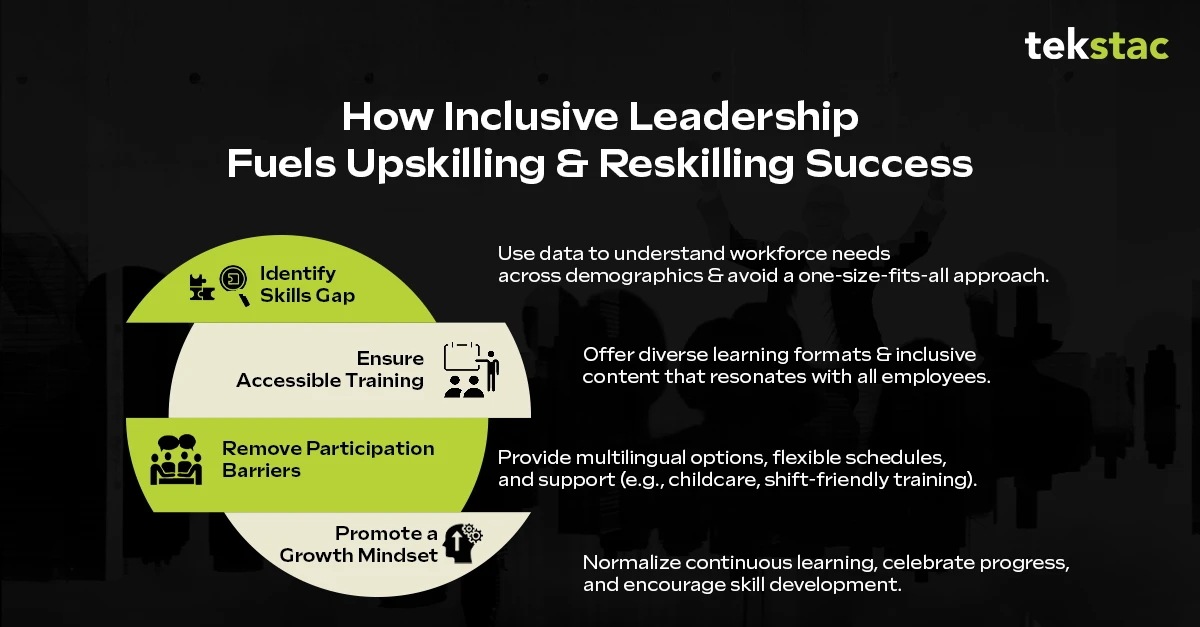
Inclusive leadership can contribute to successful retraining programs in several ways.
As leaders prove their commitment to inclusion, they’ll inspire employee trust, making workers more likely to see the benefit of and engage in learning opportunities. Plus, the more a culture fosters the inclusion of new viewpoints, the more everyone can learn from each other. This can also lead to more innovative training and development approaches, like gamification or training led by subject-matter-expert peers.
To stay aware of your progress, keep an eye on metrics like employee participation across various demographics, employee engagement scores (which can also be analyzed by demographic), and how well performance or promotion rates improve after the training sessions.
Combined, these metrics will paint a picture of how included your employees feel and how beneficial the upskilling or reskilling courses are, ensuring the programs equitably benefit all demographics and allowing you to discover and resolve any gaps. Consider using a comprehensive learning platform that tracks this data and provides insight into the ROI of your training programs.
Over time, upskilling or reskilling programs led by inclusive leadership practices should result in a stronger talent base with a better pipeline for new or higher-level roles, which should also position you with a higher competitive advantage against competitors.
As the working world transforms with the continuous advent of new technology, your company must change along with it. One of the surest ways to stay competitive in a changing landscape is through a continued focus on upskilling and reskilling of employees.
However, trying to create a single program that meets every worker’s needs is likely to result in barriers and low adoption. Inclusive leadership is the answer. By striving to understand the needs of diverse demographics and design programs that meet each employee where they are, you’ll break down barriers, increase participation, and future-proof your team.
If you’re an inclusive leader looking to get started with upskilling and reskilling, check out a Tekstac demo. With 500+ unique learning paths and assessments, there’s a way to meet every employee’s skill development needs.
1. What is the difference between inclusive leadership and transformational leadership?
Inclusive leadership focuses on diversity, equity, and ensuring every voice is heard. Transformational leadership inspires and motivates teams to achieve vision-driven goals.
2. Why is inclusive leadership important in the workplace?
It drives diversity, innovation, and employee engagement by creating a culture where everyone feels valued, boosting collaboration and business performance.
3. What are the most important traits of an inclusive leader?
Inclusive leaders show empathy, practice active listening, embrace cultural awareness, ensure fairness, and foster an environment where all voices are respected.
4. How do you measure inclusive leadership in an organization?
It can be measured through employee surveys, 360-degree feedback, and diversity metrics, along with tracking engagement, retention, and representation rates.