
The world of work isn’t just changing; it’s evolving faster than most companies can keep up. What used to work ten years ago, scheduled training sessions, fixed job descriptions, manual performance reviews, is now dangerously outdated.
In this environment, a business is only as strong as the adaptability of its people.
This is where Talent Development Programs come into the picture. These aren’t just employee workshops or onboarding checklists anymore. They are enterprise engines.
Engines that build skill, enhance judgement, and turn employees into contributors capable of facing the unknown with confidence.
According to a 2025 McKinsey report, 60% of executives now say their company’s competitive edge depends on how quickly they can reskill their people.
That’s not HR fluff.
That’s a strategic priority for business growth.
And yet, most organizations are still treating talent development like a cost center, not the profit multiplier it actually is.
The real problem is that training is still reactive. It’s not aligned to the job. It’s not intelligent. And in many cases, it’s not even reaching the right people at the right time.
That’s why businesses lose talent, productivity, and in the long run, relevance.
There’s a better way. One that treats talent like a living system, not a static resource. The new standard for Talent Development Programs is adaptability.
Not just what employees know, but how quickly they can learn something new when the rules change.
This is where AI in learning and development becomes mission-critical. AI/ML based HRTech tools now enable companies to tailor learning paths for each individual, not just based on their role, but on performance patterns, their career aspirations, business requirements, learning style, and growth trajectory.
Take a look at what this unlocks
In a recent LinkedIn Workplace Learning report, companies that invested in AI-enabled talent development platforms reported a 23% increase in internal mobility and a 30% reduction in turnover.
That’s how powerful smart development can be.
And don’t ignore Upskilling through automation. When machines handle repetitive tasks, human workers must step into higher-order thinking roles, negotiation, decision-making, leadership. But they can only do that if they have the necessary skills.
Let’s break this down through a practical lens.
Unilever, one of the world’s top consumer brands, completely reshaped its approach to talent development by dismantling traditional roles and replacing them with task-based assessments.
Instead of promoting based on time served, employees were assessed based on project complexity, agility, and learning speed.
With AI embedded in its learning system, Unilever enabled every employee to build their own career map, automatically updated based on skill growth and business needs.
This shift didn’t just improve retention, it unlocked hidden talent across the entire organization.
Or consider Genpact, a global services company. When GenAI exploded onto the scene, they immediately created AI-driven employee development tracks focused on prompt engineering and LLM literacy.
Over 75,000 employees completed their AI foundation module in under 6 months, leading to a 3x increase in total learning hours over the past four years.
These aren’t edge cases. They’re the new standard.
Now here’s what every business needs to start doing immediately
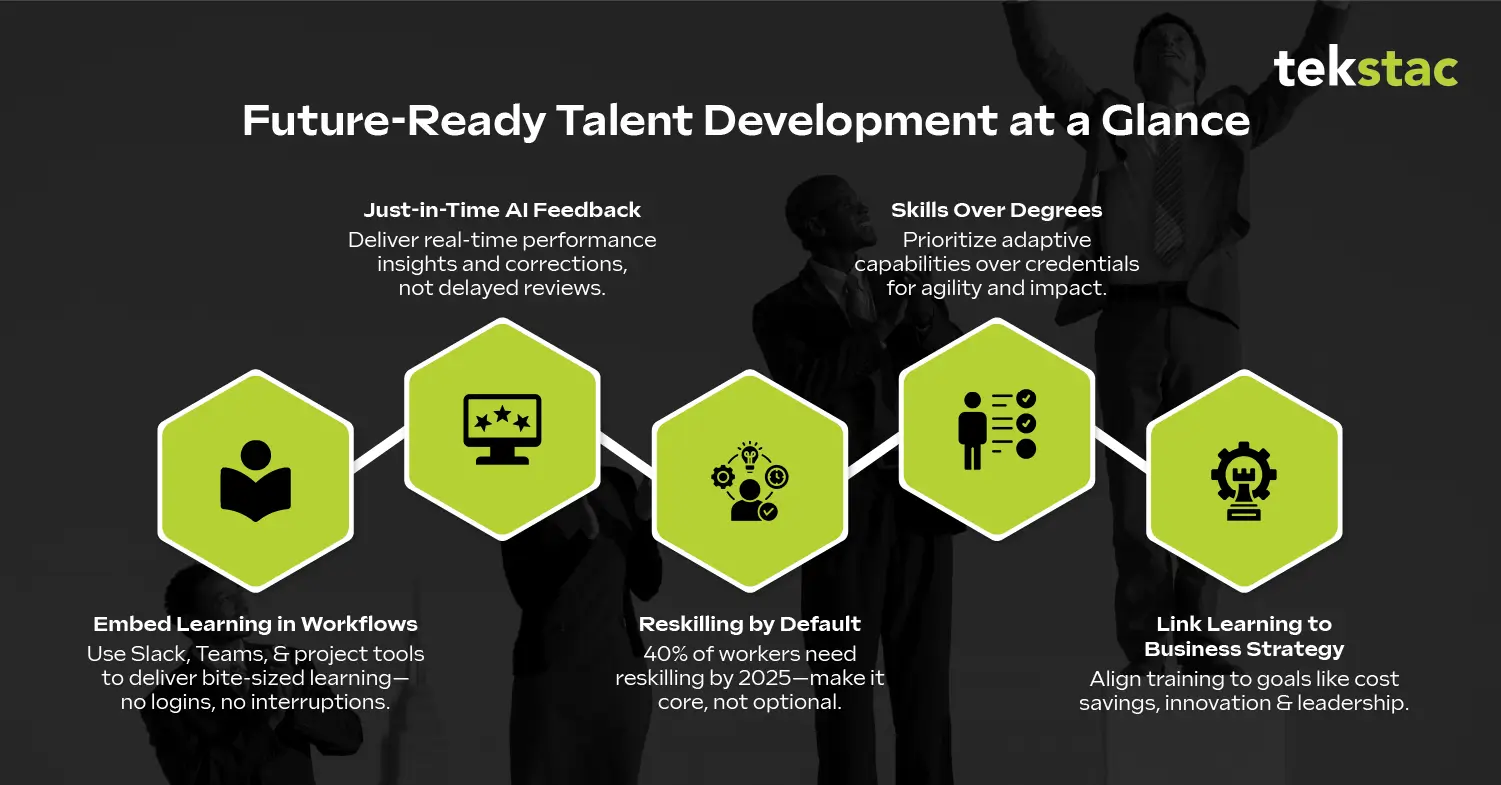
People won’t engage in training if it interrupts their work. That’s why modern Talent Development Programs embed learning into tools already being used — Slack, Teams, project management software. Microlearning modules triggered by real work tasks.
No separate login.
No off-site seminar.
Learning must happen when it matters most. With AI in learning and development, systems can now evaluate an employee’s real-time performance, detect errors or gaps, and offer corrective content instantly.
No need to wait for the next quarterly review.
A 2025 World Economic Forum study found that over 40% of all workers will need reskilling within the next three years.
That means Upskilling through automation isn’t a nice-to-have. It’s a survival plan. Companies must fund, incentivize, and promote reskilling pathways by default.
Credentials are no longer the main currency of value. The ability to adapt, learn, and apply new knowledge rapidly is what counts. AI systems can assess these traits better than any traditional resume scan.
A recent SAP SuccessFactors case study showed that companies adopting skill-first development models saw a 26% increase in project delivery speed and a 15% improvement in leadership pipeline efficiency.
This is where too many get it wrong. Learning is treated as an HR metric, not a revenue enabler. True AI-driven employee development maps every learning track to a clear business objective — cost reduction, faster innovation, customer satisfaction, leadership capacity. Training must be an investment that pays back.
Every company is sitting on a goldmine. Their people. But talent without development is just potential, not performance. The companies that win in this next decade won’t be the ones with the most capital, but the ones with the most adaptable workforce.
Talent Development Programs are no longer optional. They are the core infrastructure. As critical as cloud servers or cybersecurity. And when powered by AI, they don’t just train workers. They evolve them.
The time to act is now. The longer the delay, the wider the skills gap becomes.
And here’s the truth. Implementing this doesn’t have to be hard. Not with the right partner. There are platforms today that can deploy these capabilities out of the box — from smart learning paths to performance-linked coaching to skill analytics that make HR feel like strategy.
It’s a different game now.
Static roles have been replaced by skill clusters. One-size-fits-all training is obsolete.
And AI isn’t just automating tasks — it’s building talent.
There’s no turning back. The choice for organizations is simple.
Keep relying on outdated training systems, lose people, fall behind.
Or, switch to intelligent, data-driven, personalized development and build a workforce ready for anything.
If there’s one place to start, it’s with a smart platform that aligns learning, performance, and business goals.
One that offers everything from skill taxonomies to AI-powered coaching, from role-based content curation to real-time feedback — all personalized, scalable, and integrated
Try Tekstac today and experience what intelligent talent growth can really look like
👉Get Started Now
1. What are the key benefits of AI-powered talent development platforms?
AI-powered platforms improve internal mobility, reduce turnover, accelerate reskilling, and provide data-driven insights into workforce readiness. They help organizations build future-ready talent while turning learning investments into measurable business impact.
2. How does AI improve learning and development programs?
AI improves learning and development by delivering personalized, just-in-time content, automating skill assessments, and providing real-time feedback. It helps organizations scale training efficiently while increasing engagement, retention, and measurable performance outcomes.
3. How does AI-driven talent development support business growth?
AI-driven talent development aligns employee skills with strategic objectives such as innovation, operational efficiency, and leadership readiness. By reducing skill gaps and improving workforce agility, companies achieve faster execution, better retention, and long-term competitive advantages.
4. What business outcomes can talent development solutions deliver?
Talent development solutions improve productivity, accelerate time-to-skill, strengthen leadership pipelines, reduce hiring costs, and support faster innovation by aligning workforce capabilities with strategic business priorities.
We’re long past asking whether Artificial Intelligence (AI) matters, it’s now central to how industries operate and innovate. For startups, the AI revolution is both an opportunity and a challenge, a landscape filled with possibilities yet demanding strategic foresight. As we step into 2026, the question is not whether AI will shape the startup ecosystem, but how startups can harness AI revolution to carve a competitive edge.
For startups, AI levels the playing field. Unlike legacy enterprises burdened with outdated infrastructure, startups can adopt AI-first strategies from day one. Cloud computing, open-source models, and AI-powered automation allow small teams to compete with industry giants.
The democratization of AI tools means that even a two-person startup can deploy sophisticated machine learning models without extensive resources. AI is not just a tool, it is an enabler of innovation, efficiency, and scalability.
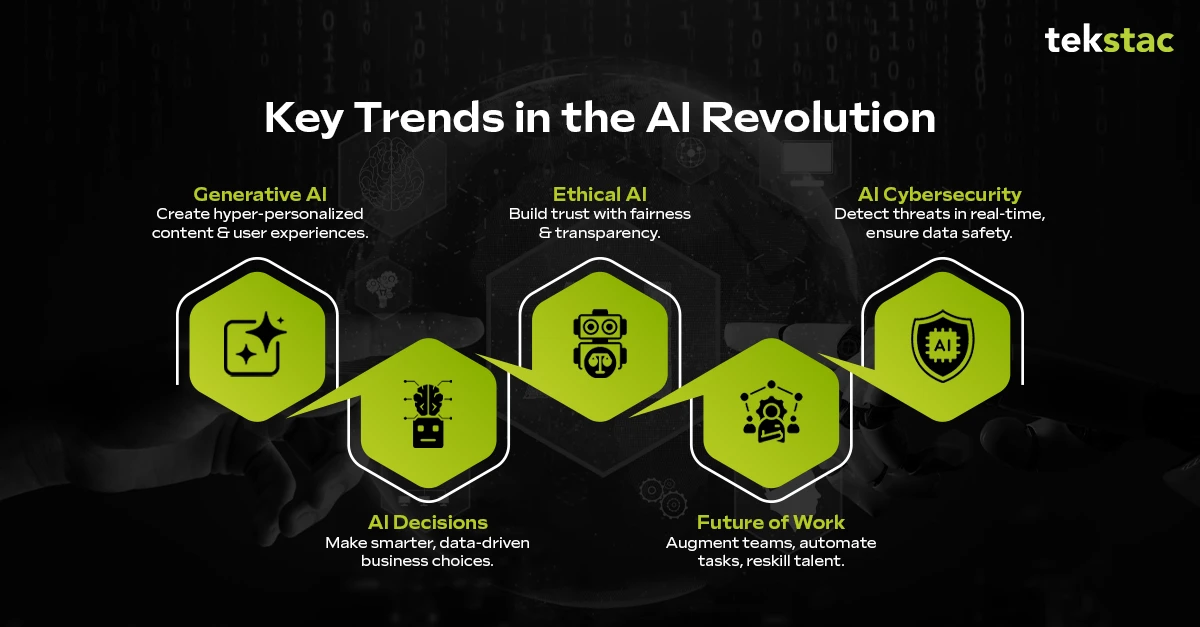
AI is no longer just about automation; it’s about creativity. Startups leveraging the Generative AI revolution can build personalized user experiences, from custom marketing content to AI-driven product recommendations.
Businesses that prioritize AI-driven personalization will not only improve engagement but also foster deeper customer loyalty. Companies in e-commerce, media, and digital marketing will see a surge in AI-driven customization, allowing brands to speak directly to their audience’s needs- a key advantage in the ongoing AI revolution.
Startups can harness AI for strategic insights, risk assessment, and predictive analytics. With AI-powered decision-making, founders can move beyond intuition and make data-backed choices, reducing failure rates and improving operational efficiency.
AI-driven business intelligence platforms are allowing startups to analyze vast amounts of market data, enabling them to pivot strategies with precision. From customer sentiment analysis to financial forecasting, AI-driven insights are becoming indispensable navigating the AI revolution.
As AI adoption grows, so does the need for ethical AI practices. Startups must prioritize transparency, fairness, and data security to build trust. Ethical AI will not just be a compliance requirement but a key differentiator in an increasingly scrutinized market.
Responsible AI practices, including bias mitigation and explainability, will be essential in maintaining credibility and securing long-term growth.
AI is reshaping workforce dynamics, automating repetitive tasks, and augmenting human intelligence. Startups that embrace AI-driven work models, such as AI-assisted customer support or intelligent project management, can enhance productivity without inflating operational costs.
AI’s integration into daily workflows will free up human potential, shifting the focus from repetitive execution to critical thinking and creativity. This transition underscores the urgent need for upskilling and reskilling, as the future of work will demand a blend of technical fluency and adaptive problem-solving.
As cyber threats become more sophisticated, startups must leverage AI for real-time threat detection and mitigation. AI-driven cybersecurity solutions will be essential in safeguarding sensitive data and ensuring business continuity. With increasing cyberattacks targeting small and mid-sized businesses, AI-powered security tools will become a necessity rather than a luxury.
While AI offers unprecedented opportunities, startups must navigate key challenges:
AI thrives on data, but startups must ensure compliance with evolving regulations like GDPR, CCPA, and upcoming AI governance laws. Companies that proactively implement privacy-first AI strategies will be better positioned to build consumer trust and avoid regulatory penalties.
AI expertise remains in high demand. Startups must invest in upskilling their teams or partner with AI specialists. Hiring data scientists and AI engineers can be expensive, making AI upskilling programs essential for non-technical teams. Platforms offering AI education and training will see growing adoption in startup ecosystems.
Unchecked AI models can reinforce biases, leading to ethical concerns and reputational damage. Responsible AI development will be crucial for long-term credibility. Startups must ensure their AI algorithms are trained on diverse datasets and implement fairness checks to mitigate biases.
While AI adoption is becoming more accessible, advanced AI solutions can still be expensive. Startups need to strike a balance between innovation and cost-effectiveness, leveraging AI-as-a-Service (AIaaS) platforms to deploy scalable AI solutions without hefty upfront investments.
AI is poised to revolutionize multiple industries, with startups leading the charge in:
“The next wave of startup innovation will be powered by AI that learns, adapts, and scales alongside human creativity.”
— Google Cloud, Future of AI: Perspectives for Startups 2025
The future of AI in startups is not just about technology, it’s about vision, adaptability, and responsible innovation. Startups that leverage AI strategically, prioritize ethical considerations, and embrace continuous learning will be the frontrunners of the AI revolution.
AI is the new frontier, and startups that embrace it will define the next decade of innovation. Whether it’s optimizing operations, improving customer experiences, or driving product innovation, AI is no longer optional, it’s essential.
As AI continues to evolve, startups have a unique advantage: agility. In a world where AI-powered disruption is the norm, the most successful startups will be those that stay ahead of the curve, embrace AI-driven transformation, and reimagine what’s possible in the digital age.
Will your startup be a disruptor or a follower in the AI era? The choice is yours.
Based on insights from Google Cloud’s ‘The Future of AI: Perspectives for Startups 2025′ report.
1. What is the AI revolution?
The AI Revolution refers to the rapid adoption of artificial intelligence across industries, transforming how businesses innovate, automate, and make data-driven decisions. It marks a shift toward smarter, more efficient digital ecosystems.
2. How can startups benefit from the AI Revolution in 2026?
Startups can leverage the AI Revolution to scale faster, personalize customer experiences, optimize operations, and gain a competitive edge through data intelligence and automation-driven innovation.
3. What challenges do startups face in the AI Revolution?
The main challenges include AI talent shortage, cost of implementation, ethical risks, and data privacy compliance.
4. Who will survive the AI Revolution?
Organizations that adapt quickly, invest in AI skills, and embrace ethical, data-driven innovation will thrive. Startups and businesses that blend human creativity with AI intelligence will lead to the future.
Based on the McKinsey report “Superagency in the Workplace – Empowering People to Unlock AI’s Full Potential”
AI work refers to the integration of artificial intelligence into everyday business processes, decision-making, and workforce productivity. It goes beyond automation to include AI-assisted collaboration, generative AI tools, and data-driven strategy execution across departments.
Artificial Intelligence (AI) is no longer a futuristic vision, it is here, reshaping industries at an unprecedented pace. Much like the steam engine revolutionized production during the Industrial Revolution, AI has the potential to redefine work, productivity, and economic growth. However, despite 92% of organizations planning to increase AI investments over the next three years, only 1% consider themselves AI-mature.
The key roadblock? Leadership readiness.
Organizations must move beyond small-scale AI initiatives and embrace bold AI-driven transformations to maintain a competitive edge.
AI is no longer just about automation; it is enabling smarter decision-making, problem-solving, and operational efficiency across industries. AI work is transforming how teams collaborate, analyze data, and execute strategies at scale. Generative AI alone is projected to generate $4.4 trillion in productivity gains. Yet, despite these promising numbers, many companies hesitate to move beyond the pilot phase of AI implementation.
Forward-thinking businesses understand that AI can:
The question is not whether companies should adopt AI but how effectively they can deploy it at scale.
One of the most striking findings of the MC Kinsey report is that employees are adopting AI faster than leaders anticipate:
This misalignment presents a major challenge for scaling AI work across the organization. Employees are ready for AI-driven change, but leadership hesitancy is slowing progress. Organizations need to bridge this gap by educating leaders, fostering AI-friendly workplace cultures, and integrating AI into strategic planning.
A critical piece of this puzzle is investing in learning and skilling programs that empower both employees and leaders to understand, adapt to, and fully leverage AI technologies.
This is where platform like Tekstac play a pivotal role to integrates AI-driven personalized learning, assessments, and skill development into the workplace. By aligning learning paths with role-specific needs, Tekstac helps individuals and organizations build the AI fluency required to lead transformation, not just follow it.
Whether it’s through simulated assessments, AI-proctored environments, or performance dashboards, we ensures continuous upskilling aligned with evolving industry demands.
With AI adoption comes responsibility. Businesses must balance the rapid deployment of AI with concerns around cybersecurity, bias, and ethical decision-making.
Key concerns include:
To mitigate these risks, organizations should implement robust AI governance frameworks, establish ethical benchmarks, and ensure compliance with data privacy regulations.
Many companies take a cautious approach to AI, experimenting with small-scale projects rather than fully embedding AI into their core operations. However, true transformation requires bold AI ambitions. Industries such as healthcare, finance, and retail are already seeing the benefits of large-scale AI integration:
Organizations that continue treating AI as an auxiliary tool rather than a fundamental part of their business model risk falling behind.
Despite the rapid advancement of AI technology, organizations face several operational challenges when it comes to AI adoption. The report highlights five major hurdles:
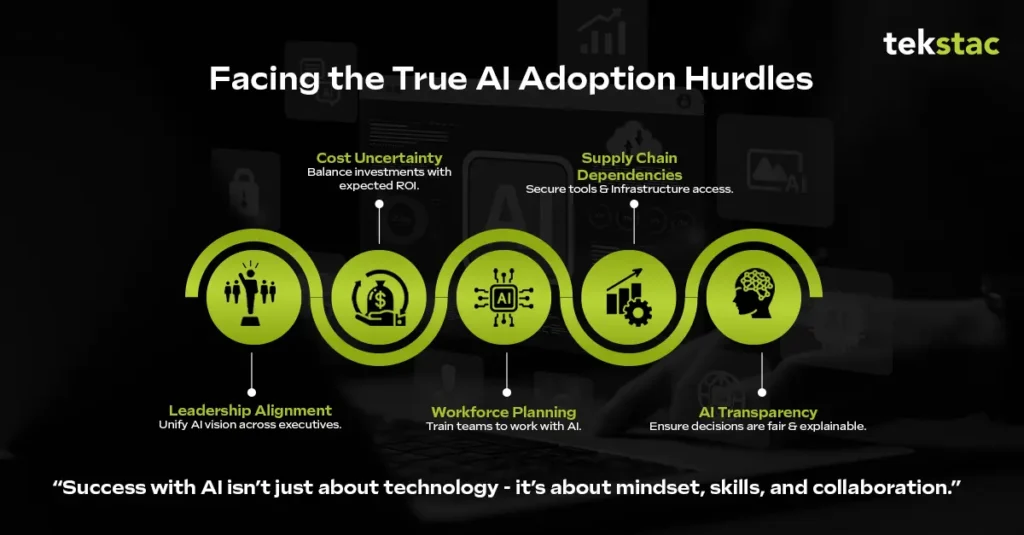
Overcoming these challenges requires strategic planning, cross-functional collaboration, and a commitment to continuous learning and adaptation.
1. Leadership inertia is the bottleneck
While 92% of companies plan to increase AI investments, only 1% consider themselves AI-mature—largely because leadership hasn’t aligned on bold, long-term AI strategies.
2. Employees are ahead of the curve
There’s a striking mismatch between executive perception and employee reality: three times more employees are using AI than leaders estimate, and 70% expect AI to significantly reshape their work within two years.
3. Ethical and secure AI is non-negotiable
As organizations scale AI, concerns around cybersecurity, data privacy, and algorithmic bias must be actively addressed. AI governance, explainability, and fairness should be foundational—not afterthoughts.
4. Small pilots are not enough
To unlock transformative value, businesses must move beyond incremental efforts and fully embed AI into their core workflows, products, and services.
5. Skilling is a strategic lever
Organizational capability depends on a well-trained, AI-literate workforce that includes both frontline employees and C-suite leaders.
AI presents limitless opportunities, but only organizations that act decisively will unlock its full potential. Leaders must step up, align AI strategies with business objectives, and foster AI-literate workplaces.
To succeed in the AI-driven future, businesses must:
AI work is no longer optional; it is a strategic imperative. The time to act is now. Organizations that embed AI work into their culture, leadership strategy, and daily operations will not only stay competitive but help shape the future of work itself.
1. What is the work of AI?
AI work refers to the integration of artificial intelligence into everyday business processes, workflows, and decision-making. It goes beyond automation to include AI-assisted collaboration, generative AI tools, predictive analytics, and data-driven strategy execution across departments. AI work transforms how employees perform tasks, analyze information, and deliver value.
2. What is the leadership gap in AI work adoption?
The leadership gap refers to the disconnect between how executives perceive AI adoption and how employees are using AI tools. Many employees already integrate AI into daily tasks, while leadership often underestimates its impact. Bridging this gap is essential to unlocking enterprise-wide AI value.
3. What role does workforce skilling play in AI work?
Workforce skilling ensures employees and leaders can effectively collaborate with AI systems. Without structured training and continuous learning programs, AI investments fail to deliver measurable impact. AI work success depends on developing digital fluency, ethical awareness, and data literacy across the organization.
A new employee walks through the virtual doors of an organization, greeted not by piles of paperwork but by an intelligent assistant that knows their role, preferences, and needs. This is not a scene from the future; it’s the power of AI-powered onboarding, reshaping first impressions and setting new standards for employee integration.
Onboarding is much more than just paperwork and introductions; it’s the foundation of a positive employee-employer relationship. According to Brandon Hall Group research, organizations with a robust onboarding process improve new hire retention by 82% and productivity by over 70%.
Despite this, a Gallup survey found that only 12% of employees strongly agree that their company does a great job onboarding new hires. This discrepancy highlights a major gap in traditional onboarding methods, which are often inconsistent and ineffective.
AI-powered onboarding addresses these challenges by streamlining processes, enhancing personalization, and ensuring consistency, all while reducing the burden on HR teams. Let’s explore how this innovative approach is reshaping the onboarding landscape.
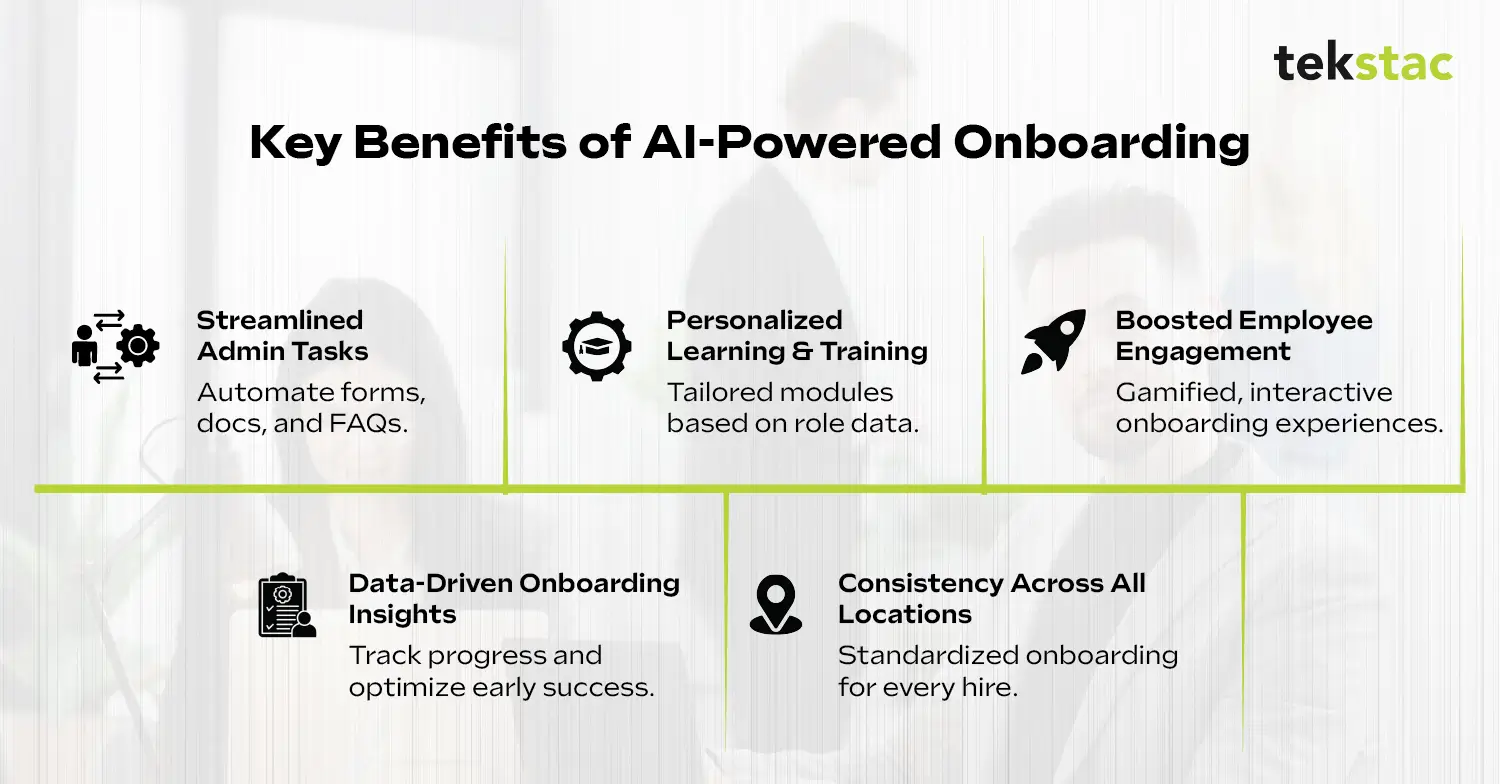
One of the significant advantages of AI in onboarding is its ability to automate repetitive administrative tasks. From generating offer letters to collecting required documents, AI-powered tools can handle these processes efficiently, allowing HR professionals to focus on more strategic aspects of onboarding.
For instance, AI chatbots can guide new hires through document submissions, answer frequently asked questions, and provide real-time support. This streamlines the process while ensuring all critical steps are consistently followed. A report from Aberdeen Group found that best-in-class onboarding processes, often backed by automation, improve employee engagement by 54%.
Every employee has unique needs, learning styles, and learns at a different pace. AI-powered onboarding platforms use data analytics to tailor training programs to individual requirements. By analyzing an employee’s role, skills, and prior experience, these systems can recommend specific learning modules, courses, and resources.
Personalized onboarding ensures that employees receive relevant training, helping them acquire the skills needed for their roles faster. Moreover, it fosters a sense of belonging by demonstrating the company’s commitment to their growth. According to LinkedIn’s 2022 Workplace Learning Report, 94% of employees say they would stay at a company longer if it invested in their learning and development.
AI-powered tools can create interactive and engaging onboarding experiences. Virtual reality (VR) tours, gamified learning modules, and AI-driven simulations make the process more enjoyable and memorable. For example, a new hire could participate in a virtual tour of the office or complete a gamified challenge that introduces them to company policies.
Such initiatives not only make onboarding more engaging but also leave a lasting impression, helping new employees feel connected to the organization from the start.
AI-powered platforms provide HR teams with valuable insights into the onboarding process. By tracking metrics such as training completion rates, employee feedback, and time-to-productivity, organizations can identify areas for improvement and make data-driven decisions.
These insights also enable proactive interventions. For example, if a new hire is struggling with a particular training module, the system can alert HR or suggest alternative resources to address the challenge. A report by the Harvard Business Review highlights that organizations leveraging data-driven onboarding processes can reduce employee turnover by up to 50%.
For organizations with multiple offices or remote teams, maintaining consistency in onboarding can be challenging. AI-powered platforms ensure that every new hire, regardless of location, receives a standardized and high-quality onboarding experience. Automated workflows and digital tools make it easy to replicate successful onboarding practices across different settings.
Several AI-powered tools and technologies are driving the transformation of onboarding processes. Here are some notable examples:
Tekstac’s AI-powered platform builds on these innovations by automating and personalizing onboarding workflows end-to-end. Through intelligent automation and data-driven insights, Tekstac helps organizations deliver seamless, engaging, and efficient new hire experiences that accelerate productivity from day one.
While AI-powered onboarding offers numerous benefits, it’s not without challenges. Organizations must address concerns related to data privacy, integration, and user adoption to fully realize its potential.
Handling sensitive employee data requires robust security measures. Organizations must ensure that AI-powered platforms comply with data protection regulations and implement encryption, access controls, and regular audits to safeguard information. According to IBM , the average cost of a data breach in 2023 was $4.45 million, making security a top priority.
Seamless integration with existing HR and IT systems is crucial for the success of AI-powered onboarding. Companies should invest in scalable and compatible solutions that can work with their current infrastructure. Research from SHRM indicates that 60% of HR professionals struggle with technology integration issues, which can hinder onboarding success.
Introducing new technology can sometimes face resistance from employees and HR teams. Providing training and demonstrating the tangible benefits of AI-powered onboarding can help drive adoption and ease the transition. Studies show that organizations offering technology training experience a 40% higher adoption rate for new digital tools.
As AI technology continues to evolve, the future of onboarding looks promising. Here are some trends to watch:
AI-powered onboarding represents a paradigm shift in how organizations integrate new hires. By automating administrative tasks, personalizing learning experiences, and providing valuable insights, it enhances the efficiency and effectiveness of the onboarding process. While challenges exist, they are outweighed by the significant benefits that AI brings to the table.
As organizations strive to attract and retain top talent in an increasingly competitive landscape, embracing AI-powered onboarding is no longer a choice but a necessity.
Platforms like Tekstac are at the forefront of this transformation, offering comprehensive onboarding solutions that combine AI-driven content delivery, personalized learning paths, skill assessments, and intelligent reporting. Tekstac enables organizations to not only onboard with efficiency but also nurture long-term talent development from the very beginning.
1. How does AI improve the onboarding experience?
AI tools automate repetitive tasks like document submission, training reminders, and feedback collection. They also personalize learning content and provide real-time support through chatbots, making the onboarding process smoother and more engaging.
2. Is AI-powered onboarding suitable for all organizations?
Yes. Whether a startup or enterprise, any organization can benefit from AI-powered onboarding tools to improve efficiency, reduce administrative burden, and create a consistent experience for new employees.
3. What is the best AI tool for scheduling?
AI scheduling tools like Clockwise, x.ai, and Calendly optimize meeting times, automate invites, and reduce conflicts, saving time for HR and employees.
4. What is contextual onboarding?
Contextual onboarding delivers role-specific guidance and resources at the right moment, helping new hires learn efficiently within their actual work environment.
Outskilling AI isn’t a futuristic dream—it’s a present-day priority. AI could start replacing many jobs as early as 2026, according to Geoffrey Hinton, often referred to as the Godfather of AI. The real challenge isn’t the technology itself—it’s building a workforce that can evolve with it. That’s where AI skilling and forward-looking workplace learning strategies come in.
To outskill AI, organizations must focus on continuous skilling, real-world learning, and human capabilities that complement automation. In this guide, we’ll explore six hands-on tactics to help your organization outskill AI and turn change into competitive advantage.
Outskilling AI doesn’t mean competing with machines or trying to replace them. It means building human capabilities that AI can’t replicate on its own, such as critical thinking, judgment, creativity, and ethical decision-making. For L&D and business leaders, to outskill AI is enabling people to apply AI tools with intent and impact, not just teaching them how the technology works.
With AI reshaping roles at speed, the World Economic Forum estimates that 44% of core workplace skills will change by 2027—underscoring why organizations must actively outskill AI, not just adopt it.
Outskilling AI isn’t about learning more tools. It’s about asking better questions.
The following six questions help leaders think strategically about how humans stay ahead in an AI-enabled workplace.
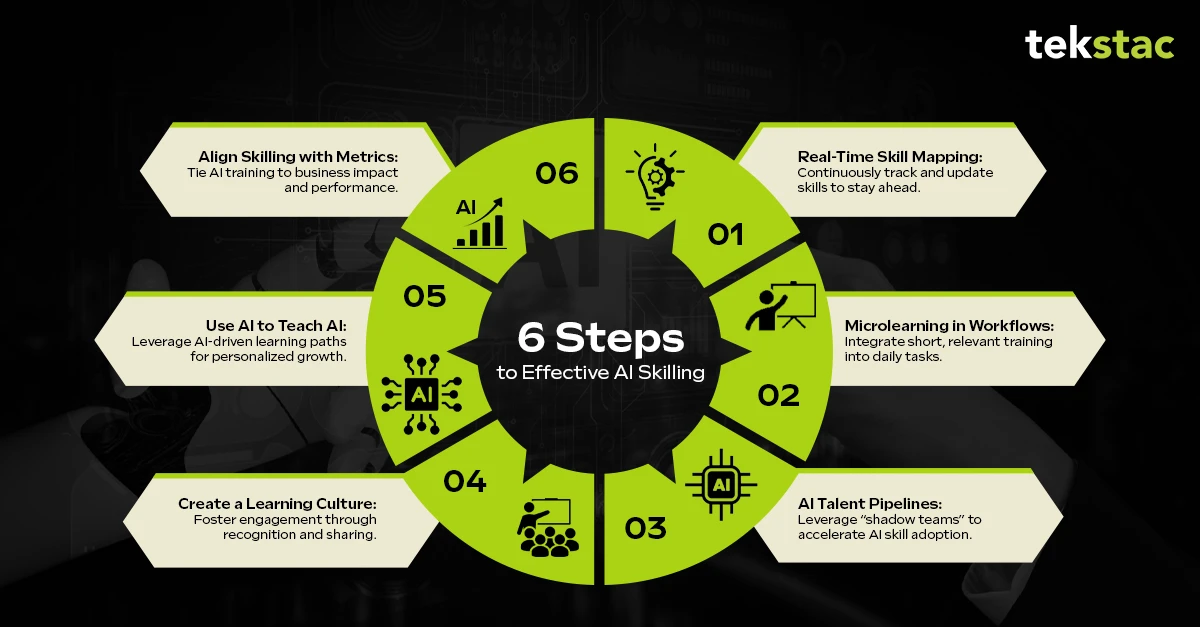
The first mistake many companies make is treating workforce planning like an annual project that gets updated once a year. By the time you identify a skill need, AI capabilities—and the market—have already shifted. A more effective approach is to make skill mapping continuous and data-driven. One organization did this by assigning a small AI readiness team to track new platform features, market trends, and emerging roles every quarter.
They used these insights to update a living skills matrix that guided hiring, training content, and internal mobility—no big reveals or annual panic meetings, just a steady cadence of updates that kept everyone on their toes.
No matter how powerful your training modules, they won’t stick if they feel like homework. To outskill AI, organizations need to embed learning directly into daily workflows, so employees build skills while doing real work.
One tech company put QR codes on production floors that linked to 2-minute how-to videos for new AI-driven machinery. The videos were relevant, concise, and directly tied to daily work—helping employees outskill AI by applying new capabilities in the flow of work rather than stepping away from it.
Most organizations have experts—whether in marketing, engineering, or customer service—who naturally pick up new systems faster than their peers. Instead of letting them operate in silos, organizations can form small “shadow teams” to pilot AI initiatives and share lessons learned with their core departments.
Think of it like a rotating fellowship: employees who show early aptitude for AI skills get the opportunity to experiment with emerging technologies, while their teams benefit from faster AI skill adoption. This approach not only accelerates workforce upskilling but also fosters a sense of ownership and engagement that keeps morale high.
If leadership sees training as a nice-to-have initiative rather than a growth driver, it’ll never get the attention and funding it deserves. The key is to tie skilling directly to metrics your organization already cares about. An AI upskilling sprint should be judged by outcomes: does it help teams outskill AI by accelerating speed to market, lifting customer satisfaction, or reducing costs? One consumer-goods manufacturer, for example, tracked how quickly new hires could start using AI-driven demand forecasting tools, then tied that ramp-up time to overall profit margins. The result? A data-backed case for investing even more in workforce development.
Connecting AI skilling to business outcomes is a key part of modern HR strategy. For a broader view on how organizations align AI with workforce transformation, explore our AI in HR guide.
It might sound meta, but it works. Generative AI can predict not only future roles but also the specific competencies each job will require. Picture a scenario where you use an upskilling platform like Tekstac which uses AI to suggest personalized learning paths for each individual, based on the projects they’re working on and the goals they’re aiming for.
One global firm took it further by having AI flag emerging trends—like a new regulation or a novel customer channel—and automatically recommend relevant micro-courses to the employees who’d be most affected. The effect was like having a virtual coach that kept everyone just ahead of the curve.
There’s a difference between mandating training hours to outskill AI and instilling a genuine culture of learning. A 2026 Deloitte survey says that although workforce access to AI tools has grown by ~50% in a year, fewer than 60% of employees with access use those tools regularly in their work. The latter happens when employees see how AI skills make their work more impactful, more efficient, and sometimes even more creative. Celebrating wins—like a team that discovered a new product idea through AI-driven insights—goes a long way toward making skilling feel like an opportunity rather than an obligation.
Some organizations run internal “demo days” where teams showcase AI breakthroughs. Others encourage managers to dedicate time in weekly stand-ups for staff to share newly acquired skills or micro-certifications. Over time, these seemingly small rituals build a collective momentum that keeps upskilling front and center.
AI is moving faster than any technology and keeping up takes more than tools or intent. The organizations that win will be those that invest in people who can continuously learn, adapt, and outskill AI; not occasionally, but as part of everyday work.
1. What are the top skills needed to outskill AI in 2026?
To outskill AI in 2026, professionals need critical thinking, creativity, emotional intelligence, adaptability, and ethical judgment—skills that enable humans to guide, interpret, and enhance AI-driven outcomes.
2. What industries require workers to outskill AI the most?
Industries like finance, healthcare, manufacturing, and customer service require workers to outskill AI the most. These sectors rely on human judgment, ethical reasoning, and nuanced communication that AI can’t fully replicate.
3. What are the core components of an effective AI skilling strategy?
The core components of an effective AI skilling strategy include identifying skill gaps, offering role-specific training, blending technical and soft skills, and enabling continuous learning through hands-on projects and real-world applications.
4. How can AI skilling help businesses stay competitive?
AI skilling helps businesses stay competitive by empowering employees to work alongside AI tools, improve efficiency, innovate faster, and adapt to changing market demands with future-ready skills.

At a fast-scaling tech organization, leaders noticed something striking: they did not have a successful mentorship program. What changed it all was a structured mentorship initiative to accelerate capability, confidence, and career momentum.
Today, that company reports stronger internal mobility, faster time-to-competency, and significantly improved engagement, all directly tied to its mentorship framework.
Mentorship bridges skill gaps and cultivates a culture where employees feel seen and supported.
In this article, we explore the five key factors that drive successful mentorship programs in enterprises.
According to a study by Gartner, employees who participate in mentoring programs are five times more likely to be promoted than those who do not.
However, not all mentoring programs yield the desired results. The key to a successful mentorship initiative lies in its design, execution, and adaptability.
For Talent Development Leaders overseeing teams of 5,000+ employees, the real challenge isn’t just setting up a mentorship program, it’s making sure it actually works. That makes for an effective mentorship program.
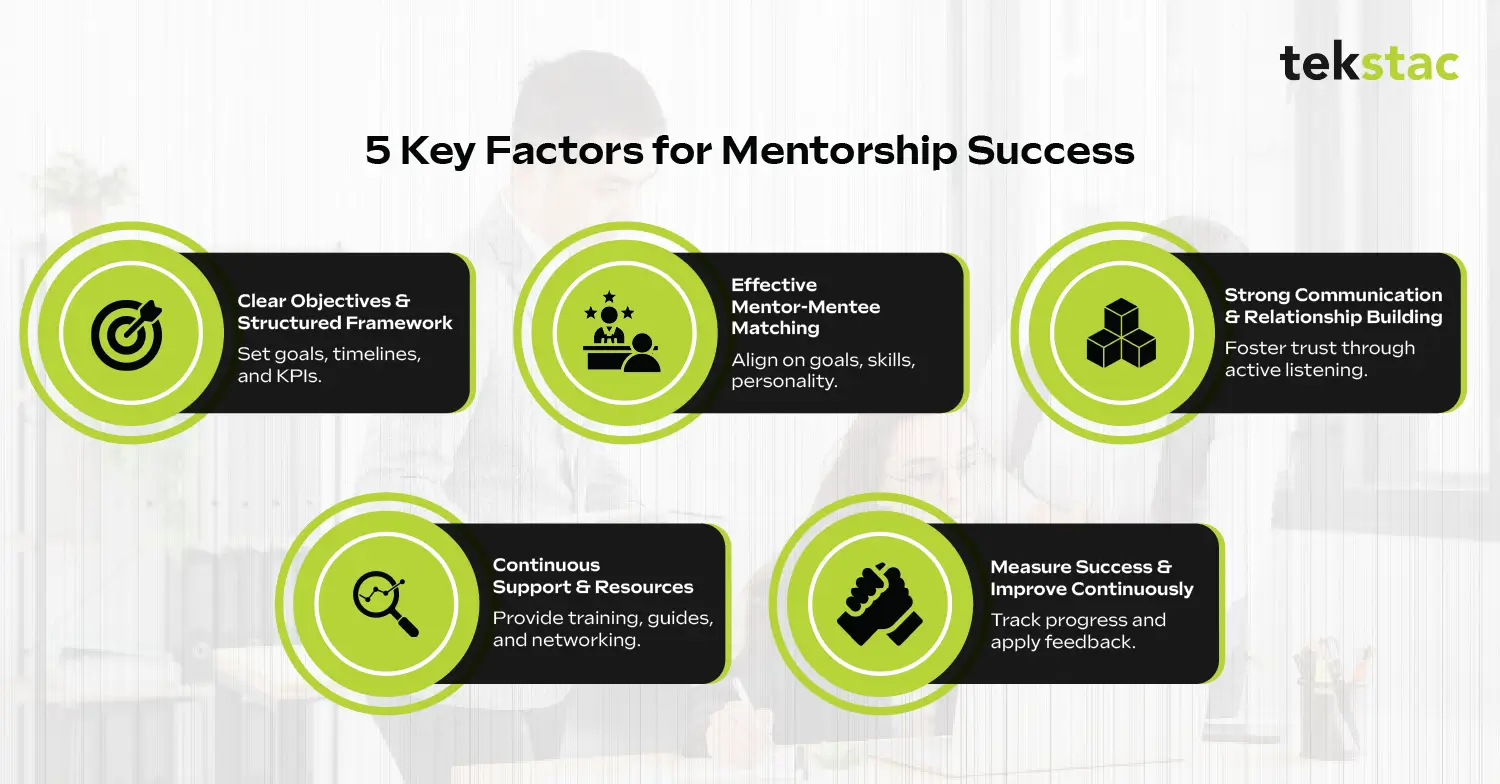
A mentorship program can only succeed when its purpose is clearly defined from the outset. Enterprises must outline measurable goals, whether the focus is accelerating career progression, building leadership pipelines, strengthening knowledge transfer, improving engagement, or advancing diversity initiatives.
However, one of the primary reasons mentorship programs fail is not the lack of intent, but the lack of structure. When expectations are unclear, mentors and mentees are left without guidance, resources, or leadership backing. Over time, participation drops and the initiative loses momentum.
Before launching mentoring programs, organizations need to answer a few hard-hitting questions:
A structured mentorship framework provides guidance for mentors and mentees. Essential elements include:
An effective mentorship program prioritizes compatibility between mentors and mentees. Poor pairings can lead to disengagement and lacklustre results.
A study by Harvard Business Review found that mentoring programs can increase retention rates by 72% for mentees and 69% for mentors. For companies, this directly boosts employee retention and builds a strong pipeline of future leaders .
Many organizations use AI-driven platforms for mentoring to facilitate mentorship matching based on preferences, career objectives, and behavioral assessments. This data-driven approach increases the likelihood of successful mentor-mentee relationships.
The heart of any mentorship program lies in strong communication and meaningful relationships. Without effective communication, mentorship programs lose their impact.
Equally important is building psychological safety. Mentors must practice active listening and create a non-judgmental space where mentees feel comfortable discussing challenges and ambitions.
Mentorship programs should not operate in isolation. Providing ongoing support and resources ensures mentors and mentees remain engaged and derive maximum value.
Even experienced professionals may not be natural mentors. Organizations should offer:
Mentees should have access to:
Studies show that 71% of Fortune 500 companies have formal mentorship programs, reinforcing the importance of structured mentorship in organizational success.
A successful mentorship program continuously evolves based on feedback and data-driven insights. Organizations must establish clear evaluation metrics to measure effectiveness.
A report by McKinsey found that companies with strong mentorship programs see a 24% increase in employee performance and engagement compared to those without.
Regularly reviewing feedback from mentors and mentees helps refine the program. Organizations should:
Successful mentorship programs require more than good intentions; they need clear goals, structure, communication, and sustained support. When executed well, they strengthen culture, build future leaders, and improve retention. The right mentorship strategy doesn’t just develop employees. It drives long-term organizational success.
So how well does your organization’s mentorship program align with these five key success factors? If you’re looking to strengthen, scale, or refine your approach, now is the time to act. The right mentorship strategy doesn’t just support employees. It transforms organizations.
1. What are the types of mentoring in the workplace?
The three main types of mentoring programs are corporate mentoring (focused on leadership development and talent retention), peer-to-peer mentoring (knowledge sharing among employees at similar levels), and professional mentoring (pairing early-career professionals with experienced leaders for career growth).
2. What makes a mentoring program successful?
A mentoring program succeeds when it is built around a clear, measurable strategic purpose and backed by strong executive sponsorship. It includes thoughtful program design, trained mentors, structured communication, quality mentor-mentee matching, ongoing data tracking, and consistently celebrating outcomes to demonstrate impact.
3. What are the top mentoring program benefits for organizations?
Mentoring programs increase employee loyalty and reduce turnover. They also strengthen skills, boost engagement through meaningful cross-functional connections, and reinforce company culture.
4. How do enterprises implement mentorship programs?
Enterprises implement mentorship programs by defining objectives, matching mentors and mentees, setting milestones, offering training, tracking progress, and scaling across diverse teams.

Imagine building your dream house, where every brick, wall, and window bears your aspirations. Now, suppose the foundation has cracked because of one tiny, overlooked mistake, it can collapse the entire structure of the house. Similarly, employer branding mistakes can weaken the core reputation of your organization. It defines how your organization is perceived by both existing and potential employees. A well-developed employer brand not only attracts talent but it also shows the values, culture, and leadership effectiveness.
Employer branding is the reputation of a company as a place to work, based on how current and potential employees perceive its culture, values, work environment, leadership, and employee benefits. It reflects whether the employee experience matches what the organization promises during hiring and recruitment.
Even well-intentioned efforts can fail due to commonly overlooked mistakes. Much like a cracked foundation compromises the stability of a house, these common failures can undermine your efforts to win and retain top talent. In 2026, as the competition for talent intensifies, avoiding these mistakes will be more important than ever. This article delves into the top 10 employer branding mistakes to avoid and offers actionable insights to help you strengthen your brand’s foundation.
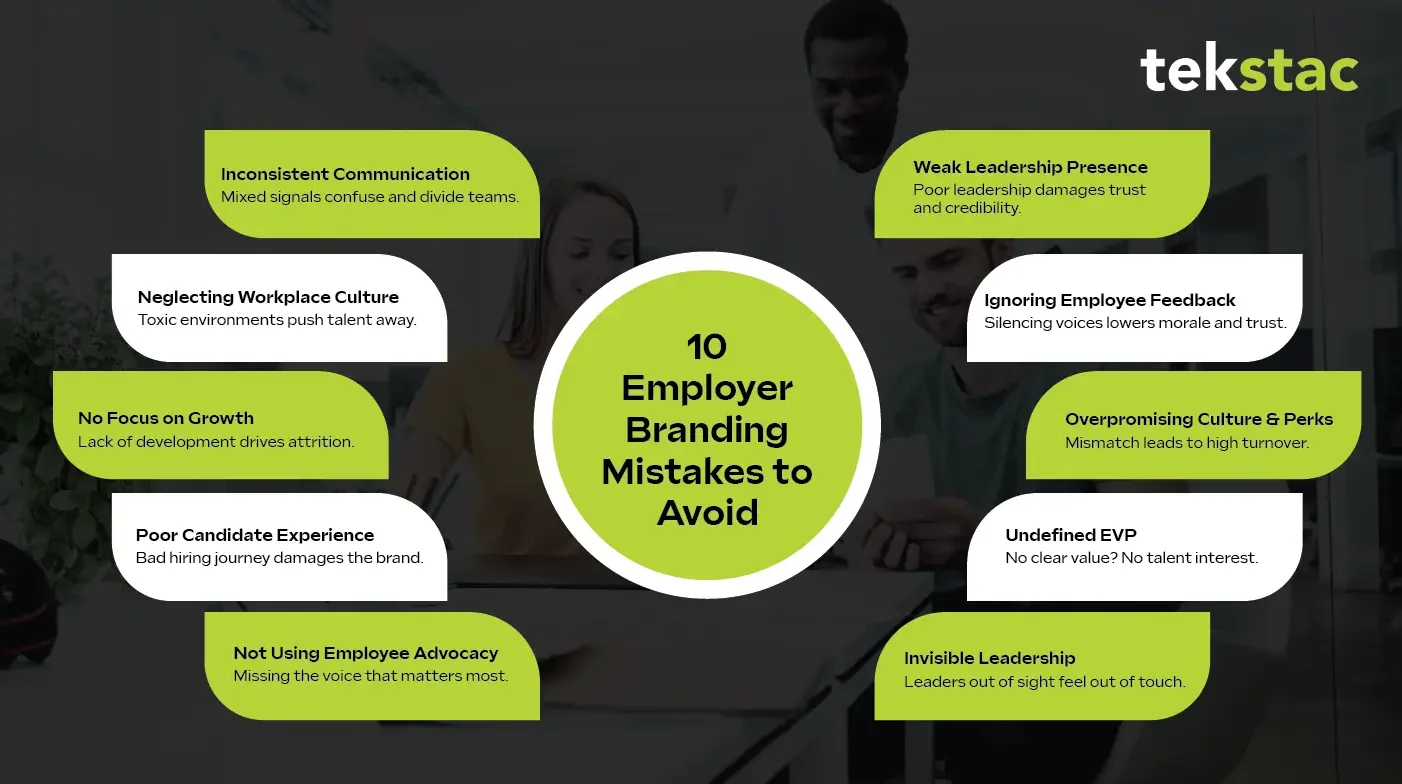
Leadership competence is actually the backbone of any strong employer brand. The lack of trust, unclear communication, and lack of vision lead to poor leadership. Employees seek inspiration, vision, and authenticity from leaders. If these qualities are missing, it makes the organization look disorganized and unreliable to both employees and potential candidates.
Incompetence in leadership often tells of poor decision-making, lack of transparency, and disengagement from the workforce. This has led to dissatisfaction and mistrust culture within the organizations.
How to address it:
Employee feedback is a valuable compass that can guide an organization toward improvement. Not listening to the voices of employees is like ignoring warning signs on a treacherous path. Failure to heed the inner voice of employees makes morale decline, erodes trust, and your employer brand suffers. In time, it comes with enormous turnover rates as well as a difficulty in acquiring the best talent.
Organizations often fail to construct effective feedback mechanisms or even to act on what they hear in the feedback. The lack of follow-up lets everyone know that the opinions of the employees do not matter.
How to address it:
Overselling workplace culture or benefits in recruitment materials is one of the most common employer branding mistakes organizations make. While it may initially attract candidates, it often backfires when the actual employee experience doesn’t match expectations. This gap erodes trust and directly impacts retention.
For example a Glassdoor study found that 58% of employees would not work for a company with a bad reputation, even if it meant a pay cut. This mismatch harms your employer brand and creates a disillusionment cycle with new hires. When employees are let down by what really exists in company culture, they will be more apt to leave, resulting in more turnover and additional recruitment costs.
Often organizations exaggerate some of their strength or overdo the polishing of an image that is way off from the real picture. Such tendencies will result in dissatisfaction and spoil your reputation.
How to address it:
The Employer Value Proposition (EVP) describes what makes your organization special and why people should work for you. An undefined or generic EVP leaves your employer brand without direction or identity. Without a clear and compelling EVP, potential candidates may fail to see the value your organization offers compared to competitors.
A good EVP reflects your culture, mission, and business goals while resonating with the needs and aspirations of your employees.
How to address it:
The invisibility of leadership contributes to a lack of trust and engagement within an organization. The lack of accessibility and engagement from leaders gives an impression of being unattached to employees. Lack of visibility may also weaken employees’ attachment to the mission and values of the organization.
Confident and responsible leaders build confidence. Leaders are not detached; they participate in activities within the workplace. They demonstrate that they are concerned with the success of the organization.
How to address it:
Confusion among employees and candidates occurs from inconsistent communication. Mixed messages, or the failure to make it clear, do not promote trust and thus undermine alignment in teams and departments. Clear and consistent communication can provide a united vision and give employees confidence.
One of the toughest challenges in communication is trying to present cohesive messaging when changes occur or are unsure. Such a lack of consistency undermines the employer brand.
How to address it:
Any organization’s heartbeat is its workplace culture. The best employer branding will be undone by a toxic or neglected culture. Employees want an environment that promotes inclusivity, collaboration, and respect. Not building a good workplace culture leads to low morale, high turnover, and damage to reputation.
A strong culture not only pulls in the talent but also bonds the existing one.
How to address it:
Employees will remain loyal to the organization that develops them professionally. Neglecting employee development conveys a message to employees that the organization is not interested in their future and therefore results in a higher rate of turnover.
Without opportunities for growth, an organization is limited in its capacity to innovate and adjust to changes in the market.
How to address it:
Hiring is a candidate’s first touch point when engaging with your organization. Failure to engage well leads to top talent not being attracted and the loss of your employer’s brand. In essence, long hiring processes, inadequate clarification of some matters, or merely a cold response can move a candidate away.
Candidate experience plays a critical role in employer branding. Research from CareerArc shows that 72% of job seekers share negative hiring experiences publicly or through word of mouth, making it essential for organizations to address gaps in the recruitment process before they affect employer brand perception.
How to address it:
Your most potent internal ambassadors are your employees. Not focusing on their role as promoters of your employer brand amounts to a lost opportunity in the strengthening of your reputation. Happy workers instinctively advocate for their workplace and help attract top talent while building morale.
Employee advocacy builds trust and authenticity and helps make your employer brand more believable and appealing.
How to address it:
Employer branding is not a strategy; it’s the bridge that brings your company’s values to the world. Avoiding these 10 employer branding mistakes will help your employer brand not just survive but truly thrive in 2026 and beyond. Authenticity, transparent communication, and leadership competence will form a brand that resonates both with employees and candidates. Nurturing this foundation and avoiding pitfalls will attract top talent and a workplace where employees are valued. Start your employer brand today—create a brand that draws in and holds the right people for long-term success.

Your employees are drowning.
Not in work, but in information.
Every training session feels like a firehose aimed straight at their heads—too much, too fast, and impossible to absorb.
Most organizations spend a fortune on upskilling and reskilling programs, yet only 30% of employees found the training ‘exceptionally rewarding.’
The problem isn’t the training itself; it’s how the information is served and how engaged employees feel. Overloaded minds don’t learn, they shut down. However, with content chunking, organizations can make every lesson stick and turn it into actual performance.
Content chunking is the process of breaking down information into smaller, bite-sized pieces that stick in the learner’s mind. It ensures learners focus on one concept at a time, reducing information overload and improving comprehension. When information is organized into logical sections, the learning is more effective, engaging, and memorable.
Example:
Imagine you’re creating a training on cybersecurity basics. Without chunking, it may look like this:
Cybersecurity refers to practices for protecting systems, networks, and data from cyber threats. These include firewalls, anti-virus software, multi-factor authentication, data encryption, intrusion detection systems, and regular software updates.
The above might take two or three takes before completely digesting it. Now, here’s the chunked version:
The information is the same but easier to understand, retain, and apply. This reduces the time spent on repeated training sessions and keeps learners focused, thereby boosting the Learning ROI of upskilling or reskilling programs.
By focusing on the “need-to-know” information, organizations can present it in accessible chunks, enabling learners to achieve better outcomes. Furthermore, content chunking increases the effectiveness of reskilling and upskilling programs in the following ways:
Learners may face time constraints when upskilling and reskilling. Content chunking focuses on the most important information, eliminating irrelevant details. Core concepts are presented on screen with optional links for deeper information. For example, in a coding upskilling program, main syntax rules are displayed upfront, while examples and edge cases are accessible as hyperlinks.
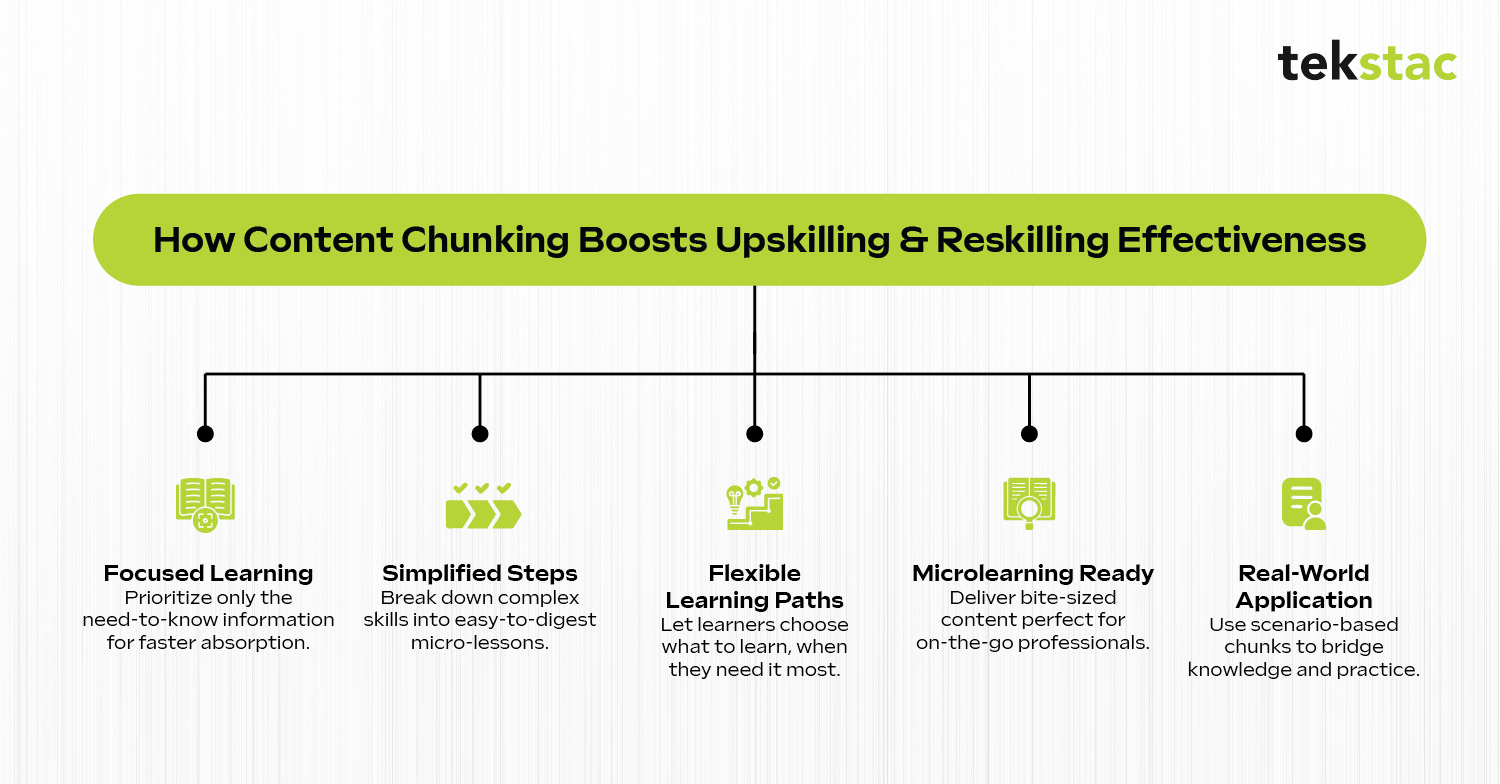
It’s overwhelming when employees focus on a large skill set to learn within a stipulated time. Content chunking breaks learning tasks into micro-lessons, where employees can easily comprehend each chunk of content. For example, instead of delivering an entire module on “Advanced Data Analysis,” chunk the content into specific sections like “Introduction to Data Tools,” “Using Formulas Effectively,” and “Visualizing Data Insights”. Use clear progress indicators to guide learners step by step.
Chunked content creates modular learning experiences that can be consumed in any order. This allows learners to focus on the areas they need most, which is essential for personalized reskilling. For instance, a digital marketing reskilling program may have independent modules on SEO, content, PPC, and so on, allowing learners to start with their most immediate need.
Microlearning delivers focused, short bites of learning ideal for busy professionals. Chunked content aligns perfectly with these approaches, ensuring each piece of information is highly targeted and digestible.
Reskilling often involves switching to unfamiliar roles or industries. Contextualized examples and learning methods make new skills more relatable and memorable. Such real-world scenarios help employees connect theory to practice. Imagine a learning reskilling for customer service. Content is chunked into micro-lessons like “Handling Difficult Customers,” “Using CRM Tools,” and “Upselling Techniques,” each with relevant, bite-sized simulations.
| Before Content Chunking | After Content Chunking |
|---|---|
| Long, text-heavy training modules that overwhelm learners | Bite-sized lessons with clear focus areas |
| Employees struggle to remember complex concepts | Learners retain and recall information more easily |
| One-size-fits-all training path | Modular, personalized learning paths |
| Low learner engagement and participation | Higher engagement with micro-lessons and interactive chunks |
| Repeated training sessions needed | Faster comprehension and reduced training time |
| Minimal ROI from training spend | Measurable ROI with better skill application |
Content chunking includes various methods to deliver practical learning experiences for reskilling and upskilling. Each method listed below caters to different learning styles, goals, and organizational needs.
Here, topics are broken down into short, independent modules that learners can complete within 10 minutes. Each module focuses on a single concept, skill, or task. It aligns well with adults’ need for immediate relevance.
Example:
For upskilling in digital marketing, microlearning modules could include:
Did you know? Research from the Dresden University of Technology shows that chunked microlearning boosts retention by nearly 80% versus old-school training.
Spaced learning involves breaking up learning lessons with rest intervals or other activities. The main goal is to reinforce memory and retention. Spaced repetition combats the “forgetting curve” by revisiting main concepts periodically.
Example:
For upskilling in data analysis, you might:
Visual chunking involves presenting information using videos, infographics, or charts. It helps process information faster, especially for visual learners and helps present concepts better visually.
This is an approach where you break content into actionable tasks that can be performed as learners move through the content material. It ensures hands-on practice. For example, for upskilling in project management, organizations can chunk tasks as follows:
Layered chunking introduces foundational concepts and adds difficult ones as learners gain proficiency. For reskilling, it bridges knowledge gaps, builds confidence with basics first and reduces overwhelm. Upskilling deepens expertise as the employee progresses through the learning material.
With AI, organizations must rethink skilling. Traditional skilling methods may become slow, disconnected, and unprepared to meet the pace skills gap. Tekstac redefines upskilling and reskilling with its all-in-one 360° skilling platform. It empowers businesses to create a skills-based organization through.
1. What is contextual chunking?
Contextual chunking organizes learning into meaningful, real-world scenarios, helping learners connect theory with practice for better retention.
2. What are chunking techniques?
Chunking techniques include microlearning, spaced learning, task-based chunking, visual chunking, and layered chunking for effective training.
3. What is chunking up and chunking down?
Chunking up means generalizing ideas broadly, while chunking down breaks them into detailed, specific, actionable parts.
4. How does semantic chunking work?
Semantic chunking groups related ideas by meaning, enabling learners to understand, remember, and apply information more effectively.

We are in 2026, and one may ask, “Are IT certifications still credible?”. A thought-provoking example surfaced recently: someone with the title “Specialist in Digital Transformational Technology” proudly shared completing a basic AI prompting course. Sounds odd, right?
This highlights a growing challenge in IT upskilling: too many professionals chase easy online certificates just to look credible on paper.
A smart IT professional focuses on certifications that strengthen their foundation, broaden their capabilities, and prepare them for real-world challenges. Employers are increasingly able to distinguish between superficial credentials and actual competency.
Choosing the right certifications becomes easier when guided by skill insights that highlight the most in-demand capabilities and evolving workforce needs.
With that in mind, here are 10 top paying IT certifications in demand for 2026.
IT certifications are professional designations offered by organizations and companies to validate your expertise in specific skills, tools, and IT knowledge areas. They provide structure to learning and upskilling, ensuring that professionals gain the confidence to apply their knowledge in real-world scenarios.
IT certifications can help professionals validate in-demand skills, strengthen their credentials, and position themselves for high-paying jobs in fast-growing technology fields. In 2026, they help IT professionals for various reasons listed below:
Technology roles are changing faster as AI reshapes the skills organizations need. The World Economic Forum identifies AI and big data, networks and cybersecurity, and technological literacy among the fastest-growing skill areas through 2030 making targeted certifications increasingly relevant for keeping technical capabilities current.
Along with skills, IT certifications also improve paychecks. Professionals with certifications in high-demand fields like cybersecurity and cloud computing also command top-tier salaries.
Even if a job doesn’t require certifications, earning one can increase the chances of promotions compared to peers or help employees land their dream role. Organizations can also ensure that employees possess the right skills to adapt to new IT trends.
According to IDC, the overall Indian public cloud services market is expected to reach $30.4 billion by 2029. This shows that cloud computing is a skill in high demand. AWS, for example, now offers certifications and micro credentials spanning cloud, security, machine learning, and agentic AI. Some of the cloud certifications one can do include,
The below certifications position employees as the go-to experts for designing and managing interconnected on-premises and cloud systems. These are important for businesses embracing hybrid setups for flexibility.
As the IT training and certifications market is growing at a rapid pace, data engineering has become increasingly important for building reliable data pipelines, analytics systems, and AI workloads. Certifications in data engineering, machine learning, and AI help professionals build the technical foundation required for this shift.
One of the top certifications in the IT industry is Gen AI. It is moving beyond prompt-based experimentation toward applications and autonomous AI agents. Certifications focused on generative AI, AI application development, and agentic AI can help professionals build, deploy, and manage AI-powered solutions. Some of the popular certifications are:
AI and Machine Learning have become the norm, and being certified in this field enables employees to lead challenging projects involving deep learning, NLP, or predictive analytics in high-demand industries.
Certifications in this area validate the ability to manage enterprise risk, design security strategies, and align cybersecurity initiatives with business goals.
Pro tip: This isn’t something to rush. The scope is wide and the depth is real. A six-to-twelve-month preparation window allows for steady progress.
With stricter regulations and growing focus on accountability, organizations need professionals who understand governance frameworks, audits, and compliance requirements. These IT certifications demonstrate expertise in evaluating IT controls, managing risk, and ensuring regulatory alignment—making them valuable for senior and advisory roles.
Despite the rise of cloud and AI, strong networking fundamentals remain critical. Certifications in this area validate the ability to design, manage, and troubleshoot enterprise networks that support large-scale digital operations and hybrid environments.
Project and program management certifications validate leadership skills in planning, coordination, risk management, and delivery.
Enterprise architecture plays a critical role in aligning technology with long-term business strategies. Certifications in this domain validate a professional’s ability to design scalable systems, guide digital transformation initiatives, and make architecture-level decisions that impact the entire organization.
Earning these certifications provides several benefits, especially for employee career development, in the following ways:
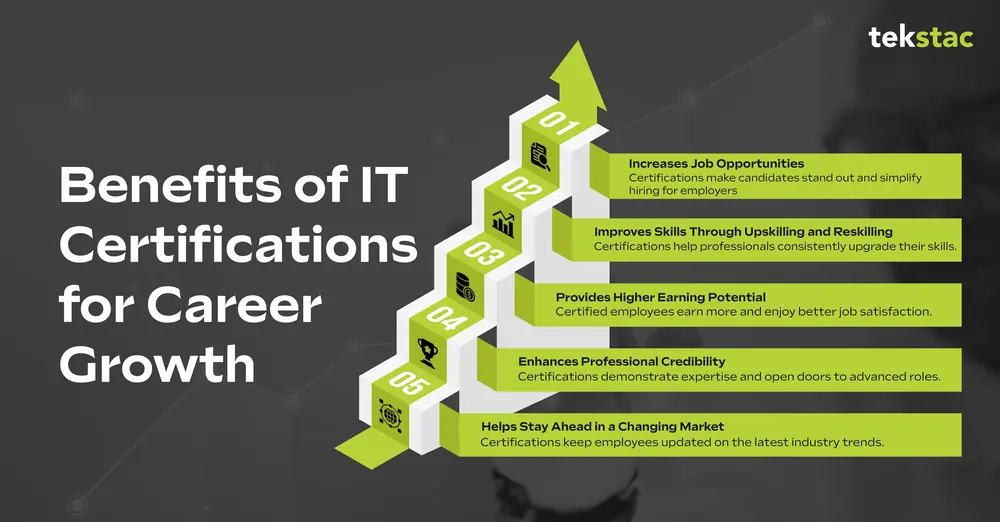
Employers are always looking for candidates with IT certifications because it shows they’re competent and ready for specific roles. It further helps recruiters identify top talent, especially in a competitive market where 82% of employers face a skill gaps. Ultimately, hiring certified professionals will reduce the time spent training new employees.
For employees, 16% of IT professionals reported landing a new job because of their certifications, while 35% of IT decision-makers acknowledged that certified staff add value by simplifying the hiring process.
Most IT certifications validate an employee’s ability to solve real challenges. With 75% of professionals pursuing certifications to increase technical expertise, employers benefit from a workforce that consistently upgrades its skills.
Certified professionals help reduce skill gaps within teams and increase the organization’s overall competency.
This makes it easier to implement new technologies and maintain a competitive edge in the market.
Certified professionals earn 20% more annually than their non-certified peers, and 60% report an improvement in the quality of their work after obtaining certification. Organizations offering better pay to certified employees also benefit from increased loyalty, retention, and job satisfaction.
Earning IT certifications helps employees demonstrate their expertise and projects.
For example, certifications like Microsoft Azure Solutions Architect Expert or Cisco CCNP demonstrate proficiency and open opportunities for advanced roles.
These include positions like Cloud Architect, Network Engineer, or Cybersecurity Specialist, where specialized knowledge is essential.
Certifications help employees stay current on the latest tools and techniques, ensuring they’re always in tune with industry changes. This means certified professionals bring fresh, updated insights to the workplace, helping organizations stay ahead.
For employers, this expanded network and knowledge base translate into better service, increased customer satisfaction, and increased innovation. It is a win-win for both the employee and the organization.
When do IT certifications become essential for your employees? These specific challenges listed below are a clear sign to explore IT certifications:
If your organization is having trouble completing projects on time or dealing with recurring technical issues, it may be a sign that employees lack the required skills. IT certifications address these gaps by equipping your team with up-to-date cybersecurity, cloud computing, or software development knowledge.
The IT industry is being reshaped at a pace never seen before, and organizations that cannot keep up may be left behind. If your teams struggle to adopt or leverage emerging technologies, certifications can bridge the gap. Certified professionals gain an in-depth understanding of industry best practices and provide solutions to organizational challenges.
Certifications can prove your team’s expertise if you’re losing business or struggling to build trust with clients. These certifications, along with experience, can be highlighted on your website, LinkedIn, or marketing materials to reassure clients that your workforce is capable and qualified to handle their needs.
Certified team members make it much easier to shift to new specialist areas such as machine learning, DevOps, or cloud computing. This ensures that the employees have clear learning paths with hands-on practice when resolving new, complex domains.
Opportunities for professional development are valued among employees. If your organization struggles to retain talent, providing support for certifications, such as reimbursing costs or providing study time, would also increase employee satisfaction. Such initiatives would not only enhance individual performance but also prove that your organization is committed to the career growth of its employees.
Traditional learning and training methods may not tie the learning to business outcome. To bridge the skills gap smarter, organizations need a platform packed with industry-relevant IT certifications and skill development programs. Tekstac has successfully upskilled 1 million+ professionals with 500+ learning paths.
Its customizable library of certifications and training resources ensures your workforce possesses the required skills in 2026 and beyond. You can also enjoy AI-driven personalization, real-world projects, and performance tracking. Book a demo to see how Tekstac can help your workforce build the skills needed for 2026 and beyond.
1. Which IT certifications are in demand for high-paying jobs in 2026?
Certifications in AI, machine learning, cloud computing, cybersecurity, data engineering, and enterprise architecture can help professionals build skills relevant to high-paying technology roles. Certification alone does not guarantee a higher salary, but it can provide a recognized way to validate specialized skills.
2. Is an AI certification enough to get an AI job in 2026?
No. An AI certification can validate foundational or specialized knowledge, but employers also look for hands-on experience, problem-solving ability, technical skills, and the ability to apply AI to real business problems. Combining certification with projects, labs, and practical experience can make the credential more valuable.
3. Should I choose a certification based on technology or the job role?
Choose based primarily on the role you want to perform. A certification should strengthen the skills required for that role rather than simply follow a popular technology. For example, someone targeting a data engineering role may benefit more from a data engineering certification than a broad cloud credential.
4. Are cloud certifications still valuable with the rise of AI?
Yes. AI workloads depend heavily on cloud infrastructure, data platforms, security, and scalable computing. Cloud skills therefore remain foundational even as organizations adopt generative AI and agentic AI.
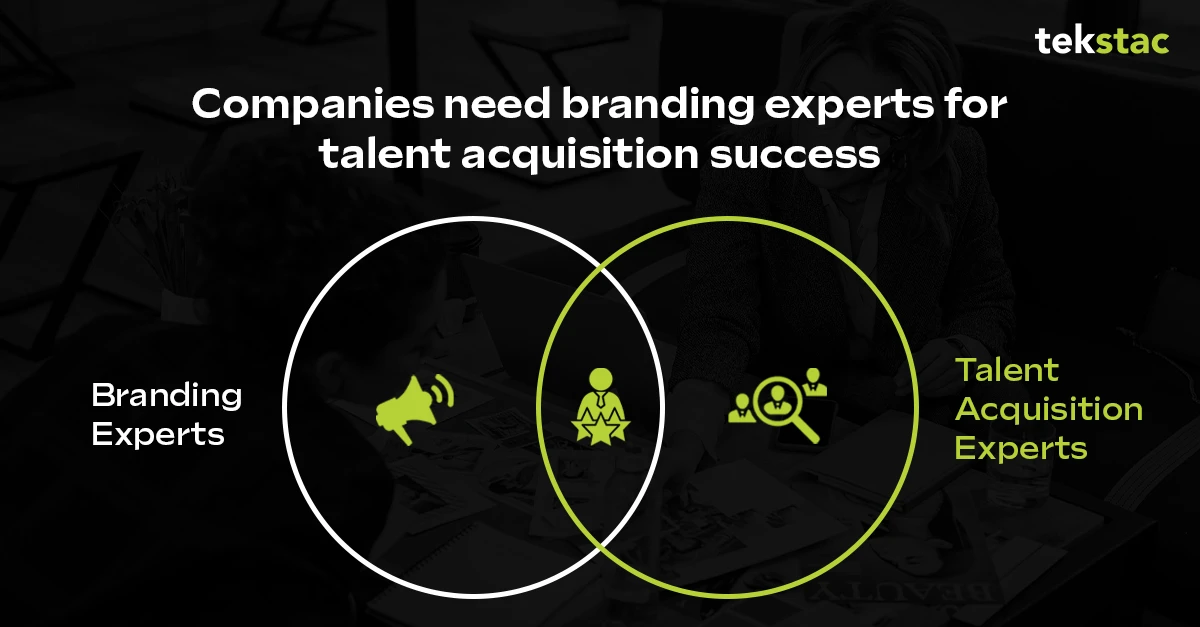
In a competitive job market, companies need branding expert to achieve talent acquisition success. The problem with talent attraction is about something other than a good package deal; it is about creating a culture or a unique image. A well-developed employer brand enhances a company’s image of culture, policies and goals. Any person who applies for a job at that company would be inclined to join that company.
Branding experts play a vital role in shaping this identity. They help craft messages that resonate with the right candidates and emphasize what makes a workplace special. By showcasing a company’s strengths and fostering a positive reputation, branding experts make it easier to attract talented professionals and retain them for long-term success.
A branding expert specializes in creating and managing a business’s identity to make it recognizable, relatable, and memorable. They define what makes a company unique by analyzing its values, mission, and target audience. This involves designing consistent visuals like logos and color schemes, shaping how customers, employees, and stakeholders perceive the business.
Branding experts play a strategic role in building trust and credibility. They align a company’s branding efforts with its goals, ensuring it stands out in a competitive market. Whether working on an employer brand to attract talent or enhancing customer loyalty through meaningful engagement, branding experts create a cohesive image that reflects the company’s strengths and fosters long-term success.
A great brand is more than simply a logo or memorable tagline in today’s fiercely competitive industry; it is the foundation of your company’s identity. A branding expert can help in this situation.
It’s easy for business owners to become engrossed in the day-to-day activities, which makes it challenging to stand back and consider your brand with objectivity. A branding expert helps you identify what makes your company special by providing an outsider’s viewpoint. Their area of expertise lies in comprehending market trends, your target audience, and how to effectively position your business.
Many firms are silently destroyed by inconsistent branding. Everywhere your brand is used, from social media to product packaging, it must convey the same message. Making sure your message, images, and tone are all consistent helps gain prospective employee’s trust and recognition.
Understanding your target audience’s needs, preferences, and pain points is no small task. Branding experts are skilled at researching and identifying the perfect approach to connect with your ideal audience. They help craft messaging that speaks directly to them, making your brand memorable.
Even though it could seem like an extra cost, hiring a branding specialist is a long-term investment in building a talented workforce.
A strong employer brand doesn’t just look good—it delivers measurable results. Companies with well-managed branding attract 50% more qualified applicants, making it easier to find the right cultural fit. By clearly communicating your values and strengths, you can also cut your cost-per-hire by up to 50% and make your hiring process 1–2× faster. That means less time wasted on trial-and-error recruitment and more time focusing on growing your team.
Consumers purchase from companies they trust. A branding specialist aids in creating a polished image that gives your audience confidence. Their experience guarantees that everything is in line to promote credibility, whether it’s your website design, brand voice, or customer experience.
Branding experts add clarity and emphasis to your brand by assisting you in defining what your firm genuinely represents. They may create a distinct brand that distinguishes you from competition while also guaranteeing that your message reaches your intended audience. With their help, your brand will become more unified, consistent, and recognizable across all platforms, gradually increasing trust and recognition.
Another significant advantage is their capacity to save time and effort. Instead of depending on guessing, branding experts use their experience to develop effective methods that will help you avoid costly blunders. A well-executed brand not only attracts the correct customers, but it also develops loyalty, making your company more sustainable in the long term.
In a current business environment, branding experts are instrumental in leading talent acquisition efforts and far beyond. With the right talent branding experts, it becomes easier for businesses to find the best talent and keep the best employees within the organization on board with their culture and values.
Becoming a branding expert requires a strong foundation in marketing, communication, and design, built through education and practical experience. Work on real-world branding projects to develop creative strategies and understand consumer behavior.
A branding expert helps businesses stand out by creating a unique, consistent identity that builds trust and recognition. They ensure the company’s values and strengths are effectively communicated, making it more appealing to customers, employees, and stakeholders.
A strong brand can help small businesses attract customers and grow their presence in the market.
Strengthen skills, improve teamwork, and empower your team with tekstac branding experts. From onboarding to skill-building, we create meaningful learning experiences that drive real results.